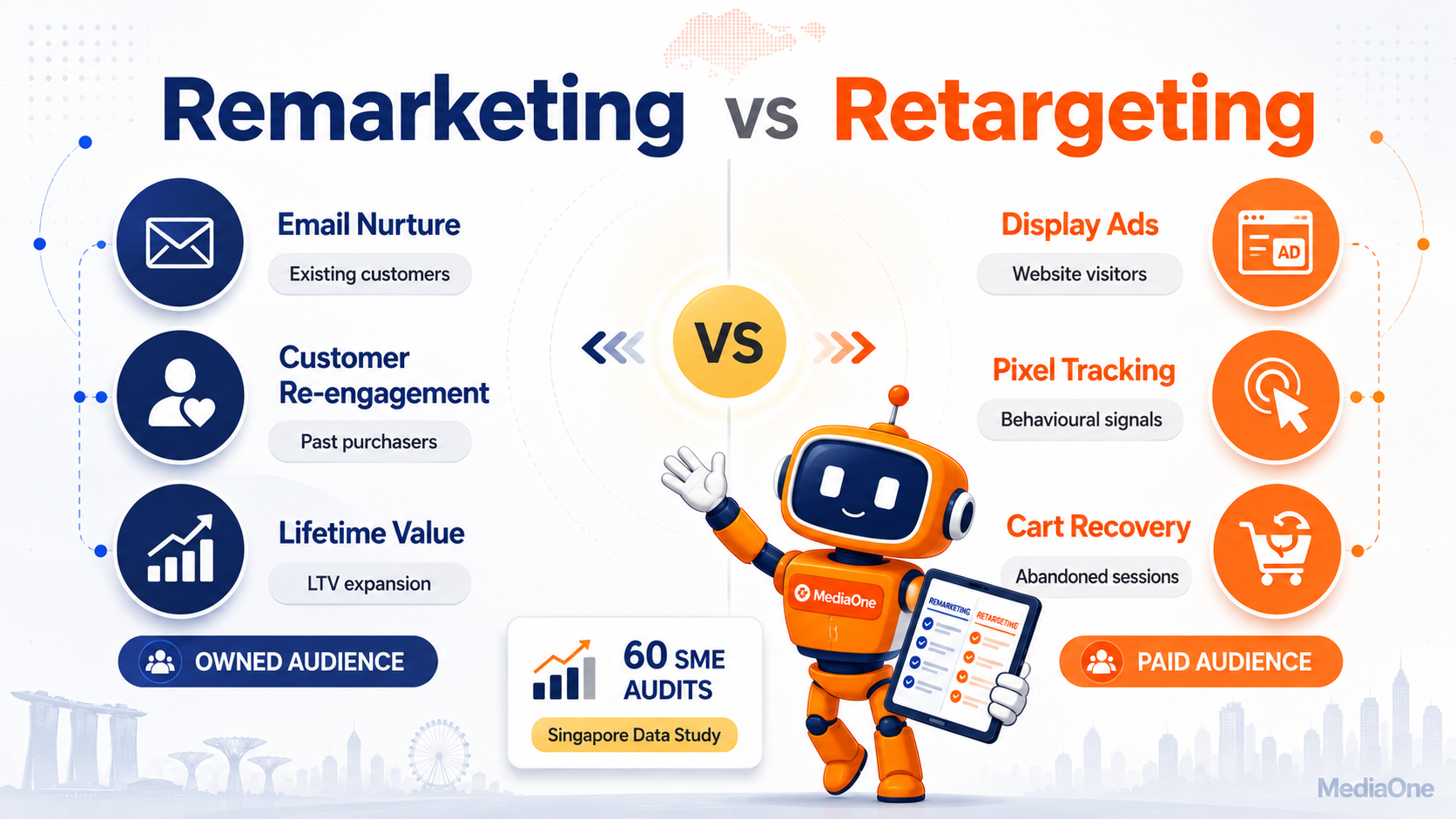
In the past three years, we’ve audited more than 60 paid media accounts for Singapore SMEs.
Roughly half of them had a remarketing or retargeting campaign running at the point of the audit. Almost none of them knew which of the two they were actually running, and even fewer had set the campaign up in a way that justified the ad spend it was burning.
That mismatch is the reason this article exists.
The industry talks about remarketing vs retargeting as if the distinction is technical trivia. In practice, choosing the wrong one for your business, or running both on the same audience without coordination, is one of the fastest ways to waste marketing budget in a market as expensive as Singapore’s.
MediaOne has been running paid media alongside SEO as a Singapore digital marketing agency since 2011. This article is what we’ve learned from the audits, including the parts most competitor articles either simplify or get wrong.
Key Takeaways
- Remarketing and retargeting are not synonyms. Retargeting is paid ads served to people who interacted with you. Remarketing is CRM and email nurture to people whose contact details you already own.
- The bigger question is not which one to run, but which one your buyer’s decision cycle actually rewards. Impulse categories reward retargeting. Considered purchases reward remarketing.
- Most Singapore SME campaigns we audit are running retargeting on cold audiences that never had meaningful intent, which is closer to display advertising than actual retargeting.
- The single biggest waste in Singapore retargeting spend is exclusion list neglect. Buyers who already converted continue to see ads meant for people who haven’t, sometimes for weeks.
- Combining remarketing and retargeting on the same audience is powerful when sequenced correctly and destructive when run in parallel without coordination.
The Definition That Changes How You Budget
Most articles define these terms in a way that is technically correct and practically useless.
Here is the working definition we use internally at MediaOne.
Retargeting
Retargeting is a paid channel.
You are buying an impression from Google, Meta, or a similar platform, targeted at a user who has already interacted with your website, watched your video, or engaged with your ad. The user’s contact details usually stay anonymous to you.
Remarketing
Remarketing is an owned channel.
You already have the customer’s email address, phone number, or account. You are re-engaging them through channels you control, without paying a platform to reach them each time.
Two Things That Fall Out of This Definition
Two implications flow from these definitions that competitor articles miss:
-
Retargeting cost scales with every impression
Remarketing cost stays roughly flat regardless of send volume. This has huge implications for how you budget.
iOS 14.5, Chrome’s tracking changes, and privacy-conscious buyers using ad blockers have all cut the addressable retargeting pool. Remarketing, because it runs on data the customer gave you directly, is unaffected by these changes.
The businesses winning at both in 2026 are the ones who understand that retargeting is renting attention while remarketing is owning it.
How to build a remarketing list in Singapore without buying data is the question most SMEs should be asking before they touch a paid retargeting campaign.
The Distinction, Framed the Way Buyers Actually Decide
| Dimension | Retargeting | Remarketing |
| What it is | Paid ads to users who interacted with you | Owned nurture to people whose data you already have |
| Where it runs | Meta, Google Display, YouTube, LinkedIn, TikTok | Email, SMS, WhatsApp Business, in-app, CRM sequences |
| What you pay for | Every impression or click | Platform subscription, mostly flat |
| Cost per touch | S$0.30 to S$4+ per click in most Singapore verticals | Fractions of a cent per email send |
| How long visibility lasts | Cookie window, typically 30 to 180 days | As long as the contact stays subscribed |
| What breaks it | Cookie loss, ad blockers, iOS tracking limits | Unsubscribes, spam complaints, poor deliverability |
| Best fit for | Impulse or high-consideration categories with short decision cycles | Considered purchases, subscription services, repeat-buy businesses |
| Where the money leaks | Missing exclusion lists, no frequency caps | Poor segmentation, generic broadcasts |
The row that carries the most weight for Singapore SMEs is the second-last one.
- If your average customer takes six weeks to buy, retargeting alone will not close them.
- If your average customer buys within 48 hours of first exposure, remarketing arrives too late.
Most SMEs pick the wrong tool for their category and then blame the channel when it does not perform.
The Five Audit Patterns Nobody Talks About
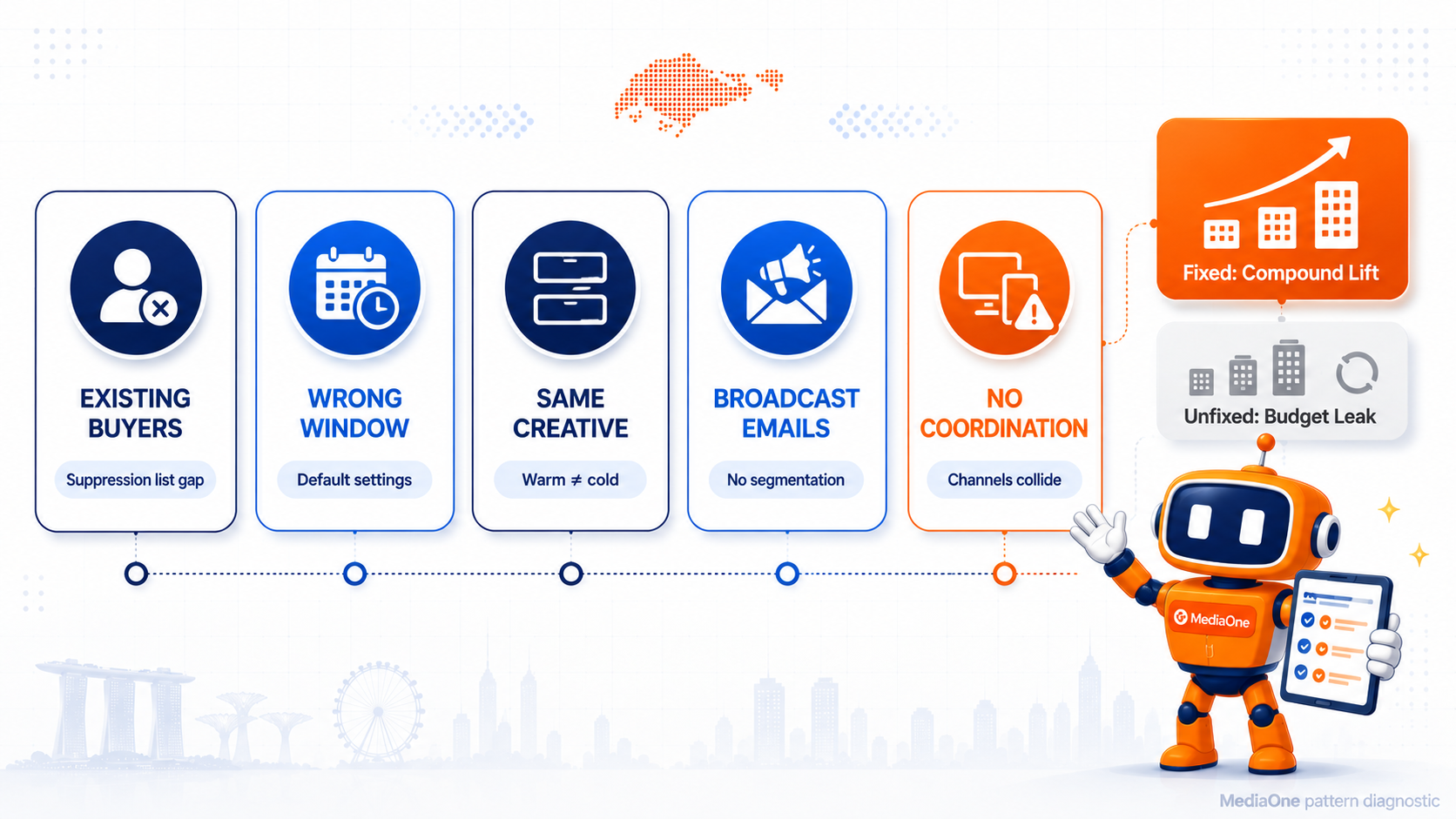
Five patterns show up repeatedly across the SME paid media audits we run at MediaOne. These are the ones you will not read about in the generic remarketing vs retargeting examples articles.
Pattern 1: Buyers Who Already Converted Are Still Seeing Retargeting Ads
The most common leak we find is that customer exclusion lists are either missing entirely or have not been refreshed in months.
That means every ad dollar spent retargeting also lands on people who bought last week.
Real example from our work:
In one recent audit for a Singapore F&B brand, roughly 18% of retargeting impressions over a three-month window were served to customers who had already placed an order in that same period.
That is not retargeting. That is paying to annoy your customers.

Fix:
- Update customer exclusion lists at least weekly.
- Push CRM data into your ad platforms as suppression audiences, not just as remarketing audiences.
Pattern 2: Retargeting Windows Set to the Platform Default
Meta’s default retargeting window is 30 days. Google’s is 30 to 540 days depending on the campaign type. Almost no SME sets this deliberately.
- For impulse categories like coffee subscriptions or food delivery, a 30-day window is far too long. By day 20, the ad is chasing users who have already decided to skip.
- For considered categories like renovation or B2B software, a 30-day window is far too short. The buyer is still doing research at day 60.
Fix: Match the retargeting window to your category’s actual decision cycle. We usually recommend:
- 7 to 14 days for impulse categories
- 60 to 120 days for considered purchases
Pattern 3: Retargeting Creative That Is Identical to Prospecting Creative
Retargeting audiences already know your brand. They have visited your site. Serving them the same ad you serve to cold audiences wastes the intent they already have.
The audits repeatedly show retargeting campaigns using the same “learn more about us” creative as top-of-funnel prospecting. Warm audiences do not need brand education. They need a reason to come back today.
Fix: Purpose-build retargeting creative around specifics:
- The product they viewed
- The plan they compared
- The promo they didn’t act on
Generic brand ads are a prospecting tool, not a retargeting one.
Pattern 4: Remarketing Emails That Look Like Broadcasts
Remarketing emails should feel like a continuation of a conversation the customer already started.
Instead, most SME remarketing emails read like the monthly newsletter with a discount code stapled to the top.
Real example from our work:
For a Singapore boutique fashion client, the remarketing sequence was one generic email sent to every customer regardless of what they had bought, browsed, or ignored. Open rates were fine. Revenue per email was almost zero.
Fix: Segment by behaviour, not just by demographic. Someone who abandoned a cart with S$300 of goods needs a different email to someone who browsed the sale page twice and left.
How to segment a remarketing email list is the highest-leverage question in email remarketing, and the one most SMEs skip.
Pattern 5: Both Channels Running on the Same Audience Without Coordination
The most damaging pattern is running remarketing emails and retargeting ads on the same person simultaneously, with no coordination between them.

The customer receives six emails in a week, sees ads for the same product on Instagram, then gets a WhatsApp offer for the same item.
This is not a strategy. It is harassment with a media budget.
Fix:
- Sequence the two channels.
- Remarketing emails typically go first because they are cheaper.
- Retargeting ads follow only for the segment that ignored the emails.
- Coordination is the whole point.
When Retargeting Is the Right Choice
Retargeting earns its budget when three conditions hold:
1. Your buyer has a short decision cycle
Retargeting works because the ad arrives while the intent is still fresh. If the buyer takes weeks to decide, the intent decays before the ad becomes useful.
2. Your website traffic includes meaningful volume of high-intent visitors
Retargeting audiences under a few thousand users are usually too small to run efficiently in the Singapore market. Below that threshold, your cost per click stays stubbornly high because the platforms cannot optimise against a small pool.
3. You have already fixed your site conversion basics
Retargeting sends users back to your site. If the site is slow, confusing, or misaligned with what the ad promised, retargeting spend compounds the underlying problem.
Businesses looking to fix this before scaling ad spend should read our guide on conversion rate optimisation, which covers the site-side changes that make paid traffic pay back.
When Retargeting Is the Wrong Choice
- When your addressable audience is tiny (very early-stage businesses).
- When your buyer’s decision cycle exceeds 90 days (some B2B categories).
- When your traffic is dominated by unqualified visitors from paid social running to broad audiences.
When Remarketing Is the Right Choice
Remarketing earns its budget when three different conditions hold:
1. You have a real database
Not a list of newsletter opt-ins from three years ago, but a maintained customer file with recent purchase data, browsing behaviour, or genuine engagement in the last 90 days.
If the list is old or noisy, remarketing effort gets wasted on unresponsive contacts and hurts your sender reputation with email providers.
2. Your customer has repeat-buy potential or long consideration cycles
Categories that reward remarketing:
- Beauty
- F&B subscription
- B2B software
- Education
- Travel
- Financial services
Categories where remarketing pays back more slowly:
- One-off high-ticket purchases like renovation or wedding photography, where the customer is unlikely to buy again for years.
3. You are willing to segment
Broadcast emails to an entire list are almost always outperformed by three or four segmented sends to smaller audiences.
Businesses that treat remarketing as a batch-and-blast exercise are running email marketing badly. We’ve written more on the specific fixes in our guide to proven email marketing strategies that actually drive revenue.
When Remarketing Is the Wrong Choice
- When your database is under a few hundred contacts (start collecting first).
- When your product has no repeat-buy or referral loop.
- When your team lacks the copy and design bandwidth to run genuine segmented campaigns.
The Sequenced Approach That Actually Works
The businesses winning at both channels in Singapore are not running them as separate campaigns.
They are running them as a sequenced flow.
Here is the sequence we typically deploy for e-commerce clients in the SGD 1M to 10M revenue range.
| Day | Channel | Action |
| Day 0–3 | Retargeting | Meta and Google Display ads showing the specific product or category the visitor engaged with. Frequency capped at three impressions per user per day. |
| Day 2 | Remarketing | First email to any visitor who provided an email address. Subject line references the specific product or content the user engaged with, not a generic promo. |
| Day 5 | Remarketing | Second email with a soft incentive (free shipping, small discount, or bundle offer). Retargeting ads continue. |
| Day 10 | Both | Retargeting exclusion list refreshes. Anyone who has purchased or unsubscribed is removed from both channels. |
| Day 14 | Remarketing | Final email with a stronger incentive or a scarcity element. Retargeting ads stop for non-converters at this point. |
| Day 15+ | Long-term nurture | Contact enters the long-term nurture list, receiving one broadcast per fortnight until they convert, unsubscribe, or go inactive for 90 days. |
What makes this sequence work:
- The coordination between paid and owned channels.
- The discipline of exclusion list refreshes.
- The willingness to stop showing ads to non-converters instead of chasing them indefinitely.
This sequence is not exotic. What separates it from what most SMEs run is the sequencing discipline, not the individual tactics.
Two Local Examples From Our Own Work
The generic articles use hypothetical cafés and gyms. Here are two anonymised examples from our own client work.
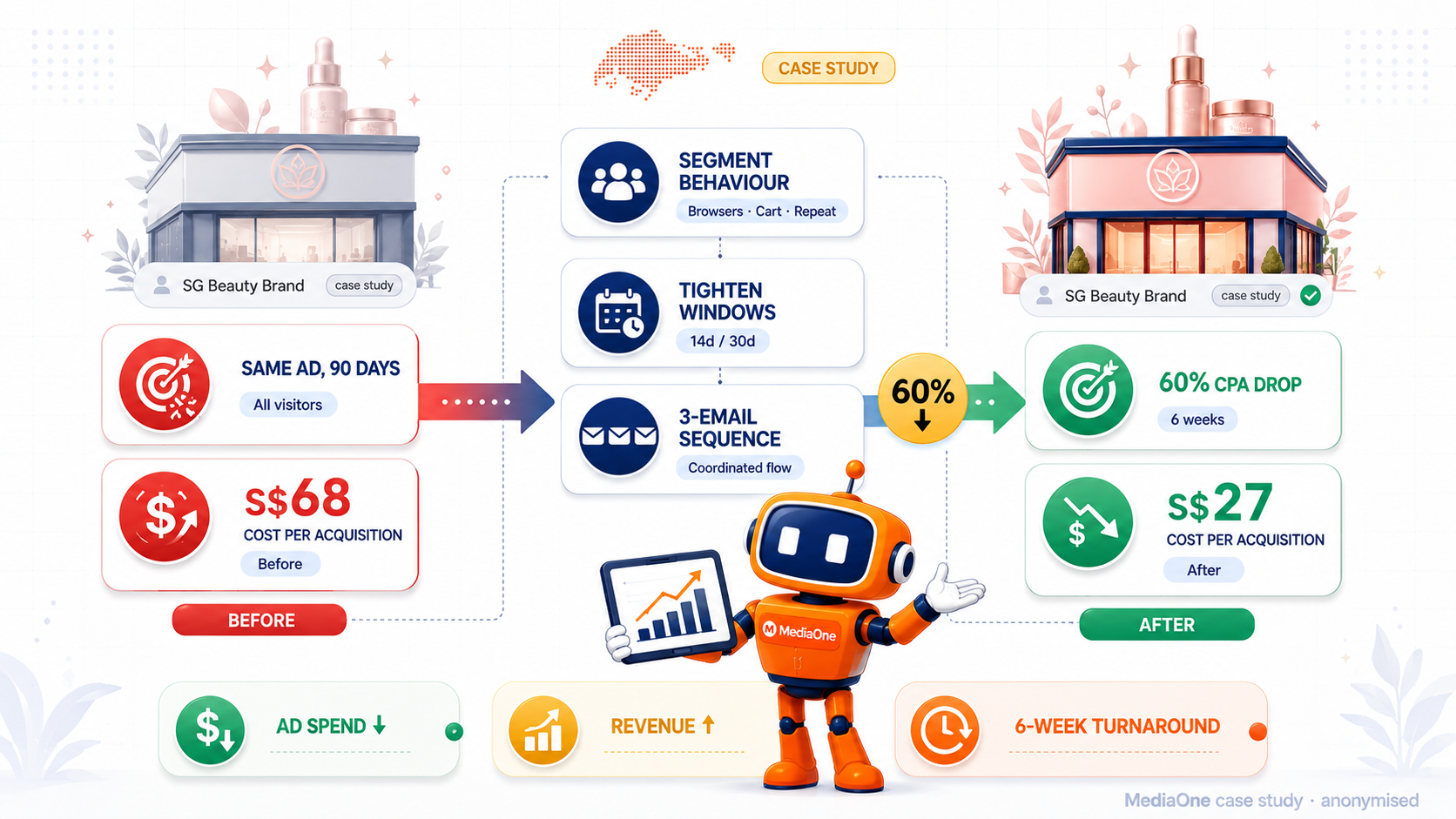
Example 1: A Singapore Beauty Brand
| Before: | After: |
| The retargeting campaign was serving the same “shop now” ad to all site visitors for 90 days. Cost per acquisition was S$68. | Cost per acquisition dropped to S$27 within six weeks. Ad spend actually decreased. Revenue rose. |
What we changed:
- Introduced behavioural segmentation (browsers vs cart abandoners vs product-page repeat visitors).
- Tightened the retargeting window to 14 days for browsers and 30 for cart abandoners.
- Layered in a coordinated three-email remarketing sequence.
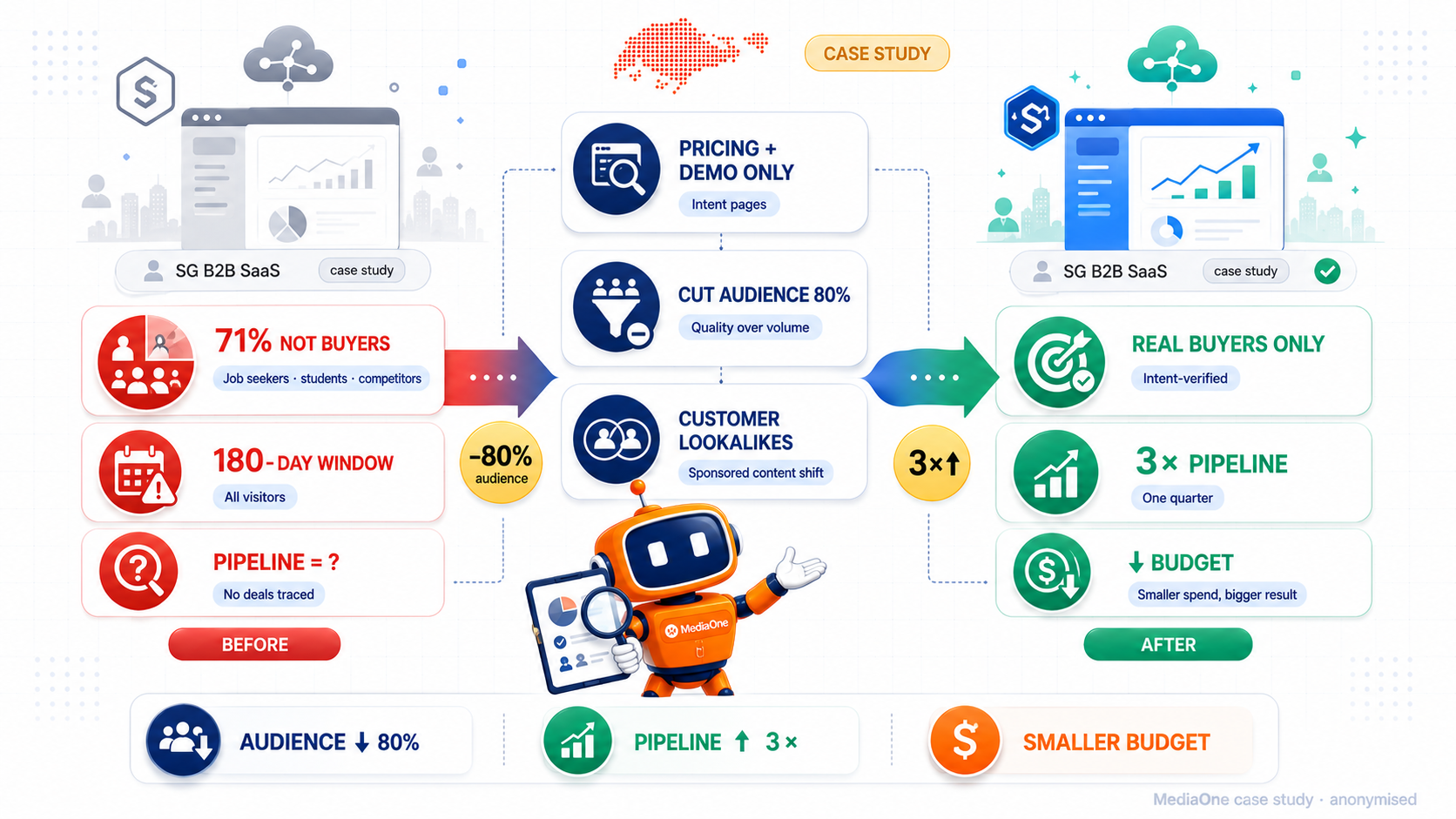
Example 2: A Singapore B2B SaaS Company
| Before: | After: |
| The team was running LinkedIn retargeting ads to every visitor from the past 180 days. Total ad spend was substantial, but the sales team could not tie any specific deal to the campaign. | Pipeline attributable to paid within one quarter was three times higher on a smaller total budget. |
What we found on audit: 71% of the retargeted audience were job seekers, students, and competitor employees, not real buyers.
What we changed:
- Rebuilt the retargeting audience around specific pricing-page and demo-page visitors.
- Cut the audience size by 80%.
- Pushed the freed budget into LinkedIn sponsored content targeting lookalikes of existing customers.
Neither result required a bigger ad budget. Both required more editorial judgement about who to target and when to stop.
What Most Articles Get Wrong About Frequency
Every article says the same thing about ad frequency: “Cap it at three to five impressions per user per campaign.”
That number is nearly always wrong.
The right frequency depends on:
- The category
- The creative
- The audience temperature
For high-consideration categories where the buyer needs multiple exposures to trust the brand, three impressions is too few. For impulse categories where the buyer decides on the first or second exposure, three is already too many.
The Measurement That Actually Works
The right measurement is not impressions per user. It is time to conversion by frequency tier.
- If your data shows conversions cluster after two impressions and never happen after seven, your frequency cap should be at seven.
- If conversions happen mostly between four and nine, cap at ten.
The default advice of three to five is a compromise that fits almost no specific business.
How Much to Spend
How much should I spend on retargeting per month in Singapore is a question we get regularly.
The honest answer depends on your average customer value and your current site traffic. For most SMEs with SGD 100K to 1M monthly online revenue:
- Below SGD 800/month: Audience too thin.
- SGD 800 to SGD 4,000/month: Usually the efficient range.
- Above SGD 4,000/month: Diminishing returns usually kick in unless the brand has scaled its traffic base.
Privacy and PDPA: The Trade-offs Nobody Wants to Talk About
Singapore’s Personal Data Protection Act governs how you collect, store, and use customer data.
Retargeting and remarketing both intersect with the PDPA, and the compliance posture carries more weight in 2026 than most SMEs realise.
| For Retargeting | The risk is usually around cookie consent and the tracking pixels loaded on your site.
If your consent banner is not compliant, or if you are firing Meta Pixel and Google Ads Remarketing tags before consent, you are exposed. Fines under the PDPA can reach S$1 million. |
| For Remarketing | The risk is usually around consent for marketing communications.
A contact who ticked “subscribe” three years ago for a webinar is not necessarily consenting to receive product promotions today. Consent needs to be specific, informed, and refreshed when the purpose changes. |
Businesses that treat PDPA compliance as an afterthought discover the cost when someone complains to the Personal Data Protection Commission. We build compliance review into every client’s remarketing and retargeting setup because retrofitting it later is more expensive than doing it upfront.
Where This Leaves Your Marketing Budget
Three questions decide whether remarketing, retargeting, or both should sit in your 2026 plan.
1. Is your buyer’s decision cycle shorter than 30 days or longer than 60 days?
- Shorter cycles favour retargeting because the ad arrives while intent is fresh.
- Longer cycles favour remarketing because the buyer needs sustained presence, and paid media over that timeframe gets expensive.
2. Do you have a database, or do you need to build one?
- Businesses without a real database of 500+ engaged contacts should build the database first through content, lead magnets, or first-purchase incentives.
- Retargeting can fund the database-building phase.
- Remarketing takes over once the list is substantial.
3. Are your site conversion basics fixed?
If your website converts poorly, retargeting spend amplifies the underlying problem. Fix conversion first, then scale paid.
For SMEs weighing these decisions against a limited budget, the PSG digital marketing grant can offset up to 50% of eligible paid media and marketing costs for qualifying Singapore businesses. That changes the calculus on what is affordable to test in the first six months.
Ready to Fix What’s Leaking?
Most Singapore SMEs we audit are underperforming their retargeting and remarketing spend by 30% to 60%. Not because the strategy is wrong, but because of the five leaks covered above.
Book a free paid media audit with MediaOne. We’ll review your Meta, Google, and email accounts, show you exactly which of the five leaks apply to your setup, and hand you a prioritised fix list you can action with or without us.
For businesses weighing broader support, our full range of digital marketing services in Singapore covers how paid, SEO, GEO, and content operate together in a coordinated retainer.
Frequently Asked Questions
What is the difference between remarketing and retargeting in simple terms?
Retargeting is paid ads shown to people who visited your site or engaged with your content, delivered through platforms like Meta and Google. Remarketing is direct outreach to people whose contact details you already have, usually through email, SMS, or WhatsApp Business. The first rents attention. The second uses attention you already own.
Which one should a small business in Singapore start with first?
Start with remarketing if you already have any list of customers or leads, because it costs almost nothing to send and pays back fastest. Start with retargeting only if your site has meaningful traffic (a few thousand monthly visitors at minimum) and your buyer’s decision cycle is short enough for ads to catch them before they lose interest.
How much should I spend on retargeting per month?
For most Singapore SMEs, monthly retargeting spend between SGD 800 and SGD 4,000 is the efficient range. Below SGD 800 the audience is too thin for the platforms to optimise properly. Above SGD 4,000, diminishing returns usually set in unless your site traffic is growing at pace.
Can I run both remarketing and retargeting on the same audience?
Yes, but only when sequenced. Sending someone six emails and three ad impressions in a day is harassment, not marketing. The coordination between the two channels is what makes the combined approach work, not the volume.
How do I avoid annoying customers with retargeting ads?
Two rules. First, exclude anyone who has already converted, and refresh the exclusion list weekly. Second, cap frequency based on your actual conversion data, not the default advice of three to five impressions. If your data shows conversions never happen after impression eight, cap at eight. Anything above becomes irritation.
Is remarketing still worth doing with all the privacy changes in 2026?
Yes, and in fact its relative value has increased. Every privacy change hurts retargeting more than remarketing, because remarketing depends on data the customer gave you directly. Businesses that invested in database growth in 2023 to 2025 are now in a stronger position than businesses that stayed reliant on cookie-based retargeting.
Does remarketing count as email marketing?
Remarketing is a subset of email marketing. Email marketing includes broadcasts, newsletters, and one-time campaigns to any subscriber. Remarketing is specifically the behaviour-triggered subset: emails sent in response to something the recipient did or did not do.
What is the ROI of retargeting vs remarketing in Singapore?
Remarketing typically delivers higher ROI per touch because the cost per send is negligible. Retargeting delivers higher absolute revenue because it can reach a larger audience. For most Singapore SMEs we work with, well-run remarketing sits at 20x to 40x ROI while well-run retargeting sits at 3x to 8x ROAS. The two are not directly comparable because they solve different parts of the funnel.