| AI Summary
Marketing communications help businesses build brand awareness, engage customers and drive conversions through advertising, public relations, content marketing, social media and direct marketing. This guide explains the marketing communications mix, key objectives, integrated strategies and a seven-step planning framework for Singapore businesses. It also covers campaign measurement, common mistakes and compliance with Singapore’s marketing regulations. |

Marketing communications helps businesses connect with their target audiences, communicate their value and influence purchasing decisions. It brings together advertising, public relations, content marketing, social media, direct marketing and other promotional activities to deliver consistent messages across customer touchpoints.
For Singapore businesses, effective marketing communications starts with understanding customer needs. The right strategy connects each message to a business objective, selects suitable communication channels and measures the results.
This guide explains the marketing communications mix, key objectives and communication process. We also cover integrated marketing communications, Singapore’s digital landscape and a practical framework for planning campaigns that generate measurable business outcomes.
Key Takeaways
- Start with clear objectives. Identify what each campaign should achieve before selecting communication channels.
- Understand your target audience. Use customer behaviour, buying intent and communication preferences to guide messaging.
- Integrate your communication channels. Maintain a consistent brand message across paid, owned and earned media.
- Measure business outcomes. Track relevant performance indicators, including qualified leads, conversions and customer retention.
- Follow Singapore’s regulations. Consider advertising standards, personal data protection and direct marketing requirements when planning campaigns.
What Is Marketing Communications?
Marketing communications refers to the methods businesses use to inform, persuade and engage customers about their products, services and brands. It covers promotional messages delivered through traditional media, digital platforms and direct customer interactions.
The purpose is to communicate a clear value proposition to the right audience. Effective marketing communications also builds brand recognition, establishes trust and supports customer relationships throughout the buying journey.
Marketing Communications vs Marketing
Marketing covers the broader process of identifying customer needs, developing products, setting prices, selecting distribution channels and creating customer value.
Marketing communications focuses on how businesses communicate that value to their audiences. It traditionally falls under promotion, one of the four Ps of marketing.
The four Ps are:
- Product: What the business offers and how it addresses customer needs.
- Price: What customers pay and how they perceive the offering’s value.
- Place: Where and how customers access the product or service.
- Promotion: How the business communicates its offering and encourages customer action.
For example, a Singapore skincare company might develop products for customers with sensitive skin, set competitive prices and sell through its website.
Its marketing communications activities would include product education, social media content, influencer partnerships and promotional emails. These activities help potential customers understand the products and decide whether to buy.
Marketing communications therefore supports the wider marketing strategy. However, promotional messages cannot compensate for a product that fails to meet customer expectations.
Why Marketing Communications Matters for Singapore Businesses
Singapore’s digitally connected population creates opportunities for businesses to reach customers through several communication channels. However, widespread internet access also increases competition for attention.
According to DataReportal’s Digital 2026 Singapore report, Singapore had approximately 5.78 million internet users in late 2025, representing 98.4% of the population.
The report also recorded 5.33 million social media user identities in October 2025. This figure represented 90.6% of the population, although DataReportal cautions that social media identities do not necessarily represent unique individuals.
Digital adoption is equally significant among businesses. The Infocomm Media Development Authority (IMDA) reported that 95.1% of Singapore’s small and medium-sized enterprises (SMEs) had adopted at least one of six measured digital areas in 2024.
These figures demonstrate the importance of digital channels, but they do not mean every business should prioritise social media advertising.
A business-to-business (B2B) software provider might generate stronger leads through LinkedIn, search advertising and industry events. A neighbourhood restaurant may benefit from Google Search, customer reviews and location-based social content.
We recommend evaluating channels according to customer behaviour and commercial objectives rather than overall platform popularity.
Benefits of Effective Marketing Communications
A well-planned strategy can deliver several business benefits.
- Stronger brand awareness: Repeated exposure to relevant messages helps customers recognise a business.
- Clearer brand positioning: Consistent communication explains why customers should choose one offering over competing alternatives.
- Higher-quality enquiries: Targeted messages attract prospects whose needs match the business’s products or services.
- Greater customer trust: Accurate information, credible evidence and responsive communication support confidence.
- Improved customer retention: Relevant updates and useful post-purchase communication encourage continued relationships.
- Better marketing accountability: Defined objectives and tracking allow businesses to evaluate spending and improve future campaigns.
The value of marketing communications depends on how effectively these activities support customer decisions. High exposure alone does not guarantee sales.
The Main Objectives of Marketing Communications
Marketing communications objectives describe the changes a business wants to produce in audience awareness, attitudes or behaviour.
We recommend defining objectives before creating advertisements or selecting platforms. Each objective should have a target audience, a measurable outcome and an evaluation period.
1. Build Brand Awareness
Awareness campaigns introduce a business to people who may not recognise its name or understand its offerings.
A new Singapore fitness studio could use local advertising, short-form videos and community partnerships to introduce its classes to nearby residents.
Useful measurements include reach, brand-related search interest and survey-based brand recall. Impressions can indicate potential exposure, but they do not establish whether people remember the brand.
2. Generate Interest and Consideration
Consideration campaigns help potential customers evaluate a business against available alternatives.
Educational articles, product demonstrations, customer testimonials and comparison guides can answer questions that influence purchasing decisions.
For a B2B company, meaningful signals might include qualified website enquiries, product demo requests or relevant content downloads. Engagement metrics provide supporting evidence but should not replace lead-quality assessments.
3. Encourage Conversions
Conversion-focused communications encourage customers to complete a specific action.
Depending on the business, the action could be purchasing a product, booking an appointment or requesting a quotation.
The message should explain the offer, address important objections and provide a clear call to action (CTA).
We recommend measuring completed conversions and acquisition costs rather than relying solely on clicks.
4. Strengthen Customer Retention and Advocacy
Marketing communications continue after the initial purchase. Existing customers need useful information, service updates and relevant reasons to engage again.
Retention activities may include product education, loyalty programmes and personalised follow-up communication. Satisfied customers may also recommend the business or share their experiences. Repeat purchase rate, customer retention and referral activity help businesses assess these outcomes.
A campaign may support several objectives simultaneously. However, identifying one primary objective makes planning and evaluation easier.
Understanding the Marketing Communications Mix
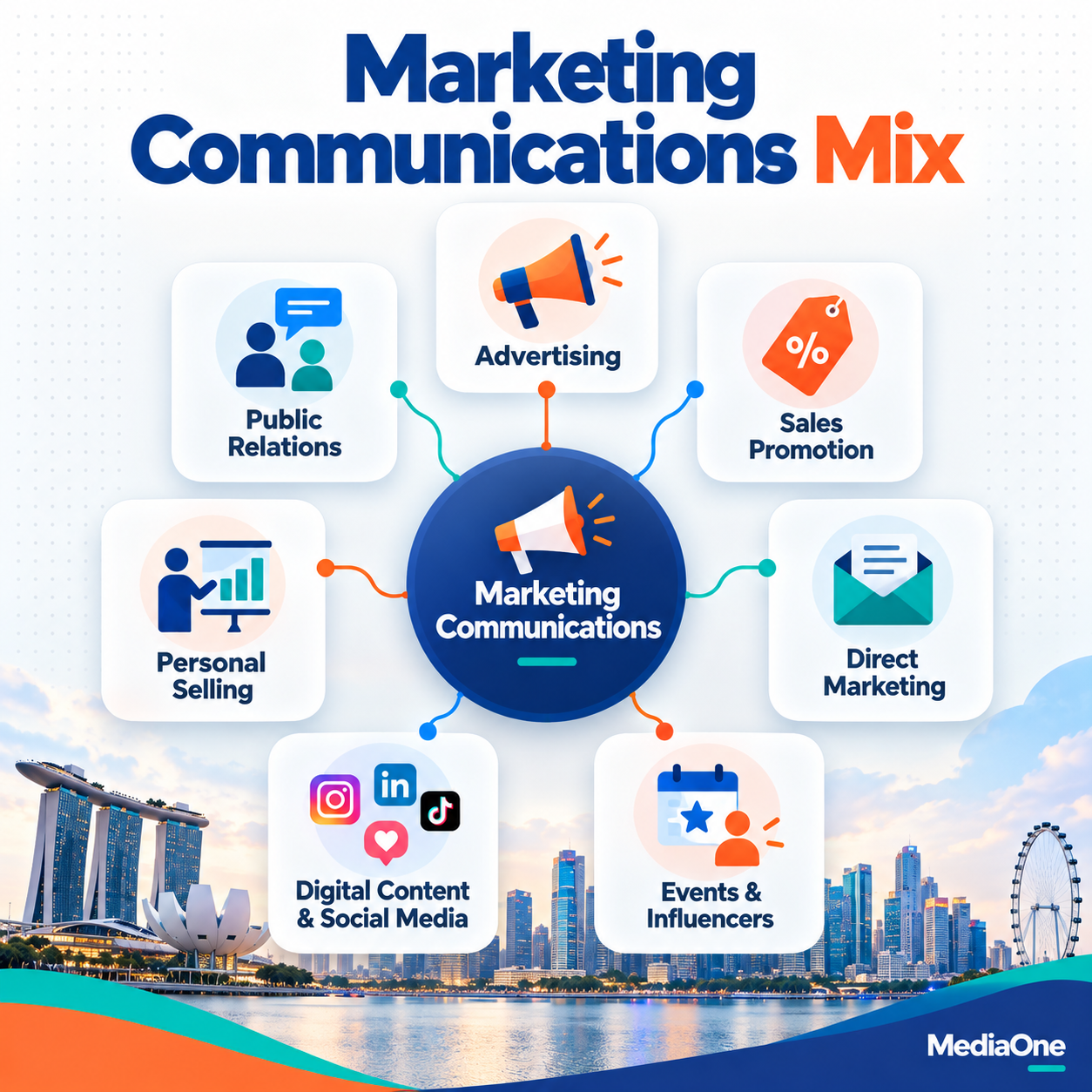
The marketing communications mix consists of promotional methods that businesses combine to reach and influence their audiences.
Traditionally, it includes advertising, public relations, sales promotion, personal selling and direct marketing. Modern campaigns also incorporate digital content, social platforms and other interactive communication methods.
1. Advertising
Advertising involves paying to present promotional messages through selected media channels. These include search engines, social platforms, television, radio and outdoor advertising.
Businesses can use advertising to build awareness or encourage direct responses. We recommend selecting placements according to audience relevance, campaign objectives and measurable performance.
For example, our search engine marketing services help businesses reach potential customers who are actively searching for relevant products or services.
2. Public Relations
Public relations (PR) focuses on building relationships and maintaining a favourable reputation among customers, media organisations and other stakeholders.
Activities include media relations, corporate announcements, community engagement and reputation management.
Unlike paid advertising, editorial coverage is generally subject to the publisher’s independent judgement. Businesses cannot guarantee favourable publicity, making credibility and accurate communication especially important.
3. Sales Promotion
Sales promotions provide temporary incentives that encourage customers to take action.
Examples include limited-time discounts, product bundles, loyalty rewards and free trials.
These incentives can support short-term sales objectives. However, excessive discounting may weaken perceived value or attract customers who rarely purchase at regular prices.

4. Personal Selling
Personal selling involves direct interaction between a business representative and a prospective customer.
It is particularly useful when customers need detailed explanations, customised quotations or assistance with complex purchasing decisions.
For Singapore B2B companies, personal selling may include consultations, product demonstrations and follow-up discussions. These interactions allow businesses to address objections and understand individual customer requirements.
5. Direct Marketing
Direct marketing involves communicating directly with selected individuals to encourage a measurable response.
Common methods include email campaigns, direct mail, telephone marketing and eligible mobile messaging campaigns.
Businesses can personalise communication according to customer interests or previous interactions. However, they must handle personal information appropriately and follow Singapore’s applicable marketing regulations.
6. Digital Content and Social Media
Digital content supports marketing communications through educational articles, videos, webinars and social media publications.
These formats can help customers discover a brand, understand its offering and evaluate its credibility.
Social platforms also support two-way communication. Businesses can answer questions, respond to feedback and develop customer relationships through meaningful interactions.
7. Events, Sponsorships and Influencer Partnerships
Events give businesses opportunities to demonstrate products, establish professional relationships and communicate directly with potential customers.
Sponsorships and influencer partnerships can extend promotional reach through relevant communities or recognised personalities.
We recommend evaluating these activities based on audience fit and credibility. Commercial partnerships should also be disclosed appropriately.
How the Marketing Communication Process Works
The communication process explains how a business creates, delivers and evaluates its messages.
It consists of several connected elements:
- Sender: The business or representative initiating the communication.
- Encoding: The process of transforming an idea into words, visuals or other communication formats.
- Message: The information or proposition being communicated.
- Channel: The medium used to deliver the message.
- Receiver: The intended audience.
- Decoding: How the audience interprets the message.
- Response and feedback: The audience’s reaction and the information available to assess it.
- Noise: Anything that interferes with the message or its interpretation.
Consider a Singapore insurance agency promoting a financial planning consultation. The agency communicates its offer through a digital advertisement and directs interested users to a landing page.
Customers may interpret the offer differently depending on their financial needs or previous experiences. Confusing language, irrelevant targeting and competing advertisements can interfere with communication.
Feedback might include enquiries, customer questions or completed consultation bookings. These signals help the agency assess its message and improve future campaigns.
However, not every response is observable. A customer may remember an advertisement and return weeks later through another channel.
What Is Integrated Marketing Communications?
Integrated marketing communications (IMC) is the coordinated planning and delivery of messages across channels and customer touchpoints. Its purpose is to maintain a consistent brand identity while allowing each channel to support a suitable objective.
For example, a business launching a new service might use social media to generate awareness, educational articles to explain the service and email follow-ups to encourage enquiries. Each channel can use different content while communicating the same underlying value proposition.
Paid, Owned and Earned Media
These three categories help businesses organise their communication channels.
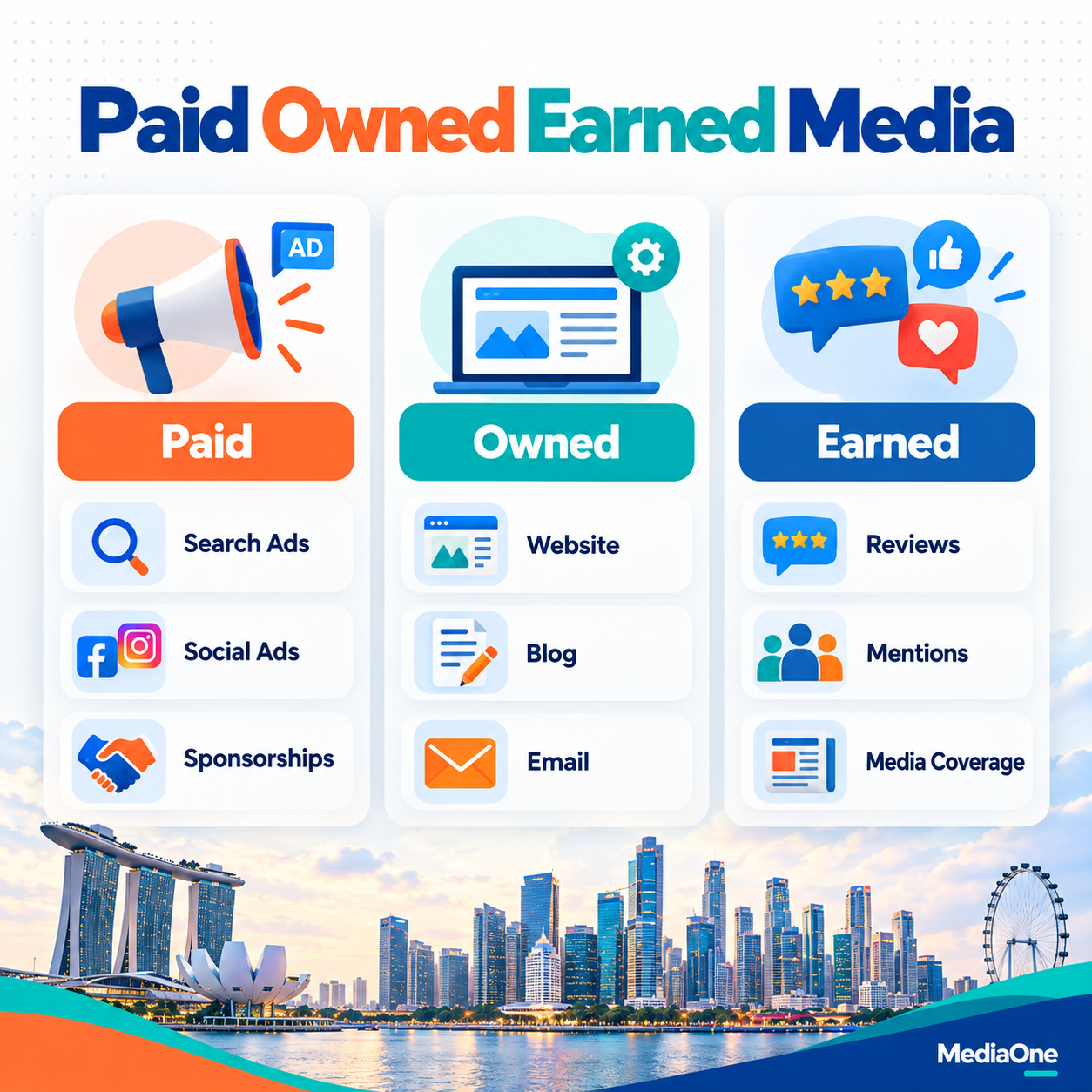
| Media type | Examples | Primary advantage | Main limitation |
| Paid | Search ads, social ads, sponsorships | Targeted reach and budget control | Requires ongoing spending |
| Owned | Website, blog, email database | Greater control over content | Requires audience development |
| Earned | Editorial coverage, organic reviews, unsolicited mentions | Independent credibility | Limited control over exposure |
Owned social media accounts require special consideration. Businesses control the content they publish but remain dependent on platform rules and distribution algorithms.
We recommend using paid media to reach relevant audiences, owned media to provide useful information and earned media to strengthen credibility. The objective is coordination rather than publishing identical advertisements everywhere.
How to Develop an Effective Marketing Communications Strategy
A successful marketing communications strategy connects business objectives with customer needs and available resources. We recommend the following seven-step process for Singapore businesses.
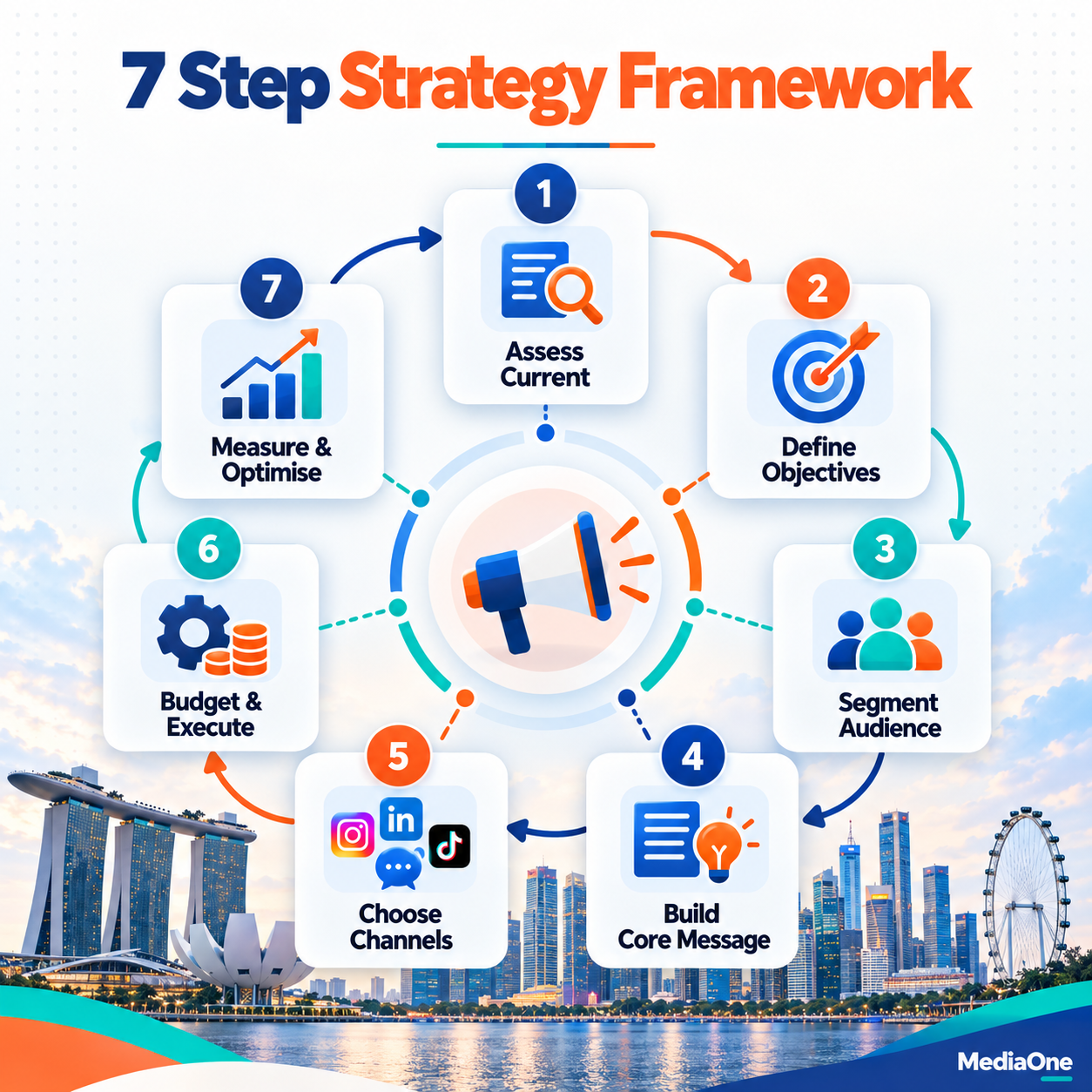
Step 1: Assess Your Current Marketing Communications
Review existing communication channels before planning new campaigns.
Examine website performance, advertising results, customer enquiries and previous campaign reports. Identify messages that generate meaningful responses and channels that consume resources without supporting business goals.
You should also review competitors’ positioning and customer feedback. These findings help establish a realistic starting point.
Step 2: Define Specific and Measurable Objectives
Use specific, measurable, achievable, relevant and time-bound (SMART) objectives to clarify campaign expectations.
For example, a B2B service company might aim to increase qualified consultation enquiries from 30 to 40 per month within three months.
This objective establishes a baseline and a measurable target. The team can then evaluate progress without relying on vague goals such as increasing engagement.
Step 3: Identify and Segment Your Target Audience
Audience segmentation groups customers according to relevant characteristics or behaviours.
For Singapore campaigns, useful criteria may include:
- Location and service availability.
- Customer needs and purchasing intent.
- Business type or industry.
- Preferred communication channels.
- Relevant language preferences.
- Previous interactions with the brand.
Avoid assuming that age, ethnicity or location automatically determines language preferences or purchasing behaviour.
Use customer interviews, sales records and available analytics to validate your segments.
Step 4: Develop Your Core Message
Your message should explain the customer’s problem, the value of your solution and the action you want the audience to take.
Start by identifying the most important benefit your business can credibly deliver. Support the message with relevant evidence, such as product specifications, demonstrations or verifiable customer feedback.
For example, an accounting firm could emphasise timely financial reporting and dependable support rather than making unsupported claims about guaranteed cost savings.
Maintain the same central message across channels. Adjust its length and presentation to suit each format.
Step 5: Select Appropriate Communication Channels
Choose channels according to how your audience discovers information and makes purchasing decisions. Search advertising may suit customers with immediate demand. Educational content can address detailed questions during the research stage.
Our social media marketing services can support campaigns where audience engagement, paid social distribution or community interaction aligns with the business objective. We recommend starting with a manageable channel mix. Expand only when performance data justifies additional investment.
Step 6: Allocate Budget and Coordinate Execution
Develop a budget covering media placements, creative production, campaign management and performance measurement.
Consider campaign duration and available resources before allocating spending. Reserve part of the budget for testing and necessary adjustments.

Assign responsibilities for creative approvals, publishing schedules and lead follow-ups. A shared campaign brief helps prevent conflicting messages and missed deadlines.
Step 7: Measure Results and Optimise
Establish performance indicators before launching the campaign.
Review whether messages reach the intended audience and produce the required actions. Compare results against the original baseline and assess differences between customer segments.
We recommend testing one meaningful variable at a time where practical. Changes to audience targeting, message positioning or landing-page design should be evaluated against measurable outcomes. Avoid declaring a successful campaign solely because impressions or social engagement increased.
Marketing Communications Strategy Example for a Singapore Business
Consider a hypothetical Singapore accounting firm seeking to increase qualified enquiries from small business owners. Its existing marketing activity generates 20 qualified enquiries per month.
The firm wants to increase that figure to 30 within three months. The marketing communications plan could use the following framework.
| Objective | Target audience | Message | Channel | Primary metric |
| Awareness | Singapore SME owners | Reliable accounting support | LinkedIn advertising | Target-audience reach |
| Consideration | Business owners researching accounting services | Clear guidance on accounting requirements | SEO articles and webinars | Qualified content enquiries |
| Conversion | Prospects comparing providers | Request a tailored consultation | Search ads and landing pages | Qualified consultation bookings |
| Retention | Existing accounting clients | Ongoing financial guidance | Email communications | Client retention rate |
The firm could initially prioritise search advertising and educational content. LinkedIn advertising would receive additional investment only if audience quality and campaign performance justified the expense. Each channel would communicate the same service proposition while addressing different customer needs.
The decision rule is straightforward: retain a channel when it contributes to a defined objective at an acceptable cost. Review or discontinue activities that consistently fail to produce meaningful results.
How to Measure Marketing Communications Effectiveness
Marketing communications performance should be assessed using metrics relevant to each campaign objective. We recommend separating audience engagement indicators from commercial outcomes. This helps prevent businesses from mistaking visibility for profitability.
Important Marketing Communications Metrics
- Reach: The estimated number of people exposed to campaign content.
- Click-through rate (CTR): The percentage of impressions that generate clicks.
- Conversion rate: The percentage of measured users or interactions that produce a defined action.
- Cost per lead (CPL): Campaign spending divided by the number of leads generated.
- Customer acquisition cost (CAC): Acquisition-related costs divided by the number of new customers acquired.
- Return on ad spend (ROAS): Attributed advertising revenue divided by advertising expenditure.
- Customer retention rate: The proportion of existing customers retained over a defined period.
Not every campaign needs all these measurements. A brand awareness initiative requires different evaluation criteria from a direct-response sales campaign.
Google explains that Google Analytics 4 events can measure interactions such as page visits and purchases. Businesses can designate important actions as key events to support performance analysis. For paid campaigns, Google Ads conversion measurement can help identify advertisements associated with valuable customer actions.
We recommend combining platform analytics with customer relationship management (CRM) records where appropriate. This can help distinguish initial enquiries from qualified prospects and completed sales.
Marketing Communications Regulations in Singapore
Singapore businesses must consider relevant legal and advertising requirements when planning communications campaigns.
Personal Data Protection Act
The Personal Data Protection Act (PDPA) governs how organisations collect, use and disclose personal data. Businesses using personal information for marketing must establish an appropriate legal basis and comply with applicable notification, consent and withdrawal requirements.
The Personal Data Protection Commission’s guidelines explain these obligations and the treatment of consent withdrawal. We recommend maintaining accurate consent records and reviewing how marketing platforms handle customer information.
Do Not Call Registry and Electronic Marketing
Singapore’s Do Not Call (DNC) provisions regulate specified marketing calls, text messages and fax messages sent to Singapore telephone numbers. Organisations must comply with applicable registry-checking and consent requirements. The PDPC’s DNC guidance explains the relevant obligations.
Separately, Singapore’s Spam Control Act regulates unsolicited commercial electronic messages sent in bulk. The IMDA’s guidance for organisations explains requirements concerning message identification, contact information and unsubscribe facilities.
Advertising Standards and Influencer Disclosure
The Advertising Standards Authority of Singapore (ASAS) administers the Singapore Code of Advertising Practice. The code promotes advertising that is legal, decent, honest and truthful. ASAS also provides guidelines for interactive marketing and social media.
Businesses should substantiate promotional claims and disclose commercial relationships appropriately. These considerations are especially relevant to influencer endorsements and sponsored content.
Common Marketing Communications Mistakes to Avoid
Even well-funded campaigns can underperform when planning and execution are disconnected. Common mistakes include:
- Unclear objectives: Launching activities without defining the business outcome they should support.
- Poor audience targeting: Selecting platforms based on popularity rather than customer behaviour.
- Inconsistent messaging: Presenting conflicting offers or claims across communication channels.
- Excessive channel expansion: Spreading limited resources across too many platforms.
- Weak conversion tracking: Measuring clicks and engagement without monitoring meaningful customer actions.
- Insufficient coordination: Allowing marketing, sales and customer service teams to communicate different information.
- Neglecting compliance: Overlooking consent requirements, advertising disclosures or promotional claim verification.
We recommend conducting regular campaign reviews to identify these problems early. Improvements should prioritise activities that directly affect customer understanding and business results.
Marketing Communications Planning Checklist
Use this checklist before launching your next campaign.
- Define the primary business objective and measurable target.
- Review existing performance and establish a baseline.
- Identify the target audience and relevant customer needs.
- Develop a clear, evidence-supported brand message.
- Select communication channels based on audience behaviour.
- Allocate the budget and establish campaign deadlines.
- Assign responsibilities for content, approvals and follow-ups.
- Configure the necessary performance tracking.
- Review Singapore’s relevant marketing regulations.
- Establish a schedule for reporting and optimisation.
The checklist should guide both campaign preparation and subsequent performance reviews. Update the strategy when customer behaviour or business priorities change.
Frequently Asked Questions
What is the main purpose of marketing communications?
The main purpose is to communicate a business’s value to its target audience and influence customer decisions. It supports brand awareness, consideration, sales and long-term customer relationships.
What are the five traditional elements of the marketing communications mix?
The five traditional elements are advertising, public relations, sales promotion, personal selling and direct marketing. Modern strategies also incorporate digital content, social media and interactive communications.
What is the difference between marketing communications and public relations?
Marketing communications covers the wider range of activities businesses use to promote their offerings and engage audiences. Public relations focuses primarily on stakeholder relationships, reputation and public communication.

Which marketing communications channel is best for Singapore SMEs?
The best channel depends on the target audience, business objective and available budget. We recommend testing channels that match demonstrated customer behaviour, then evaluating qualified enquiries, conversions or other relevant outcomes.
How often should businesses review their marketing communications strategy?
Businesses should monitor active campaigns regularly and conduct deeper reviews at suitable intervals, such as monthly or quarterly. The frequency depends on campaign duration, spending and the amount of reliable performance data available.
Build a Marketing Communications Strategy That Delivers Results
Effective marketing communications starts with clear objectives, accurate audience insights and consistent messaging.
Singapore businesses should select channels according to customer needs and evaluate campaigns using meaningful performance indicators. Advertising, content marketing, public relations and direct communication work best when coordinated around a shared strategy.
At MediaOne, we recommend reviewing your existing communication activities before increasing your marketing budget. Identify which channels generate qualified opportunities, address gaps in your messaging and prioritise improvements supported by performance data.
For businesses seeking support with coordinated digital campaigns, our digital marketing services provide a starting point for evaluating suitable strategies and services.