| AI Summary Marketing research in Singapore helps businesses make informed decisions and reduce costly risks. Learn how to choose the right research methods, estimate costs, assess sample quality and select a reliable research agency. Discover how to turn customer insights into actionable marketing strategies that improve targeting, lead generation and conversions. |
Effective marketing research in Singapore starts with a decision, not a questionnaire. Before commissioning a survey or hiring an agency, identify what your business needs to know, how the findings will influence your next move, and what a wrong decision could cost.

We recommend reviewing existing evidence first, then choosing the smallest credible study that fills the remaining gap. This guide explains suitable methods, budgets, agency selection and expected deliverables.
Key Takeaways
- Define the business decision before choosing a research method or provider.
- Use official Singapore statistics and existing customer data before paying for fieldwork.
- Match respondents to your actual customers, not simply the general population.
- Treat published agency prices as planning estimates, not standard market rates.
- Check recruitment, sample quality, privacy safeguards and reporting limitations before signing.
- Require recommendations that connect findings to actions, owners and measurable outcomes.
Marketing Research Singapore: Understand the Market Before Commissioning a Study
Singapore’s total population reached 6.21 million in June 2026, according to the National Population and Talent Division. That includes citizens, permanent residents and non-residents, not necessarily your addressable market.
A family-oriented retailer might need resident households, while a business-to-business (B2B) software provider might target procurement managers at specific companies. A hospitality brand could need visitors as well as local consumers. Define the customer population before anyone estimates demand.
Separate Singapore fieldwork from regional research
A Singapore-based research agency may manage projects across Southeast Asia. However, a regional study is useful only when the decision genuinely covers those countries. Customer preferences and buying conditions can differ substantially between markets.
If you need to choose a price for Singapore customers, insist on findings that can be reported separately for Singapore. Ask which countries supply respondents, how many interviews take place in each market and whether the local sample supports the conclusions.
Start with evidence already available
Before commissioning interviews, we would examine relevant SingStat business insights, including customer demographics, industry performance and expenditure patterns. The Household Expenditure Survey 2023 provides a useful historical baseline for household spending, although it cannot establish current demand for a particular brand.
For competitor mapping, the Accounting and Corporate Regulatory Authority’s open datasets provide business-entity information. Combine these with customer relationship management (CRM) records, sales enquiries, website analytics and frontline feedback. No source gives a complete picture.
Decide Whether Marketing Research Is Worth the Cost
Research is most valuable when uncertainty could change an expensive or difficult-to-reverse decision. Opening an outlet, entering a new segment or changing a core product proposition may warrant structured evidence. Rewriting a weak advertisement can often be tested directly at a much lower cost.
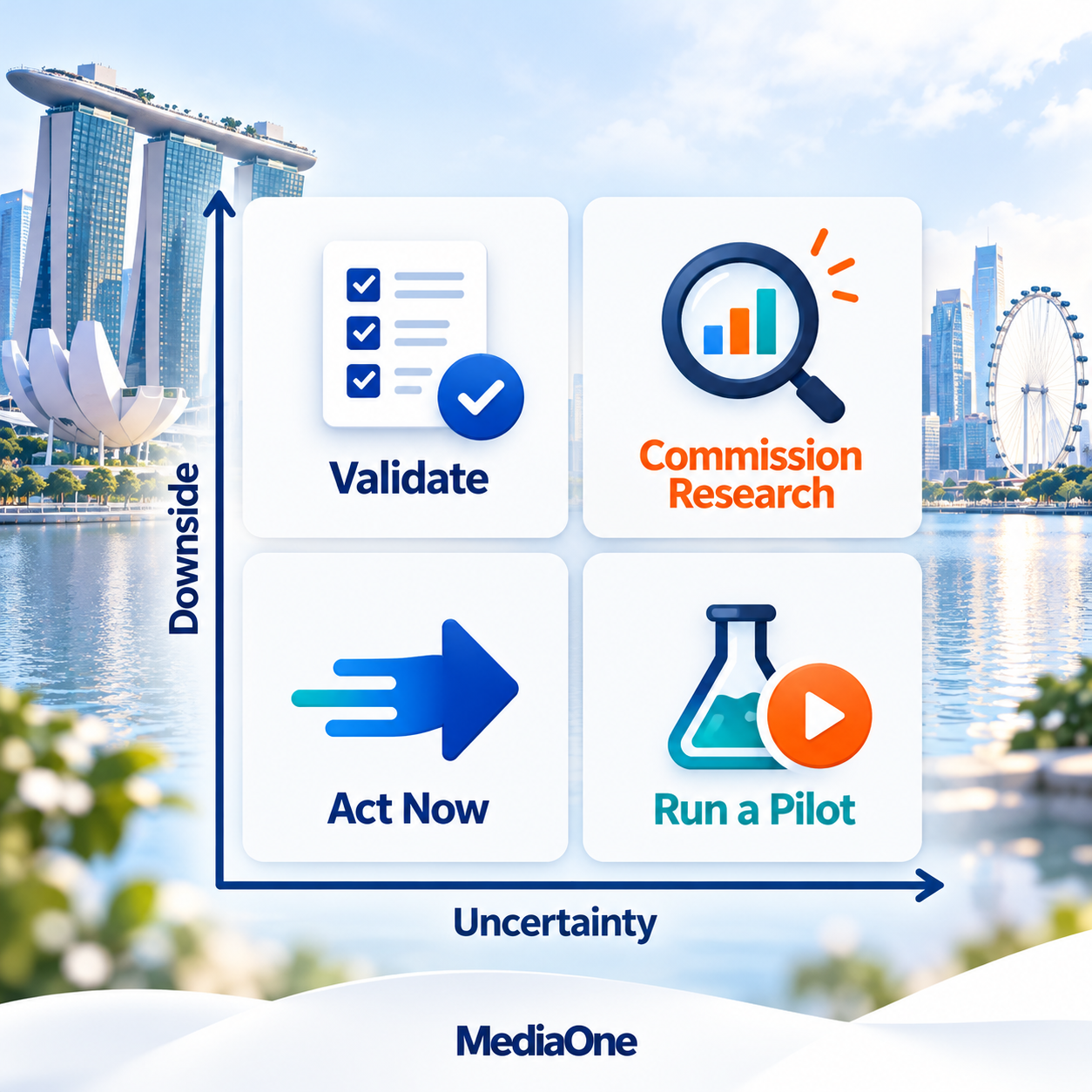
Use two questions to decide how far to investigate: How uncertain are we? and What happens if we are wrong? Our recommended response depends on both answers.
| Decision situation | Practical response |
| Low uncertainty, low downside | Act using existing evidence. |
| Low uncertainty, high downside | Validate assumptions through targeted desk research. |
| High uncertainty, low downside | Run a small pilot or controlled market test. |
| High uncertainty, high downside | Commission research matched to the decision. |
This framework does not guarantee a return on research spending. If the proposed findings would not change your decision, challenge the need for research before approving expenditure.
Turn business concerns into researchable questions
“Understand our customers” is too broad to guide useful fieldwork. A stronger question is: “Would weekday office workers near our proposed outlet buy a S$8 lunch set at least twice a week?” That wording identifies a population, product, price and behaviour to investigate.

Write down what you would do if the answer is favourable, unfavourable or inconclusive. Agree on those actions with the decision-maker before fieldwork begins. This reduces the risk of an interesting report that nobody uses.
Choose the Right Marketing Research Method
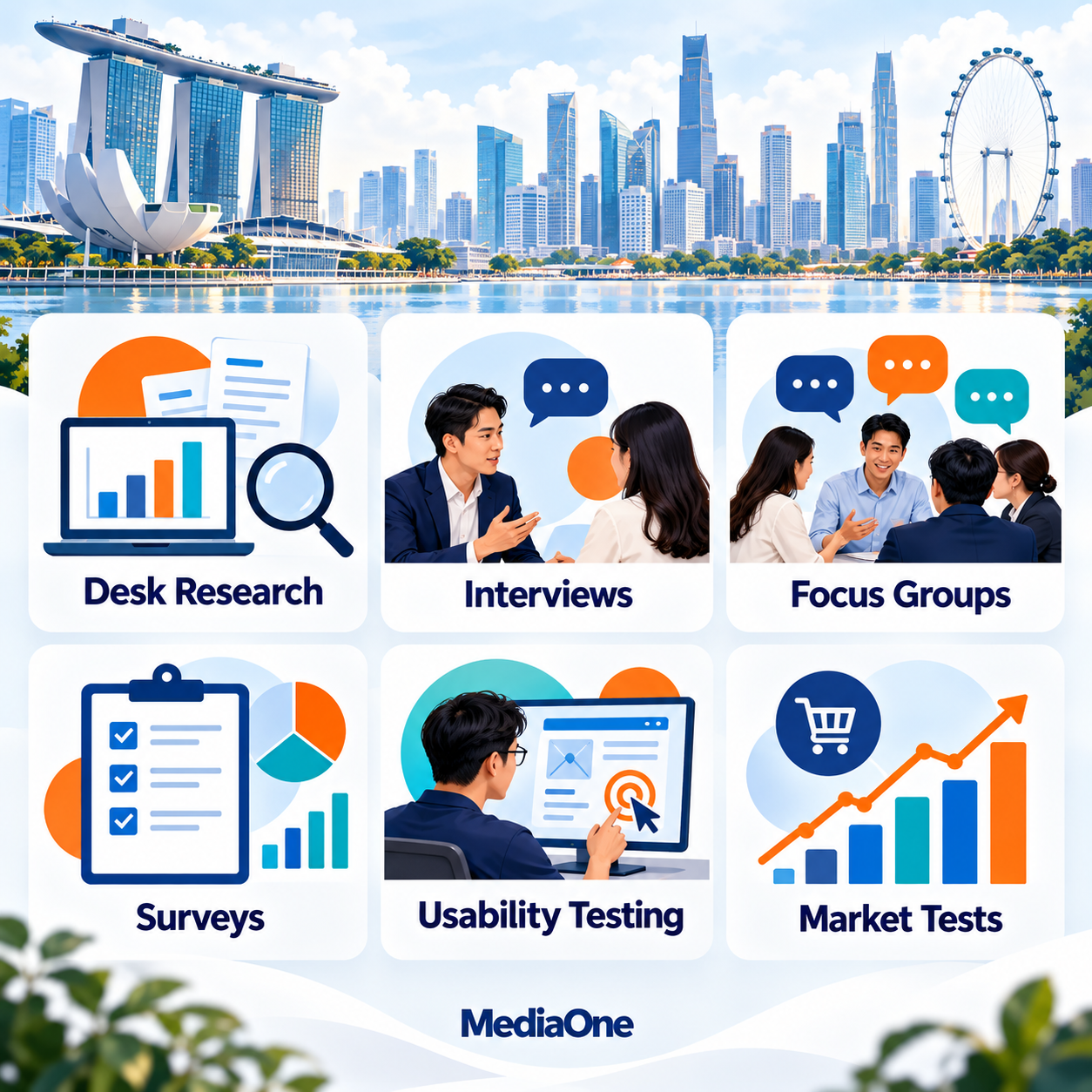
Different methods produce different kinds of evidence. A focus group cannot reliably establish how many Singapore consumers prefer a product, while a survey may fail to explain why people struggle to buy it. We recommend selecting methods according to the decision rather than the agency’s preferred package.
| Research method | Best use | Main limitation |
| Desk research | Market context, competitors and category trends | Published data may not fit your customer segment. |
| Individual interviews | Motivations, objections and buying processes | Small samples cannot measure population-wide prevalence. |
| Focus groups | Exploring concepts, language and reactions | Group dynamics can influence responses. |
| Quantitative surveys | Comparing attitudes across defined segments | Results depend heavily on recruitment and question design. |
| Usability testing | Finding friction in websites or purchase journeys | Observed tasks do not prove overall market demand. |
| Controlled market tests | Observing response to real offers | Results may depend on channel, timing and execution. |
Combine qualitative exploration with quantitative validation
When the underlying customer problem is unclear, start with interviews to discover language, frustrations and unexpected alternatives. Use those findings to build a questionnaire that measures how widespread the issues may be. This sequence reduces the temptation to impose internal assumptions on respondents.
Conversely, a business with a clearly defined question may go straight to a properly designed survey. Avoid adding focus groups merely because a bundled proposal includes them. Each stage should resolve a remaining question.
Check sample quality before trusting percentages
A survey of 500 volunteers is not necessarily representative of Singapore customers. Recruitment through social media or opt-in panels may exclude relevant groups, even when the age and gender distribution looks balanced. Ask whether respondents were selected through probability sampling or non-probability recruitment.
The American Association for Public Opinion Research requires transparent disclosure of recruitment, sample sizes and weighting. Conventional margins of sampling error are appropriate to specified probability-sampling designs, not automatically to opt-in surveys. A larger sample cannot fix poor recruitment.
For a simple random sample of 400 people, a proportion near 50% has an approximate 95% margin of sampling error of ±4.9 percentage points, before additional design effects. That illustration does not validate an online convenience sample. Segment-level results usually have fewer respondents and greater uncertainty.
Write a Research Brief That Agencies Can Price Accurately
A clear brief improves proposal quality and makes suppliers easier to compare. It should describe the decision and constraints without prescribing a method prematurely. We suggest including six essential elements:
- Business decision: Explain what will be approved, changed or rejected.
- Target audience: Specify buyers, users, locations and eligibility criteria.
- Existing evidence: Share available data and known limitations.
- Research questions: Prioritise the few answers that matter most.
- Budget and deadline: Give a realistic range and decision date.
- Required outputs: Request findings, methodology, limitations and recommendations.
For example, a café chain considering a second outlet may ask about weekday lunch demand among workers within its intended catchment. Interviews could reveal preferences, while footfall observations and a limited market test may clarify actual behaviour. A general national opinion poll would be a poor substitute.
Agree on success criteria before recruitment
Define which outcomes would justify proceeding, changing the offer or postponing investment. For a pricing project, that might mean identifying a price range that preserves expected contribution margin, rather than simply asking respondents what seems affordable.
Ask the agency to document assumptions, intended comparisons and minimum subgroup sizes. If several research questions compete for attention, rank them. A focused study is easier to analyse and less likely to overwhelm respondents.
How Much Does Market Research Cost in Singapore?
There is no universal Singapore rate card. Price depends on recruitment difficulty, methodology, sample size, incentives, languages and reporting depth. Business decision-makers are generally harder to recruit than broad consumer audiences, while regional projects add coordination and translation costs.
As illustrative planning ranges, a Singapore research-agency buyer’s guide lists approximately S3,000–S8,000 for focused desk research, S8,000–S20,000 for interview-led work and S12,000–S35,000 or more for quantitative surveys. These are published estimates from one provider, not independently verified industry averages or guaranteed quotations.
The lowest bid is not necessarily the least expensive outcome. Compare proposals by the usable evidence they will produce, not just their total fee. A cheaper survey with weak recruitment may create costly confidence in an unreliable answer.
Request an itemised quotation
Ask whether the quoted fee includes questionnaire design, screening, respondent incentives, translations, fieldwork supervision, data cleaning and analysis. Confirm presentation sessions, raw-data access, revisions and any applicable Goods and Services Tax (GST).
Also request a milestone schedule covering design approval, recruitment, collection, analysis and delivery. Timelines should reflect the population being reached; recruiting specialist executives may take longer than surveying general consumers. Do not accept an unusually short deadline without understanding the trade-offs.
Protect Respondent Data and Research Integrity
Singapore’s Personal Data Protection Act (PDPA) can apply when research involves identifiable individuals. The Personal Data Protection Commission explains obligations concerning notification, consent where required, appropriate purposes, protection, retention and overseas transfers. Whether an exception applies depends on the circumstances; do not assume that calling a project “research” removes these responsibilities.
We would require each supplier to explain what personal data it collects, why it is needed, who can access it and when it will be deleted. Contracts should also address subcontractors, breach procedures and responsibility for international data transfers. Where identifying individuals is unnecessary, request aggregated or properly anonymised findings.
The PDPC’s anonymisation guidance is useful when planning data sharing. Removing names alone may not prevent re-identification, particularly in small professional groups. Protecting confidentiality should be part of research design, not an afterthought.
For professional conduct, the updated 2025 ICC/ESOMAR Code provides an international benchmark covering transparency, responsibility and ethical research practice. Ask prospective agencies how they apply its principles, especially when automated tools or synthetic data are involved.
How to Choose a Market Research Agency in Singapore
Begin with agencies that have relevant experience in your audience and decision type. A provider skilled at consumer brand tracking may not be the strongest choice for interviewing enterprise technology buyers. We recommend inviting at least three comparable proposals using the same brief.
Evaluate methodology before presentation quality
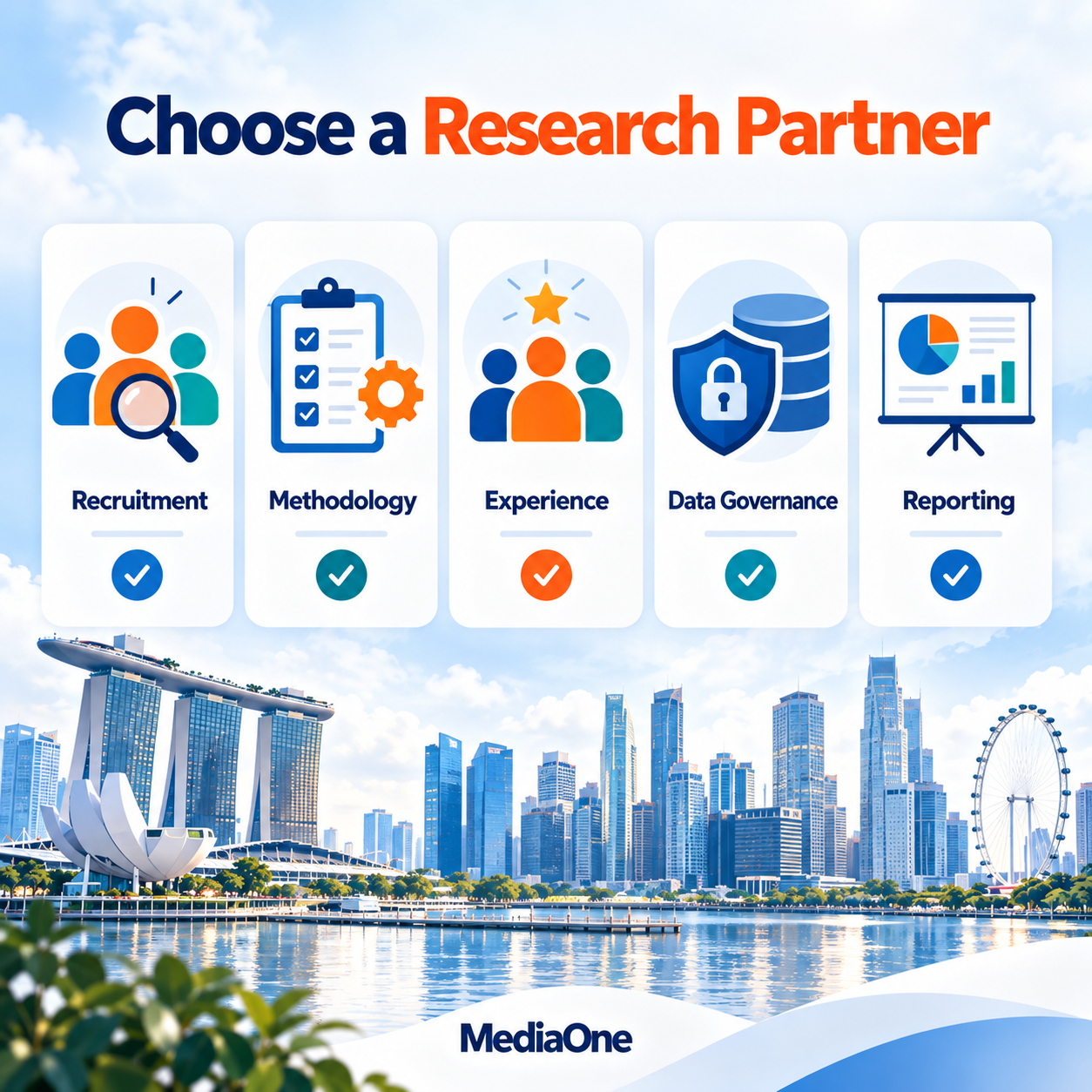
Score each agency from one to five across five criteria: audience recruitment, methodological clarity, relevant experience, data governance and decision-focused reporting. This is our suggested screening framework, not a recognised industry certification. An agency with a polished deck but an unexplained sample should not advance simply because its fee is attractive.
Ask shortlisted providers to explain their approach in plain language. Their answers should reveal the limitations of the proposed study as clearly as its strengths.
- Recruitment: Where will respondents come from, and how will eligibility be verified?
- Coverage: Which relevant customers might be missed?
- Quality control: How will duplicate, fraudulent or careless responses be detected?
- Analysis: Which subgroup comparisons are credible at the planned sample size?
- Reporting: Will we receive methodology, limitations and actionable recommendations?
- Ownership: Who can use the data, questionnaire and final outputs after delivery?
Watch for warning signs
Be cautious of agencies promising representative results without explaining sample selection. Other concerns include unclear subcontracting, guaranteed business outcomes, unexplained weighting or refusal to disclose screening rules. A credible partner should acknowledge the study’s limits.
Request a relevant, suitably redacted example report rather than relying on logos or generic testimonials. Check whether recommendations follow from evidence, whether uncertainty is disclosed and whether the report distinguishes respondent opinion from observed behaviour.
What to Expect After Commissioning the Study
A research project should move through five controlled stages: briefing, design, fieldwork, analysis and decision-making. Your organisation should approve the audience definition and research instrument before recruitment. Later changes can undermine comparisons and increase costs.
During collection, request concise progress updates on recruitment and sample composition. The agency should document exclusions, missing responses and meaningful deviations from the approved plan. At the analysis stage, review both overall findings and relevant customer segments without overinterpreting small differences.
The final package should include an executive summary, full findings, clear charts, a methodology note and explicit limitations. Where agreed, it should also include an anonymised dataset or accessible results file. We recommend requiring a decision workshop that translates findings into practical next steps.
Turn findings into marketing actions
Suppose interviews show that customers understand your product but distrust the delivery promise. The first response may be clearer fulfilment information and better proof on the product page, not a new advertising campaign. Validate the change through actual conversion and customer-service outcomes.
Research also informs SEO and audience strategy when it identifies customer language, unmet questions or segment-specific buying concerns. We would connect those insights to content priorities, landing pages and measurable conversions. Research should guide testing, not replace it.
Checklist Before You Sign a Research Contract
Use this final check to ensure the proposed project can support a real decision. If several answers are missing, request a revised scope before committing funds.
- Is the business decision specific, with a named decision-maker?
- Does existing evidence leave a meaningful unanswered question?
- Are the target respondents and recruitment method clearly defined?
- Are costs, exclusions, deadlines and deliverables itemised?
- Are privacy safeguards, data ownership and research limitations documented?
- Is there a plan to act on the findings and measure the outcome?
Frequently Asked Questions
How much does marketing research cost in Singapore?
A focused desk study may be quoted in the low thousands of Singapore dollars, while interviews and structured surveys can cost substantially more. Published planning estimates suggest about S12,000–S35,000 or more for a defined quantitative survey, but request itemised quotations for your exact brief.

When should a Singapore business commission research?
Commission research when meaningful uncertainty affects an important decision that existing evidence cannot settle. For a small, reversible change, we would usually test the idea directly before funding a larger study.

What is the difference between qualitative and quantitative research?
Qualitative methods explore motivations and experiences through interviews or group discussions. Quantitative methods measure responses across a defined sample, but their broader reliability depends on sound recruitment and analysis.

Can online surveys represent all Singapore consumers?
Not automatically. The sample must match the intended population, and opt-in recruitment can introduce selection bias even with hundreds of responses. Ask the agency to disclose sampling, weighting and limitations.
Should I hire a Singapore agency for regional research?
A Singapore agency can coordinate regional research, but its office location does not establish local expertise or sample quality in every country. Assess its fieldwork partners, language capabilities and country-level reporting before appointing it.
Turn Marketing Research Insights into Better Business Decisions
Effective marketing research in Singapore starts with a clear business decision. Review existing data, choose a method that addresses the remaining uncertainty and appoint a research partner who is transparent about sample quality, costs and limitations.
At MediaOne, we recommend using research findings to build a practical digital marketing strategy backed by measurable goals. Our lead generation services can help businesses apply customer insights to improve targeting, attract qualified prospects and increase conversions.