| AI Summary
Influencer ads pay creators to promote a business through sponsored content, sometimes supported by paid distribution. Singapore businesses need to compare audience relevance, content quality and the total campaign cost. This guide explains creator selection, formats, pricing, usage rights, disclosure and measurement across Instagram, TikTok and YouTube, with examples that connect campaign activity to business results. |
Influencer ads are promotional posts or videos that creators produce for a brand in exchange for payment or another benefit. Campaigns can include sponsored posts and paid promotion of creator content. Successful planning covers the audience, deliverables, budget, permissions, sponsorship disclosure and measurement before publication.
Key Takeaways
- Creator fees and advertising spend pay for different things; both belong in the budget.
- Engagement rates need the same calculation and comparable content before they can support a decision.
- A content production payment does not automatically buy ownership or unlimited advertising rights.
- Campaign profitability depends on product costs and campaign expenses, not sales revenue alone.
- Reporting should separate unpaid post performance from results generated by paid distribution.
A creator makes your product look convincing. Followers ask questions, the video attracts attention, and the campaign feels promising. The harder part comes when the invoice arrives: what did the business actually receive?
Influencer ads bring several purchases together. Your business may be buying content production, access to an audience and permission to run advertising. Each has a different price and a different purpose.
For Singapore founders and marketing teams, the task is to organise those purchases around a business goal. A neighbourhood café seeking weekday visits needs a different campaign from an online retailer selling across the island.
What Are Influencer Ads?
Influencer ads involve a commercial arrangement between a brand and a creator. The creator introduces, demonstrates or discusses a product, service or business.
The term covers two related activities:
- Sponsored creator content: the brand pays or provides another benefit for content published on the creator’s account.
- Paid distribution of creator content: the brand pays an advertising platform to show approved content to selected audiences.
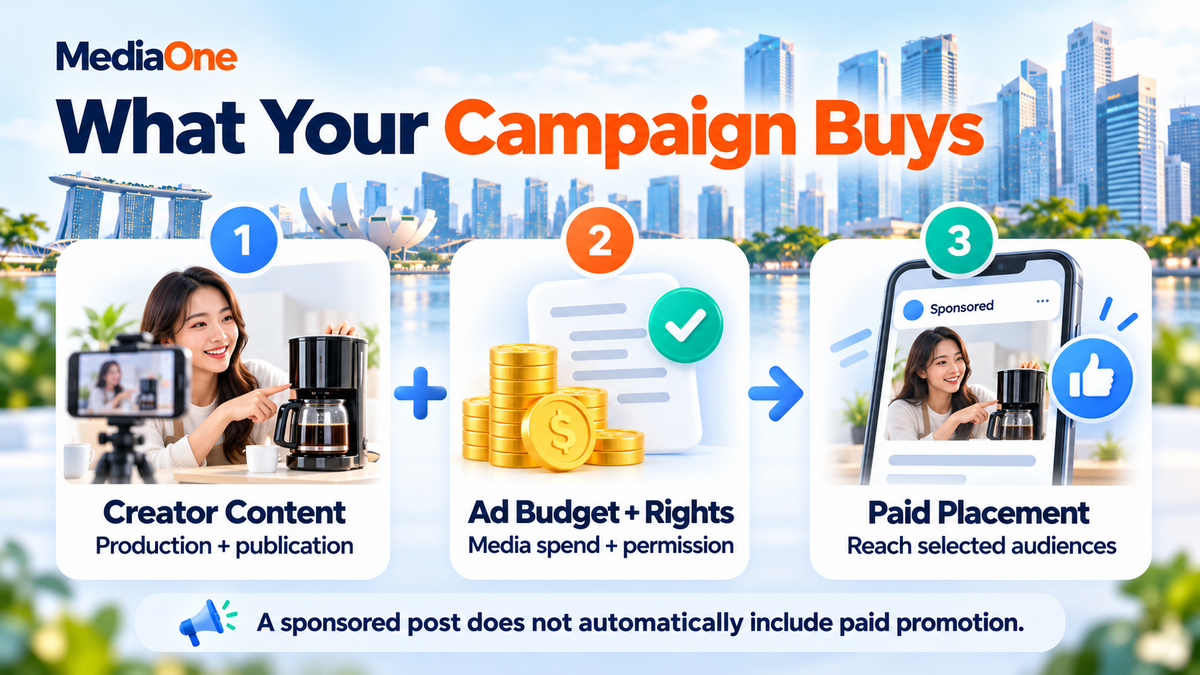
A sponsored post can reach people without additional advertising spend. A paid campaign can extend that content beyond the creator’s existing audience. Neither arrangement automatically includes the other.
This distinction matters when comparing earned and paid media. A contracted recommendation belongs to paid marketing; it should not appear to be an independent customer endorsement.
How Creator Ads Differ From Brand Ads
A brand advertisement usually presents the business through its own identity. Creator advertising can bring a person’s experience, presentation style and audience relationship into the message.
Meta’s partnership ads let advertisers promote content with a creator or partner’s handle. TikTok’s Spark Ads let brands advertise using authorised creator posts. Marketers sometimes call advertising through a creator’s identity “whitelisting.”
Those formats still involve paid advertising. A familiar face does not guarantee trust, lower costs or more sales.
When Does Paying a Creator Make Sense?
A creator partnership should solve a specific communication problem. A portable coffee machine may need someone to show its size, setup and cleaning. A photograph and a discount code cannot explain all three.
The purchase also needs a defined purpose:
- Audience access: the creator publishes to people your business wants to reach.
- Content production: the creator makes material for the brand’s channels.
- Both: the agreement covers publication and reusable assets.
A content-only arrangement can work without a large following because the brand supplies distribution. A campaign buying audience access needs evidence about who follows and watches the creator. Those purchases deserve separate evaluation.
Which Creators Should Your Business Choose?
The strongest shortlist starts with the people your business wants to reach. A Singapore-based creator can have many overseas followers, so their location alone tells you little about the audience.
Recent audience analytics can show the countries, age groups and other available characteristics behind the follower count. Content history adds context: who asks questions, which topics attract discussion and how the creator handles sponsored work.
What Do Influencer Tiers Tell You?
Follower tiers describe account size. Their boundaries vary, and they do not measure content quality.
| Tier | Common working range | What to investigate |
| Nano | Fewer than 10,000 followers | Local audience concentration and production ability |
| Micro | 10,000 to fewer than 100,000 | Subject knowledge and relevant audience response |
| Macro | 100,000 to fewer than one million | Audience spread and comparable sponsored results |
| Mega | One million or more | Buyer relevance and the cost of broader exposure |
A microinfluencer may specialise in home cooking, parenting or fitness. That specialism can matter more than account size when the product serves a particular group.
A larger account may support a broad launch. A smaller account may reach a concentrated local community. Campaign evidence should decide which earns the budget.
What Should You Check Before Outreach?
A practical screening sheet can record:
- Audience relevance: whether followers live where you sell and share the interests your product serves.
- Recent sponsored work: how comparable advertisements performed.
- Comment quality: whether responses discuss the product or merely repeat generic praise.
- Production ability: whether the creator can demonstrate the product accurately.
- Brand suitability: whether previous content conflicts with your business.
- Reliability: whether proposed deadlines and reporting commitments are realistic.
A bakery offering collection in Tampines needs nearby potential customers. An account with national reach may still work, but local audience evidence strengthens the case.
Unusual follower growth or repetitive comments deserve investigation. Those signs alone do not prove that a creator bought followers.
How Should You Compare Engagement?
Engagement rate expresses interactions as a percentage of followers, reach or views. Different calculations produce different results.
A follower-based calculation is:
- Follower-based engagement rate: interactions ÷ followers × 100.
Comparisons need the same audience measure and interaction types. A rate based on likes and comments cannot be compared directly with one that also includes saves and shares.
Several recent, comparable sponsored posts provide more context than one viral video. A universal minimum such as 4% would ignore differences between platforms, formats and audiences.
How Should You Contact Creators?
A first outreach message can name the business, mention a relevant piece of the creator’s work and outline the proposed collaboration.
The initial exchange should establish:
- The assignment: what the creator would make and publish.
- The timing: when production and publication would happen.
- The commercial scope: whether advertising rights or exclusivity are required.
- The response needed: availability, a proposal and relevant audience information.
A personalised reference helps explain why the business approached that creator. A long message listing every product feature makes the proposal harder to assess. Recent sponsored examples and a quote against the proposed scope give the team something concrete to compare.
Which Influencer Ad Formats Support Your Goal?
The content format should help the audience understand or act on the offer. Your wider social media marketing strategy should also connect the creator’s message with what customers see on your own accounts.
| Goal | Possible format | What the content should show |
| Product discovery | Short demonstration | The problem and the product in use |
| Purchase consideration | Tutorial or comparison | Features, limitations and practical details |
| Local visits | Venue walkthrough | Location, experience and booking information |
| Enquiries | Explanation or case example | Who the service helps and the next action |
| Ongoing familiarity | Repeated partnership | Different relevant experiences over time |
Sponsored Posts, Reviews and Tutorials
Sponsored content can include genuine opinions. Payment does not justify invented experiences or unsupported praise.
A tutorial can answer questions that a product photograph leaves open. For example, a storage organiser demonstration can show assembly, shelf dimensions and what actually fits inside.
The brief should identify factual requirements while leaving room for the creator’s usual voice. An honest limitation may help buyers decide whether the product meets their needs.
Instagram, TikTok and YouTube Content
Platform choice depends on audience behaviour and how much explanation the product needs.
An Instagram influencer marketing campaign might combine a demonstration Reel with Stories answering follow-up questions. TikTok may suit a creator who already makes demonstrations in that setting. A YouTube video can give a complicated product more explanation time.
Platform popularity alone cannot choose the format. Previous relevant content and audience analytics provide better evidence.
Testing Before Paying for More Reach
A small creative test can compare different openings, demonstrations or offers. One version might show the problem first; another might begin with the finished result.
Instagram’s trial reels show content to non-followers first. Meta says initial engagement metrics become available after approximately 24 hours.
That feature can provide early feedback, but it does not reproduce a paid advertising test. Different audiences, delivery settings and objectives affect the outcome. Advertising permission and content eligibility still need checking before promotion.
How Much Do Influencer Ads Cost in Singapore?
Influencer ad costs depend on the work and rights being purchased. A follower-based rate list cannot account for every campaign.
A quote for one video may include filming and publication but exclude advertising rights, extra edits or exclusivity. Another may cover production only, with no post on the creator’s account.
The comparison needs the same scope. Separate lines for creation, publication, licensing and advertising make the differences easier to assess.
What Changes the Price?
The main cost factors include:
- Deliverables: the number, length and complexity of posts or videos.
- Production: locations, equipment, travel, props and demonstrations.
- Distribution: whether the creator publishes the content.
- Usage rights: the permitted channels, countries and period.
- Exclusivity: restrictions on working with competing brands.
- Revisions: the included changes and any reshoot charges.
Product exchanges and affiliate commissions are other payment arrangements. A creator may decline either, and an affiliate agreement can still include a fixed production fee.
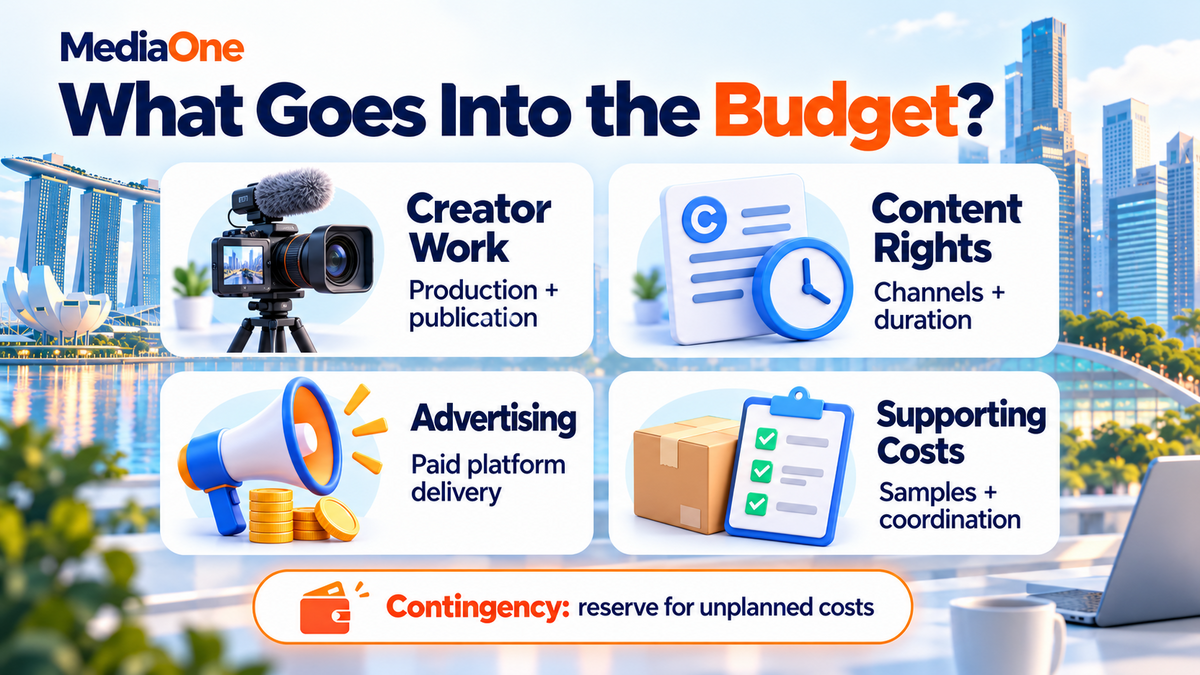
What Should the Total Budget Include?
The following example shows how a hypothetical S$6,000 budget could be recorded. These figures illustrate budgeting; they are not Singapore market rates.
| Budget item | Illustrative amount |
| Creator production and publication | S$2,400 |
| Paid usage rights | S$600 |
| Advertising spend | S$1,800 |
| Product samples, delivery and production support | S$500 |
| Coordination and reporting | S$400 |
| Contingency | S$300 |
| Total | S$6,000 |
A contingency covers unplanned costs; it does not need to be spent. Final reporting should use actual expenses.
An Instagram advertising budget covers platform delivery. Creator fees buy the agreed work. Separate budget lines show whether a higher bill came from more production, longer usage or additional paid reach. The invoice should also identify management fees.
How Can You Control Costs?
A smaller initial scope can reveal whether the working relationship and content deliver what the business needs.
A proposal might cover one demonstration, specified edits and a limited advertising licence. A later agreement can extend successful content where permission allows.
Exclusivity deserves particular attention. A restriction covering every food brand could cost more than one covering a named competing product category. The restriction should match the commercial need.
What Should the Campaign Brief and Agreement Include?
A brief explains the work. An agreement records the commitments and permissions. Both should be settled before production starts.
What Belongs in the Brief?
A concise brief should cover:
- Objective: the business result the campaign supports.
- Audience: the people, locations and needs the content addresses.
- Product facts: accurate features, prices and availability.
- Deliverables: formats, lengths, publication dates and required versions.
- Message: the main point and supporting evidence.
- Action: the page, booking step or purchase option viewers should reach.
- Responsibilities: who approves content, answers questions and supplies reporting.
Specific calls to action connect the content to a practical next step. “Book a table” suits a restaurant reservation page; “See sizes and delivery options” suits a product page.
A creator cannot compensate for a broken booking form or an unavailable product. Those checks belong in campaign preparation.
What Permissions Does the Business Need?
Payment for production does not automatically transfer copyright. IPOS explains that copyright ownership generally remains with the creator, including commissioned work, subject to the agreement and applicable exceptions.
The agreement should specify:
- Permitted uses: creator publication, brand reposting, advertising, website or email.
- Duration and territory: how long and where each use is allowed.
- Editing rights: whether the brand can crop, subtitle or shorten content.
- Advertising access: the account or post permissions required.
- Expiry arrangements: what happens to live advertisements and retained copies.
A licence permits agreed uses while ownership remains with the rights holder. Buying ownership and licensing content are different arrangements.
Platform authorisation also needs to cover the planned advertising period. A written content licence does not activate the platform permissions by itself.
What Else Prevents Disputes?
The agreement should record payment timing, included revisions, cancellation terms and the deadline for performance data.
A product delay may require a new posting date. A factual error may require a correction. Named contacts and an agreed response process help both parties handle those situations.
How Should Influencer Ads Be Disclosed in Singapore?
Sponsored content should identify the commercial relationship so viewers can recognise the promotion.
Singapore’s ASAS social media disclosure provisions cover paid messages, sponsored mentions and solicited reviews involving products or services supplied at the client’s expense. A cash payment is not the only arrangement that can require disclosure.
Where Should the Disclosure Appear?
ASAS says disclosure should appear as early as reasonably possible. Image disclosures can appear in the picture or caption; video disclosures should appear visibly within the video, including when viewers watch without sound.
Practical checks include:
- Images: sponsorship wording appears where viewers can notice it.
- Videos: readable disclosure appears within the content.
- Audio: listeners hear the commercial disclosure.
- Platform tools: the creator activates the relevant disclosure setting.
A long caption ending with a hidden sponsorship tag is a poor way to communicate the relationship.
The Singapore Government’s explanation of sponsored content standards describes ASAS as an industry self-regulatory body. Its code should not be described as legislation.
YouTube also requires creators to identify commercial relationships through its paid promotion disclosure setting. Platform labels and local disclosure responsibilities need attention together.
What About Claims and Music?
Product statements should match evidence the business can support. A creator’s personal experience cannot establish a promise that every buyer will achieve the same result.
Music rights also matter. TikTok’s Commercial Music Library provides tracks for commercial content, with region and placement filters. Permission for TikTok use does not establish permission to reuse the same soundtrack elsewhere.
How Do You Measure Influencer Ad Results?
Measurement should show what the campaign achieved against its original goal. A large view count cannot answer every business question.
Which Metrics Match the Objective?
| Objective | Main measures | Additional context |
| Awareness | Reach and frequency | Relevant audience location and video viewing |
| Consideration | Product page visits and meaningful engagement | Questions, saves and demonstration viewing |
| Leads | Qualified enquiries and cost per qualified lead | Bookings and later sales |
| Sales | Attributed orders and cost per customer | Discounts, returns and contribution profit |
| Content production | Approved assets delivered | Production cost and later advertising performance |
A qualified enquiry meets the business’s agreed requirements. For a service company, that could mean an enquiry from the service area for work the company actually provides.
What Does Each Interaction Cost?
Cost per interaction divides the relevant campaign cost by recorded interactions. The calculation should state which expenses and interactions it includes.
For example, a hypothetical S$600 sponsored post generating 800 interactions costs S$0.75 per interaction. A S$1,200 post generating 1,000 interactions costs S$1.20 per interaction.
The first post has the lower interaction cost. That does not establish which generated more profit. Comments, saves and shares represent different behaviours, and one person may interact more than once. Comparable calculations need the same cost basis, reporting period and interaction types. Paid promotion should also be identified so the team knows whether advertising helped generate those interactions.
How Do Tracking Links and Codes Help?
A separate link for each creator helps identify website visits. Google Analytics supports campaign tracking with UTM parameters, which label details such as the traffic source, campaign and content version.
Consistent labels make GA4 channel reporting easier to interpret. Creator names and campaign identifiers belong in the tracking plan before publication.
What Can Attribution Tell You?
A promo code adds another signal, but customers may share it or forget to enter it. Some viewers buy later through another channel. Tracked sales therefore represent attributed activity, not proof that every purchase happened because of the creator.
Campaign reports should explain the attribution window: the period during which a platform credits an advertisement with a result. Different windows can produce different totals.
What Is the Difference Between ROAS and ROI?
Return on ad spend, or ROAS, compares attributed revenue with advertising spend. The calculation does not subtract product costs or creator fees.
Return on investment, or ROI, asks whether the campaign generated profit after its relevant costs.
A hypothetical campaign illustrates the difference:
| Item | Illustrative amount |
| Attributed revenue after discounts and returns | S$18,000 |
| Product and other variable delivery costs | S$9,000 |
| Contribution before campaign costs | S$9,000 |
| Total campaign costs, including creators and advertising | S$6,000 |
| Contribution after campaign costs | S$3,000 |
Campaign ROI = contribution after campaign costs ÷ total campaign costs × 100
In this example, S3,000dividedbyS6,000 gives a campaign ROI of 50%.
This calculation shows contribution after campaign costs, before any additional overheads or taxes. It also depends on the attribution assumptions. A revenue-to-cost ratio alone should not be labelled profit or ROI.
When Should You Review Results?
Early checks can catch broken links, missing disclosures or advertising delivery problems. Performance decisions need enough data to reflect the campaign’s objective and buying cycle.
A low-cost purchase may generate orders quickly. A renovation enquiry may take longer to become a signed contract. Fourteen days cannot serve as a universal deadline for both.
A reporting schedule should include:
- Launch checks: content, links, prices and permissions work as intended.
- An agreed interim review: delivery and spending are compared with the plan.
- A final assessment: the attribution period has ended and available cancellations or returns are included.
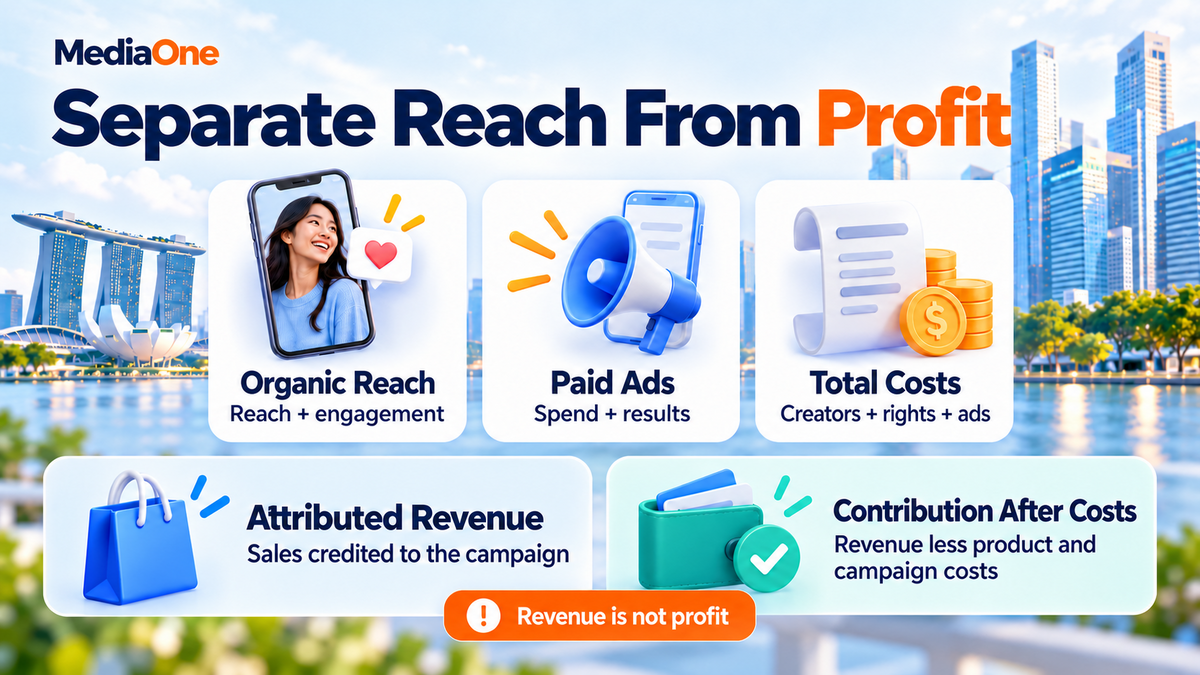
Unpaid creator performance and paid advertising results should appear separately. Otherwise, purchased reach can make the original post look stronger than it was.
What Should You Change When Results Disappoint?
The next action depends on where people stop.
| Campaign symptom | What to investigate |
| Relevant people rarely see the content | Audience data and paid targeting |
| Viewers leave early | Opening, pace and product demonstration |
| People click but do not buy | Price, delivery charges, stock and checkout |
| Enquiries produce few customers | Lead quality and sales follow-up |
| Sales rise but profit remains weak | Margins, discounts and total campaign costs |
A weak result does not automatically mean the creator failed. The advertisement, offer and destination page all influence what happens next.
Planning Influencer Ads Around Business Results
Influencer ads need a campaign structure that connects creative work with commercial decisions. Your team should know what it is buying, how the content may be used and which results justify another investment.
An initial campaign can establish a working baseline for future partnerships. The next brief can then build on actual audience response, production experience and costs.
For businesses that need help coordinating the work, MediaOne’s influencer marketing services cover creator discovery, campaign management and performance tracking. A starting brief should explain the product, target customers and business objective so the proposed work has a defined purpose.
Frequently Asked Questions
Can a B2B company run influencer ads?
Yes. A business audience may respond to a specialist who explains an industry problem or demonstrates professional software. The creator’s subject knowledge and access to relevant decision-makers matter. A large general audience offers little value if viewers have no role in buying the service.
Can a brand work with a creator who has never used its product?
Yes, but the creator needs an opportunity to try it before describing personal experience. A demonstration can explain observable features without claiming long-term results. The content should distinguish what the creator has tested from information supplied by the brand.
Should a creator promise a fixed number of sales?
A sales guarantee deserves scrutiny because the creator cannot control stock, checkout, delivery or customer demand. An agreement can define deliverables and performance-related payments. It should also explain how sales are counted and which conditions affect payment.
How should a brand handle negative comments under an influencer ad?
A named team member should answer factual questions and genuine complaints. The creator can flag issues that need the business’s response. Polite criticism can stay visible; abusive content or exposed personal information can be handled under an agreed moderation policy.
Can an employee appear alongside the creator?
Yes. A founder, product specialist or staff member can answer detailed questions while the creator demonstrates the product. Each person needs a distinct role. For example, a chef can explain ingredients while a food creator describes the meal from a customer’s perspective.