| AI Summary
Singapore businesses can outsource generative engine optimisation, or GEO, through a one-off audit, a short project or an ongoing agency contract. The right scope depends on who can fix website issues, write accurate content and check AI answers after publication. This guide explains how to set a budget, compare proposals, test what an agency reports and decide whether to renew after 90 days. |
To outsource GEO services, list the questions buyers ask, choose the AI platforms you want to monitor and give shortlisted agencies the same brief. Compare who will make website changes, how each agency measures mentions and citations, what the fee covers and which reports you keep when the work ends.
Key Takeaways
- The lowest quote may cover fewer tasks. A monitoring report, a rewritten service page and a technical fix are three separate pieces of work.
- A brand mention and a citation tell you different things. The first shows whether the answer names you. The second shows which page the answer links to as a source.
- Your staff still have a role. Sales teams supply buyer questions, service leads check the facts and someone inside the business approves website changes.
- A 90-day review gives you a decision point. By then, you can compare the work delivered with the starting plan and decide which tasks deserve more budget.
Ask an AI assistant to recommend a supplier in your industry. Does your business appear? If it does, would you recognise the company it describes? An answer that lists a service you stopped offering two years ago gives you a very different job from an answer that leaves your company out of a shortlist.
Generative engine optimisation, or GEO, gives your team a way to study those gaps and improve the information buyers can find. An outside agency can help with the work. Before you hire one, it helps to know which jobs need outside support and how you will judge the results.
What Does It Mean to Outsource GEO Services?
When you outsource GEO services, you hire an outside team to review and improve how your business appears in AI-generated answers. The agency may test buyer questions, find inaccurate descriptions, improve web pages and check whether AI answers link to those pages over time. Here, GEO means generative engine optimisation. Geospatial services, such as digital mapping, are a separate purchase.
The work overlaps with search engine optimisation. A service page that search engines can find, and that explains who the service is for, can serve people arriving from either traditional search or an AI answer. The distinction between AEO and GEO helps when you set goals. Your team might want a direct answer to a common question, a source link inside an AI response or more appearances in supplier comparisons. Each calls for a different check.
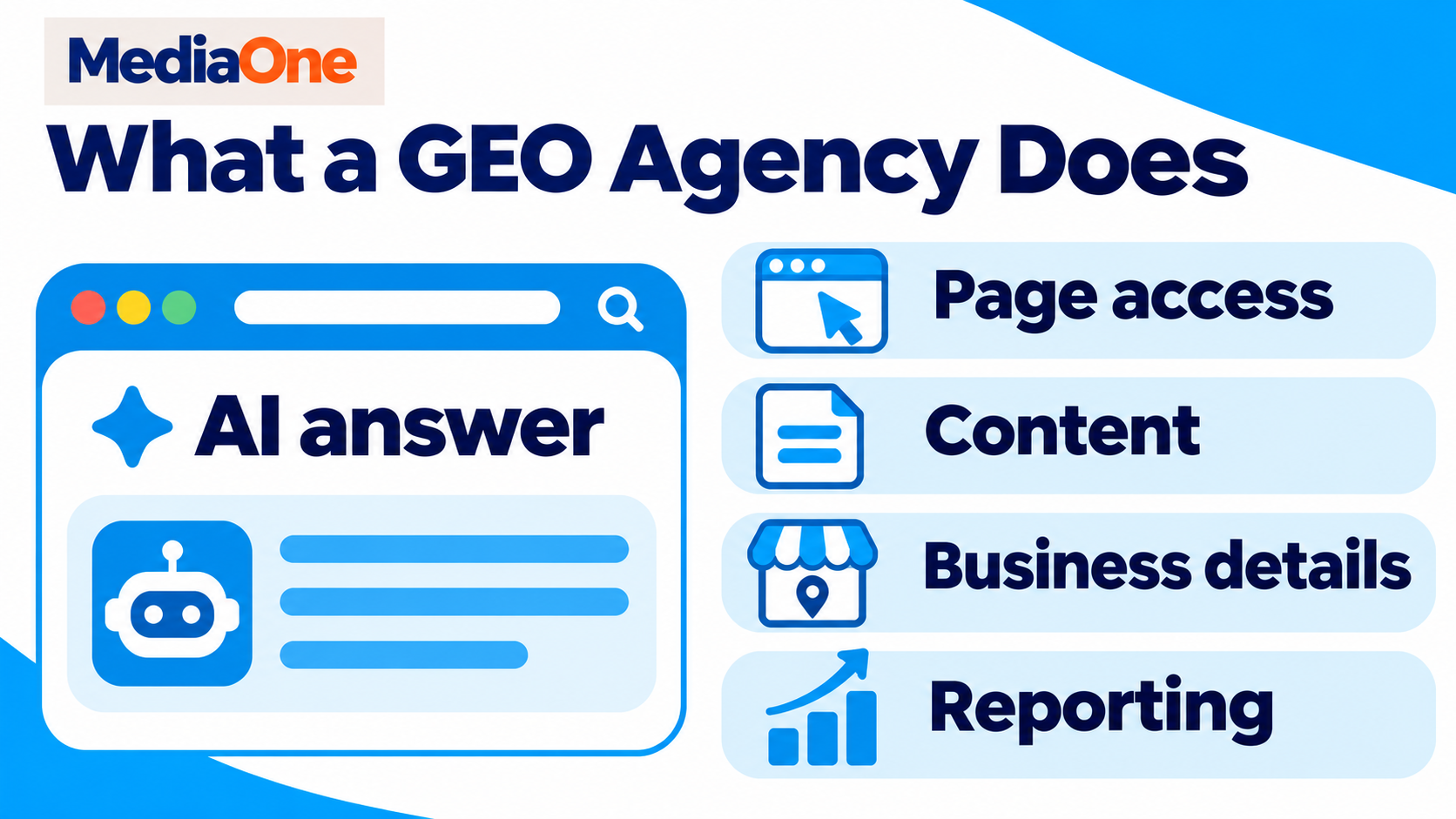
What can a GEO agency deliver?
| Work | What the agency does | What your team should receive |
| AI visibility audit | Tests buyer questions and checks the answers for mentions, citations and mistakes | A dated record of questions, answers and sources |
| Technical review | Checks whether important pages can be accessed and found | A list of affected URLs, issues, priorities and owners |
| Content improvements | Updates service pages or creates material that answers buyer questions | Published pages or approved drafts, as specified in the quote |
| Business information review | Compares service details across your website and relevant public sources | A list of conflicting details and corrections made or requested |
| Reporting | Repeats agreed tests and reviews available traffic and enquiry data | A report that separates the work completed from the results observed |
When Should a Singapore Business Hire a GEO Agency?
Outside support can help when your team has a specific problem and lacks the time or skills to fix it. A commercial cleaning company, for example, might find that AI answers name it for office cleaning but miss its warehouse service. If the website only mentions warehouses in a brochure, the first job may be to publish a service page that explains what the company handles and how it serves Singapore buyers.
A different business might have strong service pages and a developer who can update them. It may only need help testing questions and interpreting the answers. The amount of work you outsource should follow the gap you need to close.
Audit, pilot or monthly contract?
| Engagement | When it makes sense | What to agree before signing |
| One-off audit | Your team can make changes but needs to know what to tackle first | The pages, platforms and markets covered, plus the format of the handover |
| Short pilot | One service or group of buyers gives you a manageable place to start | The starting measures, pages to update and date for the review |
| Monthly contract | Several services need regular testing, content updates and technical work | The monthly workload, review dates, extra fees and exit terms |
A short pilot is easier to assess when the business already knows its priority service. A Singapore IT support firm, for instance, might focus on buyers comparing managed support for small offices. A pilot can cover that service and the questions around it before the firm spends money on unrelated topics such as cloud migration or software procurement.
When a site rebuild is already planned, the agency and web team should share a list of priority pages before launch. That gives both teams time to agree which URLs to keep, which pages need better information and who checks them after launch. It also gives the business one list of work to fund.
What Should a GEO Brief Include?
The brief should tell agencies who your buyers are, what they ask and what your business wants to learn. A page or two is enough if it contains the details a provider needs to price the work. Every agency on the shortlist should receive the same version.
Buyer questions and the Singapore market
Sales calls, enquiry forms and support emails can reveal how people describe a problem before they know the name of the service. Those phrases can inform keyword research and give the GEO team better questions to test. A buyer asking about overnight warehouse cleaning has different needs from someone asking about a weekly office visit.
The brief should name the market, languages and buyer groups the agency will cover. A Singapore headquarters may buy for local premises, while a regional procurement team may need a provider that serves multiple countries. If the contract includes testing both groups, the results should identify which group each question represents.
- Business scope. The services, locations and customer groups the agency should cover.
- Buyer questions. Examples from discovery, comparison and supplier checks.
- Platforms. The AI search products the agency will test and how often.
- Staff and access. Who can approve facts, publish changes and share reports.
- Decision date. When the business will assess the work and choose what to fund next.
An example brief for a local supplier
A Singapore commercial cleaning company wants more enquiries from warehouse managers. It asks agencies to test questions about after-hours work, service coverage and how buyers compare suppliers. It can share examples of enquiries with personal details removed. Its operations manager can check service claims, and its web team can publish approved updates.
That brief gives an agency enough information to propose a starting scope. The agency can price a review of the warehouse service page, tests of buyer questions and changes to a small group of pages. The business can then compare that quote with another agency’s offer line by line.
How Do You Compare GEO Agencies and Proposals?
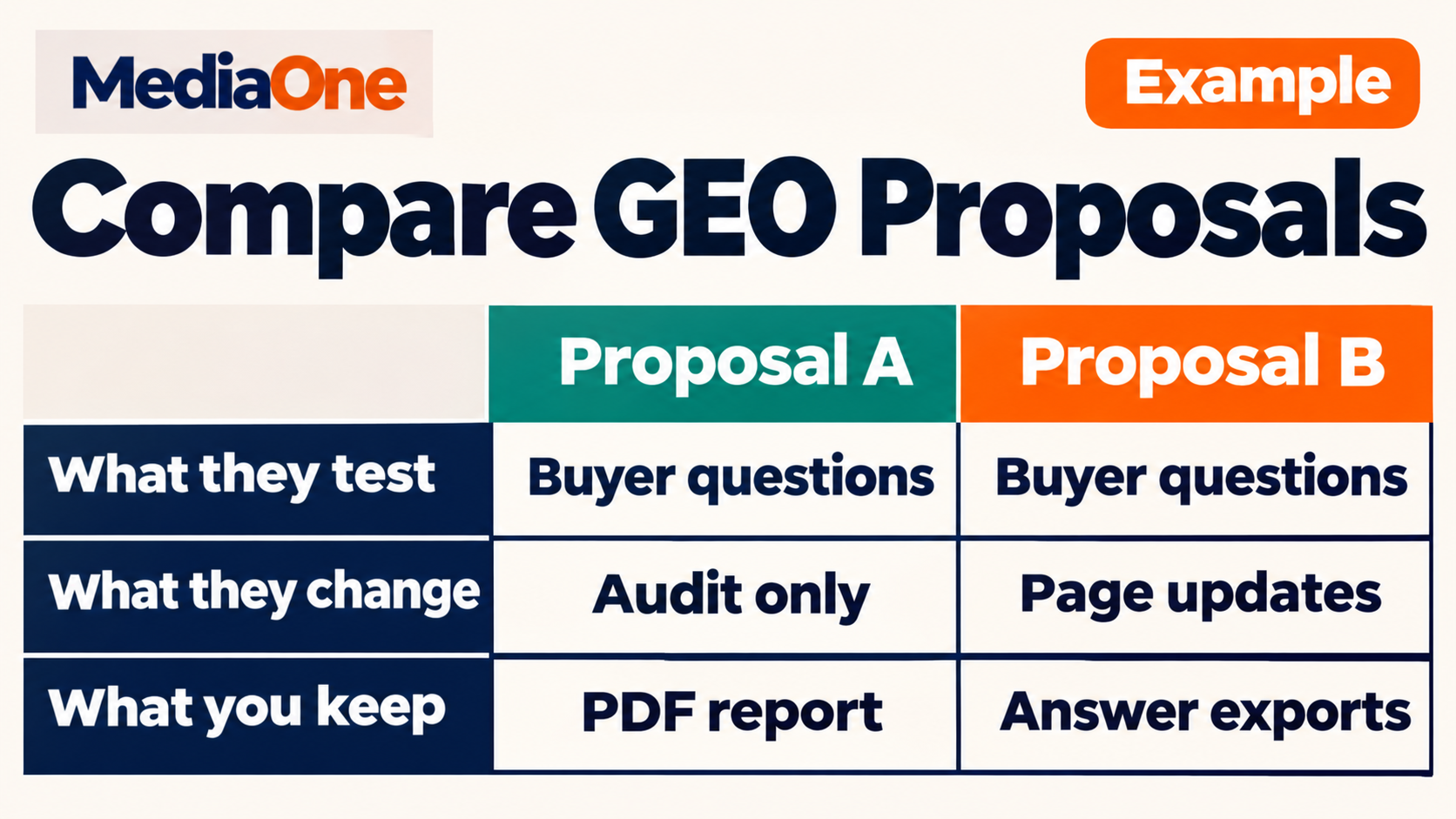
A GEO proposal should explain what the agency will test, what it will change and who will do the work. The first meeting is a chance to ask for a sample report and see whether the people presenting it can explain the figures without relying on a slide deck.
Evidence from the first meeting
A good sample report shows the original question, the AI answer, the date, the platform and any linked sources. It should also show how the agency marks an incorrect description. If the provider has permission to share a case study, ask what changed on the website and what else the client was doing during that period.
A traditional SEO case study can show how a team handles web content or technical work. Evidence for GEO should show the AI answers or citations the agency measured. ChatGPT’s web search can include links to sources, and OpenAI says it cannot guarantee top placement. MediaOne’s own review of ChatGPT recommendations and GEO also explores what buyers should examine before paying for a promise of visibility.
The contract behind the proposal
The scope should name who tests the answers, writes the pages and handles technical changes. If a proposal says it includes four page updates, the quote should explain whether the agency will write, publish and check all four pages. Your team should also know what it needs to supply and what happens if approvals take longer than planned.
Google’s AI search optimisation documentation gives buyers a way to assess claims about special files, markup and mass-produced pages. Its web search spam policies also help you assess proposals to publish many similar pages or pay for links intended to influence rankings. A provider should be able to explain what each proposed change does for a reader or for access to the page.
A GEO proposal scorecard
Each item can receive 0 if the proposal leaves it out, 1 if the agency describes it and 2 if the agency shows evidence or commits to it in writing. The score helps you compare offers. A low score on a task you need can carry more weight than the total.
| Area | Evidence to look for |
| Buyer research | Sample questions based on your services and market |
| Starting report | A dated example with answers, source links and errors |
| Technical work | A named person responsible for fixes and checks |
| Content delivery | Pages, publishing responsibilities and approval rounds |
| Measurement | Definitions, testing schedule and sample exports |
| Fees | Setup costs, recurring fees, exclusions and extra charges |
| Handover | Ownership of copy, account access and report exports |
How Much Do Outsourced GEO Services Cost?
The cost depends on the number of services, languages, pages and AI platforms in the brief. It also depends on who makes the changes. Two monthly quotes can look similar until you see that one covers testing and reports, while the other includes writing and technical work. An itemised quote in Singapore dollars gives you a better basis for comparison than a headline fee.
The agency should separate one-off costs from recurring costs. It should also say whether the quote includes GST where applicable, how long the agreement runs and which tasks cost extra. That makes it easier to compare a short project with a monthly contract.
An example of comparing two GEO quotes
Suppose Agency A quotes S$1,500 per month for testing and reporting. Your business expects to spend another S$900 per month on writing and development to act on its findings. Agency B quotes S$2,300 per month for testing, agreed page updates and technical checks. These are fictional figures for comparison.
| Cost | Agency A | Agency B |
| Monthly agency fee | S$1,500 | S$2,300 |
| Separate monthly writing and development | S$900 | Included for agreed tasks |
| Estimated monthly total | S$2,400 | S$2,300 |
| Estimated three-month total | S$7,200 | S$6,900 |
Agency B costs S$300 less over three months in this example. That difference only holds if its quote covers the updates the business expects. If the firm already has staff available to write and publish the pages, Agency A may be the less expensive choice. Staff hours still belong in the comparison because those hours come out of other work.
What can add to the fee?
- Additional markets or languages. More questions to test and, in some cases, separate writing and review.
- New pages or original research. Time to interview staff, gather evidence and produce material.
- Developer work. Repairs beyond the pages or tasks named in the agreement.
- Extra review rounds. Revisions after the rounds included in the quote.
- Tool fees. Separate charges for dashboard access, testing or exports.
How Should a GEO Agency Measure Results?
The agency should record what appears in AI answers and what people do after they reach your site. Each tells you something different. A business can gain citations for a service page and still see few enquiries if the page leaves out a detail buyers need before contacting a supplier.
Mentions, citations and recommendations
| Measure | What it tells you | Example |
| Mention | The answer names your business | An answer lists your company among Singapore providers |
| Citation | The answer links to a page as a source | The answer links to your checklist on cleaning requirements |
| Recommendation | The answer puts your business forward for a specific need | It suggests your company to a warehouse manager who needs weekend coverage |
| Accuracy | The answer describes your business correctly | The response lists the right service areas and hours |
The report should give you the count behind each percentage. If your company appeared in 8 of 40 recorded answers, the mention rate was 20% for those tests. If it later appeared in 12 of the same 40 tests, that would be 30%, a rise of 10 percentage points. The figures describe the tested questions and conditions. They cannot tell you how often every real customer sees your company.
A fair before-and-after comparison
The agency should repeat the same core set of questions under comparable conditions. A report should name the platform, dates, market and language used, plus the number of attempts. If the agency adds questions about a new service, it can show those results separately so the new tests do not change the original comparison.
Screenshots help when an answer changes or disappears. A table with answer captures can be even easier to review. Your team can see which answers improved, where a competitor appeared and which pages the platform cited. This gives the agency specific pages and questions to investigate at the next review.
Traffic and enquiries
The GA4 traffic acquisition report can show how tracked visits reached your site. Your analyst can check visits attributed to an AI source when that source is identifiable, then see whether those visits led to tracked actions such as an enquiry form submission. A short question on the form can capture another part of the buyer’s story, especially when the person first saw the business in an AI answer and later visited the site directly.
For Google, AI Overviews and AI Mode follow Google Search’s eligibility rules. Teams should check what their Search Console property reports before making promises about the detail they can measure. A test of selected answers, a platform report and a sales lead record capture different events. Showing them separately makes the monthly report easier to interpret.
What Should Happen in the First 90 Days?
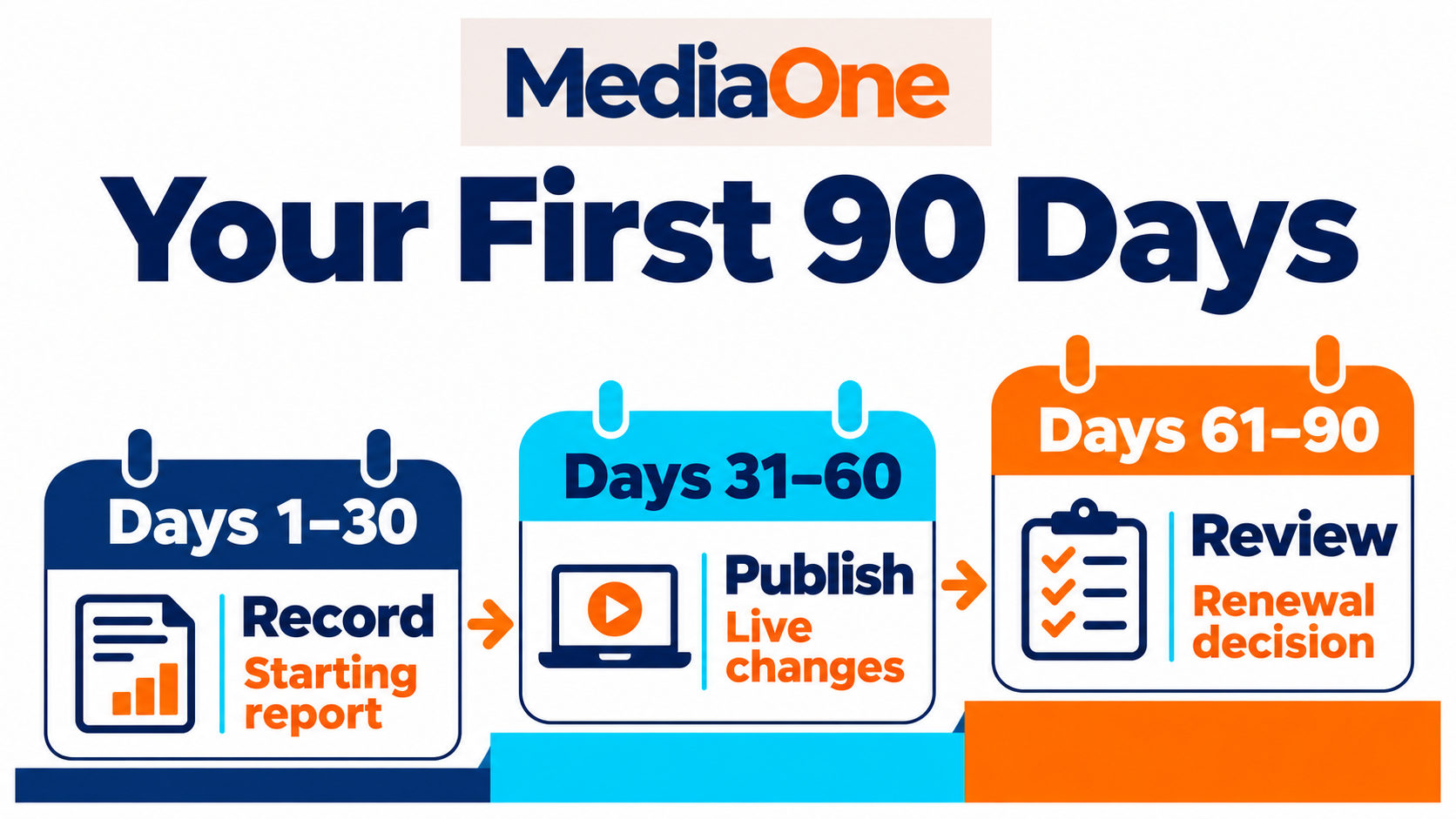
The first 90 days should give both teams enough time to record the starting point, deliver the first changes and check what happened next. The schedule below is an example for a short project. Technical access, publishing approvals and the size of the website can change the timing.
Days 1 to 30: Record the starting point
The agency should agree on buyer questions, record answers and inspect the pages that explain your main services. Google’s URL Inspection tool can help the web team check individual pages and see what Google reports about indexing. OpenAI’s crawler documentation distinguishes OAI-SearchBot, which supports ChatGPT search, from GPTBot, which serves a separate purpose. The agency and site owner can use those details when reviewing access settings.
Days 31 to 60: Publish the first changes
The second month should focus on the work that addresses the most important gaps. A warehouse cleaning page might gain service hours, a list of premises the business serves and a brief explanation of how quotes are prepared. The agency’s work log should show which pages changed and when each change went live.
If another supplier manages the website, the GEO team should send that supplier the exact page addresses, draft copy and checks needed after publishing. Your service lead can review the wording in one batch. That reduces the chance that a factual correction gets lost between two teams.
Days 61 to 90: Review the work and decide what comes next
The agency should rerun the agreed tests and compare the answers with the starting report. The review can cover completed work, errors that persist, changes in citations and early enquiry signals. If a key page went live near the end of the pilot, record the date and give that page its own follow-up check.
- Continue when the agency delivered the agreed work and can explain the next set of priorities.
- Narrow the scope when a smaller group of services or buyer questions shows a better reason to keep testing.
- Pause when your team needs to resolve publishing, access or service information problems first.
Choosing a GEO Partner Your Team Can Work With
A GEO partner should be able to take a buyer question, show what AI search returns today and explain which changes your business can make. When two proposals look similar, the most telling difference may be who owns the work between the audit and the next report. That is where writing, website updates and approvals can add time or cost.
For businesses comparing MediaOne’s GEO services with other offers, the same brief can anchor each meeting. Our team can discuss your priority services, the questions your buyers ask and the work your team can handle internally. A GEO enquiry to MediaOne can start with one service page and a few real buyer questions.
FAQs About Outsourcing GEO Services
Can an agency run GEO for a business without a website?
An agency can assess how the business appears in AI answers and review public information such as directory profiles. A website gives the business a place to publish its own service details, policies and examples. The proposal should specify which public pages the agency can update and who controls them.
Can GEO support a new service before it launches?
Yes. The agency can study how buyers describe the service, see what sources appear in current answers and prepare pages for launch. A pre-launch review gives you a record of the market before your own page goes live. It can also help the sales team prepare answers to questions that are likely to come up.
Should our agency test from personal ChatGPT accounts?
A provider should explain what account settings it uses and whether prior chats or personalisation could affect the test. A standard setup helps compare results over time. Tests from staff or customers can provide additional examples when the report identifies them as separate observations.
Who should handle an inaccurate AI answer about our company?
One person inside the business should own the facts, while the agency can trace the claim to any sources shown. If the incorrect detail appears on a page your company controls, your team can fix it there. For a third-party listing, the next step may be a correction request to the publisher. The agency can then log the request and check later answers for the same error.
Can a company outsource GEO and keep its existing SEO agency?
Yes. The two providers can work together if the contract spells out who edits pages, who handles technical changes and where both teams record their work. A shared change log helps them connect website updates to their reports and reduces duplicate work.
What happens to reporting when the GEO contract ends?
The contract should identify what your business receives at handover. Typical items to request include the question list, dated answer records, approved copy and a list of published changes. If the dashboard belongs to the agency, an export can give your next team a starting point for future checks.