| AI Summary
Instagram advertising cost in Singapore depends on the auction, campaign goal, audience, ad content and customer response. A spending plan should connect clicks and enquiries to sales the business can afford to acquire. Cost per click and cost per thousand impressions explain delivery, while cost per qualified lead or purchase explains commercial performance. The examples below use Singapore dollars for planning, with advertising, production and management counted separately. Actual campaign results provide the basis for budget decisions. |
Instagram advertising cost has no fixed Singapore price list. A business chooses its budget, while competition and Meta’s delivery system influence how much exposure and how many results that money buys. The same S$1,000 can produce different outcomes for a neighbourhood café, an online skincare shop and a software company.

Singapore advertisers usually want two answers: whether their costs are reasonable and what to change when results disappoint. Both depend on what happens after someone sees or clicks the ad. An inexpensive click has limited value when the visitor never buys.
The sections below explain the main cost measures, show planning examples and connect common symptoms with checks that can identify wasted spending. Every campaign figure presented as an example is hypothetical, not a Singapore market average or a promised result.
Key Takeaways
- Comparisons need matching objectives, currencies, placements and reporting periods.
- Click totals can include actions that never send someone to the website.
- Small budgets lose value when teams divide them among too many tests.
- Retargeting needs enough eligible people; a fixed spending share can exhaust a small audience.
- Campaign revenue needs a margin check before anyone calls the result profitable.
Why One Average Cannot Price Your Campaign
A published average describes the campaigns in its sample. Its value depends on who supplied the data, which countries it covers and what the advertisers wanted to achieve. A global traffic benchmark cannot establish the expected cost of a Singapore purchase campaign.
The currency also needs attention. A dollar symbol may mean US dollars, Singapore dollars or another currency. Conversion alone does not turn an overseas average into local evidence because competition, buying behaviour and the sampled businesses also differ.
A dependable comparison includes:
- Geography and currency.
- Collection dates and sample details.
- Campaign objective and conversion definition.
- Placement and ad format.
- Click type, including whether it measures website visits.
The strongest starting comparison is often the business’s own recent results for a similar offer. A coordinated Instagram marketing strategy helps connect those paid results with the profile, content and customer conversations supporting them.
An established campaign can supply a baseline. A new business needs an initial test and a spending limit that it can afford without relying on immediate sales.
How Instagram Ad Pricing Works
The Auction Considers More Than the Bid
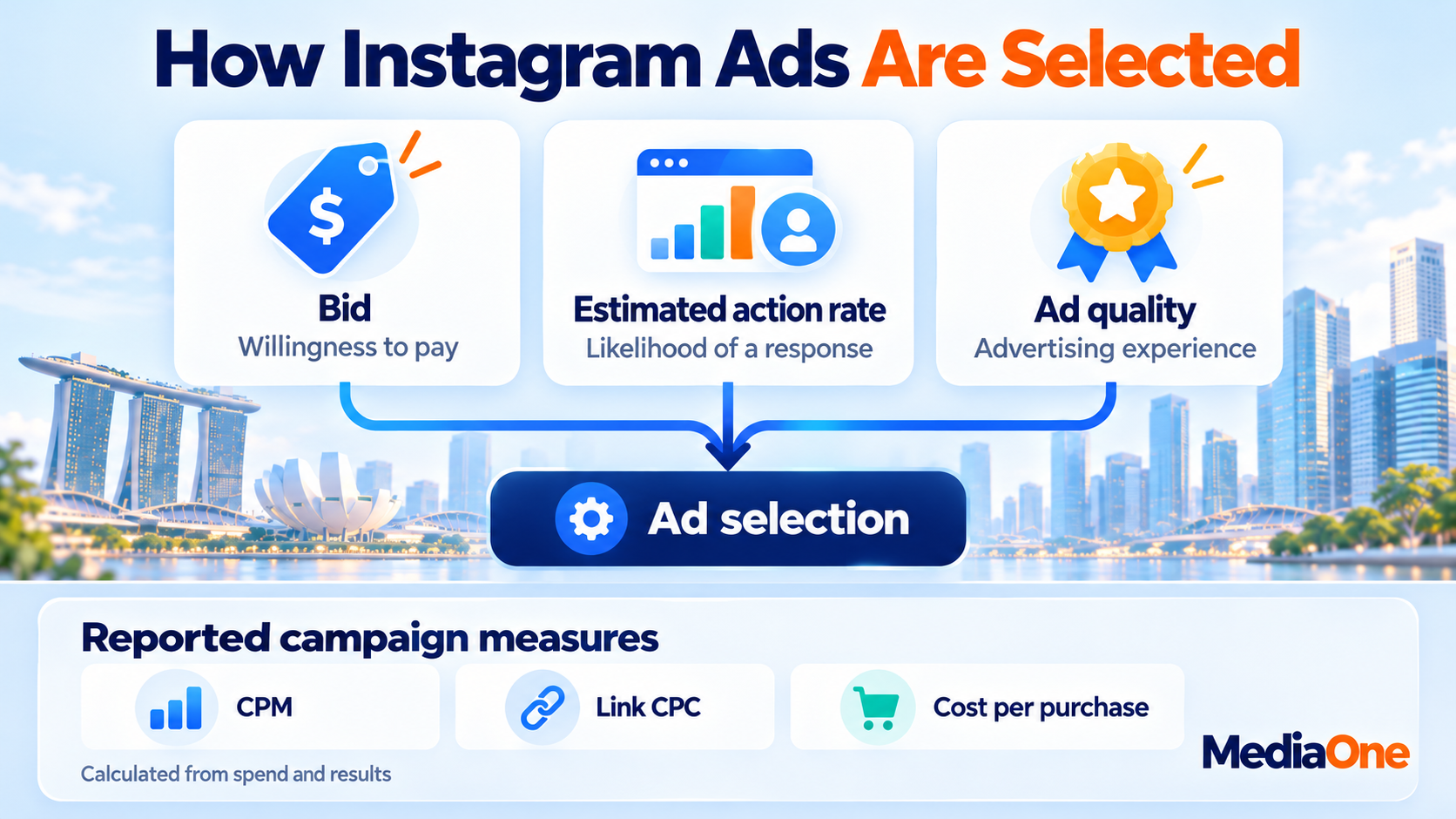
Meta uses auctions to decide which eligible ad appears when an advertising opportunity becomes available. Its published explanation of ad auction value identifies three components: the advertiser’s bid, the estimated likelihood of the desired action and ad quality.
The bid expresses what the advertiser is willing to pay under the selected bidding approach. The estimated action rate predicts the likelihood of a response, such as a purchase. Ad quality includes signals about the advertising experience.
Two businesses can therefore reach different people and achieve different costs despite setting the same budget. Stronger creative can help performance, but it does not guarantee a particular auction price or sales result.

The Reporting Metric Is Different From the Billing Rule
Cost per click describes spending divided by clicks. Its appearance in a report does not automatically mean Meta charges the campaign only when someone clicks.
The billing event and delivery settings determine how charges arise. The reporting columns show what the spending produced. A sales campaign can display CPM, CPC and cost per purchase together because each calculation describes the same campaign from a different angle.
Campaign Setup Affects What the System Seeks
A traffic campaign seeks visits or related traffic outcomes, while a sales campaign seeks purchase-related outcomes under its chosen settings. A cheaper traffic campaign may attract people who click readily but rarely buy.
Meta’s explanation of its ad ranking systems describes how engagement information helps determine which ads people see. The practical lesson is to select an outcome that represents the business goal and supply dependable measurement.
New campaigns also need observation time. Early results can fluctuate, and major edits can disrupt delivery. A few clicks cannot establish whether an offer works, although broken links and incorrect targeting need immediate correction.
Ads Manager provides detailed campaign settings and reporting. Promoting an existing post offers a simpler setup with fewer options. Both approaches include controls, so the choice should reflect the measurement and testing the campaign needs.
The account structure has three main levels. A campaign holds the overall objective. An ad set groups delivery settings such as the audience, placements and schedule. An ad contains the image or video, wording and destination. Budgets can sit at different levels depending on the setup. These distinctions help explain why changing one audience can affect several ads within the same ad set.
Instagram Ad Cost Benchmarks for Singapore Budget Planning
The Main Cost Measures
Campaign reports become easier to interpret when every measure has one purpose.
| Measure | Calculation | What it explains |
| CPM | Ad spend ÷ impressions × 1,000 | Cost of 1,000 ad displays |
| Link CTR | Link clicks ÷ impressions × 100 | Share of displays producing a link click |
| Link CPC | Ad spend ÷ link clicks | Average cost of a link click |
| CPL | Ad spend ÷ leads | Cost of each recorded enquiry |
| Cost per purchase | Ad spend ÷ purchases | Advertising cost of each recorded purchase |
Impressions count displays, including repeated displays to the same person. Reach counts people or accounts reached under the platform’s reporting definition. Neither figure measures sales.
The click definition also changes the comparison. All-click figures can include interactions within the platform. Outbound clicks focus on movement away from Meta’s platforms, while landing-page views indicate that the destination page loaded. A report should name the version it uses.
Example Costs Without an Unsupported Local Average
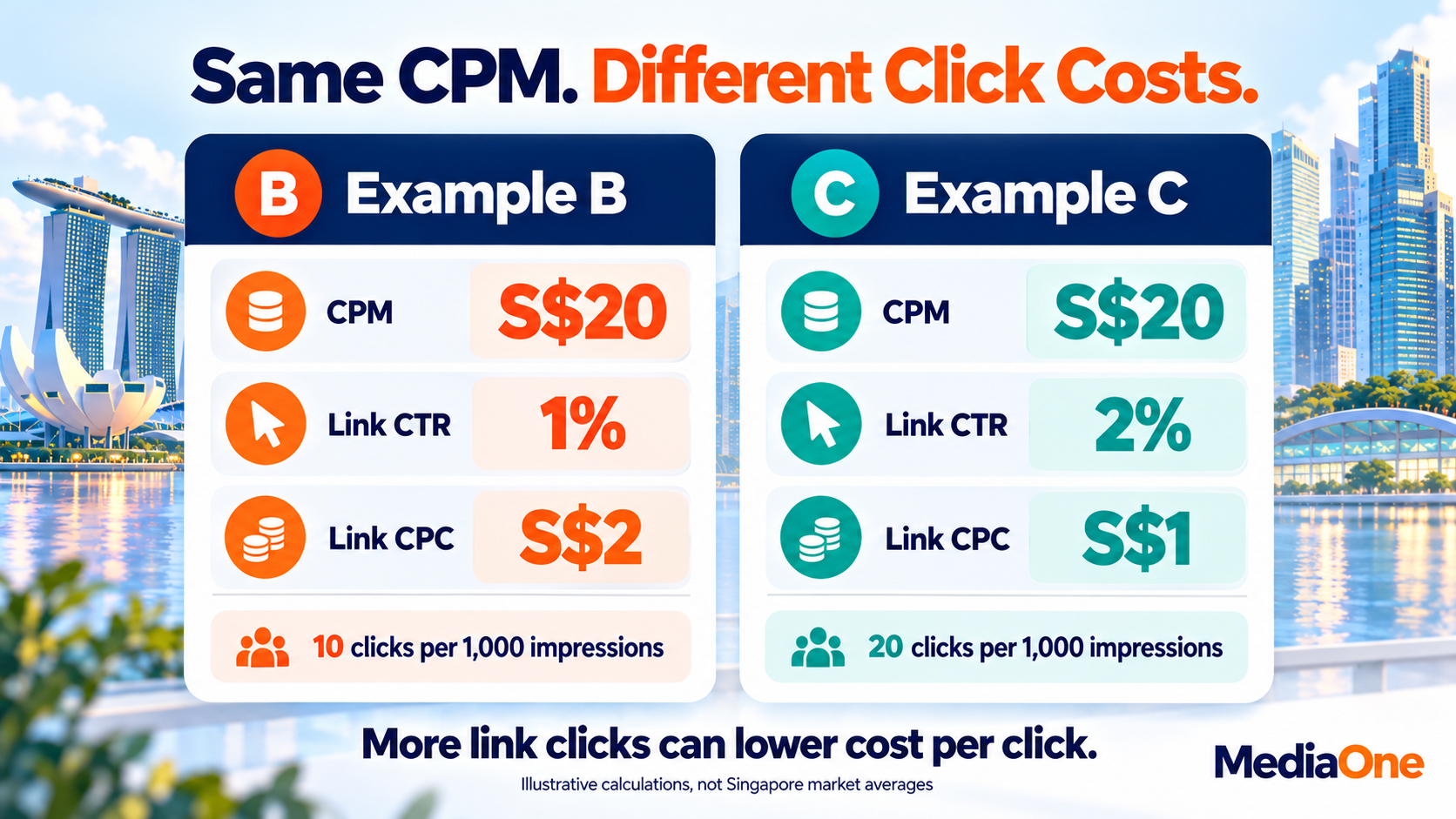
The table shows how CPM and link CTR combine to produce link CPC. These figures are illustrative calculations in Singapore dollars, not measured Singapore benchmarks.
| Example | CPM | Link CTR | Link clicks per 1,000 impressions | Link CPC |
| A | S$10 | 1% | 10 | S$1.00 |
| B | S$20 | 1% | 10 | S$2.00 |
| C | S$20 | 2% | 20 | S$1.00 |
| D | S$30 | 2% | 20 | S$1.50 |
Examples A and C produce the same CPC despite different CPMs. Example D buys more expensive exposure than B but achieves a lower CPC because more displays produce clicks.
The relationship explains why CPM alone cannot identify a poor campaign. Customer outcomes still need a separate calculation: a SGD 1 click with a 1% click-to-purchase rate produces a SGD 100 advertising cost per purchase.
A Business Benchmark Starts With Affordable Acquisition
A shop that can allocate SGD 25 to advertising for each purchase needs a campaign below that limit over a meaningful period. A campaign costing SGD 15 per purchase may support expansion; one costing SGD 40 needs investigation.
The S$25 ceiling must come from the shop’s economics. Product costs, fulfilment, returns and the required profit affect how much remains available for acquisition.
With an affordable purchase cost of SGD 25 and an assumed click-to-purchase rate of 2%, the implied maximum CPC is SGD 0.50. The calculation is SGD 25 × 0.02. A SGD 1 CPC would need a 4% click-to-purchase rate to reach the same purchase cost. These assumptions identify what the ad and destination must achieve. They cannot predict whether the campaign will achieve it.
For service businesses, lead generation campaigns need a qualification step. A completed form and an enquiry from someone ready to buy have different commercial value.
How to Diagnose High Instagram Ad Costs
The cost diagnosis starts with reliable reporting, then follows the journey from ad display to customer. Each measure suggests possible explanations; none proves the cause on its own.
Reporting Checks Come First
The comparison needs the same date range, objective, click definition and conversion rules. A combined Facebook and Instagram campaign also needs a platform breakdown before anyone describes its blended costs as Instagram results.
Missing or duplicate purchase records can distort cost per result. A test enquiry or test order helps confirm that the intended action reaches the reporting system once.
CPM Shows the Cost of Exposure
A rising CPM means the campaign pays more for the same number of displays. Competition, audience restrictions, placement mix and delivery changes can contribute.
A narrow audience is one possible explanation. A higher CPM can also be acceptable when the people reached buy at a stronger rate. The next check is whether customer acquisition costs rose alongside it.
CTR and CPC Show the Response to the Ad
A falling link CTR with similar CPM can indicate declining interest in the message. The audience, offer and creative all deserve attention.
A product demonstration might attract a stronger response than another product photograph. An opening line that explains who the product helps can also change the audience response. A test should compare one main change at a time.
Conversion and Lead Quality Explain What Happens Next
Healthy click figures with weak sales can point to a mismatch between the ad and its destination. Slow pages, unexpected delivery fees, unavailable stock and difficult forms are possible causes.
Website design affects this experience through mobile layouts, readable product details and straightforward checkout or enquiry steps.
| Symptom | Possible explanation | First check |
| Rising CPM, stable purchase cost | More expensive exposure reaches stronger buyers | Purchase quality and margin |
| Stable CPM, falling link CTR | Message loses attention or audience response changes | Creative and offer |
| Many clicks, few page loads | Slow destination or accidental clicks | Page speed and mobile loading |
| Page visits, few enquiries | Offer, form or trust information causes friction | Page and form completion |
| Cheap leads, few sales | Low qualification or weak follow-up | Lead records and sales feedback |
In a hypothetical skincare campaign, SGD 600 buys 300 website clicks and six purchases. Advertising cost per purchase is SGD 100. A page revision that produces 12 purchases from the same spending and traffic would reduce that figure to S$50. Actual testing must establish whether the revision caused the improvement.
Instagram Ad Budgets and Minimum Spend
The Platform Minimum Is Different From a Test Budget
An accepted budget allows a campaign to run. It does not establish that the spending will produce enough purchases to judge performance.
Meta’s minimum requirements depend on campaign settings and account conditions. The budget validation shown during setup is the relevant check. A universal Singapore-dollar minimum would give readers false precision.
The test budget should instead reflect the likely cost of the outcome and the evidence needed for a decision. A campaign expecting leads to cost SGD 50 each cannot reliably assess lead quality from a total test budget of SGD 50.
An initial forecast can divide the proposed budget by the assumed cost per result. SGD 1,500 divided by SGD 50 gives an estimated 30 leads. That volume is a planning estimate, not a guarantee or a platform learning requirement. If half those leads meet the business’s qualification rules, the same spending produces 15 qualified leads at S$100 each. The forecast should preserve that distinction when the team decides what it can afford.
Example Monthly Spending Plans
These amounts illustrate different testing scopes. They are not business-size benchmarks, recommended minimums or agency quotations. Daily equivalents assume a 30-day month and do not promise identical daily delivery.
| Monthly media budget | Daily equivalent | Example scope |
| S$600 | S$20 | One offer and a small creative test |
| S$1,500 | S$50 | A focused campaign with more creative comparisons |
| S$3,000 | S$100 | More conversion evidence or a second controlled test |
| S$6,000 | S$200 | Additional offers or audiences when results support expansion |
Company size alone cannot determine the budget. A small company selling expensive equipment may need more spending per enquiry than a larger retailer selling familiar products.
A social media advertising strategy connects spending with the desired sale, available creative and the team’s ability to respond to customers.

A S$1,000 Allocation Needs a Reason
A business might reserve SGD 800 for reaching new people and SGD 200 for retargeting existing visitors. That split is only a planning example.
Retargeting means advertising to eligible people who have already interacted with the business. A small visitor audience may not support the reserved amount without excessive repetition. More spending can remain with the main campaign until audience size and results justify another allocation.
The number of simultaneous tests also affects learning. Ten ad sets sharing S$1,000 may each collect too little evidence. One offer with several distinct creative ideas provides a more focused starting test.
A review plan should name the loss limit before launch. The business might schedule checks for technical errors immediately and commercial performance after a defined spending amount and sales follow-up period. That distinction prevents a slow sales process from being mistaken for a failed ad, while keeping the experiment within an affordable budget.
Production and Management Belong in the Total
An illustrative campaign could include SGD 1,000 in media spend, SGD 300 in production and SGD 400 in management. Total campaign cost would be SGD 1,700 before applicable taxes or other charges.
At 20 purchases, media-only cost per purchase would be SGD 50. The campaign cost per purchase, including those additional expenses, would be SGD 85.
A quotation should identify the amount paid to Meta separately from work such as design, filming, reporting and page changes. Different social media marketing services include different work, so identical headline fees may buy different deliverables.
Factors That Affect Costs and How to Reduce Them
Audience Restrictions and Campaign Goals
Targeting should reflect people the business can actually serve. A local café needs geographic limits, while a retailer delivering islandwide may have room to test a wider audience.
Extra interests and demographic restrictions can limit delivery without improving customer quality. A controlled comparison can show whether those restrictions earn their place. Location, eligibility and service limits remain necessary even when broader targeting performs well.
The chosen goal also needs consistency. A campaign designed to attract enquiries should not be declared successful solely because it produced inexpensive video views.
Creative Quality and Repeated Exposure
Meta’s advertising principles explain why relevance forms part of the advertising experience. A message that answers a real customer concern gives people a reason to respond.
A skincare ad could demonstrate texture, show packaging size or answer a delivery question. Each idea tests a different reason to buy. Small colour changes alone may leave the main weakness untouched.
Repeated exposure deserves context. Frequency describes average displays per person reached. Rising frequency alongside falling response can indicate that the same audience has seen the message too often, but frequency has no universal failure threshold.
Placements and Production Choices
Feed, Stories and Reels present content differently. Vertical video needs readable captions and room around important text so interface elements do not cover it. A square image may need a separate composition for a vertical placement.
Placement reports reveal differences, but a low CPC alone does not justify moving the entire budget. Purchase rates, lead quality and the amount of available evidence also belong in the decision.
Seasonality and Testing Discipline
Shopping events, festive promotions and changes in customer demand can affect results. The same offer may face different competition or attract different buyers across periods.
A test log helps separate these effects from deliberate changes. The record can include the date, creative, audience, offer, spending and result. One successful weekend needs more evidence before it becomes a permanent spending rule.
An increase also needs its own review. Suppose the first S$1,000 produces 20 purchases, while an additional S$500 produces five more. The average cost per purchase becomes S$60 across the full campaign, but each additional purchase costs S$100.

The total average hides the weaker return on the extra spending. Further increases need to account for that recent cost.
How to Measure Advertising Returns
Return on ad spend, or ROAS, divides attributed revenue by advertising spend. Revenue of S$3,000 from S$1,000 in ads produces 3 times ROAS. That figure does not establish profit. The business must also cover product or service delivery costs and the rest of the campaign. The following hypothetical calculation keeps those amounts separate.
| Item | Amount |
| Revenue attributed to advertising | S$3,000 |
| Direct product and fulfilment costs | S$1,500 |
| Advertising spend | S$1,000 |
| Production and management | S$400 |
| Amount remaining before overheads, tax and other costs | S$100 |
A campaign with attractive ROAS can therefore leave little money after costs. Refunds, cancelled orders and repeat-customer purchases can also affect the commercial assessment.

Repeat purchases can change the calculation, but future revenue needs evidence. A shop with established reorder records can assess the contribution from later purchases over a defined period. A new advertiser should avoid treating hoped-for repeat orders as money already earned. Discounts used to acquire the first order also reduce what remains available to pay for advertising.
The reporting period needs to reflect the buying process. A service enquiry received this month may become a customer later. A campaign report can show current enquiry costs alongside later sales outcomes, with dates attached, so the team does not confuse unfinished conversations with completed revenue.
Lead campaigns need another step: cost per qualified lead and the share becoming customers. A S$20 enquiry that never meets the service requirements provides less value than a S$60 enquiry that becomes a profitable customer.

Consistent campaign URL parameters help identify advertising traffic in Google Analytics. These labels record information such as source and campaign name. Sales records then show which enquiries or orders became completed business.
An attribution model determines how reporting assigns credit across customer interactions. Reported revenue indicates credited results; an experiment is needed to estimate how many sales advertising added beyond what would otherwise have happened.
Instagram Compared With Facebook, TikTok and Google Ads
The decision should reflect how customers discover and buy the offer. No platform is automatically the cheapest for every business or objective.
| Platform | Example role | Cost consideration |
| Product demonstrations, visual discovery and customer enquiries | Creative production and purchase quality | |
| Feed advertising, local offers and broader Meta campaigns | Platform breakdown and customer acquisition cost | |
| TikTok | Short video demonstrations and discovery | Video output, audience response and budget requirements |
| Google Search | Reaching people actively searching for a product or service | Search demand, click costs and conversion |
TikTok’s budget requirements apply to its own campaign setup. A Meta spending plan cannot simply transfer across without checking those rules and the production involved.
Google Search ads connect advertisements with relevant searches. A person searching for an urgent repair has a different immediate need from someone discovering a product while browsing Instagram.
A Google Ads campaign may complement Instagram when search demand exists. A combined digital marketing plan should assign each channel a role and assess completed sales without counting the same revenue twice.
Turning Instagram Advertising Cost Into a Spending Plan
The next campaign needs a written outcome, a spending ceiling and a defined review period. A short brief can state the offer, intended buyer, campaign budget and customer acquisition limit before launch.
The review should identify one change supported by the evidence: a new message, a page correction, a different audience test or a controlled budget increase. The team can then record the result and decide whether further spending remains affordable.
Businesses with active campaigns can bring their reports and sales figures to a paid media campaign consultation. That conversation can connect the next spending decision with the campaign’s actual results.
Frequently Asked Questions
Do Instagram Ads Require a Large Follower Count?
Paid delivery can reach people who do not follow the account. A large following is therefore unnecessary as a starting budget requirement. The profile still needs accurate business details and content that helps potential customers understand the offer when they investigate the advertiser.
Can a Business Pause Advertising Without Deleting Its Instagram Posts?
A business can pause paid delivery without deleting its ordinary profile posts. An existing post used in advertising can remain visible organically. Paid reach stops when the relevant advertising stops, subject to delivery and reporting updates.
Does a Higher Budget Guarantee That an Ad Will Run?
A higher budget cannot resolve an account restriction, rejected ad, failed payment or unavailable destination. Campaign status and account notifications identify these delivery problems. Additional spending becomes relevant after the campaign is eligible and functioning.
Is an Influencer Payment the Same as Instagram Advertising Spend?
An influencer payment covers agreed work or rights from a creator. Instagram media spend pays for advertising delivery. A campaign using creator content in paid ads can involve both charges. The agreement should identify the content rights and separate the creator’s payment from the media budget.