AI Summary

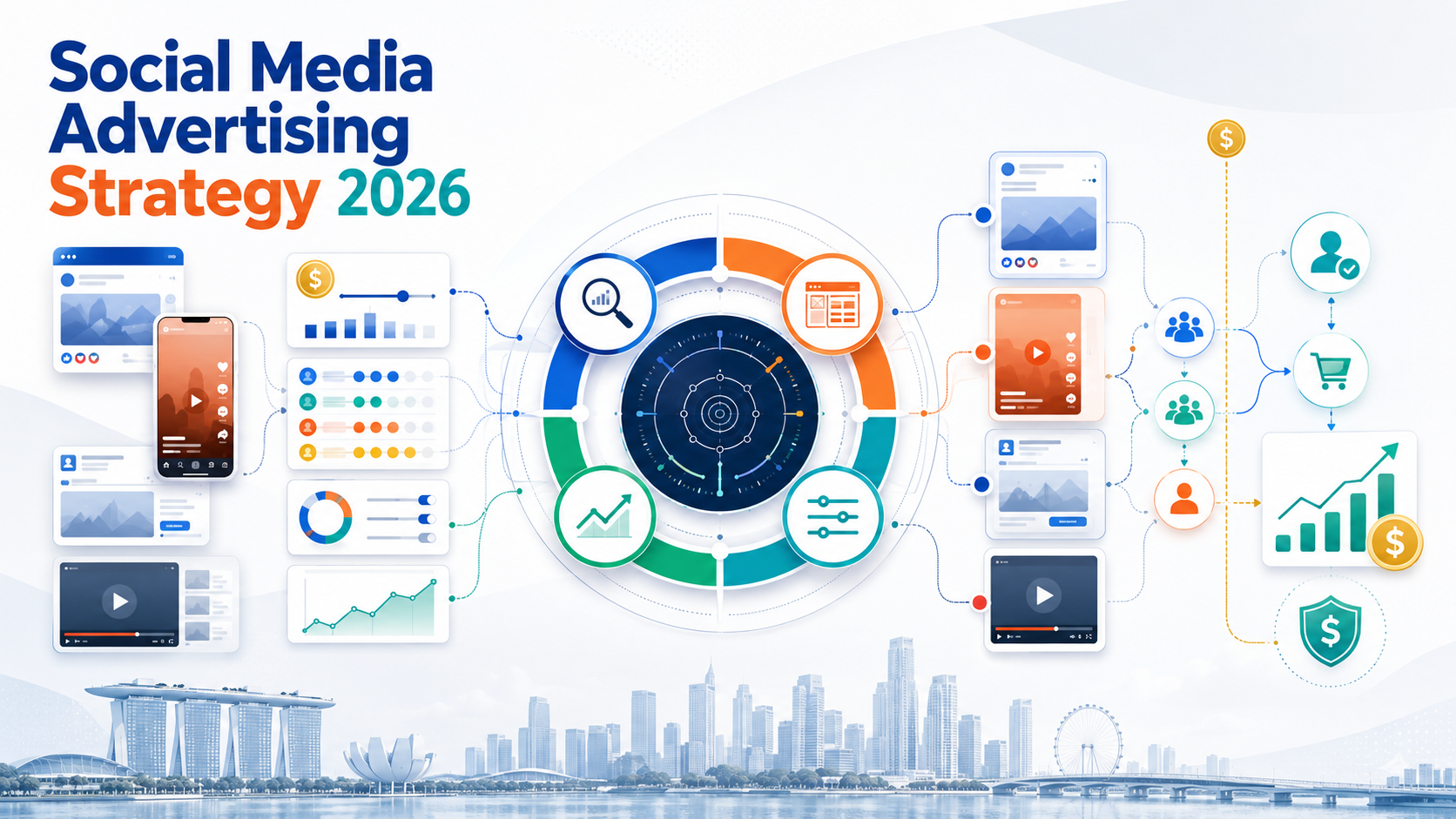
A strong social media advertising strategy in Singapore starts with the highest cost per qualified lead or customer the business can afford, not with audiences or platform settings. Meta, TikTok and LinkedIn now automate more of the targeting, so results depend more on the offer, the creative, and the quality of the conversion data sent back to the platform. We use a four-stage framework: Diagnose the acquisition economics, Architect the offer before the audience, Optimise from a clear diagnosis, and Scale only when marginal CPA and sales feedback confirm the gains. We also recommend choosing platforms by the sale you need, funding enough conversions to learn from, and checking platform ROAS against analytics, CRM and finance records. Singapore advertisers should also follow PDPA and DNC rules when handling customer data.
Start with the highest cost your business can accept for a qualified lead or customer. Then choose the deepest reliable conversion event. We recommend this order because cheap clicks and low-cost form fills can hide weak sales quality.
Platform automation has made that discipline even more important in 2026. Meta uses AI across its Advantage+ campaign tools. TikTok now gives advertisers full, partial, or manual control in its upgraded Smart+ setup. Meanwhile, LinkedIn has moved Accelerate features into Classic campaigns.
Platforms do not know your true profit limit or which leads your sales team can close. That judgement belongs to the business.
Key Takeaways
- Set the financial limit first. Calculate the highest CPA or CPL that protects your target contribution margin.
- Optimise for business progress. A qualified lead, completed sale, or retained customer carries better information than a click.
- Test the offer before building extra audiences. Strong targeting cannot rescue a vague promise or a weak reason to act.
- Give automation useful inputs. Supply clear conversion data, varied creative, sensible location controls, and enough budget to learn.
- Check platform reporting against sales records. Analytics, CRM data, refunds, and gross profit can expose results that Ads Manager misses.
- Scale from recent acquisition cost. The campaign average can hide weaker returns from the latest increase in spend.
Social Advertising Changed in 2026

Paid social media once placed heavy weight on manual audience construction. Advertisers created detailed interest groups, lookalikes, exclusions, and narrow ad sets.
Current platform tools give algorithms wider control. Meta says Advantage+ audience can search beyond audience suggestions while respecting strict controls such as age, location, language, and exclusions.
TikTok’s August 2026 Smart+ update unified automated and manual campaign creation for supported objectives. Advertisers can select full automation, partial automation, or manual control across major campaign inputs.
LinkedIn changed its campaign structure on 4 August 2026. Accelerate stopped operating as a separate campaign type, while its main creation features moved into Classic campaigns.
These changes shift our focus to the offer and creative. Conversion signals, landing pages, and acquisition costs also need close attention. We still apply firm controls for geographic, regulatory, eligibility, or commercial limits.
With a limited budget, a Singapore SME can learn more from three strong creative ideas than twelve similar ad sets. Extra complexity should earn its place.
Our Four-Stage Social Media Advertising Framework
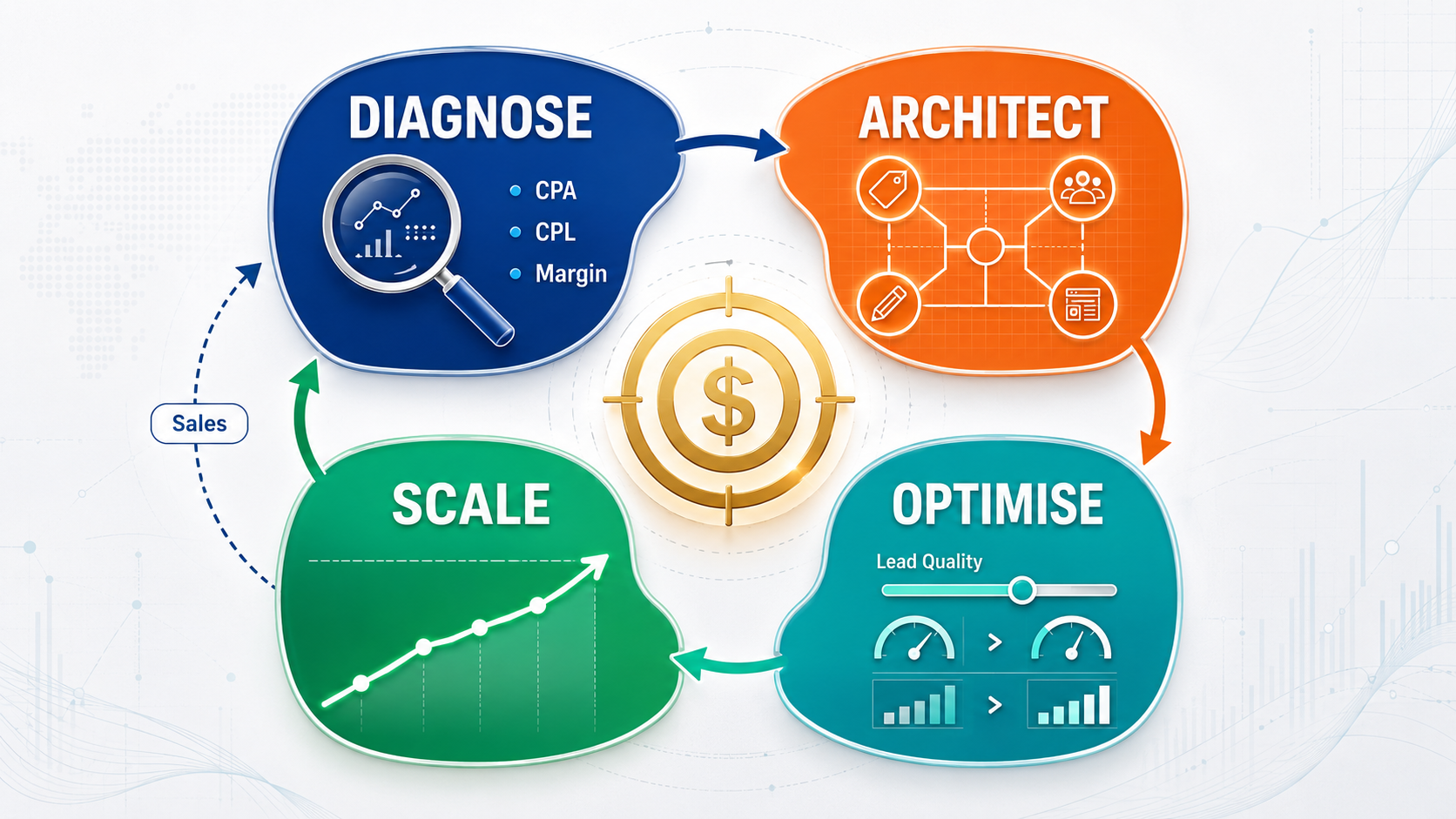
We use Diagnose, Architect, Optimise and Scale to give campaign decisions a practical order. Our social media marketing framework moves from auditing into funnel design, testing, performance refinement, and controlled expansion.
1. Diagnose the acquisition economics
We first calculate what the business can afford to pay for a customer. Revenue alone gives a misleading answer because gross margin, fulfilment cost, refunds, repeat purchases, and sales conversion affect the acquisition limit.
Consider a Singapore professional service selling a SGD 1,200 package with a 50 per cent gross margin. Gross profit equals SGD 600. If one in five qualified leads becomes a customer, each qualified lead carries SGD 120 in expected gross profit before advertising and fixed costs.
Suppose the business wants to retain SGD 60 before fixed costs. Its working CPL ceiling becomes SGD 60. A reported CPL of SGD 45 can still fail if half the enquiries never meet the qualification rules.

We then trace the signal from the ad click to the final revenue record. Our audit checks the landing page, conversion event, CRM stage, sales outcome, cancellations, and refunds. This reveals where the platform receives misleading data.
2. Architect the offer before the audience
Detailed targeting cannot fix a weak offer. We first define the customer problem and commercial promise. Then we choose the proof and next action before building audiences.
A software company might test time saved, fewer errors, faster reporting, or stronger compliance confidence.
We would not change every input at once. The first test should tell us which promise attracts qualified demand. Later rounds can test hooks, proof, formats, and landing-page treatments around that winning idea.
3. Optimise from a clear diagnosis
Campaign teams often react to a falling result by changing the audience, bid, ad, CTA, and page together. The account may improve, but nobody learns which change caused the result. That weakens the next decision.
We connect each symptom with a likely cause. Falling CTR with stable conversion can indicate creative fatigue. Stable CTR with falling conversion can point to landing-page friction, lower-quality traffic, or offer fatigue.
Sales feedback can change the diagnosis again. A falling CPL looks positive until the sales team reports that fewer leads meet the buying criteria. We treat lead quality as part of campaign performance, not a separate sales problem.
4. Scale after the evidence becomes credible
One strong week does not justify a large budget increase. We look for stable economics, enough conversion volume, repeatable creative patterns, and confirmation from sales.
Marginal CPA gives us a sharper view than the account average. A campaign may show an average CPA of SGD 50 while the latest SGD 2,000 in spend acquires customers at SGD 90. The total average hides the decline created by the added budget.
At that point, we would pause the increase and find the constraint. The next action may involve new creative, a stronger offer, a broader source of demand, or a different channel.
Choose the Platform From the Sale You Need
The largest audience does not automatically produce the best customers. We choose the platform from the buying context, creative fit, and acceptable acquisition cost.
| Platform | We would use it when | Main risk |
| Meta | The business needs broad consumer reach, ecommerce sales, local leads, or retargeting. | Weak conversion signals can direct spend towards easy but low-value actions. |
| TikTok | The offer works in short-form video, and the team can produce fresh native creative regularly. | A small creative supply can fatigue before the campaign finds stable economics. |
| Customer value supports a higher acquisition cost, and professional attributes help qualify buyers. | Low-cost form fills can still produce poor pipeline quality. | |
| YouTube | The product benefits from explanation, demonstration, repeated exposure, or video-led discovery. | Testing becomes expensive when every concept needs polished production. |
For smaller budgets, we usually choose one primary platform and one controlled secondary test. Splitting SGD 3,000 across five networks can leave every campaign short of useful conversion evidence.
Businesses that want paid and organic activity managed under one plan can review our social media marketing services in Singapore. Brands planning a Meta-led campaign can also explore our Facebook marketing services.
Build the Budget From the Acquisition Model
We do not recommend a fixed starting budget based only on company size. A SGD 5,000 monthly budget can exceed the useful audience for one offer yet fail to generate enough conversions for another.
We use four inputs to set an initial range.
- Target acquisition cost. Set the highest cost that still protects the economics of the sale.
- Expected conversion rate. Use historical data when available. Do not base the plan on an optimistic forecast.
- Learning volume. Fund enough conversions to compare the main offers and creative concepts.
- Creative capacity. Match media spend with the team’s ability to produce fresh ads.
Suppose an ecommerce brand can afford a SGD 30 CPA. The team wants 50 purchases before it makes a larger budget decision. An initial media budget of about SGD 1,500 fits that planning assumption if CPA lands near target.
That figure is not a performance promise. It connects the budget with the evidence the team wants to buy.
Creative Now Carries Part of the Targeting Job
When automated systems search broadly, the ad itself helps filter attention. A video about accounting software speaks to a wide market. A video that opens with “Still reconciling five Singapore outlets in spreadsheets every Friday?” identifies a precise operating problem.
For the first creative batch, we would test distinct ideas before minor visual changes. One ad could lead to a costly problem. Another could show the desired result. A third might use customer proof, while a fourth answers a common buying objection.
Once one idea attracts a stronger, qualified response, we test its format. Our guide to KOL marketing for ecommerce growth explains how creator fit affects commercial results.
Send Platforms Deeper Conversion Signals

Paid social cannot optimise towards information it never receives. We want conversion events to represent business progress, not convenient clicks.
For lead generation, the form submission may start the record. The CRM should then capture qualification, booked consultation, proposal, and sale. Meta’s Conversions API for CRM can send lead outcomes back to Meta and help its systems optimise lead campaigns from deeper sales data.
The same principle applies to ecommerce. Platform purchase data needs context from cancelled orders, refunds, gross margin, and new-customer share. A strong reported ROAS can weaken after those costs enter the calculation.
Singapore advertisers need clear personal-data controls. PDPC requires organisations to state why they collect, use, or disclose personal data. The PDPA also covers consent, access, protection, retention, and data transfers.
We would not share customer lists through informal spreadsheets. What we do is first confirm who can access the data and why. Then, we also check retention, security, and consent rules.
Promotional calls and texts to Singapore numbers may fall under DNC rules. Check the DNC registers unless valid consent or an applicable exception allows the message.

Treat Platform ROAS as One View of Performance
We compare three views. The ad platform reports attributed conversions. Analytics records site behaviour, while CRM and finance records show which users became customers and how much revenue the business kept.
The figures will not always agree. The gaps can reveal duplicated attribution, missing tracking, long sales cycles, repeat customers, cancellations, or channels that assisted a sale without receiving final-click credit.
For larger campaigns, incrementality tests can ask a harder question. TikTok’s Conversion Lift Study uses test and control groups to estimate additional conversions caused by advertising. This differs from standard attribution, which assigns credit after an ad interaction.
We do not scale from platform ROAS alone. Retargeting can report attractive returns by reaching people who were already close to buying. New-customer share, gross profit, qualified lead rate, and incremental sales give us stronger evidence.
MediaOne Campaign Evidence Shows Why Context Beats Benchmarks
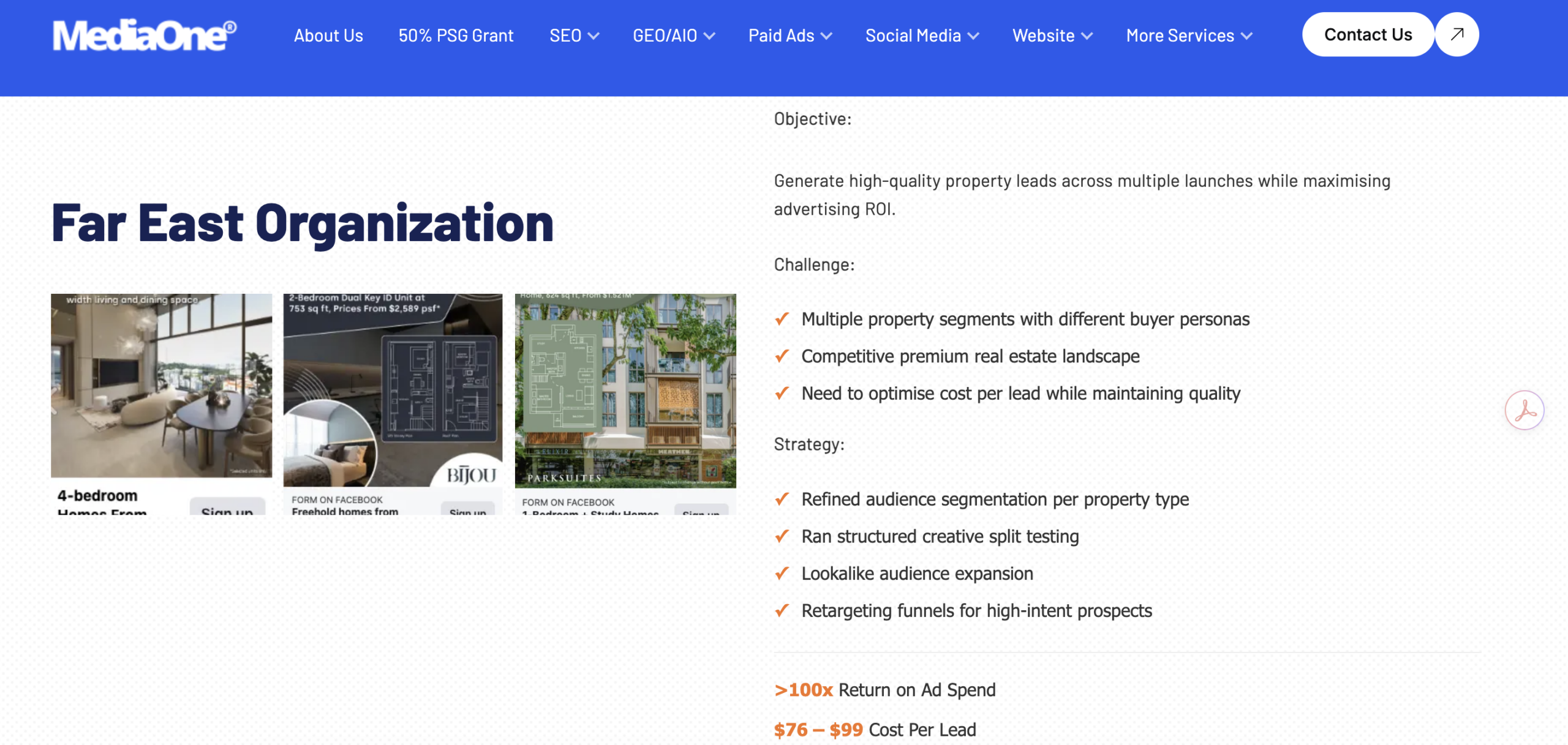
Our published Far East Organisation case study used audience segmentation by property type, structured creative split testing, lookalike expansion, and retargeting funnels. We reported over 100 times ROAS and a CPL range of SGD 76 to SGD 99 for that property campaign.
We would not turn those figures into a target for another advertiser. Property value, lead intent, sales follow-up, and attribution can produce very different economics in another sector.
The useful lesson sits in the method. The KPI must fit the campaign’s job, sales funnel, and unit economics. A benchmark without that context can push a team towards the wrong decision.
Five Mistakes We Would Fix Before Adding Spend
- Optimising for the easiest event. Cheap traffic may look efficient when the business needs qualified leads or sales. Choose the deepest conversion event that has reliable data.
- Changing campaigns too quickly. Frequent edits destroy the evidence needed to judge a test. Make a change after the data identifies a likely weakness.
- Using one ad at every buyer stage. Cold prospects may need a clear reason to care. Warmer prospects often need proof or an objection answered.
- Calling every lead a success. Marketing and sales should agree on qualification rules before launch. A low CPL has little value when sales cannot convert the enquiries.
- Spreading a small budget too widely. Concentrated spend often produces clearer learning. Add another channel after the first has a repeatable offer and dependable measurement.
Decide What To Fix Before You Increase Spend
Choose the next action from the weakest part of the campaign. Fix tracking first when sales outcomes never return to the ad account.
Test the offer when several audiences ignore the same message. Refresh creative when attention falls, but post-click conversion stays stable. Scale only when recent spend still produces qualified customers inside the financial limit.
Our Diagnose, Architect, Optimise and Scale framework gives those decisions a clear order. Businesses with active campaigns but unclear results can book our paid media campaign consultation so we can identify the tracking, funnel, creative, or budget constraint before the next increase in spend.
Frequently Asked Questions
A social media advertising strategy defines the commercial goal, target customer, platform choice, offer, creative testing plan, budget, tracking, and performance rules for paid campaigns. We use it to decide what to test, what to stop, and when added spend still makes financial sense.
No single platform suits every Singapore business. We often choose Meta for consumer and ecommerce campaigns, LinkedIn for high-value B2B offers, TikTok for creative-led discovery, and YouTube when the sale benefits from explanation or repeated video exposure.
Start with the maximum CPA or CPL the business can afford. Then fund enough conversions to judge the test with useful evidence. A SGD 1,500 test may fit a SGD 30 CPA target and a 50-purchase learning goal.
Test when you have a clear hypothesis and enough data to compare the outcome. We check creative fatigue, conversion quality, acquisition cost, and sales feedback before deciding what to change.
Should we use automated or manual targeting?
We would test automation when the campaign has reliable conversion signals and enough creative variation. Manual controls still help when strict eligibility rules, narrow account requirements, or a tightly isolated test limit the audience.