| AI Summary
Earned vs Paid Media compares unpaid publicity and customer recommendations with paid advertising. Earned media builds credibility through independent coverage, while paid media offers faster reach and greater control over targeting. Singapore businesses can combine both strategies to improve brand visibility, generate leads and measure marketing performance. |
Earned media is publicity or customer advocacy a business does not purchase as advertising. Paid media is exposure a business buys through ads, sponsorships or other promotional placements. Paid media usually offers greater control and faster distribution. Earned media can bring independent credibility, but coverage is neither guaranteed nor always positive.


For Singapore businesses, we recommend choosing the mix based on business goals and customer response. A launch may need paid reach immediately, while a trust-sensitive business may need independent reviews. Neither approach guarantees sales.
This guide compares earned vs paid media, explains where owned and shared channels fit, and shows how we would allocate and evaluate a realistic campaign. Our recommendations focus on useful decisions rather than fixed channel rankings.
Key Takeaways
- Choose paid media when timing, targeting and controlled testing matter most.
- Invest in earned media when independent coverage, customer recommendations or industry credibility can influence buying decisions.
- Budget for both. Earned placements do not normally involve buying editorial space, but outreach, research and customer experience still cost money.
- Treat sponsored creator posts as paid, not earned. Disclose relevant commercial relationships.
- Measure channel outcomes separately. Compare paid advertising returns with earned coverage quality and customer response, then assess overall marketing efficiency.
Earned vs Paid Media: Key Differences at a Glance
The following comparison provides a starting point. Actual performance depends on the audience, industry and execution.

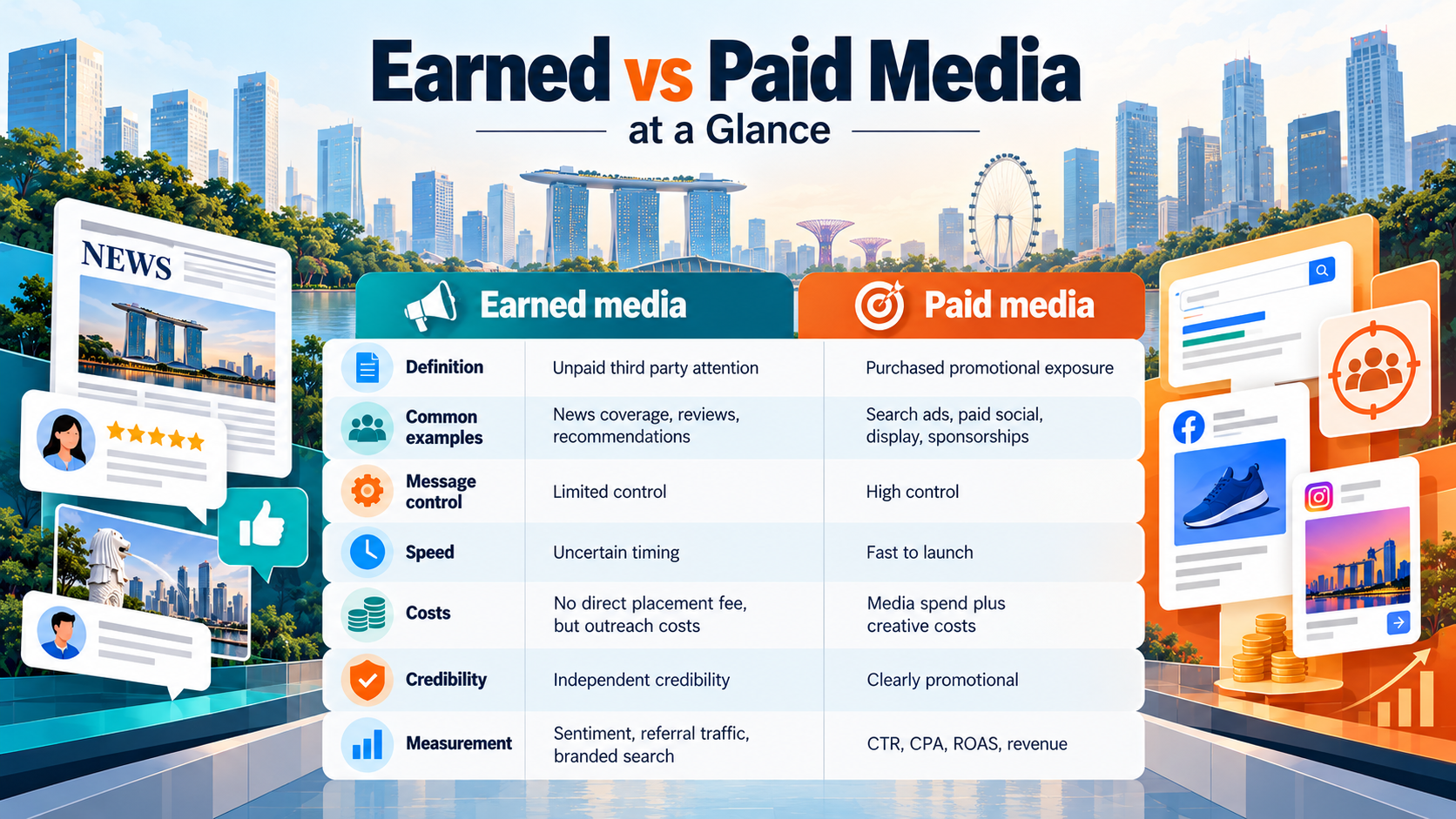
| Factor | Earned media | Paid media |
| Definition | Unpaid third-party attention or advocacy | Purchased advertising or promotional exposure |
| Common examples | Independent news coverage, unsolicited reviews, customer recommendations | Google Ads, paid social, display ads, sponsored articles |
| Message control | Limited; publishers and customers retain editorial discretion | Usually high within platform, policy and placement limits |
| Speed | Uncertain; outreach may take weeks or produce no placement | Can begin quickly once creative and campaigns are approved |
| Direct placement cost | Usually no fee for independent editorial coverage | Media, sponsorship or placement fees apply |
| Other costs | Staff, research, public relations, customer experience and monitoring | Creative production, campaign management and measurement |
| Credibility | May benefit from perceived independence; sentiment can be negative | Clearly promotional; credibility depends on execution and claims |
| Duration | Coverage may remain discoverable, but its reach can fade | Distribution generally depends on continuing spend |
| Measurement | Coverage quality, referral traffic, sentiment, branded search | Reach, clicks, conversion rate, acquisition cost and attributed revenue |
Neither channel is the automatic winner. Paid ads can waste money on poor targeting, while earned coverage can attract the wrong audience. Start with the business outcome.
Earned media: independent attention
Earned media includes an independent publication covering your research, a customer posting an unsolicited review, or people recommending your business without compensation. These mentions can influence consideration because the message comes from outside the brand.
Independence creates uncertainty. Journalists can reject a pitch, and customers can criticise a service. We assess placements by relevance and accuracy, not publicity volume alone.
Paid media: purchased distribution
Paid media includes search advertisements, paid social campaigns, display placements, native advertising and sponsored creator content. Depending on the arrangement, a business may pay per click, per thousand impressions, per action or through a fixed sponsorship fee.
Advertisers control budgets and creative but cannot guarantee conversions. Results depend on competition, approval requirements and the offer.
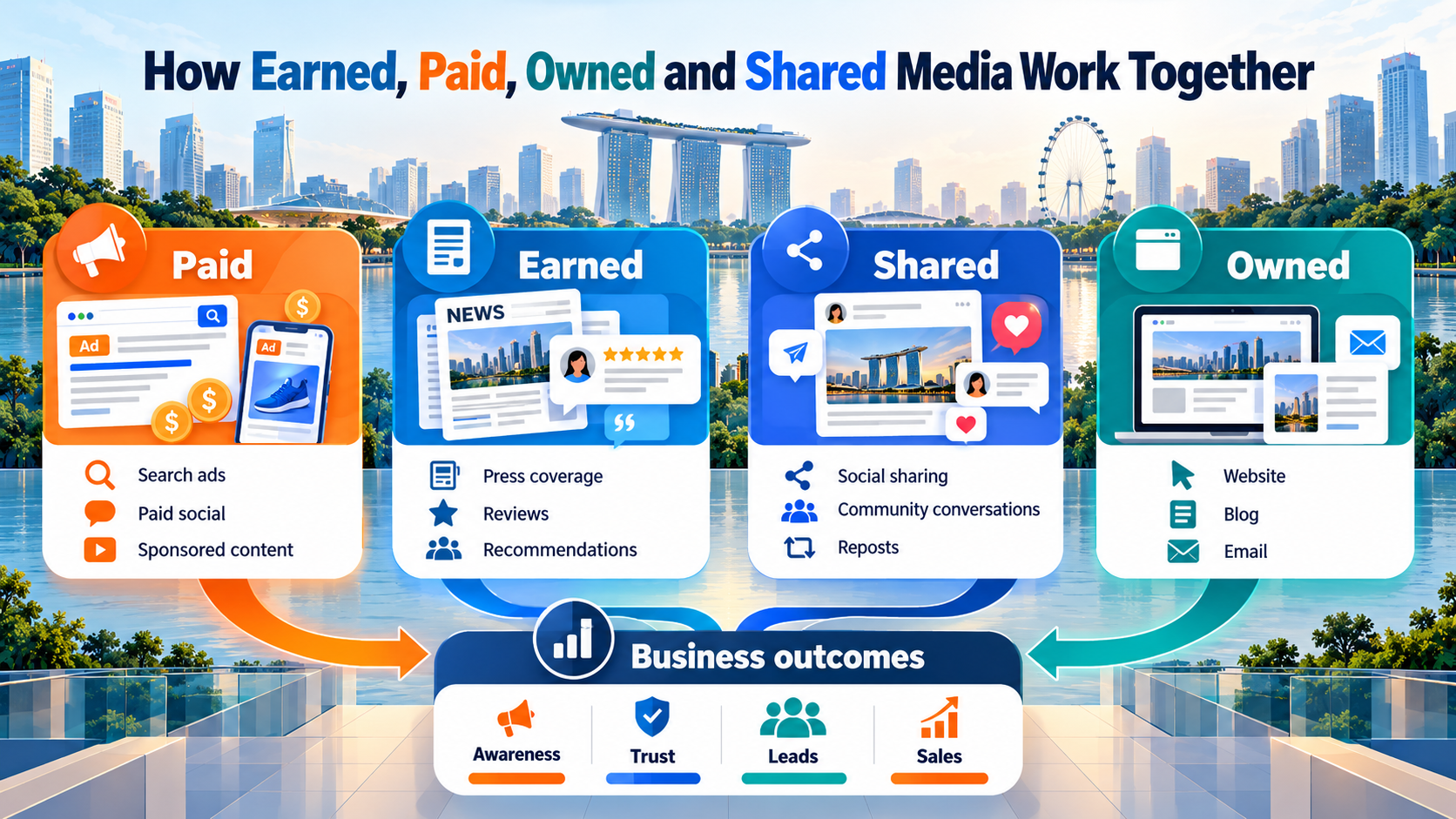
Owned media includes your website, blog, email database and other content or customer touchpoints you manage. Shared media covers distribution and conversation across social platforms, including reposts and community interactions. The categories can overlap: an unpaid customer recommendation shared on social media can be earned attention amplified through a shared channel.
The PESO model, created by Gini Dietrich and introduced in 2014, connects paid, earned, shared and owned media. We use it to connect channels, not set fixed budget percentages.

Advantages and Limitations of Earned vs Paid Media
Control and speed
Paid media is usually the better fit for a promotion with a specific start date. A Singapore retailer can prepare product ads, select an audience and adjust spending when performance data arrives. Approval and reliable conversion data can still take time.

Earned outreach is less predictable. We would never rely on unconfirmed press coverage as the only source of launch traffic.
Trust and reputation
Earned coverage can support credibility because the business does not control the third party’s opinion. Nielsen’s 2021 global trust research found that 88% of respondents trusted recommendations from people they knew. That statistic refers to global respondents and personal recommendations; it is not a Singapore-specific estimate of trust in all earned media.
A friend’s recommendation differs from a news article or sponsored video. Evaluate the source before claiming credibility.
Cost and lasting value
Earned exposure is not cost-free. Research, media relationships, review management and public relations work require resources. Strong content may keep attracting attention after publication, but visibility and referral traffic can also decline quickly.
Paid campaigns offer clearer spending limits, but reporting can lag. Continued distribution usually requires continued spending.
Risk and predictability
Paid campaigns face wasted spend, ad fatigue, tracking gaps and creative rejection. Earned activity carries reputational risk and limited message control. A popular negative review can generate attention that no business would have chosen to buy.
Prepare accurate claims and customer-response procedures before increasing exposure. Publicity cannot rescue unreliable service.
When Should Singapore Businesses Choose Earned or Paid Media?
We would make the initial choice using business goals rather than a universal channel ranking. The examples below illustrate the trade-offs.
| Business objective | Recommended emphasis | Reason |
| Launch a product next month | Paid first, earned outreach in parallel | Advertising offers more control over launch timing |
| Generate leads for an established service | Paid search plus credible proof | Ads capture active demand; reviews help people evaluate the provider |
| Build a new company’s reputation | Earned and owned first, with selective paid tests | Independent validation and useful content support the brand’s claims |
| Promote a short seasonal offer | Paid | Scheduled reach and conversion tracking matter most |
| Establish authority in a specialist industry | Earned and owned, supported by selective paid distribution | Original research and expert commentary can reach relevant decision-makers |
| Enter a new customer segment | Test paid, then expand relevant earned outreach | Advertising can test messages while third-party attention builds recognition |
For example, we would prioritise high-intent search ads for an accounting firm that needs enquiries this quarter. We would also strengthen its service pages and gather authentic client feedback. A business-to-business software company selling a complex product may gain greater value from original research, expert interviews and relevant industry mentions before scaling paid campaigns.
These are hypotheses. We would change the mix if customer or sales evidence suggested another approach.
How to Allocate a Budget Across Earned and Paid Media
No credible formula assigns the correct percentage to every business. We recommend setting the target outcome, estimating delivery costs and reserving a portion of the budget for experiments. A fixed split is useful for planning but should not become a permanent rule.
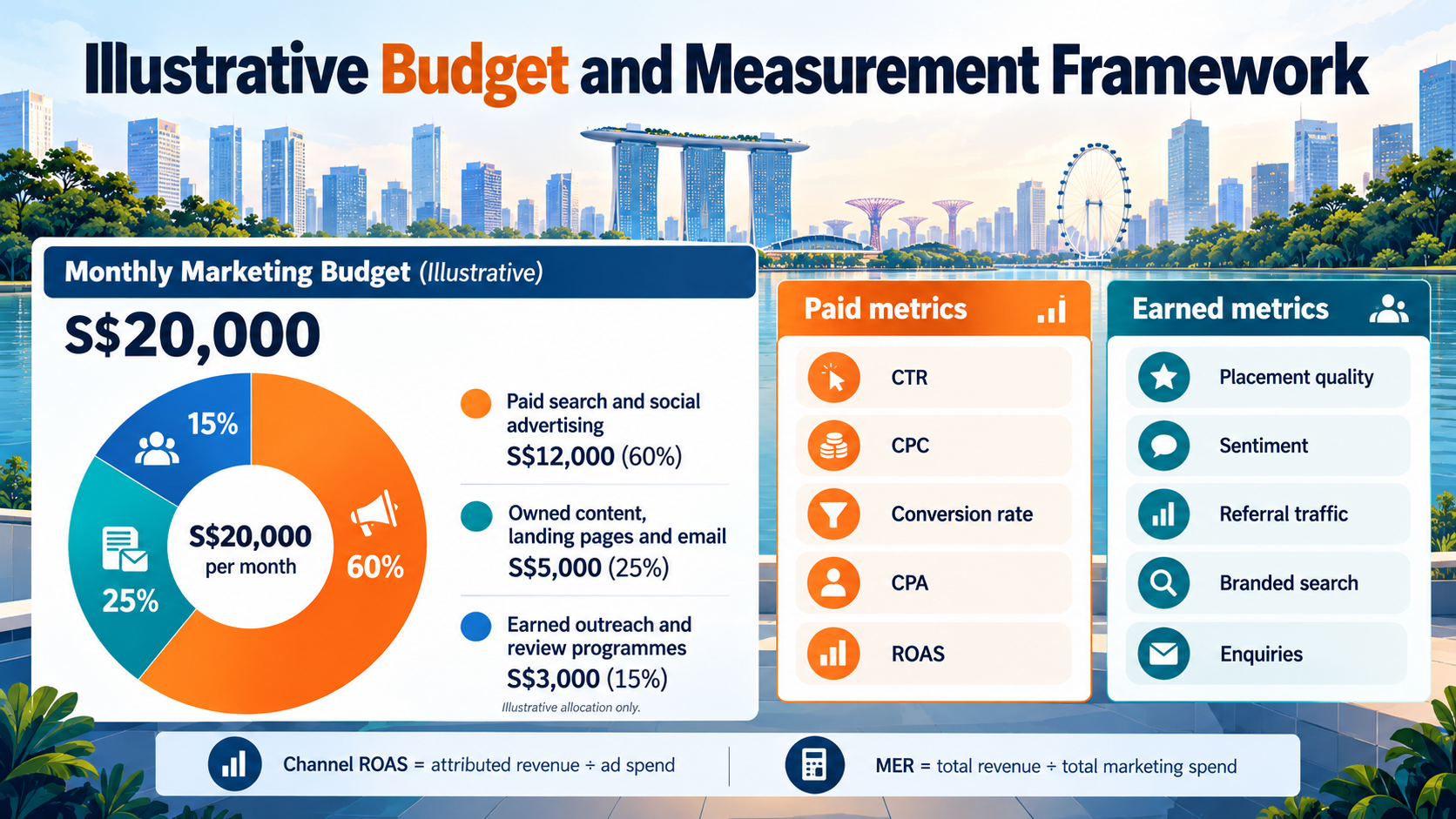
Consider a hypothetical S$20,000 monthly marketing budget for a Singapore business preparing a launch. The split supports immediate acquisition tests and longer-term content investment:
| Activity | Illustrative monthly budget | Purpose |
| Paid search and social advertising | S$12,000 (60%) | Reach interested audiences and test acquisition |
| Owned content, landing pages and email | S$5,000 (25%) | Explain the offer and convert or nurture visitors |
| Earned outreach and review programmes | S$3,000 (15%) | Develop credible stories and customer advocacy |
| Total | S$20,000 (100%) | Illustrative allocation only |
The S$3,000 earned-media line covers the work needed to pursue publicity. It is not a payment to secure supposedly independent editorial coverage. These are illustrative figures, not a benchmark or client result.
Before committing the full amount, we would review four questions. Is there enough search demand? Does the website convert visitors? Is there a credible story worth pitching? Can the business measure genuine enquiries or sales? If conversion tracking is unreliable, we would fix it before interpreting channel returns.
Review the budget after six to eight weeks if data volume allows. Longer sales cycles need longer windows; one strong week is insufficient.
Practical Strategies for Earned Media
Publish something worth covering
Journalists and industry writers need useful information, not recycled promotional claims. Share original findings or documented customer problems. State the methodology and limitations.
Pitch relevant specialist publications, not just large outlets. Never call advertorials independent press mentions.
Encourage authentic customer recommendations
Ask customers for honest feedback after a completed purchase or service. Make the request neutral and allow positive or negative responses. With permission, useful customer stories can also support sales materials and website content.
Treat compensated reviews and gifted creator arrangements carefully. Singapore’s Advertising Standards Authority guidance identifies circumstances where sponsored content, paid promotions and reviews solicited through free products or services require disclosure. A complimentary product does not automatically make a creator post independent earned media.
Extend the value of genuine coverage
Record publication dates, relevant links, audience fit and accurate quotations. Seek permission or follow applicable rights before reusing third-party images or substantial extracts. Refer prospects to the original coverage where appropriate.
Turn recurring questions from coverage into helpful owned content. Monitor whether it assists enquiries.
Practical Strategies for Paid Media
Start with the customer and the objective
For immediate demand, we would consider relevant search terms and a landing page closely matched to the advertisement. For audiences not actively searching, paid social or video can introduce the problem and offer before asking for an enquiry.
Set a target cost per qualified lead or acquisition before launch. Choose a conversion action that reflects business value, not merely page views. For businesses with longer sales cycles, connect advertising data to the customer relationship management system so lead quality is visible.
Test messages without changing everything at once
Build a small set of creative variations around different objections or benefits. Keep offers and landing pages sufficiently consistent to understand what changed. Review conversion volume before declaring one message the winner.
A campaign may report inexpensive clicks but generate unsuitable leads. We prioritise qualified enquiries and eventual revenue over engagement alone. MediaOne’s paid search services connect naturally with this kind of goal-led campaign planning.
Follow Singapore’s disclosure and privacy requirements
Paid creator promotions should be identifiable as commercial communications. Avoid presenting sponsored material as an independent endorsement, and make sure testimonial claims can be supported.
Where a campaign uses personal data, review the relevant requirements under Singapore’s Personal Data Protection Act. The Personal Data Protection Commission’s marketing-consent guidance explains considerations when organisations seek consent to use personal data for marketing purposes. Requirements depend on the circumstances.
How to Combine Earned and Paid Media in One Campaign
We recommend a coordinated sequence in which the same credible message reaches customers through different channels. Consider a hypothetical Singapore software provider launching a new invoicing product. The following is a process illustration, not a documented client case study.
- Owned: Publish a clear product explainer, pricing page and original analysis of a relevant invoicing problem. Include methodology and limitations for any claims.
- Earned: Offer the findings to relevant business publications or independent commentators. Invite existing customers to provide honest product feedback.
- Shared: Publish practical summaries on company social channels and respond to genuine questions. Encourage voluntary discussion without scripting customer opinions.
- Paid: Run search or social ads addressing the strongest verified customer concerns. Where rights and platform policies allow, test accurately attributed third-party quotations in advertisements.
- Measure: Record enquiry quality, acquisition costs, referral visits, branded searches and total sales. Compare the outcomes against the agreed baseline.
Do not delay a launch while awaiting press coverage. Test whether genuine reviews improve advertising performance.

Use insights from coverage to test ad copy. Turn recurring ad responses into useful explanations.
How to Measure Earned vs Paid Media Performance
Measure earned vs paid media using distinct channel metrics and shared business outcomes. Neither potential press readership nor ad-attributed sales establishes causation.
Paid media metrics
Use advertising-platform reporting alongside analytics and confirmed business records. Depending on the goal, we would track:
- Click-through rate (CTR): the share of impressions that generate clicks.
- Cost per click (CPC): advertising spend divided by clicks.
- Conversion rate: the share of tracked visits or interactions producing the defined action.
- Cost per acquisition (CPA): advertising spend divided by attributed acquisitions, with the acquisition clearly defined.
- Return on ad spend (ROAS): attributed advertising revenue divided by the relevant advertising spend.
- Lead quality or revenue: confirmed enquiries, sales and margins from business systems.
Platform ROAS is attributed revenue, not necessarily additional revenue. Some conversions might have happened without the campaign.
Earned media metrics
For earned publicity, we would measure relevant placements, the prominence and accuracy of brand mentions, sentiment, referral visits and the behaviour of visitors who arrive from coverage. Branded search trends and direct enquiries can offer supporting evidence, but they do not by themselves prove that publicity caused demand.
Industry guidance supports evaluating outcomes rather than equating coverage volume with success. The AMEC Integrated Evaluation Framework separates activities and outputs from audience responses, outcomes and organisational impact. We would not treat a speculative advertising-value equivalent as earned-media revenue.
ROAS vs marketing efficiency ratio
A useful correction is to separate channel ROAS from the marketing efficiency ratio (MER), sometimes called blended ROAS. The denominators describe different spending categories.
- Channel ROAS = revenue attributed to a paid channel ÷ advertising spend on that channel.
- MER = total business revenue ÷ total marketing expenditure for the same period.
For illustration, suppose paid search reports S$24,000 in attributed revenue from S$6,000 in ad spend. Its reported ROAS is 4.0×. Suppose the business also records S$90,000 in total revenue against S$20,000 in total marketing expenditure. Its MER is 4.5×.
The 0.5 difference does not quantify earned-media contribution. MER can include returning customers and existing demand. Shopify’s guide to MER explains the distinction from campaign ROAS.
Attribution reports vs incremental results
Attribution assigns credit across observed customer touchpoints. Google Analytics attribution documentation describes data-driven and last-click approaches, each with different assumptions. Neither ordinary channel reporting nor a rise in branded search alone establishes what would have happened without marketing.
For eligible paid campaigns, a properly designed conversion-lift experiment compares exposed and control groups. Google’s Conversion Lift documentation describes user-based and geography-based methods, although access and suitability vary. We would check eligibility and expected statistical power before recommending such a test.
Earned coverage is different. A publication’s readers generally cannot be randomly assigned to see or avoid a news story. Compare relevant periods or markets where feasible, note other campaigns and seasonal factors, and describe the evidence as directional unless a stronger causal design is available.
A practical six-step measurement checklist
- Define the main business outcome, such as qualified enquiries, purchases or contribution margin.
- Record a baseline for traffic, branded searches, revenue and customer acquisition before the campaign.
- Use consistent campaign tags for links you control. Google’s UTM guidance explains how tagged URLs support campaign reporting; independent coverage may use untagged links.
- Track paid expenditure separately from outreach, content and other marketing costs.
- Review placement quality, attributed results and overall revenue together. Investigate overlapping conversion claims rather than adding platform figures blindly.
- Use an appropriate controlled test for paid activity where feasible. Otherwise, document uncertainty and make budget decisions from several indicators.
Frequently Asked Questions
Is earned media really free?
Earned media normally involves no payment for independent editorial placement, but creating a newsworthy story and securing attention takes resources. Research, public relations work and customer experience should appear in the marketing budget.
Is influencer marketing earned or paid media?
An unsolicited recommendation from an independent creator may qualify as earned media. A sponsored post, paid endorsement or incentivised product review has a commercial connection that should be disclosed under relevant guidance.
Is search engine optimisation earned or owned media?
Your website content and its optimisation are usually owned-media activities. Independent backlinks, recommendations and coverage generated by that work are earned media, while advertising on search results is paid media.
Which type of media is better for small businesses in Singapore?
Paid advertising suits businesses needing controlled visibility or fast demand testing. Earned activity can support trust and recommendations, so we would choose an affordable mix based on the buying cycle and available evidence.
Can paid advertising strengthen earned media results?
Yes, paid campaigns can distribute accurately attributed press coverage or relevant customer stories when usage rights permit. Test whether this improves qualified traffic or conversions instead of assuming that wider reach guarantees better results.
What is the best way to measure earned media ROI?
Record outreach costs and track relevant coverage, referral visits, customer enquiries and changes in brand demand. Attribute revenue only where evidence supports the connection, and use qualified estimates rather than invented advertising-equivalent values.
Choose the Mix That Matches the Goal
There is no permanent winner in earned vs paid media. Choose paid for controlled distribution and faster testing. Choose earned when credible recommendations can help buyers evaluate your brand.
Our recommendation is to start with one measurable business objective, build useful owned content and select the two or three channels most likely to reach the right audience. Measure advertising performance and earned attention separately, then assess the total cost and commercial results. Our social media marketing services provide another route to coordinate paid distribution and customer conversations.