The demand for digital marketing professionals continues to grow as businesses allocate increasing budgets toward online acquisition channels. According to LinkedIn’s recent workforce reports, digital marketing roles remain among the most in-demand job categories globally as companies prioritise online visibility and data-driven growth.

As a result, interest in obtaining a digital marketing certificate has risen significantly. Whether you are a fresh graduate, a career switcher, or a business owner seeking structured knowledge, certification programmes promise fast-track access to in-demand skills, including practical insights from a top SEO agency in Singapore.
This guide explores the requirements, time commitment, financial investment, and career outcomes of earning a digital marketing certificate so you can evaluate whether it aligns with your professional goals.
Key Takeaways
- A digital marketing certificate is a short-term professional credential focused on practical online marketing skills.
- Entry requirements are generally accessible, though advanced programmes may expect prior experience.
- Costs vary widely depending on provider and format.
- Certification improves employability but does not replace hands-on experience.
- Choosing the right programme depends on curriculum depth, credibility, and career alignment.
What Is a Digital Marketing Certificate?

A digital marketing certificate is a professional credential awarded upon completing a structured training programme focused on online marketing disciplines. Unlike a traditional degree, which may span several years and cover broad academic theory, a certificate programme is typically shorter and skill-oriented.
The purpose of a digital marketing certificate is to verify that the learner understands core digital marketing principles, including search engine optimisation, paid advertising, social media strategy, content marketing, and analytics.
There are several types of digital marketing certificates:
- Online platform-issued certificates
- University-backed professional certificates
- Executive education programmes
- Industry-recognised certifications (e.g., platform-specific credentials)
The depth, credibility, and industry recognition vary significantly across providers. Therefore, understanding programme structure is crucial before enrolling.
Digital Marketing Certificate Requirements (Entry Criteria)

Entry requirements for a digital marketing certificate depend largely on the programme level and the institution offering it. Most beginner-level certificates are designed to be accessible.
A digital marketing agency recognises that many learners are entering the field without prior marketing experience.
Beginner-Level Requirements
For foundational programmes, requirements are typically minimal. Most institutions require only a high school diploma or equivalent qualification. No prior marketing experience is usually necessary, as the curriculum begins with fundamentals.

Basic digital literacy is expected, meaning familiarity with email, web browsing, and common online platforms. English proficiency may be required for international programmes.
These accessible requirements make digital marketing certificates attractive for career switchers and recent graduates.
Intermediate or Advanced-Level Requirements
Professional or executive-level programmes may require a more substantial background.
Some institutions prefer applicants with a bachelor’s degree, prior business experience, or existing marketing exposure. In certain cases, candidates may need to submit a portfolio or demonstrate relevant work history.
These requirements exist because advanced programmes focus less on fundamentals and more on strategic application and leadership-level decision-making.
How Long Does It Take to Get a Digital Marketing Certificate?
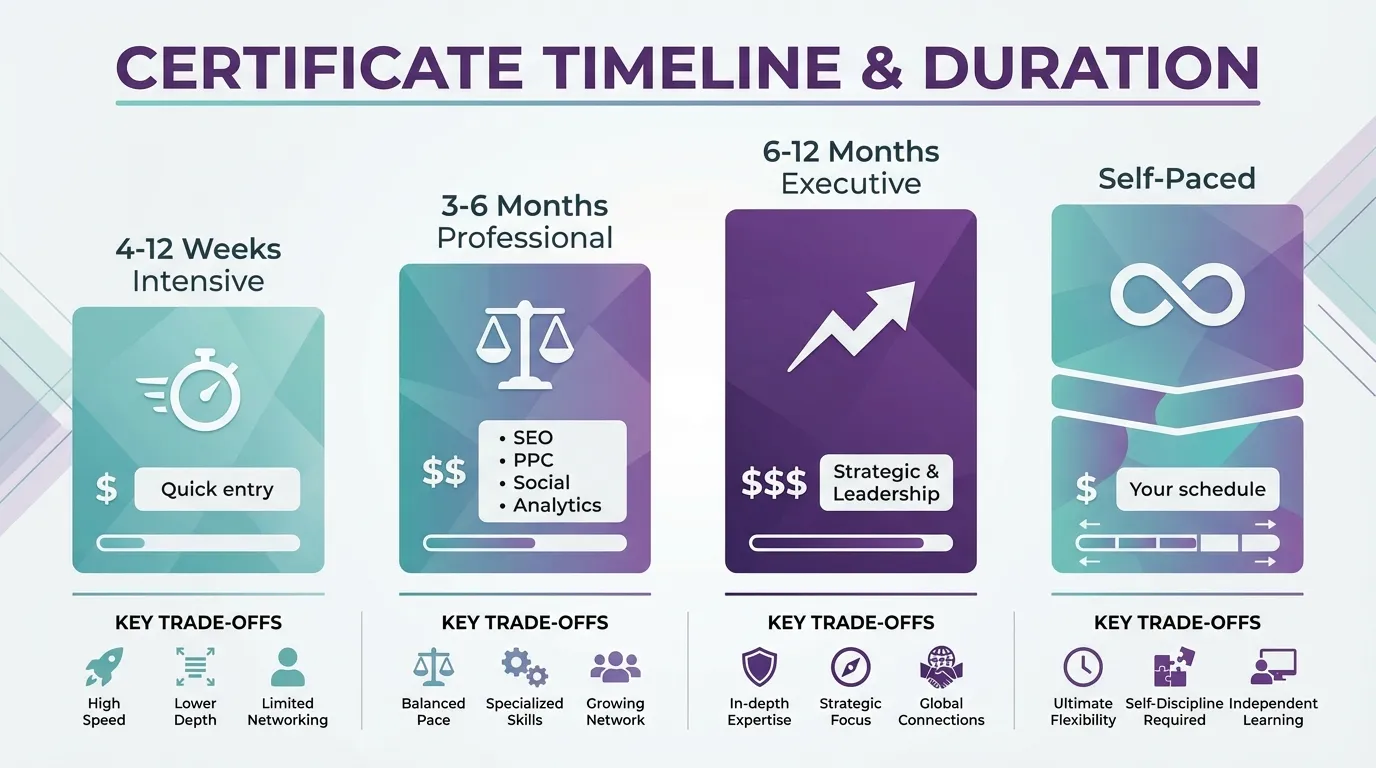
The time required to earn a digital marketing certificate depends on the programme’s depth, delivery format, and credential level. While some courses can be completed in weeks, others may span several months.
Below is a structured timeline overview to help you understand what to expect at each stage.
4–12 Weeks: Intensive Bootcamps
Short-format bootcamps are designed for rapid skill acquisition. These programmes typically focus on foundational areas such as SEO basics, paid advertising setup, and social media strategy.
Because of their compressed schedule, they are often delivered online and may prioritise practical tasks over theory.
Cost Level: Generally affordable and accessible.
Best For: Career switchers seeking quick entry-level exposure.
Trade-Off: Limited depth and minimal strategic coverage.
3–6 Months: Professional Certificate Programmes
Mid-length certificate programmes balance theoretical understanding with practical execution. These are commonly part-time and structured around weekly modules.
Students typically learn:
- SEO fundamentals
- Paid advertising frameworks
- Social media campaign structuring
- Analytics and reporting
Cost Level: Moderate investment depending on provider reputation.
Best For: Professionals seeking structured, credible upskilling.
Trade-Off: Requires consistent commitment over several months.
6–12 Months: Executive or Advanced Certificates
Longer programmes are often positioned as professional or executive-level certifications. They include deeper strategic training, case studies, mentorship, and networking opportunities.
These programmes focus more on:
- Integrated marketing strategy
- Data-driven decision-making
- Leadership-level campaign planning
- AI and automation in digital marketing
Cost Level: Premium pricing due to instructor access and brand prestige.
Best For: Mid-career professionals seeking career acceleration.
Trade-Off: Higher financial and time commitment.
Flexible Timeline: Self-Paced Online Certificates
Some platforms allow learners to complete coursework entirely at their own pace. Completion may range from a few weeks to several months, depending on schedule flexibility.
Cost Level: Usually lower upfront, though additional exam or certification fees may apply.
Best For: Independent learners with strong self-discipline.
Trade-Off: Less structured guidance and accountability.
Cost Considerations Across the Timeline
Regardless of duration, total investment extends beyond tuition fees. Prospective learners should also consider:
- Certification examination fees
- Software subscriptions for tools such as analytics or advertising platforms
- Learning materials
- Opportunity cost of time spent studying instead of working
When evaluating a digital marketing certificate, cost should be weighed against return on investment rather than price alone. A higher-priced programme may offer greater industry credibility, better networking opportunities, and greater potential for career advancement.
The right timeline is not necessarily the shortest or cheapest; it is the one aligned with your long-term professional objectives.
How Much Does a Digital Marketing Certificate Cost?
When evaluating a digital marketing certificate, tuition cost is only one part of the equation. The total investment depends on several factors, including the provider’s reputation, delivery mode, depth of curriculum, and the credential’s recognition in the job market.
Most programmes fall into three broad categories with distinct cost profiles and value propositions. Understanding these differences helps you balance affordability with career impact.
1. Online Platform Certificates (Entry-Level / Budget-Friendly)
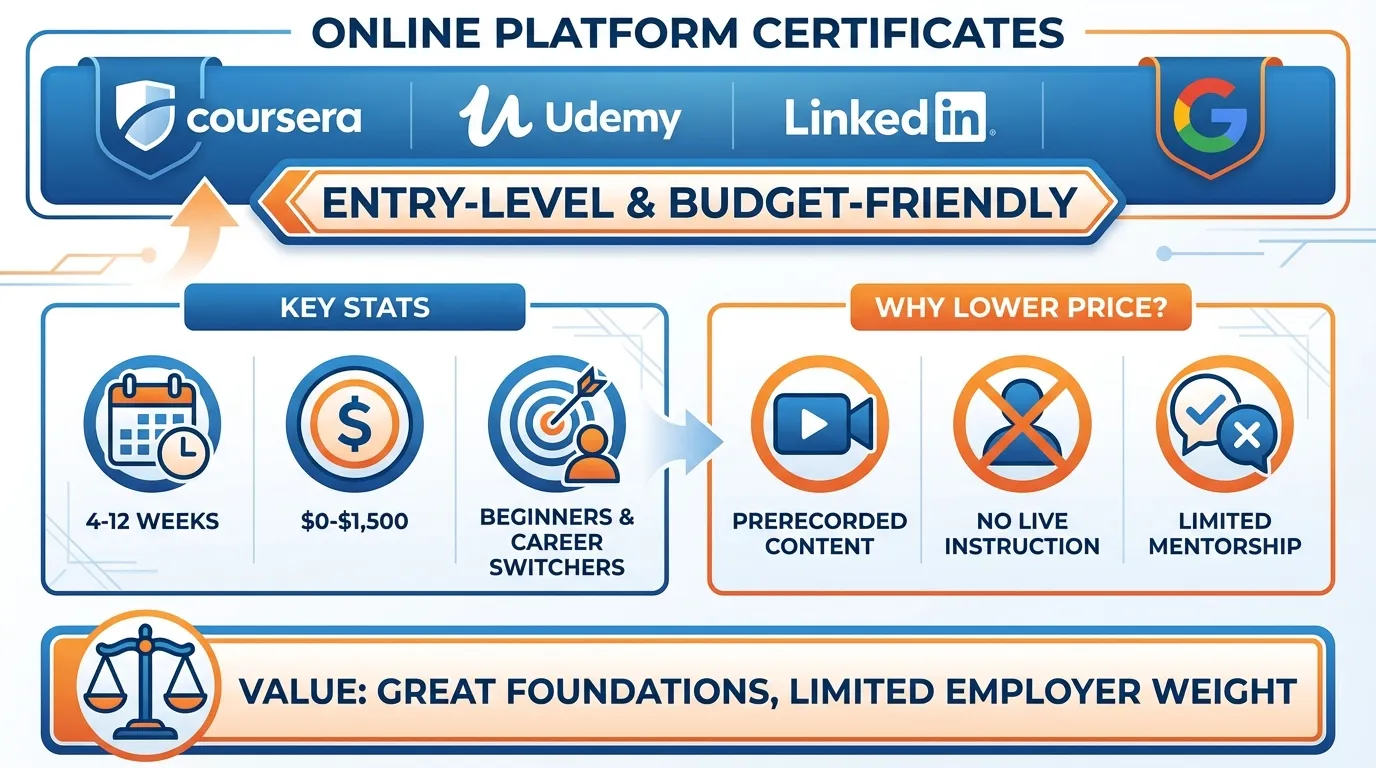
Online learning marketplaces and specialist platforms (e.g., Coursera, Udemy, LinkedIn Learning, Google Career Certificates).
- Duration: 4–12 weeks (self-paced or cohort-based)
- Cost range: $0 – $1,500 USD (often < $500)
These programmes are designed to be accessible, focus on core skills, and are ideal for beginners or career switchers.
Why is the price lower?
- Mostly prerecorded content
- Little to no live instruction
- Minimal mentorship or personalised feedback
Value proposition: Great for foundational skills and demonstrating initiative, but may carry limited weight with employers compared to staffed or accredited programmes.
2. University-Issued Certificates (Professional / Career Oriented)
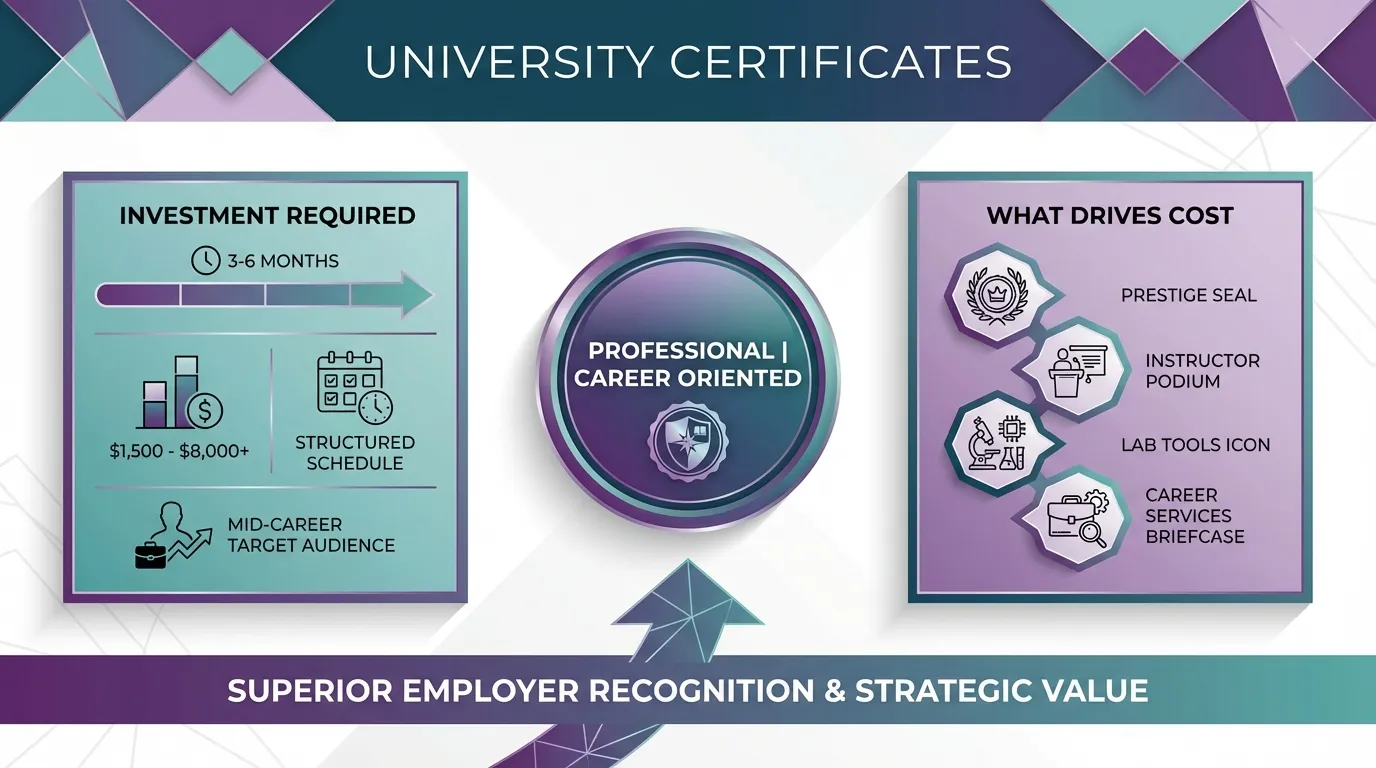
Colleges, universities, or accredited executive education arms.
- Duration: 3–6 months (structured schedule)
- Cost range: $1,500 – $8,000+ USD
These programmes often combine instructor-led modules with strategic projects, assessments, and certification exams.
What affects cost:
- Institution prestige
- Faculty involvement
- Access to labs or proprietary tools
- Career support services
Value proposition: Stronger employer recognition and more strategic depth. Often preferred in corporate hiring or mid-career advancement.
3. Executive & Advanced Professional Programmes
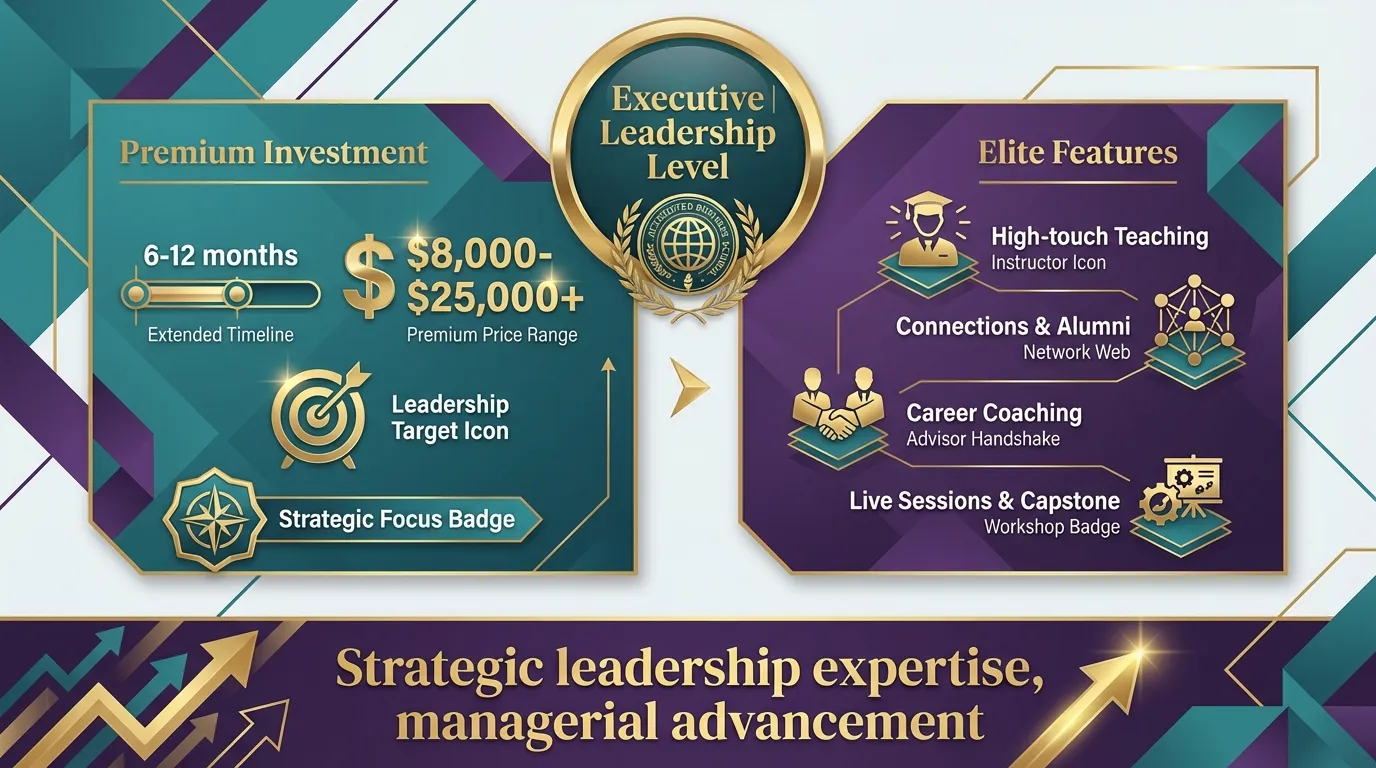
Top universities, business schools, or specialised executive education providers.
- Duration: 6–12 months
- Cost range: $8,000 – $25,000+ USD
These are premium certificates that blend advanced strategy, leadership modules, mentorship, and networking opportunities. Some include live workshops, capstone projects, and career coaching.
Why do they cost more?
- High-touch instruction
- Industry connections and alumni access
- Career advisors and recruiters

Value proposition: Best suited for professionals targeting managerial or leadership roles in digital marketing, or building strategic expertise rather than tactical skills.
Additional Costs to Consider
Beyond basic tuition, total investment may include:
- Certification exam fees: Some recognised certificates require additional fees for official credentialing.
- Software subscriptions: Tools such as Google Analytics 360, SEM platforms, or SEO suites may incur associated costs.
- Learning materials: Textbooks, case studies, templates, or specialised resources.
- Opportunity cost of time: Time spent studying rather than working.
When evaluating programmes, always calculate total investment rather than headline price.
Cost vs Value: What to Consider
Rather than choosing purely on price, evaluate programmes using these questions:
- Does the curriculum align with real-world digital marketing services? (e.g., hands-on projects, case studies, platforms you will use on the job)
- Does the certificate carry industry recognition or accreditation? Employers often value recognised credentials over generic certificates.
- Will the programme provide job placement support? Career coaching, portfolio development, or interview prep increases ROI.
- Does the cost reflect access to instructors or mentors? Higher cost often correlates with personalised guidance and accountability.
A cheaper certificate may be fine for learning the basics. But for career acceleration or competitive markets, investing in higher-tier programmes often yields stronger outcomes.
Quick Cost Summary
Here’s a quick cost summary table for your reference:
| Certificate Type | Typical Duration | Cost Range (USD) | Typical Value |
| Online Entry Courses | 4–12 weeks | $0 – $1,500 | Fundamentals & accessibility |
| University-Issued Certificates | 3–6 months | $1,500 – $8,000+ | Structured learning + credibility |
| Executive/Advanced Certificates | 6–12 months | $8,000 – $25,000+ | Strategic depth + career uplift |
This summary shows that the cost of a digital marketing certificate varies significantly by depth, credibility, and intended career impact. Lower-cost options provide accessible entry into foundational skills, while higher-tier programmes offer stronger industry signalling and strategic exposure.
What Skills Do You Learn in a Digital Marketing Certificate Programme?
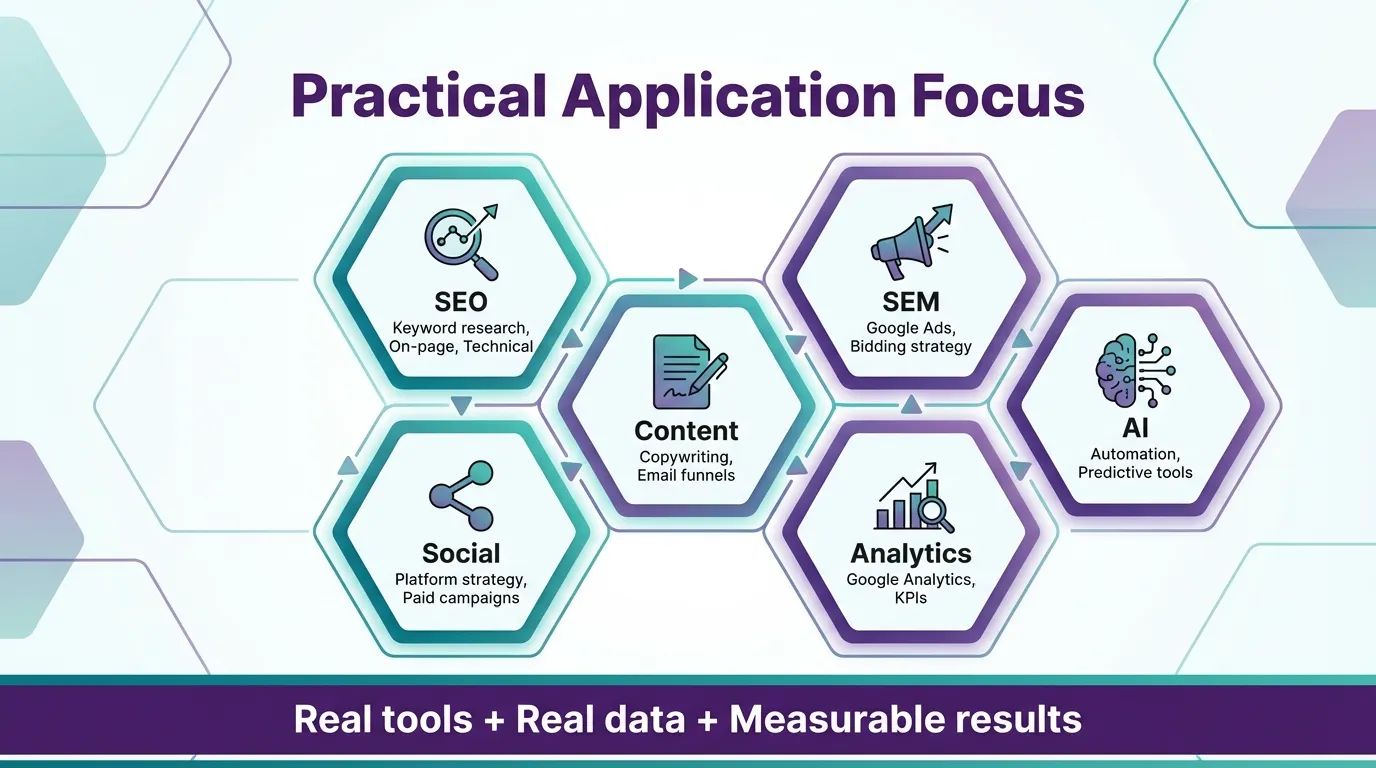
A well-designed digital marketing certificate programme mirrors real-world digital marketing execution rather than focusing purely on theory. Strong programmes emphasise practical application, measurable outcomes, and familiarity with tools. Core skill areas typically include the following:
- Search Engine Optimisation (SEO): Students learn keyword research fundamentals, on-page optimisation techniques, and basic technical SEO principles. They also understand how content strategy aligns with search intent to improve organic visibility. This foundation enables learners to optimise websites for long-term search performance.
- Search Engine Marketing (SEM): Learners explore how to set up paid advertising campaigns on platforms such as Google Ads. They are introduced to bidding strategies, conversion tracking, and performance analysis frameworks. This prepares them to manage and optimise paid acquisition campaigns effectively.
- Social Media Marketing: Courses typically cover platform strategy, audience targeting, and content development across major social channels. Students also learn how paid social campaigns are structured and optimised for engagement and conversions. This builds both brand awareness and performance marketing skills.
- Content and Email Marketing: Students learn to craft funnel-based messaging tailored to the different stages of the customer journey. They learn basic copywriting principles and lead nurturing strategies. This ensures that traffic from other channels can be effectively converted.
- Analytics and Reporting: Programmes introduce tools such as Google Analytics and KPI measurement frameworks. Learners understand how to track campaign performance and interpret marketing data. This skillset enables data-driven decision-making rather than guesswork.
- AI in Digital Marketing: Modern certificates increasingly incorporate AI-driven automation and predictive analytics concepts. Students gain exposure to how AI enhances targeting precision and optimisation speed. This reflects evolving industry standards and prepares learners for future-ready marketing environments.
While the exact curriculum varies by provider, the strongest digital marketing certificate programmes prioritise practical execution over abstract theory.
The goal is not just to understand digital marketing concepts, but to apply them using real tools, real data, and measurable performance benchmarks.
Career Outcomes After Earning a Digital Marketing Certificate
A digital marketing certificate can enhance employability by demonstrating foundational knowledge in SEO, paid advertising, analytics, and social media strategy. However, certification alone does not guarantee career advancement. Employers typically value measurable results and practical experience alongside formal credentials.
Entry-Level Career Opportunities
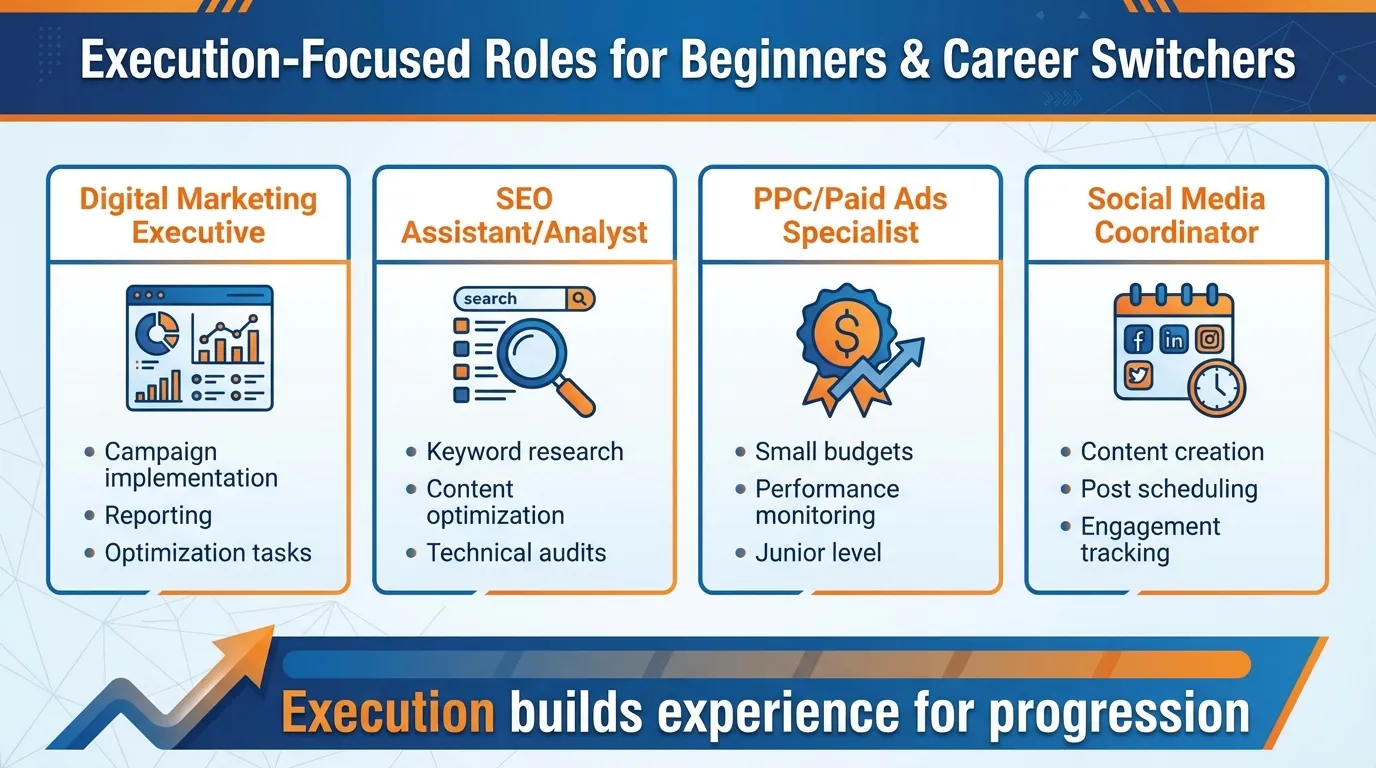
For beginners or career switchers, a digital marketing certificate can qualify you for junior, execution-focused roles where hands-on learning continues.
Typical entry-level roles include:
- Digital Marketing Executive: Assisting with campaign implementation, reporting, and optimisation tasks.
- SEO Assistant or Analyst: Supporting keyword research, content optimisation, and technical audits.
- PPC / Paid Ads Specialist (Junior): Managing smaller advertising budgets and monitoring performance metrics.
- Social Media Coordinator: Creating content, scheduling posts, and tracking engagement data.
These roles emphasise execution rather than strategic leadership, providing the practical exposure necessary for progression.
Mid-Level Career Progression
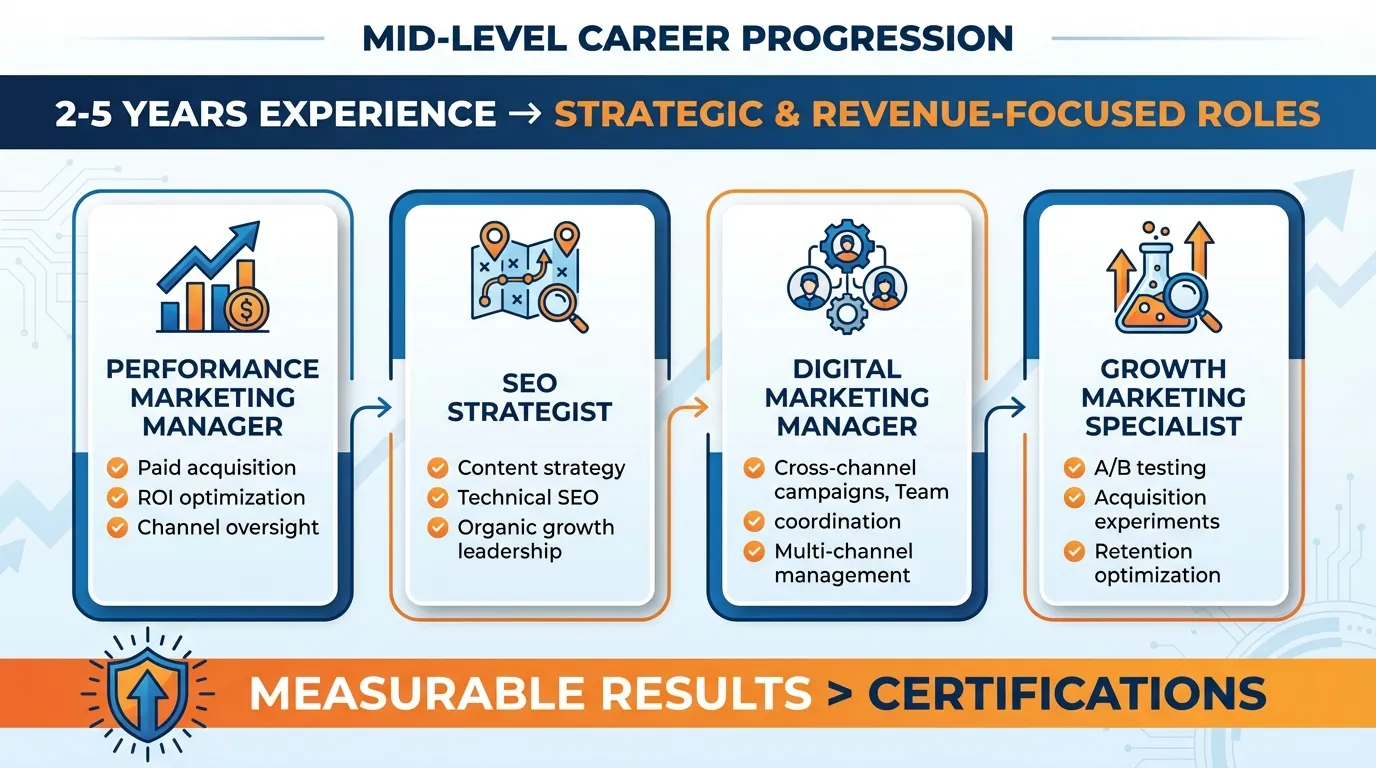
With consistent performance and 2–5 years of experience, professionals can advance into more strategic and revenue-focused roles.
Common mid-level pathways include:
- Performance Marketing Manager: Overseeing paid acquisition channels and ROI optimisation.
- SEO Strategist: Leading content, technical SEO, and organic growth initiatives.
- Digital Marketing Manager: Managing cross-channel campaigns and coordinating marketing teams.
- Growth Marketing Specialist: Running experiments to improve customer acquisition and retention.
At this stage, measurable impact, such as improved conversion rates or revenue growth, outweighs certification credentials.
Salary and Earning Potential
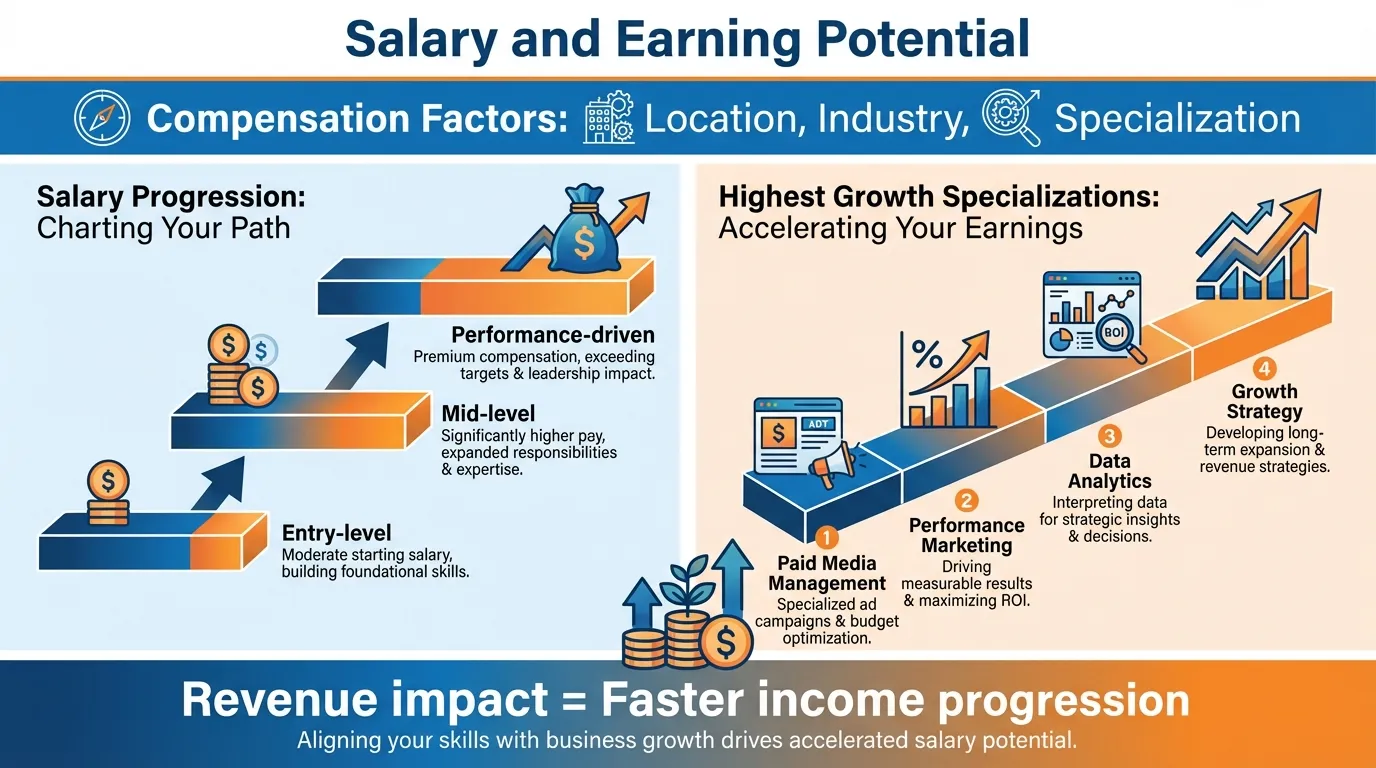
Compensation depends on geographic location, industry, and skill specialisation. Entry-level positions typically offer moderate starting salaries, while mid-level and performance-driven roles can command significantly higher pay.
Salary growth is often strongest in areas such as:
- Paid media management
- Performance marketing
- Data analytics
- Growth strategy
Professionals who directly influence revenue generation typically see faster income progression.
Freelance and Entrepreneurial Opportunities
A digital marketing certificate can also support independent consulting or freelance work. Many small and medium businesses require assistance with online visibility and paid acquisition.
Freelance pathways often include:
- SEO consultancy
- Paid advertising management
- Social media campaign strategy
- Content and funnel optimisation
In freelance markets, portfolio strength and results matter more than credentials alone.
Digital Marketing Certificate vs Degree vs Self-Learning
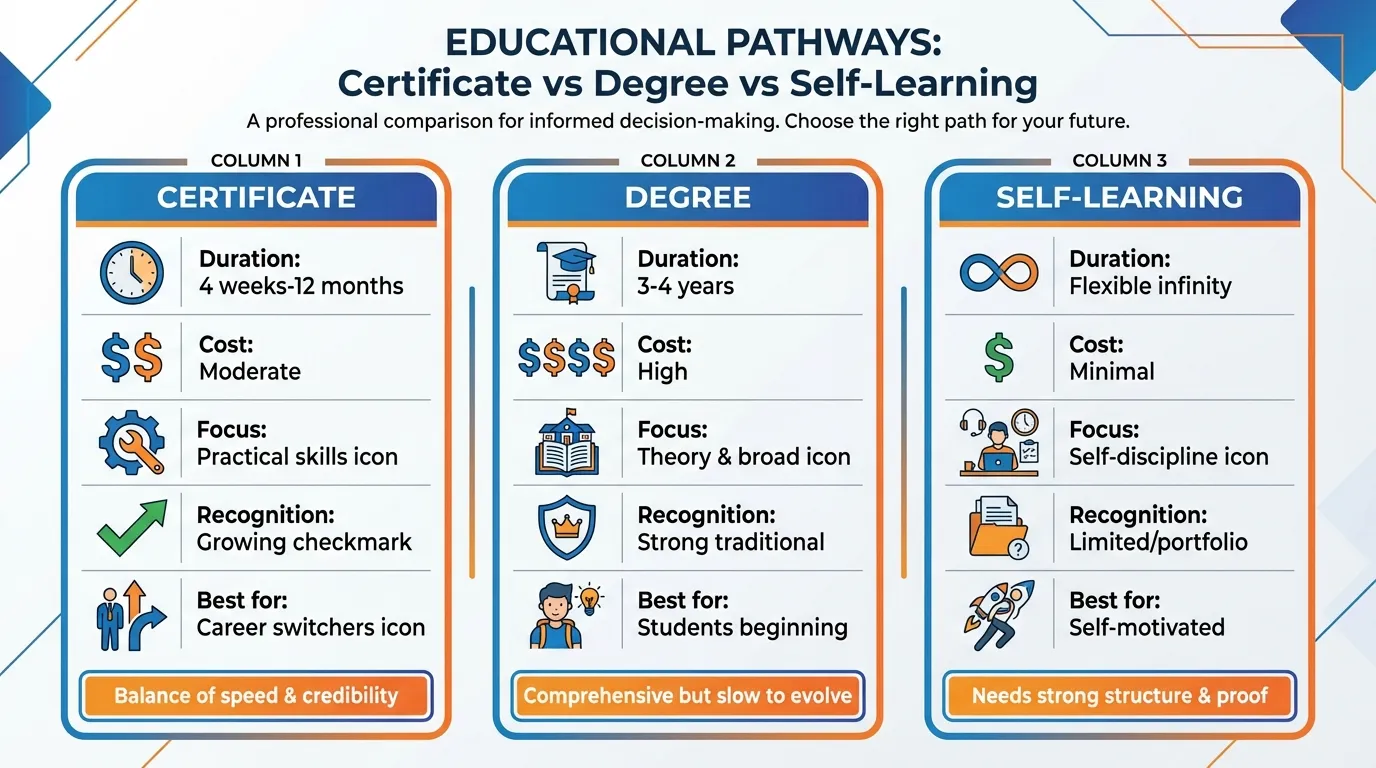
When evaluating a career in digital marketing, one of the most common questions is which learning path provides the best return on investment. There are three primary routes: earning a digital marketing certificate, pursuing a formal degree, or learning independently through self-study.
Each option differs in time commitment, cost, structure, credibility, and industry relevance. The right choice depends on your career stage, financial flexibility, and long-term goals.
1. Digital Marketing Certificate
A digital marketing certificate is a short to mid-term professional credential focused on practical skills. Most programmes are designed to provide structured exposure to areas such as SEO, paid advertising, analytics, social media, and AI tools.
Characteristics:
- Duration: 4 weeks to 12 months
- Cost: Moderate
- Focus: Practical and skill-based
- Employer recognition: Growing, especially when issued by reputable institutions
- Best suited for: Career switchers, fresh graduates, working professionals seeking upskilling
Certificates strike a balance between speed and credibility, making them one of the most efficient pathways into the field.
2. Marketing or Business Degree
A degree programme offers broader academic coverage, often including business fundamentals, economics, consumer psychology, and strategic marketing theory. It typically spans three to four years and includes general education modules beyond digital marketing.
Characteristics:
- Duration: 3–4 years
- Cost: High
- Focus: Theoretical and broad-based
- Employer recognition: Strong in traditional corporate environments
- Best suited for: Students beginning their education journey
While degrees provide comprehensive foundations, they may not always keep pace with rapidly evolving digital platforms and tools.
3. Self-Learning
Self-learning involves using free or low-cost resources such as online tutorials, blogs, YouTube channels, and platform certifications. This route offers maximum flexibility and minimal financial investment.
Characteristics:
- Duration: Flexible
- Cost: Low to minimal
- Focus: Depends on learner discipline
- Employer recognition: Limited unless supported by portfolio
- Best suited for: Highly self-motivated learners
Self-learning can be effective, but it requires strong structure and accountability. Without formal validation, candidates must rely heavily on demonstrable results.
Here’s a side-by-side comparison:
| Factor | Certificate | Degree | Self-Learning |
| Time Commitment | Short to Medium | Long | Flexible |
| Financial Investment | Moderate | High | Low |
| Practical Skill Focus | Strong | Moderate | Variable |
| Industry Speed Alignment | High | Slower | Depends |
| Structured Curriculum | Yes | Yes | No |
| Employer Signal | Moderate to Strong | Strong | Weak without a portfolio |
Which Path Should You Choose?
Choose a digital marketing certificate if you want structured, practical skills within a short timeframe.
Choose a degree if you are early in your academic journey and want a broad business foundation.
Choose self-learning if you are disciplined, resourceful, and able to build a measurable portfolio independently.
For many professionals, a blended approach works best: structured certification combined with continuous self-learning and real-world execution.
How to Choose the Right Digital Marketing Certificate
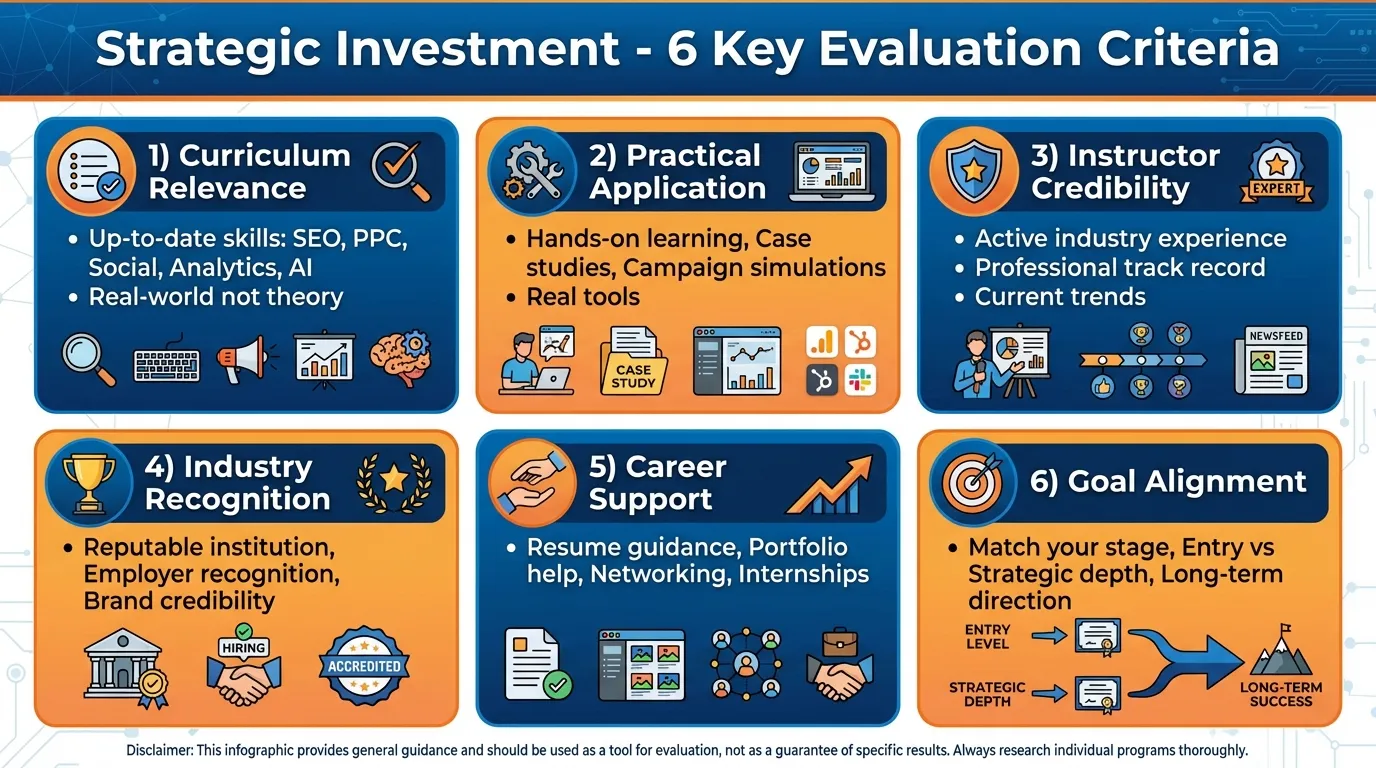
Choosing the right digital marketing certificate requires more than comparing prices or brand names. Programmes differ significantly in depth, credibility, and career impact. The right choice should align with your goals and reflect current industry practices.
- Curriculum Relevance: A strong digital marketing certificate should cover practical, up-to-date skills such as SEO, paid advertising, social media strategy, analytics, and AI tools. Avoid programmes that focus heavily on theory without real-world application. The curriculum should mirror how digital marketing is executed in competitive environments today.
- Practical Application: Digital marketing is performance-driven, so hands-on learning is essential. Look for programmes that include case studies, campaign simulations, or capstone projects using real tools. Practical exposure significantly improves employability and skill confidence.
- Instructor Credibility: Instructors with active industry experience often provide deeper insights than purely academic trainers. Evaluate their background, case studies, and professional track record. Learning from practitioners ensures exposure to current trends and best practices.
- Industry Recognition: Not all certificates carry equal weight in the job market. Consider whether the issuing institution is reputable and recognised by employers in your region. Stronger brand credibility enhances the signalling value of your qualification.
- Career Support: Some programmes offer resume guidance, portfolio development, networking opportunities, or internship pathways. These additional resources can accelerate job placement and career transition. While not mandatory, they add meaningful value.
- Alignment With Career Goals: The best digital marketing certificate is one that matches your professional objectives. Entry-level learners may prioritise foundational skills, while mid-career professionals may seek strategic depth. Your investment should reflect your long-term direction.
Selecting a digital marketing certificate should be approached as a strategic investment rather than a quick credential. The right programme strengthens both your technical capability and your professional positioning in the job market.
Pursue a Digital Marketing Certificate Today
A digital marketing certificate can serve as a powerful starting point in one of today’s fastest-evolving industries. It provides structured knowledge, builds foundational skills, and signals initiative to employers in a competitive job market.
For career switchers, fresh graduates, and professionals seeking to remain relevant, certification offers clarity in a field that evolves rapidly.
However, certification is not the finish line; it is the foundation. The real advantage comes from applying those skills in live campaigns, analysing performance data, and adapting to platform and algorithm changes. Digital marketing rewards execution, experimentation, and measurable results.
If you want to understand how digital strategies operate beyond the classroom, explore how professional digital marketing services are structured and executed in real performance environments. At MediaOne, we apply SEO, paid advertising, social media, and AI-driven optimisation strategies to deliver measurable business outcomes.
Whether you are building your career or scaling a business, understanding how digital marketing works in practice is the next step. Contact us now!
Frequently Asked Questions
Can I get a digital marketing certificate without any prior marketing background?
Yes, most beginner-level digital marketing certificate programmes are designed for individuals with no prior marketing experience. They typically start with foundational concepts before moving on to applied strategies. However, self-discipline and basic digital literacy help improve comprehension speed.
Do employers verify digital marketing certificates during the hiring process?
In most cases, employers verify certificates only if they are issued by recognised institutions or listed as accredited programmes. However, hiring managers often focus more on demonstrable skills, portfolio work, and performance results than on the certificate itself.
Can a digital marketing certificate help me transition into remote work?
Yes, digital marketing roles are among the most adaptable to remote work environments. A certificate can provide the structured knowledge needed to qualify for remote-friendly roles such as SEO specialist, PPC analyst, or social media manager. Practical experience and measurable results further increase remote job opportunities.
Is a digital marketing certificate valid internationally?
The international recognition of a digital marketing certificate depends on the issuing institution. Globally recognised universities and major online platforms carry broader credibility. However, digital marketing skills themselves are transferable across markets regardless of geographic location.
How often should a digital marketing certificate be updated?
Digital marketing evolves rapidly due to algorithm changes, platform updates, and AI advancements. While certificates do not usually expire, professionals should continuously update their skills through ongoing learning and new platform certifications to remain competitive.