
AI tools are changing search behaviour, but they are not replacing popular search engines completely. What we are seeing is a split in how users find, compare, and verify information across Google, social platforms, and AI search engines.
Instead of typing short queries into Google, more users now ask ChatGPT, Gemini, Copilot, and Perplexity for direct answers, summaries, recommendations, and follow-up explanations.
For marketers, this creates a serious visibility challenge. Brands that only optimise for traditional rankings risk being summarised out of the conversation, which is exactly why GEO and SEO now work better together.
The answer is clear: search is not dying. It is becoming more conversational, AI-assisted, and fragmented.
Key Takeaways
- AI tools are not replacing search engines; they are being absorbed into them.
- User behaviour is split between conversational queries on AI platforms and transactional or local queries on Google.
- Visibility now depends on being cited by AI, especially in Google AI Overviews, not just ranked by Google.
- Brands need a dual strategy: traditional SEO and Generative Engine Optimisation.
Popular Search Engines are Being Rebuilt Around AI
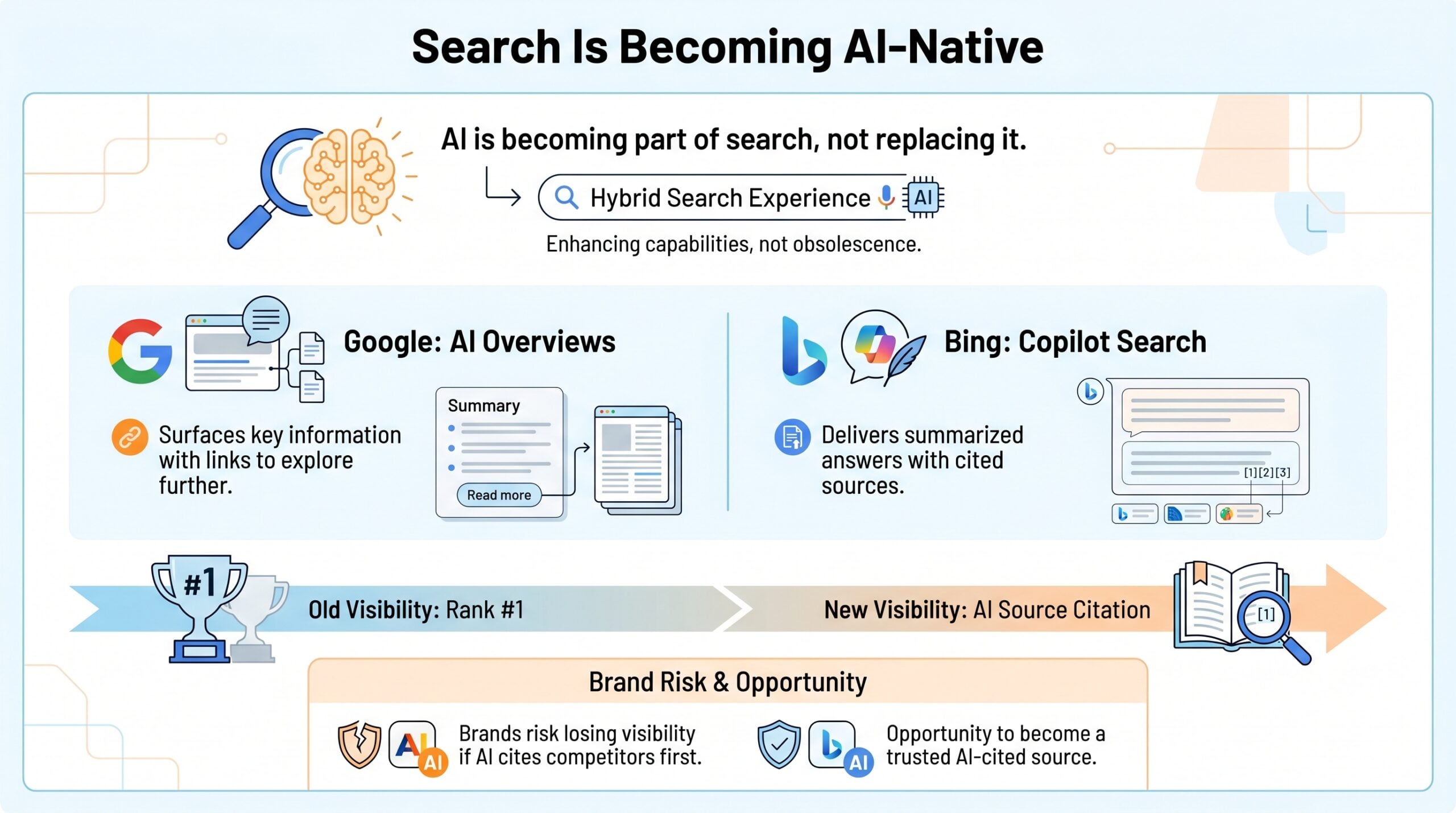
AI is becoming part of the search.
Google, Bing, and other popular search engines are rebuilding the search experience around AI-generated answers, summaries, follow-up prompts, and cited sources.
Google has rolled out AI Overviews and AI Mode as core parts of the search experience, describing AI Overviews as snapshots that surface key information with links for users to explore further. For website owners, Google has also published a dedicated Search Central guide on how AI features work and how content can be optimised for them.
Bing has moved in the same direction with Copilot Search, where users receive summarised answers backed by clearly cited sources, images and videos from publishers. Search is becoming more answer-led, while remaining just as relevant for the brands that learn to show up inside those answers.
For marketers, the real shift is that visibility now extends from rank #1 to being the source AI cites. Ranking remains a strong signal, and it now sits alongside a second prize — earning a place in the AI-generated answer itself.
When Google AI Overviews, Microsoft Copilot, Gemini, ChatGPT, or Perplexity summarise your category and cite competitors, your brand can lose visibility before a user even reaches a search result.
How User Behaviour Is Actually Changing
User behaviour is moving from keyword-based searching to conversational discovery.
In 2026, it was confirmed that Google’s AI Mode in Search has surpassed one billion monthly users within a year of launch, with queries more than doubling every quarter. As Google’s VP of Search put it, “your curiosity doesn’t always fit into keywords.”
Instead of searching for short phrases such as ‘SEO agency Singapore’ or ‘best CRM software,’ users now ask more specific questions, such as which SEO agency a B2B company in Singapore should work with if it needs both Google rankings and AI visibility.
This changes how SEO professionals approach content. Users expect answers that are clear, contextual, and useful immediately. They also expect the ability to ask follow-up questions without restarting the search process, which is where AI search engines have become more useful.
At the same time, Google still plays a major role when users need to verify information, compare providers, check reviews, find local businesses, view prices, or make a high-intent enquiry. AI may shape the early research journey, while Google often supports the final decision.
What This Means for Your Marketing Strategy
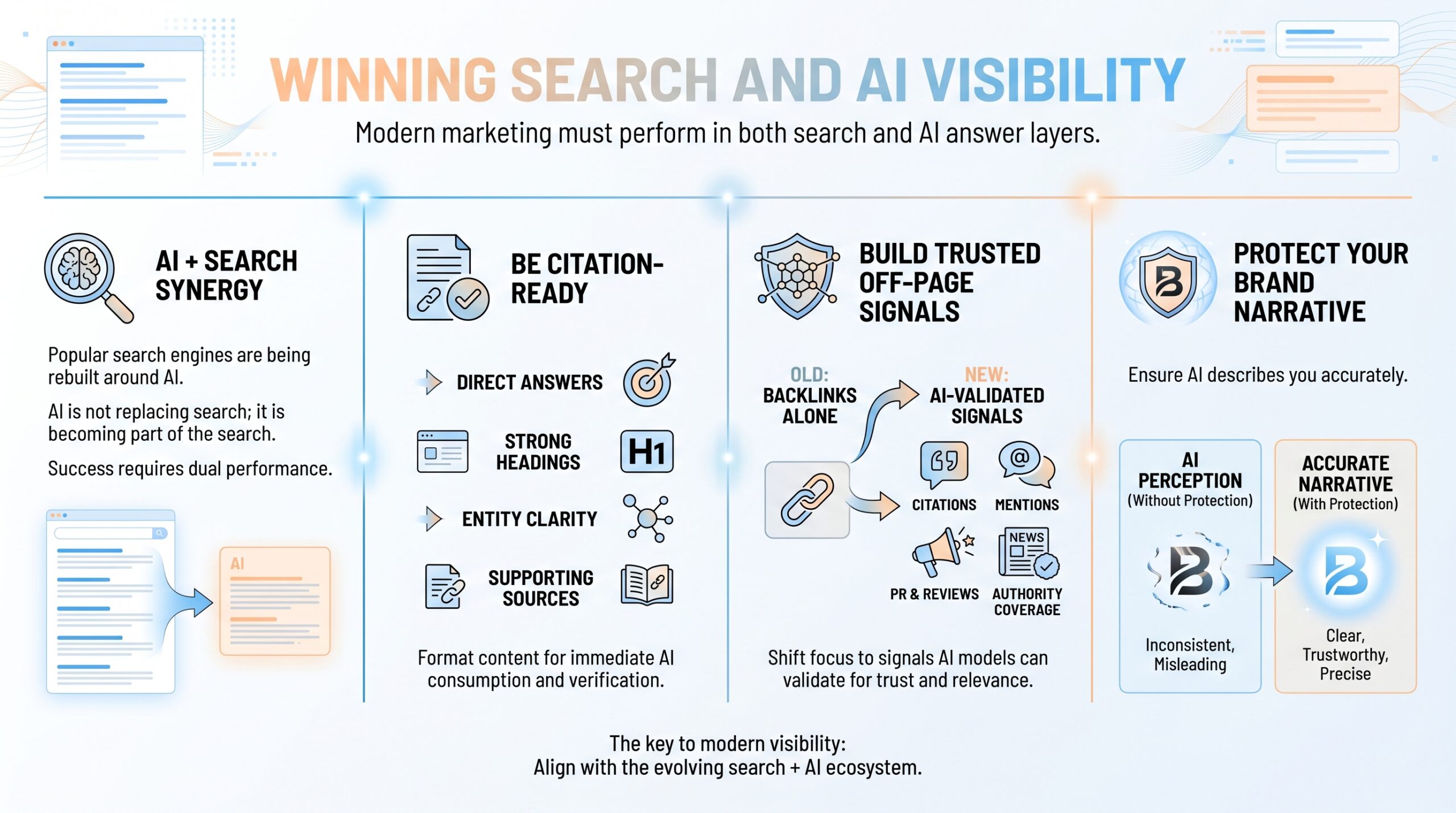
Your marketing strategy now needs to win both search rankings and AI-generated recommendations.
1. Optimise to be cited by AI, not just ranked by Google.
The new battleground is the Google AI Overviews citation. Structure, clarity, E-E-A-T, topical depth, and verifiable claims all influence whether AI systems can understand, trust, and reference your content.
This means your pages need direct answers, clear headings, strong entity signals, original insight, and supporting sources. Read the full playbook in our guide to getting mentioned in Google AI Overviews.
2. Build off-page signals AI models actually trust.
AI systems do not only assess your website. They also look at how consistently your brand appears across third-party mentions, reviews, directories, media coverage, citations, and trusted industry sources.
When the wider web validates your brand, AI systems have more context to understand and recommend you. If you are evaluating a GEO agency, this off-page layer should be part of the strategy, not an afterthought. See our off-page GEO guide for the tactical breakdown.
3. Earn citations and brand mentions, not only backlinks.
Traditional link building still matters, but it has to evolve. Backlinks support rankings, while credible brand mentions help AI systems understand who you are, what you offer, and whether your brand is recognised in its category.
This is why digital PR, expert commentary, reputable directories, reviews, and third-party coverage now play a bigger role in visibility. Our link-building for GEO and AISEO guide explains the shift.
4. Protect how AI describes your brand.
AI systems may summarise your brand whether you actively participate or not. If your online footprint is thin, outdated, inconsistent, or unclear, AI tools may describe your business inaccurately or omit it altogether.
Your brand narrative needs active management across your website, structured data, third-party sources, and authority signals. This is where working with a GEO agency Singapore team can help align your SEO, entity optimisation, and brand visibility strategy. Read how GEO is affecting branding online.
Should You Stop Doing SEO?
No. SEO is the foundation of GEO.
Pages that cannot be crawled, indexed, understood, or trusted by search engines are less likely to be cited by AI systems. Google’s own guidance for AI features still points site owners back to strong Search fundamentals, including content accessibility, quality, and eligibility for search features.
AI models still depend heavily on the web. They draw from indexed pages, publishers, reviews, directories, structured information, and third-party references. That means technical SEO, content quality, internal linking, structured data, topical authority, and backlinks still matter.
The smartest brands are not choosing between SEO and Generative Engine Optimisation. We recommend running both in parallel and treating them as one visibility system.
Search is not dying. It is splitting. Some users will ask AI tools and AI search engines for answers, while others will continue using Google for verification, comparison, local discovery, and purchase intent. Brands that prepare for both journeys will be easier to find, easier to trust, and harder to replace.
If you want to understand how your business appears across Google, Google AI Overviews, ChatGPT, Gemini, Copilot, Perplexity, and other AI-led search experiences, speak to MediaOne.
As an SEO agency in Singapore, we help businesses build a hybrid strategy that protects their search rankings while improving visibility in AI-generated answers.
Speak to MediaOne today to find out where your brand stands across the AI search engines, and how we can help you turn that visibility into measurable business growth.
Frequently Asked Questions
Are AI tools replacing popular search engines?
AI tools are not fully replacing popular search engines. They are changing how people search, especially for informational and exploratory queries. At the same time, Google and Bing are integrating AI into their own search results, so search engines are becoming more AI-driven rather than disappearing.
Why are people using AI instead of Google for some searches?
People use AI tools and search engines because they can ask detailed questions, receive direct summaries, and continue with follow-up questions in a single conversation. This is useful for learning, planning, comparing ideas, and understanding complex topics without having to open multiple search results.
Do AI tools use information from websites?
Yes. Many AI search experiences use information from websites, publishers, reviews, databases, and other online sources. Google AI Overviews also include links that let users explore more on the web, which means website visibility still matters.
Will SEO still matter if AI tools dominate search?
Yes. SEO will still matter because AI visibility depends on crawlable, trustworthy, and well-structured web content. If your pages are unclear, outdated, thin, or difficult for search engines to understand, they are also less likely to be cited in AI-generated answers.
How can businesses stay visible as AI search grows?
Businesses should combine SEO with Generative Engine Optimisation. This means improving technical SEO, publishing useful content, strengthening E-E-A-T, earning credible third-party mentions, using structured data, and monitoring how AI platforms describe, cite, or recommend the brand. A GEO agency can help structure this process strategically.