
The rules of SEO have fundamentally changed, and most content creators haven’t noticed yet. For years, success meant one thing: rank on page one, capture clicks. Today, millions of searches never result in a click. Users find their answers directly at the top of Google, synthesised and served by AI.

The uncomfortable truth? Being visible no longer guarantees being visited. But here’s what most marketers miss: AI Overviews aren’t a threat. They’re the most incredible opportunity to build brand authority since search engines were invented.
When Google’s AI cites your content as one of 3-8 authoritative sources, it’s telling millions of users that your brand represents trustworthy, expert information.
The challenge? Most content, even expertly crafted content, will never be cited. Google’s AI is remarkably selective, favouring sources that meet specific criteria most marketers don’t understand.
This comprehensive guide changes that. You’ll discover the critical factors Google’s AI uses to select sources, proven strategies that increase citation probability, fatal mistakes to avoid, and a practical action plan you can implement immediately.
The brands that master AI Overview citations in 2026 will dominate their industries tomorrow. The question is simple: will your GEO agency be amongst them?
Let’s begin.
Key Takeaways
- Google’s AI Overview synthesises multiple authoritative sources into concise answers, fundamentally changing how users discover and consume content.
- AI citations are the new SEO currency. They signal credibility and authority, even when users don’t click through.
- Quality trumps quantity: Comprehensive, well-structured content written in clear language wins AI citations.
- Established websites with accurate, current information have a significant advantage in Google’s AI selection process.
- The game has changed: Traditional SEO still matters, but being “AI-ready” is now essential.
What Is Google’s AI Overview? Understanding the Search Revolution
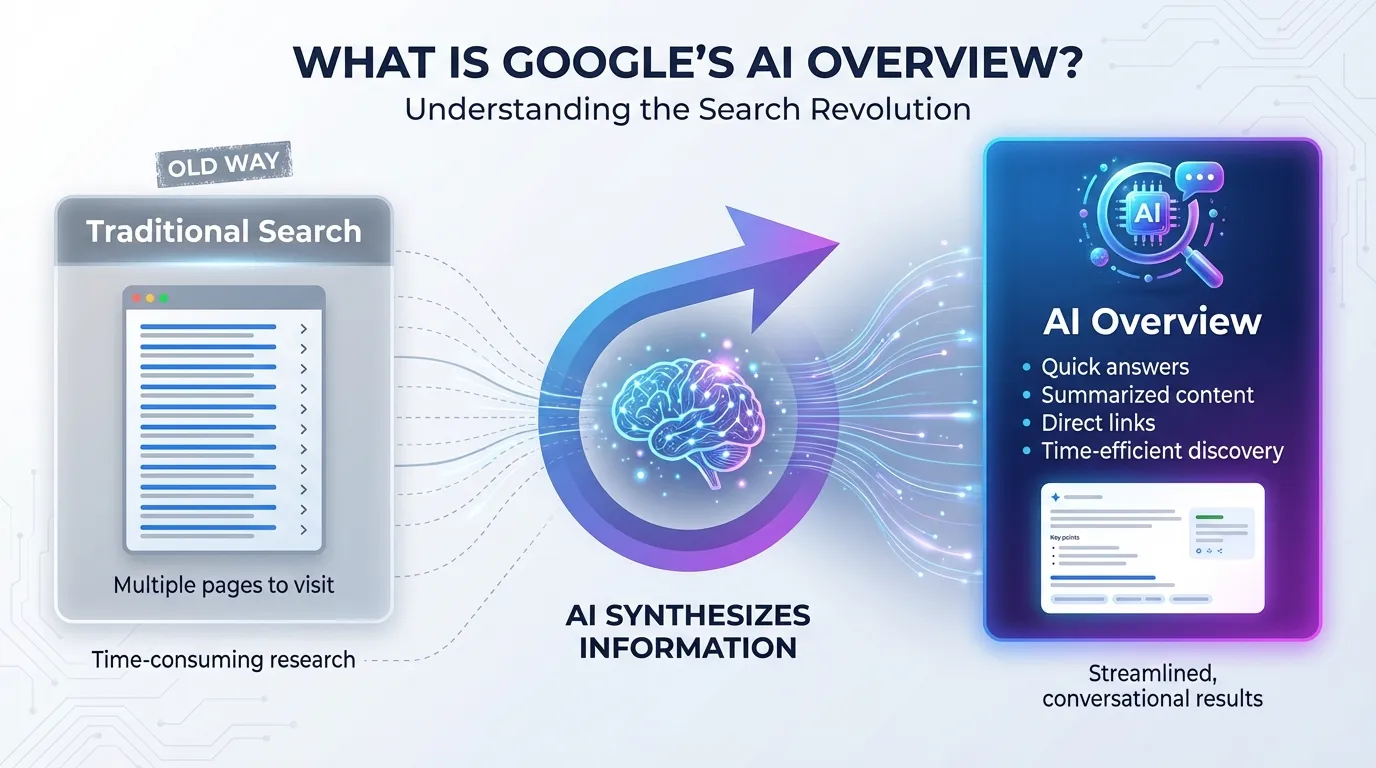
Google’s AI Overview represents a seismic shift in how search engines deliver information. Rather than presenting a traditional list of blue links, Google now generates intelligent, multi-source summaries that appear directly at the top of search results.
These AI-powered snapshots synthesise information from multiple authoritative sources, creating a comprehensive answer before users ever click a link. Think of it as having a knowledgeable assistant who’s already read the top 5-10 articles on your topic and distilled the key insights into one cohesive answer.
Unlike featured snippets that highlight a single source, AI Overviews weave together insights from multiple pages, creating a richer, more nuanced response to user queries.
This approach proves particularly valuable for users seeking immediate understanding of complex topics without having to navigate multiple websites.
AI Overview vs. Traditional Search Results: What’s Changed?
| Feature | AI Overview | Traditional Results |
| Information Delivery | Concise, synthesised summaries combining multiple sources | List of individual web pages with meta descriptions |
| Source Attribution | Cites 3-8 sources with inline references | Single page per result listing |
| User Experience | Immediate answers without clicking | Requires visiting multiple pages |
| Content Creator Impact | Visibility without guaranteed clicks | Direct traffic through clicks |
| Best For | Quick facts, overviews, comparisons, research-intensive queries | In-depth research, specific page content, detailed exploration |
What this means for you: Your content can now gain authority and visibility even if users never visit your page—but only if Google’s AI deems it citation-worthy.
Why Google’s AI Overview Citations Matter More Than You Think
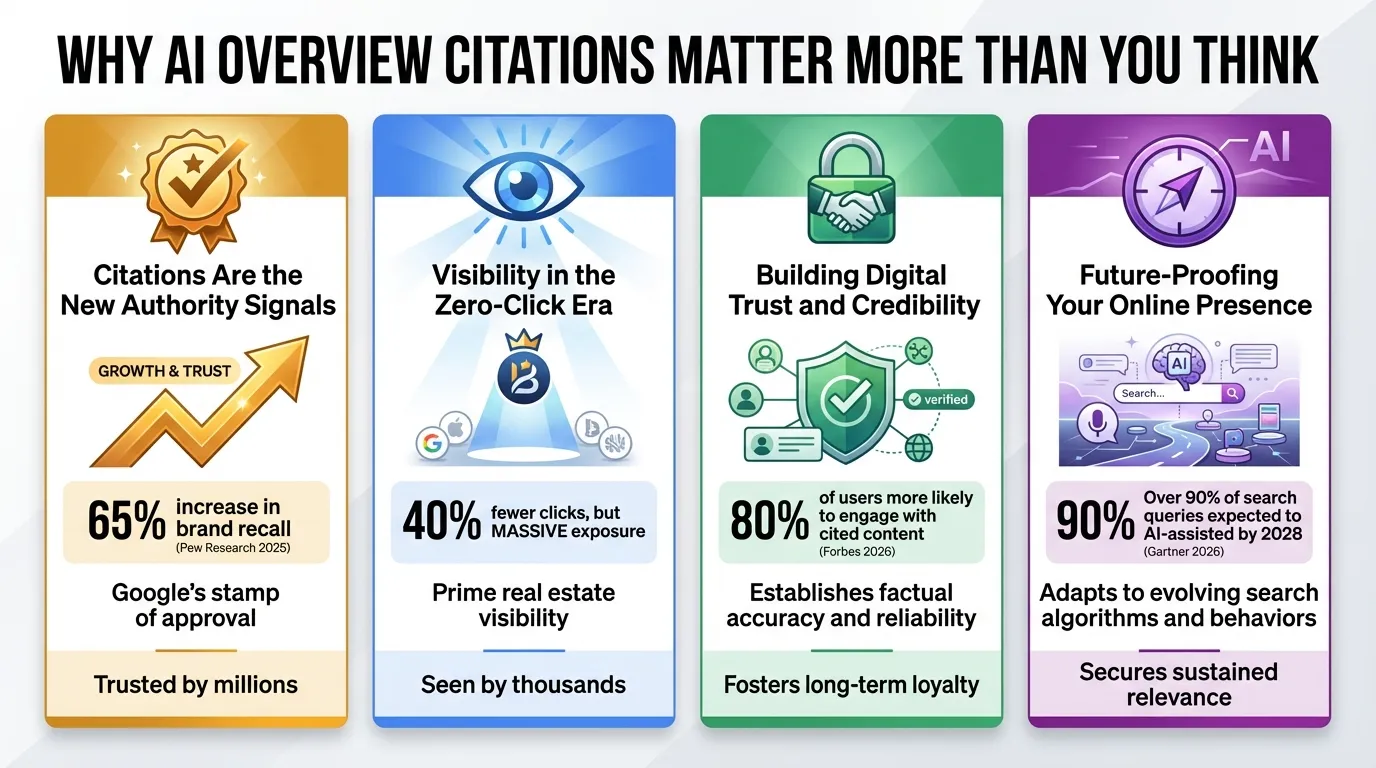
AI overview citations influence how your content is discovered and ranked, directly affecting your visibility and authority in search results. Understanding the impact of AI overview citations sets the stage for actionable strategies to ensure your content gets noticed and referenced.
1. Citations Are the New Authority Signals
When Google’s AI selects your content as a source, it gives your brand a stamp of approval. This recognition tells users—and competitors—that your content is reliable and valuable enough to represent the broader conversation on a topic.
This perceived authority translates directly into tangible benefits. Users instinctively trust brands that appear in AI Overviews, viewing them as go-to resources for specific topics. Over time, this trust compounds, positioning your website as a thought leader in your niche.
The ripple effect: One AI citation can lead to more backlinks, increased social shares, and recognition as a thought leader in your industry. Other content creators notice your authority and reference your work, amplifying your reach exponentially.
2. Visibility in the Zero-Click Era
Even without direct clicks, appearing in an AI Overview places your brand at the pinnacle of search results—often above traditional organic listings. This prime real estate ensures your brand is seen by thousands of users, creating powerful, passive exposure that rivals paid advertising.
For businesses, this visibility creates opportunities that extend beyond immediate website traffic. Users who repeatedly see your brand cited in AI Overviews remember you when they’re ready to engage more deeply or make purchasing decisions.
Real-world impact: A 2025 Pew Research Center analysis found that users are much less likely to click through to external links when Google’s AI Overviews are shown—and that clicks on the cited sources themselves occur in only about 1% of cases.
3. Indirect SEO Superpowers
AI citations correlate strongly with high-performing organic content. Whilst being cited isn’t a direct ranking factor, pages that earn citations typically also:
- Rank well in traditional search results.
- Attract more backlinks from other content creators.
- Demonstrate content quality signals that benefit your entire domain.
- Receive increased social shares and engagement.
The relationship works both ways: strong SEO practices make citations more likely, and citations reinforce your SEO performance. Other websites may reference your content after seeing it cited by Google’s AI, increasing your backlink profile and enhancing your site’s overall authority.
Think of it this way: AI citations are both a validation of your existing SEO strategy and an amplifier of its effects.
4. Future-Proofing Your Content Strategy
As AI continues to dominate search experiences, citation-worthy content becomes essential for long-term visibility. The shift towards AI-generated summaries isn’t temporary—it represents the future direction of search engines worldwide.
Brands that optimise for AI citations now will maintain relevance as search behaviours continue evolving. Those who ignore this shift risk becoming invisible, regardless of how substantial their traditional SEO metrics appear today.
Strategic imperative: Securing AI citations should be treated as a core content objective, not an optional enhancement. As AI increasingly plays a central role in search, your citation rate will become a key indicator of your brand’s digital authority and long-term competitiveness.
How Google’s AI Overview Selects Sources: Decoding the Algorithm
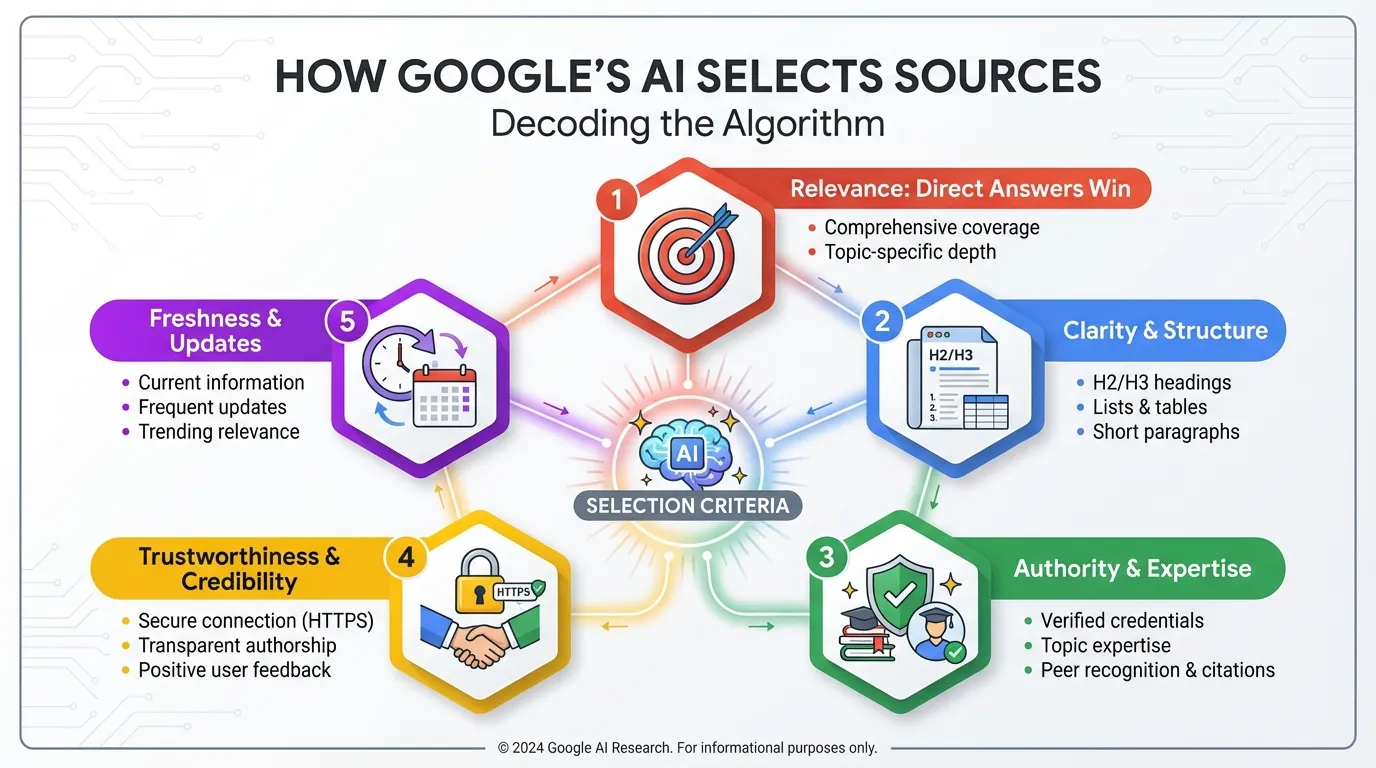
Whilst Google hasn’t published the exact formula, industry analysis and testing reveal five critical factors that determine whether your content gets cited:
1. Relevance: Direct Answers Win
At the heart of AI citations lies relevance. The AI prioritises content that comprehensively addresses the user’s query with precision and depth. Pages that provide in-depth, topic-specific information dramatically outperform those that offer tangential or partial coverage.

For example, if a user searches for “how to optimise content for AI citations,” the AI favours pages that explicitly outline optimisation methods with actionable steps, rather than generic SEO guides that only mention AI Overviews in passing.
Relevance also encompasses accuracy and complete topical coverage. Content that addresses the full scope of a query—including subtopics, related concepts, and potential follow-up questions—is far more likely to be recognised as authoritative.
Pro tip: Structure your content around specific user questions and provide complete, authoritative answers—not just keyword-stuffed paragraphs that dance around the topic.
2. Clarity and Structure: Make It Easy for AI to Parse
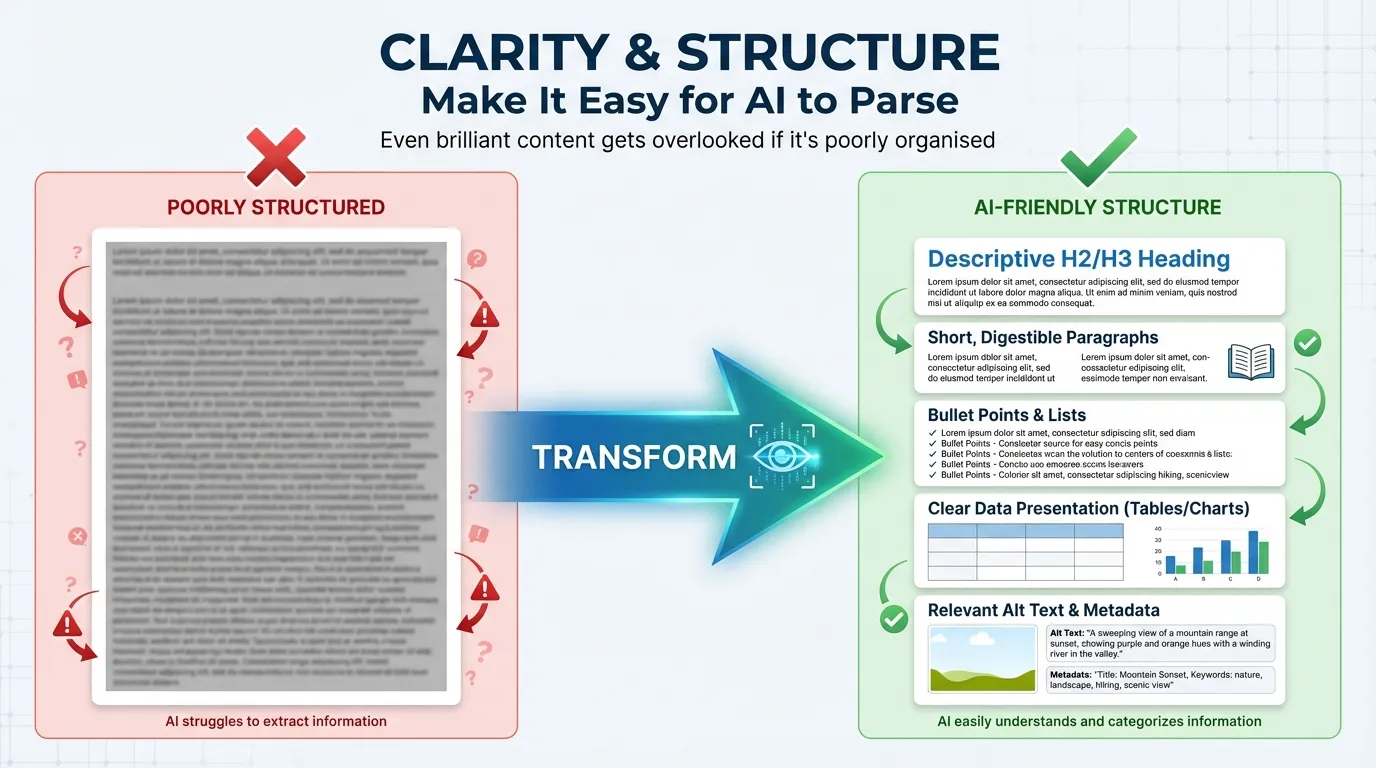
Even brilliant content gets overlooked if it’s poorly organised. Google’s AI models excel at extracting information from content that’s logically structured, concise, and clearly formatted.
The AI favours content featuring:
- Descriptive H2 and H3 headings that clearly signal topic coverage and could stand alone as mini-answers
- Bullet points and numbered lists for step-by-step information and key takeaways
- Tables for comparisons, data presentations, or structured information
- Short paragraphs (3-4 sentences maximum) that focus on single concepts
- Clear topic sentences that immediately convey the paragraph’s main point
Content written in this structured manner serves dual purposes: humans can quickly scan and comprehend it, and AI models can efficiently parse and extract relevant information for citations.
Remember: If a human can quickly scan and understand your content in 30 seconds, so can AI. Clarity for one audience creates clarity for the other.
3. Authority: Reputation and Expertise Matter
Another major factor is the source’s perceived authority. Google’s AI prefers to cite established, reputable sources because it aims to provide reliable summaries that minimise the risk of presenting inaccurate information to users.
Authority signals include:
- Published credentials or expertise demonstrating subject matter knowledge
- High-quality backlinks from other authoritative sites in your industry
- Consistent accuracy across your domain’s content
- Original research, data, or unique insights that other sources reference
- Positive signals from social validation and industry mentions
Trustworthy sources earn citations because they’ve built reputations for reliability over time. This reputation acts as a quality assurance signal that Google’s AI can depend on when synthesising information for users.
The trust factor: AI models are risk-averse by design. Sources with proven track records receive priority because they provide safer, more reliable information.
4. Semantic Alignment: Speak the AI’s Language
Google’s AI models interpret queries by semantic meaning, not just keyword matching. For your page to be cited, its language and terminology must closely align with the AI’s understanding of user intent.
This requires:
- Using precise, topic-relevant terminology that matches industry standards
- Answering questions directly and unambiguously without vague or evasive language
- Including synonyms and related phrases that comprehensively cover the concept
- Matching the user’s search intent, whether informational, navigational, or transactional
Semantic alignment ensures the AI recognises your content as highly relevant and accurate for the query it’s summarising. Content that uses unclear jargon, ambiguous phrasing, or mismatched terminology—even if precise technically—may be overlooked in favour of sources that communicate more clearly.
Example: For “how to optimise for AI Overview,” content should explicitly address AI Overview optimisation with those specific terms—not just generic SEO tips that might tangentially relate to the topic.
5. Traditional SEO Foundations Still Count
Whilst AI-friendly content grows increasingly important, traditional SEO signals still play a crucial role. Most sources cited in AI Overviews come from pages that already rank well in organic search, confirming that SEO fundamentals remain valuable.
Essential traditional signals include:
- Quality backlink profiles from diverse, authoritative sources
- Technical optimisation, including page speed, mobile-friendliness, and clean code
- Strong domain authority built through consistent, quality content
- Proper metadata, including title tags, meta descriptions, and URL structures
This underscores that presentation and readability for AI models are now just as crucial as traditional SEO metrics, not replacements for them.
The balance: You need both traditional SEO strength AND AI-friendly presentation to maximise citation chances. Think of conventional SEO as the foundation and AI optimisation as the finishing touches that make your content truly competitive.
Proven Strategies to Get Your Content Cited On Google’s AI Overview
Getting your content cited not only boosts your credibility but also improves visibility and authority in your field. To put these strategies into action, let’s break down the key steps you can follow to increase the chances of your content being cited.
Strategy 1: Engineer Your Content for AI Consumption
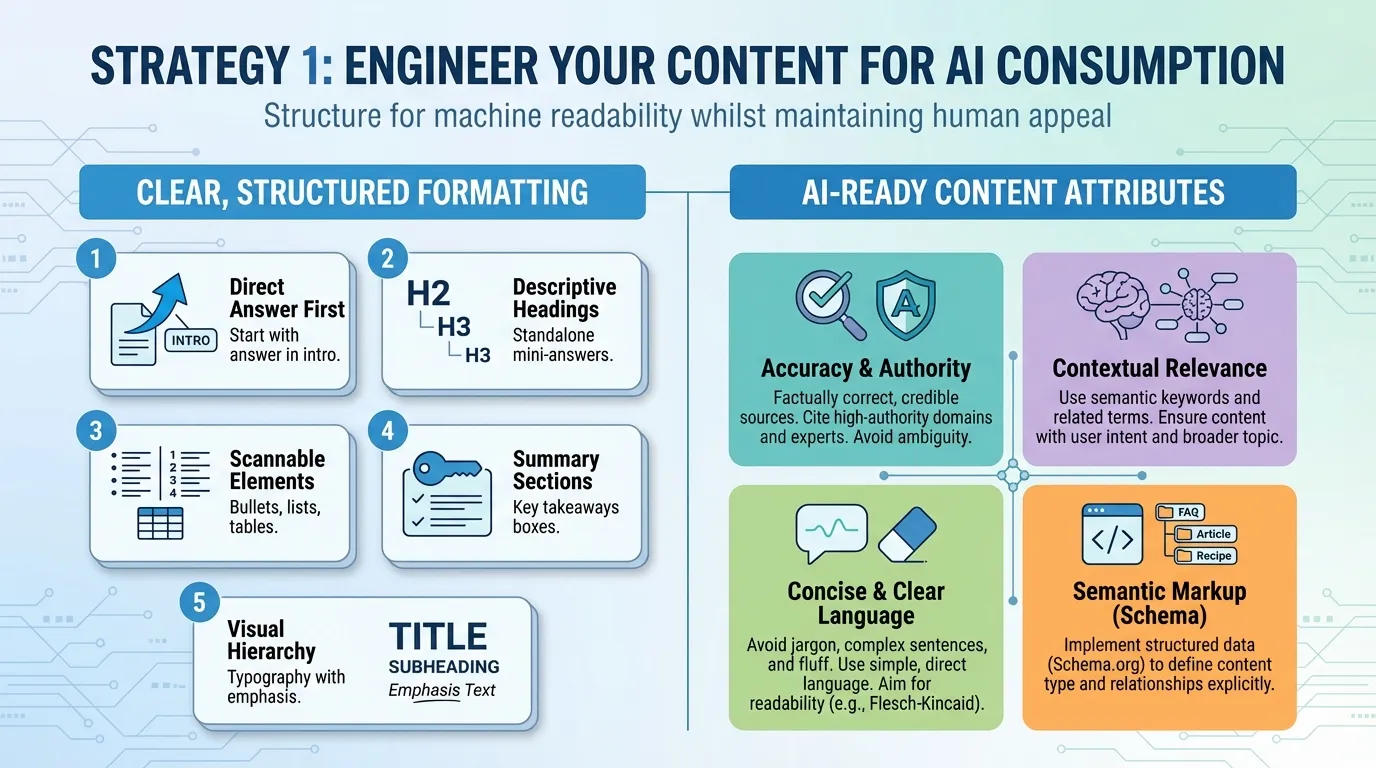
Structure your content specifically for machine readability whilst maintaining human appeal:
Clear, structured formatting:
- Start with a direct answer to the primary question in your introduction.
- Use descriptive headings (H2, H3) that could function as standalone mini-answers
- Break complex information into scannable bullet points, numbered lists, or tables.
- Add summary sections with key takeaways or quick-reference boxes.
- Create a visual hierarchy with bold text, subheadings, and white space.
This structured approach helps AI systems quickly identify key points for summaries whilst simultaneously improving the user experience for human readers.
Example transformation:
- Before: “There are several ways to improve your content for better visibility in search engines, including various formatting techniques and optimisation strategies that can help…”
- After: “5 Ways to Improve Content for AI Citations: 1. Use clear, descriptive headings, 2. Add structured data markup, 3. Update content quarterly…”
Strategy 2: Write Conversationally (Like Answering a Friend)
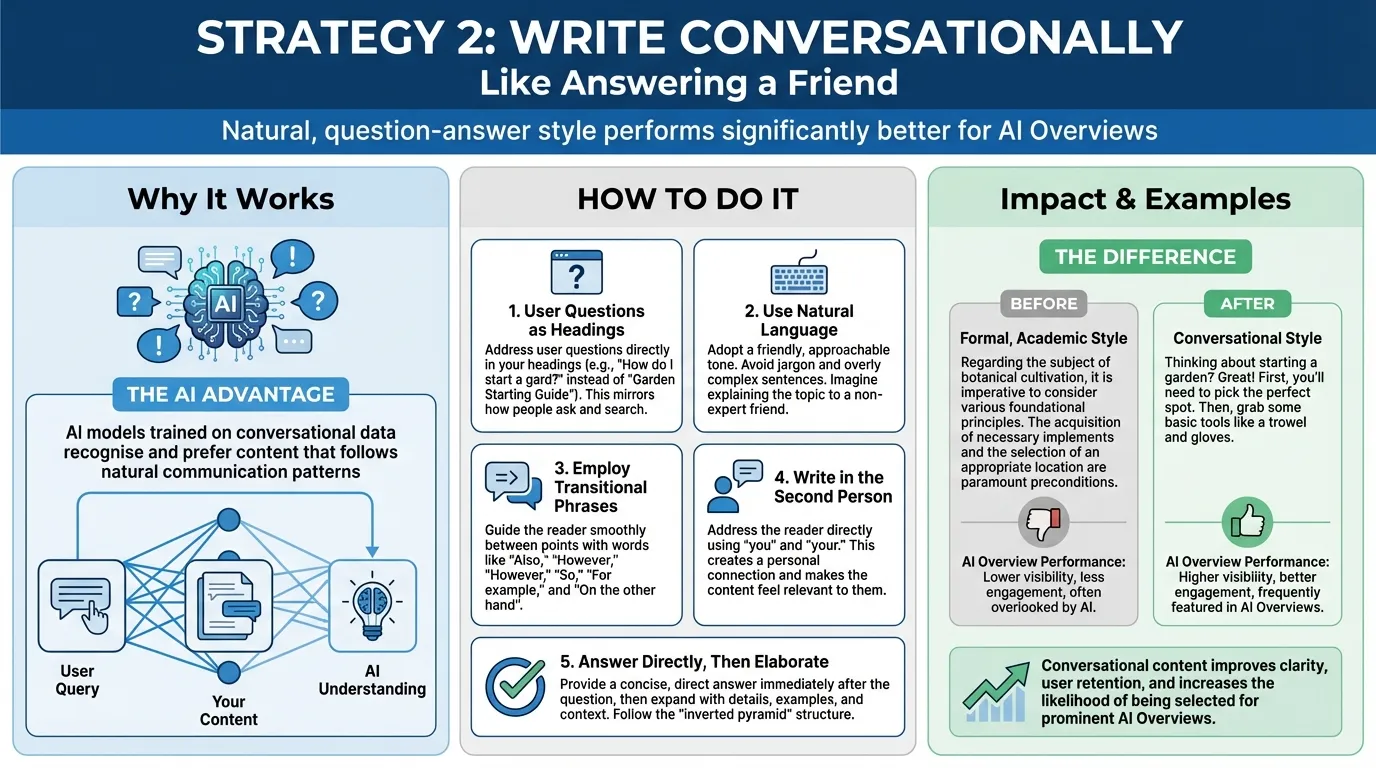
Content written in a natural, question-answer style performs significantly better for AI Overviews because it mirrors how users naturally search and ask questions.
Implementation tactics:
- Include common user questions as H2/H3 headings exactly as users might ask them.
- Answer questions immediately and directly in the first sentence following the heading.
- Create dedicated FAQ sections addressing long-tail queries and related questions.
- Use conversational transitions like “Here’s how,” “The key is,” “This means,” “In practice”
- Avoid corporate jargon in favour of clear, accessible language.
This conversational approach improves the AI’s ability to extract your content because it aligns with the natural language processing models Google uses to understand user queries.
Why it works: AI models trained on conversational data recognise and prefer content that follows natural communication patterns.
Strategy 3: Add Unique, Data-Driven Value
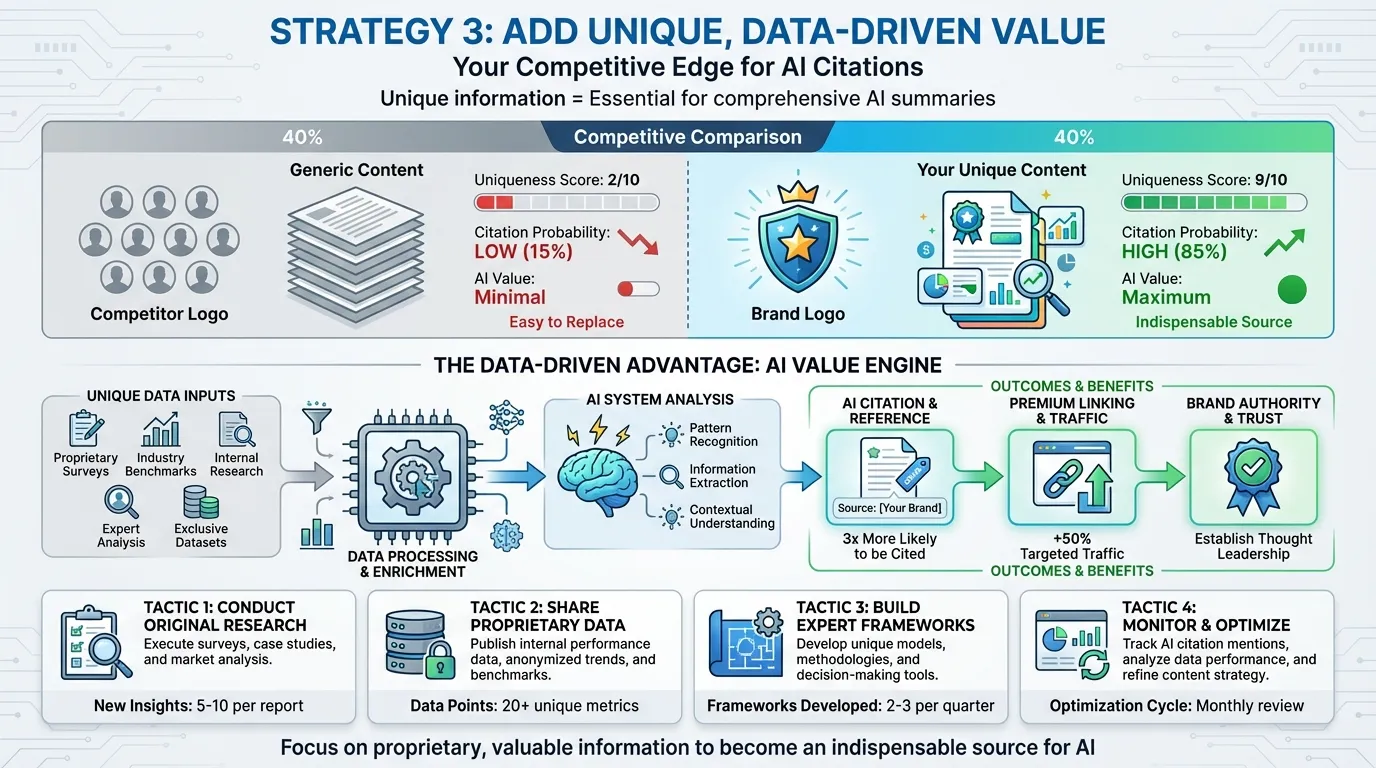
Stand out by providing information that can’t be easily found elsewhere. AI models prioritise sources that offer verifiable, unique information over generic summaries that rehash common knowledge.
High-value content types:
- Original research: Conduct surveys, experiments, or studies within your industry
- Proprietary data: Share unique statistics, case studies, or analytical insights
- Expert insights: Include interviews, expert commentary, or professional perspectives
- Updated information: Be amongst the first to cover new developments or emerging trends
- Unique examples: Provide real-world case studies or detailed implementation stories
Make sure all data is clearly labelled, properly sourced, and easy to reference. Use tables, charts, or callout boxes to highlight key statistics that AI can easily identify and extract.
Why it works: When your content offers information unavailable elsewhere, it becomes essential for comprehensive AI summaries, dramatically increasing citation probability.
Strategy 4: Implement Schema Markup
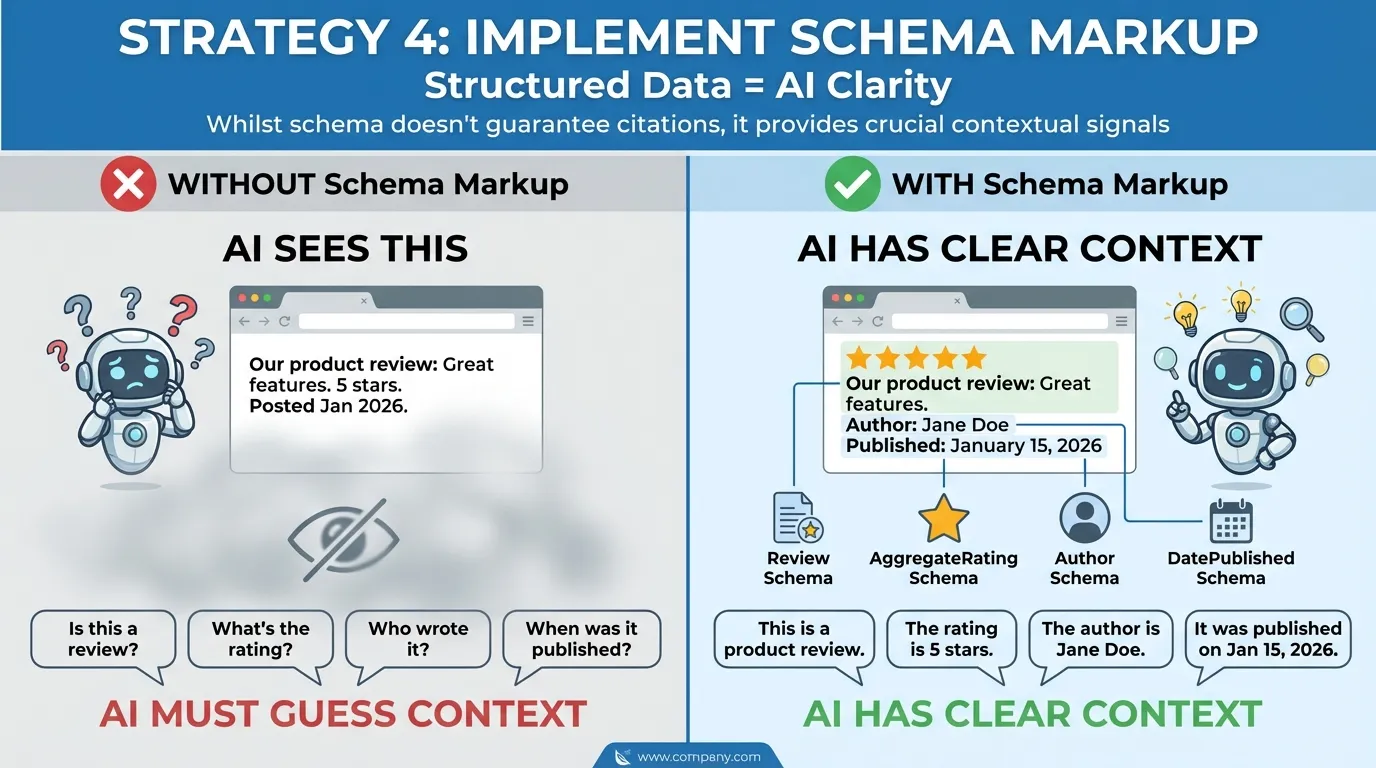
Structured data helps AI systems interpret your content with greater precision and confidence. Whilst schema doesn’t guarantee citation, it provides crucial contextual signals that improve your content’s discoverability and interpretability.
Priority schema types for AI citations:
- FAQ Schema: For question-answer content and FAQ sections
- HowTo Schema: For step-by-step guides and instructional content
- Article Schema: For news articles, blog posts, and editorial content
- Review Schema: For product or service reviews with ratings
Implementing schema is relatively straightforward using tools such as Google’s Structured Data Markup Helper or the schema.org documentation. Validate your markup using Google’s Rich Results Test to ensure proper implementation.
Technical tip: Focus on schema types that align with your content format and user intent, rather than implementing every possible markup type.
Strategy 5: Keep Content Fresh and Current
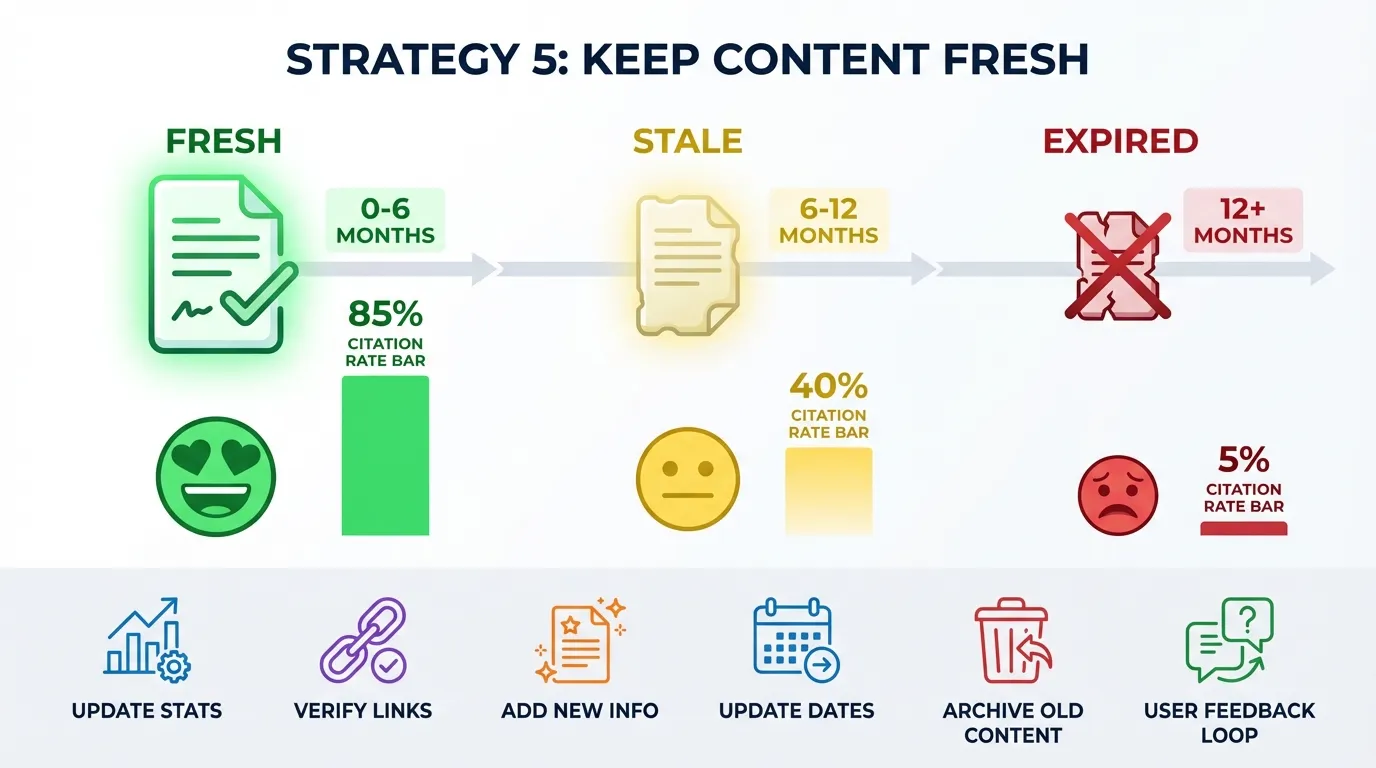
AI-generated summaries are designed to provide users with accurate, up-to-date information. Pages containing outdated statistics, old references, or obsolete recommendations are significantly less likely to be cited.
Content maintenance checklist:
- Review and update statistics quarterly or when new data becomes available.
- Replace outdated examples with current case studies and real-world applications.
- Verify all external links remain active, relevant, and point to authoritative sources.
- Add new sections addressing emerging trends or recent developments.
- Update publication dates when content is substantially refreshed
- Remove or archive genuinely outdated content that no longer serves users.
For example, citing a 2022 study on search engine trends in 2026 content—without acknowledging more recent research—significantly reduces your content’s perceived relevance and citation worthiness.
Strategic approach: Create a content calendar that includes regular audit dates for your highest-priority pages. Treat content maintenance as an ongoing investment, not a one-time project.
Critical Mistakes That Lowers Your Chances on Being Cited On Google’s AI Overview
Even well-written, informative content can fail to appear in Google’s AI Overview if it falls into common pitfalls. Understanding and avoiding these mistakes is crucial for maximising your citation probability.
Mistake 1: Thin, Generic Content
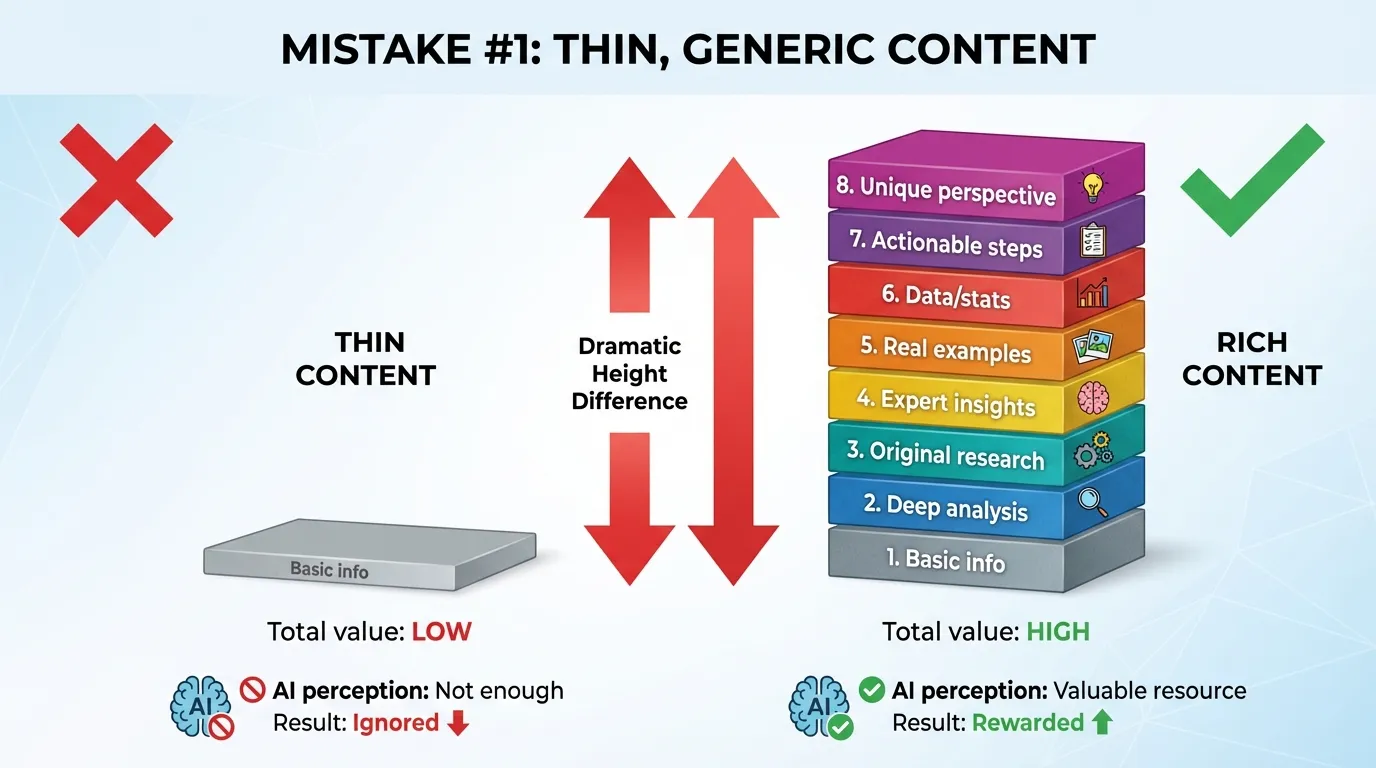
The problem: Surface-level content that rehashes widely available knowledge without adding new insights, depth, or unique perspectives.
Thin content typically:
- Provides superficial information that only scratches the surface
- Repackages common knowledge without original analysis
- Offers limited context, leaving important questions unanswered
- Fails to differentiate itself from dozens of similar articles
AI models prefer sources that fully address user queries with thorough explanations, detailed examples, and actionable guidance. Generic content gets filtered out in favour of comprehensive, authoritative sources.
The fix: Create content that is demonstrably more comprehensive and insightful than competing pages. Go deeper than your competitors by adding:
- Real-world examples and case studies
- Step-by-step implementation guidance
- Expert perspectives and interviews
- Original analysis or unique frameworks
- Practical templates or tools
Citation killer example:
❌ “SEO is important for rankings and helps drive traffic to your website.”
✅ “SEO drives 68% of trackable website traffic according to BrightEdge 2025 data, making it the highest-ROI marketing channel with an average return of £22 for every £1 invested (Deloitte Digital).”
Mistake 2: Outdated Information
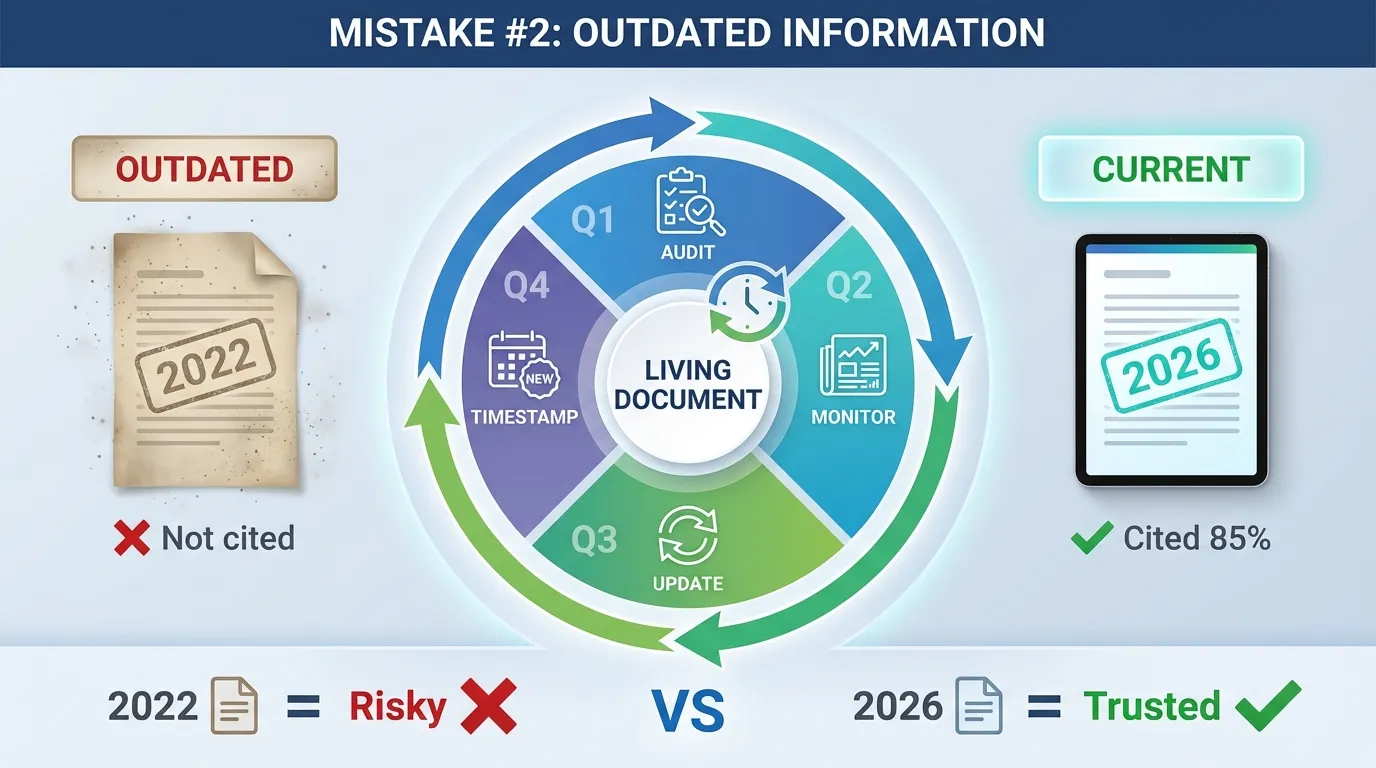
The problem: Old statistics, obsolete recommendations, or references to past years as if they were current undermine your content’s credibility.
Outdated content signals to AI that your page may not represent the current state of knowledge on a topic, making it risky to cite.
The fix: Establish a content audit schedule and treat high-value pages as living documents:
- Flag time-sensitive content for quarterly or bi-annual reviews
- Set calendar reminders for pages with dated information.
- Monitor industry news for developments that affect your content.
- Update publication dates when content is substantially refreshed
- Add “Last updated” timestamps to show content currency.
Citation killer example:
❌ “In 2022, Google announced major algorithm updates that changed how content is ranked…”
✅ “Google’s March 2026 core update prioritised E-E-A-T signals, building on foundational changes introduced in previous years…”
Mistake 3: Excessive Filler and Fluff
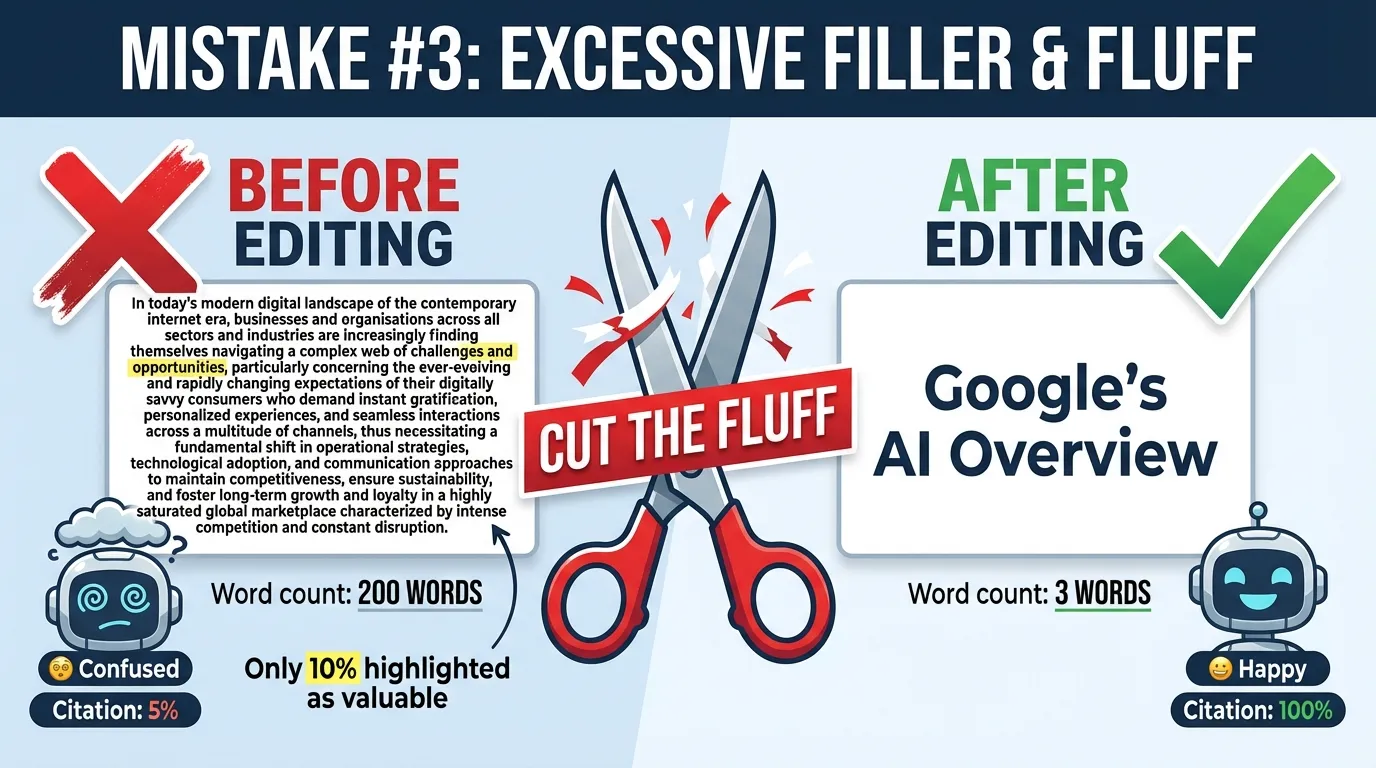
The problem: Long-winded text that buries key information under unnecessary verbiage, making it difficult for AI models to identify valuable content.
AI algorithms are designed to extract concise, high-value information. Content that’s verbose or unfocused risks being overlooked entirely, even if it contains good information somewhere within the fluff.
Examples of problematic filler:
- Long introductory paragraphs that don’t address the topic
- Repetitive sections that restate the same ideas multiple times
- Irrelevant tangents or background information
- Overuse of jargon or unnecessarily complex sentences
- Meandering explanations that take 200 words to convey a 50-word concept
The fix: Edit ruthlessly with focus on clarity and concision:
- Every paragraph should deliver distinct value.
- Use the “so what?” test—if you can’t explain why a sentence matters to the reader, cut it.
- Remove redundant phrases and tighten language.
- Get to the point quickly in introductions.
- Break long paragraphs into shorter, focused segments.
Citation killer example:
❌ “In today’s modern digital landscape of the contemporary internet era, businesses and organisations across all sectors and industries are increasingly discovering and realising…”
✅ “Google’s AI Overview now appears in 64% of searches, fundamentally changing content strategy requirements.”
Mistake 4: Poor Structure and Formatting

The problem: Large walls of text without clear organisation, vague headings, or a lack of visual hierarchy make it difficult for AI to extract and understand key points.
Even if your content contains excellent information, poor presentation can render it invisible to AI systems that rely on structural cues to identify important content.
The fix: Use visual hierarchy and formatting strategically:
- Create descriptive headings that clearly convey the section’s content.
- Use subheadings to break content into logical, digestible chunks.
- Add bullet points or numbered lists for sequential information or key points.
- Include tables for comparisons, data, or structured information.
- Incorporate white space to prevent overwhelming visual density.
- Bold key concepts to create scannable anchor points
Technical tip: Test your content by scrolling quickly through the page. Can you understand the main points from headings and formatted elements alone? If not, improve your structure.
Tracking Your Google’s AI Overview Performance
Because Google doesn’t provide dedicated reporting tools for AI Overview citations, content creators must use a combination of methods to track their presence and measure impact.
Method 1: Strategic Manual Monitoring

One of the most direct ways to track AI Overview citations is through regular manual searches. This involves entering queries related to your content and observing which sources the AI Overview cites.
Best practices for manual monitoring:
- Test 10-15 core queries weekly that align with your priority content topics
- Use incognito mode to avoid personalised results that might skew observations.
- Note repeated citations across multiple related searches to identify your strongest content.
- Track competitor appearances to understand which other pages are cited alongside yours
- Screenshot citations for reporting, trend analysis, and stakeholder communication
- Test query variations to see how different phrasings affect citation patterns
Whilst time-consuming, manual checks allow you to directly confirm AI recognition and understand the competitive landscape for citations.
Efficiency tip: Create a spreadsheet template to systematically document your findings, including date, query, whether you were cited, position in citation list, and competing sources.
Method 2: SERP Monitoring Tools
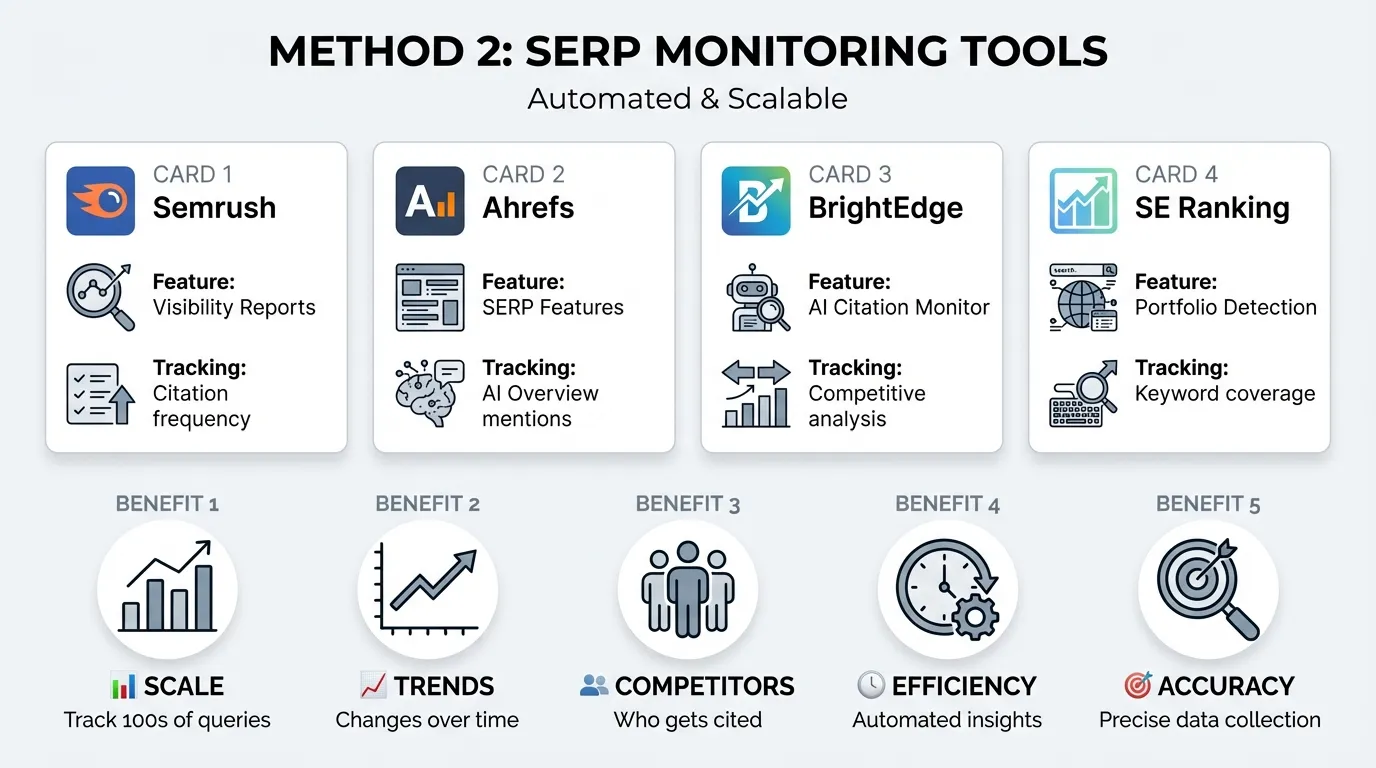
For a more automated and scalable approach, advanced SEO platforms now offer functionality to detect AI Overview appearances and track citations over time.
Recommended tools with AI Overview tracking:
- Semrush: AI Overview, visibility reports, and citation frequency tracking
- Ahrefs: SERP features tracking, including AI Overview mentions
- BrightEdge: Dedicated AI citation monitoring and competitive analysis
- SE Ranking: AI Overview detection across keyword portfolios
Benefits of using monitoring tools:
- Ongoing visibility: Track citations across dozens or hundreds of queries simultaneously
- Trend analysis: Identify changes in citation frequency and visibility over time
- Competitive intelligence: See which competitor pages are cited and how often
- Historical data: Build a database of citation patterns for strategic planning
- Alert systems: Receive notifications when your content appears in new AI Overviews
Whilst no tool can perfectly capture every AI Overview citation across all possible queries, combining automated tracking with manual checks provides comprehensive visibility.
Method 3: Indirect Analytics Signals
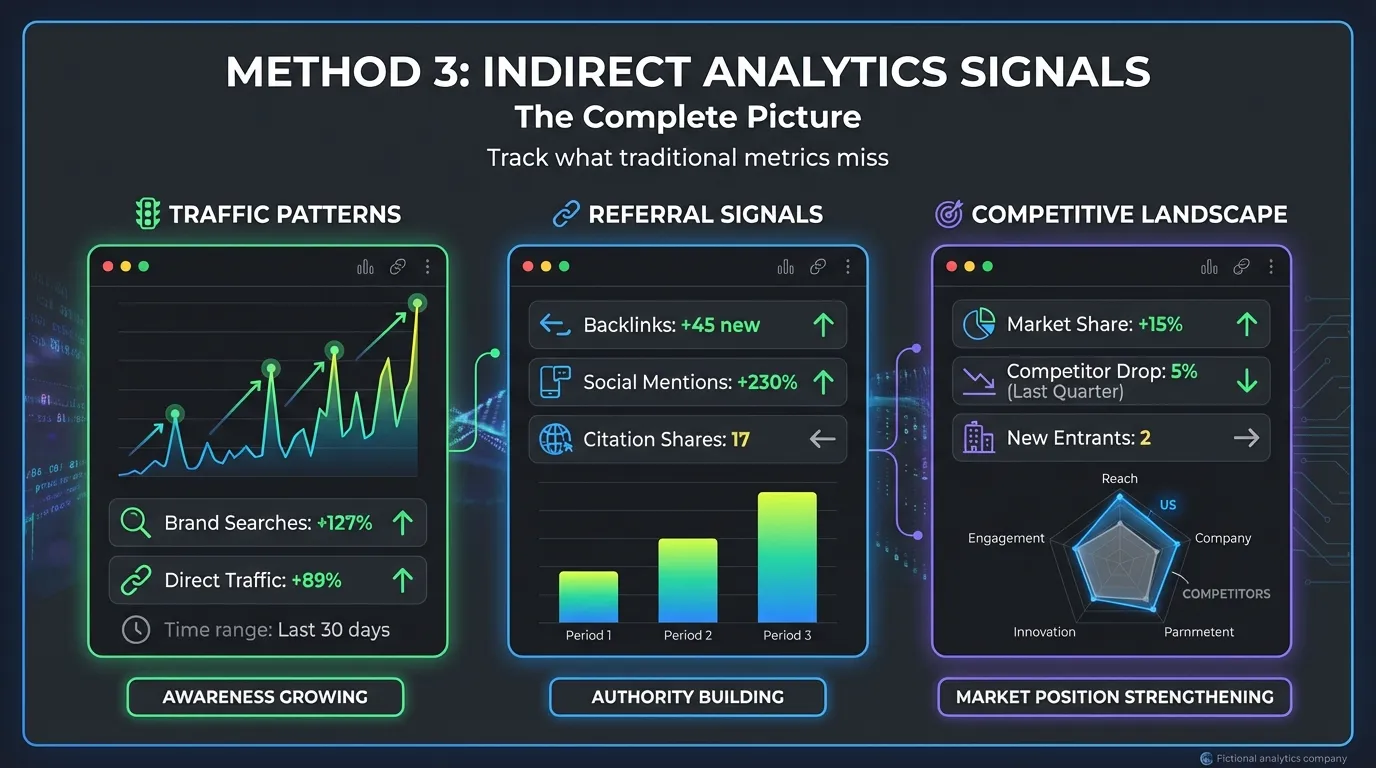
Because AI Overviews can reduce direct clicks to your page, traditional traffic metrics may not fully capture their value. Indirect analytics help measure the broader impact of being cited.
Key metrics to monitor:
Traffic patterns:
- Traffic spikes corresponding with relevant search queries, even if clicks are delayed
- Increases in direct traffic as users remember your brand from citations
- Branded search volume growth indicates increased awareness.
Referral analysis:
- Referral sources are driving users to your site after seeing citations.
- Social media mentions of your content following AI Overview appearances
- Backlink acquisition from other sites referencing your cited content
Engagement signals:
- Time on page for organic visitors (higher engagement suggests strong content quality)
- Pages per session indicates users exploring more of your content.
- The return visitor rate shows the percentage of users who return after initial exposure.
- Scroll depth demonstrating content consumption.
These indirect metrics provide a broader understanding of how AI citations influence user behaviour and contribute to your overall brand presence.
Method 4: Brand Monitoring and Authority Signals
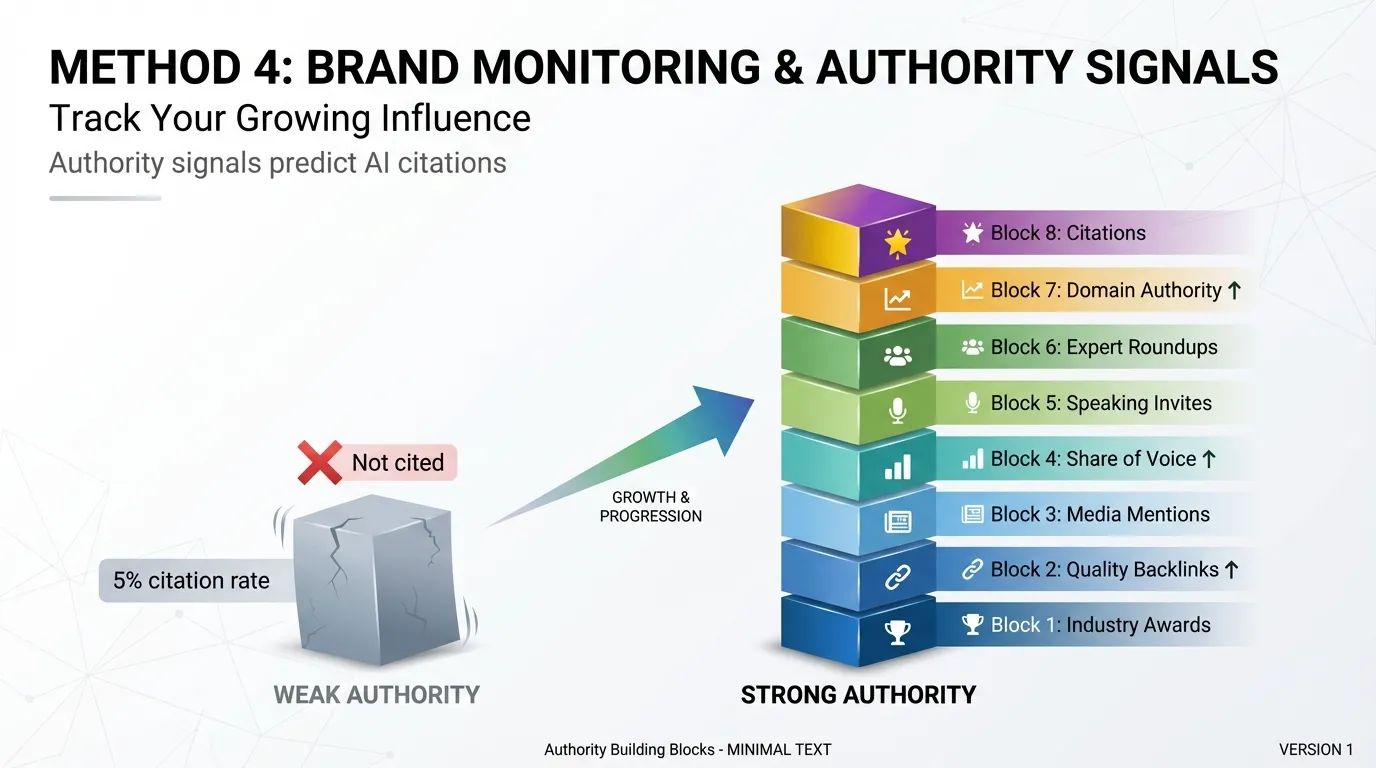
Track broader indicators of growing authority that correlate with AI citations:
Brand presence metrics:
- Brand mention volume across the web, news, and social media
- Share of voice compared to competitors in your industry
- Industry publication features or expert roundup inclusions
- Speaking invitation increases or partnership opportunities
Authority indicators:
- Backlink growth rate from authoritative domains
- Domain authority improvements over time
- Citation by other content creators referencing your work
- Industry recognition, such as awards or certifications
Redefining Success Metrics for the AI Era
It’s critical to understand that AI Overviews fundamentally change how we measure content success.
Old mindset: “Success = click-through rate and immediate traffic”
New mindset: “Success = visibility + authority + long-term brand equity + citation frequency”
Focus on comprehensive performance indicators:
- Impression share: How often your brand appears in AI Overviews for target queries
- Authority signals: Backlinks, mentions, and industry recognition resulting from citations
- Content reputation: Becoming known as the definitive source on specific topics
- Organic ranking improvements: Correlation between citations and traditional search performance
- Brand recall: Users remembering and returning to your content

By combining manual observation, SERP monitoring tools, indirect analytics, and authority signals, you can effectively track your AI Overview presence and adapt your strategy to maximise both visibility and long-term brand value in an AI-driven search landscape.
Your Action Plan: 7 Steps to Start Earning Citations Today
Ready to optimise your content for AI Overview citations? Follow this structured, week-by-week action plan to systematically improve your chances of being cited.
Week 1: Audit and Prioritise
Step 1: Identify high-potential content
- Review your analytics to find your top 10-20 highest-traffic pages.
- Identify cornerstone content that represents your core expertise.
- Flag pages targeting queries where AI Overviews currently appear
Step 2: Conduct competitive citation research
- Manually search for queries related to your priority content.
- Document which competitors are being cited in AI Overviews
- Analyse what makes their content citation-worthy (structure, depth, data)
Step 3: Prioritise optimisation targets
- Score pages based on traffic potential, competitive gap, and citation likelihood
- Focus first on pages where you’re already close to citation (ranking in top 5-10)
- Create a prioritised list of 5-10 pages to optimise first.
Week 2-3: Optimise Existing Content
Step 4: Restructure for AI readability
- Add clear, descriptive H2 and H3 headings that answer specific questions.
- Break long paragraphs into 3-4 sentence chunks.
- Convert dense text into bullet points, numbered lists, or tables.
- Add a “Key Takeaways” or summary section at the top.
Step 5: Update and enhance information
- Replace outdated statistics with the current 2026 data.
- Add original insights, case studies, or unique examples.
- Include expert quotes or interviews if available.
- Remove or rewrite thin, generic sections.
- Verify all external links are current and authoritative.
Step 6: Implement technical optimisation
- Add relevant schema markup (FAQ, HowTo, Article)
- Optimise page speed and mobile experience
- Ensure proper meta descriptions and title tags.
- Add internal links to related content.
Week 4: Create New Citation-Worthy Content
Step 7: Develop comprehensive resources
- Identify gaps where AI Overviews appear, but you lack content.
- Create in-depth guides on topics where you have genuine expertise.
- Include original data, research, or proprietary insights.
- Structure content specifically for AI consumption from the start
Step 8: Use the question-based approach
- Research common questions in your niche using Answer the Public or People Also Ask.
- Create content that directly answers these questions.
- Use questions as H2 headings followed by direct answers.
- Build comprehensive FAQ sections.
Ongoing: Monitor and Iterate
Step 9: Establish tracking systems
- Set up manual monitoring for 10-15 priority queries weekly.
- Configure SERP tracking tools if available
- Create a spreadsheet to log citation appearances.
- Monitor analytics for indirect signals (brand searches, engagement)
Step 10: Analyse performance patterns
- Review which content types and formats get cited most frequently.
- Identify common characteristics of your successfully cited content.
- Document what works and what doesn’t in your specific niche.
- Share insights with your content team.
Step 11: Continuously refine your approach
- Double down on strategies that generate citations.
- Revise or retire underperforming content.
- Stay updated on AI Overview changes and algorithm updates.
- Test new formats and approaches regularly.
- Maintain a quarterly content refresh schedule.
Bonus: Build a sustainable system
- Train your content team on AI-friendly writing principles.
- Create templates and checklists for citation-optimised content.
- Establish content maintenance calendars.
- Set up alerts for industry changes that require content updates.
By following this systematic approach, you’ll position your content to earn AI Overview citations whilst simultaneously improving its value for human readers. Start with one high-potential page this week, apply the strategies, and track your results over the next 30-60 days.
The Future of Google’s AI Overview Is Here
Google’s AI Overview isn’t a temporary experiment or a feature that might be rolled back—it’s the future of search, and that future is already here. We’re shifting from a click-based economy to an authority-based one. Your brand’s value is now measured by how often you’re recognised as a trusted source, not just by traffic.
The good news? Earning citations still follows timeless content principles: be comprehensive, accurate, clear, and authoritative. AI Overviews simply make them more visible and important.
Master these principles, and you’ll thrive in both AI-driven and traditional search. Brands that adapt fastest will dominate tomorrow’s landscape, while those clinging to old strategies will fade.
Your competitive advantage starts today. The brands winning AI citations in 2026 will be the industry leaders of 2027 and beyond. Make sure your brand is amongst them. Partner with MediaOne to start optimising your content for AI citations today. The AI era waits for no one. Contact us now!
Frequently Asked Questions
Can new or small websites get cited in AI Overviews?
Yes, absolutely! Whilst established domain authority helps, Google’s AI prioritises content quality and relevance above site size or age. Small sites and new domains with exceptional, unique content regularly appear in AI Overviews, sometimes even outranking larger competitors.
The key is focusing on creating the most comprehensive, authoritative content on specific topics where you have genuine expertise. A well-researched 3,000-word guide from a small site will outperform a superficial 500-word post from a major publication. Original research, unique data, expert insights, and superior content structure can level the playing field.
How often do AI Overviews update?
AI Overviews are dynamic and can update multiple times daily, as Google’s algorithms continuously reassess available sources.
Your content might appear in an AI Overview today and be replaced tomorrow, or vice versa, as the system discovers new sources or reevaluates existing ones.
This dynamic nature makes ongoing optimisation and content freshness absolutely critical. A one-time optimisation won’t guarantee permanent citation. Instead, treat your high-value content as living documents that require regular maintenance, updates, and improvements.
Do AI citations improve my traditional SEO rankings?
There’s no direct ranking boost from AI citations—Google has confirmed that appearing in an AI Overview doesn’t automatically improve your organic position. However, a strong correlation exists between content that earns citations and content that ranks well organically.
Can my content be included in AI Overviews?
No formal submission process exists. Unlike submitting a sitemap to Google Search Console, you cannot request inclusion in the AI Overview directly. Google’s AI systems automatically discover, evaluate, and select sources based on relevance, quality, and authority signals.
Whilst you can’t request inclusion, you can make your content impossible for Google’s AI to ignore by becoming genuinely authoritative and comprehensive on specific topics.
How do I handle reduced click-through rates from AI Overviews?
Reframe your success metrics and recognise that AI citations deliver value beyond immediate clicks. Whilst AI Overviews can indeed reduce click-through rates, as users get answers directly from summaries, this doesn’t diminish citation value.