
You already know rankings are no longer the end goal. What you are really fighting for now is recommendations. As AI tools start to replace traditional search engines, every brand has to make a choice. When Google AI Overviews, ChatGPT, or Perplexity answers a question, you are either cited, summarised, or invisible.

Here is the shift most businesses in Singapore still underestimate. AI answers are not built from your website alone. They are constructed from distributed authority signals across the web. News sites. Reviews. Forums. Industry blogs. Databases. Anywhere your brand shows up, with or without a link.
This is exactly where off-page GEO earns its place in your strategy. It addresses a gap that traditional SEO strategies were not originally built to solve: proving authority beyond your own website.
Even with strong on-page optimisation, clean schema, and technically sound content, your brand may still be excluded from AI-generated answers if the wider web does not independently validate your expertise. This is one of the main reasons brands are losing organic traffic to AI search without realising it.
We have not written this guide to repeat SEO basics. Together, we will unpack what off-page GEO actually is, why it now drives AI visibility, and how to execute it deliberately. You will learn what off-page GEO actually is, why it now drives AI visibility, and how to execute it deliberately, using the signals AI systems already rely on rather than guesswork.
Because AI engines weigh trust before they cite, the brands that win visibility are the ones already shaping how the wider web talks about them. This is why serious brands are now working with a GEO agency to build the external authority needed to turn online mentions into AI citations.
Key Takeaways
- Off-page GEO determines whether AI engines trust and cite your brand by evaluating how consistently and credibly others talk about you across the web, not how well your own website is optimised.
- AI systems favour brands that show strong entity validation, repeated third-party mentions, and real user signals such as reviews and expert commentary, because consensus across sources reduces uncertainty in generated answers.
- Winning AI visibility requires an ongoing, strategic effort to build authoritative mentions and reputation beyond links, as off-page trust accumulates and increasingly separates cited brands from those that remain invisible.
What Is Off-Page Generative Engine Optimisation (GEO)?
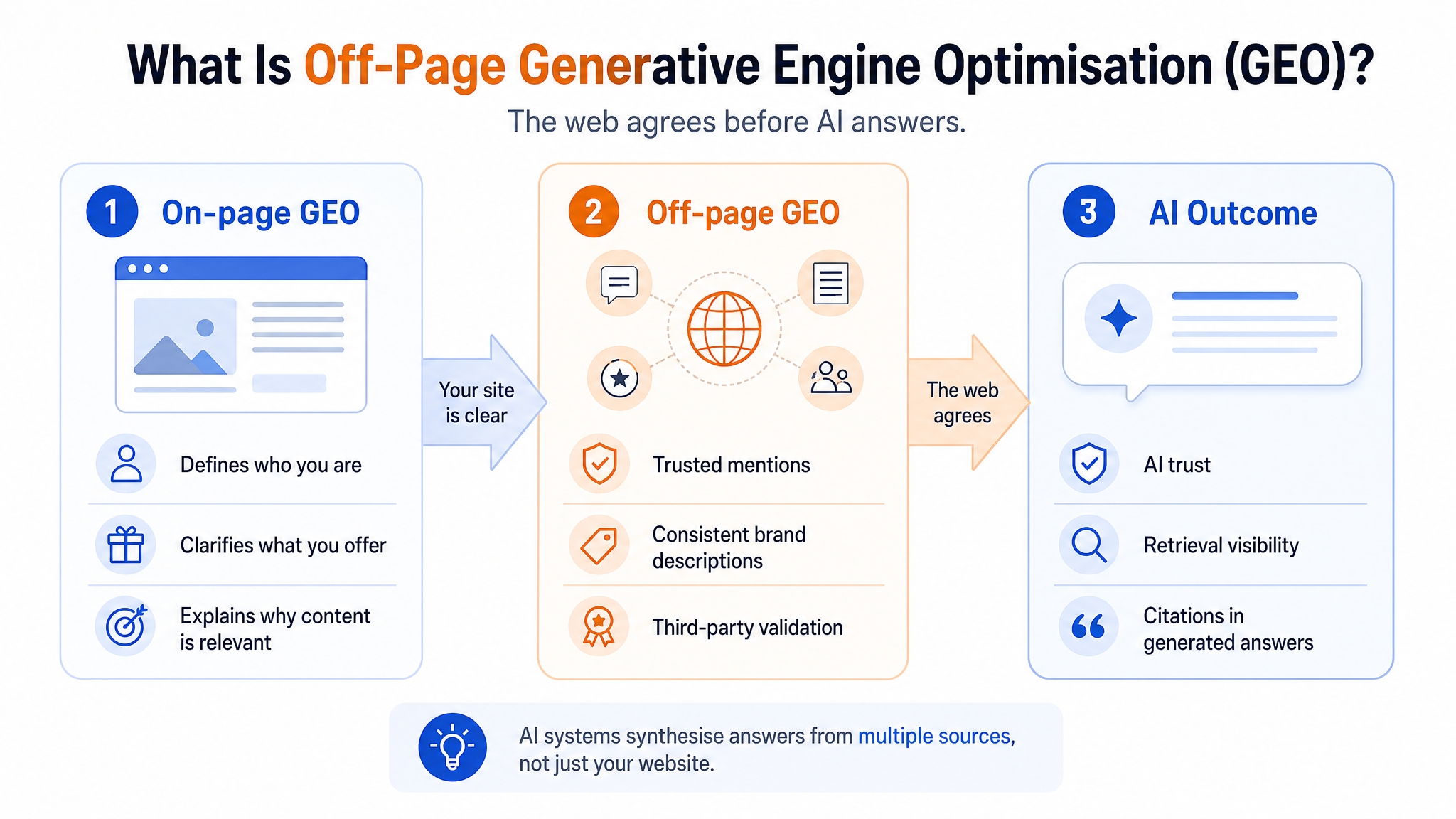
Off-Page Generative Engine Optimisation is the process of shaping how AI systems perceive your brand through third-party signals beyond your website. It focuses on trust, consensus, and entity credibility rather than rankings alone.
Traditional off-page SEO was built for crawlers. Build links. Increase domain authority. Climb the SERPs. That still matters, but AI systems work differently. They synthesise answers by evaluating how consistently and credibly your brand appears across multiple independent sources.
On-page GEO makes your website clear to AI systems by defining who you are, what you offer, and why your content is relevant. Off-page GEO takes that a step further by proving that the wider web agrees. This is not a replacement for traditional SEO, but a methodological shift that complements it.
Traditional crawlers evaluate rankings largely through content quality, site structure, links, and technical signals, while AI search engines increasingly synthesise answers from multiple sources, retrieval systems, and real-time web signals.
That means brands can no longer rely on their own website as the main proof of authority. Without external validation from trusted publishers, industry sources, reviews, and third-party mentions, even a well-optimised site can remain invisible in AI-generated answers.
Here is what that looks like side by side:
| Traditional Off-Page SEO | Off-Page GEO |
| Links for rankings – Builds backlinks to improve search rankings. | Mentions for AI trust – Builds credible mentions that help AI engines trust and cite your brand. |
| Domain authority – Strengthens the perceived authority of your website. | Entity authority – Strengthens how clearly AI recognises your brand as a trusted entity. |
| Page-level signals – Evaluates the strength of individual pages. | Brand-level consensus – Evaluates whether the wider web consistently supports your brand’s claims. |
| Crawler visibility – Helps search engines crawl, index, and rank pages. | AI retrieval visibility – Helps AI engines retrieve your brand for generated answers. |
| Link volume and quality – Prioritises authoritative backlinks. | Context and relevance – Prioritises relevant mentions in the right topical context. |
| Rankings and traffic – Measures success through rankings, backlinks, and organic traffic. | Mentions and citations – Measures success through AI mentions, citations, and answer visibility. |
If your brand is rarely mentioned, inconsistently described, or absent from trusted publications, AI has no reason to surface you.
How AI Engines Decide Who Gets Cited
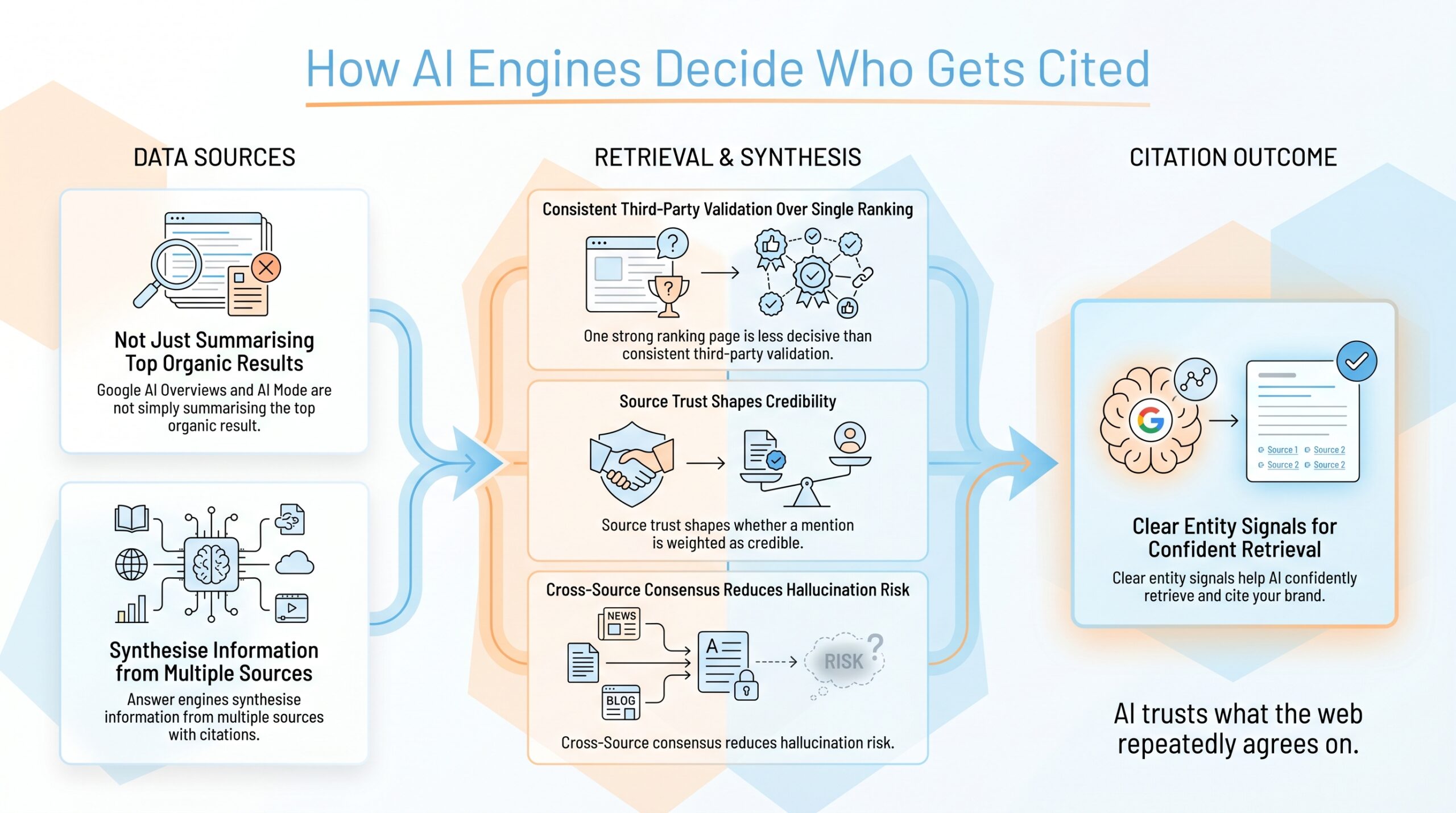
AI engines do not think like search engines from ten years ago. They rely on two core components: Large training datasets and retrieval layers that surface live or indexed content.
Google’s AI Overviews and AI Mode are no longer just summarising the top organic result, which is why understanding how to get mentioned in Google AI Overviews has become a core off-page GEO priority. Perplexity positions itself as an answer engine built around real-time, citation-backed synthesis, while OpenAI states that ChatGPT search and deep research can pull together fresh web information from multiple sources with citations.
In practice, this means AI visibility is shaped less by one strong ranking page and more by whether your brand is consistently validated across the wider web.
Across Google AI Overviews, Perplexity, ChatGPT, and other answer engines, three patterns are becoming clear:
| Pattern | What It Means | Why It Matters For Off-Page GEO |
| Source Trust | AI systems prefer information from sources with clear authority, editorial standards, or reliable retrieval signals. | Mentions from reputable publishers, trade sites, industry platforms, and recognised databases carry more weight than thin directory listings or low-quality blogs. |
| Cross-Source Consensus | AI engines are less likely to rely on a single source. They compare repeated claims across multiple independent sources before treating them as reliable. | Your brand needs consistent third-party validation across different domains, not just one press release, one article, or your own website. |
| Entity Clarity | AI systems need to understand what your brand is, what you offer, who you serve, and which topics you are associated with. | Off-page GEO strengthens the relationship between your brand, services, expertise, and market position so AI engines can confidently retrieve and cite you. |
Consensus matters more than strength. One powerful backlink can’t outweigh ten credible mentions across different sources. AI systems are designed to reduce hallucinations. The easiest way to do that is to trust what the web repeatedly agrees on.
The Core Pillars of Off-Page GEO
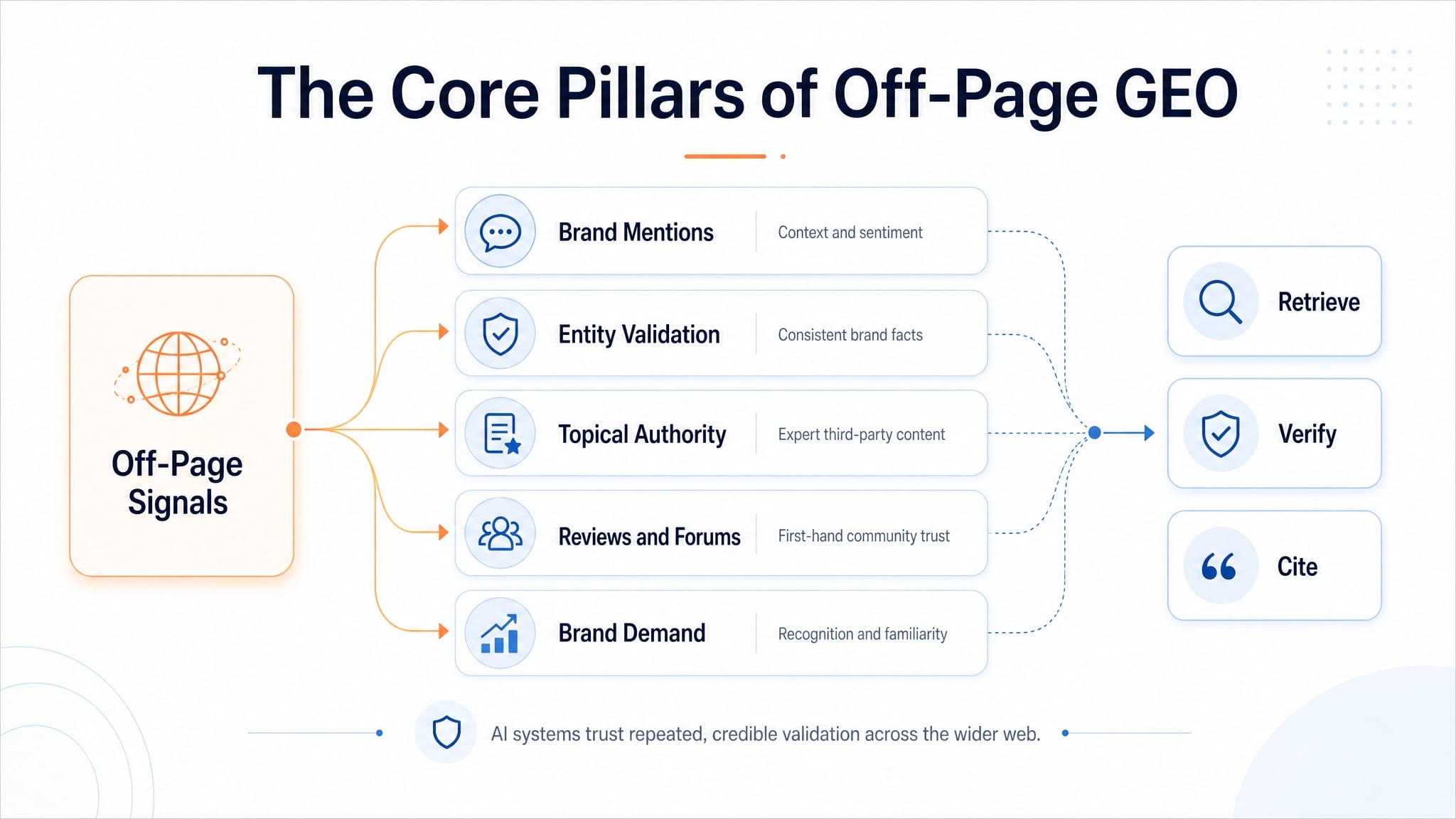
Off-page GEO is built on signals that help AI systems understand who you are, what you’re known for, and whether your brand deserves to be surfaced as a credible answer.
Brand Mentions (Linked and Unlinked)
Unlinked brand mentions matter because modern AI does not rely on hyperlinks alone to understand relationships. Through natural language processing, models can associate brand names with topics, services, locations, and sentiment even when no URL is present.
Industry analysis has shown that unlinked mentions still contribute to entity understanding, especially when they appear in authoritative or editorial contexts.
What matters is not volume alone, but quality:
- Context is critical: are you referenced as a subject-matter expert, or merely listed in passing?
- Sentiment also plays a role. Neutral and positive language reinforces trust, while repeated negative framing weakens authority.
- Relevance is equally important. Mentions should clearly align with your core services rather than unrelated topics.
Repeated mentions across diverse domains send a powerful legitimacy signal. Brands consistently quoted across media sites, blogs, podcasts, and community platforms are more likely to appear in AI-generated answers.
This is where off-page GEO evolves from traditional link building into deliberate narrative building.
Entity Validation and Knowledge Graph Signals
Entities are identifiable objects such as businesses, people, products, services, locations, and concepts. AI systems use these signals to understand what a brand is, what it offers, and how it connects to the wider web.
Google’s Knowledge Graph is built around real-world entities, while structured data helps search engines interpret details such as companies, authors, products, and services.
This becomes more important in AI search, where Google says AI Overviews and AI Mode may use query fan-out to search across multiple subtopics and data sources before forming a response.
Off-site profiles, trusted mentions, structured listings, and consistent third-party references therefore help reduce ambiguity, reinforce legitimacy, and make a brand easier for AI systems to retrieve, verify, and cite.
Consistency across trusted platforms is essential:
- Wikipedia and Wikidata support notability and factual accuracy.
- Crunchbase helps validate company details and history.
- Google Business Profile strengthens local authority, particularly for Singapore-based businesses.
- Industry-specific directories add contextual relevance within your niche.
If your brand name, description, services, or location details vary across platforms, AI confidence drops. Consistent information tells AI systems that your brand is real, stable, and reliable enough to be cited in summaries and answers.

Topical Authority via Third-Party Content
AI systems trust claims more when they are validated by reputable third-party sources, not just published on a brand’s own website. This is why digital PR fits naturally into off-page GEO: it places expert commentary in trusted editorial environments that AI systems can retrieve, compare, and cite.
Effective formats include:
- Expert quotes in industry articles
- Guest features with clear authorship
- Data-backed commentary on market trends
Google has repeatedly emphasised first-hand experience and expert input as markers of high-quality content. When AI summarises a topic, it draws from voices that have already been validated by editors and audiences. Consistent third-party exposure builds topical authority that strengthens with every credible reference.
Reviews, Forums, and Community Signals
User-generated content is a major trust signal, and Google explicitly uses reviews to evaluate local businesses. Here is what we recommend you keep in mind:
- AI models read these reviews across thousands of sources.
- Volume matters, but sustained activity is more meaningful than short-term spikes.
- Language patterns also matter. Specific, experience-based wording carries more weight than generic praise.
- First-hand indicators such as “I used,” “we worked with,” or “our experience was” strengthen credibility.
Platforms like Google Reviews, Reddit, Quora, and niche forums frequently appear in AI Overviews and answer engines.
For Singapore businesses, reviews tied to local areas such as Orchard, Jurong, or the CBD reinforce both geographic relevance and trust.
Brand Searches and Demand Signals (Light Touch)
Brand searches may not be a direct ranking factor, but they still reflect recognition, demand, and market familiarity.
Google’s guidance on local ranking prominence explains that well-known businesses are more likely to appear in relevant results, with signals such as links, reviews, and positive ratings helping Google understand reputation.
This makes brand-driven demand an important off-page GEO asset: the more people search for, mention, and engage with your brand across the web, the easier it becomes for AI systems to associate your brand with trusted authority over time.

Off-Page GEO vs Traditional Link Building
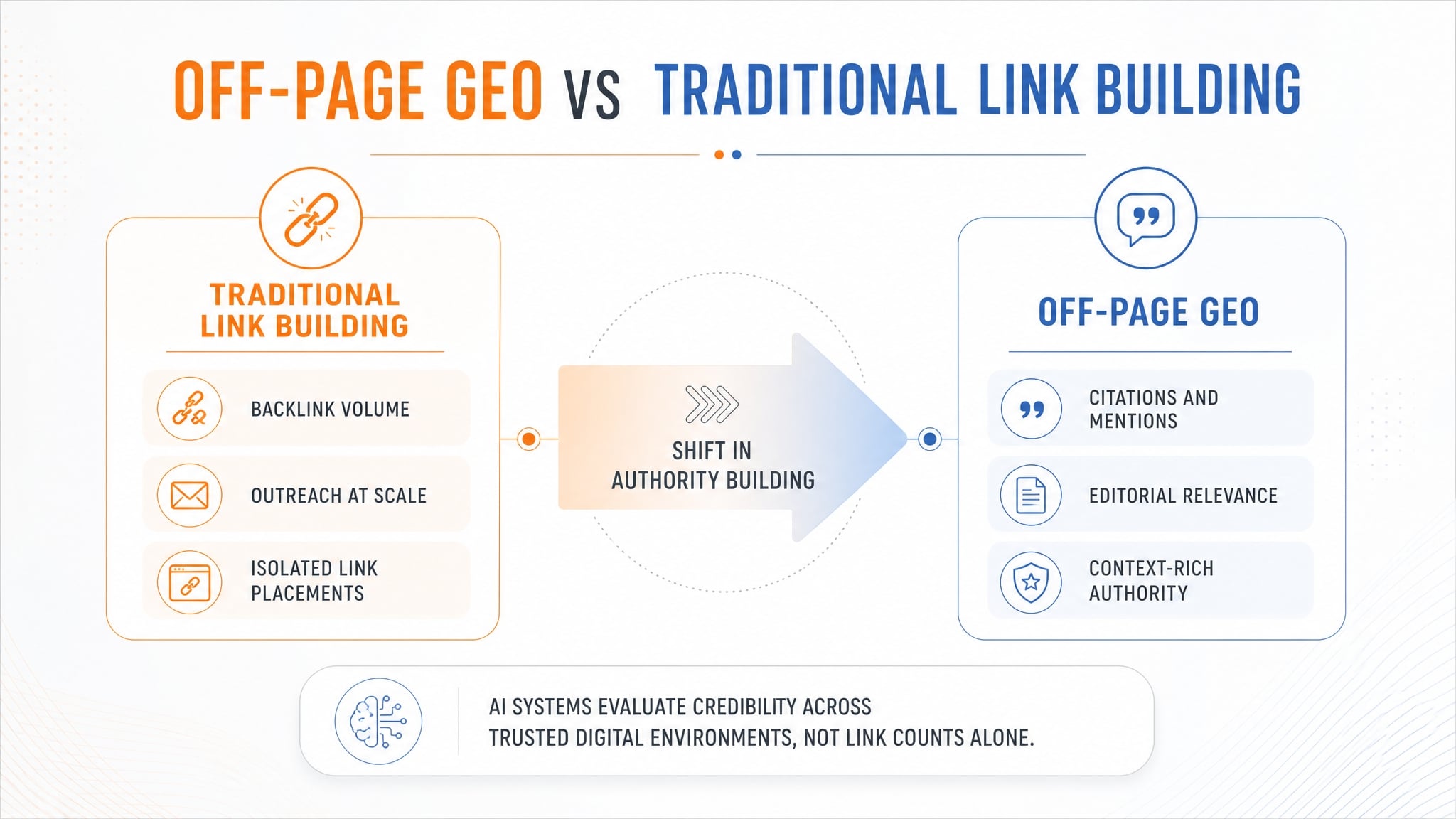
Off-page GEO represents a shift in how authority is built and measured. Instead of chasing link volume, the focus is on building a meaningful presence across trusted digital environments that AI systems recognise and reference. For a deeper breakdown of how this changes outreach, see our guide on link building for GEO and AI SEO.
Success Metrics: Links Count vs Citations and Mentions
Traditional link building measures success by the number and perceived strength of backlinks. Off-page GEO looks beyond links to citations, brand mentions, and repeated references across authoritative sources.
These signals help AI models understand credibility, relevance, and real-world recognition, even when no hyperlink exists.
Outreach: Editorial Relevance Over Volume
Classic outreach often prioritised scale. Off-page GEO prioritises editorial fit. Being mentioned in the right publication, by the right author, within the right context carries far more weight than dozens of generic placements.
Content Placement: Contextual Authority Beats Sidebar Links
AI systems evaluate surrounding content, not just URLs. Context-rich mentions embedded within relevant discussions outperform isolated sidebar or footer links. Low-quality links are frequently ignored by AI trained to discount manipulation. Links remain a signal, but mentions build the narrative that AI trusts.
Practical Off-Page GEO Strategies You Can Execute
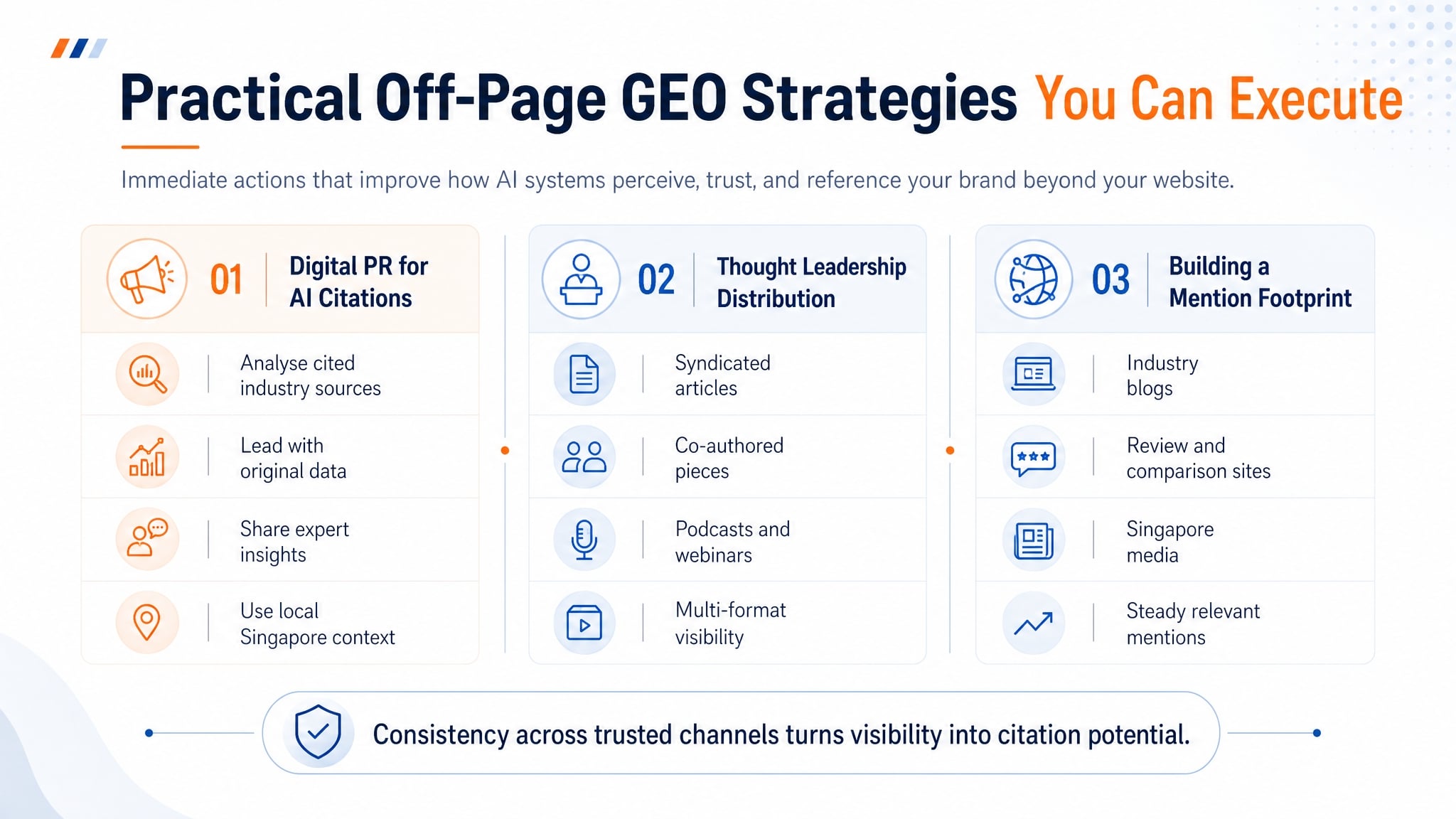
These strategies focus on actions you can implement immediately to improve how AI systems perceive, trust, and reference your brand beyond your own website.
Digital PR for AI Citations
Begin by analysing the sources AI tools already cite within your industry. These are typically established news outlets, reputable blogs, and trusted trade publications with strong editorial standards. Rather than generic pitches, lead with value. The angles that perform best include:
- Original data
- Expert insights tied to real market trends
- Commentary grounded in first-hand experience
For Singapore businesses, localisation matters. Insights that reference local regulations, industry dynamics, or costs expressed in SGD add contextual credibility. When your brand appears consistently in authoritative editorial environments, it becomes part of the knowledge base AI systems draw from during retrieval and summarisation.
Thought Leadership Distribution
Relying on a single channel limits reach and validation. Strong off-page GEO comes from diversified visibility across formats AI can process and index.
Effective approaches include:
- Syndicated articles on authoritative platforms
- Co-authored pieces with recognised industry experts
- Appearances on podcasts or webinars
These formats are increasingly transcribed, indexed, and used to inform search understanding, reinforcing your expertise across multiple touchpoints.
Building a Mention Footprint
Virality is unreliable. Consistency is not. Focus on earning mentions in:
- Industry blogs your buyers actually read
- Credible comparison and review sites
- Local or regional media within Singapore
A steady stream of relevant mentions builds the consensus AI systems look for, turning off-page GEO into a long-term authority asset rather than a short-term campaign.
How to Measure Off-Page GEO Success
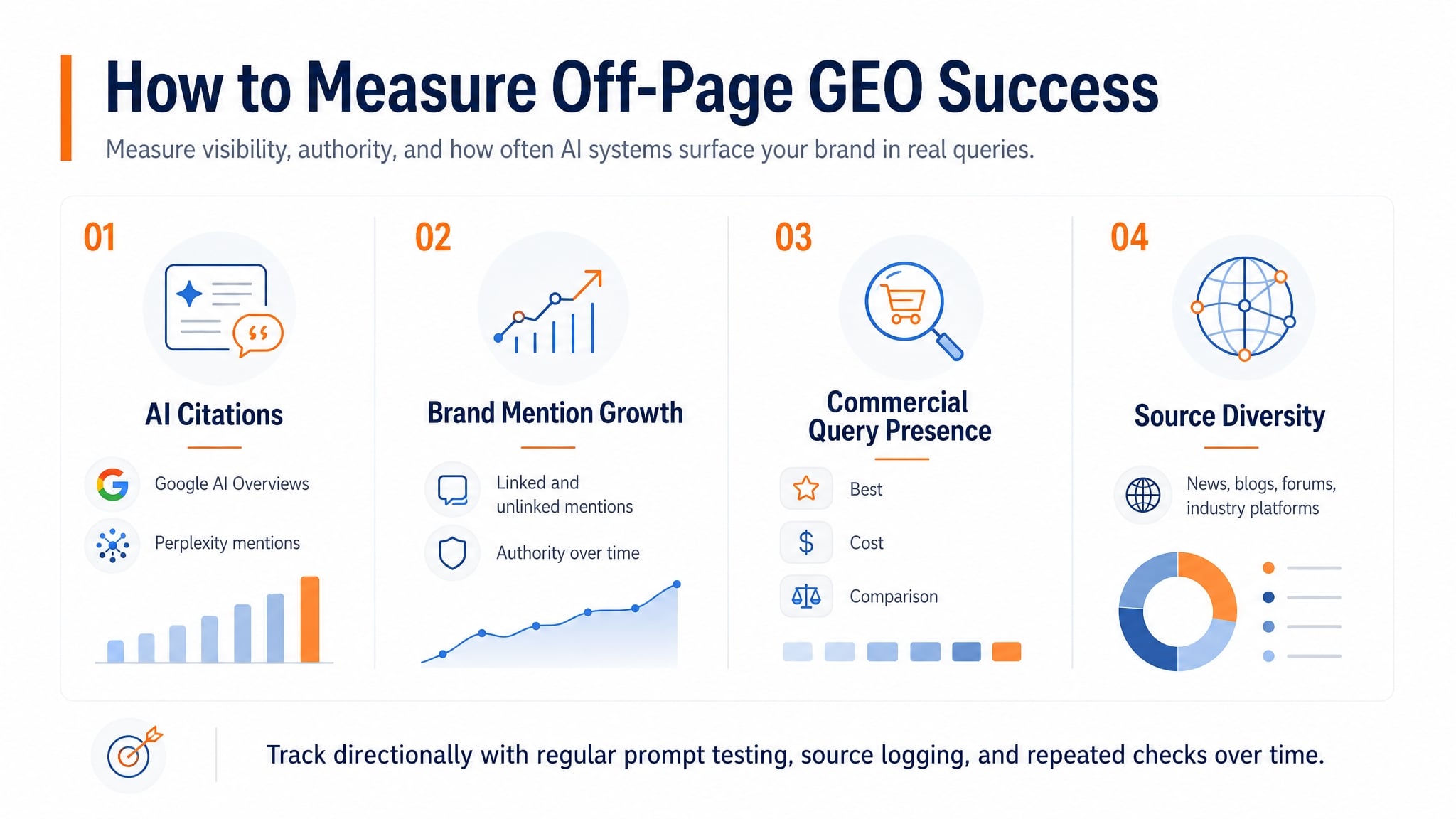
Traditional keyword rankings only tell part of the story. Off-page GEO performance should be evaluated based on visibility, authority, and how often your brand is surfaced by AI systems during real user queries.
- AI Citations Across Google AI Overviews and Perplexity: Monitor whether your brand, experts, or data are being cited in AI-generated responses. These citations indicate that your content is considered trustworthy and retrievable within AI answer frameworks, even if no traditional ranking is visible.
- Brand Mention Growth Using Tools Like Ahrefs or Brand24: Track increases in unlinked and linked brand mentions over time. Consistent growth signals rising authority and strengthens the likelihood of AI systems recognising your brand as a credible source.
- Inclusion in AI Answers for Commercial Queries: Test buyer-intent prompts such as “best,” “cost,” or “comparison” queries. Being referenced here suggests real commercial relevance, not just informational visibility.
- Source Diversity Across Media, Blogs, and Communities: Evaluate how widely your brand appears across news sites, niche blogs, forums, and industry platforms, as diverse citations help AI systems detect consensus.
Since AI answers can vary across prompts, runs, and time, recent research on measuring visibility in AI search recommends regular prompt testing, source logging, and directional reporting rather than treating GEO measurement as absolute.
Common Off-Page GEO Mistakes to Avoid
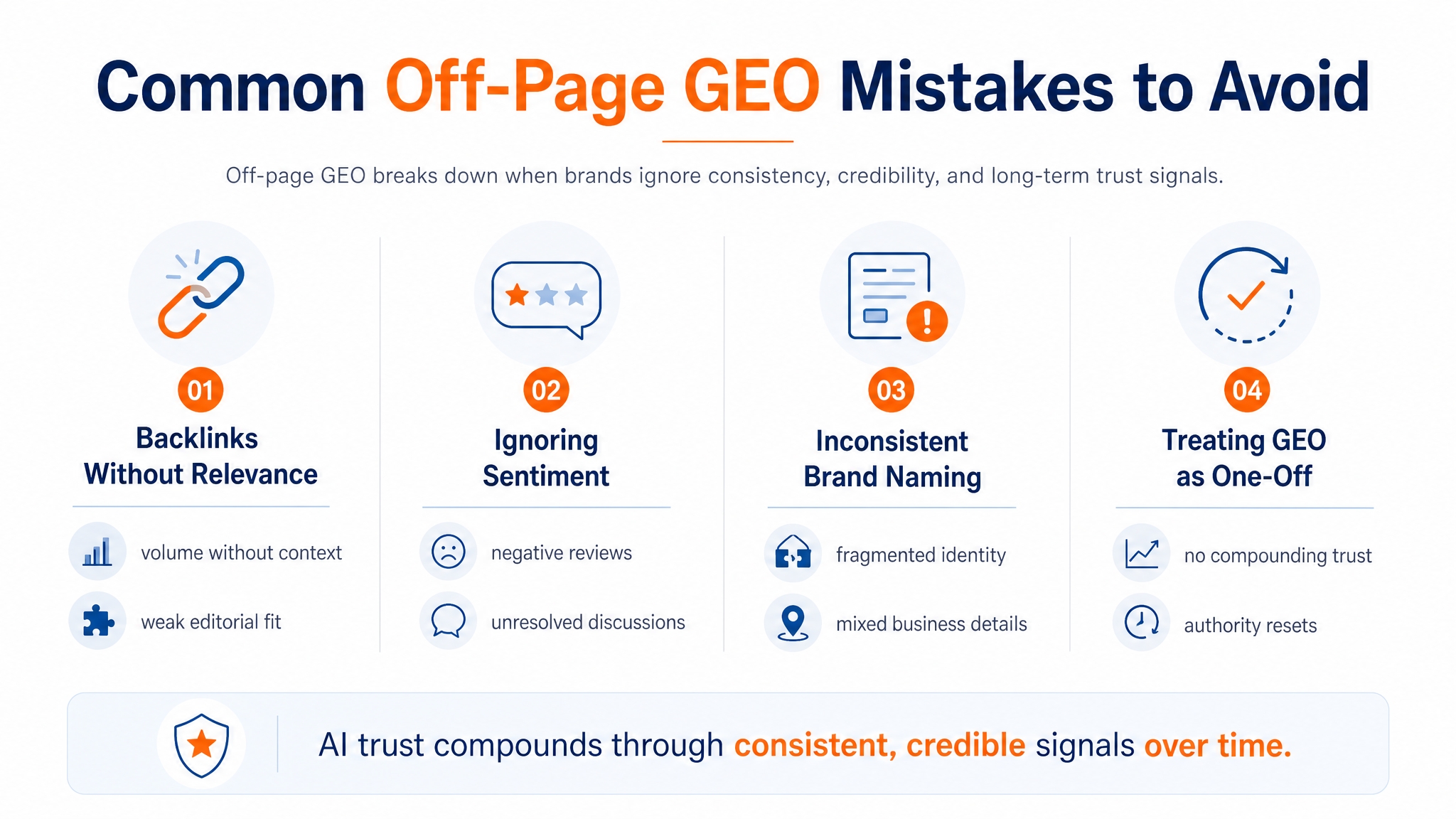
Off-page GEO success depends on consistency, credibility, and long-term signals. Many brands undermine their own efforts by focusing on outdated SEO habits or overlooking how AI systems evaluate trust.
- Chasing Backlinks Without Editorial Relevance: Not all links carry equal weight in GEO. Backlinks placed without genuine editorial context or topical alignment are unlikely to influence AI systems. AI prioritises meaningful citations from trusted sources, not volume-driven link acquisition.
- Ignoring Sentiment in Reviews and Mentions: AI models assess how your brand is discussed, not just where it appears. Negative or unresolved sentiment in reviews, forums, and social platforms can weaken trust signals, even when mention volume is high.
- Inconsistent Brand Naming Across Platforms: Variations in brand names, abbreviations, or business details fragment your authority. AI systems rely on entity consistency to form confidence, and inconsistency dilutes citation and recognition signals.
- Treating GEO as a One-Off Project: GEO is not a campaign with a finish line. Authority builds cumulatively through ongoing visibility, engagement, and validation. AI trust compounds over time. Inconsistency resets it.
What Will the Future of Off-Page GEO Look Like?
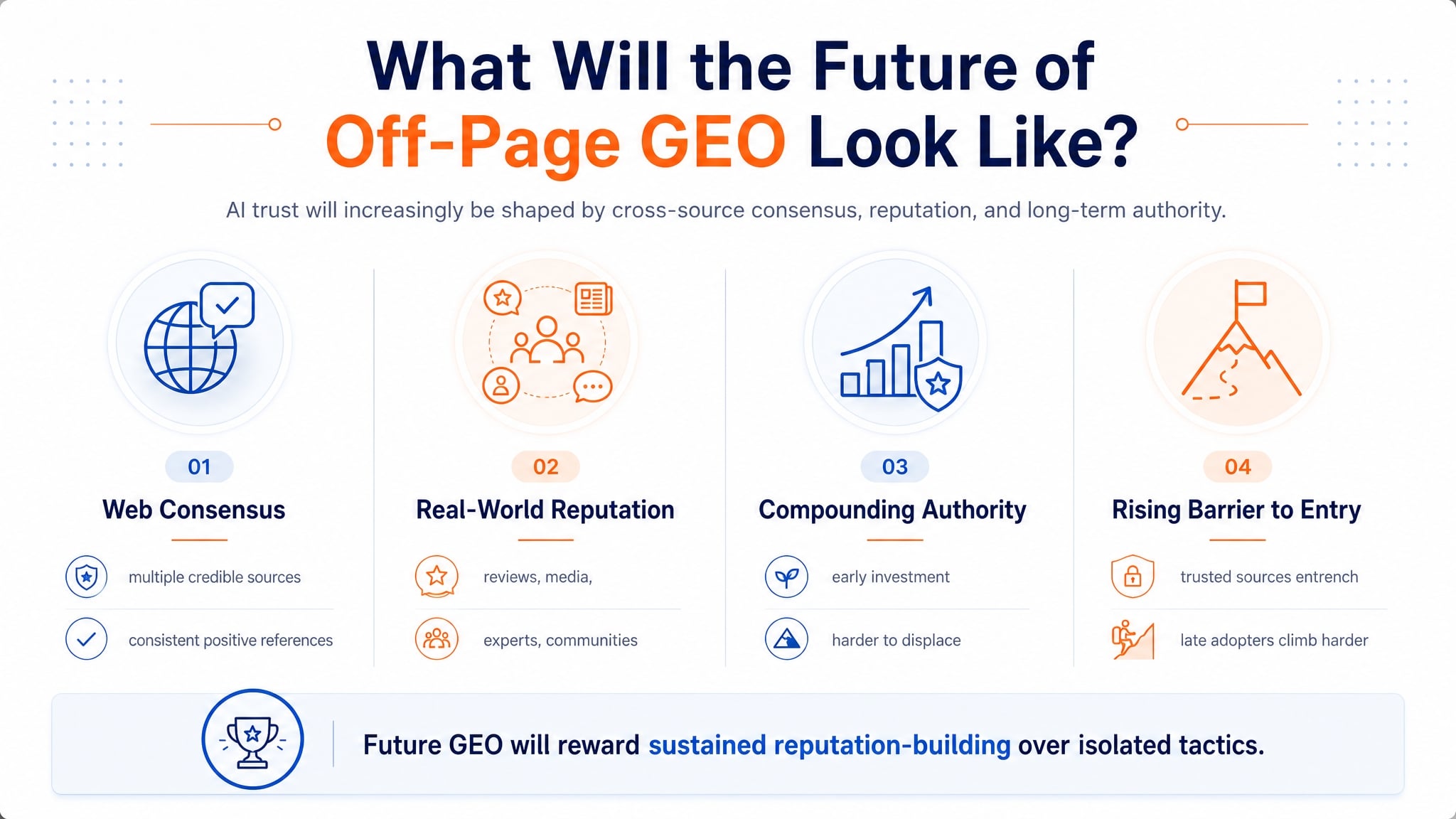
The future of off-page GEO (Generative Engine Optimisation) will be shaped by how AI systems evaluate trust at scale. Rather than rewarding isolated mentions or single high-authority links, AI models increasingly look for consensus across the web.
When multiple credible sources reference a brand consistently and positively, it signals reliability. This mirrors how humans validate information and aligns closely with how large language models are trained to identify authoritative answers. We explore this shift in more detail in our breakdown of how GEO is reshaping branding online.
Real-World Reputation Will Matter More Than Ever
Offline credibility and online signals will continue to converge. Reviews, expert citations, media coverage, and brand mentions across forums, communities, and industry publications will play a larger role in shaping AI visibility.
As AI engines begin to factor reputation into how brands are cited and framed, online reputation management should be treated as part of off-page GEO rather than a separate brand activity.
Early Investment Creates Compounding Authority
Brands that invest early in genuine thought leadership, digital PR, and consistent brand mentions will benefit from long-term authority compounding. Once AI systems recognise preferred sources, those positions become increasingly difficult to displace. Late adopters may still gain visibility, but they will face a much steeper climb.
The Barrier to Entry Will Rise

As AI entrenches trusted sources, off-page GEO will become less about tactics and more about sustained reputation-building. The gap between established authorities and newcomers will widen, making proactive investment essential.
Take Control of AI Visibility with Off-Page GEO
Winning AI visibility means owning the conversation beyond your website. That is the reality now. Off-page GEO is not optional. It is strategic, ongoing, and defensible when done properly. It turns your brand into a trusted reference rather than just another result.
If you are serious about appearing in AI answers that influence real buying decisions, we recommend starting with an audit. Identify where your brand appears, how it is described, and where trust is missing. From there, build a deliberate strategy that grows your authority month after month.
If AI engines need trusted third-party signals before they cite your brand, your next step is to identify where those signals are missing.
MediaOne’s GEO service helps brands audit their AI visibility, map citation gaps across trusted sources, and build an off-page GEO strategy that turns mentions into measurable AI citations. Book a GEO visibility audit with us today and see exactly how your brand appears, or fails to appear, across AI-generated answers.
Frequently Asked Questions
How long does off-page GEO take to show results in AI answers?
Off-page GEO usually takes time because AI systems look for repeated trust signals across the web, not isolated mentions.
Some early visibility may appear within a few months, but consistent AI citations typically require sustained mention velocity, credible third-party validation, and ongoing source building.
Is off-page GEO only for large or well-known brands?
No. Smaller and mid-sized businesses can compete by building authority within a specific niche, service area, or location. AI engines do not rely on brand size alone. They look for clear entity signals, relevant mentions, expert validation, and consistent evidence that the brand is trusted for a specific topic.
How is off-page GEO different from traditional digital PR?
Traditional digital PR often focuses on exposure, backlinks, and media coverage. Off-page GEO goes further by shaping how AI systems interpret those mentions. The goal is to make your brand easier to verify, compare, and cite by building contextual mentions across trusted, relevant sources.
Does off-page GEO work for local businesses in Singapore?
Yes. Local businesses can benefit strongly from off-page GEO because AI systems use location-based signals such as reviews, local media mentions, directories, community discussions, and geographically relevant content.
For Singapore brands, consistent local validation helps AI connect the business to local search intent and service relevance.
Can off-page GEO help in regulated or competitive industries?
Yes, but source quality matters more. In sectors such as finance, healthcare, education, and professional services, AI systems are more cautious about claims.
Brands need accurate information, credible publishers, expert commentary, strong reputation signals, and consistent third-party consensus to reduce ambiguity and improve citation potential.
What is the difference between a brand mention and an AI citation?
A mention means your brand appears somewhere online. A citation means an AI engine actively uses or references your brand in a generated answer. Off-page GEO helps bridge that gap by turning scattered mentions into trusted signals that AI systems can retrieve and cite.
Why does my website alone not guarantee AI visibility?
Your website explains your own claims, but AI engines often look for external validation before trusting and citing those claims. If trusted publishers, reviews, industry sources, and community platforms do not reinforce what your website says, your brand may still be overlooked in AI-generated answers.
What should brands track for off-page GEO performance?
Brands should track AI mentions, cited sources, sentiment, mention velocity, source quality, topical relevance, and how consistently AI tools associate the brand with its core services. GEO measurement is directional, so regular prompt testing and source logging are more useful than relying on one fixed visibility score.