How to Get an AI Overview Mention When Your Page Already Ranks on Google
When page one isn’t enough to get invited into the AI answer.

You did the keyword research. You built the page properly. Google indexed it. Maybe you are even sitting comfortably in positions one, two, or three.
Then you search the keyword and see an AI Overview above your result.
Your competitor is cited. Maybe Reddit or YouTube is cited.
Your page? Nowhere.
The obvious question is:
“If Google already thinks my page is good enough to rank, why isn’t it good enough for an AI Overview?”
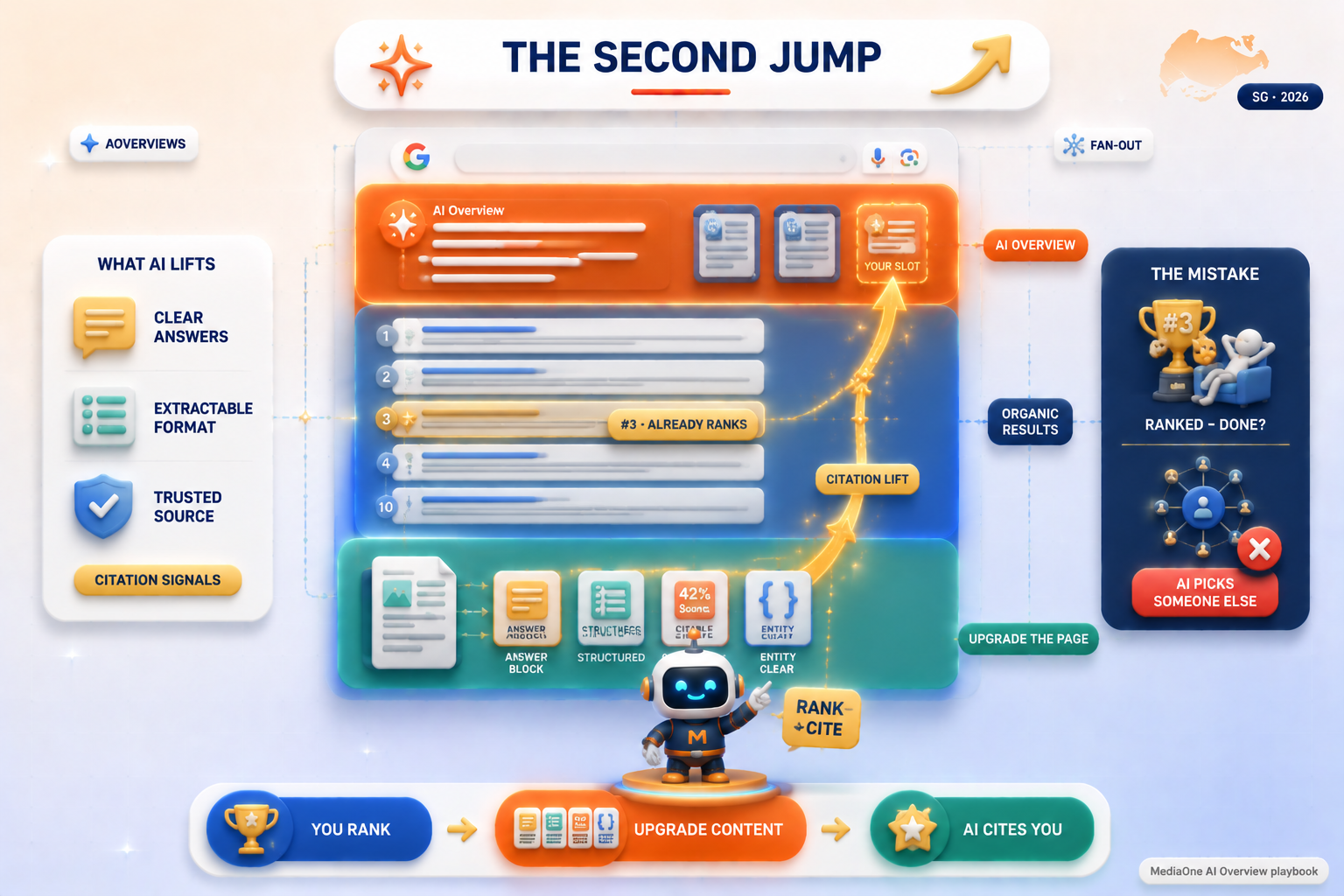
Because ranking and AI citation are related, but they are not the same thing.
Google says there are no special technical requirements or secret AI-specific schema needed for AI Overviews. Your page still needs the normal SEO foundation: indexing, Search eligibility, useful content, accessibility, and authority.
But being eligible does not mean being selected.
That distinction is where I would start.
Key Takeaways
- Ranking #1 does not guarantee an AI Overview mention. Google may rank your page highly while citing a completely different source in its AI-generated answer.
- Start with the question the AI Overview is actually answering. Your page may rank for the broader keyword but miss the specific sub-question Google wants to resolve.
- Audit AI Overview sources separately from organic competitors. Look at what cited pages, Reddit threads, videos, or third-party sources provide that your page does not.
- Improve the relevant passage before rewriting the whole page. Clearer answers, headings, tables, and supporting evidence may be more useful than starting over.
- Original evidence and third-party authority matter. First-hand experience, research, expert commentary, and legitimate brand mentions can make your content harder to replace.
- Track AI visibility over time. AI Overview citations can change, so one manual search should never be treated as the final verdict.
First: What Do I Mean by an “AI Overview Mention”?
Before getting into optimization, it helps to separate a mention from a citation.
I use AI Overview mention broadly to describe a brand, company, product, person, or page being represented in an AI-generated answer.
An AI Overview citation is more specific: Google actually displays your page as a supporting source or link.
You can therefore have situations where:
- your brand is discussed but your website is not cited;
- your website is cited as a supporting source;
- a third-party page mentioning your brand gets cited instead;
- you rank organically but are completely absent from the AI-generated answer.
That last one is what this guide focuses on.
And if that’s happening to you, I would not immediately assume your normal SEO is broken.
Ranking on Google and Getting Cited by AI Are Related, but Not Identical
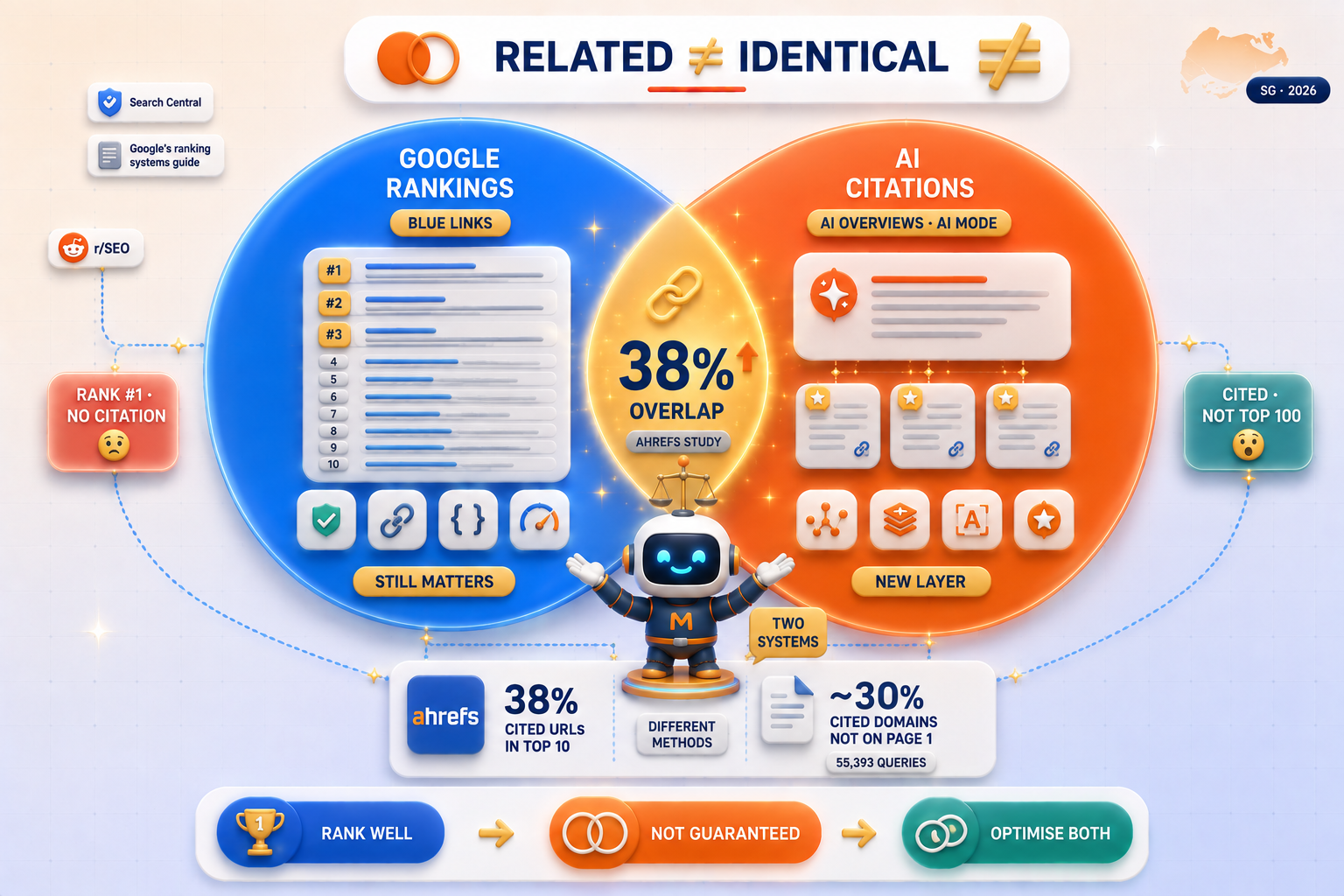
Traditional ranking still matters.
Google says AI Overviews and AI Mode are built on its existing Search systems, while its Search Central guidance continues to recommend the same fundamentals: crawlability, internal links, useful text, good page experience, appropriate structured data, and people-first content.
But ranking #1 does not automatically reserve you a seat inside the AI Overview.
That’s why optimizing for Google AI Mode and AI-driven search requires looking beyond traditional blue-link rankings.
This is where the research gets interesting.
Ahrefs analyzed AI Overview citations and found that roughly 38% of cited URLs also appeared in Google’s top 10 for the same query. It also found citations from pages that did not rank in the top 100 for that exact keyword.
A separate 2026 academic study of 55,393 Google queries found that nearly 30% of domains cited in AI Overviews were absent from the co-displayed first-page organic results.
Those studies use different datasets and methodologies, so I would not treat either number as a universal rule.
The useful takeaway is much simpler:
Strong organic rankings can improve your chances of AI visibility, but they do not guarantee an AI Overview mention.
SEOs are already running into this problem in practice. In one r/SEO discussion, users described pages ranking in the first or second organic positions while still being absent from AI Overviews.
If the page already ranks, that tells me many of the fundamentals are probably working.
The next question is:
Why did Google prefer another source for the AI-generated answer?
1. Check Whether Your Page Actually Answers the Question the AI Overview Is Answering
This would be the first thing I check.
A page can rank because it is the best overall result for a keyword while still failing to provide the specific answer Google wants to synthesize.
Imagine I rank for:
best Amazon listing image size
My article might cover:
- main images;
- secondary images;
- A+ Content;
- file formats;
- compression;
- mobile design.
That is excellent topical coverage.
But if the AI Overview is specifically answering:
“What dimensions should an Amazon product image be?”
Google may prefer a source that answers that question immediately rather than forcing readers, or a search system, to extract it from several paragraphs.
This is not about writing for robots. Google’s guidance for generative AI search still recommends useful, original content organised primarily for people.
So instead of:
Image Requirements
…followed by 400 words before giving the actual answer, I would prefer:
What Size Should an Amazon Product Image Be?
Start with the answer. Then explain the exceptions, reasoning, examples, and recommendations.
The reader gets what they came for, and the section is easier for a search system to understand.
2. Structure Important Information So It Can Stand Alone
AI optimization does not mean chopping every article into tiny answer blocks.
The goal is simply to make important information easy for readers, and search systems, to identify.
That usually means using:
- descriptive H2 and H3 headings;
- short direct answers before deeper explanations;
- comparison tables when people are actually comparing options;
- numbered steps for processes;
- bullets for requirements or checklists;
- clear definitions;
- original images or examples where they add context.
Google specifically recommends organizing useful content into clear paragraphs and sections while supporting it with relevant images and videos when appropriate.
One question I like to ask is:
If someone landed directly on this section, could they understand the answer without reading the entire article first?
If yes, the structure is probably doing its job.
3. Cover the Question Behind the Keyword, Not Just the Keyword
Google’s AI search experiences can use what it calls query fan-out.
Instead of relying only on the exact phrase somebody typed, Google may issue several related searches across subtopics and data sources to help build the answer.
Suppose the original search is:
best CRM for small business
Related searches might explore:
- easiest CRM for beginners;
- affordable CRM software;
- CRM with email automation;
- HubSpot alternatives;
- CRM pricing;
- CRM for a five-person team.
I am not suggesting creating six thin articles for those six variations.
The better approach is to cover the related questions when they genuinely belong in the reader’s decision-making process.
There is an important difference:
Do not add more keywords just to appear comprehensive. Answer more of the questions the reader actually needs answered.
4. Give Google Something That Isn’t Available on 50 Other Pages
This may be the most important change I would make to an already-ranking page.
Google’s newer guidance specifically emphasizes unique, non-commodity content and gives examples such as first-hand reviews, original viewpoints, and information rooted in actual experience.
That makes sense.

If 25 articles already say:
“Improve content quality, build backlinks, optimize for search intent, and add schema.”
why would Google need your 26th version?
I would look for something that comes from actual work:
- original tests or data;
- screenshots and before-and-after results;
- firsthand observations;
- expert commentary;
- real examples;
- comparisons competitors have not made.
That is the standard I would apply to an already-ranking page.
If competing pages already explain the basics, repeating them more elegantly may not create much additional value. Original data, experience, examples, expert input, or a comparison nobody else has made gives both readers and search systems a reason to choose your page.
That also lines up with MediaOne’s broader strategies for getting content cited in Google’s AI Overview: give search systems genuinely useful information worth referencing rather than another rewritten version of what is already available.
5. Compare AI Overview Sources, Not Just Organic Competitors
This is an audit step I think a lot of people miss.
Normally, I would analyze the top organic competitors.
For this problem, I would analyze two SERPs at once:
| What I Check | Organic Results | AI Overview |
| Pages ranking | Yes | Sometimes |
| Sources cited | Not necessarily | Yes |
| Brands mentioned | Sometimes | Yes |
| Content format | Whole page | Specific passage/answer |
| Reddit/forums | Possible | Possible |
| YouTube | Possible | Increasingly relevant |
| Sources outside top 10 | N/A | Definitely possible |
Search your target query and record every source Google uses.
Then ask:
What does that source provide that mine doesn’t?
Maybe it has:
- a clearer definition;
- fresher information;
- original statistics;
- a better comparison table;
- stronger first-hand experience;
- a useful video;
- a better answer to one specific sub-question;
- third-party validation.
I would not simply copy its structure. I would look for the information gap.
That is far more actionable.
A MediaOne Example: Ranking #2 but Losing the AI Overview
We have seen this exact problem in client work.
One anonymised Singapore professional-services client came to MediaOne ranking #2 for “corporate secretarial services Singapore.” The ranking itself had barely moved, but organic CTR had fallen from 18% in June 2025 to 6% by October.
The interesting part was what appeared above it.
Google’s AI Overview was citing a competitor FAQ page that ranked only #7 organically.
So this was not really a traditional ranking problem. The client was already outperforming that competitor in the blue links. The competitor was simply providing Google with a more usable source for the AI-generated answer.
We restructured the client’s content around the questions and passages appearing in the AI Overview rather than trying to push an already-strong organic ranking even higher.
Within eight weeks:
- the client’s page appeared in the AI Overview citation set 73% of the time in our tests;
- organic CTR recovered from 6% to 14%;
- the page retained its strong traditional organic visibility.
I would not treat those numbers as a guarantee that the same changes will produce the same result on another site. AI Overview citations are dynamic, and different queries behave differently.
But the case illustrates the distinction I have been making throughout this guide:
Sometimes the page that wins the ranking contest is not the page that wins the citation contest.
That is why, when an already-ranking page is missing from an AI Overview, I compare the cited passages first instead of automatically reaching for more backlinks, more keywords, or a complete rewrite.
6. Don’t Ignore Brand Mentions Outside Your Own Website
This is where AI visibility starts moving beyond traditional on-page SEO and into off-page GEO.
An Ahrefs study of 75,000 brands found that web mentions correlated strongly with visibility across AI Overviews, AI Mode, and ChatGPT.
YouTube mentions showed the strongest correlation in the dataset at roughly 0.74.
That does not prove YouTube mentions cause AI Overview rankings. Correlation is not causation, and I would be suspicious of anyone presenting it as a guaranteed ranking factor.
But it is useful evidence that AI visibility may reflect how widely and consistently an entity is discussed across the web.
Ahrefs separately found that YouTube accounted for 5.6% of AI Overview URLs cited in one dataset, and 18.2% of citations outside Google’s top 100 for the direct query were YouTube URLs.
This expands the off-page question beyond:
“Who links to us?”
I also want to know:
“Where does the web independently talk about us?”
That could include publications, genuine reviews, YouTube videos, podcasts, forums, communities, and credible comparison content.
The word independently matters. Manufactured mentions and fake discussions are not a sustainable GEO strategy.
7. Use Reddit and Forums for Research, Not Spam
Reddit deserves its own section because it appears so often in discussions around AI search.
Recent reporting has highlighted how frequently Reddit and similar community content surface across AI systems, while moderators simultaneously deal with fake recommendations, covert marketing, bots, and accounts designed specifically to influence AI-generated answers.
My approach is simple:
Use Reddit to understand people, not to trick Google.
Search your topic and look for:
- questions that keep appearing;
- objections people have;
- language real users use;
- bad advice that needs correcting;
- missing explanations;
- experiences that do not appear in polished competitor content.
Use those conversations to understand recurring questions, objections, terminology, bad advice, and experiences missing from polished competitor content.
If SEOs repeatedly ask:
“I’m ranking first. Why am I not in the AI Overview?”
that is useful research.
Posting fake recommendations for your own brand is not.
8. Make Sure Technical SEO Isn’t Quietly Blocking You
If your page already ranks, major crawling problems are less likely.
I still would not skip this step.
Google says pages used as AI Overview supporting links need to be indexed and eligible to appear with a Search snippet.
I would check:
- Is the preferred URL indexed?
- Is the canonical correct?
- Can Googlebot access the page?
- Is important content available as text?
- Are nosnippet or restrictive snippet controls interfering?
- Does structured data match visible content?
- Is the important information rendered reliably?
- Can internal links clearly lead Google to the page?
One myth is worth clearing up:
You do not need special AI schema or an llms.txt file to qualify for Google AI Overviews.
Google says there is no special Schema.org markup, AI text file, or other new machine-readable requirement.
I would spend that time making the page accessible, useful, authoritative, and technically sound instead.
9. Make E-E-A-T Visible
E-E-A-T — Experience, Expertise, Authoritativeness, and Trustworthiness — is not something I would treat as a box to tick at the bottom of a page.
Make the evidence visible.
That can include:
- identifying the author;
- explaining relevant experience;
- linking to credible sources;
- showing when the article was updated;
- citing original research;
- explaining methodology;
- correcting outdated information.
For high-stakes topics such as finance or healthcare, these signals become especially important. But even ordinary SEO content should make three things obvious:
Who wrote this? Why should I trust them? Where did the claims come from?
If the page cannot answer those questions, strengthen the evidence before worrying about another AI optimisation tactic.
10. Track AI Visibility Separately From Traditional Rankings
Do not optimize blindly.
Google introduced dedicated Search Generative AI performance reports in Search Console in June 2026, giving site owners clearer visibility into how their pages appear across Google’s generative search experiences.
If that reporting is available in your account, use it.
Otherwise, I would combine:
- manual SERP checks;
- a reliable AI visibility tracker;
- Google Search Console;
- Analytics;
- brand mention monitoring;
- referral traffic;
- conversion data.
And do not panic when different checks produce different answers.
AI Overviews are dynamic. Ahrefs’ research on AI Overview changes found meaningful fluctuations in both generated answers and the URLs cited over time.
One screenshot is not a trend.
Track the same valuable queries consistently.
AI Overview Mention Checklist
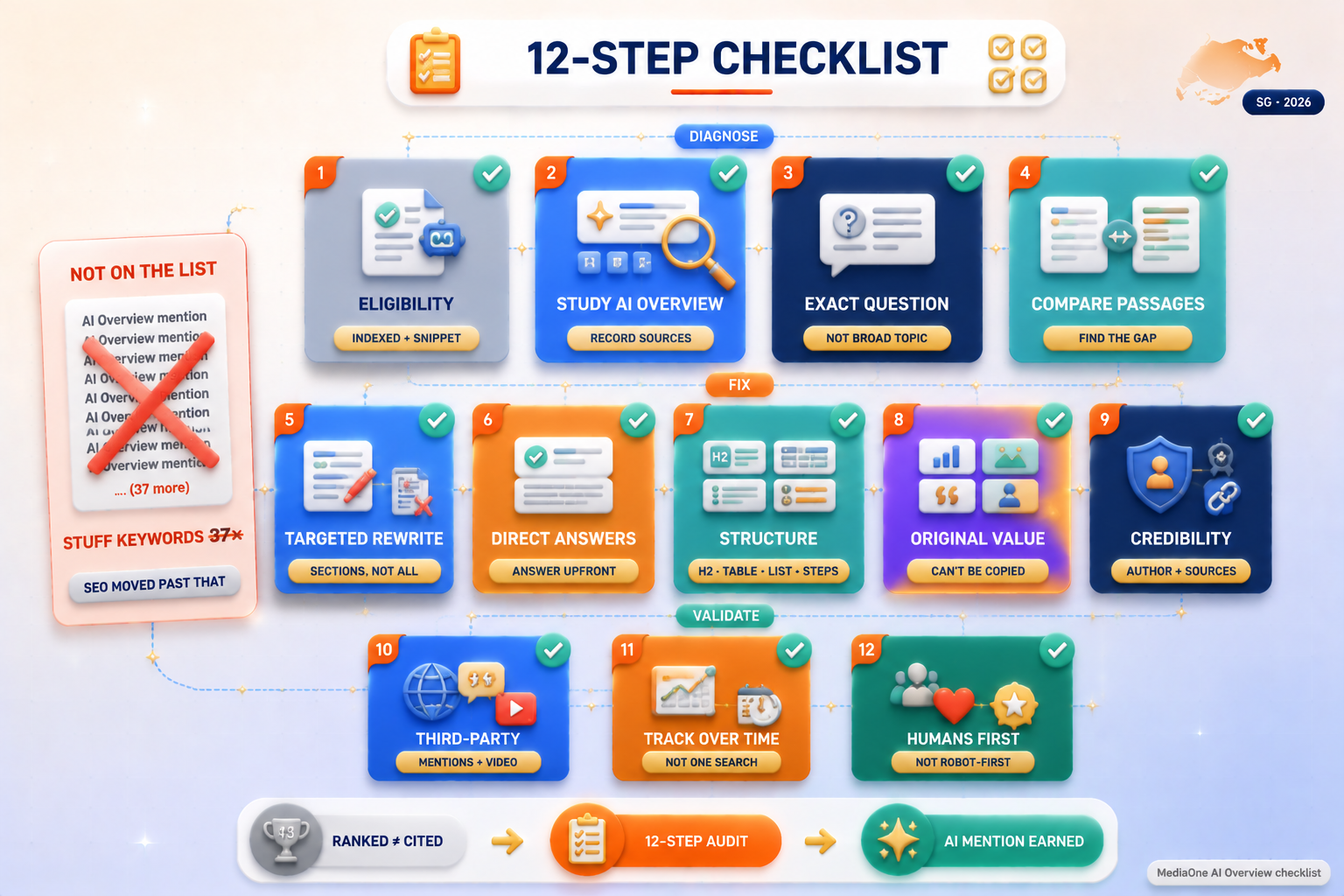
If one of my pages already ranked but was not appearing in the AI Overview, this is the order I would work through:
- Confirm eligibility. Make sure the page is indexed and snippet-eligible.
- Study the current AI Overview. Record every cited source and brand.
- Identify the exact question being answered.
- Compare cited passages with your own content.
- Rewrite unclear sections, not the whole article by default.
- Add direct answers where readers genuinely need them.
- Improve headings, tables, lists, and step-by-step sections where useful.
- Add something original that competing pages cannot easily reproduce.
- Strengthen author and source credibility.
- Look at legitimate third-party brand mentions and relevant video opportunities.
- Track the query repeatedly instead of judging it from one search.
- Keep improving the page for humans first.
Notice what is not on that list:
“Stuff the phrase AI Overview mention into the page 37 times.”
Thankfully, SEO has moved past that.
Ranking Is the Foundation, Not the Finish Line

If my page already ranks but is absent from the AI Overview, I treat that as a clue rather than a failure.
Google already understands the page well enough to rank it. The question is why another source is more useful for the specific answer being assembled.
Maybe its answer is clearer. Maybe it is fresher. Maybe it contains original evidence. Maybe it handles a sub-question my page barely covers. Or maybe a third-party source provides a perspective my own website cannot credibly provide about itself.
That is why I would not chase a secret AEO hack.
Keep the technical foundation solid. Make important answers easy to find. Add information competitors cannot simply reproduce. Build genuine authority beyond your own domain.
Then measure AI visibility separately from normal rankings.
Ranking gets you into the conversation. Being genuinely useful gives Google a reason to bring you into the answer.
Already Ranking but Still Missing From AI Overviews?
If your page already ranks well, tearing it down and starting again is rarely my first move.
I would first compare your content with the sources Google is actually citing: what questions they answer, which passages appear useful, what evidence they provide, and what your page is missing.
That is exactly what a proper SEO and GEO audit should uncover.
MediaOne can compare your organic rankings with AI Overview citation sources, identify the gaps, and prioritise what is actually worth changing.
If you want a second set of eyes on your visibility, explore MediaOne’s GEO services.
Frequently Asked Questions
Can I get an AI Overview mention without ranking #1?
Yes. Ranking highly can help, but available research shows AI Overview citations do not perfectly match normal organic rankings. Ahrefs found many cited URLs outside the top 10, while a 2026 academic study found nearly 30% of cited domains absent from the co-displayed first-page organic results in its dataset.
Does schema help you rank in AI Overviews?
Structured data can still help Google understand your page and remains useful where appropriate. However, Google says there is no special AI Overview schema required to appear in its generative Search features. Structured data should accurately match what visitors can see on the page.
Do I need llms.txt for Google AI Overviews?
No. Google states that site owners do not need new AI text files or special machine-readable files to appear in AI Overviews or AI Mode.
How long does it take to get an AI Overview mention?
There is no guaranteed timeline. Google needs to crawl and process your changes, and AI Overview sources can fluctuate. I would therefore monitor several relevant queries over multiple weeks instead of treating one search as proof that an optimisation did or did not work.
Are backlinks still important for AI Overviews?
Yes, legitimate authority still matters because Google’s established Search systems remain part of the foundation. However, research also shows correlations between AI visibility and wider brand and YouTube mentions. Treat that as a reason to build a genuine presence across the web, not evidence of one magic AI ranking factor.
Should I create separate pages for every AI Overview question?
Usually, no. Google specifically warns against creating large numbers of pages around query variations primarily to manipulate Search or generative AI responses.
A stronger strategy is to build genuinely useful content that covers related questions when they naturally belong together.