Social commerce is buying and selling products inside social media apps, from first sight in a feed to payment. For Singapore businesses, the shopping decision now starts in the feed. Around 25% of shoppers already buy from social media platforms, according to Salesforce.
This guide explains where that purchase happens and how to test whether your business is ready to sell there. If you would rather have someone audit that readiness with you, our social media marketing team in Singapore does exactly that.
Key Takeaways
- Social commerce moves the buying decision into the feed, where creators and peers build trust before shoppers see a product page.
- Around 44% of global shoppers say they have bought directly on social media.
- Score your business from 1 to 5 on Discovery, Trust, Friction and Measurement. This is an illustrative self-assessment, not an industry standard. Fix any lever scoring 2 or below before spending on ads.
- Live shopping converts at 25 to 35%, but compare it only with similar formats and offers.
- Separate the discovery platform from the payment platform, and check local payment support.
- Judge success on first-time and repeat customer acquisition, not raw traffic.
Start Here: Three Decisions to Make First
Before you spend on any platform, decide three things:
- Where your buyers already spend time. Pick the app your customers use most on social media, using The Platforms That Matter for Singapore Brands.
- Where the sale will close. Confirm whether buyers can complete the purchase in the app or must leave for a website, checking the platform comparison, so the shopping experience stays smooth.
- How you will earn trust. Choose your creators, reviews or customer content, as set out in Creators, Reviews and the Trust Economy, and measure engagement from the start.
What Social Commerce Is and Why It Is Growing
Social commerce defined, and how it differs from traditional ecommerce
Social commerce is buying and selling products inside social platforms, where discovery, persuasion, and purchase happen in the same feed. Traditional ecommerce separates these stages: a shopper finds a product through search or an advert, then moves to a website to pay. Social commerce shortens that path, so shoppers often decide before they visit a product page.
That difference shapes where a Singapore business should spend its effort. In a feed, a creator’s video, a friend’s review, or a live demonstration does the persuading, and the product page becomes a backup. Salesforce reports that about 25% of shoppers buy from social media platforms.
Social commerce trends shaping 2026
As of 2025, 7 in 10 global shoppers shop directly on social media platforms, according to Anchanto. Social commerce runs $1.2 trillion in 2025 and $1.5 to $2.3 trillion by 2030, according to Anchanto’s projections. Treat these as vendor forecasts rather than settled market size.
Key elements: shoppable content, in-app storefronts and built-in checkout
Three components make social commerce work. Shoppable content lets a viewer tap a product in a post or video to see its price and details. In-app storefronts give a brand a catalogue inside the platform. Built-in checkout lets buyers pay without leaving the app, removing the step where many shoppers abandon a purchase—the same drop-off that conversion rate optimisation targets on a website.
|
Type |
How it works |
Main role |
|
Shoppable posts |
Tagged products in images or videos |
Discovery and quick purchase |
|
Live shopping |
Real-time demonstrations with buy buttons |
High-intent conversion |
|
Peer-to-peer selling |
Individuals resell or recommend products to their networks |
Trust-led sales |
|
User-generated content (UGC) |
Customer photos and videos that show the product in use |
Credibility and proof |
Most Singapore brands will combine two or three of these rather than rely on one.
Shoppable posts
A shoppable post tags a product in an image or video so the viewer can tap through to its details. It works best as a first touchpoint. Its limit is that the post must do the persuading in a few seconds.
Live shopping
Live shopping is a real-time demonstration with buy buttons, usually hosted by a brand or creator. It takes planning, a host who can hold attention, and a stock and fulfilment plan for sudden demand. Brands that go live see conversion rates between 25 and 35%, compared with 2 to 3% on standard e-commerce sites, according to Dash Social. Treat that gap with caution, because it compares different formats and audiences.
Peer-to-peer selling
In peer-to-peer selling, individuals recommend or resell products to their own networks. Trust carries most of the weight, and social proof from friends can help persuade buyers who would otherwise hesitate. Its limitation is that you have less control over how the product is presented.
The Platforms That Matter for Singapore Brands
Most Singapore sellers do not need every social commerce channel. They need the one where their buyers already spend time, and where they can take payment without losing the sale. Often these are different apps, and that gap shapes the decision.
TikTok Shop, Instagram Shopping and Facebook Shops compared
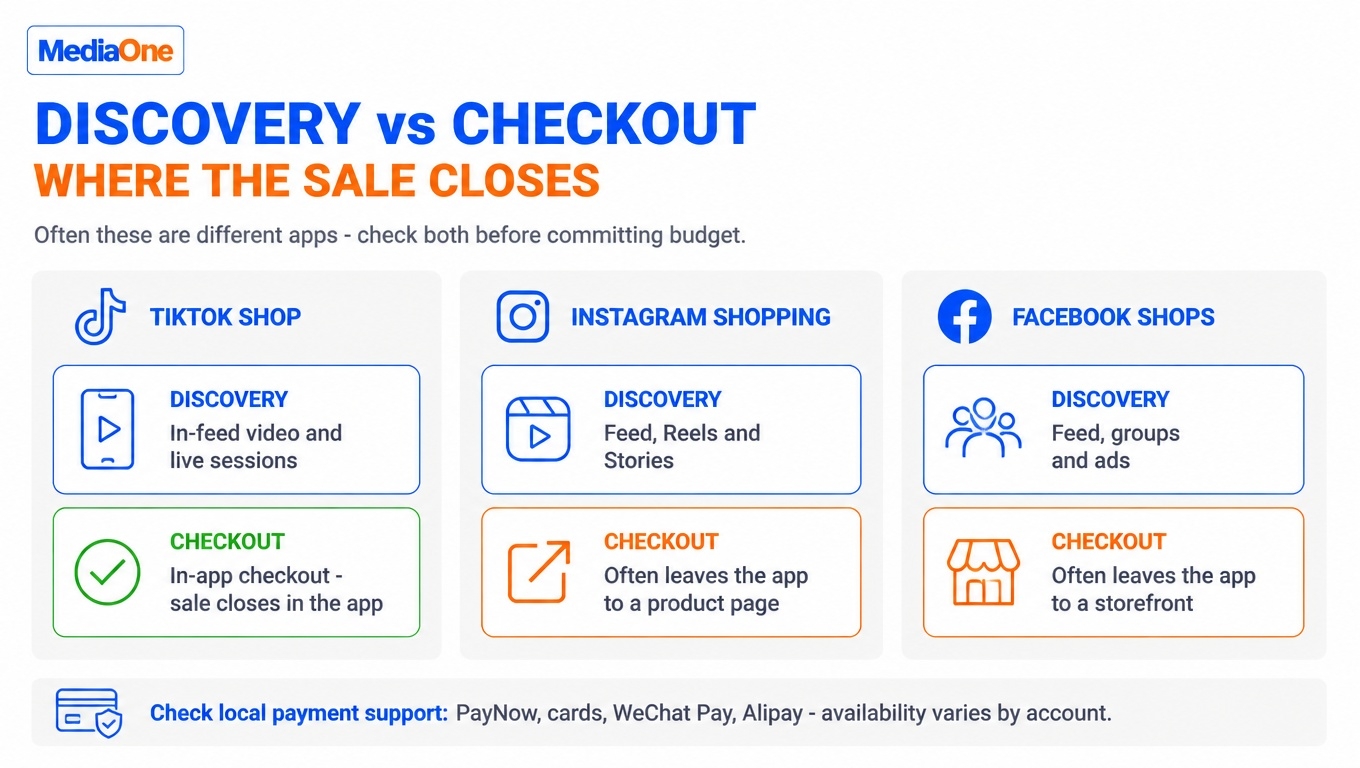
Discovery is TikTok Shop’s strength. According to Salesforce, 34% of Gen Z use TikTok to explore brands. eMarketer reports over 100 million social buyers in 2024, with more than 44% making at least one purchase on TikTok Shop, as cited by Tinuiti. Checkout happens inside the app, so the sale closes where the product is found.
Instagram and Facebook both let you tag products, but many users are sent to a website or messaging thread to complete the order. They are strong for helping brands build trust and repeat audiences — the same ground covered in our social media marketing strategy guide for Singapore.
|
Platform |
Where discovery happens |
Where the sale closes |
Best fit |
|
TikTok Shop |
In-feed video and live sessions |
In-app checkout |
Impulse-friendly, visual products |
|
Instagram Shopping |
Feed, Reels and Stories |
Product page or external checkout |
Lifestyle and brand-led products |
|
Facebook Shops |
Feed, groups and ads |
Storefront or external checkout |
Older buyers and community selling |
Payment support varies by platform setup, from PayNow and credit cards to WeChat Pay and Alipay. Confirm which methods each platform supports for your account before committing budget, as availability changes.
Choosing platforms by audience and product fit
Start with the audience, not the feature list. Ask where your users spend time, which content they watch, and whether the product is an impulse buy or a considered one. Low-price, visual items suit discovery-led apps. Products that need explanation may convert better through a creator’s review or a brand account that answers questions.
Singapore is mobile-first, so help your team create creative designed for a phone screen, with the product visible within the first few seconds. Buyers expect a smooth online experience from first view to checkout, so test that path on your chosen social platforms before scaling spend.
Use this quick test before choosing a first platform:
- Where do your best customers already spend time on their phones?
- Can a buyer complete checkout in that app, or will they leave it?
- Does your product show well in short video or photo?
- Can you produce creative weekly for that channel?
If you cannot answer yes to at least three, start with one platform and add a second later.
Creators, Reviews and the Trust Economy
Social commerce moves the purchase decision into the feed, where people already trust the voices around them. A product page asks a buyer to believe the seller. A creator video or a customer’s review asks them to believe someone they follow. For Singapore businesses, trust drives purchase decisions far more than raw traffic does.
Influencer marketing is the most visible form of creator-led selling. A creator can tag a product in a post, host a live session or post a review linking to checkout. Singapore’s small, dense market suits micro-influencers, who often hold loyal niche audiences across their channels and charge less than national names. A brand can run several small partnerships for the cost of one large one — the planning logic behind our influencer marketing services and our KOL marketing programmes.
For campaign structure, see the influencer marketing campaign guide for Singapore brands, and for budget bands by creator tier, influencer marketing for Singapore SMEs.
Creator content, UGC and reviews as purchase triggers
Creator content gives a product a face and a use case. User-generated content (UGC) shows ordinary customers using the product, which often feels more credible than polished studio shots. Reviews answer the sceptical question: does this work for people like me?
Ask creators for raw, unscripted footage, and reuse the best customer clips as paid creative. Test these against studio content, as real-buyer ads often perform well. Our UGC marketing strategy guide sets out how to source, brief and reuse that footage without paying for it twice.
A Singapore example: a review-led setup
A home-goods seller could ask five micro-influencers for unscripted kitchen videos, then tag the best customer reviews under each post. Track results in your own dashboard, comparing review volume, average rating and conversion rate before and after each campaign. Use your own sales data to judge which creators actually move customers, rather than relying on follower counts or assumptions.
Buyers in feeds move quickly, so proof must appear at the moment of doubt. Place star ratings and review counts on shoppable posts, pin a short testimonial to the profile, and reply publicly to every negative comment. Users who see proof at the point of doubt are more likely to act.
Track review volume, average rating and the share of orders citing a creator. As a working threshold, aim for at least 20 reviews and a 4.5 average rating before scaling paid ads. This is not a sourced benchmark, so adjust it to your category.
A product with few reviews is a readiness gap. Fixing it before spending on ads usually lifts conversion more than new creative does. The types of social proof that move Singapore buyers are worth mapping against your own product pages.
The Business Case: Benefits for Singapore Merchants
Concrete benefits, from discovery to first-time customer acquisition
Social commerce shortens the path from discovery to purchase. Around 44% of global shoppers say they have bought a product directly on social media. Gen Z leads in discovery, with 34% using TikTok to explore brands, according to Salesforce’s social commerce research. A merchant that appears in those feeds reaches buyers before they start searching online.
The benefit shows up at three stages:
- Discovery: A product seen in a creator video or shoppable post reaches people who were not looking for it. This matters most for new brands with no search history.
- Consideration: Reviews, comments and creator demonstrations answer questions in the feed, so buyers need not visit a separate product page.
- First purchase: Built-in checkout lets buyers pay without leaving the app, which means fewer abandoned carts — the same levers covered in our ecommerce marketing strategies for 2026.
In one Snapchat campaign reported by Tinuiti, 88% of purchases came from first-time customers. This reflects one advertiser’s results, so treat it as directional rather than a benchmark.
Live formats can lift conversion sharply. Brands that go live see conversion rates of 25% to 35%, compared with 2% to 3% on standard e-commerce sites, according to Dash Social. This uplift does not transfer directly to a static product page.
Social commerce suits products that are visual, low-consideration and easy to explain in under a minute. It is a weaker fit for:
- High-ticket or technical products that need detailed specifications
- Thin-margin businesses that cannot absorb paid reach costs
- Brands whose customers search by need rather than browse for inspiration
If a product sells well through search and comparison sites, paid social may add cost without adding sales. Test before committing budget. For those categories, ecommerce SEO usually carries the demand more cheaply than feed advertising.
Building a Social Commerce Strategy, Step by Step
Most Singapore brands that stall on social commerce do not lack ideas. They start spending before they know what success looks like or whether they are ready to earn trust in the feed.
Setting goals and choosing your first platform
Score your business from 1 to 5 on four levers. This is an illustrative self-assessment, not an industry standard:
Discovery (is your product visible where people scroll), Trust (do you have creator content, user-generated content and social proof such as reviews), Friction (can a buyer complete a purchase without leaving the app) and Measurement (do you track conversion and repeat purchase per platform). Fix any lever scoring 2 or below before spending on ads.
Choose one platform for your first 90 days, matched to where your buyers spend time. Check each platform’s supported payment methods before committing budget.
Creative production and structured testing
Build creative for a phone screen first. Almost 90% of Asia Pacific’s population shops on mobile, according to Anchanto. Vertical video, large product shots and short captions do most of the work.
Test in a structured way:
- Pick one variable per test, such as the hook, creator, or offer.
- Run each variant long enough to reach a meaningful sample.
- Record results per platform, not in a blended total.
- Keep the winner and replace the weakest variant.
Platform-specific optimisation: content, bidding and budget
Each platform rewards different content. Shoppable posts need clear product tags and a single call to action. Live sessions need a host, a schedule and a reason to stay. Review budgets per platform weekly, and scale only the variants that bring repeat buyers, not just first clicks.
|
Lever |
Question to ask |
Act if the score is 2 or below |
|
Discovery |
Is the product seen where people scroll? |
Post more native, mobile-first content |
|
Trust |
Are reviews and creator content visible? |
Collect reviews and partner with creators |
|
Friction |
Can buyers pay inside the app? |
Enable in-app checkout or shorten the path |
|
Measurement |
Are conversion and repeat rates tracked per platform? |
Set up tracking before scaling spend |
Practices that separate performing stores from stalled ones
Growing stores design for mobile first: vertical video, captions that work without sound, and the product visible within two seconds. They test one variable at a time and reply to comments and messages quickly, since hesitant buyers often decide there.
Stalled stores typically rely on heavy ad spend, lack creator or customer content, and send buyers away from the app at checkout.
Social Commerce KPIs and How to Read Them
Raw reach and follower counts tell you little about whether social commerce is paying. Read these metrics together.
|
KPI |
What it tells you |
Read it with |
|
Click-through rate |
Whether the creative earns attention |
Impressions and product page visits |
|
Conversion rate |
Whether visitors buy |
Same audience and offer only |
|
Cost per purchase |
Whether paid activity is efficient |
Average order value |
|
Repeat purchase rate (90 days) |
Whether buyers return |
First-time versus returning customers |
|
Share of new customers |
Whether the channel acquires, not just recycles |
Platform split |
Do not compare live shopping conversion rates directly with product page figures. Live sessions have a warmer, self-selected audience and a time-limited offer, so judge them against their own baseline.
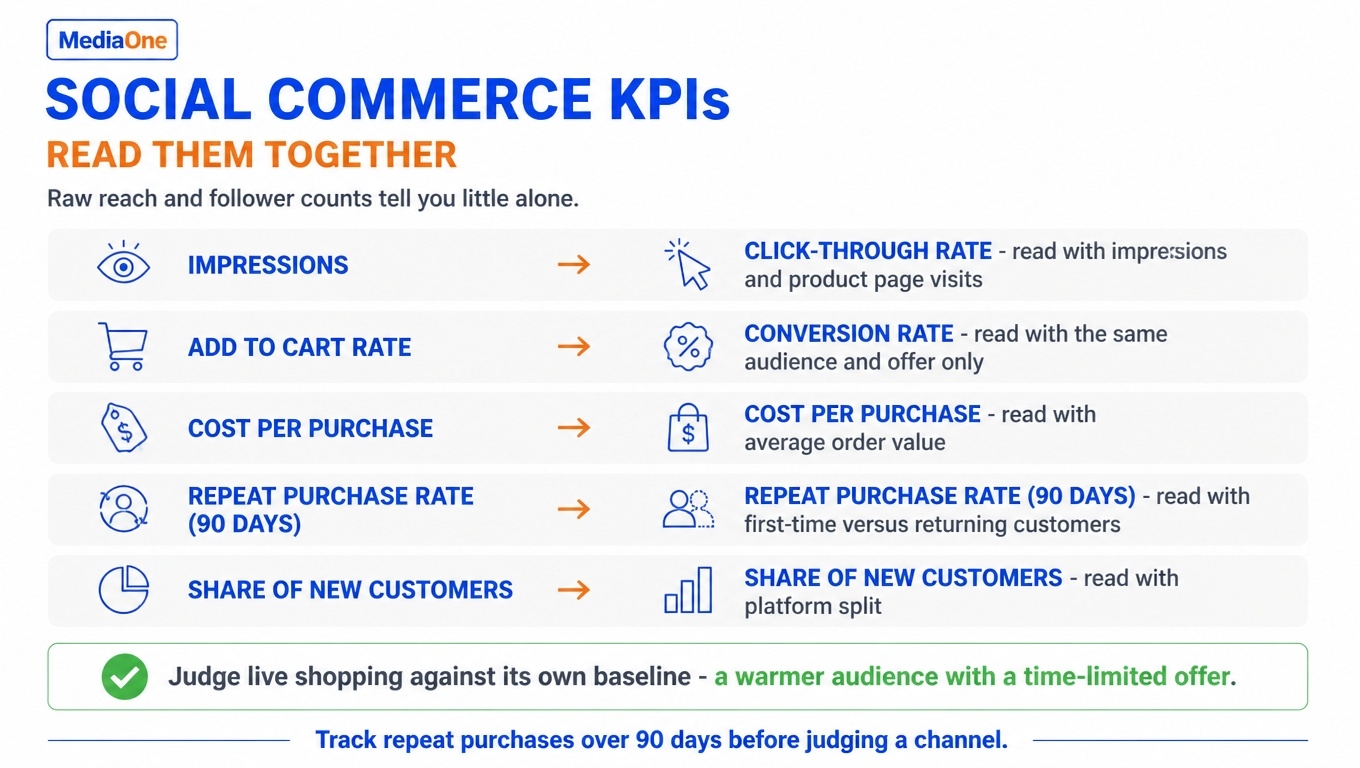
Track repeat purchases over 90 days before deciding a channel works. A high first-order conversion that never returns may be buying discounts rather than customers, so test whether sales from each online channel hold up over time.
Our guides to digital marketing KPIs and customer retention explain how to build that view without a data team.
Your Next Steps to Improve Your Social Commerce
Social commerce rewards businesses that earn trust inside the feed. Judge the channel on how well it builds trust and removes friction, not on reach alone.
Start by scoring your business on Discovery, Trust, Friction and Measurement. Fix any lever scoring 2 or below before buying paid placements.
Next steps for a Singapore business:
- Score all four levers this week and note the two weakest.
- Fix the weakest lever before buying paid placements.
- Pick one platform your buyers use and confirm its payment methods suit Singapore shoppers.
- Run one small creator or user-generated content test, tracking conversion and 90-day repeat purchase against your own baseline.
If you want the readiness score reviewed against your own numbers, talk to our Singapore team — or start with the social media marketing service page to see what a managed programme covers.
Frequently Asked Questions
Social media marketing builds awareness, and the sale usually happens later on a website or in a store. Social commerce moves the purchase into the feed, so viewers can see a product, check reviews and pay without leaving the app. If the path to purchase ends inside the platform, you are doing social commerce.
Start where your customers already spend time and where your product suits the format. TikTok Shop suits visual, impulse-driven products, as 34% of Gen Z use TikTok to explore brands. Instagram suits lifestyle and considered purchases. Pick one platform, run it for 90 days, then add a second.
Measure contribution after advertising, creator fees and fulfilment, not revenue alone. Track conversion rate per platform, cost per first purchase and repeat purchase over 90 days. Live-selling conversion rates of 25 to 35% sit well above the typical rates for standard ecommerce sites, but they depend heavily on format.
No, but you need proof from someone other than yourself. Reviews, customer content, and demonstrations by real buyers can do much of the work of a creator. Influencers help most when your product needs demonstration, or you have no reviews yet.
Is live shopping worth the effort for a small brand?
It can be, if you already have a steady audience and a product that benefits from demonstration. Live sessions convert far higher than standard pages, but they demand scheduled hosting, stock readiness and real-time answers to questions. Test one 30-minute session a week for four weeks. Keep it only if cost per sale beats your other channels after fulfilment and hosting costs. Our TikTok Live setup and engagement guide covers the operational side.