| AI Summary
An influencer marketing campaign connects a brand with creators who can reach its intended customers. A sound plan connects the audience, content, budget and reporting before any partnership begins. For Singapore brands, the practical checks include local audience evidence, agreed content rights and visible sponsorship labels. This guide explains how to turn those checks into a campaign brief and a five-part planning scorecard. |
An influencer marketing campaign is a planned partnership in which a brand pays or rewards creators to promote products or services. Campaign planning covers the objective, target audience, creator selection, content, payment, permissions and measurement. Success depends on the agreed goal, which may be awareness, enquiries or sales.
Key Takeaways
- Audience evidence deserves more weight than a creator’s follower total.
- Creator fees, content rights and advertising spend belong on separate budget lines.
- Paid posts and product incentives need appropriate sponsorship disclosure.
- Tracked sales show attributed results; they do not prove every purchase was additional.
- A completed campaign brief gives the team a basis for approving spend.
A creator’s video attracts comments, saves and questions about your product. The campaign looks promising. Your team still needs to know what those reactions should achieve for the business.
An influencer marketing campaign works best when that answer comes before creator outreach. A café seeking weekday visits needs a different plan from a software company seeking demonstration bookings.
The sections below follow that planning decision: what to buy, whom to work with, what to spend and how to assess the outcome. Examples use hypothetical figures in Singapore dollars, not market rates or promised results.
How does an influencer marketing campaign work?
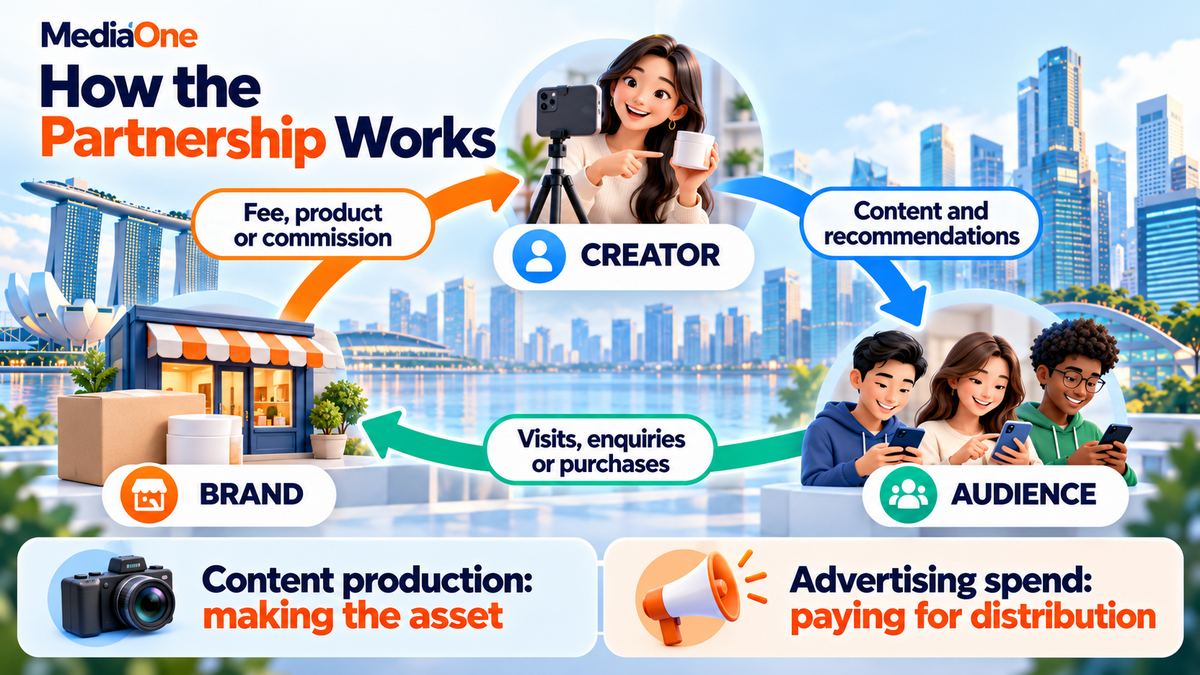
An influencer marketing campaign brings three parties together. The brand provides a fee, product, service or commission. The creator produces content and may publish it to their audience. Viewers decide whether to watch, respond, visit or buy.
Those exchanges can involve different purchases:
- Content production: the creator makes photographs, videos or written posts.
- Audience access: the creator publishes content on their own channels.
- Content permission: the brand receives agreed rights to reuse the work.
- Paid distribution: advertising spend puts approved content in front of more people.
A production fee does not automatically include every item. A brand paying for one Instagram Reel should confirm whether Stories, advertising permission and website reuse are separate charges.
Awareness and sales need different tests
An awareness campaign introduces a brand to potential customers. A sales campaign asks people to buy. Both can support the business, but they need different evidence.
Relevant reach can support an awareness report. Orders and acquisition costs belong in a sales report. A high view count alone cannot establish profit, while immediate purchases may miss the purpose of a campaign designed to introduce a new brand.
Within a wider social media marketing plan, creator content should have a defined job alongside the brand’s own posts and advertising.
Which campaign format supports your objective?
The campaign format should follow what the business needs people to do. A product demonstration, affiliate offer and giveaway may attract different responses even when the same creator publishes them.
| Campaign format | Main purpose | Evidence to collect |
| Sponsored post or video | Introduce or explain an offer | Relevant reach, viewing and visits |
| Product review or demonstration | Help buyers assess a product | Questions, saves and product-page visits |
| Giveaway | Encourage participation | Eligible entries and relevant audience growth |
| Ambassador programme | Build repeated brand association | Audience response across several posts |
| Affiliate campaign | Generate tracked orders | Valid sales, returns and commission |
| Commissioned creator content | Produce assets for brand channels | Approved assets and performance where reused |
Sponsored posts and product demonstrations
A sponsored post gives the creator an agreed message to deliver through their own style. A demonstration adds detail by showing the product in use.
For example, a kitchenware brand might commission a video showing how a container closes, stacks and washes. The demonstration answers buying questions that a product photograph leaves open.
Platform choice follows the explanation needed. Instagram influencer marketing can combine a visual demonstration with follow-up Stories. Longer videos may suit a product that needs more explanation. The creator’s audience evidence should support that choice.
Affiliate partnerships and ambassador programmes
An affiliate campaign pays commission under agreed sales rules. An ambassador programme creates an ongoing relationship, often involving several posts over time. The two models can work together.
A fitness retailer, for instance, could commission a series showing equipment in different routines. An affiliate code can track orders, while the wider series helps people understand the products. Commission terms still need to account for cancellations and returns.
Creator content and customer-generated content
Commissioned creator content and unpaid customer posts are different sources of material. A paid creator may produce a video without publishing it to their followers. An ordinary customer may post without any agreement with the brand.
Both require attention to permission before reuse. A broader content marketing strategy can connect licensed demonstrations with product pages, email and other brand channels. Production quality alone does not establish which format will perform best.
What should the campaign achieve, and whom should it reach?
Every campaign needs a primary objective that the team can measure. Supporting goals can remain in the plan, but one outcome should guide budget decisions.
A statement such as “increase engagement” leaves too much open. A more specific example is “generate 40 completed trial bookings from Singapore residents during the campaign period.” That is a hypothetical planning target, not a benchmark.
One objective, one main measure
| Primary objective | Main measure | Supporting checks |
| Awareness | Reach within the intended audience | Viewing time and audience location |
| Consideration | Visits to a relevant product or service page | Saves, questions and return visits |
| Lead generation | Qualified enquiries or bookings | Lead quality and cost per enquiry |
| Sales | Valid orders or new customers | Revenue, returns and contribution after costs |
The reporting period also belongs in the brief. A short promotion and a service with a longer buying cycle need different follow-up periods.
Campaign targets should reflect the business’s own records where available. A team without past creator results can begin with a limited test budget and revise its expectations after the first campaign.
A Singapore audience needs more than a location label
A Singapore-based creator can have a large overseas following. A creator based elsewhere may reach customers in Singapore. The account’s home location does not settle the question.
A practical audience description covers:
- Customer location and the areas the business serves.
- Language preferences and age group.
- The need the product or service addresses.
- Price expectations and likely buying questions.
- Whether customers can buy online, visit an outlet or book a service.
For a neighbourhood café, proximity to the outlet may outweigh national exposure. For an online retailer serving Singapore, islandwide demand may be relevant. Audience details should connect with the offer and the business’s ability to deliver it.
How should you assess creators before shortlisting them?
Creator selection needs evidence from several sources. Recent platform analytics, examples of comparable posts and the creator’s response to the brief provide more context than a public follower total.
The shortlist should record what is known and what remains unverified. A short discussion can resolve missing details before either side spends time preparing a proposal.
Audience location and viewing patterns
Recent audience screenshots can show country, age and other available details. The team should also ask about typical reach on content similar to the planned post.
A highly viewed travel video may say little about likely interest in a local service promotion. Several comparable posts give a stronger basis for discussion than one exceptional result.
Engagement quality and follower tiers
Comments can reveal product questions, local references and conversations with the creator. Generic comments or sudden growth warrant closer checks, but neither proves fraud on its own.
Nano, micro, macro and mega are common follower labels. Their boundaries vary across sources and platforms, so the shortlist should record actual follower counts. No tier guarantees stronger sales, lower costs or a more engaged audience.
A consistent comparison includes:
- Recent sponsored posts as well as unpaid content.
- Typical views across comparable formats.
- The calculation behind any engagement percentage.
- Audience location and available age data.
- Earlier partnerships and how the creator explained sponsorship.
A worked shortlisting example
Suppose Creator A has 80,000 followers, with 60% based in Singapore. Creator B has the same follower count, with 15% based locally. Those hypothetical figures suggest different local audience potential, but they do not predict post reach or sales.
Creator A may deserve further discussion for a Singapore-only offer. The decision still needs content examples, pricing and audience relevance. Creator B could remain suitable for a regional campaign.
How much should a Singapore influencer marketing campaign cost?
A campaign budget depends on the work purchased. Follower count alone cannot price production, publication, revisions, exclusivity and reuse rights.
Comparable quotes need the same scope. A quote for one video on the creator’s channel is different from a package that also includes paid advertising permission and edited versions for the brand’s website.
The budget lines to separate
| Budget item | What the team should confirm |
| Creator fee | Content, publication and included revisions |
| Product and delivery | Samples, shipping and any event costs |
| Usage rights | Channels, duration, territory and editing permission |
| Advertising spend | Separate media budget and account access |
| Exclusivity | Competing brands covered and restriction period |
| Management | Outreach, coordination, reporting and administration |
| Commission | Eligible sales, returns and payment timing |
Quotes should also state currency and any applicable taxes. A low headline fee may cover less work than another proposal.
A budget example based on order contribution
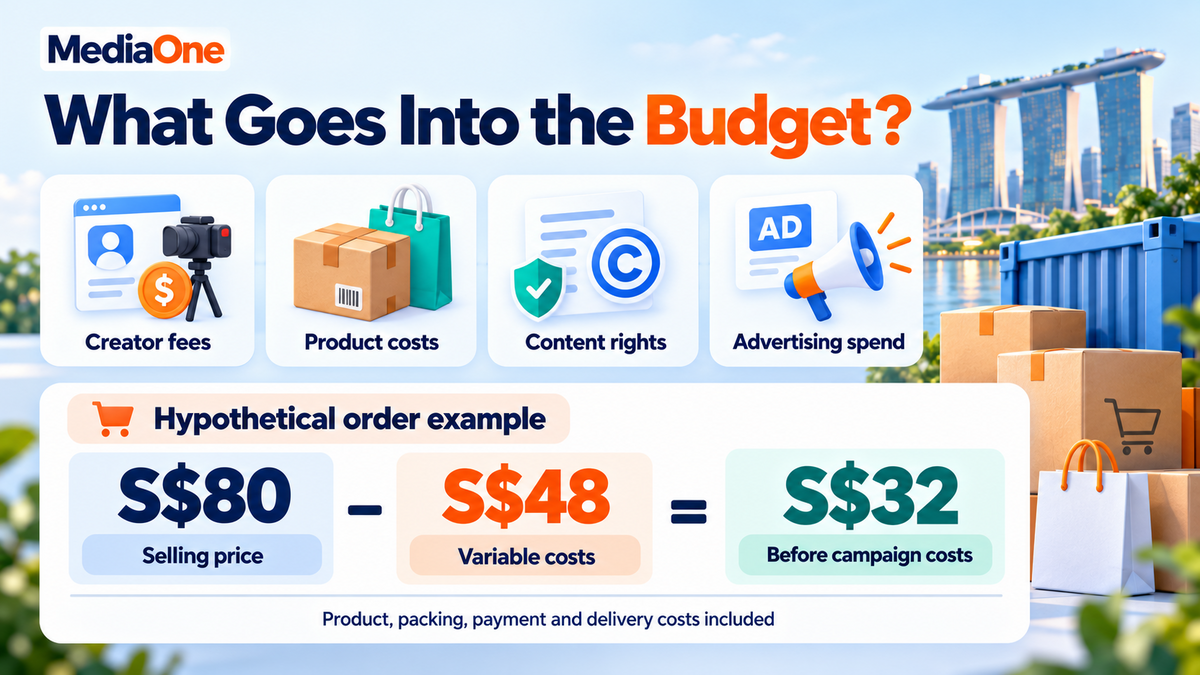
A hypothetical retailer sells a product for S$80. Product, packing, payment and delivery costs total S$48 per order, leaving S$32 before campaign costs. A campaign costing S$3,200 would need 100 additional orders at that contribution to cover its campaign cost:
Break-even additional orders: S$3,200 ÷ S$32 = 100 orders
That calculation assumes the S$32 amount already reflects relevant discounts and variable costs. Returns or extra service costs would change the result. The example provides a spending test, not a sales forecast.
Fixed fees, commission or a combination
A fixed fee pays for agreed work even if sales disappoint. Commission links some payment to eligible purchases. A combined arrangement can pay for production while rewarding tracked sales.
The agreement should define the commission base, attribution period, returned orders and payout timing. No single commission percentage suits every product margin or creator relationship.
What belongs in the brief and content agreement?
A campaign brief turns the business plan into a job the creator can understand. The content agreement records the terms both parties accept.
The brief can remain short while covering the essentials:
- Objective: the main outcome and reporting period.
- Audience: intended customers, location and language.
- Offer: product details, price and buying destination.
- Deliverables: formats, quantities and publishing channels.
- Message: key points and evidence for factual claims.
- Creative freedom: areas where the creator chooses the story.
- Approvals: reviewer, deadlines and included revisions.
- Measurement: links, codes and reporting requirements.
A workable social media content plan also leaves room for the brand to answer questions after publication. Customer service needs the same offer details as the creator.
Content rights and advertising permission
Singapore’s copyright ownership rules generally place ownership with the creator, including commissioned work, subject to the contract and applicable exceptions. Payment alone does not establish unlimited ownership or reuse rights.
The agreement should identify permitted channels, duration, territory and edits. Advertising through a creator’s account also needs the relevant platform permission. A licence for website use should not be treated as permission for every future advertisement.
Sponsorship disclosure in Singapore
The ASAS social media advertising standards require marketing communications to be distinguishable from personal opinion and editorial content. A sponsored recommendation should remain recognisable as advertising.
The ASAS disclosure notes cover paid messages, sponsored products and reviews solicited through products or services supplied at the brand’s expense. Disclosures should appear as early as reasonably possible, including visibly within video content where appropriate.
Platform requirements apply alongside Singapore’s standards:
- TikTok’s commercial content disclosure setting must be enabled for content promoting a brand, product or service.
- YouTube’s paid promotion declaration requires creators to notify the platform about paid placements, sponsorships and endorsements.
A publishing check should cover the actual post, caption and video. A correct draft can still become an incomplete disclosure during upload.
Music and third-party material
A creator’s permission does not resolve rights in someone else’s music, photographs or footage. Those assets need their own checks.
TikTok’s Commercial Music Library provides music for commercial TikTok content, with region and placement options. A track’s availability on one platform should not be treated as permission to reuse it elsewhere.
How should campaign results be measured?
Measurement begins before publication. Each creator needs an agreed reporting method, and the business needs a working destination for interested viewers.
An influencer post can lose potential customers if its link opens an unrelated page or a difficult booking form. The campaign’s website design should support the promised offer with readable product information and a short route to purchase or enquiry.
Links, codes and sales records
Google Analytics supports campaign tracking through UTM parameters, which identify campaign traffic arriving through tagged links. A consistent naming system helps separate creators and content versions.
A simple tracking plan includes:
- A distinct link or identifier for each creator.
- A campaign name used consistently across reports.
- A tested purchase, booking or enquiry event.
- A unique code where checkout supports one.
- An agreed method for removing cancelled or refunded orders.
Codes and links can overlap. An order using a code after clicking a tracked link should count once in the combined campaign total.
Attributed sales and additional sales
Google Analytics attribution models assign credit to interactions before an important action. That credit describes recorded customer activity; it does not establish that the campaign caused every credited purchase.
Some customers would have bought anyway. Others may see creator content, later search for the brand and purchase without using a code. Reporting should acknowledge both possibilities.
Where practical, a planned comparison with an unexposed group can help assess additional demand. A simple before-and-after comparison needs caution because promotions, seasonality and other marketing can affect sales.
Revenue and profit answer different questions
A sales report should separate revenue from contribution after costs. S$10,000 in attributed sales does not mean S$10,000 in profit.
For a hypothetical campaign, S$10,000 in sales less S$6,000 in variable product and delivery costs leaves S$4,000. Campaign costs of S$2,500 then leave S$1,500 before overheads and other expenses. Any claim about additional profit still depends on how much demand the campaign actually added.
Decisions for the next campaign
A final report should explain what the team will repeat, change or stop. Results by creator and format can reveal differences hidden by the campaign total.
The next decision should follow the evidence:
- Many visits with few orders call for a review of the offer and purchase page.
- Repeated questions about price suggest that the content or destination needs more detail.
- Strong orders with frequent returns call for a check of product expectations.
- Limited local viewing calls for another audience review before renewing the partnership.
A small test works best when the team changes one major element at a time. Otherwise, the next report may show a different result without explaining why.
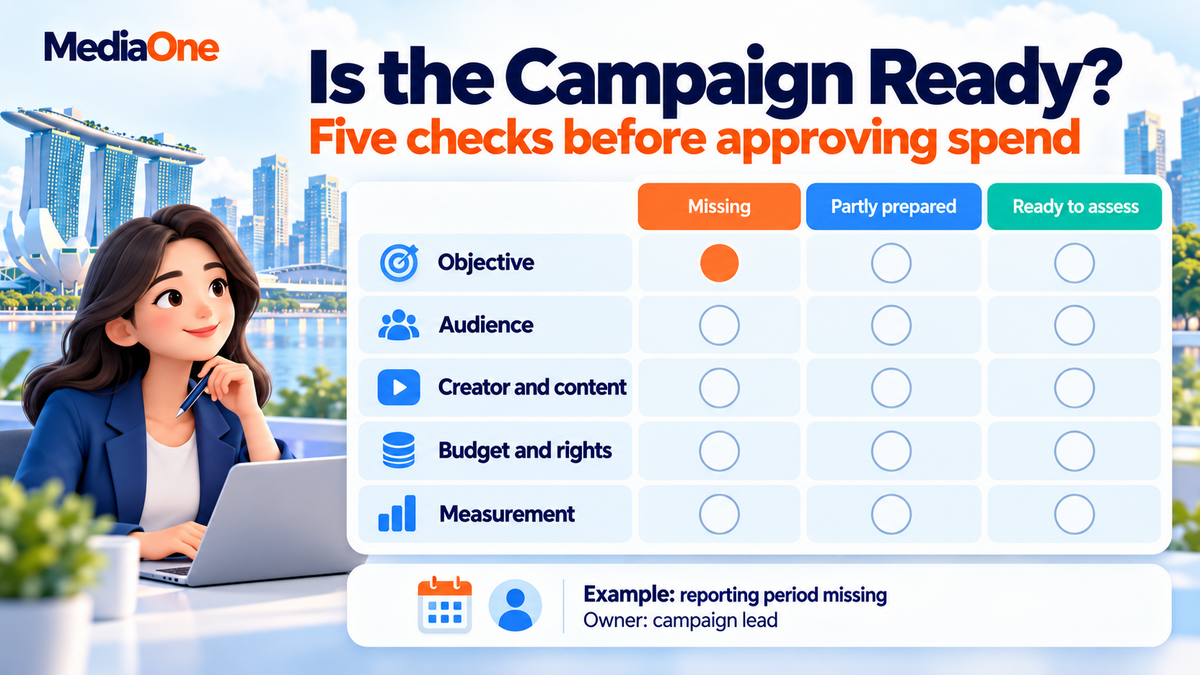
The five-part campaign planning scorecard
The scorecard below checks whether the proposal is ready for a spending decision. It is a planning tool, not an industry benchmark or a guarantee of results.
| Planning check | 1: Missing | 2: Partly prepared | 3: Ready to assess |
| Objective | No defined outcome | Goal without target or period | Outcome, target and period recorded |
| Audience | Broad description only | Some supporting data | Customer profile and creator evidence recorded |
| Creator and content | Selection based on popularity | Relevant examples reviewed | Audience, format and deliverables assessed |
| Budget and rights | Headline fee only | Some costs or permissions missing | Costs and permissions documented |
| Measurement | No reporting plan | Metrics selected, tracking untested | Tracking tested and reporting agreed |
An unresolved item needs an owner and an action before approval. A high total should never cancel out missing rights, missing disclosure or a broken purchase link.
A worked campaign approval
A hypothetical Singapore homeware retailer is preparing a storage-container launch. Its team has a creator shortlist and a spending limit, but the first proposal promises only “strong exposure.” The objective row scores 1 because the intended customer action remains undefined. The proposal also includes advertising permission without a duration, leaving the budget and rights row incomplete.
A revised proposal records a sales target, a reporting period and the relevant audience evidence. The creator quote now specifies one demonstration video, two follow-up Stories and a stated advertising licence period. The website team tests the purchase link and confirms product availability.
Those changes do not guarantee sales. They give the team enough information to decide whether the proposed spend is reasonable. After approval, day-to-day influencer campaign management keeps the agreed deliverables, approvals and reporting on schedule.
Building an influencer marketing campaign around business goals
An influencer marketing campaign deserves a budget when the team can explain the purchase, the intended audience and the evidence it expects to collect. The brief and scorecard give that spending decision a shared basis.
MediaOne’s influencer marketing services cover creator discovery, campaign coordination and performance tracking. Our team can discuss how a proposed campaign connects with your social content, advertising and website through a campaign consultation.
FAQs about influencer marketing campaigns
Can a brand send products without requiring a post?
A brand can offer a product without making publication a condition. The outreach should state whether content is optional. A gift should not be treated as a guaranteed deliverable; any later content still needs assessment of the commercial relationship and disclosure requirements.
Creator access should use platform roles and permissions wherever available. Account ownership and recovery details should remain with the business. The team should grant only the access needed for the agreed work and remove it when that work ends.
What happens if a creator cannot publish on the agreed date?
The agreement should record how delays are handled, including notice, replacement dates and cancellation terms. A time-sensitive offer may need different treatment from an evergreen demonstration. Any revised delivery date should be accepted in writing by both parties.
Can two creators publish similar content for the same brand?
Several creators can address the same product benefit while presenting different experiences or examples. The brief should identify shared facts without requiring identical scripts. Distinct approaches also let the team compare which explanations attract questions from potential customers.
Can an old campaign post remain online after the partnership ends?
The agreement should state how long the post remains live and what happens when an offer expires. An outdated price or code may confuse later viewers. Caption updates, offer end dates or removal terms can address that problem before publication.
Should exclusivity cover every competing product?
Exclusivity should describe the competing products, brands, channels and restriction period. A broad ban may limit the creator’s other work and increase the quote. A homeware campaign, for example, may need restrictions on competing storage containers without covering every household product. Both parties need the same written understanding before accepting the fee.