

Most businesses believe they are struggling with SEO. But the truth is, they’re struggling because they are measuring the wrong things.

In 2026, SEO KPIs are no longer about chasing rankings or celebrating traffic spikes that never turn into revenue. You are operating in a search landscape shaped by AI answers, zero-click results, personalised SERPs, and longer buying journeys. If your KPIs still stop at clicks and keyword positions, you are flying blind.
That is also why many businesses turn to an SEO agency in Singapore for help building reporting frameworks that connect search performance to real commercial outcomes.
This guide is written for business owners and marketers in Singapore who are actively investing in digital marketing and expect SEO to drive measurable business outcomes. Not reports that look impressive. Outcomes that justify budgets in SGD, protect margins, and compound growth.
You will learn what to measure, why it matters now, and how to align SEO KPIs with real commercial impact. Not theory; just practical leadership.
Key Takeaways
- SEO performance in 2026 must be measured by business impact, not surface-level metrics. Rankings, traffic, and backlinks only matter when they translate into qualified demand, conversions, and revenue in SGD.
- The difference between KPIs and metrics is critical. KPIs are tied to commercial outcomes, while metrics provide context. Treating vanity metrics as KPIs is one of the main reasons SEO loses credibility with leadership teams.
- Modern SEO measurement has shifted from pages to topics, and from clicks to influence. Visibility, engagement, and assisted conversions now matter as much as direct traffic due to AI-driven search and zero-click behaviour.
- Effective SEO KPIs must be aligned with the business model. E-commerce, lead generation, and content-led brands all require different KPI priorities to avoid misreading performance.
- Realistic SEO benchmarks rely on trends and ranges, not fixed targets. Flexible, intent-aware benchmarking allows SEO to adapt to algorithm changes and SERP volatility while remaining accountable to growth goals.
SEO KPIs vs SEO Metrics: What Is the Difference?
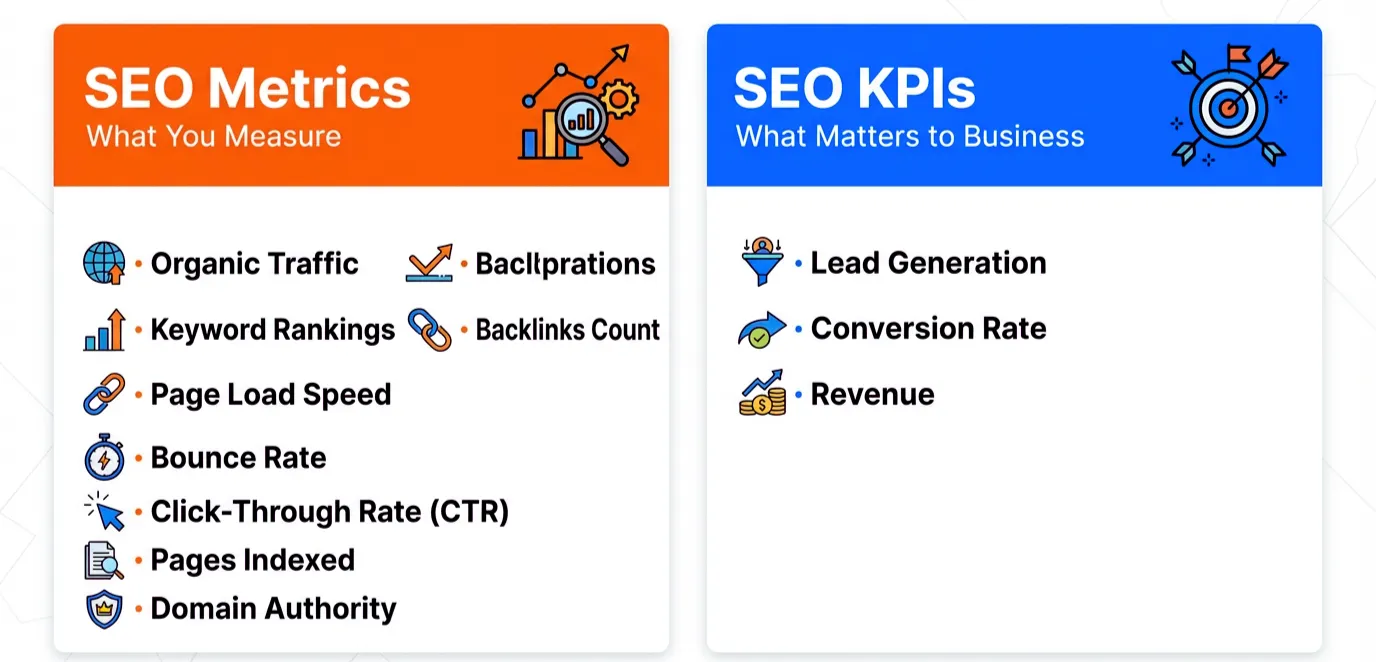
If you treat every metric as a KPI, you end up with noise instead of insight. This is one of the most common reasons SEO loses credibility at the board level. Not because it does not work, but because it is measured poorly.
A KPI is a performance indicator tied directly to a business objective. Meanwhile, a metric is a supporting data point that explains movement.
For example, organic revenue is a KPI. Click-through rate and impressions are metrics. Rankings are usually just context.
When you confuse the two, reporting becomes performative instead of strategic. When rankings become the KPI, teams optimise for position instead of outcomes. When total organic sessions become the KPI, traffic quality gets ignored. When backlink counts become the KPI, authority is reduced to volume rather than relevance or trust.
At that point, reporting becomes performative instead of strategic. Teams celebrate surface-level wins. A digital marketing company sees activity but not progress. Trust erodes.
You still see this play out every month in reports that lead with vanity numbers, such as:
- Average keyword position across unrelated queries
- Total organic sessions without brand or intent segmentation
- Raw backlink counts without quality or relevance analysis
- Bounce rate reported without understanding the page’s purpose
None of these is inherently useless. The mistake is treating them as successful SEO metrics. Decision-making KPIs look very different. They are framed as questions that matter to the business, not to the SEO tool.
- Is SEO driving qualified demand in Orchard more than in Jurong or the CBD?
- Do organic leads convert at a higher rate than paid search leads?
- Is content investment reducing cost per acquisition over time?
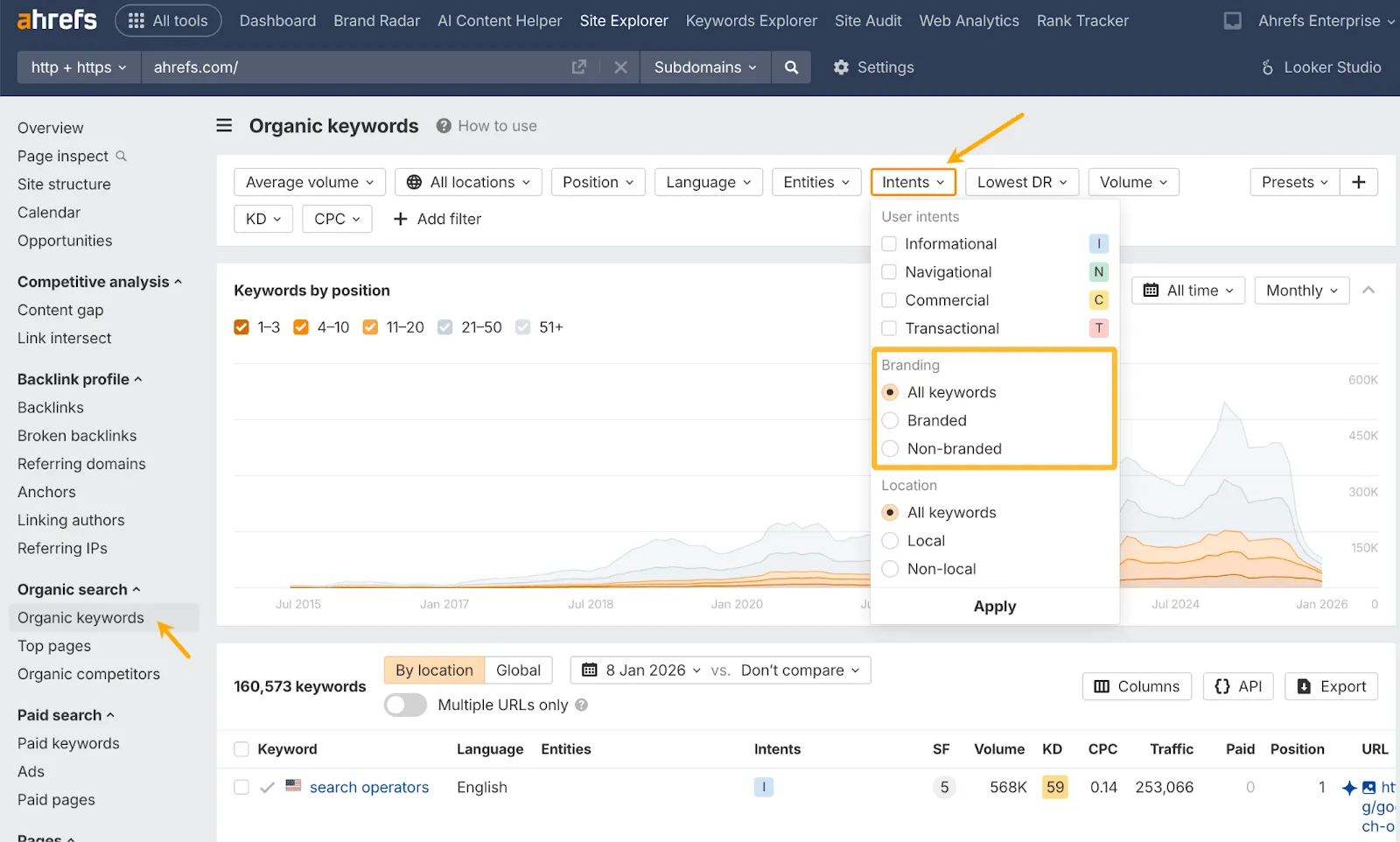
- Are non-branded queries contributing to pipeline growth, not just awareness?
When KPIs are framed this way, SEO becomes measurable in commercial terms. It also becomes easier to defend when budgets are reviewed.
Misaligned KPIs lead to a poor SEO strategy because teams optimise for what is measured. If you measure rankings, you get ranking tactics. If you measure traffic, you get traffic tactics. If you measure revenue and lead quality, you get strategies that support growth.
Measure the wrong thing, and you get the wrong outcome. Measure the right thing, and SEO starts behaving like a serious business channel, not a reporting exercise.
How SEO Measurement Has Changed Since 2023
Since 2023, SEO measurement has not evolved gradually. It has shifted structurally. If you are still using the same KPIs you relied on three years ago, you are not just slightly out of date. You are measuring the wrong reality.
Three changes explain why.
AI Overviews and Featured Answers Have Fundamentally Reduced Blue-Link Visibility

Source: Google
Google has been explicit about its direction. Generative search experiences are now embedded across more queries, more formats, and more markets. The goal is speed and satisfaction inside the search results themselves, not necessarily clicks to websites.
In practical terms, this means your content can perform well without generating traffic. It can shape decisions, educate users, and influence brand preference while never earning a click.
Traditional KPIs like sessions and click-through rate fail to capture this influence. Visibility now includes impressions, search appearance types, and repeated exposure across related queries. If your measurement model ignores this, it undervalues SEO’s real impact.
Performance Has Shifted From Pages to Topics and Entities
Source: Google
Google’s helpful content guidance and its emphasis on E-E-A-T make this clear. Search engines are no longer evaluating isolated URLs in a vacuum. They assess whether your site demonstrates sustained expertise across a subject area, supported by credible authorship and consistent depth.
This is why page-level KPIs alone are misleading. One well-ranked article does not indicate topical authority. Conversely, a group of pages working together can lift visibility even if no single page dominates rankings.
Measurement must expand to topic coverage, internal linking effectiveness, and entity association. You are no longer optimising pages. You are building relevance systems.
SEO Has Become Inseparable from Business Outcomes
As paid media costs rose and attribution models matured, rankings without revenue attribution became less relevant. A top-three position that drives unqualified traffic is no longer a win. Visibility that does not support pipeline, sales, or retention is difficult to defend in boardroom conversations.
This shift is especially visible in markets like Singapore, where competition is dense, and buying journeys are rarely linear. SEO often influences consideration long before conversion. That influence must now be measured by an SEO company through assisted conversions, lead quality, and revenue contribution, rather than solely through last-click attribution.
Taken together, these changes force a reset. Your SEO KPIs must reflect contribution, not presence. Influence, not just traffic. When measurement evolves to reflect how search actually works today, SEO stops being a reporting exercise and becomes a growth lever.
Core SEO KPI Categories for 2026

In 2026, you cannot afford to look at SEO KPIs as a flat list of numbers. Modern SEO reporting works only when you understand how different KPI categories interact and compound. There are five core groups you should pay attention to, and none should ever be reviewed in isolation.
Visibility
At the top of the funnel sits visibility. This is about whether you are present where demand exists. Impression share, search appearance types, and topic-level coverage tell you if your brand is even entering the conversation. Without visibility, nothing else downstream matters. You cannot convert traffic you never earn the right to attract.
Traffic Quality
This is where many teams get misled. Raw organic sessions look impressive in reports, but they hide the real question. Are the right people landing on the right pages?
Traffic quality KPIs help you understand intent, geography, device behaviour, and landing page concentration. In a market like Singapore, where intent can vary dramatically by location and query context, quality almost always matters more than volume.
Engagement
Engagement KPIs act as a reality check on your visibility and traffic assumptions. They tell you whether users find your content useful once they arrive.
Metrics such as engaged sessions, scroll depth, and interaction events help you diagnose content effectiveness and user experience issues early. Weak engagement is often the first signal that rankings alone are masking deeper problems.
Conversion and Revenue
These KPIs connect SEO to commercial outcomes. Leads, sales, assisted conversions, and revenue per session show whether your SEO strategy is contributing to growth, not just awareness.
This is where SEO earns credibility with finance teams and leadership. If you are not measuring this layer properly, SEO remains vulnerable during budget reviews.
Authority and Trust
This category underpins everything else. Authority KPIs reflect whether search engines and users see your brand as credible within its topic space. Link quality, brand mentions, topical depth, and consistency of coverage all sit here. Authority compounds over time and amplifies the performance of every other KPI category.
Technical KPIs deserve special mention because they support all five groups rather than standing alone. Indexation, crawl efficiency, site performance, and error trends determine whether your visibility, engagement, and conversions can scale at all. But technical health is not the end goal. It is the foundation that allows everything else to work.
Balance across these categories is where experienced SEO leadership shows. If you overweight technical metrics, you may ship a flawless site that fails to generate demand. If you overweight conversions, you may miss early warning signs, such as declining visibility or engagement, that predict future revenue drops.
A strong SEO strategy comes from reading these signals together and understanding how movement in one category influences the others over time. This systems-level thinking is what separates reporting from leadership.
Content Performance KPIs
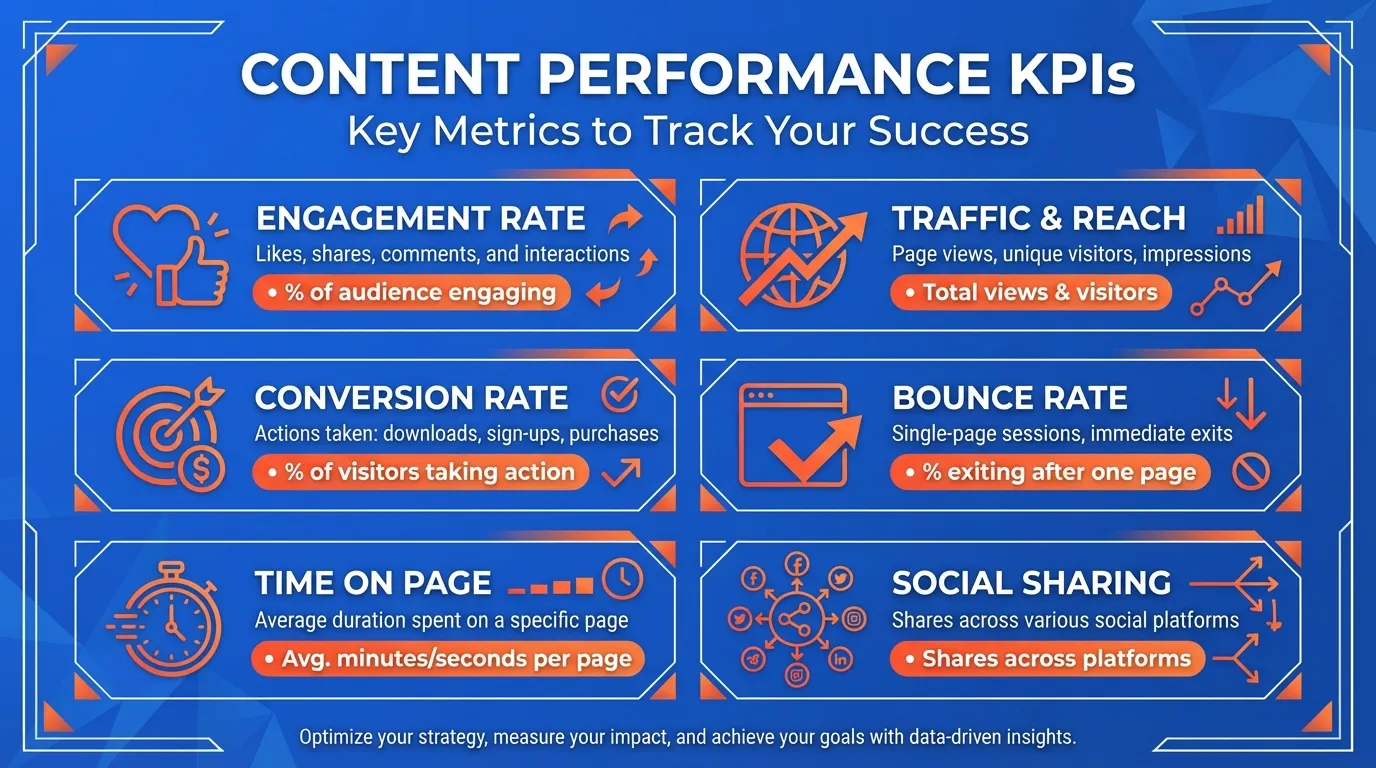
If you are still evaluating content performance page by page, you are measuring SEO the way we did a decade ago. That approach no longer reflects how search engines interpret relevance or how users actually consume information.
Topic Level
Content performance should be assessed at the topic level first, with individual pages serving as supporting assets. Google no longer rewards isolated “good pages.” It rewards depth, consistency, and coverage across an entire subject area.
That means your KPI is not whether one article ranks, but whether your content cluster owns visibility, engagement, and conversion for a topic that matters to your business.
This is where many teams misread success. One page dropping in traffic does not automatically signal failure. It may be seasonal. It may be displaced by another page in the same cluster. Or it may be doing its job quietly by supporting authority rather than driving clicks directly. Topic-level KPIs help you see that full picture instead of reacting emotionally to page-level fluctuations.
Content decay indicators are critical here. Over time, even strong content loses ground due to fresher competitors, changing intent, or outdated examples. Monitoring traffic decline, impression loss, and reduced engagement at the topic level tells you when content needs updating rather than replacing.
This is far more cost-effective than constantly publishing new pages while old ones quietly erode your authority.
Internal Linking Metrics
Internal linking metrics sit right beside decay tracking. Strong content clusters distribute authority intentionally. If your cornerstone pages are gaining links but your supporting content never ranks or receives impressions, authority is not flowing correctly.
KPIs such as internal link depth, anchor text distribution, and assisted conversions from supporting pages help you diagnose whether your structure is working or leaking value.
Ranking Performance
You also need to separate ranking performance from commercial performance, because they are not always the same thing. Some content ranks extremely well but never converts. That content still has value. It captures awareness, qualifies intent, and deepens user engagement in your ecosystem.
Other content converts consistently but never ranks broadly because it targets narrow, high-intent queries or branded searches. That content is often closer to revenue and should be protected, even if traffic volume looks unimpressive in isolation.
Your KPIs must reflect these different roles, you will optimise the wrong pages and weaken your funnel. At a minimum, strong content performance KPIs should help you answer four questions clearly:
- Are we owning visibility across priority topics, not just individual keywords?
- Is our content maintaining relevance over time, or quietly decaying?
- Is authority flowing logically through our internal structure?
- Are we correctly valuing content that influences conversions, even when it does not drive volume?
When content KPIs are designed this way, content stops being treated as disposable blog posts and starts being managed as a long-term growth asset. That is the difference between publishing content and building an SEO engine.
Technical SEO KPIs
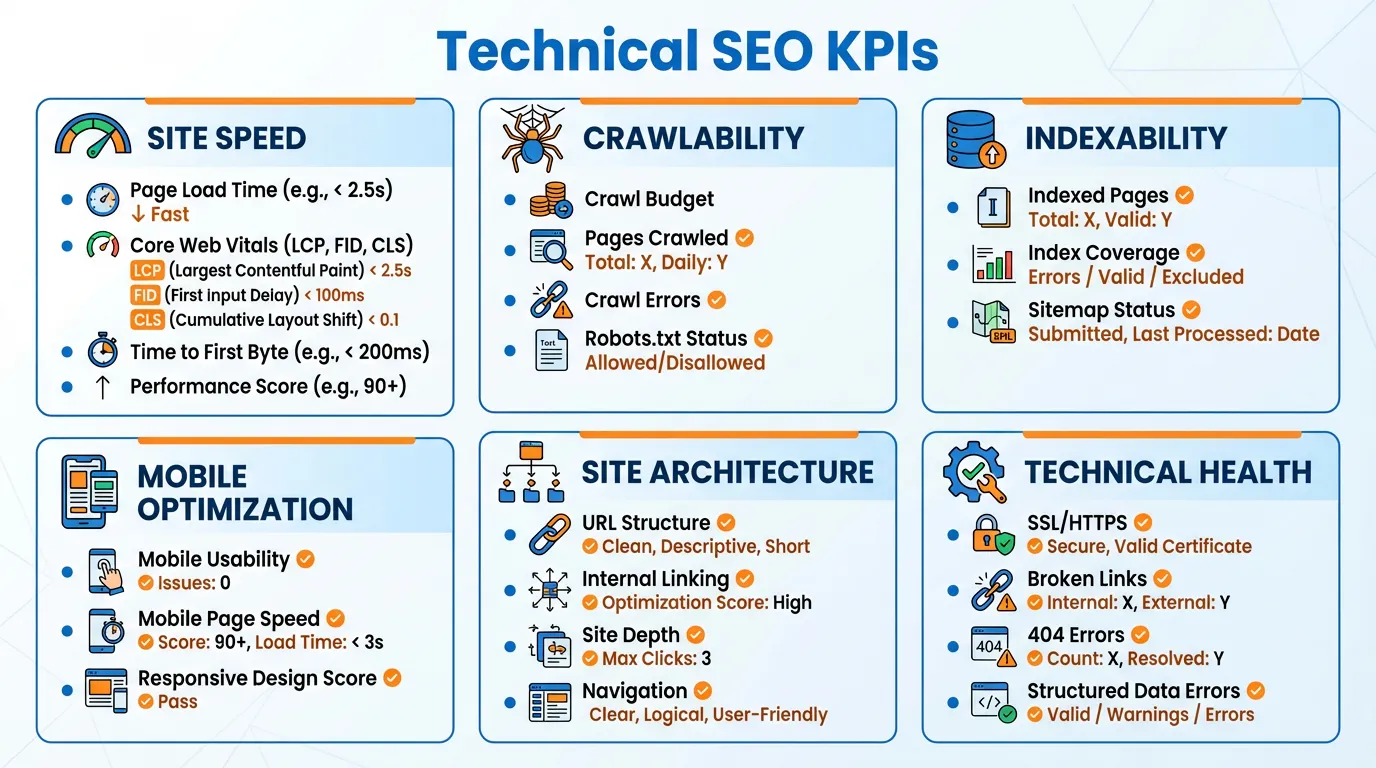
Technical SEO KPIs sit in an uncomfortable place. They rarely impress executives on their own, yet when they break, everything else collapses. The mistake many teams make is treating technical performance as a scorecard rather than what it really is. An enablement layer that determines whether your content and authority can even compete.
Think of technical SEO as infrastructure. No one invests in infrastructure because it is exciting. You invest because without it, growth stalls.
Core Web Vitals
Core Web Vitals are the clearest example of this shift. Google has been explicit that these metrics are designed to reflect real user experience, not developer convenience.
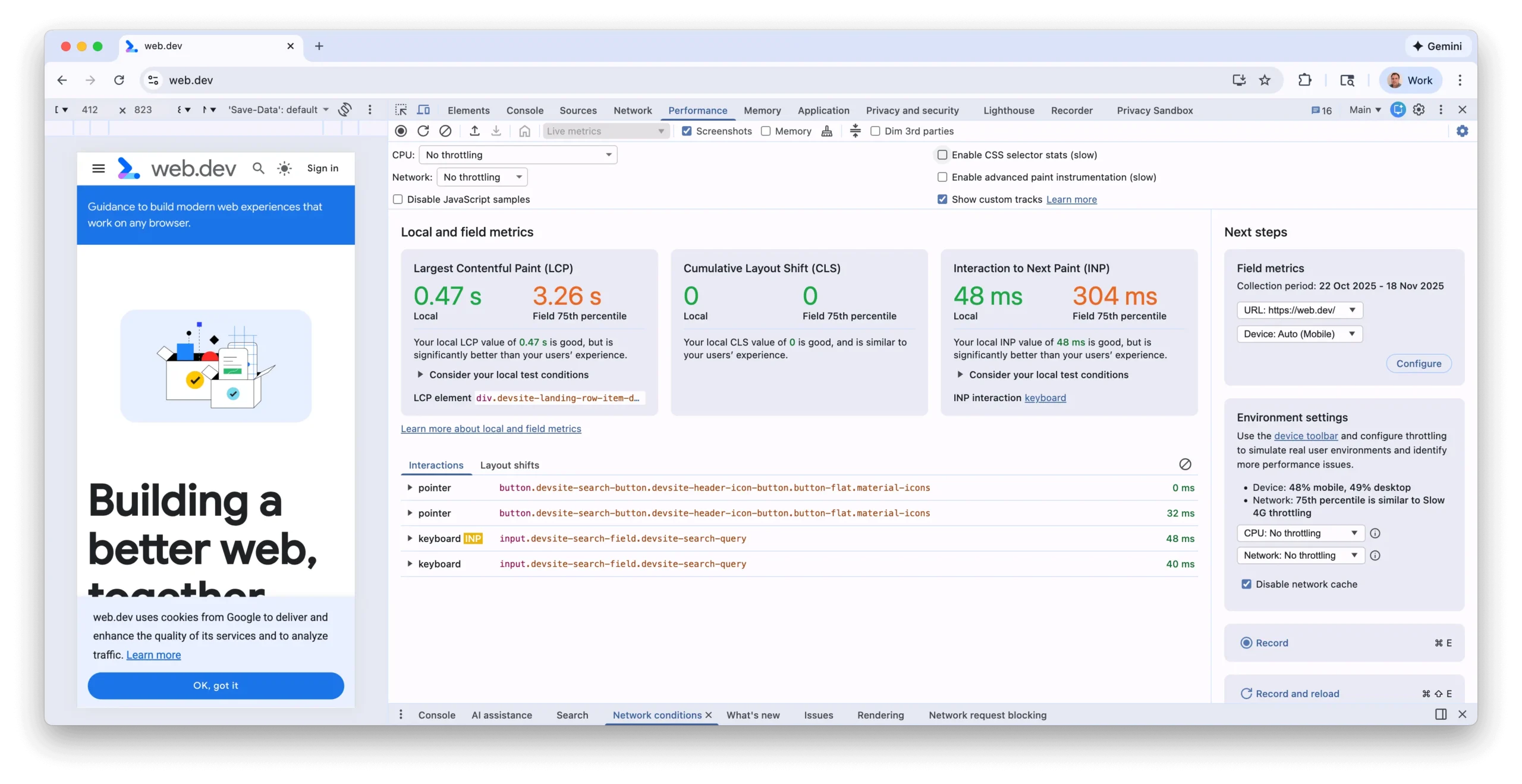
Largest Contentful Paint, Interaction to Next Paint, and Cumulative Layout Shift do not exist to help you rank better in isolation. They exist to reduce friction for users who have already found you. When pages load slowly or jump around, users disengage. That disengagement later manifests as weaker conversions, poorer retention, and lower brand trust.
In practice, Core Web Vitals should be tracked as trend indicators, not as pass-or-fail badges. A gradual improvement in interaction responsiveness across high-value landing pages is far more meaningful than chasing perfect scores site-wide.
For Singapore businesses targeting mobile-first audiences, this matters even more. Mobile performance directly affects lead form completion and e-commerce checkout behaviour.
Indexation Rate and Crawl Efficiency
Beyond experience metrics, indexation rate and crawl efficiency determine whether your SEO investment is even visible to search engines. If Google cannot reliably discover, crawl, and index your pages, your best content never enters the competition. Google Search Console data on indexed pages versus submitted URLs gives you an early signal of technical bottlenecks.
Crawl efficiency becomes critical as sites scale. Bloated parameter URLs, weak internal linking, and duplicated content waste crawl budget. You should not be asking whether Google can crawl your site. You should be asking whether Google is spending its crawl time on the pages that matter commercially.
Error Monitoring
Error monitoring is another area where experienced teams think differently. Individual 404s, redirect chains, or minor validation issues are rarely the problem. Trends are. A rising pattern of soft 404s across product pages or a steady increase in excluded URLs often signals deeper structural issues that will eventually suppress performance. Google itself advises focusing on patterns rather than isolated errors.
The most important mindset shift is this. Technical health does not replace content quality or authority. It supports them. A technically perfect site with weak content will not win. Strong content and brand presence held back by poor technical foundations will also underperform.
As an SEO leader, your role is to ensure technical KPIs are stable, improving, and aligned with business priorities. Not to over-optimise them for reporting optics. When technical SEO is working properly, it becomes invisible. And that is exactly the point.

This is the hardest part of SEO measurement right now. It is also the part most agencies oversell. AI-driven search results and large language models are influencing how buyers research, shortlist, and make decisions. What they are not doing yet is giving you clean, reliable analytics.
Google has been explicit about this gap: AI Overviews and other generative features do not currently provide the same level of reporting granularity as traditional search results, and attribution remains incomplete.
That means you need to approach AI and LLM-related SEO KPIs with discipline. Measure what is observable. Acknowledge what is not. Do not invent certainty where none exists.
Visibility in AI Overviews
The first signal to watch is whether your content appears, directly or indirectly, in AI-generated answers. This is usually detected through branded search lifts, query patterns that previously drove clicks but now show impressions without traffic, and manual SERP sampling for high-value terms.
This is not scalable yet, but it is still valuable directional insight.
Citation Frequency and Source Attribution
When AI-generated answers reference sources, even inconsistently, being cited matters. Citations signal perceived authority and influence. Today, tracking this is largely manual or assisted by third-party tools that monitor AI outputs across prompts.
Treat citation frequency as a qualitative KPI. It indicates brand and content trust, not traffic volume.
Content Reuse by Language Models
In some cases, you will notice phrasing, structure, or examples from your content appearing in AI responses without explicit attribution. This is difficult to prove.
Based on observed patterns in public LLM outputs, repeated exposure to similar phrasing can suggest content ingestion, but this cannot be verified at the page or domain level with certainty.
What You Should Not Do
- Do not claim guaranteed traffic, leads, or revenue from AI Overviews.
- Do not roll AI visibility into traditional ranking reports.
- Do not promise clients measurable ROI from LLM exposure alone.
Google itself has cautioned that AI search interactions are still evolving and reporting will lag behind product changes.
What You Should Do Instead
- Track impression trends in Search Console alongside click declines for affected queries. Document where AI features appear for your priority topics.
- Monitor branded search demand over time. Record citation examples when they occur. Most importantly, be explicit about the gaps.
In 2026, AI- and LLM-related SEO KPIs focus on influence rather than attribution. The brands that win will be the ones that measure carefully, communicate honestly, and resist the temptation to oversell what cannot yet be proven.
SEO KPIs for Different Business Models
If you apply the same SEO KPIs to every business, you will misread performance and make the wrong decisions. SEO does not exist in a vacuum. It exists to support a business model. That model determines what success actually looks like.
This is where many companies go wrong. They copy competitors’ or agencies’ KPI dashboards without asking a basic question. How does this business make money, and how does SEO realistically contribute to that outcome?
Let’s break this down by model.
E-commerce Businesses
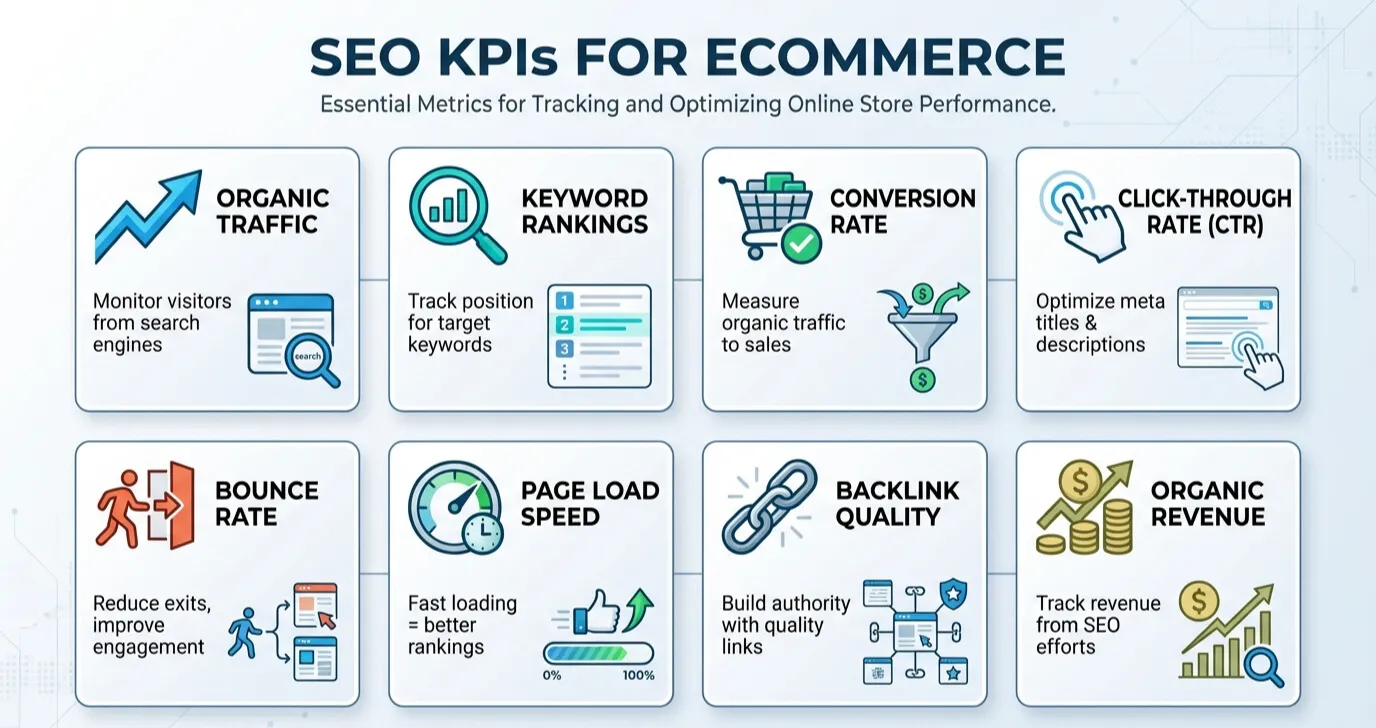
For e-commerce, SEO lives or dies by commercial efficiency. Traffic without transactions is a cost. Rankings without revenue are a distraction.
Your primary SEO KPIs should tie organic visibility directly to sales performance. Revenue per organic session tells you whether your traffic is commercially qualified. Category-level visibility shows whether you are winning where demand already exists, not just ranking blog posts that never convert.
Other supporting metrics matter, but only in context. Product page engagement, internal search usage, and repeat organic customers all help explain performance. They are not the end goal.
If your eCommerce SEO report cannot clearly answer whether organic search is driving profitable revenue in SGD, it is not doing its job.
Lead Generation and Service-Based Businesses
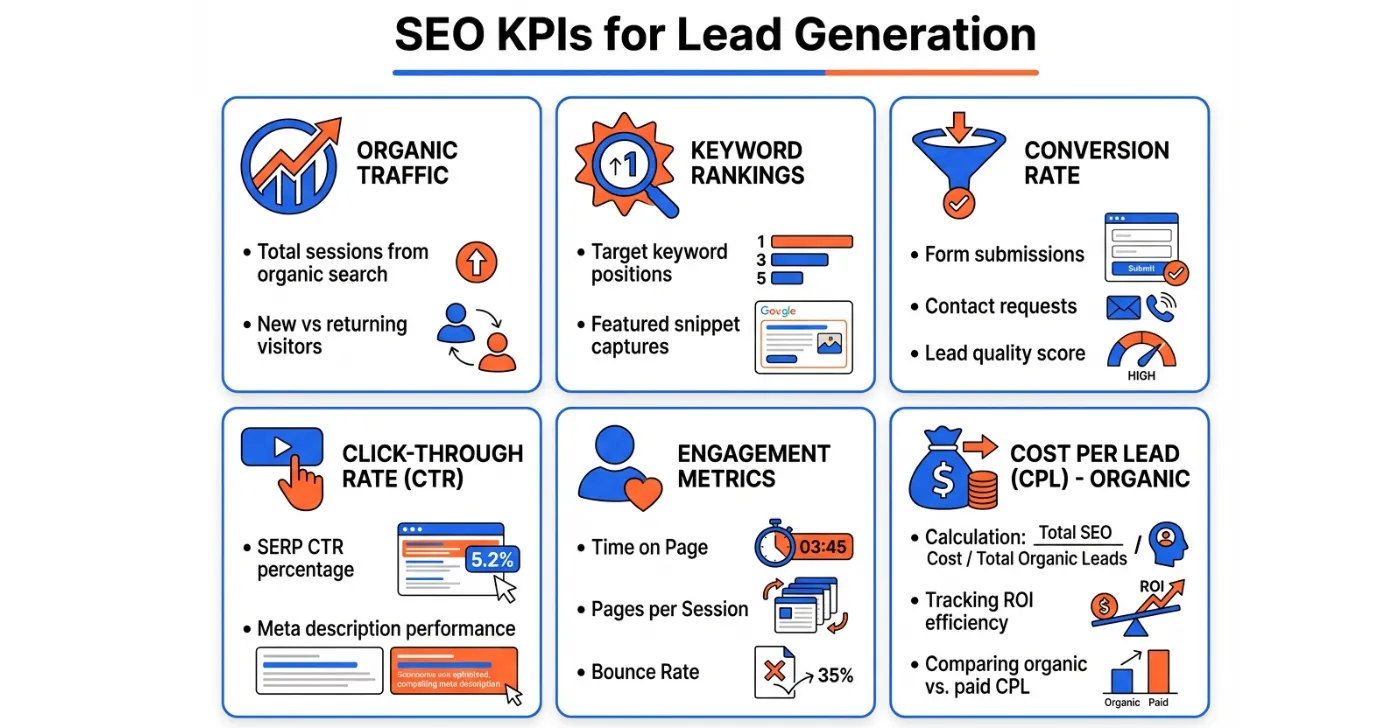
Lead generation SEO works differently. A law firm in Raffles Place or a B2B consultancy targeting regional clients does not need volume. It needs intent.
Here, qualified enquiries matter more than raw form fills. Assisted conversion value becomes critical because SEO often introduces or educates prospects long before they convert. This is especially true in Singapore, where B2B buying cycles are long, and decision-making is conservative.
Your KPIs should reflect this reality. Track organic leads by intent category, not just total numbers. Measure how often organic search appears in conversion paths. Evaluate lead quality using downstream data such as sales acceptance or deal value.
If SEO is driving fewer leads but higher close rates, that is progress. Many teams miss this because they are chasing volume instead of impact.
Publishers and Content-led Brands

Publishers play a different game altogether. Revenue often comes from ads, subscriptions, or sponsorships. That means attention and loyalty matter as much as acquisition.
Engagement depth becomes a core KPI. Pages per session, scroll depth, and time spent indicate whether content resonates. Return visits signal brand trust and habit formation, which directly affect monetisation potential.
For publishers, SEO success is not just about ranking once. It is about building a repeat audience that chooses to come back through search, direct, and brand queries.
Measuring only traffic growth without engagement tells you very little about long-term value.
Why One Framework Does Not Fit All
The biggest mistake you can make is forcing a single SEO KPI framework across fundamentally different business models. Doing so flattens insight and leads to bad optimisation choices.
SEO should be measured based on how it supports revenue, growth, or sustainability for that specific business. The mechanics may overlap, but the priorities never do.
An expert-led SEO strategy starts by aligning KPIs to the business model. Everything else flows from that decision.
How to Set Realistic SEO Benchmarks
Source: SERanking
If your SEO benchmarks feel either impossible to hit or suspiciously easy, the problem is rarely execution. It is almost always how the benchmark was set.
SEO does not operate in a controlled environment. Search demand shifts. SERPs change shape. Algorithms update without warning. That means benchmarks must guide decisions, not lock you into false certainty.
Historical Data
Start with historical data, but treat it as context, not a promise. Your past organic traffic, conversions, and visibility trends tell you how your site behaves under known conditions.
They do not predict how it will perform after a core update, a SERP layout change, or a shift in user intent. A twelve-month view is usually more useful than month-on-month comparisons because it smooths out seasonality and campaign-driven spikes. Even then, the value is directional. It shows momentum, not destiny.
Competitive Analysis
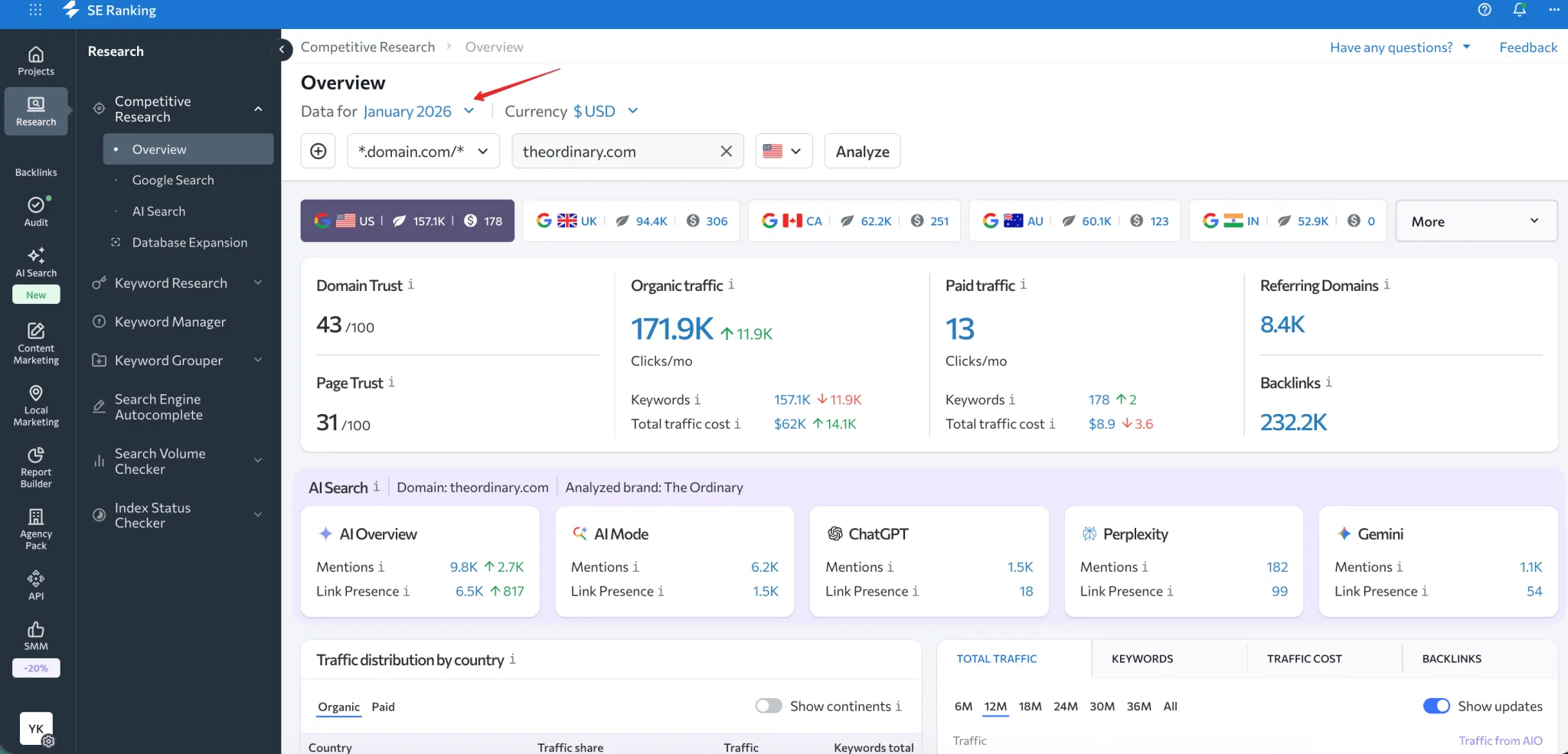
Competitive benchmarking needs the same discipline. Too many teams fixate on absolute numbers. Domain authority scores, total backlinks, or estimated traffic volumes. Those figures look precise, but they hide critical context. Algorithm updates regularly reshuffle winners and losers.
A competitor’s sudden traffic drop may have nothing to do with your progress, and a short-term spike may disappear just as fast. Instead, focus on trends. Are you closing the visibility gap on shared topics? Are you appearing more often across the same commercial queries? Are you gaining share of voice in the SERP features that matter to your audience?
When you do competitive analysis, anchor it to questions that inform action, not ego. For example:
- Are competitors investing more heavily in certain content formats or topics?
- Are they winning visibility through local packs, rich results, or brand-driven queries?
- Are their gains sustained over multiple months or tied to a single update or campaign?
This approach keeps benchmarks grounded in reality rather than wishful thinking.
Rigid targets are where SEO strategies quietly fail. Fixed goals like “increase organic traffic by 30 percent this quarter” assume a stable search environment. That assumption is no longer valid.
Search changes constantly, sometimes reducing the number of available clicks even when visibility improves. AI-generated answers, expanded SERP features, and zero-click behaviour can all suppress traffic without reducing influence or revenue.
More effective benchmarks are range-based and intent-aware. Instead of committing to a single number, define acceptable performance bands and leading indicators. For example, you might benchmark impression growth and engagement quality first, then expect conversions to follow with a delay. This allows you to adjust strategy without framing every fluctuation as failure.
In practice, realistic SEO benchmarking follows a few principles:
- Use historical data to understand patterns, not to lock in forecasts.
- Compare trends over time, not isolated snapshots.
- Benchmark against competitors qualitatively and quantitatively.
- Build flexibility into targets to account for algorithm and SERP volatility.
When benchmarks are set this way, they become tools for decision-making rather than pressure points. They help you spot early signals, justify investment, and adapt before performance drops show up in revenue reports. That is what mature SEO leadership looks like.
Measuring SEO KPIs That Actually Matter
Source: Ahrefs
SEO success in 2026 is not about chasing every metric or producing reports that look impressive but change nothing. It is about clarity. You choose a small set of measurements that reflect how your business actually grows, then you use them to guide decisions, not to justify past work.
When you align SEO KPIs with real commercial outcomes, SEO stops being treated as a cost centre and becomes a growth engine. Visibility connects to demand. Demand connects to conversion. Conversion connects to revenue. Every optimisation has a reason, and every result has a business explanation you can stand behind.
This level of measurement does not happen by accident. It requires experience, context, and the discipline to ignore metrics that do not drive action. That is where working with the right partner matters. A professional SEO team does more than track numbers. They help you decide which numbers deserve attention in the first place.
If you are serious about building an SEO strategy that stands up to scrutiny and delivers measurable returns in Singapore’s competitive market, it is time to work with MediaOne. Our approach focuses on outcomes, not noise, and on SEO KPIs that support sustainable business growth, not short-term vanity wins. Contact us today!
Frequently Asked Questions
What tools can help me accurately measure SEO KPI performance?
Many platforms help you track SEO KPIs, such as Google Search Console for visibility and impressions, Google Analytics 4 for engagement and conversion attribution, and specialised SEO tools like Ahrefs or SEMrush for broader trend and competitor insights. Each tool has limitations, so combining them gives a fuller picture of performance.
How do I justify SEO KPI targets to non-SEO stakeholders?
The best way to justify SEO KPI targets is to link them directly to business outcomes such as increased leads, revenue contributions, or cost savings compared to paid channels, and show historical trends that support expected ranges. When stakeholders see how organic search moves revenue rather than just rankings, buy-in becomes easier.
Can SEO KPIs vary by industry, and why?
Yes, SEO KPIs vary widely by industry because search intent, buying cycles, and monetisation models differ; for example ecommerce prioritises revenue per session while B2B lead generation emphasises qualified enquiries and pipeline value. Industry context ensures you measure what truly reflects commercial impact rather than generic activity.
How often should SEO KPI benchmarks be updated?
SEO KPI benchmarks should be reviewed at least quarterly to account for seasonality, shifts in search behaviour, and algorithm changes, with more frequent checks on leading indicators like visibility and engagement trends. Sticking rigidly to outdated benchmarks can mask issues or create false positives.
What role does user intent play in setting SEO KPIs?
User intent is central because it determines which organic visits are likely to convert or deliver business value. Informational queries often require different KPIs than transactional ones; aligning your KPIs to intent ensures you optimise for commercial outcomes rather than vanity metrics.