
Most Singapore merchants choose payment gateways by comparing headline fees. That is understandable, and it is often the wrong starting point. A gateway charging slightly less per transaction can still cost you more if it doesn’t support PayNow, the cards your shoppers carry, or the wallet they prefer, because each unsupported method is a checkout that may never complete.
This guide explains how gateways work, what they actually cost, and how to choose one using a scorecard built around your own customers’ payment behaviour. It is written for owners and marketers who want a decision they can defend.
Key Takeaways
- The fee is not the whole cost. A lower headline rate can lose to a gateway that supports more of the methods your shoppers use.
- Check method coverage before price. In Singapore, cards still carry an estimated 73% of e-commerce transaction value, but PayNow is the familiar rail for almost everyone else.
- Small rate gaps scale. A 0.10% merchant discount rate difference on S$10 million in card volume is about S$10,000 a year.
- Confirm the licence covers your activity. Under the Payment Services Act 2019, merchant acquisition and money transfer are licensed separately.
- Score candidates rather than rank them by price. The Gateway Fit Scorecard below weights coverage, cost, integration, licensing and fraud support.
- Review annually. Contracts run one to five years, and terms change.
Why Checkout Decides the Outcome
The payment gateway sits at the moment a shopper decides whether to trust you with money. It shapes whether the purchase completes, what each sale costs and how the checkout feels.
Singapore’s market is large and almost entirely online. Internet penetration reached 98.4% at the end of 2025, with 5.78 million users, according to DataReportal’s Digital 2026 Singapore report. E-commerce is forecast to grow 17.7% in 2026 to around S$40.5 billion, per GlobalData.
That scale makes checkout friction expensive. Roughly 70% of online shopping carts are abandoned before purchase, a rate Baymard Institute has tracked for over a decade. Two of the top reasons are directly controllable by your gateway choice: a checkout that is too long or complicated (17% of shoppers), and a site that does not offer the payment method the shopper wants (9%). Both figures come from Baymard’s checkout usability research.
Neither is a Singapore-specific figure, so treat them as direction, not a forecast. But the mechanism is universal: a shopper who cannot pay the way they intended leaves.
What a Payment Gateway Actually Does
A gateway is the software service that securely passes card and wallet details from your checkout to the banks that approve them, then returns the result to your store. It is the messenger between your storefront and the financial system.
That role determines three things you are really buying: which payment methods you can offer, how fast funds settle into your bank, and how much of the security and compliance burden you carry.
Hosted Checkout or API: The Integration Decision
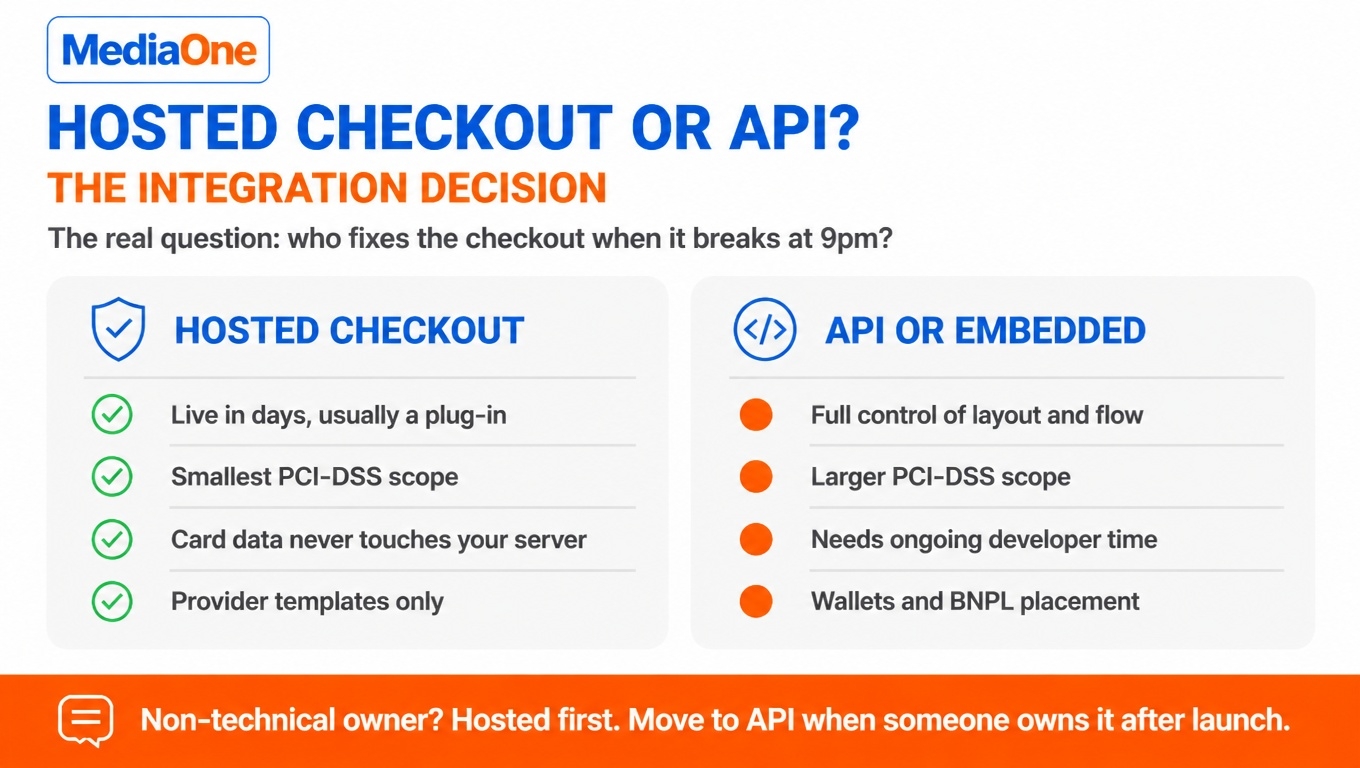
Gateways connect to a store in two ways. Hosted checkout sends the shopper to the provider’s payment page. An API or embedded integration puts the payment fields inside your site.
|
Factor |
Hosted checkout |
API or embedded |
|
Control over design |
Provider templates only |
Full control of layout and flow |
|
PCI-DSS scope |
Smaller — card data never touches your server |
Larger — your systems handle card data |
|
Development effort |
Low, usually a plug-in |
Higher, needs ongoing developer time |
|
Customisation |
Basic branding |
Extensive, including wallets and BNPL placement |
Who maintains it? A shop doing a few dozen orders a month rarely needs more than hosted checkout: you avoid most of the security burden and can go live in days. A brand with developers, a custom checkout, or several sales channels gains more from an API integration — provided someone owns it after launch. For a non-technical owner, the question is not which is better, but who fixes the checkout when it breaks at 9 pm.
Platform integration. Most mainstream platforms offer a native gateway plug-in, so setup means API keys, method selection and sandbox testing. Confirm your platform supports the methods you need before you start, because a gateway can only offer what your platform can display. Our ecommerce SEO guide covers the storefront side, and Shopify SEO covers what a hosted platform lets you control. If you are still choosing a platform, our comparison of Shopify and Wix and our ecommerce website build guide cover how payment options differ.
Integration readiness checklist
- Name the person who maintains the integration after launch.
- Confirm your platform has a certified plug-in for the gateway.
- Check the gateway supports every method on your priority list.
- Test refunds and declined payments in the sandbox, not only successful ones.
- Confirm the contract term and exit terms before signing.
Payment Methods Singapore Shoppers Expect
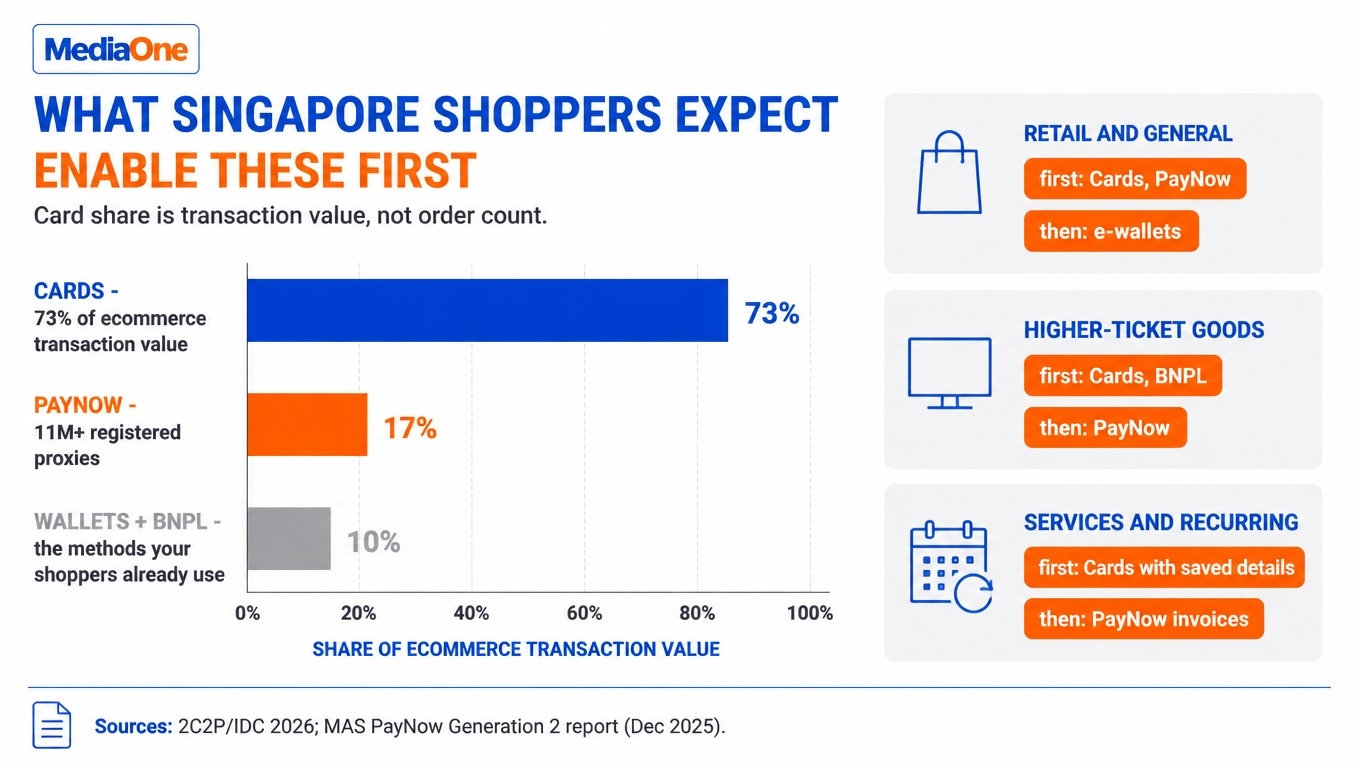
Cards remain the backbone. Card payments are estimated at 73% of Singapore e-commerce transaction value — about US$8.3 billion — in 2026, rising to 76% (US$9.88 billion) by 2029, according to 2C2P’s analysis of IDC data. Note that this measures value, not transaction count, and it is a vendor-commissioned estimate rather than a regulator’s figure.
PayNow is the other half of the picture. Total proxy registrations passed 11 million as at December 2025 — 6.3 million via mobile number, 4.5 million via NRIC/FIN and 0.5 million via UEN, per MAS’s PayNow Generation 2 report. A checkout without PayNow removes the route most Singapore shoppers already use daily.
Which methods to enable first
|
Business type |
Enable first |
Then |
|
Retail and general |
Cards, PayNow |
The e-wallets your shoppers already use |
|
Higher-ticket goods |
Cards, BNPL |
PayNow for one-off purchases |
|
Services and recurring |
Cards with saved details |
PayNow for invoices |
Confirm in writing with any provider: which card networks are covered; whether PayNow works through your specific hosted checkout; which wallets and BNPL services are supported; and whether methods can be switched on or off without renegotiating the contract. That last point matters more than it sounds — a method you cannot enable later is a method you cannot test.
What Gateways Actually Cost
Headline rates hide most of the cost. Start with the structure.
Merchant discount rate (MDR) is the percentage taken from each transaction. On top of it, most providers add a fixed per-transaction fee, a settlement charge to pay out to your bank, and a currency conversion margin on foreign cards. Refunds and chargebacks often carry their own charges.
The cost of a small rate gap
Reducing the MDR by 0.10% on S$10 million of annual card volume saves about S$10,000 a year. That arithmetic is the whole argument for negotiating — and it is also why the argument can mislead. A store processing S$500,000 a year saves S$500 from the same cut, which will not cover the cost of a single month of lost PayNow orders.
A worked example
The published sources give no merchant figures, so here is the calculation with illustrative numbers. The inputs are assumptions, not benchmarks — substitute your own.
A store processing S$500,000 a month in card payments, with an S$80 average order value, takes about 6,250 orders a month.
|
Gateway A |
Gateway B |
|
|
MDR |
2.90% |
2.75% |
|
Monthly fee on S$500k |
S$14,500 |
S$13,750 |
|
Annual fee |
S$174,000 |
S$165,000 |
|
PayNow supported |
Yes |
No |
|
Annual savings vs A |
— |
S$9,000 |
Gateway B looks like it saves S$9,000 a year. Now price the missing method. Assume PayNow’s absence costs you just 2% of orders — a deliberately conservative assumption for a market with 11 million registered proxies:
- 2% of 6,250 orders = 125 orders a month
- 125 × S$80 = S$10,000 a month in lost revenue
- Over a year: S$120,000
Gateway B’s S$9,000 savings costs S$120,000 in revenue. The break-even point is stark: if missing PayNow loses you more than 0.94% of orders, the cheaper gateway is the more expensive choice.
Run this with your own volume, order value and a realistic loss rate from your own traffic. The point is not the numbers — it is that the fee comparison and the revenue comparison are different calculations, and only one of them decides the outcome.
Fees to check before signing
- Chargebacks: fee per dispute, plus any penalty once disputes exceed a set rate
- Refunds: whether the original transaction fee is returned
- Monthly minimums: a fixed charge you pay even in a quiet month
- Settlement timing: how many days until funds reach your bank
- Contract length and exit fees: the real cost of changing your mind
Security, Fraud and Licensing
PCI-DSS scope
PCI-DSS applies to any business handling card data, and the integration model decides how much of the burden is yours. With hosted checkout, card details are entered on the provider’s page, so your scope is smaller. With an API integration, card data can pass through your servers, widening the scope and the work. The current standard is PCI-DSS v4.0.1 — ask your provider which version they certify against. Our website security checklist for Singapore SMEs covers the wider controls.
The Payment Services Act 2019
Singapore regulates payment providers under the Payment Services Act 2019, administered by MAS. Check the provider’s licence on MAS’s public register before you sign, and confirm it covers the activity you need. Merchant acquisition (accepting payments for your goods) and money transfer (moving funds out to you) are separately licensed activities, and a provider may hold one without the other. Our digital marketing law guide covers the parallel obligations on the marketing side.
Building trust at the payment step
Show security signals exactly where the shopper decides to pay: recognised card scheme logos, a visible padlock, a clear refund policy, and a contact route if something fails. These cost little and address the hesitation directly. If you sell through marketplaces as well as your own store, our comparison of Singapore’s online shopping platforms explains how payment options differ by channel, and our Shopee selling guide covers that platform’s own payment flow. If checkout abandonment is already high, our guide to diagnosing bounce rate explains how to isolate whether the problem is the page or the payment step.
How to Choose: The Gateway Fit Scorecard
Work through the steps in order, then score the survivors.
- Map your payment mix from your own order data — not market averages. Which methods appear in completed orders, and which do shoppers attempt and abandon?
- Shortlist providers that support those methods and hold a licence under the Payments Services Act covering merchant acquisition.
- Compare all-in cost at your real monthly volume, including setup, minimums, refund and chargeback fees, and settlement charges.
- Test in a sandbox, including a refund and a declined card.
- Go live only after a test order settles correctly into your bank account.
Scoring the shortlist
Score each candidate 1 to 5 on each criterion, multiply by the weight, and add.
|
Criterion |
Weight |
Why it matters |
|
Local payment method coverage |
35% |
Missing methods lose sales directly |
|
All-in cost at your volume |
25% |
Small rate gaps compound |
|
Integration and maintenance effort |
15% |
Hosted suits most small shops |
|
Licence and regulatory standing |
15% |
Determines what they may legally provide |
|
Fraud tooling and PCI-DSS support |
10% |
Protects against chargebacks and exposure |
For a consumer store, coverage should carry the most weight, because it is the only criterion that loses revenue rather than adding cost. The highest total identifies the best fit — not the cheapest option.
Common mistakes
- Chasing the lowest headline rate without pricing the methods it omits. The worked example above shows how quickly a 0.15% saving reverses.
- Ignoring refunds and support. Confirm refunds are processed cleanly and that you can reach a human when a payment fails outside office hours. A gateway with no weekend support is a gateway that loses weekend orders.
- Signing a long contract before testing volume. Terms of one to five years are common. Negotiate a shorter initial term or a review clause, and never sign a multi-year deal before you have processed a real month of traffic.
Choose the Best Payment Gateways
Payment mix, not headline price, should drive the decision. A gateway quoting a lower rate but missing PayNow, cards, or the wallet your customers prefer will cost more in lost sales than it saves in fees.
Use the scorecard to weigh coverage, cost, integration, licensing and fraud support, and let the total decide. Once the gateway is live, the next lever is what each sale costs you overall — see our customer acquisition cost formula and conversion rate optimisation strategies. Then review annually: check the licence is still current, confirm your methods are still supported, and compare terms before a contract auto-renews.
If the gateway decision sits inside a wider build, our ecommerce web development service covers payment integration as part of the project, and our ecommerce launch checklist lists what to verify before you take the first live order. You can also talk to our team directly.
Frequently Asked Questions
What is the difference between a payment gateway and a payment processor?
A gateway securely passes card or wallet details from your checkout to the banks. A processor handles the transaction itself, moving funds between the shopper’s bank and yours. Many providers do both, so merchants often deal with them without noticing the distinction. Ask which role each provider plays before comparing prices, since they are not directly substitutable.
Do I need a licensed payment provider in Singapore?
In practice, yes. Payment service providers are regulated under the Payment Services Act 2019, administered by MAS. Check the provider’s licence on MAS’s public register and confirm it covers the specific activity you need — merchant acquisition and money transfer are licensed separately, and holding one does not imply the other.
Is PayNow supported by most gateways?
Not by default. Confirm it explicitly, including whether it works through your chosen hosted checkout rather than only via direct API. PayNow passed 11 million proxy registrations as at December 2025, so a checkout without it removes the payment route most Singapore shoppers already use.
How much does a payment gateway cost in Singapore?
Pricing varies by provider, volume and contract, so no single figure applies. Costs typically combine a percentage MDR, fixed per-transaction fees and sometimes a monthly charge. Compare the all-in total at your real monthly volume rather than the advertised rate, and include refund and chargeback fees.
Does a gateway handle PCI-DSS compliance for me?
Not entirely — responsibility is shared. Hosted checkout shrinks your scope because card data never reaches your servers. A direct API integration widens it, because your systems handle more cardholder data. Ask which model you are on, and which PCI-DSS version the provider certifies against.