

If your brand operates beyond a single city or country, international SEO is no longer optional. Search engines personalise results based on geography, language, and user intent. That means the strategy that helps a business rank in Singapore may not work in Australia, the United Kingdom, or the United States.

At the same time, many companies still rely heavily on local visibility to capture high-intent buyers near physical locations. Understanding the difference between international SEO and local SEO helps marketers avoid wasted budgets, technical mistakes, and missed growth opportunities.
In this guide, we break down how international SEO works, how it differs from local SEO, and how to determine which strategy aligns with your expansion goals. If you are exploring options for an SEO agency in Singapore to guide your strategy, structured expertise can help you scale correctly from day one.
Key Takeaways:
- International SEO requires a region-specific strategy, localisation, and proper technical setup to reach different country audiences effectively.
- Local SEO excels at capturing nearby high-intent searches and supports foot traffic and services tied to specific districts.
- Proper architecture, keywords, hreflang tags, and local behaviour research are essential for building visibility across markets.
- Avoiding common international SEO mistakes, such as generic translation and ignoring competition, ensures stronger performance.
- Combining international and local SEO strategies can maximise both cross-border reach and immediate revenue generation.
What Is International SEO?

International SEO is the process of optimising your website so search engines can identify which countries and languages you want to target. The goal is to increase organic visibility across multiple geographic markets.
Unlike traditional SEO, which focuses on ranking in a single region, international SEO ensures that users in different countries see the correct version of your content based on their language and location.
International SEO Definition and Core Objectives
At its core, international SEO aims to:
- Target multiple countries or regions
- Serve content in different languages
- Signal geographic relevance to search engines
- Avoid duplicate content across regional versions
For example, an ecommerce brand selling globally may need separate English pages for Singapore, Australia, and the United Kingdom because search behaviour and terminology vary.
When Do Businesses Need International SEO?
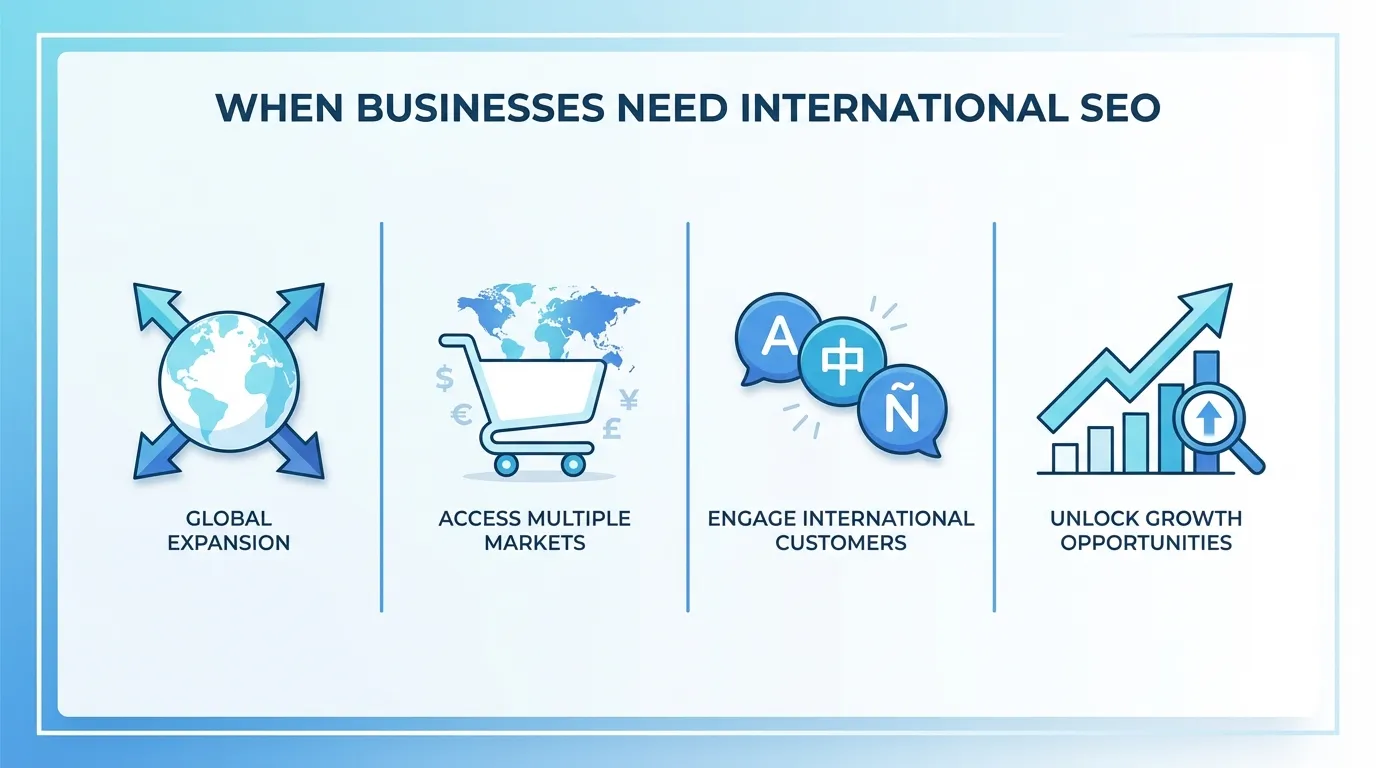
You need international SEO the moment your revenue model is no longer geographically contained.
Many business owners assume cross-border visibility will happen naturally once they start shipping overseas or accepting international clients. It does not. Google does not automatically understand which country you are prioritising unless you signal it clearly through structure, content, and authority.
Here is when international SEO becomes a strategic requirement rather than a “nice to have”:
First, when overseas revenue is already contributing meaningfully to your turnover.
If 15 to 30 percent of your enquiries come from Australia, Malaysia, or the UK, you are already competing in those markets whether you planned to or not. Without international SEO, you are competing blind.
Second, when you price, regulate, or position differently by country.
If your SGD pricing does not apply in AUD or GBP markets, you need separate landing pages that reflect those realities. Google’s documentation on multi-regional sites makes it clear that content targeting different countries should be explicitly signaled to avoid confusion in search results.
Third, when you operate in multilingual environments.
Singaporean businesses expanding into markets such as Indonesia, Thailand, or parts of Europe must account for language signals. Google recommends using hreflang to serve the correct language and regional version to users.
Fourth, when you are entering competitive regional markets.
For example, Singapore is consistently ranked among the world’s most open economies by the Heritage Foundation Economic Freedom Index 2025.
That openness means your competitors are already targeting international audiences. If you are not structured for it, they will outrank you in their home territories.
Fifth, when brand perception matters globally.
If you are a SaaS company targeting Asia Pacific enterprise clients, appearing only in Singapore search results limits your authority. Enterprise buyers often research regionally before shortlisting vendors. International SEO ensures your brand appears in those broader evaluation searches.
Finally, when expansion is part of your three to five-year plan.
International SEO is not a switch you flip. It requires architecture, content investment, and link acquisition in each market. The earlier you structure correctly, the less expensive and disruptive scaling becomes later.
If your ambition extends beyond one country, your search strategy must reflect that ambition. International SEO is not about visibility everywhere. It is about visibility where your growth is headed.
What Is Local SEO and How Does It Differ From International SEO?

Local SEO is about visibility within a specific geographic area. If you run a clinic in Novena or a tuition centre in Tampines, local search is your revenue engine.
Google states that local search results are based primarily on relevance, distance, and prominence. This means:
- Proximity matters
- Google Business Profile optimisation matters
- Reviews matter
When Local SEO Is the Right Strategy
Local SEO should dominate your focus if you rely on:
- Foot traffic
- Service areas within a defined radius
- Location-based trust signals
- Immediate purchase intent
For example, dental clinics in Singapore compete intensely in local search. The Singapore Dental Council maintains a registry of licensed practitioners, and patients frequently search with location qualifiers before booking.
In this context, ranking globally is irrelevant. Ranking locally is revenue.
Local SEO vs International SEO in Search Intent
The intent difference is decisive.
- Local SEO captures high-intent transactional searches.
- International SEO captures broader cross-border commercial research and comparison searches.
If someone searches “digital marketing agency Orchard”, they are near the decision stage. If someone searches “best digital marketing agency Asia Pacific”, they are still evaluating.
Here is a side-by-side comparison to guide your decision.
| Decision Factor | International SEO | Local SEO |
| Primary Goal | Expand visibility across multiple countries or regions | Dominate search visibility within a specific city or service area |
| Ideal For | eCommerce brands, SaaS companies, exporters, regional franchises | Clinics, law firms, tuition centres, F&B outlets, home services |
| Target Audience | Country-level or multi-country audiences | Users within a defined geographic radius |
| Search Intent Focus | Commercial research, comparison, cross-border buying | High-intent, near-me, ready-to-act searches |
| Website Structure Required | ccTLDs, subdirectories, or subdomains with hreflang implementation | Single domain with strong local landing pages and Google Business Profile |
| Content Approach | Market-specific, localised content per country | City-specific pages, testimonials, local references |
| Keyword Strategy | Country-specific keyword research and localisation | Location modifiers such as city names and neighbourhood terms |
| Backlink Strategy | Acquire authority links from each target country | Build citations and links from local directories and associations |
| Technical Complexity | High. Requires geo-targeting signals and structured architecture | Moderate. Focus on NAP consistency and local schema |
| Investment Level | Higher. Multi-market content and link building required | Lower to moderate. Concentrated geographic effort |
| Time to Scale | Longer ramp-up due to broader competition | Faster impact in defined local markets |
| Best When | You generate or plan to generate revenue internationally | Your revenue depends on local enquiries and foot traffic |
You do not choose based on ambition alone. You choose based on where your customers are today and where your growth strategy is taking you tomorrow.
Your strategy must reflect that maturity gap. Before you decide where to allocate the budget, you need to see the trade-offs clearly. The choice between international SEO and local SEO is not about scale alone. It is about business model, operational readiness, and revenue source.
International SEO vs Local SEO: Core Differences Marketers Must Understand
If you are deciding where to invest your next SEO dollar, this is the section that matters most. The difference between international and local SEO is not cosmetic. It affects your targeting, your technical stack, your content production workflow, and ultimately your revenue model.
You are not simply choosing between two tactics. You are choosing the scale at which you compete. Here are the key differences between them:
Target Audience and Geographic Scope
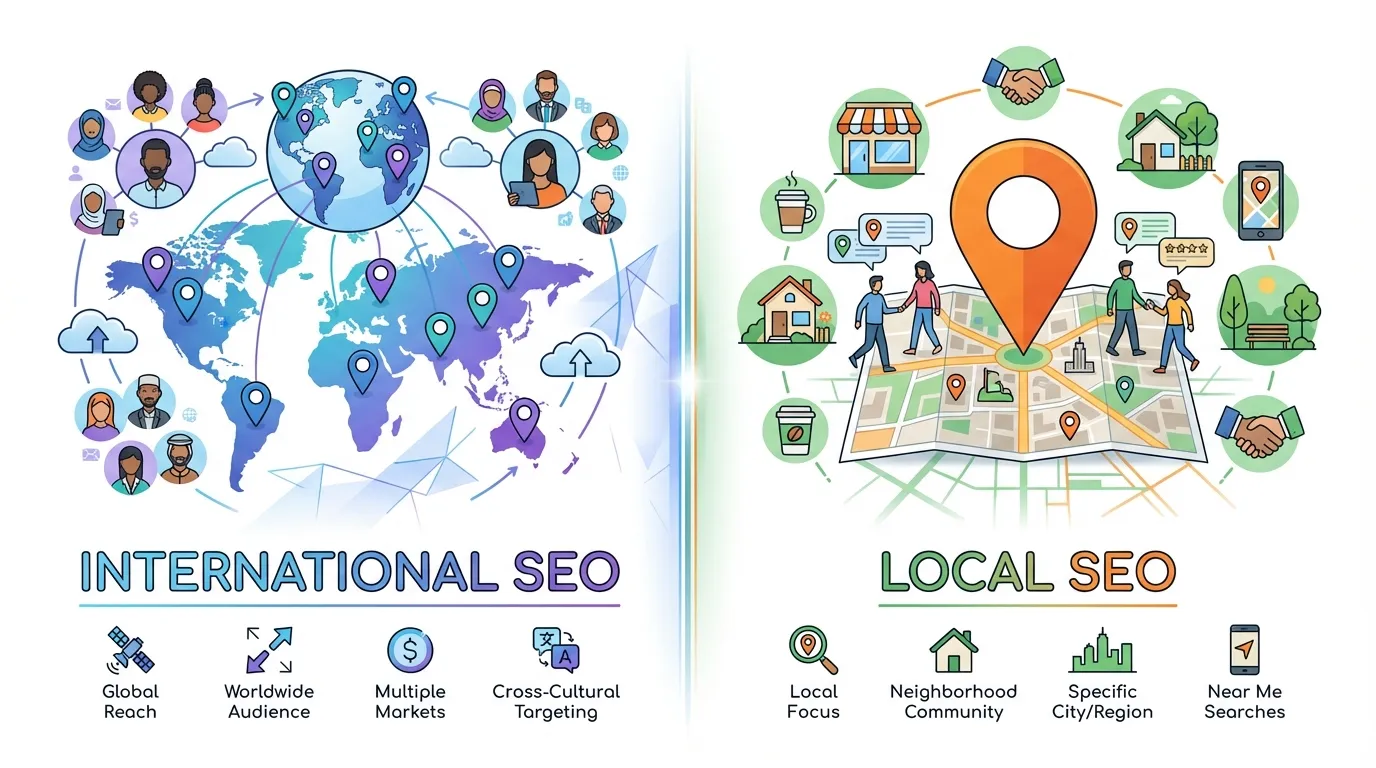
The first distinction is scope. Not traffic. Not keywords: Scope.
International SEO targets entire countries or regions. You are competing at a national or multi-national level.
Local SEO targets specific cities, districts, or neighbourhoods. You are competing within a defined geographic radius.
Here is what that looks like in practical terms:
- International SEO: Singapore vs Malaysia vs Australia
- Local SEO: Jurong vs Tampines vs Orchard
When you move from Jurong to Australia as your competitive set, everything changes. The number of competitors increases. The authority threshold increases. The backlink profile required increases. The expected content depth increases.
Local competition is dense. International competition is broad and often more authoritative. If you misunderstand this shift, you under-budget and under-prepare.
Keyword Strategy Differences
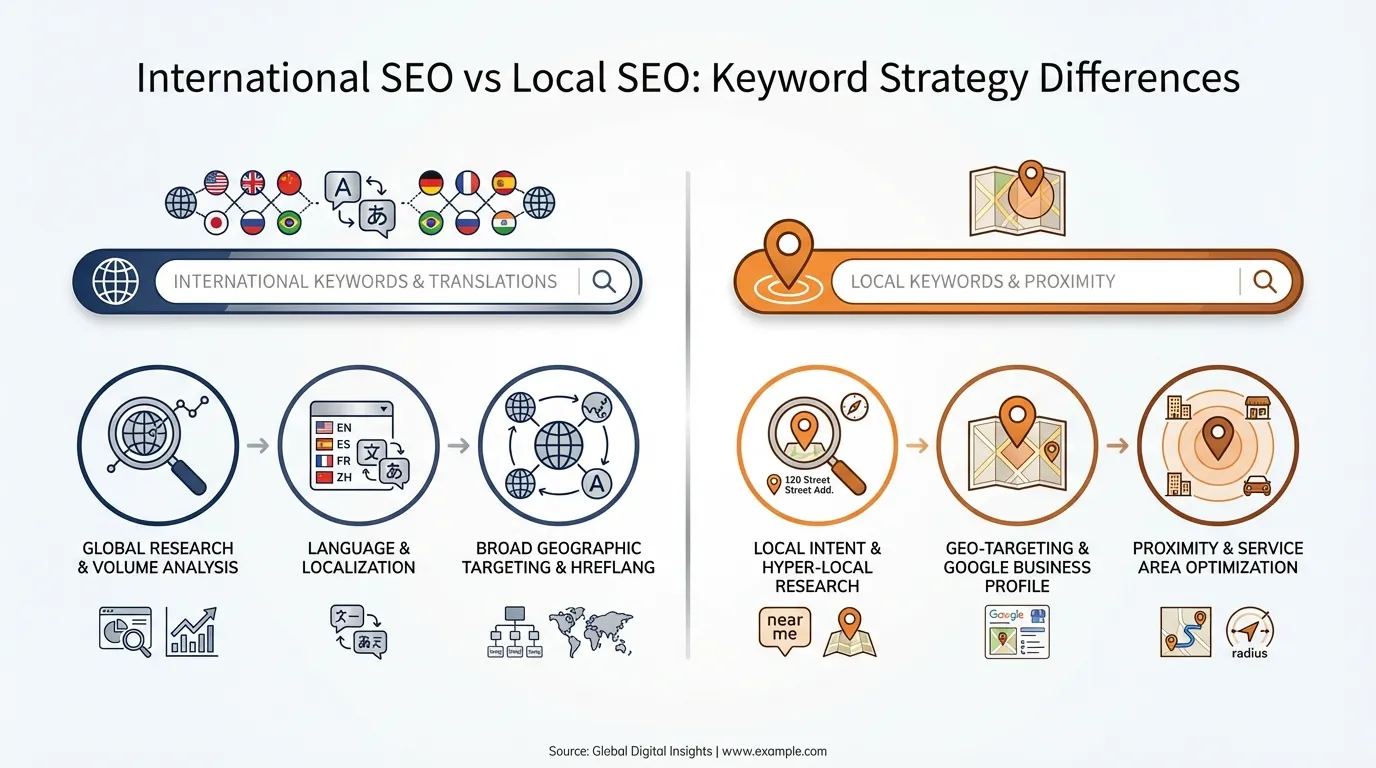
Keyword research is where many businesses make their first costly mistake. With local SEO, the pattern is straightforward. You optimise for service plus location:
- “digital marketing agency Orchard”
- “dentist near me”
- “plumber Tampines”
Modifiers drive intent. Google’s local algorithm places a heavy weight on proximity for these queries, so geographic terms become critical ranking signals.
International SEO operates differently. Even when two countries share the same language, search behaviour often differs. Terminology varies. Commercial phrasing changes. Buying psychology shifts.
For example:
- “Digital marketing agency” vs “online marketing company”
- “Hire SEO consultant” vs “SEO specialist”
Those differences may appear subtle, but search volume, competition level, and user intent can diverge significantly.
Here is what you must do for international SEO:
- Conduct country-specific keyword research, not global keyword exports
- Analyse search volume by region, not by language alone
- Identify commercial vs informational intent per market
- Study competitor keyword portfolios within each country
Direct translation rarely works. Localisation is required. That means adapting not only the language, but also the framing, proof points, and call-to-action tone. When you skip this step, you rank for terms nobody in that country actually searches.
Technical Setup Requirements
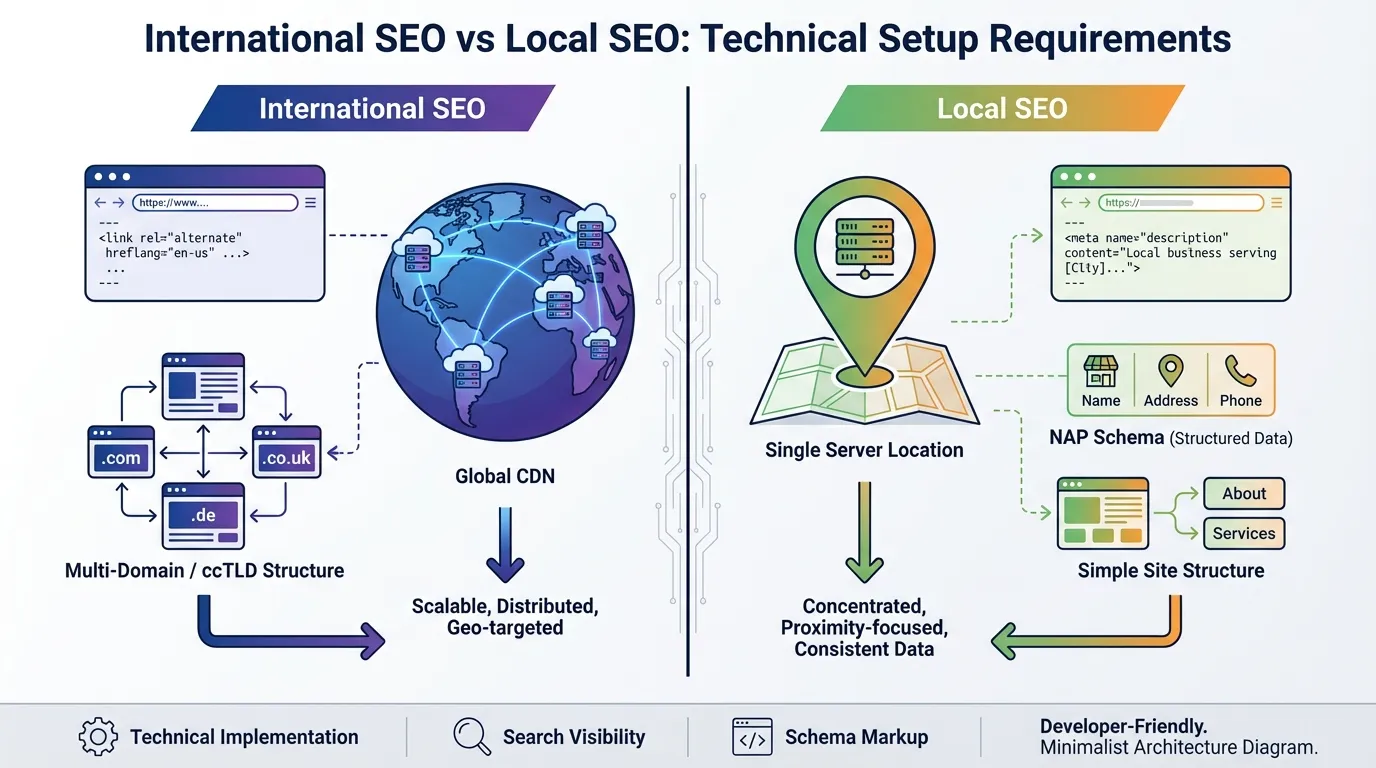
Technical structure is where international SEO becomes more demanding. For international SEO, you often implement one of the following:
- Country-code top-level domains such as example.sg or example.com.au
- Subdirectories such as example.com/sg/ or example.com/au/
- Subdomains such as au.example.com
- Hreflang tags to signal language and country targeting
Each structure entails trade-offs among authority consolidation, maintenance costs, and scalability. Hreflang implementation adds another layer of complexity. It tells search engines which version of a page to show to users in a specific region. When implemented incorrectly, you risk duplicate content conflicts or dilution of rankings across markets.
Local SEO, by comparison, relies far less on complex site architecture. Its technical priorities typically include:
- Google Business Profile optimisation
- Local structured data markup
- Consistent Name, Address, Phone information across directories
- Clean internal linking to city landing pages
The infrastructure required for international SEO is usually heavier. It demands coordination between developers, SEO strategists, and content teams. Local SEO demands precision, but not multi-market architecture.
Content Strategy Differences
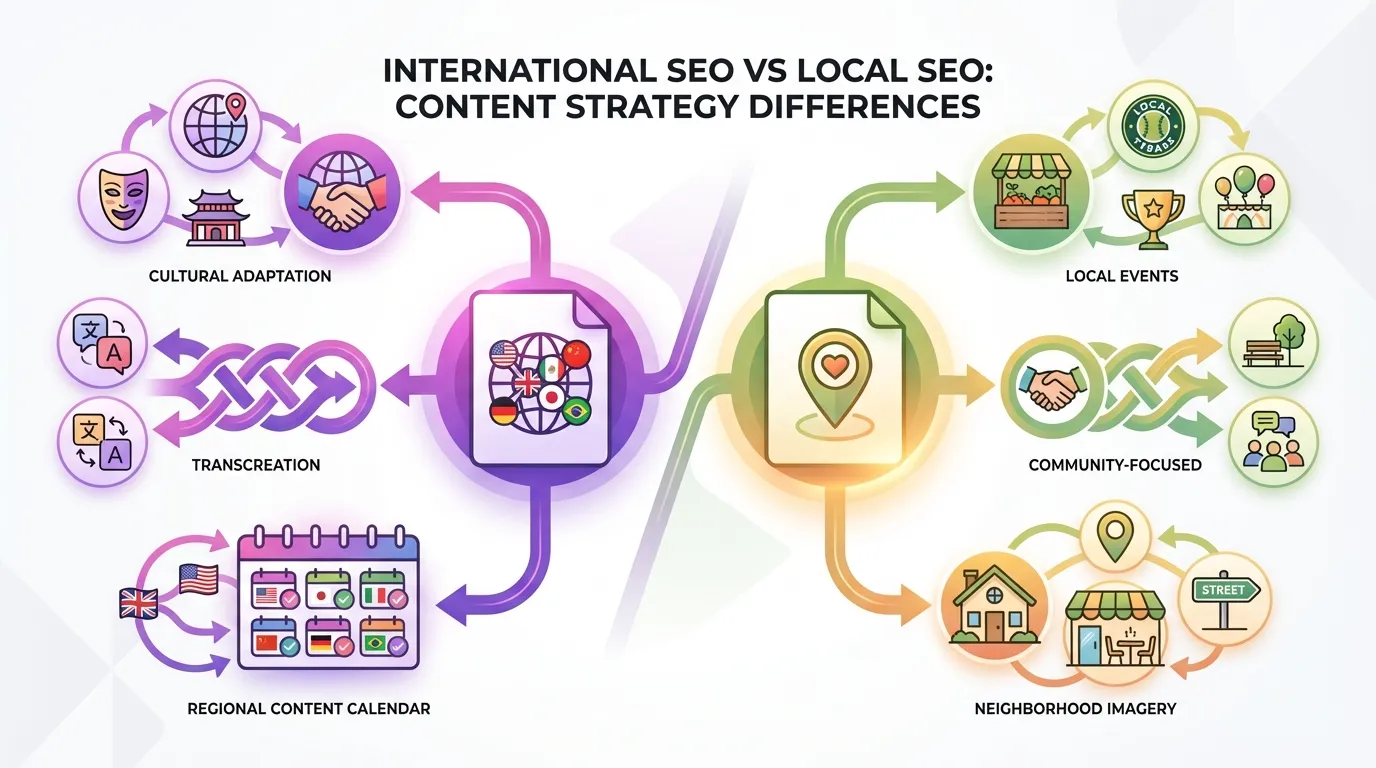
Content strategy is where scale becomes visible. With international SEO, you are creating market-specific content ecosystems. That includes:
- Dedicated country landing pages
- Regionally adapted messaging
- Localised case studies
- Currency-specific pricing in SGD, AUD, or MYR
- Regulatory or market references relevant to each country
You are not duplicating pages. You are building distinct experiences.
For example, a Singapore-based SaaS company expanding into Australia should not simply replicate its Singapore homepage with minor edits. It should reference Australian business challenges, use AUD pricing where relevant, and cite Australian client examples.
Local SEO content, on the other hand, is geographically granular rather than nationally expansive. It focuses on:
- City landing pages
- Local testimonials
- References to neighbourhood landmarks
- Community involvement
- Service-area clarifications
Both strategies require strong on-page optimisation. However, international SEO multiplies your content workload by the number of markets you enter. That is a strategic commitment, not a casual experiment.
Link Building Differences
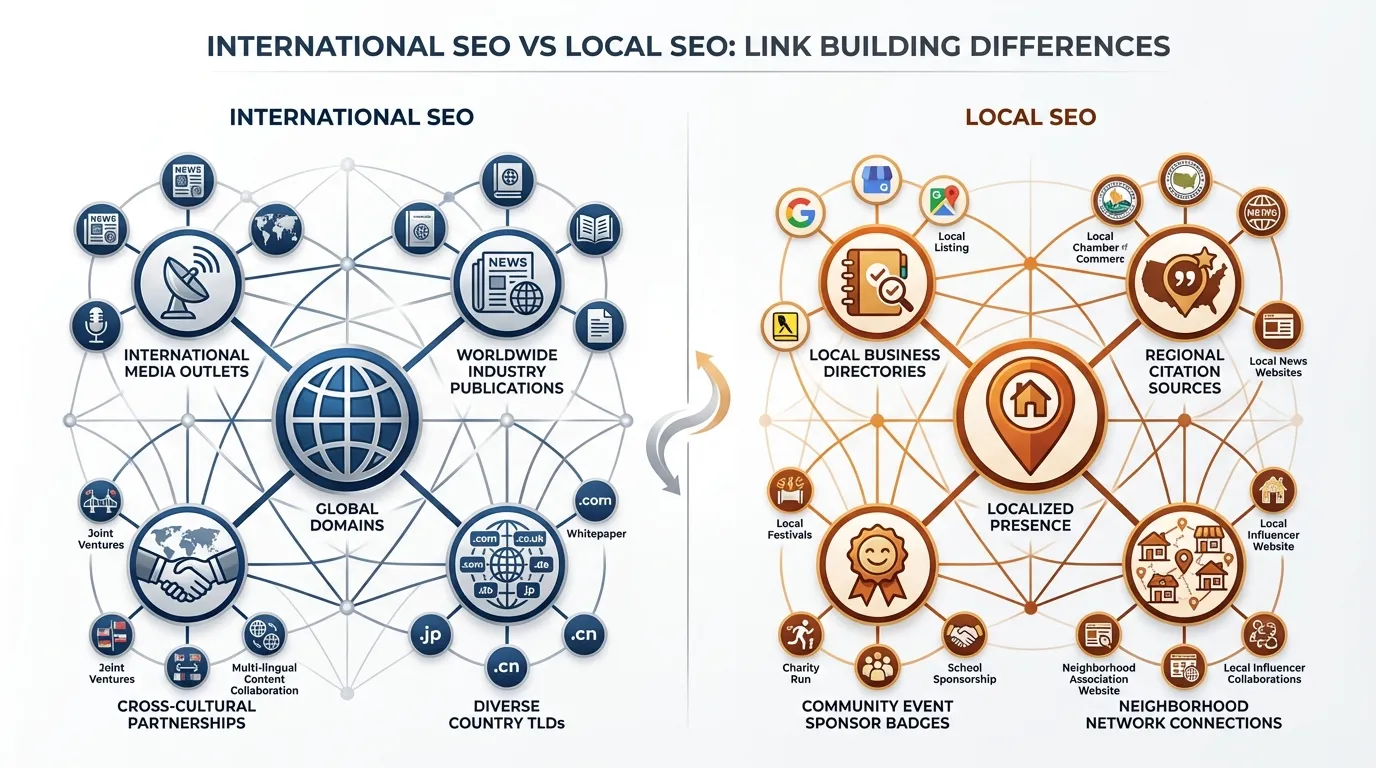
Backlinks remain a core ranking signal. The difference lies in where those links come from and what they signal. For international SEO, you need:
- Backlinks from country-relevant domains
- Regional PR coverage
- Mentions from authoritative publications within each target market
- Partnerships that signal geographic credibility
If you are targeting Australia, backlinks from Singapore alone will not fully establish Australian authority. You are building trust at a national scale.
Local SEO link building operates closer to the ground. It prioritises:

- Local directories
- Industry associations
- Community partnerships
- Sponsorship mentions
- Location-based citations
These links may carry lower domain authority globally, but they send strong local prominence signals.
In short:
- International SEO builds national or multi-national authority.
- Local SEO builds community-level prominence.
Both are valid. Both are powerful. They simply operate at different competitive layers.
The Real Question
You are not choosing which tactic sounds more impressive. You are choosing where your growth lies.
If your revenue depends on walk-in traffic in Orchard, local SEO is your frontline strategy. But if your ambition is to generate leads from Singapore, Malaysia, and Australia simultaneously, international SEO becomes the structural foundation of your expansion.
Understand the scale you are stepping into. Budget accordingly. Build correctly from the start. That is how you avoid rebuilding your entire SEO architecture twelve months later.
Common International SEO Mistakes Marketers Should Avoid
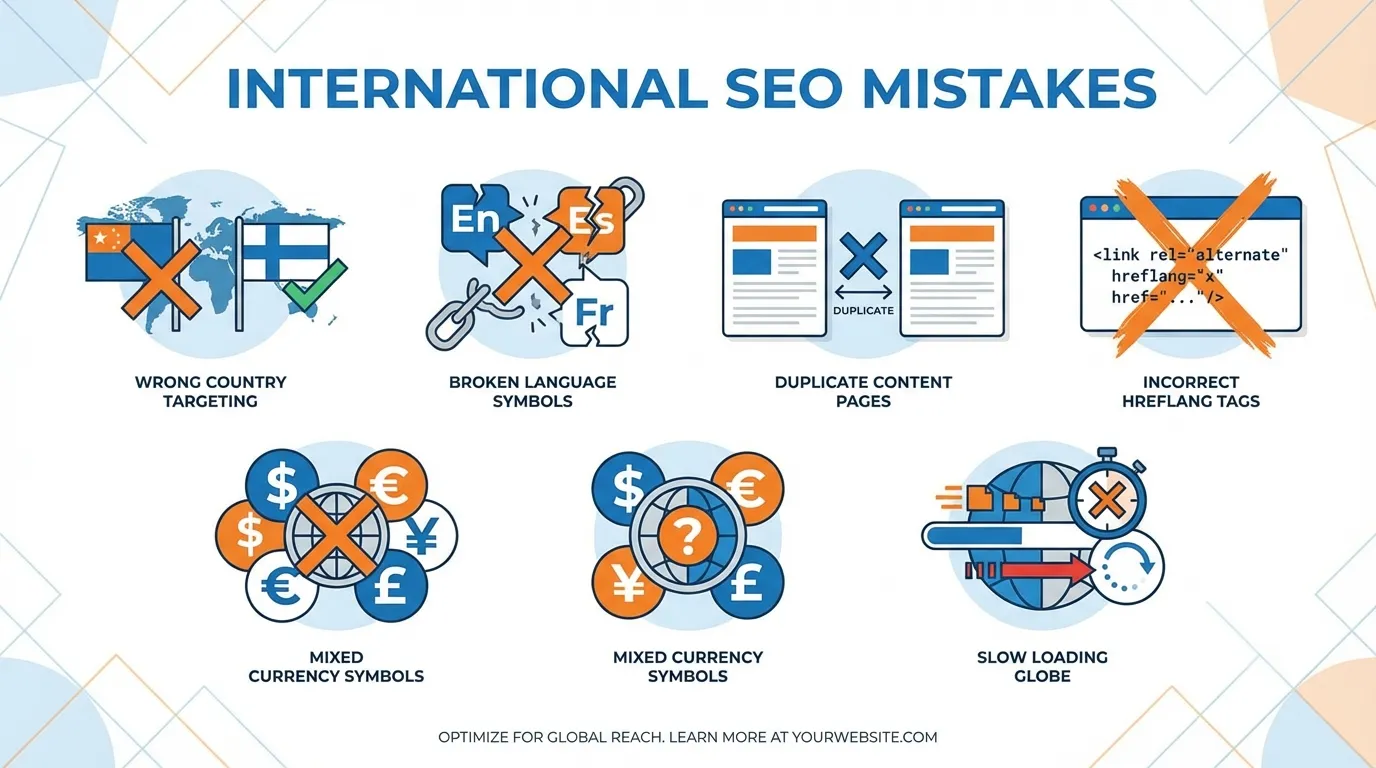
When businesses struggle with international expansion, the root cause is rarely “bad SEO”. It is usually flawed assumptions. The biggest one is this: believing markets behave the same way simply because they share a language or sit within the same region. They don’t.
Search behaviour reflects culture, economics, regulation, competition, and even purchasing psychology. If you approach international growth with a copy-paste mindset, you will waste the budget before you realise what went wrong.
Below are the most common international SEO mistakes I see, along with the thinking error behind each one and how you should approach it instead:
Mistake 1: Direct Translation Without Localisation
Translation converts words. Localisation converts intent. You might assume that English-speaking markets such as Singapore, Australia, and the United Kingdom can share identical content. That is rarely effective. Terminology, pricing expectations, regulatory references, and even tone differ significantly.
For example:
- “Digital marketing agency” may be common in Singapore.
- “Online marketing company” might surface differently in another market.
- Legal disclaimers, data policies, and consumer protection references vary by country.
Search engines evaluate relevance at a market level. If your content reads like it was written for another audience, engagement metrics will reflect that mismatch. Lower engagement signals can weaken rankings over time.
What to do instead:
- Conduct country-specific keyword research before writing.
- Adapt case studies and testimonials to reflect local credibility.
- Align pricing examples and currency formats with the target market.
- Review tone and messaging through the lens of cultural nuance.
Localisation is not cosmetic. It is a strategic positioning.
Mistake 2: Ignoring Regional Search Behaviour
Search volume is not universal. Neither is search intent. Two countries can search for the same solution in completely different ways. In some markets, users prefer informational queries before engaging with commercial providers. In others, transactional queries dominate.
If you assume that your top-performing Singapore keywords will perform equally well in Malaysia or Australia, you risk building content that no one is searching for.
Regional search behaviour can vary in:
- Query length
- Use of modifiers
- Price sensitivity signals
- Mobile versus desktop usage patterns
Ignoring these behavioural nuances leads to thin performance across markets. The smarter approach is to:
- Validate keyword demand within each country individually.
- Analyse SERP layouts in each region to understand intent.
- Study competitor positioning inside that specific market.
Your strategy should adapt to how people search, not how you hope they search.
Mistake 3: Incorrect Hreflang Implementation
Hreflang tags tell search engines which version of a page to show based on language and country. When implemented correctly, they prevent cannibalisation between regional pages. When implemented incorrectly, they confuse crawlers and dilute rankings.
Common hreflang mistakes include:
- Missing reciprocal tags between versions.
- Using incorrect country codes.
- Pointing to non-canonical URLs.
- Forgetting to update tags when new regions are added.
If your Singapore page and your Australian page compete against each other in search results, you are fragmenting authority.
The solution requires discipline:
- Ensure every regional page references all other variants correctly.
- Validate hreflang implementation through structured testing tools.
- Maintain a centralised documentation process for multi-market updates.
Technical errors compound quickly in international SEO. Precision matters.
Mistake 4: Duplicate Content Across Markets
Many businesses clone their entire website into multiple country folders and change nothing except the currency symbol. That shortcut often creates duplicate content issues.
Search engines attempt to determine which version is most relevant. If content is identical, they may prioritise one version and suppress others. That defeats the purpose of multi-market targeting.
Duplicate risk increases when:
- Product descriptions are copied verbatim across regions.
- Service pages remain unchanged except for minor location swaps.
- Blog content is published identically without regional adaptation.
To avoid this:
- Differentiate messaging based on market maturity.
- Introduce country-specific examples and references.
- Highlight local partnerships or regulatory considerations.
- Adjust FAQs to reflect local concerns.
Your goal is to create genuine regional relevance, not surface-level duplication.
Mistake 5: Using One Global Keyword Strategy for All Regions
This mistake is subtle but costly. A single global keyword list may look efficient on paper, but it ignores differences in competition and demand. A keyword that is moderately competitive in Singapore might be extremely competitive in the United Kingdom.
Without regional keyword segmentation, you risk:
- Over-investing in terms that are unattainable in certain markets.
- Ignoring high-opportunity keywords unique to specific countries.
- Diluting content relevance across regions.
International SEO requires layered keyword strategy:
- A country-level master list.
- Market-specific priority keywords.
- Supporting long-tail variations tailored to each region.
Think of it as multiple SEO campaigns under one umbrella, not one campaign stretched thin.
Mistake 6: Underestimating Local Competition in Foreign Markets
When expanding internationally, many businesses assume their existing authority will transfer seamlessly. That assumption often collapses under competitive reality.
In a new country, you are the newcomer. Established local competitors may already have:
- Strong domain authority within that market.
- High-volume local backlinks.
- Trusted brand recognition.
- Established media relationships.
If you enter the market without analysing competitive strength, you miscalculate timelines and budget. Before expansion, you should:
- Audit the top-ranking competitors in the target country.
- Evaluate backlink profiles specific to that market.
- Assess content depth and localisation quality.
- Estimate realistic ramp-up periods.
International SEO is not simply exporting success. It is rebuilding authority within a new ecosystem.
The Core Problem Behind These Mistakes
Most international SEO failures stem from a single flawed belief: that markets behave identically. But they don’t.
Economic context differs. Consumer expectations differ. Regulatory landscapes differ. Even digital maturity differs.
When you respect those differences and design your SEO architecture around them, international expansion becomes structured rather than speculative.
If you treat every market as interchangeable, performance gaps will expose the oversight. International SEO rewards precision, research, and long-term commitment. It punishes shortcuts.
Win New Markets with a Disciplined International SEO Strategy
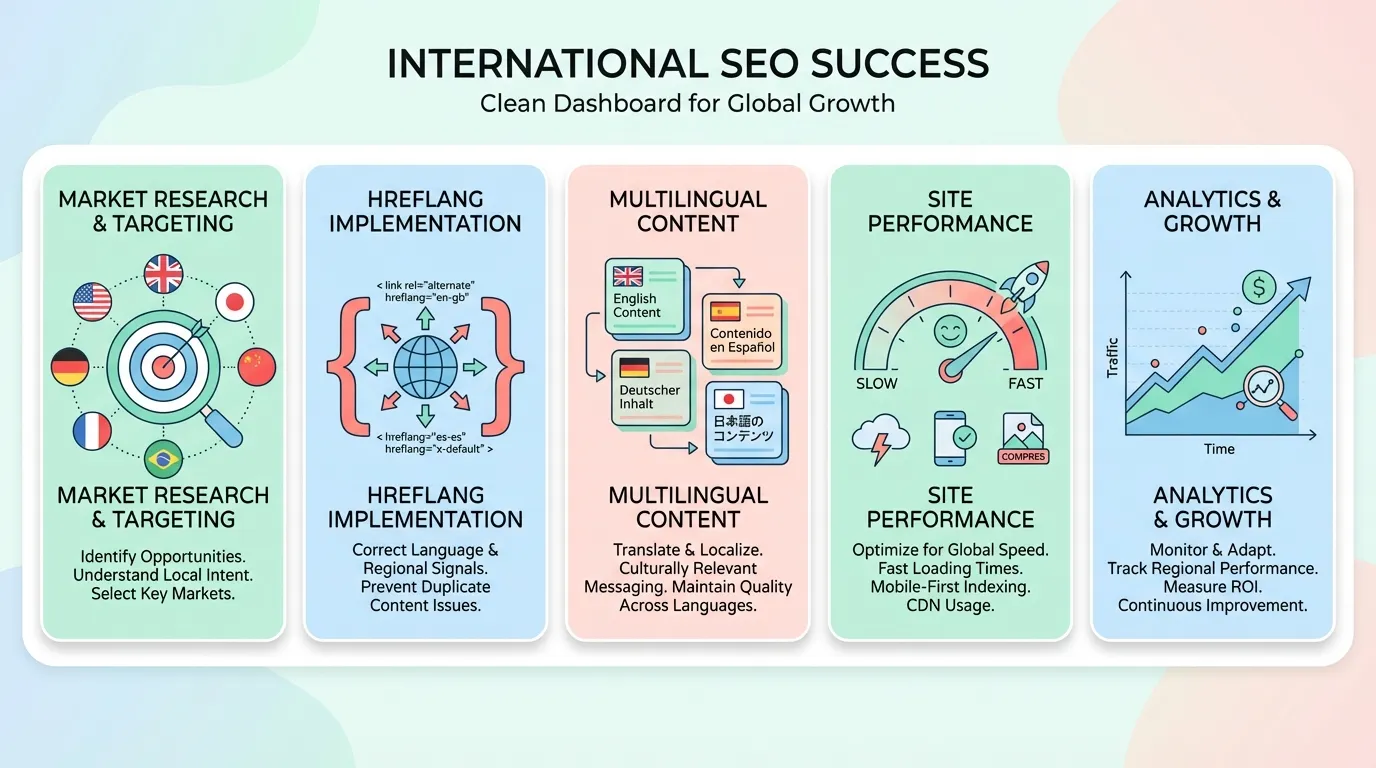
Expanding beyond your home market is not a branding exercise. It is an operational decision that requires technical precision, cultural awareness, and sustained authority building. If your structure is weak, your expansion stalls. If your keyword research is shallow, your messaging misses. If your localisation is superficial, trust erodes before conversions happen.
A disciplined approach forces you to think long term. You validate demand before building pages. You align content with regional search intent. You implement hreflang correctly. You build authority within each market rather than assuming it will transfer automatically.
That level of execution separates companies that “test” new markets from those that establish durable visibility.
If you are evaluating how to expand beyond Singapore or strengthen your footprint across the Asia Pacific, the right strategic partner matters. MediaOne works with growth-focused brands that need structured, performance-driven SEO services aligned to real commercial outcomes.
If your next stage involves cross-border visibility, speak with us directly to assess whether your current foundations can support a serious international SEO strategy.
Frequently Asked Questions
How does international SEO affect your website’s crawl budget?
International SEO increases the number of URLs search engines must crawl. If your site structure is inefficient or duplicate-heavy, crawl budget can be wasted. Clean architecture, regional sitemaps, and correct hreflang tags help search engines prioritise the right country pages.
Can international SEO work without hreflang tags?
It can function, but with less accuracy. Hreflang tags signal the correct language and country version of a page, reducing mismatched results. Without them, search engines may show the wrong regional page to users.
Do you need different currencies and pricing strategies for international SEO?
Yes. Displaying local currency and region-specific pricing improves relevance and user experience. Search engines favour content that aligns clearly with the target market’s expectations.
Is local search different on alternative search engines like Baidu or Yandex?
Yes. Baidu and Yandex use different ranking signals and language requirements. Successful international SEO in those markets requires platform-specific optimisation beyond Google best practices.
How do international SEO and multilingual SEO differ?

International SEO targets users in specific countries. Multilingual SEO targets users in different languages. A strategy can involve one without the other, but combining both strengthens geographic relevance.