

Southeast Asia stands out as a global leader in e-commerce growth. According to Google, Temasek, and Bain & Company’s e-Conomy SEA 2025 report, Southeast Asia’s digital economy is expected to surpass US$300 billion in Gross Merchandise Value (GMV) by 2025, driven largely by e-commerce, digital payments, and online services.

For Singapore brands, this growth represents a major opportunity. Expanding into nearby markets such as Malaysia and Indonesia allows businesses to tap into millions of new consumers who are increasingly comfortable shopping online.
However, entering multiple markets increases complexity. Search engines must identify which store version targets each country, the correct currency to display, and the most relevant pages for each region.
International e-commerce SEO is essential. Without a clear framework, businesses risk duplicate content, incorrect rankings, and fragmented search visibility.
For companies building their e-commerce growth strategy, it is useful to first understand the broader technical foundations of online store optimisation. For more information, our insights on e-commerce SEO in Singapore explain how technical architecture, structured data, and search optimisation work together to drive organic traffic.
In this guide, we focus specifically on international e-commerce SEO for Singapore brands expanding across Southeast Asia, covering store structure, hreflang implementation, localisation strategies, and technical SEO frameworks needed to scale across regional markets.
Key Takeaways
- International e-commerce SEO enables online stores to optimise their websites for multiple countries while ensuring search engines understand which version of a page should appear in each market.
- Singapore brands expanding into Southeast Asia must localise key elements such as pricing, currency, shipping policies, and product content while maintaining a consistent technical SEO framework.
- A successful international e-commerce SEO strategy combines strong site architecture, correct hreflang implementation, localisation, and ongoing technical optimisation.
What Is International E-commerce SEO?

International e-commerce SEO refers to the process of optimising an e-commerce website to rank in search engines across multiple countries or regions.
Unlike traditional e-commerce SEO, which focuses on a single market, international e-commerce SEO involves managing multiple regional versions of the same store. Each version may contain different currencies, languages, product availability, and shipping policies.
For example, a Singapore brand may operate storefronts targeting:
- Singapore
- Malaysia
- Indonesia
Although many products remain the same across markets, search engines must clearly understand which version of each page should appear for users in different countries.
International e-commerce SEO ensures that search engines deliver the correct regional experience while maintaining strong organic visibility across markets.
International E-commerce SEO Store Structure for Multi-Country Stores
Choosing the right site structure is critical in international e-commerce SEO. How you organise regional storefronts affects geographic targeting and the distribution of SEO authority.
A poorly structured international website can lead to duplicate content, diluted ranking signals, and confusion for search engines when determining which page to display to users in different countries.
There are three primary website structures commonly used for international e-commerce websites.
Subfolder Structure
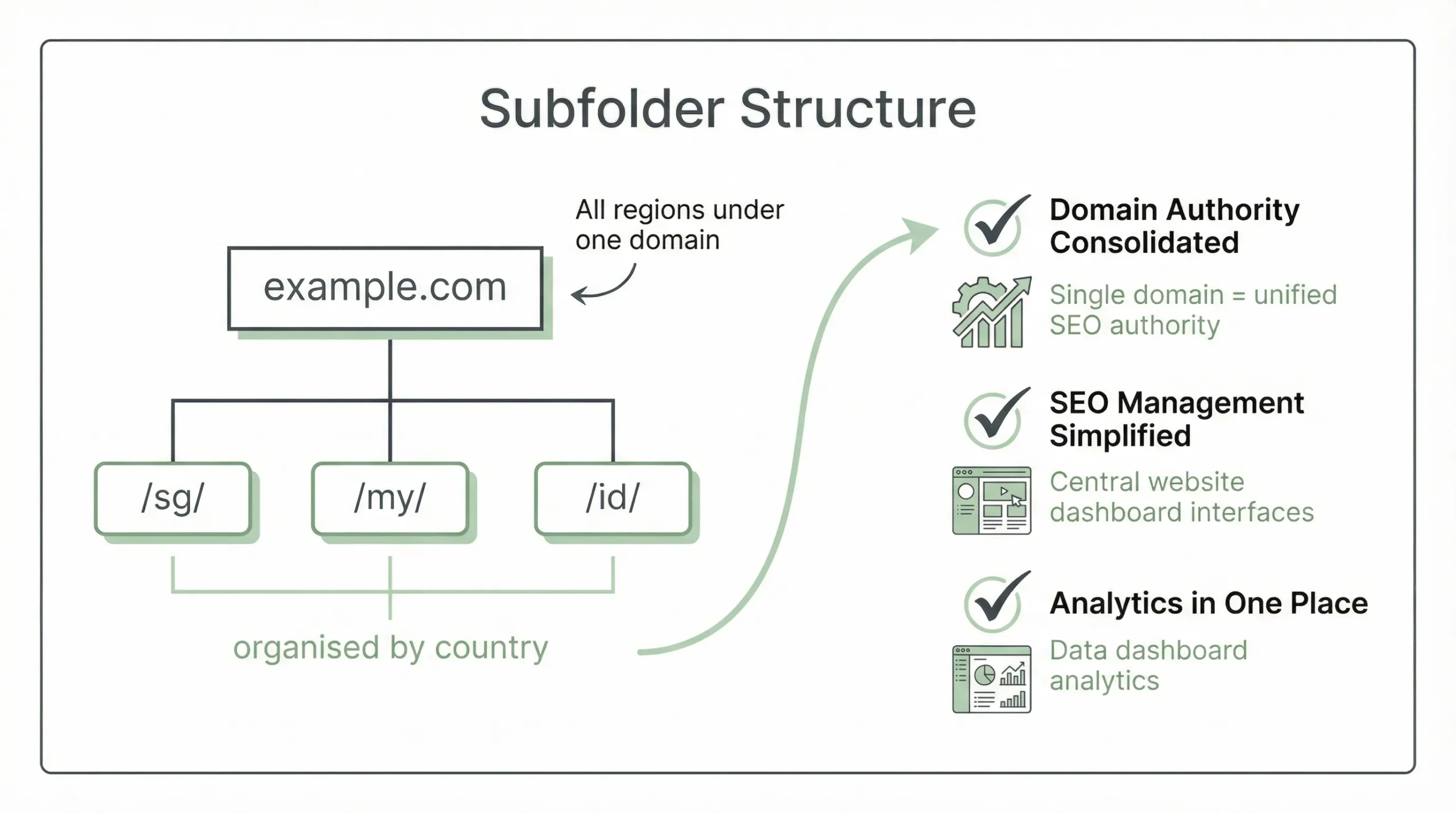
A subfolder structure places country-specific storefronts within directories on the main domain. This means all regional versions of the store operate under the same root domain but are organised using folders.
This approach allows businesses to maintain a single domain authority while logically separating regional content.
Example:
example.com/sg/
example.com/my/
example.com/id/
Under this structure:
- the Singapore storefront is located under /sg/
- the Malaysia storefront is located under /my/
- the Indonesia storefront is located under /id/
Because all pages exist under one domain, search engines can consolidate authority across the entire website.
Advantages of a subfolder structure include:
- stronger domain authority consolidation
- simpler technical SEO management
- easier analytics tracking across markets
For many Singapore e-commerce brands expanding into Southeast Asia, this structure is often the most efficient and scalable option.
Subdomain Structure
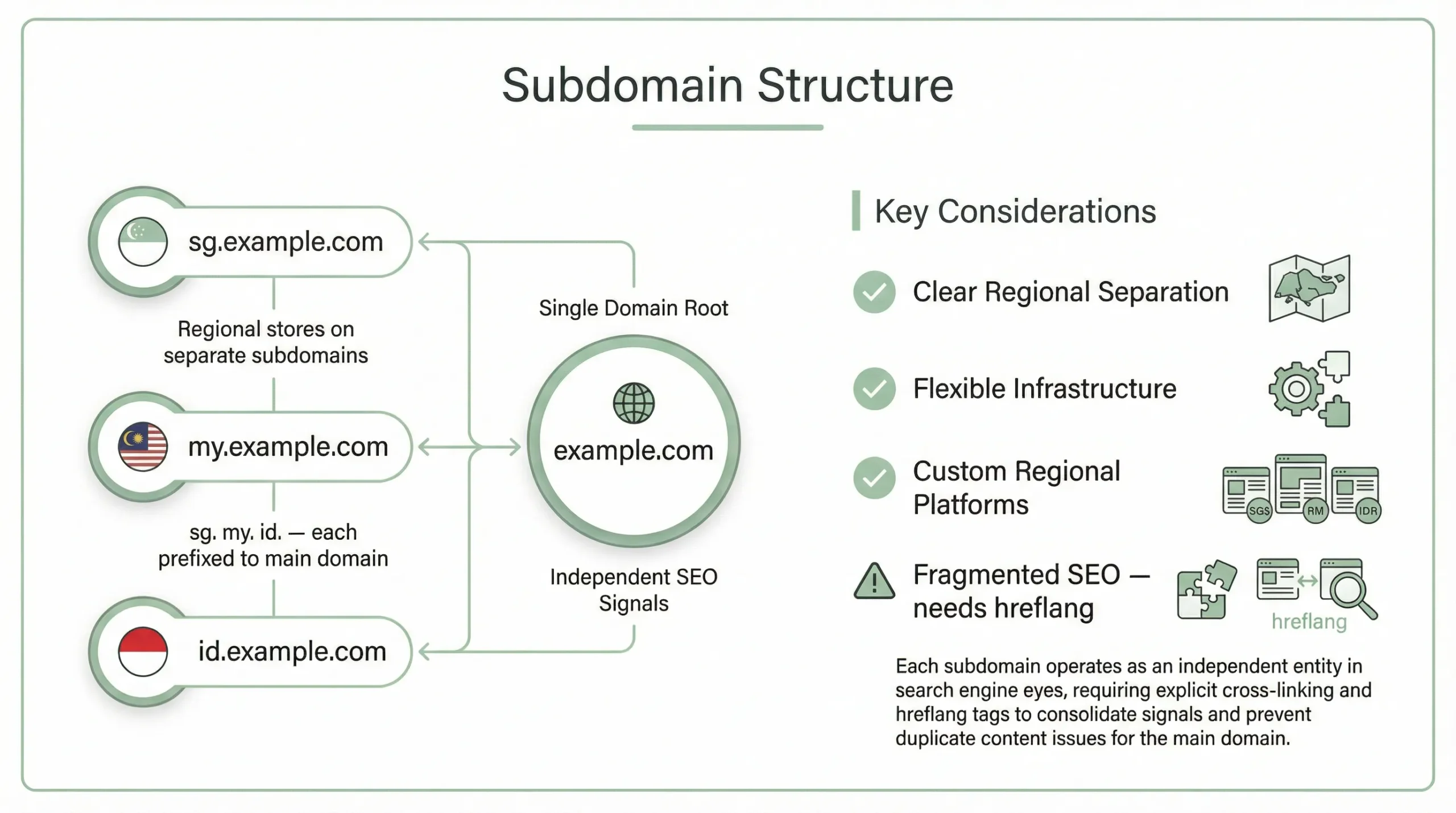
A subdomain structure assigns each regional storefront to its own subdomain, still tied to the main domain.
Example:
sg.example.com
my.example.com
id.example.com
Under this structure:
- Singapore storefront operates under sg.example.com
- Malaysia storefront operates under my.example.com
- Indonesia storefront operates under id.example.com
Subdomains provide greater separation but may fragment SEO signals, making management more complex, since each subdomain may require its own strategy.
SEO management is more complex as each subdomain may need its own optimisation.
Benefits of subdomains include:
- clearer separation between regional storefronts
- flexibility for hosting infrastructure
- easier customisation of regional platforms
However, businesses must ensure consistent linking and hreflang implementation to maintain strong SEO signals across subdomains.
Country-Code Domains
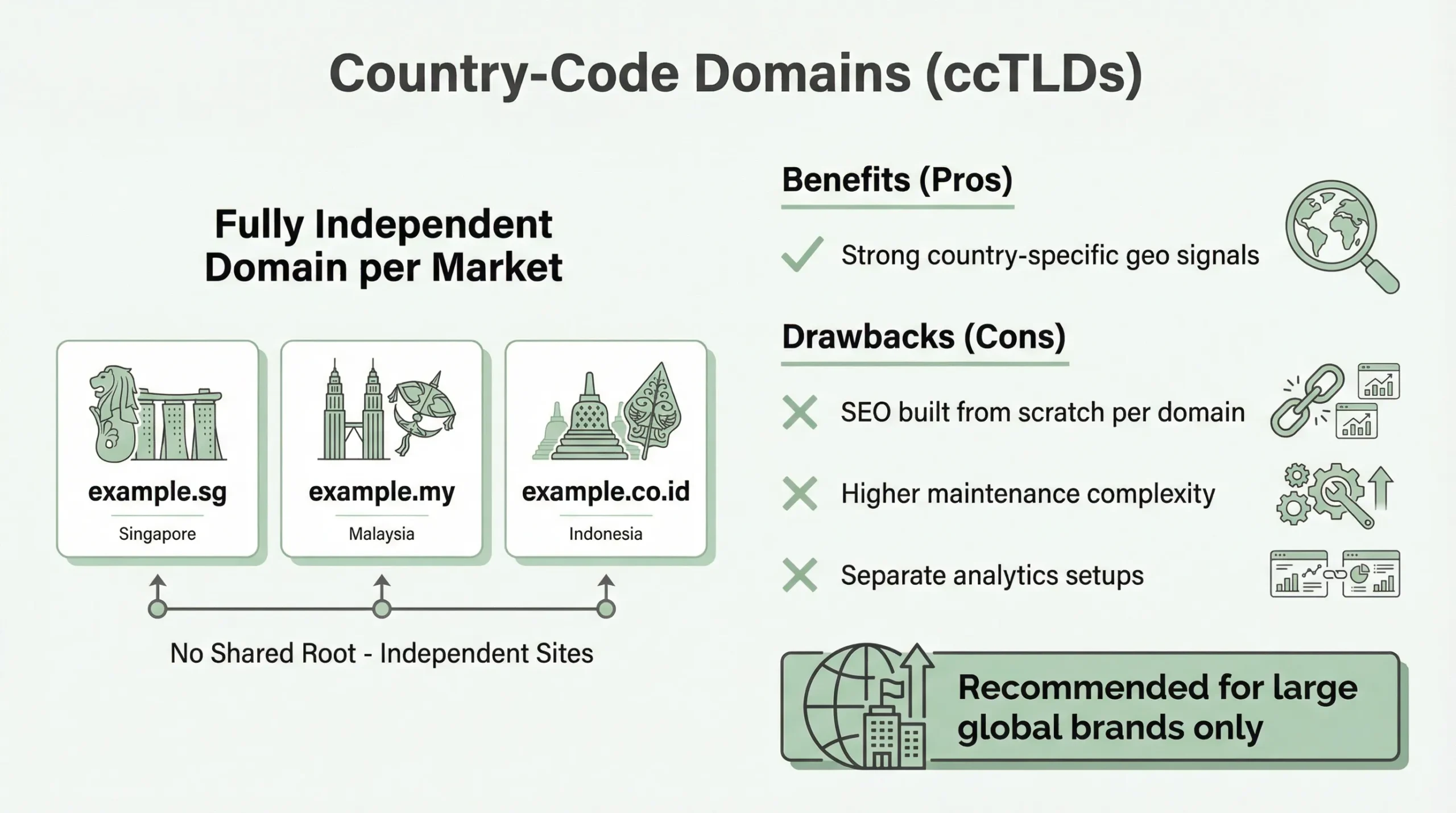
Country-code top-level domains (ccTLDs) use a unique domain with a country-specific extension for each market.
Example:
example.sg
example.my
example.co.id
Each ccTLD operates independently and targets one country.
Country-code domains send strong geographic signals to search engines and users. However, they require businesses to build SEO authority for each domain separately.
Challenges of ccTLD structures include:
- SEO authority must be built individually for each domain
- higher maintenance and technical complexity
- separate analytics and tracking setups
This structure is usually recommended only for large global e-commerce brands with significant resources.
Recommended Structure for Singapore Brands
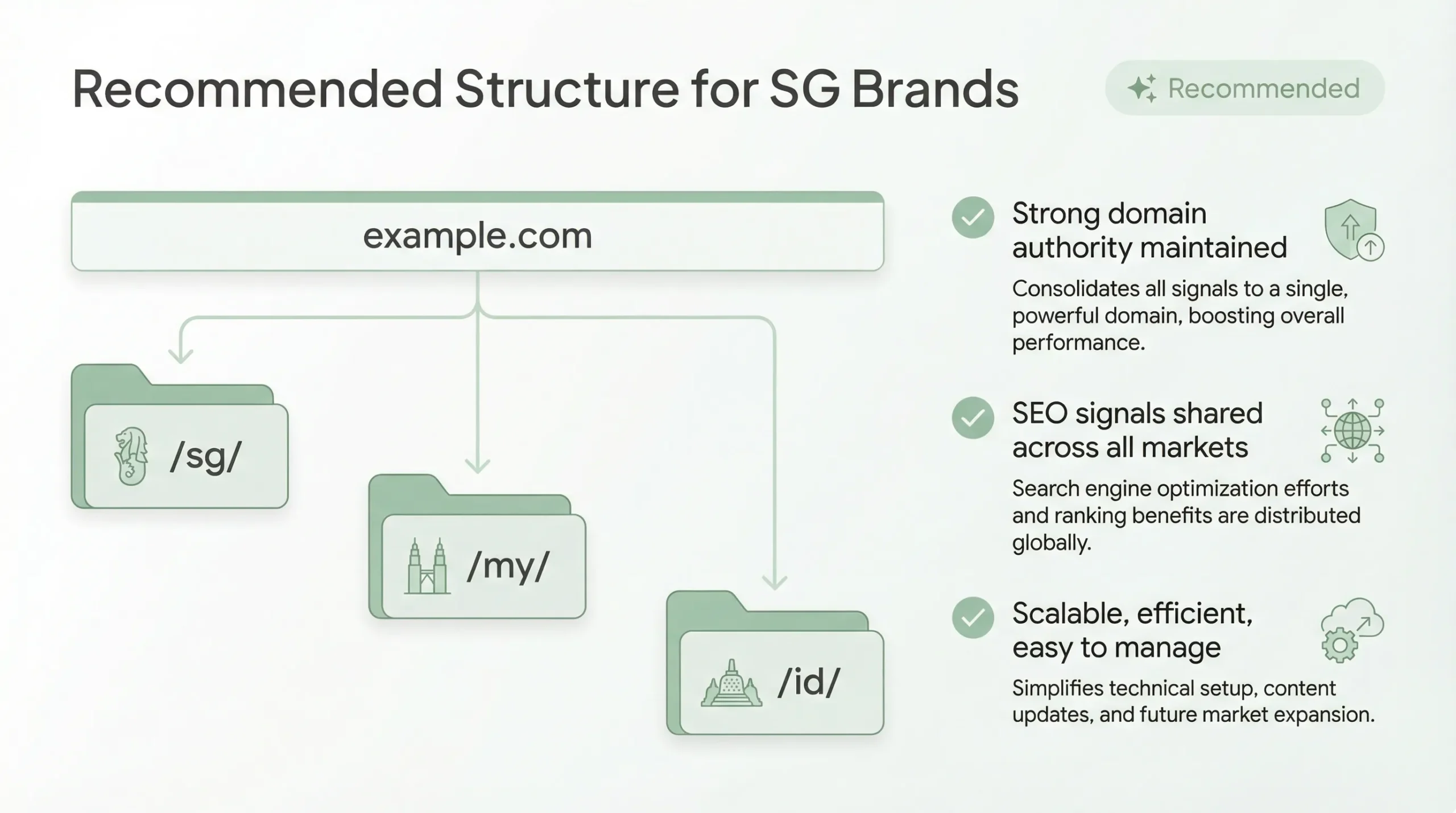
For most Singapore brands expanding across Southeast Asia, the subfolder structure is typically the most practical option.
This structure enables businesses to maintain strong domain authority while efficiently managing multiple regional storefronts.
Example store structure:
example.com
├── /sg/
├── /my/
└── /id/
This setup ensures that SEO signals from backlinks, internal linking, and content benefit the entire domain rather than being split across multiple domains.
Implementing Hreflang for International E-commerce SEO
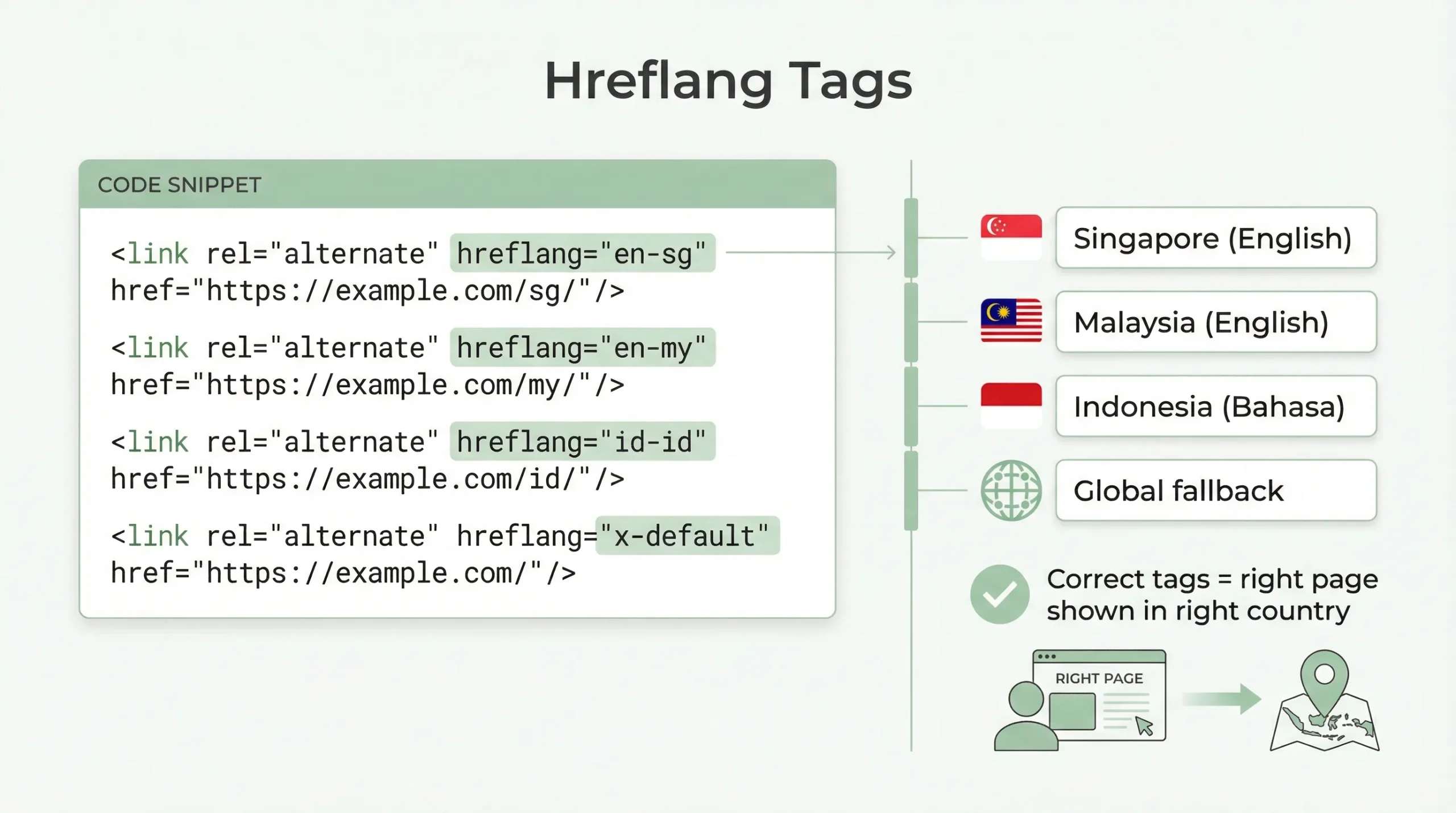
Hreflang tags signal to search engines how regional web pages relate to one another.
Operating multiple regional storefronts means many similar pages. Without proper tagging, search engines may not know which page to show in each location.
Hreflang tags tell search engines which page is best suited to each region.
For example, a product page may exist in three regional versions targeting Singapore, Malaysia, and Indonesia.
The hreflang implementation for these pages may look like the following:
<link rel=”alternate” hreflang=”en-sg” href=”https://example.com/sg/product” />
<link rel=”alternate” hreflang=”en-my” href=”https://example.com/my/product” />
<link rel=”alternate” hreflang=”id-id” href=”https://example.com/id/product” />
<link rel=”alternate” hreflang=”x-default” href=”https://example.com/product” />
In this example:
- en-sg signals the page targeting English-speaking users in Singapore
- en-my signals the page targeting English-speaking users in Malaysia
- id-id signals the Indonesian language version of the page
- x-default signals the default version for users whose location cannot be determined
Correct hreflang tags help search engines show users the right page by location and language.
Currency and Pricing Localisation in International E-Commerce SEO
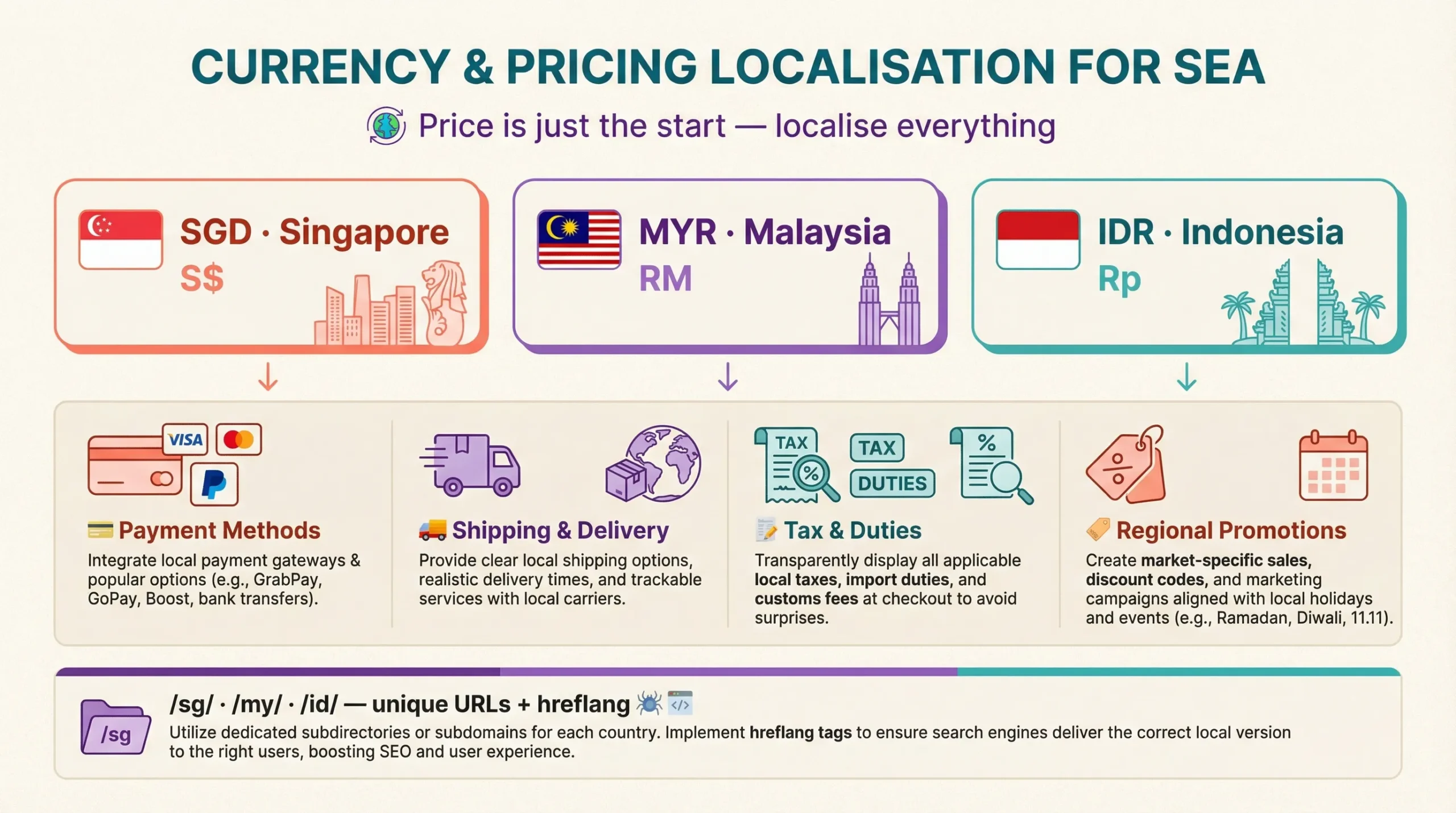
When expanding an e-commerce store into multiple countries, pricing localisation becomes one of the most important factors affecting both user experience and search performance. Customers expect product prices to be displayed in their local currency, and failing to localise pricing can create friction during the purchasing process.
Currency localisation helps search engines distinguish between regional product pages.
If only currency changes across country pages, search engines may see them as duplicates and show wrong results.
For Singapore brands expanding into Southeast Asia, pricing localisation typically involves adapting product pricing for markets such as Singapore, Malaysia, and Indonesia while maintaining a clear URL structure that signals each regional storefront.
For example, the same product may appear in three different currencies depending on the target market:
- Singapore: SGD
- Malaysia: MYR
- Indonesia: IDR
To illustrate how pricing differs across markets, the following example shows a simple conversion from Singapore Dollars to Malaysian Ringgit.
Displaying local currency values like this helps customers understand pricing immediately without needing to perform manual conversions. This small adjustment can significantly improve conversion rates, particularly for cross-border e-commerce stores.
However, currency localisation alone is not enough. E-commerce brands should also ensure that regional product pages include other elements that reinforce localisation and prevent duplicate content issues.
Key elements that should be localised alongside pricing include:
- payment methods that are commonly used in each market
- shipping costs and delivery timelines that reflect local logistics providers
- tax or duty information that may differ across countries
- promotional pricing or regional offers tailored to each market
When these elements are localised together, search engines gain stronger signals that each storefront is designed for a specific country audience. This helps ensure the correct version of a product page appears in search results for users in Singapore, Malaysia, or Indonesia.
In addition, e-commerce stores should ensure that each regional storefront has its own unique URL structure, such as:
example.com/sg/product
example.com/my/product
example.com/id/product
Using distinct URLs allows search engines to index each market version independently, while hreflang tags help indicate the relationship between them.
Shipping and Returns Localisation for International E-commerce SEO
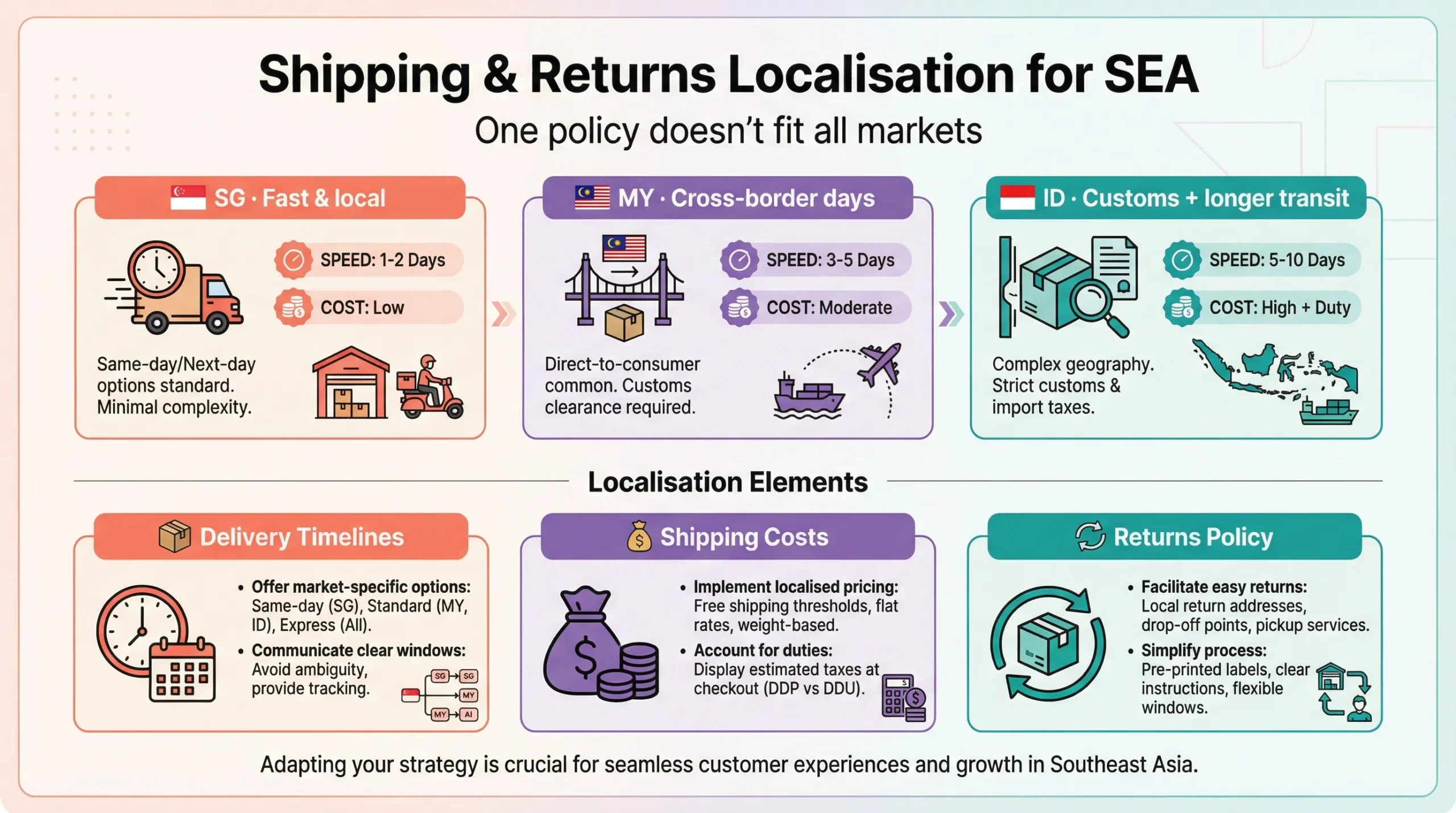
When e-commerce businesses expand into multiple countries, shipping and returns policies become an important component of both user experience and search visibility.
Customers in different markets often expect delivery timelines, shipping fees, and return processes that reflect local logistics infrastructure. If these details are not clearly localised, users may hesitate to complete a purchase, even if the product itself is relevant.
From an SEO perspective, shipping and returns localisation helps search engines understand the geographic relevance of a storefront.
When country-specific shipping information is present on regional pages, it reinforces the signal that the page is designed for users in that market. This strengthens the overall international e-commerce SEO framework and improves the likelihood that the correct storefront appears in search results.
For Singapore brands expanding into Southeast Asia, shipping policies often vary across markets due to differences in logistics networks, customs regulations, and delivery expectations. Providing clear, market-specific shipping information helps build customer trust while reducing confusion during the purchasing process.
For example, a Singaporean e-commerce store expanding into Malaysia and Indonesia may need to adjust its shipping policies as follows.
- Delivery timelines may differ across markets: Shipping within Singapore is typically faster due to the country’s compact geography and highly developed logistics network. Deliveries to Malaysia may take several days, while shipments to Indonesia may take longer due to customs clearance and local courier services.
- Shipping costs may vary depending on cross-border logistics: Local deliveries in Singapore may offer free or low-cost shipping options. However, cross-border shipping to neighbouring countries may involve additional logistics fees, customs duties, or courier surcharges that should be clearly communicated to customers.
- Return policies may need to accommodate international customers: Returns within Singapore may be straightforward, but international returns can involve longer processing times, international courier arrangements, and additional documentation. Clearly outlining these processes helps customers understand how returns will be handled.
Because of these variations, e-commerce stores should avoid using a single generic shipping policy across all markets. Instead, country-specific shipping and returns pages can help both users and search engines better understand the store’s regional operations.
For instance, an e-commerce site might organise shipping information using dedicated regional pages such as:
Each page can include market-specific information such as delivery timelines, shipping rates, courier partners, and return procedures relevant to that country.
Localising shipping and returns content also creates opportunities to capture additional search traffic. Customers often search for delivery-related queries when deciding whether to purchase from a store.
Ultimately, shipping and returns localisation is not only about operational transparency. It is also a critical element of international e-commerce SEO because it helps align technical SEO signals with the real customer experience across different markets.
Avoiding Duplicate Content in International E-commerce SEO
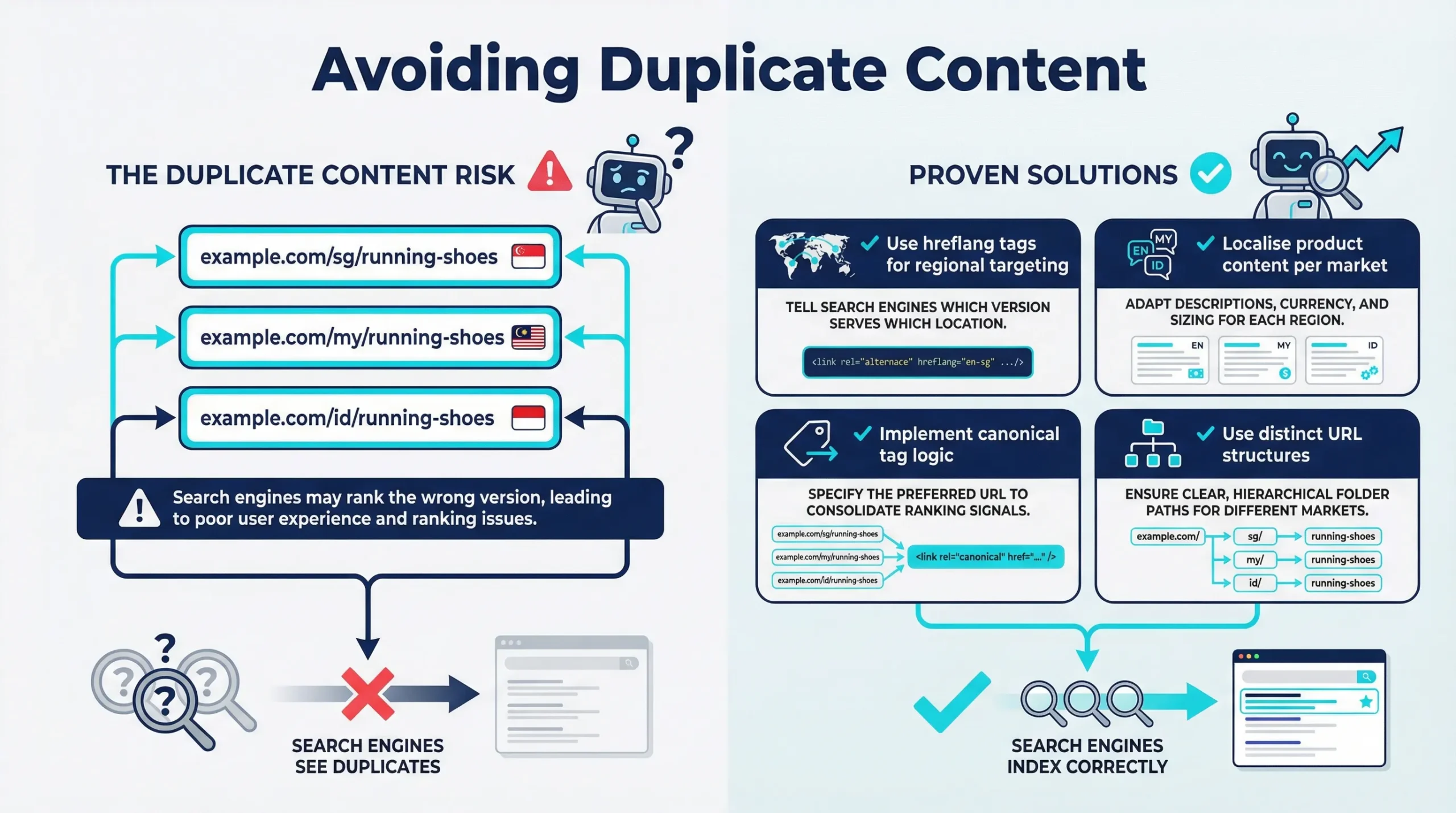
Duplicate content is one of the most common technical challenges faced by e-commerce businesses operating in multiple countries. When a store expands internationally, many product pages across regional storefronts may contain very similar or identical content.
This typically happens because the same product catalogue is used across different markets, with only small variations such as currency, shipping options, or language.
Search engines attempt to identify the most relevant version of a page to display in search results. When multiple pages contain nearly identical content, search engines may struggle to determine which version should rank. As a result, the wrong regional page may appear in search results, or ranking signals may become diluted across multiple pages.
For Singapore brands expanding into Southeast Asia, duplicate content often occurs when the same product pages are replicated across country storefronts such as Singapore, Malaysia, and Indonesia. Without proper technical signals and content localisation, search engines may treat these pages as duplicates rather than unique regional versions.
To illustrate this issue, consider the following example of a product page that exists across three country storefronts.
Example regional product URLs:
Although these URLs represent different regional stores, the underlying product content may be nearly identical. If search engines cannot clearly distinguish the intended market for each page, they may index only one version or display the wrong page to users in a particular country.
To avoid duplicate content issues in international e-commerce SEO, businesses should implement several key strategies that help search engines understand the relationship between regional pages.
- Use hreflang tags to signal regional targeting: Hreflang tags indicate which version of a page is intended for a specific country or language. This helps search engines deliver the correct regional page to users while recognising that the pages are related versions of the same content.
- Localise product content where possible: Even small adjustments to product descriptions, promotional messaging, or supporting information can help differentiate regional pages. For example, a product page targeting Indonesia may include references to local shipping options or payment methods commonly used in that market.
- Implement consistent canonical tag logic: Canonical tags help signal the preferred version of a page when similar content exists across multiple URLs. When used carefully alongside hreflang, canonical tags can reinforce the relationship between regional pages without causing indexing conflicts.
- Ensure regional storefronts use distinct URL structures: country-specific directories or subdomains help search engines recognise that each page version belongs to a different regional store. Clear URL structures also make it easier to implement hreflang correctly.
- Avoid automatic redirection based solely on IP location: Automatically redirecting users to a different country version of the site can prevent search engines from crawling alternate versions of a page. Instead, users should be able to navigate freely between regional storefronts.
Proper duplicate content management allows international e-commerce SEO strategies to scale across multiple markets without weakening overall organic performance.
Technical SEO Foundations for International E-commerce SEO
International e-commerce SEO relies heavily on strong technical foundations that allow search engines to crawl, understand, and index regional storefronts correctly.
Without proper technical configuration, search engines may struggle to identify which pages belong to each market, which can reduce visibility or cause the wrong pages to appear in search results.
Technical SEO ensures that search engines can efficiently discover country-specific pages, interpret their relationships, and prioritise the correct version of content for each market.
For Singapore brands expanding into Southeast Asia, establishing these technical foundations early helps ensure regional storefronts scale without causing indexing or crawling issues. Several key technical elements play an important role in supporting international e-commerce SEO.
International XML Sitemaps
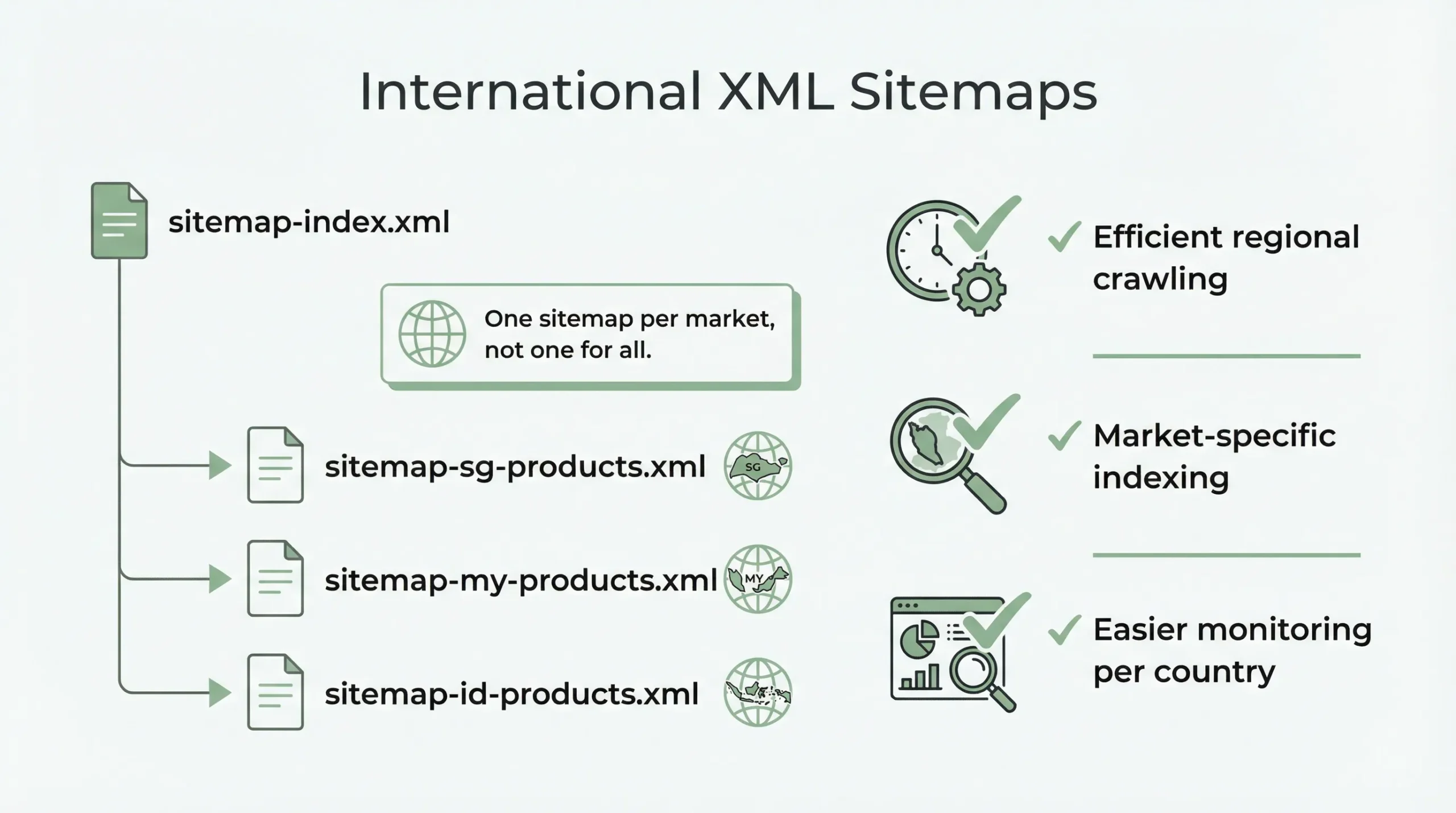
XML sitemaps help search engines discover important pages on a website. For international e-commerce websites, sitemaps should include URLs for each regional storefront so search engines can easily identify the site’s structure.
Instead of maintaining a single large sitemap, many e-commerce websites organise their sitemaps by region or page type. This allows search engines to crawl country-specific content more efficiently and helps site administrators monitor indexing performance for each market.
Example sitemap structure:
sitemap-sg-products.xml
sitemap-my-products.xml
sitemap-id-products.xml
By separating regional sitemaps, businesses can ensure that each country’s storefront is properly indexed by search engines.
Internal Linking Between Regional Storefronts
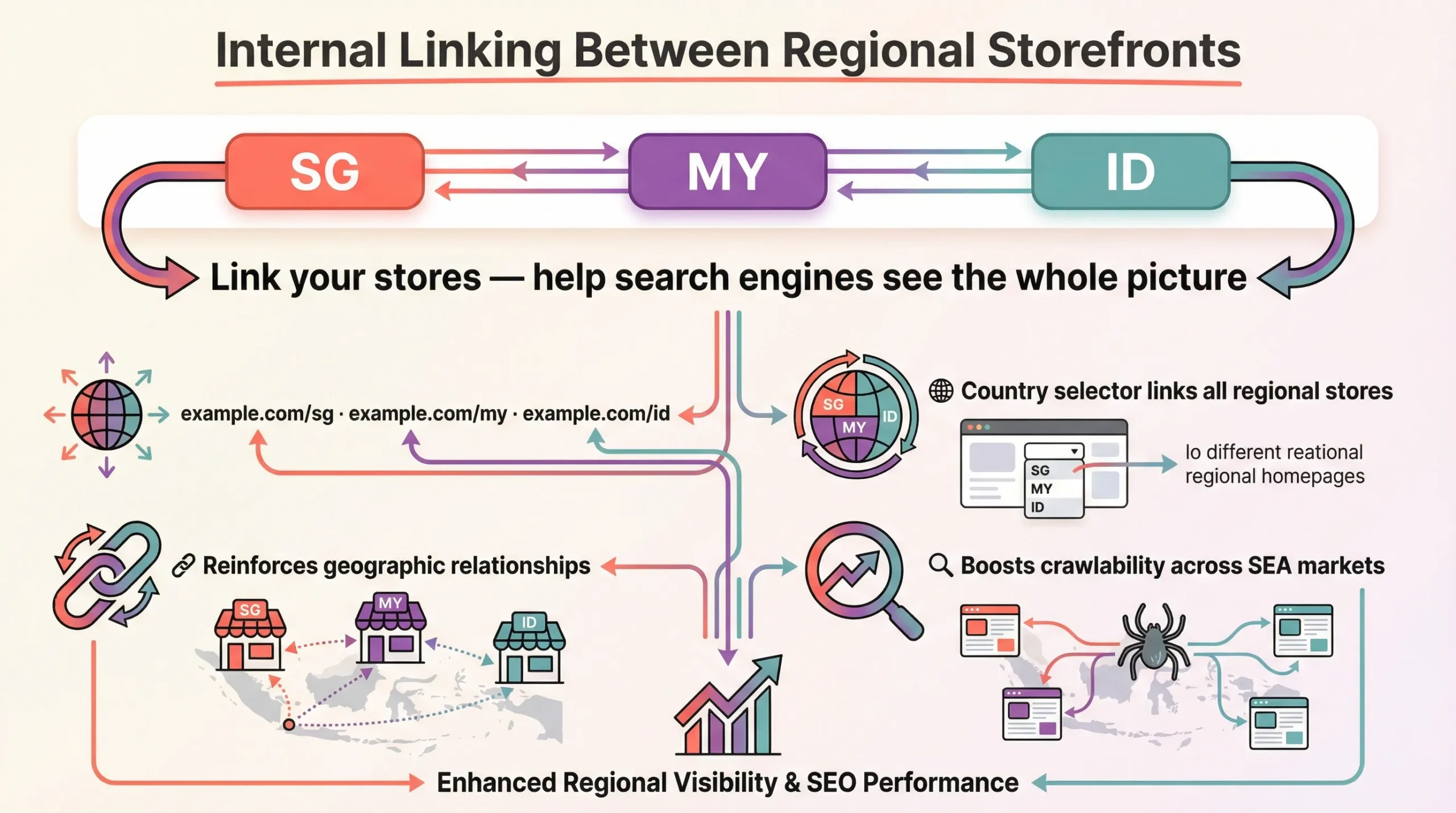
Internal linking helps search engines understand how different pages across a website relate to one another. For international e-commerce stores, internal links should clearly connect regional storefronts so search engines recognise them as part of the same ecosystem.
For example, many international websites include a country selector in their site navigation that lets users switch between regional stores. These links help both users and search engines discover alternative versions of the site.
Example regional navigation links:
- Singapore store: example.com/sg
- Malaysia store: example.com/my
- Indonesia store: example.com/id
This type of linking reinforces geographic relationships across the site and improves crawlability.
Crawl Budget Management for Large E-commerce Sites
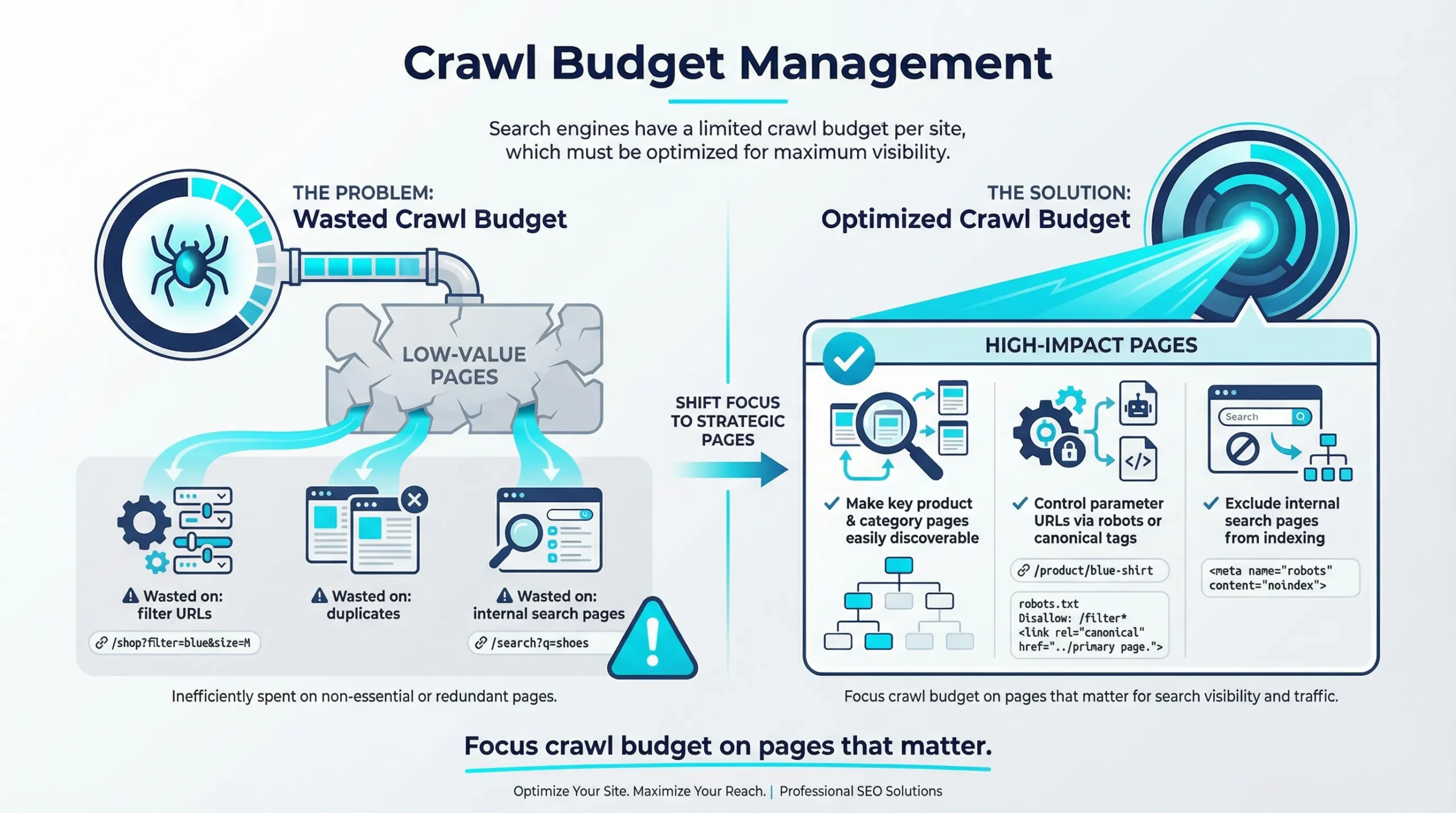
Large e-commerce websites may contain thousands of product pages, category pages, and filter variations. When a store expands internationally, the number of indexed pages can grow significantly, as each market may have its own version of the product catalogue.
Search engines allocate a limited crawl budget to each website. If this budget is wasted on crawling duplicate pages, filter parameters, or low-value URLs, important pages may be crawled less frequently.
To manage crawl budget effectively, e-commerce brands should ensure that:
- important product and category pages are easily discoverable
- parameter-based URLs are controlled through robots directives or canonical tags
- Internal search pages are not unnecessarily indexed.
These practices help search engines focus on indexing the most important pages for each regional storefront.
Canonical Tags and Regional Page Relationships
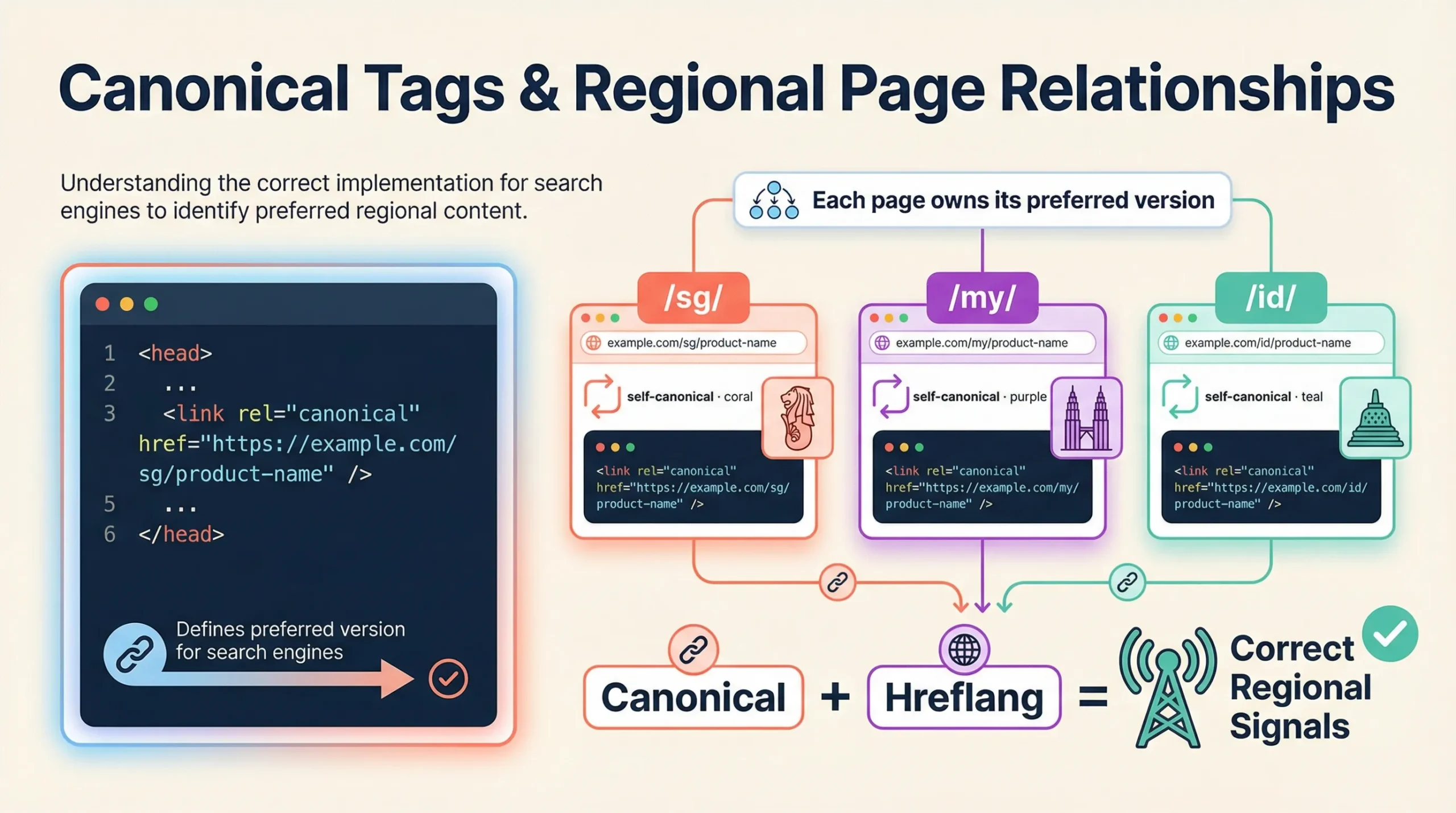
Canonical tags help search engines understand which page version should be treated as the primary reference when similar content exists across multiple URLs. In international e-commerce SEO, canonical tags are often used alongside hreflang to manage relationships between regional product pages.
For example, if similar product pages exist across Singapore, Malaysia, and Indonesia storefronts, canonical tags help reinforce which page should be considered the preferred version within each market.
Example canonical tag implementation on a product page:
<link rel=”canonical” href=”https://example.com/sg/product-name” />
When used correctly with hreflang tags, canonical tags help search engines interpret regional page relationships without incorrectly consolidating all versions into a single URL.
Site Performance and Core Web Vitals Across Markets
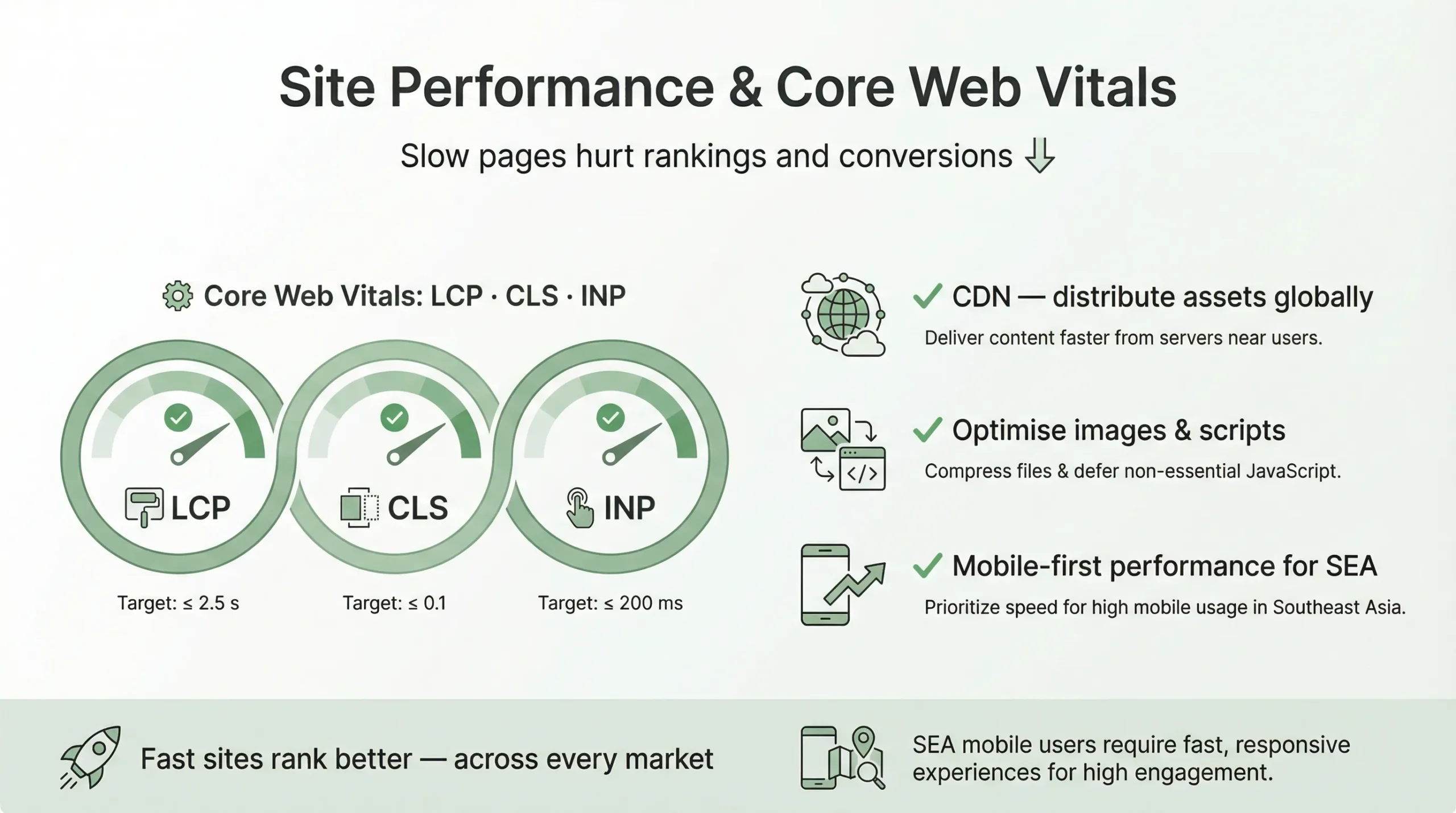
Website performance plays an important role in both search rankings and user experience. When e-commerce stores expand internationally, page speed may vary depending on server and user locations.
To maintain consistent performance across markets, businesses should ensure that:
- Content delivery networks (CDNs) distribute assets globally.
- Images and scripts are optimised for fast loading.
- Mobile performance remains strong across regional storefronts.
Fast-loading pages improve both SEO performance and conversion rates, particularly for mobile users in Southeast Asia.
A strong technical architecture enables search engines to clearly understand regional storefronts, ensuring each market maintains its own visibility while benefiting from the site’s overall authority.
Building an International E-commerce SEO Strategy for Singapore Brands
Expanding an e-commerce business beyond Singapore requires more than simply launching additional country storefronts.
A successful international e-commerce SEO strategy requires careful planning across multiple areas, including keyword targeting, localisation, technical architecture, and market-specific optimisation. Each Southeast Asian market has its own search behaviour, purchasing patterns, and digital ecosystem, which means SEO strategies must be adapted accordingly.
For Singapore brands looking to expand into markets such as Malaysia and Indonesia, international e-commerce SEO should focus on building a scalable framework that allows the business to grow across multiple regions while maintaining strong organic visibility.
The strategy should align technical SEO, content localisation, and user experience so that search engines clearly understand the intended audience for each storefront. Below are several key components that help shape an effective international e-commerce SEO strategy for Singapore brands.
Conduct Keyword Research Across Regional Markets
Search behaviour can vary significantly across Southeast Asia, even when countries share similar languages. While Singaporeans and Malaysians frequently use English in search queries, Indonesian users often use Bahasa Indonesia.
Understanding these differences helps businesses identify the keywords customers in each market actually use when searching for products.
For example, the same product may be searched differently depending on the market.
| Product | Singapore Keyword | Malaysia Keyword | Indonesia Keyword |
| Running shoes | running shoes | running shoes | sepatu lari |
| Laptop bag | laptop bag | laptop bag | tas laptop |
This example highlights how localisation becomes essential when targeting Indonesian markets. Although the product is the same, the search query is completely different. Businesses that rely solely on English keywords may miss a significant portion of search demand in certain countries.
Conducting keyword research for each target market ensures that product pages and category pages align with local search behaviour.
Develop Localised Content for Each Market
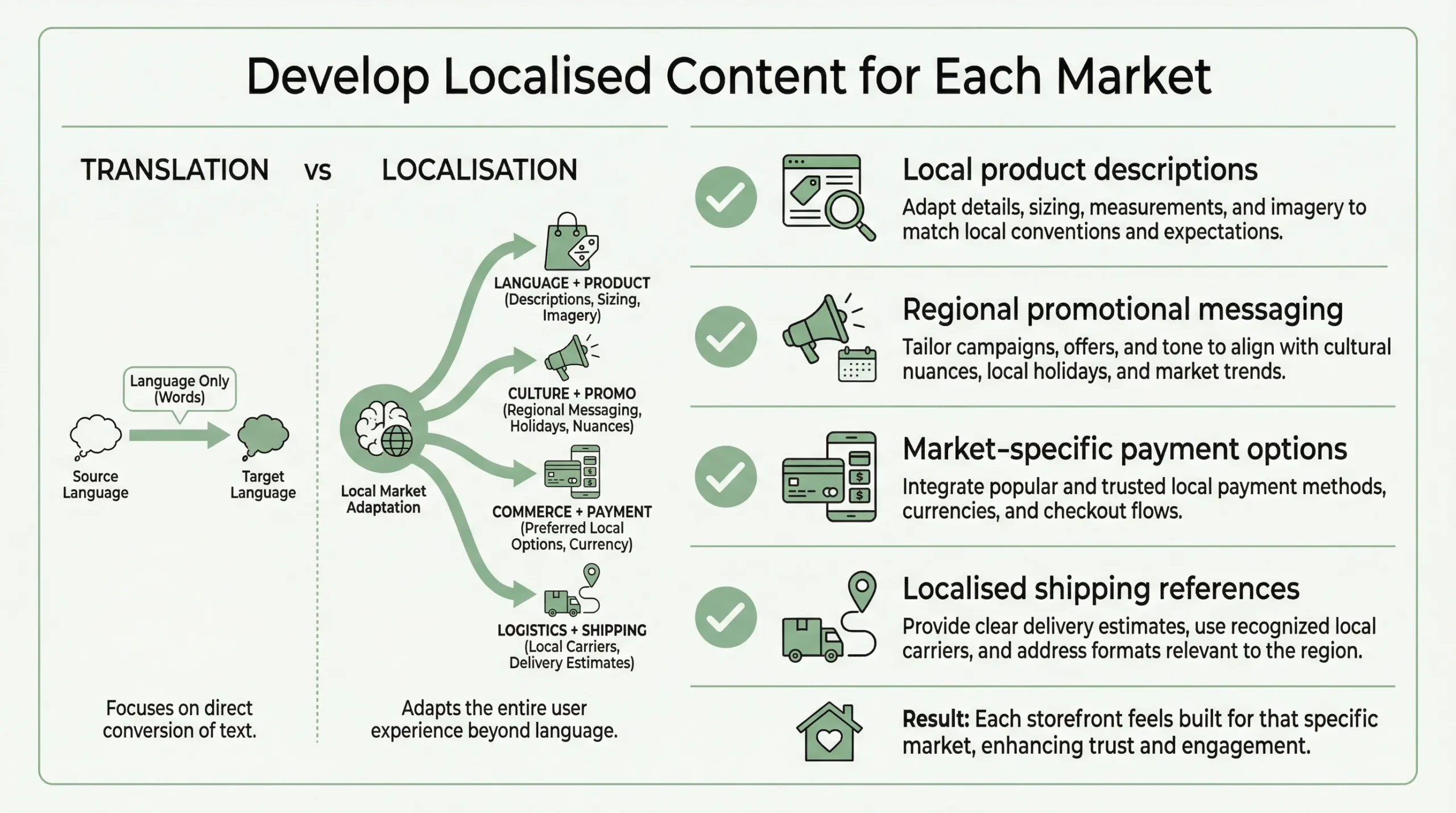
Localisation goes beyond translating content into another language. A well-executed e-commerce SEO strategy adapts product content to reflect the expectations and preferences of each market.
Localised e-commerce content may include adjustments to:
- product descriptions that reflect local terminology
- promotional messaging that resonates with regional audiences
- payment options commonly used in each country
- references to shipping options and delivery expectations
For example, Indonesian e-commerce shoppers may prioritise payment methods such as digital wallets or bank transfers, which are widely used in that market. Incorporating these details into product or checkout pages can improve both search relevance and customer trust.
Localised content also signals to search engines that each regional storefront is designed for a specific audience rather than duplicating another market.
Align SEO With Local E-commerce Platforms and Marketplaces

Southeast Asia has a unique e-commerce ecosystem where marketplaces play a major role in product discovery. Platforms such as Shopee, Lazada, and Tokopedia dominate many markets and influence consumer search behaviour.
While an e-commerce website may serve as the primary store, businesses should consider how their SEO strategy complements these platforms. For example, users may search on Google for product reviews or brand information before purchasing on a marketplace.
Ensuring that product pages contain informative descriptions, structured data, and useful supporting content helps brands capture organic search traffic even when marketplaces dominate product transactions.
Monitor Regional SEO Performance

International e-commerce SEO strategies require continuous monitoring because performance can vary across markets. Factors such as competition, search behaviour, and platform adoption differ from one country to another.
Businesses should monitor SEO performance metrics separately for each regional storefront, including:
- organic traffic by country
- keyword rankings in local search results
- indexed pages for each market
- conversion rates across regional storefronts
Monitoring these metrics allows businesses to identify which markets are performing well and which require further optimisation.
By combining regional keyword research, localisation, and ongoing performance analysis, Singapore brands can build an international e-commerce SEO strategy that supports long-term expansion across Southeast Asia while maintaining strong organic visibility.
International E-commerce SEO Implementation Checklist
The following checklist outlines key areas that e-commerce brands should review when implementing international e-commerce SEO across markets such as Singapore, Malaysia, and Indonesia.
- Website structure supports multiple country storefronts.
- Hreflang tags correctly identify regional page versions.
- Currency and pricing are localised for each market.
- Shipping and returns policies are localised.
- Product pages avoid duplicate content across markets.
- International XML sitemaps include regional URLs
- Internal linking connects regional storefronts.
- Structured data reflects regional pricing and availability.
- Localised keywords are integrated into regional content.
- Technical SEO audits confirm regional pages are crawlable and indexable.
By reviewing these elements before launching new country storefronts, e-commerce brands can build a strong international e-commerce SEO framework that supports sustainable growth across Southeast Asia.
Scale Southeast Asia Growth with International E-commerce SEO
As Southeast Asia’s e-commerce ecosystem continues to grow, Singapore brands are uniquely positioned to expand into neighbouring markets and capture new demand. However, successful regional expansion requires more than launching multiple storefronts.
Search engines must clearly understand how each country version of a website relates to one another, from hreflang signals and store architecture to currency localisation and regional content.
A well-structured international e-commerce SEO strategy allows businesses to scale across markets while maintaining strong organic visibility. By combining the right technical SEO foundations with localised user experiences, e-commerce brands can reach new customers in Malaysia, Indonesia, and other Southeast Asian markets without sacrificing search performance.
For companies planning regional expansion, partnering with experienced SEO specialists can make a significant difference. At MediaOne, we help e-commerce brands implement scalable SEO frameworks that support international growth across Southeast Asia.
If your business is planning to expand beyond Singapore, explore MediaOne’s e-commerce SEO expertise. Contact us today!
Frequently Asked Questions
How long does international e-commerce SEO take to show results?
International e-commerce SEO typically takes three to six months to show measurable improvements in organic traffic and rankings. The timeline depends on factors such as domain authority, market competition, and how well the website structure and localisation are implemented across regional storefronts.
Do I need separate domains to rank in different countries?
Separate domains are not always required. Many e-commerce websites successfully target multiple countries using subfolders such as /sg/, /my/, and /id/. This approach allows businesses to consolidate SEO authority under a single domain while still enabling clear regional targeting for search engines.
Should product content be translated or rewritten for different markets?
Direct translation is rarely enough for effective international e-commerce SEO. Product content should be localised, which means adapting descriptions, terminology, and messaging to reflect local search behaviour, cultural preferences, and regional buying patterns.
Can international e-commerce SEO help reduce paid advertising costs?
Yes. Strong international e-commerce SEO enables businesses to capture organic search demand in new markets, reducing reliance on paid advertising. Over time, organic traffic can become a stable acquisition channel that complements paid campaigns.
How do search engines determine which country version of a page to show?
Search engines rely on several signals to determine the correct regional page to display. These signals include hreflang tags, site structure, localised content, user location, and search behaviour. When these signals are properly implemented, search engines can deliver the most relevant page for users in each country.