

eCommerce SEO services in Singapore are not about publishing more blog posts. It is about structuring, optimising, and protecting the pages that generate revenue.

If your collection pages do not rank, growth is capped. If your product pages are thin or duplicated, conversions suffer. If your filters and pagination are unmanaged, crawl budget is wasted.
This guide focuses on what actually moves rankings for online stores:
- Category and subcategory architecture
- Product page optimisation
- Faceted navigation and crawl control
- Internal linking systems
- Schema and indexing rules
- Authority-building content that strengthens revenue pages
No theory. No history of search engines. Just what helps an online store rank?
Key Takeaways
- Clear commercial keyword mapping. Assign one primary keyword cluster to each category or subcategory. Map long-tail transactional queries to product pages. Prevent keyword cannibalisation before it happens, a key principle in any Shopify eCommerce SEO guide.
- Deliberate taxonomy and URL structure. Build a shallow, logical hierarchy from the homepage to the category to the product. Create new subcategories only when search demand and product depth justify them.
- Strict index control. Canonicalise filtered and parameter-based URLs that do not deserve standalone rankings. Apply noindex to low-value variations. Keep XML sitemaps limited to preferred, revenue-driving pages.
- Collection page optimisation built for both SEO and UX. Add a concise, intent-focused intro above the product grid. Place deeper buying guides, comparisons, and FAQs below the grid or in expandable sections.
- Conversion-focused product pages. Use unique descriptions with contextual depth. Structure specifications clearly. Implement accurate product schema for price, availability, and reviews.
- Engineered internal linking systems. Reinforce hierarchy from homepage to category to product. Use contextual links from guides and comparison content to strengthen commercial hubs. Eliminate orphan pages.
- Controlled faceted navigation. Index only filter combinations with proven search demand and sufficient product depth. Consolidate low-value variations to protect crawl budget and authority.
- Technical performance and crawl efficiency. Maintain clean canonicals, stable URL formats, and fast-loading templates. Optimise for mobile-first indexing and Core Web Vitals.
- Category-centric content clusters. Support revenue pages with comparison guides, buying advice, and structured FAQs that funnel authority back to collection pages.
What eCommerce SEO Actually Means for Online Stores
In an online store, SEO is not primarily a content exercise. It is an architectural discipline. You are not optimising a handful of blog posts. You are managing a living system of categories, subcategories, product pages, filters, pagination layers, and dynamic URLs.
Every structural decision influences how search engines crawl, interpret, and prioritise your site.
At its core, eCommerce SEO is the practice of designing that system so revenue pages rank and low-value pages stay out of the way. Here are some tips on how to achieve this:
1. Clear Keyword Ownership Across URLs

Every important keyword theme must have a single, intentional owner.
That means:
- A primary keyword cluster is assigned to one category or subcategory page.
- Long-tail transactional queries are mapped to specific product pages.
- Supporting informational or comparison queries reinforces commercial hubs rather than competes with them.
Without clear ownership, multiple pages may target the same keyword. This creates cannibalisation. Rankings fluctuate. Authority fragments. Growth stalls without an obvious explanation.
Strong eCommerce SEO begins with a keyword-to-URL map. Before a page is published or optimised, you should know:
- What search intent does it serve?
- What primary term does it target?
- How it relates to adjacent categories
- Whether it overlaps with an existing page
Structure comes first. Content follows.
2. Preventing Duplicate and Thin Pages From Entering the Index

Online stores generate duplication by default. It is not usually intentional. It is a by-product of how eCommerce platforms function.
- Filters create parameter-based URLs.
- Sorting options generate alternate versions of the same category.
- Product variants sometimes appear on separate URLs rather than on a unified product page.
- Pagination introduces additional crawl paths that may look like standalone pages to search engines.
Individually, each variation seems harmless. At scale, they multiply quickly. A single category with colour, size, and price filters can produce hundreds of URL combinations. Most of them contain nearly identical content.
Mini Case: Singapore Electronics Retailer
A mid-sized electronics store had over 18,000 indexed URLs despite carrying fewer than 2,000 products. Filter combinations created crawl waste and diluted authority.
After consolidating canonicals and applying noindex to low-demand filter variations, indexed pages dropped by 62 percent. Within four months, primary category rankings stabilised, and two high-margin collections moved from page two to the top five positions.
This is what disciplined index control achieves at scale.
When these URLs are indexable:
- Search engines spend crawl budget on low-value pages.
- Link equity fragments across multiple versions of the same content.
- Ranking signals become diluted.
- Core collection pages struggle to consolidate authority.
The issue is not duplication alone. It is signal dilution. Effective eCommerce SEO requires disciplined index control.
- Canonical tags should point all alternate or filtered versions back to the preferred URL when they do not deserve independent visibility. This consolidates authority and clarifies which page owns the keyword theme.
- Noindex directives should be applied to filter combinations that exist for usability but do not reflect real search demand. These pages can remain accessible to users while staying out of search results.
- Parameter handling must be audited regularly. Review how your CMS generates URLs for sorting, tracking, and filtering. Small configuration oversights can quietly expand your index footprint.
The goal is not to index everything your platform can generate. The goal is to ensure that only commercially meaningful, intent-aligned pages compete in search results. More indexed pages do not equal better SEO. Clear index discipline does.
3. Strengthening Commercial Clusters Through Internal Linking
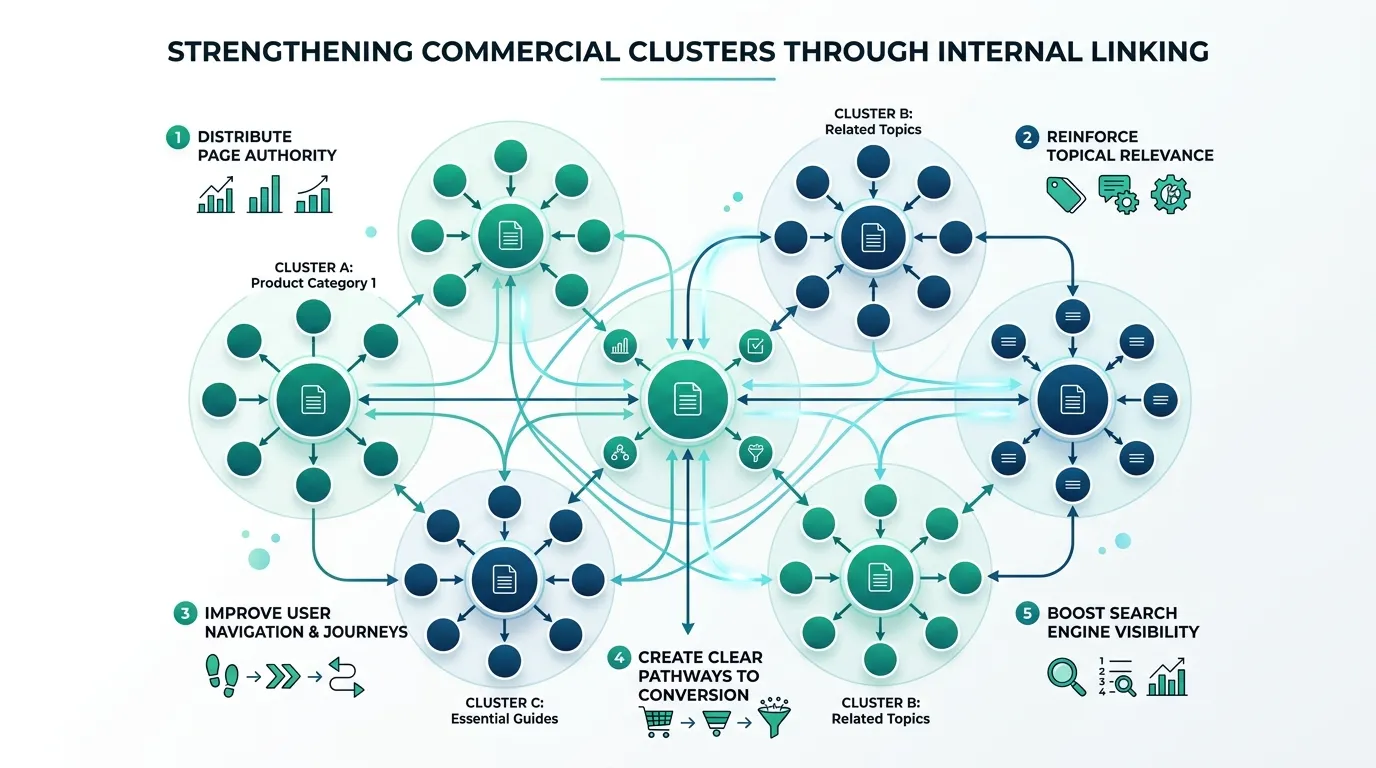
In a content-heavy site, links often grow organically. In an online store, they must be engineered.
- Category pages should link logically to subcategories.
- Subcategories should reinforce parent themes.
- Product pages should connect back to their commercial hubs.
Beyond navigation, contextual links inside guides, comparisons, and FAQs strengthen topical relationships. When multiple supporting pages link back to a collection page using relevant anchor text, search engines gain confidence about that page’s authority.
Internal linking is not decoration. It is the mechanism through which authority flows.
4. Supporting Revenue Pages With Structured, Intent-Aligned Content

Publishing more content does not automatically improve rankings. Publishing the right content in the right place does.
Collection pages require concise commercial introductions, structured buying considerations, and clearly organised FAQs. Product pages need detailed specifications, unique descriptions, and well-implemented schema. Supporting articles should answer evaluation-stage questions and link back to revenue categories.
Everything must align with intent.
If a query signals readiness to buy, it belongs on a product or collection page. If it signals comparison or research, it can support those pages. When intent mapping is clear, search engines are less confused and users convert more easily.
Why eCommerce SEO Is Structurally Different
Unlike editorial websites, online stores manage:
- Thousands of URLs rather than dozens
- Dynamic inventory that changes daily
- Filter-generated page variations
- Pagination chains
- SKU-level duplication risks
This complexity means that publishing another blog post rarely solves ranking problems. Often, the issue lies deeper in architecture.
A strong eCommerce SEO strategy prioritises:
- Logical taxonomy
- Clean URL structures
- Controlled indexation
- Efficient crawl pathways
- Scalable internal linking
It is less about volume and more about control.
The Real Objective
The goal is straightforward, even if the execution is not. Make it effortless for search engines to understand:
- Which collection pages represent primary commercial themes
- Which product pages satisfy specific transactional queries
- Which filtered or parameter-based URLs should remain invisible
When structure is clear, authority consolidates. When authority consolidates, rankings stabilise. When rankings stabilise, revenue pages become reliable growth assets.
In eCommerce, SEO is not an add-on marketing tactic. It is the framework that determines whether your catalogue can scale without collapsing under its own complexity.
How to Rank Collection Pages at Scale

Category and collection pages are the commercial core of eCommerce SEO. They capture broad, high-intent queries such as:
- Ergonomic office chairs
- Protein powder Singapore
- Wireless earbuds with mic
- Men’s running shoes
These pages often drive more revenue than individual product pages because they sit at the intersection of search demand and product variety.
Here are some things to consider when following a collection page SEO strategy:
Intent Mapping Before Structure
Before you create or restructure any category page, pause and validate the intent behind it. Structure should follow search demand, not internal inventory labels.
Start by defining the fundamentals:
- What is the primary commercial keyword?
Identify the core term the page is meant to rank for. This should be a phrase with clear buying intent, not a vague informational topic. - Does this keyword represent a distinct intent?
A new category should serve a meaningfully different search goal. If the intent overlaps heavily with an existing page, you risk splitting authority and confusing search engines. - Are there enough products to support it?
A category with only a handful of loosely related products rarely performs well. Search engines expect depth and relevance. Users expect choice. - Will it cannibalise an existing page?
If two pages compete for the same keyword cluster, rankings often fluctuate or stall. Each commercial theme should have one clear owner.
Do not create a category page unless it can stand on its own. A weak or redundant category does not add opportunity. It spreads authority thinner across the site.
Think in structured clusters.
| Main category |
|
| Subcategories |
|
Each subcategory must have a distinct keyword theme and search intent. “Ergonomic Office Chairs” targets buyers focused on posture and support. “Leather Office Chairs” attracts users prioritising material and aesthetics. “Gaming Chairs” speaks to a different use case and audience altogether.
When intent is clearly separated, structure becomes stronger. Rankings become more stable. And the site scales without internal competition undermining itself.
Taxonomy Rules for Scalable Stores
A scalable eCommerce taxonomy is built on clarity and restraint. The goal is not to create as many categories as possible. The goal is to create a structure that search engines can understand and users can navigate without friction.
A reliable hierarchy typically follows:
Homepage
→ Category
→ Subcategory
→ Product
This layered structure signals importance. Top-level categories represent broad commercial intent. Subcategories refine that intent. Product pages capture specific transactional demand. When each level has a clear purpose, authority flows logically from the homepage down to revenue pages.
Core Principles
- Keep Important Categories Shallow: Revenue-driving categories should be reachable within three logical clicks from the homepage. This improves crawl efficiency and reinforces importance. Pages buried five or six layers deep tend to receive weaker internal authority and less consistent crawling.
- Do Not Create Subcategories for Minor Variations: Not every attribute deserves its own indexable page. Variations such as colour, minor size differences, or niche price thresholds often lack meaningful search demand. Turning every attribute into a subcategory fragments authority and creates thin pages that struggle to rank.
- Avoid Over-Granular Structures; When categories become too narrow, authority gets split across similar URLs. Instead of building one strong “Ergonomic Office Chairs” page, you may end up with multiple weak pages competing for related terms. Consolidation often performs better than fragmentation.
Before Creating a New Indexable Subcategory
Validate three things:
- Search demand exists. Use keyword data to confirm consistent queries for that theme.
- A meaningful number of products support it. A category with only a few items rarely justifies its own URL.
- It reflects real user behaviour. Structure around how customers search and browse, not how suppliers label inventory internally.
If a refinement does not meet these criteria, it likely belongs as a filter within an existing category rather than a standalone, indexable page.
Strong taxonomy design is deliberate. Each new category should strengthen the site’s structure, not dilute it.
Collection Page Copy Framework
A collection page must satisfy two audiences simultaneously. Search engines need enough structured content to understand a page’s theme and authority. Buyers need to see products immediately to evaluate options.
The balance is deliberate. The structure should feel natural to users while remaining semantically clear for search engines and AI systems.
Below is a practical, scalable framework that you can use:
1. Above-the-Fold Intro
This short introduction sits above the product grid. Its purpose is not to tell a brand story. It exists to clarify intent.
It should:
- Define what the category includes.
- Reinforce the primary keyword in a natural way.
- Set expectations about price range, features, or selection depth.
For example, an “Ergonomic Office Chairs” collection intro might briefly explain who the chairs are designed for, what differentiates them from standard models, and what buyers should consider before choosing one.
Keep it concise (around 60 to 120 words). Avoid generic filler. Products must remain visible without forcing users to scroll past long paragraphs. The goal is orientation, not education.
2. Product Grid
The product grid is the commercial core of the page. It should appear immediately after the intro.
Key elements:
- Clear and intuitive sorting options.
- A logical default order, such as best sellers or most relevant.
- Filters that are visible and easy to use.
- Transparent pricing and visible ratings were available.
Do not allow SEO copy to push products below the fold. If visitors must scroll through text before seeing items, conversion friction increases. Ranking without usability rarely produces revenue.
3. Expandable SEO Section (Below the Grid)
Once products are visible and accessible, you can support the page with deeper content below the grid. This is where you build topical depth without compromising user experience.
Include structured sections such as:
- Buying considerations that explain key decision factors.
- Feature breakdowns that clarify technical differences.
- Use-case explanations for different customer needs.
- Comparison insights between subtypes within the category.
- Structured FAQs that address common objections and delivery concerns.
Organise this content using clear H2 and H3 headings. Write in complete, informative sentences. Avoid repeating the primary keyword mechanically. AI-driven search systems reward logical structure, semantic clarity, and direct answers more than density.
When implemented correctly, the collection page feels product-first to users while remaining content-rich for search engines. That balance is what allows it to rank without sacrificing conversion performance.
SEO vs UX Balance
A category page has one primary job. It must help shoppers quickly find and compare products. Strong rankings are valuable, but they lose meaning if users land on the page and feel slowed down, confused, or overwhelmed.
The balance between SEO and user experience is not about choosing one over the other. It is about structuring content so that search engines receive context while buyers see products without friction.
Here are the core principles:
- Keep commercial copy concise above the fold. A short, focused introduction can clarify what the category offers and reinforce keyword relevance. It should guide, not dominate. Products should remain visible immediately, especially on mobile devices.
- Use expandable or clearly separated sections for long-form content. Detailed buying guides, feature breakdowns, and FAQs are useful for both rankings and conversions. Place them below the product grid or inside expandable sections so they support the page without interrupting product discovery.
- Prioritise filtering and sorting usability. Filters must be easy to access and logically grouped. Sorting options should reflect real buying behaviour, such as price, popularity, or newest arrivals. If filtering feels complicated, users leave before SEO has a chance to matter.
- Avoid long, generic paragraphs that delay product visibility. Repetitive keyword-heavy blocks do not improve experience and rarely improve rankings. Structured headings, bullet points, and clear sections perform better for both humans and AI systems.
When reviewing a category page, ask a simple question: Would a buyer scroll past this content just to reach the products?
If the answer is yes, restructure the layout. A well-optimised category page feels efficient. It communicates context quickly, surfaces products immediately, and supports deeper exploration only when the user wants it.
Breadcrumbs and Hierarchical Signals
Breadcrumbs are more than a navigation aid. In eCommerce SEO, they act as a structural signal that reinforces how your site is organised.
A clear breadcrumb path might look like this:
Home > Office Chairs > Ergonomic Office Chairs > Product Name
That sequence communicates context immediately. It tells users where they are. It tells search engines how the page fits into the broader taxonomy.
When implemented correctly, breadcrumbs support rankings in several ways.
Strengthen Internal Linking Upward
Each breadcrumb level links back to its parent category. That creates consistent upward internal links from product pages to subcategories and from subcategories to primary categories. This reinforces authority flow. Product pages pass relevance signals back to their commercial hubs. Over time, this helps consolidate strength around collection pages that target competitive keywords.
Clarify Keyword Ownership
Breadcrumbs reinforce thematic relationships.
If a product consistently sits under “Ergonomic Office Chairs,” that association becomes clear. Search engines repeatedly see that this product belongs to that category cluster. This strengthens semantic alignment and reduces ambiguity about which page owns which keyword theme.
It also prevents structural confusion when products appear in multiple filtered views. The breadcrumb establishes the canonical hierarchy.
Support Clean Search Result Paths
When breadcrumb schema is implemented properly, search engines can display structured category paths in search results instead of long URLs.
This improves:
- Click-through rates
- Visual clarity in SERPs
- Trust perception
However, a schema does not repair poor architecture. If your taxonomy is fragmented or inconsistent, breadcrumb markup will simply reflect that confusion.
Breadcrumb schema should mirror your real hierarchy. It enhances clarity, but it cannot compensate for weak structural decisions.
Product Page SEO Optimisation That Converts

Category pages bring in qualified traffic. Product pages determine whether that traffic turns into revenue.
A well-optimised product page does two jobs at once. It must clearly signal relevance to search engines while also removing doubt for buyers. When either side is neglected, performance suffers. Rankings without trust do not convert. Persuasive copy without technical clarity struggles to rank.
Every product page should be treated as a high-intent landing page built for a specific transactional query. That means deliberate keyword targeting, structured information, and strong conversion signals woven together in a way that feels natural to the reader.
Title Tag and URL Structure

The title tag remains one of the strongest on-page ranking signals. It tells search engines what the page is about and shapes how your listing appears in search results.
A practical structure looks like this:
Primary keyword + defining feature + geographic modifier if relevant
Example: Ergonomic Mesh Office Chair with Lumbar Support Singapore
This format works because it:
- Places the main keyword at the front
- Adds differentiation through a key feature
- Signals local relevance when applicable
Each product must have a unique title tag. Avoid templated duplication where only a SKU changes. Search engines evaluate distinctiveness. If dozens of products share near-identical titles, ranking potential weakens.
Keep titles within roughly 55 to 60 characters to reduce truncation in search results. Clarity is more important than squeezing in every possible keyword variation.
URL Structure
URLs should reinforce the topic without creating unnecessary complexity.
Best practices:
- Use lowercase letters
- Separate words with hyphens
- Include the primary product keyword
- Avoid long parameter strings
- Keep the structure stable over time
Example: /ergonomic-mesh-office-chair-black/
Do not allow sorting parameters, tracking codes, or internal session IDs to create indexable variations. Clean URLs support crawl efficiency and make it easier for search engines to consolidate authority.
Unique Descriptions With Depth

Manufacturer descriptions are rarely enough. They are often duplicated across retailers and written in generic, feature-heavy language that lacks context.
A strong product description should do more than list attributes. It should instil confidence in the buyer.
Effective product descriptions typically:
- Explain who the product is designed for
- Clarify practical use cases
- Address common objections or concerns
- Expand on specifications in real-world terms
- Reinforce the primary keyword naturally
Instead of listing “lumbar support, mesh back, adjustable height,” provide context:
- Explain how lumbar support reduces lower back strain during extended desk work.
- Describe how a breathable mesh back improves airflow in warm climates.
- Clarify the height-adjustment range and who it suits.
This approach improves semantic depth. Search engines recognise related concepts and supporting terminology. At the same time, buyers receive meaningful information that reduces uncertainty.
Avoid forced keyword repetition. Write in clear, complete sentences. Structure the content with subheadings when needed so that both users and AI systems can easily interpret the page.
Structured Specifications
Specifications should be easy to scan. Dense paragraphs that hide key details create friction. Use clearly labelled bullet points for:
- Dimensions
- Materials
- Weight capacity
- Colour options
- Compatibility
- Warranty coverage
- Assembly requirements
For example:
Specifications
- Seat height range: 45 to 55 cm
- Maximum weight capacity: 120 kg
- Frame material: Reinforced steel
- Upholstery: Breathable mesh
- Warranty: 3 years structural coverage
This format serves two purposes. It improves readability for buyers who want quick answers, and it makes it easier for search engines and AI systems to extract structured information.
Clarity in specifications also reduces pre-purchase hesitation, thereby improving conversion rates.
Product Schema and Review Markup


Structured data allows search engines to interpret product information accurately. Without a schema, important details may not be processed correctly or displayed in rich results.
At a minimum, implement structured data for:
- Product name
- Price
- Currency
- Availability
- SKU
- Brand
- Aggregate rating
- Review count
An accurate schema increases the likelihood of rich snippets, such as star ratings and pricing, appearing directly in search results. These enhancements can improve click-through rates even when the ranking position remains the same.

Accuracy is critical. If the schema indicates that a product is “InStock” but the page shows it as unavailable, trust signals weaken. Regular audits should ensure pricing and availability data remain synchronised with actual inventory.
Review markup deserves particular attention. Genuine customer reviews naturally add long-tail keyword variation. They also act as persuasive social proof. Structured review data helps search engines understand rating volume and sentiment at scale.
Media Optimisation

In eCommerce, visuals carry significant weight. Buyers rely on images to evaluate quality, scale, and design. However, media files are also one of the most common causes of slow loading times.
Optimisation should balance visual clarity with performance. Images should be:
- Resized to the maximum display dimensions before upload
- Compressed to reduce file size without visible quality loss
- Saved in modern formats such as WebP, where supported
- Named descriptively, for example: ergonomic-mesh-office-chair-black.jpg
- Paired with meaningful alt text that describes the product accurately
Alt text should explain what the image shows rather than mechanically repeating keywords. For example: “Black ergonomic mesh office chair with adjustable lumbar support”
This improves accessibility and supports image search relevance.
Use lazy loading for images and videos that appear below the fold. Avoid excessive third-party scripts that delay rendering, especially on mobile devices. Product pages often include chat widgets, analytics tags, and recommendation engines. Each additional script affects load speed.
Performance is not separate from SEO. Slow pages increase bounce rates and reduce the likelihood of conversion. Fast pages create a smoother buying experience and strengthen ranking signals over time.
Final Principle
Product page SEO is not about stuffing keywords into templates. It is about aligning search intent, structured clarity, and buyer confidence within a single URL.
When title tags are precise, descriptions are contextual, specifications are structured, schema is accurate, and media is optimised for speed, product pages become both machine-readable and human-convincing.
That is where rankings stabilise, and conversions improve.
Technical SEO for Large Catalogues

On a small website, technical mistakes are often contained. A misconfigured canonical affects a handful of pages. A slow template impacts a limited section.
In a large eCommerce catalogue, the same mistake can replicate across hundreds or thousands of URLs. A single faulty rule in your CMS can generate thousands of thin, duplicate, or poorly indexed pages overnight. That is why technical SEO for large stores is not a checklist exercise. It is a control system.
When your catalogue scales, control becomes the differentiator between steady organic growth and silent ranking decay.
Crawlability and Index Management

Search engines operate with finite crawl resources. They do not crawl every URL equally, and they do not reward sites that waste those resources.
For a large eCommerce store, crawl efficiency should be intentional. Search engines must be able to:
- Discover your most important category and subcategory pages quickly
- Crawl product pages consistently, especially new or updated SKUs
- Avoid spending time on low-value parameter URLs and duplicated variations
If discovery is slow or fragmented, indexing lags behind inventory changes. If crawling is wasted on thin pages, your revenue-driving URLs may receive less attention.
Maintain Clean XML Sitemaps
Your XML sitemap should:
- Include only canonical, indexable URLs
- Exclude filtered, parameter-heavy, and noindex pages
- Update automatically when products are added or removed
Large stores often generate bloated sitemaps that include every URL variation. That approach dilutes signals. A sitemap is not a dump of all URLs. It is a curated list of preferred pages.
Build Logical Internal Linking
Search engines primarily discover content through links. If key category pages are buried deep in menus or only accessible via filters, they may not receive consistent crawl attention.
Ensure:
- Core revenue categories are linked from the homepage or primary navigation
- Subcategories are linked clearly from parent categories
- Products are accessible through structured paths, not just on-site search
Internal linking reinforces both crawl priority and authority distribution.
Configure robots.txt Carefully
A well-structured robots.txt file can:
- Prevent crawling of unnecessary parameter combinations
- Block duplicate internal search result pages
- Reduce crawl waste
However, blocking URLs in robots.txt does not automatically remove them from the index. Use it strategically in combination with proper canonical and noindex directives.
Audit Crawl Reports Regularly
Do not assume that if a page is indexed, it is optimised.
Review:

- Crawl stats in Google Search Console
- Index coverage reports
- Parameter behaviour
- Sudden spikes in discovered URLs
Look for patterns. If thousands of low-value URLs are being crawled, investigate the source. In large catalogues, small technical misalignments compound rapidly.
Canonical Strategy

Filters, sorting options, tracking parameters, and product variations can result in multiple URLs that display nearly identical content.
Without a clear canonical strategy, authority fragments across these duplicates. Rankings weaken. Crawl budget spreads thin. A disciplined canonical framework starts with clarity.
Define One Preferred URL Per Category
Every category and subcategory must have a single, definitive URL. For example:
Preferred: /office-chairs/ergonomic/
Filtered variation: /office-chairs/ergonomic?colour=black
If the filtered version does not represent standalone search demand, it should reference the preferred category URL via a canonical link.
Define One Preferred URL Per Product
Product variants often create duplication risks. If size or colour variations exist as separate URLs, decide whether:
- They justify individual indexing due to search demand, or
- They should consolidate under a single primary product URL
Indecision leads to inconsistent signals. Choose a model and apply it consistently.
Use Self-Referencing Canonicals
Every primary page should include a self-referencing canonical tag. This confirms the page as the authoritative version, even if parameters are appended by users or tracking systems.
Self-referencing canonicals reduce ambiguity and reinforce index stability.
Avoid Structural Inconsistencies
Minor technical inconsistencies scale poorly. Watch for:
- Mixed HTTP and HTTPS references
- Trailing slash inconsistencies
- Uppercase versus lowercase URL variations
- Parameter order inconsistencies
One overlooked inconsistency may replicate across thousands of URLs. At scale, these small misalignments distort authority signals.
Pagination

Large category pages require pagination. Few stores can display hundreds of products on a single page without harming usability. Pagination must balance user experience and crawlability.
Paginated pages should:
- Be fully crawlable and indexable where appropriate
- Link clearly to subsequent pages
- Maintain a consistent internal linking structure
Search engines need to understand that page two, page three, and beyond are part of a structured sequence.
Avoid Infinite Scroll Without Fallback
Infinite scroll may improve user experience, but if it is not supported by crawlable paginated URLs in the background, deeper products may become invisible to search engines.
If you use infinite scroll:
- Ensure paginated URLs exist
- Confirm they are discoverable through internal links
- Validate that search engines can access product listings beyond the first view
Protect Product Discoverability
Products buried on page five should still be reachable through:
- Subcategories
- Related product modules
- Cross-linking within the hierarchy
If pagination becomes the only access path, deeper products may struggle to gain visibility. Structured linking reduces that risk.

Pagination and faceted navigation SEO improve user experience by allowing shoppers to refine results by:
- Colour
- Size
- Price
- Brand
- Material
From an SEO perspective, however, each filter combination can generate a new URL. On large catalogues, which may create thousands of variations. Not every filter combination deserves to rank.
Index a Filtered Page Only If:
- There is proven search demand for that variation
- The refinement reflects distinct and meaningful intent
- The page contains sufficient products to justify standalone indexing
- You can support it with unique, optimised content
For example, “black ergonomic office chairs” may warrant a dedicated page if demand is strong. A highly specific price-and-colour combination likely does not.
For Low-Value Filter Variations:
- Apply noindex where appropriate
- Canonicalise to the main category or approved subcategory
- Avoid heavily linking to parameter-heavy URLs
Faceted control protects crawl budget. More importantly, it consolidates authority toward your strongest category pages instead of dispersing it across thin variations.
Core Web Vitals and Mobile-First Performance

Technical SEO does not stop at indexing. Performance metrics increasingly influence ranking stability and user engagement.
Monitor consistently:
- Largest Contentful Paint, which measures how quickly the main content loads
- Cumulative Layout Shift, which tracks visual stability
- Interaction with Next Paint, which evaluates responsiveness
Performance is not abstract. A slow category page reduces time on site. A shifting layout during checkout erodes trust.
Optimise for Speed and Stability
Focus on:
- Fast server response times
- Efficient image compression and delivery
- Deferred or lazy loading of non-critical scripts
- Removing unnecessary third-party tracking bloat
Prioritise Mobile Experience
In most markets, mobile traffic dominates eCommerce. Search engines also use mobile-first indexing. Ensure:
- Navigation is intuitive and tappable
- Filters are usable without frustration
- Product images load efficiently
- Checkout flows are streamlined
Mobile performance is not a secondary consideration. It directly affects both ranking signals and completed transactions.
Internal Linking System for Scale

Internal links determine how authority flows through your store. They clarify hierarchy, reinforce topical relationships, and influence which pages gain ranking strength. In a large catalogue, linking must be deliberate.
If you leave internal linking to the default CMS behaviour, authority distribution becomes accidental. Some high-value categories receive minimal support. Low-priority pages may accumulate unnecessary prominence.
An effective internal linking system ensures that:
- Core revenue categories receive strong, consistent support
- Products are not isolated
- Supporting content strengthens commercial clusters
- Crawl paths remain shallow and logical
Internal linking at scale is not about adding more links. It is about directing authority intentionally. In large eCommerce environments, technical precision and structured linking determine whether growth compounds or stalls.
Mini Case: Singapore Furniture Brand
A local furniture retailer prioritised blog traffic but underlinked to its core dining table collections. After restructuring internal links and adding contextual anchors from comparison guides, category-level impressions increased by 38 percent within one quarter. Revenue growth followed category visibility, not blog traffic.
Internal linking determines which pages accumulate authority.
When crawl control, canonical discipline, pagination clarity, and authority flow align, category and product pages gain the structural support required to rank consistently.
Hierarchical Linking
Hierarchy is the backbone of internal linking. It communicates structure to search engines and reduces friction for users.
A scalable structure typically follows:
- Homepage links to top revenue categories
- Categories link to relevant subcategories
- Subcategories link to individual products
- Products link back to their parent collections
This pattern does more than organise navigation. It reinforces keyword ownership at every level.
For example:
- The homepage passes authority to “Office Chairs.”
- “Office Chairs” passes authority to “Ergonomic Office Chairs.”
- “Ergonomic Office Chairs” passes authority to individual products.
- Each product reinforces its parent category by linking back upward.
This bidirectional reinforcement clarifies topical relationships. Search engines interpret repeated structural signals as confirmation of hierarchy. Over time, this consistency stabilises rankings.
Key implementation principles:
- Ensure primary categories are visible in the main navigation and footer menus.
- Avoid burying commercially critical categories under unnecessary submenus.
- Maintain consistent anchor text patterns that reflect actual category themes.
Hierarchy should be clean, predictable, and aligned with keyword mapping. If a product appears in multiple collections, assign a primary category and ensure canonical clarity supports that decision.
Contextual Links From Content
Navigation links establish structure. Contextual links establish meaning. Contextual links appear within buying guides, comparison articles, FAQs, and editorial content. These links carry stronger semantic weight because they are embedded in descriptive text.
For example, a guide titled “How to Choose the Right Ergonomic Chair” should link naturally to:
- The main ergonomic chair collection
- Relevant subcategories, such as mesh or lumbar-support models
- Selected products that match specific use cases
Avoid generic anchors such as “click here” or “view products.” Instead, use descriptive anchors that reflect intent:
- Adjustable ergonomic office chairs
- Mesh chairs designed for humid climates
- Budget-friendly standing desks
When multiple supporting pages link back to a collection page using semantically aligned anchors, search engines recognise that collection as the thematic centre of that topic. This strengthens category visibility for commercial investigation queries and broader transactional terms.
To scale contextual linking effectively:
- Map each blog or guide to a primary commercial category before publishing.
- Include at least one prominent link to the core collection.
- Add secondary links only where the context naturally supports them.
Contextual linking should feel helpful to users. When done correctly, it supports both navigation and SEO.
Orphan Page Prevention
An orphan page is a URL with no internal links pointing to it. In large eCommerce catalogues, orphan pages often appear when:
- New products are uploaded without being assigned to collections
- Seasonal pages expire but remain live
- CMS migrations disrupt category assignments
Orphan pages create three major issues:
- Search engines struggle to discover them consistently
- They receive little to no internal authority
- They rarely rank for meaningful queries
Every product and category page should be reachable through structured navigation. A practical benchmark is ensuring that important revenue pages are accessible within three logical clicks from the homepage.
Audit your store regularly for:
- Pages with zero internal links
- Pages buried deeper than four clicks
- Broken links that disrupt crawl pathways
Fixing orphan pages is not cosmetic maintenance. It directly impacts indexing frequency and ranking potential.
Where necessary, reintegrate isolated products by:
- Assigning them to appropriate categories
- Linking to them from related products
- Including them in comparison modules or featured blocks
Crawl accessibility is foundational. If search engines cannot easily reach a page, they are unlikely to prioritise it.
Revenue-Based Authority Prioritisation
Not all categories deserve equal authority. Some collections generate higher margins. Others convert better. Certain seasonal categories may drive disproportionate revenue during peak periods. Internal linking should reflect these realities.
Increase internal prominence for:
- High-margin collections
- Strategic seasonal categories
- Best sellers and flagship products
- New launches with growth potential
You can reinforce priority pages by featuring them in:
- Homepage modules
- Category-level cross-links
- High-traffic buying guides
- “Featured Products” or “Top Picks” sections
- Footer reinforcement blocks
Authority flows through links. Each internal link acts as a signal of importance. By deliberately increasing link frequency and prominence to strategic pages, you guide both search engines and users toward revenue drivers.
This does not mean manipulating anchors or flooding pages with repetitive links. It means aligning structural prominence with commercial objectives.
Bringing It All Together
An internal linking system for scale requires coordination across structure, content, and technical configuration. Hierarchical clarity ensures predictable authority flow. Contextual reinforcement strengthens thematic clusters. Orphan prevention protects crawl accessibility. Revenue prioritisation aligns SEO with business goals.
When these elements operate together, category pages accumulate strength steadily rather than sporadically. Product pages benefit from both upward and lateral reinforcement. New inventory integrates smoothly into existing clusters.
In large eCommerce environments, growth does not come from isolated optimisations. It comes from a disciplined structure repeated consistently across hundreds or thousands of URLs. Internal linking is that discipline.
Content Clusters That Strengthen Category Pages

Publishing blog posts without a structural purpose is one of the most common mistakes in eCommerce SEO. Informational traffic may increase, but if that traffic does not reinforce your commercial pages, rankings for revenue-driving categories remain fragile.
Content clusters solve this problem. A content cluster is a deliberate structure in which a core category page acts as the central authority, and supporting articles expand on related subtopics, questions, comparisons, and use cases. Every supporting page feeds relevance and internal link equity back into the category.
Instead of writing broad, disconnected articles, you build depth around a commercial theme.
Why Clusters Matter for Rankings
Search engines no longer evaluate pages in isolation. They assess topical coverage across a domain. When multiple well-structured pages explore different dimensions of the same subject, it signals authority.
For example, if your main collection page targets:
Ergonomic Chairs
Supporting pages might include:
- How to Choose an Ergonomic Chair
- Ergonomic Chair vs Gaming Chair
- Best Chairs for Back Pain
- Office Ergonomics Setup Guide
Each of these pages captures a different intent stage:
- Early research
- Comparison
- Problem-specific queries
- Broader ergonomic education
Together, they strengthen the main category page in three ways:
- They expand semantic relevance around the topic.
- They attract backlinks and informational traffic.
- They funnel internal authority toward the revenue page.
When implemented properly, the category page becomes the commercial anchor, not just another listing.
How to Structure a Category-Centric Cluster
Start with a revenue-driving category. Avoid building clusters around low-margin or low-demand products. Then:
- Identify real buyer questions using search data, customer service queries, and on-site search logs.
- Separate those questions into informational, comparative, and problem-solving themes.
- Create standalone articles that fully answer each theme.
- Link naturally and clearly back to the main collection page using descriptive anchor text.
Every supporting article should:
- Contain a contextual link to the main category page.
- Reinforce the category keyword cluster without repetition.
- Address a specific concern or decision stage.
- Use structured headings that are easy for AI systems to parse.
Avoid vague transitions such as “check out our products.” Instead, embed the link where it makes logical sense. For instance:
“If you are evaluating options, explore our full range of ergonomic chairs designed for extended desk use.”
The goal is to make the commercial page feel like the logical next step in the reader’s journey.
Comparison Pages

Comparison queries often signal mid-funnel intent. The user is no longer asking what the product is. They are deciding between options.
These searches typically include:
- Mesh vs Leather Office Chairs
- Standing Desk vs Traditional Desk
- Budget vs Premium Ergonomic Chair
Visitors at this stage are evaluating trade-offs. They are close to purchasing but want clarity.
Why Comparison Pages Perform Well
Comparison content captures:
- Commercial investigation queries
- Feature-based searches
- Use-case decision queries
These pages often convert better than purely informational posts because they speak directly to the decision process.
They also align well with AI search behaviour. Users frequently ask large language models comparative questions. Pages that provide structured, neutral comparisons are easier to extract and summarise.
How to Structure an Effective Comparison Page
A strong comparison page should include:
1. Clear Introduction
Briefly explain what is being compared and for whom the comparison is. Avoid generic marketing language. Focus on decision clarity.
2. Structured Comparison Table
Present objective differences in a clean format:
- Materials
- Comfort level
- Price range
- Durability
- Maintenance requirements
- Ideal use case
Tables improve readability for humans and scannability for AI systems.
3. Contextual Explanation
After the table, expand on key differences. Explain not just what is different, but why it matters. For example, instead of stating “Mesh is breathable,” explain how breathability affects comfort during long working hours in a humid environment.
4. Use-Case Recommendations
Help the reader choose:
- Best for small home offices
- Best for long-duration desk work
- Best for aesthetic-focused setups
- Best for budget-conscious buyers
Decision support builds trust. It also moves the reader naturally toward the relevant collection page.
5. Strategic Internal Links
Each comparison page should link to:
- The main collection page
- Relevant subcategories
- Top-performing products
Keep the links contextual. Do not cluster them awkwardly at the end.
When structured properly, comparison pages do more than answer questions. They strengthen the thematic authority of the category they support.
Structured FAQs

Frequently Asked Questions are often treated as filler content. In reality, they are one of the most efficient ways to strengthen category and product pages.
Well-written FAQs:
- Address buyer hesitation
- Improve clarity
- Support long-tail keyword coverage
- Increase eligibility for featured snippets
- Improve extractability for AI-generated summaries
The key is precision.
How to Write Effective SEO FAQs
Each FAQ should:
- Ask a real, specific question.
- Provide a complete, direct answer in the first paragraph.
- Avoid vague or promotional language.
- Reflect genuine buyer concerns.
For example:
How long does an ergonomic chair typically last? A high-quality ergonomic chair can last between five and ten years, depending on build quality and usage intensity. Chairs with reinforced frames and adjustable components tend to maintain support longer than fixed models.
Notice that the answer is:
- Direct
- Informative
- Structured
- Free from fluff
This format improves readability and makes extraction easier for search engines and AI systems.
Where to Place FAQs
FAQs can appear:
- On category pages
- On product pages
- Within comparison guides
- Inside buying guides
On category pages, FAQs should address broad concerns. On product pages, they should address model-specific issues.
Avoid duplicating identical FAQ blocks across multiple pages. Duplicate content reduces differentiation and weakens page-level relevance.
Why Structured FAQs Improve Visibility
Search engines look for:
- Clear question formatting
- Concise answers
- Semantic clarity
- Logical heading hierarchy
Structured FAQs contribute to:
- Featured snippet eligibility
- Voice search visibility
- AI search summarisation
- Improved dwell time
More importantly, they reduce friction. A buyer who finds a clear answer is more likely to proceed.
Treat FAQs as strategic conversion assets, not padding to increase word count.
Bringing It Together
A category page rarely ranks on its own. It ranks because:
- The taxonomy is clean.
- The internal linking system is deliberate.
- The supporting content expands topical coverage.
- Comparison pages guide evaluation.
- FAQs resolve hesitation.
When clusters are built intentionally around revenue categories, authority compounds. The collection page stops being just a product grid. It becomes the central node in a structured ecosystem.
That structural reinforcement is what separates stores that rank temporarily from stores that sustain visibility in competitive search environments.
Core Schema Types Every eCommerce Store Should Implement
Search engines do not rely on visible text alone to understand your store. They depend on structured data to interpret products, prices, availability, reviews, and category relationships accurately. Without schema markup, key commercial details may be crawled but not fully processed or displayed in rich search features.
For eCommerce sites, implementing the right schema types is not optional. It directly affects eligibility for product-rich results, review stars, merchant listings, and enhanced visibility in AI-driven summaries. Below are the core structured data types every online store should deploy to ensure search engines can clearly interpret and present revenue-driving pages.
1. Product Schema

Use on: Individual product pages only
Do not use on: Category or collection pages
Product schema tells search engines that a page represents a specific purchasable item. It should describe one primary product. If your page shows variants such as colour or size, the schema must reflect how those variants are structured.
Required and Recommended Properties
- Name
- Image
- Description
- SKU
- Brand
- Offers
- AggregateRating (only if genuine reviews exist)
- Review (optional but valuable)
Product schema becomes far more powerful when paired correctly with Offer and AggregateRating data.
2. Offer Schema

Offer is not optional in eCommerce. It defines the product’s commercial conditions.
Each Product schema should include:
- price
- priceCurrency
- availability
- url
- itemCondition
If your store operates in Singapore, for example, ensure that the currency reflects SGD and that pricing updates dynamically.
Accuracy Rule
Price and availability in the schema must match what is visible on the page. If the page shows “Out of Stock” but the schema says InStock, that inconsistency erodes trust signals.
3. AggregateRating and Review Schema

Use only if your product has real, visible reviews. AggregateRating should include:
- ratingValue
- reviewCount
If you include individual reviews:
- Ensure they are present on the page
- Avoid marking up hidden or collapsed content that users cannot access
Structured review data improves eligibility for rich snippets and can improve click-through rates, even if rankings remain constant.
4. BreadcrumbList Schema

Breadcrumbs are not just navigational aids. Structured breadcrumb data reinforces hierarchy.
Use BreadcrumbList on:
- Category pages
- Subcategory pages
- Product pages
Each breadcrumb item should include:
- @type: ListItem
- position
- name
- item (URL)
Breadcrumb schema should mirror your actual page hierarchy. If your taxonomy is inconsistent, structured data will reflect that confusion.
5. Organisation or LocalBusiness Schema

Every eCommerce site should implement one of these at the domain level. Use:
- Organisation for national or international eCommerce brands
- LocalBusiness: if your business operates in a defined geographic region and serves local customers
Include:
- Name
- Logo
- URL
- Contact information
- SameAs (social profiles)
For local operations, include:
- Address
- Area served
- Opening hours
This supports entity clarity and strengthens brand signals across search.
6. FAQPage Schema

Use carefully. The FAQPage schema should only be implemented when:
- The page contains genuine question-and-answer content
- Each question is visible on the page
- Each answer directly follows its question
Do not apply the FAQPage schema to:
- Marketing copy formatted as statements
- Collapsed content that is not user-accessible
- Repetitive boilerplate FAQs are duplicated across dozens of pages
When used correctly, FAQPage can improve snippet eligibility and clarity of AI extraction.
Schema Do and Don’t Guide
Do
- Keep the schema synchronised with the live page content.
- Use the Product schema only for individual product pages.
- Implement self-consistent pricing and availability.
- Validate structured data in Google’s Rich Results Test.
- Use BreadcrumbList consistently across hierarchy levels.
- Apply the FAQ page only to genuine Q&A sections.
Don’t
- Mark up hidden content.
- Use AggregateRating without visible reviews.
- Apply Product schema to category pages.
- Inflate review counts.
- Duplicate identical FAQ schema across hundreds of pages.
- Leave outdated price data in structured markup.
Implementation Best Practices
- Automate Where Possible: Schema should be generated dynamically from your CMS. Hard-coded JSON-LD blocks create maintenance risks when inventory changes.
- Audit Regularly: Check the following:
- Price mismatches
- Broken image URLs
- Incorrect availability status
- Duplicate structured data types on a single page
- Large catalogues amplify small technical errors.
- Avoid Over-Markup: More schema does not mean better rankings. Focus on clarity and accuracy rather than quantity.
Schema does not replace strong taxonomy, internal linking, or content quality. It reinforces them. Think of structured data as a precision tool. When aligned with clean architecture and disciplined index control, it strengthens extractability for search engines and AI systems.
When misused, it introduces ambiguity. Treat schema as part of your structural SEO framework, not as an afterthought added during development.
Singapore-Specific eCommerce SEO Signals That Drive Rankings and Trust

If you operate in Singapore, local optimisation is not optional. It directly affects rankings, conversion rates, and buyer confidence. Search engines evaluate location relevance. Buyers evaluate legitimacy. Your eCommerce architecture must address both.
This section outlines how to build a Singapore-local layer that strengthens commercial visibility rather than adding surface-level localisation.
1. Shipping and Delivery Pages That Capture Local Intent
In Singapore, delivery speed and clarity significantly influence purchasing decisions. Many users search with urgency or location qualifiers such as:
- “same day delivery Singapore”
- “next day delivery SG”
- “free shipping Singapore”
- “fast delivery office chairs Singapore”
If your shipping information is buried in footer text or condensed into a single sentence, you miss both ranking and conversion opportunities.
Create a Dedicated, Indexable Shipping Page
Instead of treating shipping as a policy afterthought, structure it as a strategic asset. Your shipping page should:
- Clearly state delivery timeframes within Singapore
- Specify cut-off times for same-day or next-day delivery
- Break down delivery costs by order value or region
- Clarify handling times for pre-order or custom products
- Address peak-period delays transparently
For example, rather than saying “Delivery available islandwide,” specify:
- Standard delivery: 2 to 4 working days
- Express delivery: 1 to 2 working days
- Same-day delivery: Orders before 12 PM, subject to stock availability
This improves clarity for users and allows search engines to associate your site with time-sensitive local queries.
Optimise for Local Delivery Modifiers
Naturally incorporate Singapore-relevant terms where appropriate:
- “Islandwide delivery across Singapore”
- “West, Central, East delivery zones”
- “CBD office delivery options”
Avoid keyword stuffing. Instead, answer practical questions buyers already have. When clarity improves, trust improves. Rankings follow consistent engagement.
2. GST and Pricing Transparency as Trust Signals
Singapore buyers are highly price-sensitive, especially in competitive ecommerce categories. Confusion around GST often increases cart abandonment.
Search queries such as:
- “price inclusive of GST Singapore”
- “GST for online purchases SG”
- “import GST Singapore”
Signal evaluation-stage intent.
Clarify GST Treatment Explicitly
Your product pages and policy pages should:
- State clearly whether prices are GST-inclusive
- Explain how GST applies at checkout
- Clarify additional import duties if cross-border
A concise FAQ example:
Are your prices inclusive of GST? All displayed prices are inclusive of 9 percent GST unless otherwise stated. The final checkout total reflects no additional hidden tax charges for Singapore deliveries. This reduces friction and supports long-tail query coverage.
For Cross-Border Sellers
If inventory ships from overseas:
- Explain estimated customs processing times
- Clarify potential import GST thresholds
- Provide contact support for tax-related queries
Transparency reduces uncertainty. Reduced uncertainty improves conversions. Search engines also reward clear, structured explanations that match user queries.
3. Store Locations and “Near Me” Intent for Hybrid Retailers
If you operate both online and offline, your eCommerce SEO must intersect with local SEO.
Singapore users frequently search:
- “buy ergonomic chair near me”
- “office chair showroom Singapore”
- “where to try office chairs SG”
Ignoring this intent leaves revenue on the table.
Create Optimised Store Location Pages
Each physical location should have its own dedicated page that includes:
- Full Singapore address
- Embedded map
- Opening hours
- Contact number with local country code (+65)
- Public transport directions were relevant
- Structured LocalBusiness schema
Avoid combining all locations into a single thin page. Individual pages allow you to rank for area-specific queries such as:
- “office chair showroom Ubi”
- “furniture store Jurong East”
Integrate eCommerce and Local Signals
On collection pages, you can include contextual messaging such as:
- “View in our Singapore showroom”
- “Available for in-store pickup”
This bridges online discovery with offline conversion and strengthens local relevance signals.
4. PDPA Compliance and Privacy Visibility as Credibility Architecture
In Singapore, the Personal Data Protection Act (PDPA) governs how businesses collect and manage personal data. Compliance is not only legal protection. It is also a trust differentiator.
Search engines evaluate trust indicators indirectly through user behaviour and site transparency.
Make Privacy and Data Handling Visible
Your site should include:
- A clearly accessible Privacy Policy page referencing PDPA compliance
- Transparent cookie usage explanations
- Explicit consent mechanisms for email marketing
- Contact information for data-related queries
Avoid burying privacy pages in unreadable legal jargon. Write them in plain English while retaining compliance accuracy.
For example:
“We collect personal information such as your name, delivery address, and contact number solely for order fulfilment and customer support. We do not sell or share your data with third parties for marketing purposes.”
Clarity reduces suspicion. Reduced suspicion improves engagement metrics.
5. Contactability and Singapore Business Signals
Local buyers want reassurance that a business is reachable. Anonymous eCommerce stores struggle to build trust in competitive markets.
Display Clear Business Information
Prominently include:
- Registered Singapore business address
- Local phone number with +65 prefix
- Business registration number, where appropriate
- Responsive contact forms
- Clear operating hours
Avoid hiding contact information behind multiple clicks. Trust signals should be visible in:
- Header or footer
- Contact page
- Checkout reassurance sections
When buyers know where you are located and how to reach you, hesitation decreases.
Reinforce Local Presence Across the Site
Strategically mention:
- “Singapore-based support team”
- “Local warehouse in Singapore”
- “Serving customers across Singapore since [year]”
Do not fabricate local signals. Authenticity matters. Search engines increasingly evaluate consistency between on-page claims, structured data, and external listings.
6. Local Reviews and Reputation Signals
Encourage and showcase reviews from Singapore customers. These reviews often contain natural local modifiers such as:
- “Fast delivery in Tampines”
- “Arrived within two days in Woodlands”
This user-generated language strengthens local semantic relevance organically.
Implement:
- Structured review schema
- Location-referenced testimonials
- Verified purchase indicators
Local social proof reduces purchase anxiety and supports richer search result displays.
Bringing It All Together
A Singapore-local ecommerce layer is not decorative. It is structural. When properly implemented, it:
- Captures location-modified commercial queries
- Reduces checkout friction through tax and delivery clarity
- Strengthens hybrid online-offline visibility
- Reinforces regulatory compliance credibility
- Signals real-world presence and accountability
The result is not just better rankings for “ecommerce SEO Singapore.” It is higher confidence in conversion among local buyers.
In competitive Singapore markets, technical optimisation alone is insufficient. Structural clarity must be paired with local trust architecture. When both align, eCommerce growth becomes more predictable and sustainable.
Common eCommerce SEO Mistakes That Quietly Kill Rankings

Most eCommerce SEO problems are not dramatic. They do not look like penalties. They look like a slow decline. Rankings fluctuate. New products fail to index. Category pages refuse to break into the top results. Traffic plateaus even though content volume increases.
In almost every case, the issue is structural. Below are the most common eCommerce-specific SEO mistakes, why they happen, and how to correct them before they erode authority at scale:
1. Indexing Every Filter Combination
Faceted navigation improves user experience. It allows shoppers to refine products by colour, size, brand, material, and price. From an SEO perspective, however, every filter combination can generate a unique URL.
A single category with five filter types can produce hundreds or even thousands of crawlable variations. Most of those URLs:
- Contain nearly identical product sets
- Have no standalone search demand
- Compete with the main category page
- Consume crawl budget
When all of them are indexable, search engines distribute ranking signals across duplicates. Authority fragments. Core collection pages struggle to consolidate strength.
What to do instead
- Index only filtered pages with proven search demand.
- Apply canonical tags from low-value filter combinations to the primary category.
- Use noindex where filters exist purely for usability.
- Monitor Search Console for sudden spikes in indexed URLs for parameters.
More indexed pages do not create more visibility. Clear index discipline does.
2. Publishing Thin Category Pages
A category page with three products and two generic sentences rarely ranks for competitive commercial terms. Search engines expect depth. Users expect meaningful selection.
Thin category pages often emerge because internal inventory labels are mistaken for search demand. A merchandising team creates a subcategory for operational reasons. SEO assumes it deserves its own indexable URL.
When that page has:
- Limited product volume
- Minimal unique content
- Overlapping intent with another category
It becomes a weak node in the architecture. Authority spreads thin across similar pages. None of them became strong enough to rank consistently.
What to do instead
- Validate search demand before creating indexable subcategories.
- Consolidate overlapping categories where intent is similar.
- Add structured buying guidance below the grid.
- Ensure sufficient product depth supports the theme.
Consolidation often outperforms fragmentation.
3. Allowing Duplicate Product Variants to Compete
Many platforms generate separate URLs for product variations, such as colour or size. If each variant is indexable, you may unintentionally create internal competition.
For example:
- /ergonomic-chair-black/
- /ergonomic-chair-grey/
- /ergonomic-chair-blue/
If all target the same core keyword, ranking signals are split. Reviews and backlinks are distributed across multiple URLs. Search engines may rotate them unpredictably.
What to do instead
- Decide whether variants justify independent indexing based on search demand.
- Consolidate variations under a single primary product page where appropriate.
- Use canonical tags consistently to reinforce the preferred version.
- Ensure internal links point to the canonical URL rather than random variants.
Indecision causes fragmentation. A clear canonical strategy restores stability.
4. Misconfigured Canonical Tags
Canonical errors rarely produce warnings. They simply dilute authority silently.
Common issues include:
- Cross-category canonicals that point to the wrong parent page
- Missing self-referencing canonicals
- Canonicals that reference non-indexable URLs
- Inconsistent trailing slash or parameter handling
When canonicals conflict, search engines may choose a different version than the one you intended to rank.
What to do instead
- Ensure every primary category and product page has a self-referencing canonical.
- Confirm that the filtered URLs point to the correct preferred page.
- Audit canonical consistency after platform updates or migrations.
- Avoid dynamic canonical rules that shift based on user-selected filters.
Canonical discipline is foundational. Without it, scale becomes unstable.
5. Blocking Critical JS or CSS Files
Modern eCommerce platforms rely heavily on JavaScript to render content. If important JS or CSS files are blocked in robots.txt, search engines may not render the page correctly.
The result can include:
- Missing product grids in rendered HTML
- Hidden internal links
- Incomplete structured data
- Incorrect layout interpretation
Rendering issues are often overlooked because the page appears normal to users.
What to do instead
- Use URL inspection tools to confirm how search engines render category and product pages.
- Avoid blocking essential JS and CSS directories in robots.txt.
- Test pagination and infinite scroll rendering explicitly.
- Monitor indexing anomalies after theme updates.
If search engines cannot fully render the page, they cannot fully evaluate it.
6. Deleting Out-of-Stock Product Pages
When products go out of stock, some stores remove the page entirely. Others return a 404 immediately. This approach can destroy accumulated equity.
If the product page has:
- Backlinks
- Rankings
- Historical engagement
- Structured review data
Deleting it discards authority that could still benefit the category.
What to do instead
- Keep the page live if the product will return.
- Clearly mark it as temporarily unavailable.
- Suggest related or alternative products.
- If permanently discontinued, consider redirecting to the closest relevant category or successor product.
Out-of-stock handling should preserve authority, not eliminate it.
7. Leaving Internal Search Pages Indexable
Internal search results often generate URLs like: /search?q=ergonomic+chair
These pages typically:
- Duplicate category intent
- Lack of structured optimisation
- Contain thin, auto-generated content
If indexable, they create redundant search entries and dilute crawl focus.
What to do instead
- Block crawling of internal search result parameters where appropriate.
- Apply noindex to internal search pages.
- Ensure category pages, not search result pages, own commercial keyword themes.
Internal search is for users, not search engines.
8. Failing to Implement Product Schema
Without structured product data, search engines must infer details such as price, availability, and ratings from unstructured content. This reduces eligibility for rich results.
Missing or incorrect schema can mean:
- No star ratings in search results
- No visible price in snippets
- Reduced click-through rates
- Lower extractability for AI summaries
What to do instead
- Implement structured data for product name, price, currency, availability, SKU, brand, and aggregate ratings.
- Keep pricing and stock data synchronised with real inventory.
- Validate schema using structured data testing tools after template updates.
Schema does not guarantee rich results. It improves eligibility and clarity.
The Pattern Behind These Mistakes
Notice the pattern. None of these issues stems from writing too little content. They stem from structural misalignment.
In eCommerce, SEO failures usually come from:
- Uncontrolled index growth
- Authority fragmentation
- Weak taxonomy decisions
- Inconsistent canonical handling
- Neglected technical audits
The solution is not more pages. It is better control.
When filter indexing is disciplined, thin categories are consolidated, canonical logic is consistent, rendering is accessible, and structured data is accurate, rankings stabilise. Authority accumulates instead of leaking. Revenue pages strengthen instead of competing against their own duplicates.
That structural clarity is what allows an online store to scale without undermining itself.
Making Your eCommerce SEO Rank From Day One

Strong rankings rarely happen by accident. They are the result of deliberate structure, disciplined execution, and consistent refinement. If your taxonomy is unclear, your filters are uncontrolled, or your category pages lack depth, search engines will struggle to prioritise your revenue pages. The earlier you correct structural issues, the faster authority compounds.
From day one, focus on the foundations that matter. Assign clear keyword ownership to collection pages. Control indexation across filters and parameters. Strengthen product pages with unique, conversion-focused content. Build internal links that channel authority toward high-margin categories. Support commercial pages with comparison content and structured FAQs that answer real buyer questions.
These elements work together. When properly aligned, they create a system in which rankings are stable, scalable, and commercially aligned.
If you want a strategic partner to audit your architecture, refine your taxonomy, and implement performance-driven eCommerce SEO, speak directly with the team at MediaOne. A focused discussion can clarify where structural gaps exist and how to prioritise them. Call MediaOne to explore a structured eCommerce SEO roadmap built for sustainable growth.
Frequently Asked Questions
Is eCommerce SEO worth it for small online stores?
Yes, eCommerce SEO can deliver strong returns for small online stores, particularly in competitive markets like Singapore. Unlike paid ads, organic rankings continue to generate traffic without ongoing media spend.
A well-structured site with optimised product and category pages can compete effectively even against larger brands. The key is prioritising high-intent keywords and maintaining technical discipline from the start.
How long does eCommerce SEO take to show results?
Results typically take three to six months to show noticeable traction, depending on competition, site authority, and technical health. Highly competitive categories may require longer. Early improvements often appear in crawl efficiency and indexing before ranking gains. Consistency in optimisation and internal linking is critical for sustained growth.
How much does eCommerce SEO cost in Singapore?
Costs vary depending on catalogue size, technical complexity and competition level. In Singapore, structured eCommerce SEO campaigns often require ongoing technical oversight rather than one-off optimisation.
Larger stores with thousands of SKUs demand more extensive audit and implementation work. Investment should align with projected organic revenue growth, not traffic alone.
Can eCommerce SEO reduce reliance on paid ads?
Yes, strong eCommerce SEO can reduce dependency on paid search over time. Ranking high-intent category and product pages provides consistent traffic without cost per click. However, SEO and paid media often work best together during growth phases. Organic visibility builds long-term resilience while paid campaigns support short-term promotions.
Do marketplaces affect eCommerce SEO performance?
Marketplaces such as Lazada and Shopee compete aggressively for transactional queries in Singapore. This increases the difficulty of ranking for independent stores. However, owning your organic visibility strengthens brand control and margin retention. A focused eCommerce SEO strategy helps businesses capture high-intent searches that bypass marketplace platforms.