If you run a small or medium enterprise in Singapore, you need to decide which digital marketing services for SMEs to buy, how much to spend, and how to tell whether they worked. Options range from search advertising and social media management to search engine optimisation (SEO), email campaigns, content production, and full-service retainers. The simplest route is to pick one focused service that fits a fixed monthly budget and one named goal.

- Choose the service that fits your budget and your goal.
- Measure your customer acquisition cost (CAC) before you scale.
- Check which provider can prove its results.
Use the decision path below to jump to the section that answers your next question.
- Service-based business with a small budget: start with “Which services a small business needs first and which can wait”.
- Business choosing between a freelancer and an agency: read “Where in-house, agency and freelance models fit”.
- Budget planning: go to “Typical monthly budget bands in S$ by business size and sector”.
- Choosing and vetting a provider: go to “Scoring candidate agencies against your business goals”.
Key Takeaways
- Buy the service that fits a fixed budget and one named goal. For startups and early SMEs spending S$3k to S$10k a month, a pilot engagement covering 1-2 platforms with organic and small paid activity is the typical starting point.
- Measure acquisition cost before you scale. If you do not yet know your CAC by channel, you cannot tell which spend produced a sale.
- Score every candidate on three columns. Use the Scope-Budget-Proof matrix: the outcome it targets, the minimum monthly spend for a readable result, and whether the provider reports that outcome in a form you can check. Exclude any service that scores low on proof.
- Verify leads, not just enquiries. Ask whether reported leads are paying customers or form fills, and agree on that definition in writing before signing.
- Separate media spend from management fees. Request an itemised quote so you can see what goes to the ad platform and what goes to the agency.
- Run a three-month test with a stop rule. Decide in advance what result will justify continuing, pausing or changing provider.
What Digital Marketing Services Actually Cover for a Singapore SME
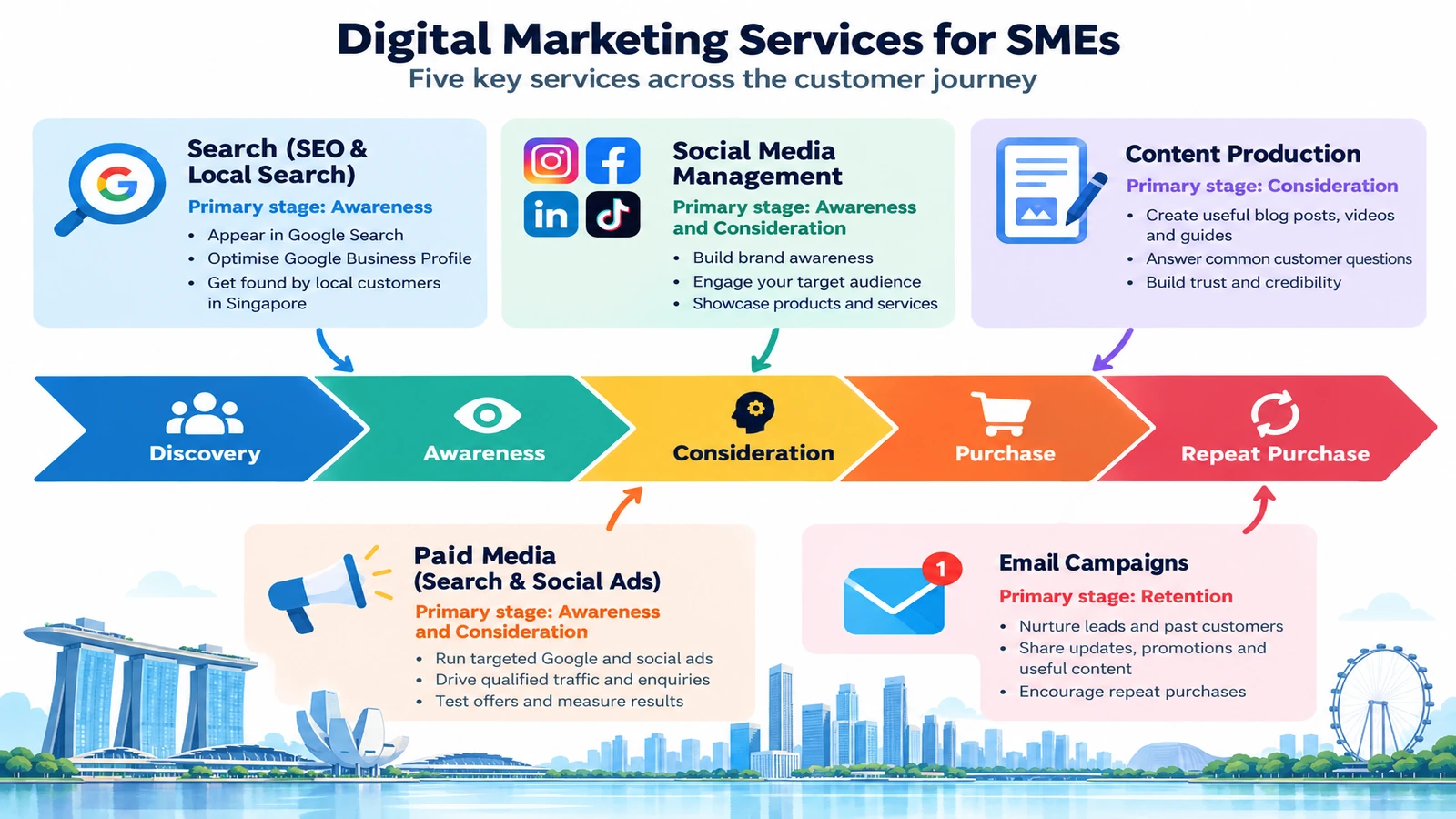
Which services a small business needs first and which can wait
Start with the service closest to a sale. For most Singapore SMEs, that means a properly set up Google Business Profile and a clean local search presence. Many enquiries for service businesses start with a phone search. Accurate hours, photos, reviews and a working website contact form are simple to set up and meet an immediate need.
Next, add one search channel, paid or organic. Choose based on how buyers look for you. Paid search gives a faster signal when people are searching for your service today. SEO compounds over time and suits a longer research cycle. Run one channel long enough to read it before you add another.
Social media, content programmes and email can wait until you have a working search channel and a clear view of what a lead is worth. Email in particular should follow once you have contacts who have agreed to hear from you.
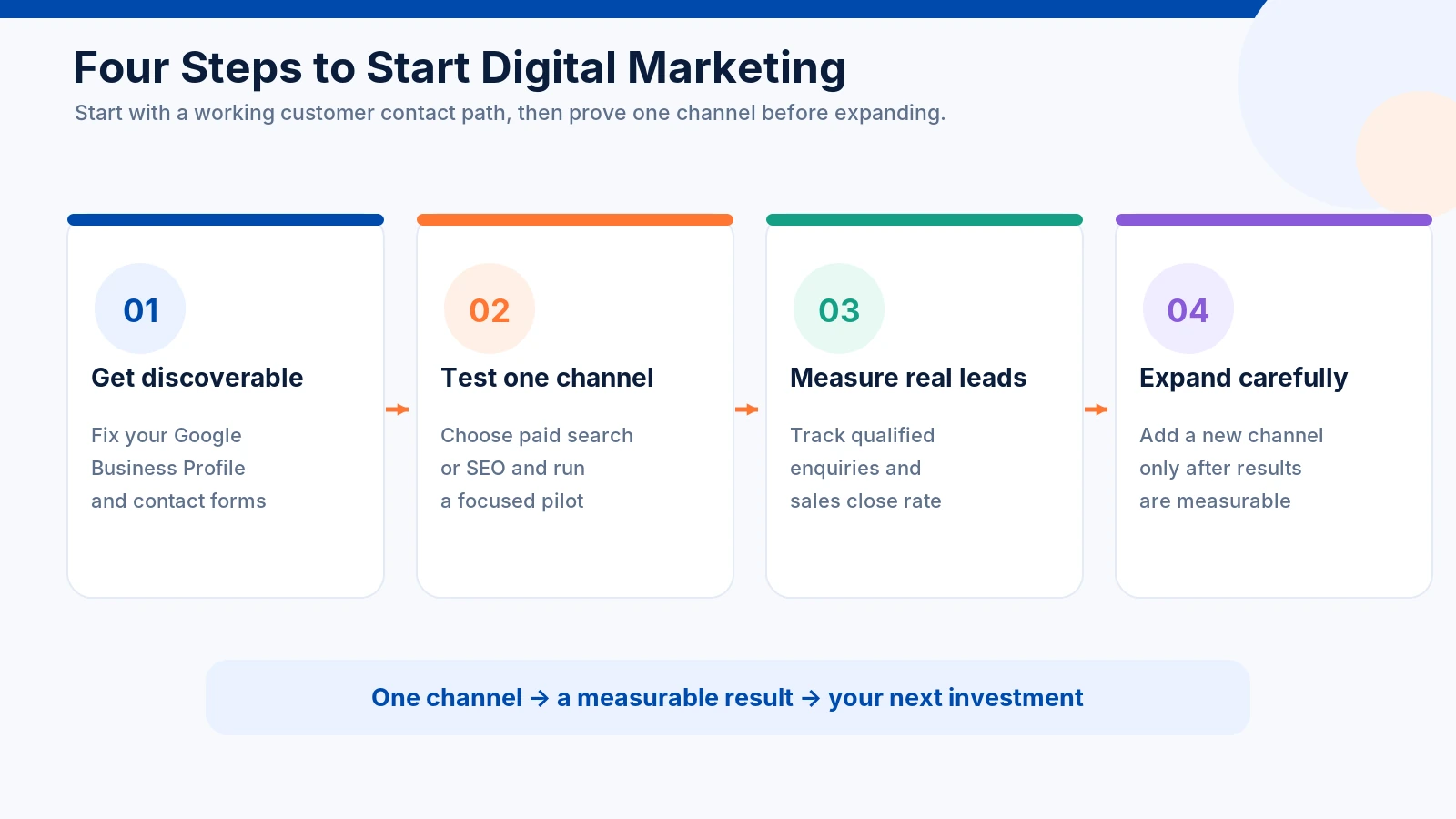
A practical sequence for an owner with a limited budget:
- Fix the Google Business Profile and website contact path.
- Run one search channel (paid or SEO). SEO rankings typically take shape over a few months, so judge them over a longer window than paid search.
- Measure cost per qualified enquiry and close rate.
- Add a second channel only if the first produces a readable result.
Prioritise fixing your Google Business Profile this week, then run one search channel for three months before considering any additional channels.
Where in-house, agency and freelance models fit
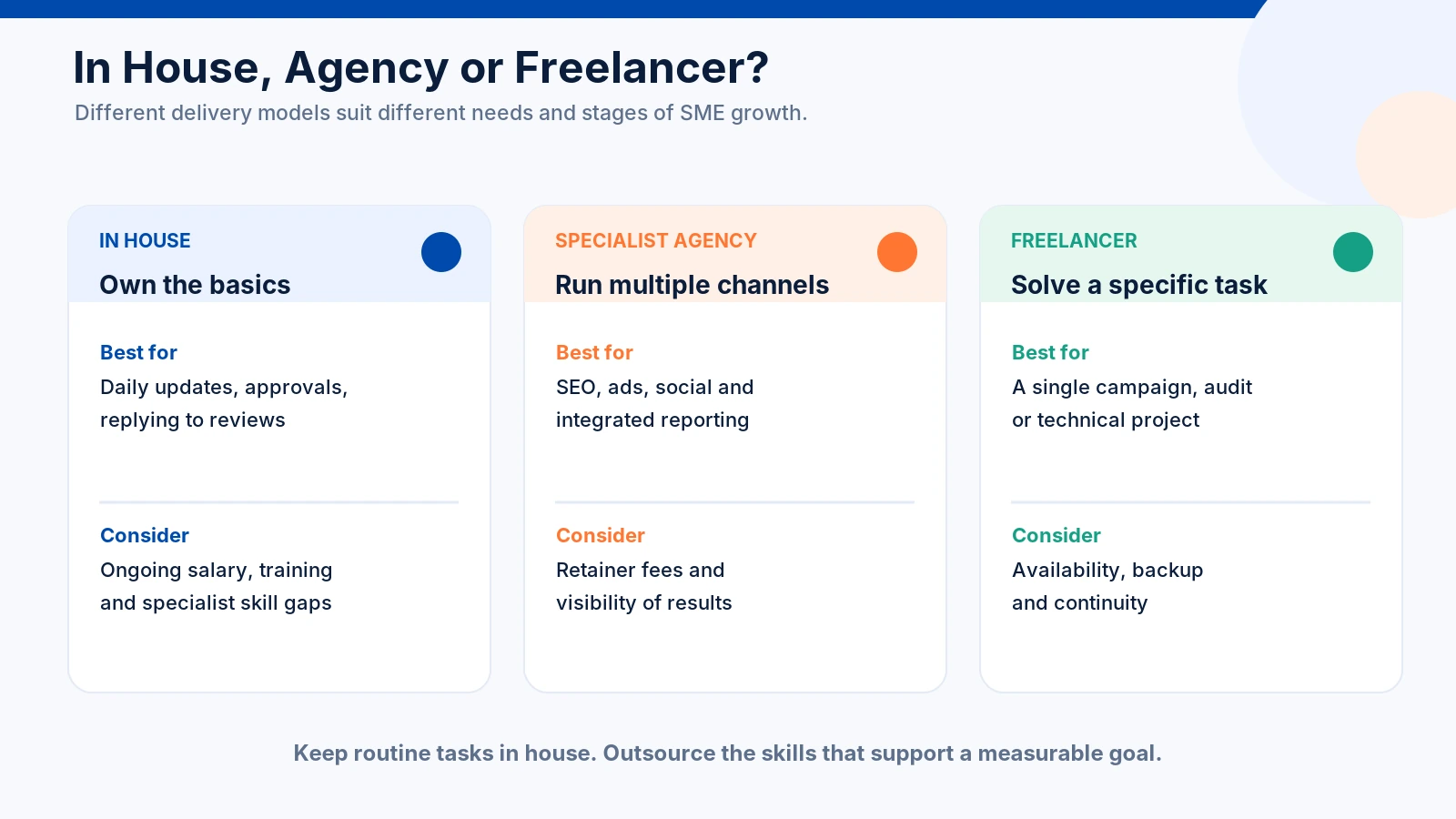
Each model suits a different stage and budget.
| Model | Best suited to | Main trade-off |
|---|---|---|
| In-house staff | Owners with steady, high-volume marketing needs and someone to manage it daily | Salary and training cost, and risk of skill gaps |
| Full-service agency | Businesses that need several channels run at once and can afford a retainer | Higher fees, and harder to see which channel earns sales |
| Freelance specialist | One clearly defined task, such as search ads or SEO audits | Depends on one person, so continuity and coverage are limited |
If you only need one thing, like SEO, a specialist might go deeper. An in-house owner can handle low-effort tasks, like replying to Google reviews and updating business information, and outsource acquisition work that requires specialist skills. A full-service agency makes sense once the owner knows which channels pay back and needs help running several at once.
Action: Keep low-effort tasks in-house, and hire a specialist only for the one channel you have chosen to test.
Typical monthly budget bands in S$ by business size and sector
The chosen channel sets the minimum spend you can read. Once you know which channel you are testing, check how much it needs each month to produce a readable result. Budget then follows from that spend and from how much a customer is worth to you. A café selling S$8 coffee needs far more transactions to justify spending than a conveyancing firm, where the standard HDB conveyancing line item is $235.62.
The table below shows the writer’s own planning estimates, not sourced market benchmarks. No dated, named Singapore benchmark was supplied for these bands, so treat them as illustrative assumptions and test them against your own numbers.
| Business profile | Writer’s planning estimate (S$ per month) | What it usually covers |
|---|---|---|
| Freelancer or micro-business with a single service | S$300 to S$800 | One search or social channel, basic setup, light management |
| Startup or early SME | Around S$2,500 to S$5,000 total | One or two paid channels, a Google Business Profile, monthly reporting |
| Growing SME with several product lines | S$3,000 to S$8,000 | Search and social together, content production, email |
Sector matters as much as headcount. High-margin professional services usually justify higher spending per lead than low-margin retail. Use a simple test: multiply your average customer’s gross profit by the number of new customers you expect each month, then cap marketing spend at a fraction of that figure. If you cannot estimate the number of new customers, please make that your first task before hiring anyone.
Budget action: Pick one channel, find its minimum readable monthly spend, and only then set your budget band.
Retainer, project and performance-fee pricing models compared
Providers usually charge in one of three ways. Each suits a different risk profile.
| Pricing model | How it works | Suits | Watch for |
|---|---|---|---|
| Monthly retainer | Fixed fee for an agreed scope each month | Businesses wanting steady output and predictable cost | Fees paid even when results dip; scope creep |
| Project fee | One-off fee for a defined deliverable | Businesses with a clear, finite task | Ongoing management is often not included |
| Performance fee | Payment linked to leads, sales or a share of ad spend | Businesses that want cost tied to outcomes | Loose definitions of a “lead” or “sale” |
Be careful with blended invoices. Many providers charge a management fee on top of media spend, or a percentage of spend, and quote it as a single line. Ask for the media budget and the management fee as separate items. A fee calculated as a percentage of ad spend rises as you spend more, which may not match your interests.
If a provider offers a performance fee, define the qualifying event in writing. It should be a paying customer, not a form submission. Substantiate any result claims used in advertising and document the performance-fee terms in the contract.
Hidden costs: tools, creative production and staff time
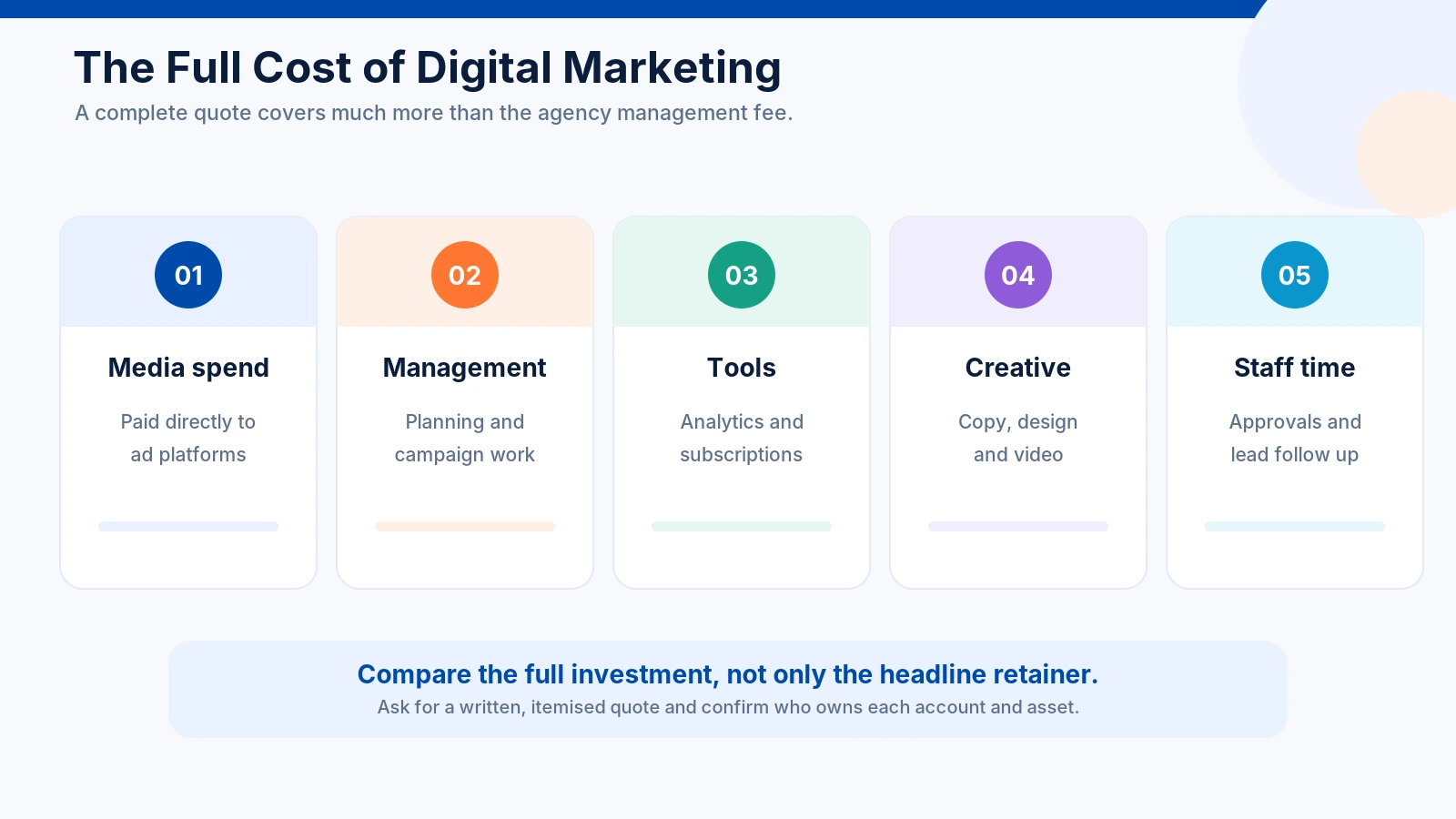
Quoted fees rarely capture a channel’s full cost. Three categories are easy to miss:
- Tools: Subscriptions for analytics, scheduling, call tracking and keyword research can add up each month.
- Creative production: Photography, video, copywriting and design are often billed separately from the management fee.
- Staff time: Someone in your business must approve content, answer enquiries, and follow up on leads, and that time costs money.
Please include these in the quote before comparing providers.
Scoring candidate agencies against your business goals
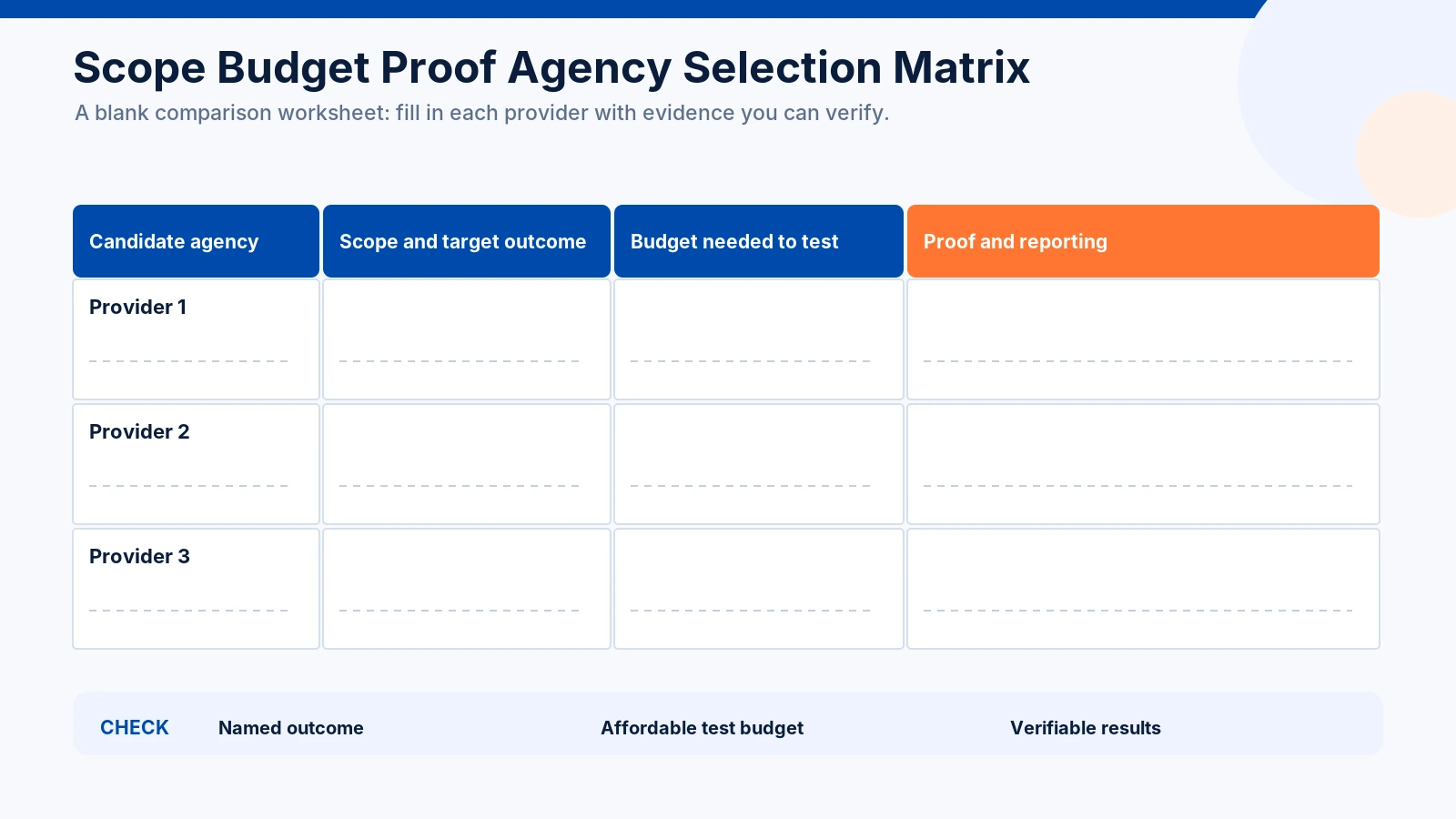
The Scope-Budget-Proof matrix assigns each candidate a score of 1 to 3 on three questions. A score of 3 means the provider answers fully in writing, 2 means it answers partially, and 1 means it doesn’t answer.
- Scope: Does the proposal name the outcome the work targets, such as enquiries or sales?
- Budget: Does it state the minimum monthly spend needed for a readable result?
- Will the provider provide results that you can verify, such as cost per qualified lead?
Shortlist a candidate only if it scores at least 7 out of 9, with no single column scored 1. Below that threshold, a provider is more likely to sell activity than results.
| Candidate | Scope (1-3) | Budget (1-3) | Proof (1-3) | Total | Shortlist? |
|---|---|---|---|---|---|
| Example provider | 3 | 2 | 2 | 7 | Yes |
Questions to ask before signing a contract
- What is the media budget, and what is the management fee, as separate lines?
- What qualifies as a lead or sale for any performance fee?
- How often will you report, and in what format?
- What happens to the account data if we end the contract?
- How long is the notice period, and are there exit fees?
Red flags: guaranteed rankings, opaque reporting and lock-in clauses
Be wary of any provider that promises guaranteed rankings, since the platform, not the provider, controls search results. Reports that show impressions and clicks but not enquiries or sales are a warning sign. Long lock-in periods with no exit clause also limit your ability to change course if results do not arrive.
Translating revenue targets into leads, conversion rates and customer acquisition cost
Start with the revenue you want. Divide it by your average sale value to get the number of customers needed. Divide that by your close rate to get the leads you need. Then divide your planned spend by that lead number to find your cost per lead and your CAC once you know the customer count.
Choosing metrics that matter at each stage of growth
At the beginning, please track cost per qualified enquiry and close rate. As you grow, add CAC by channel and the repeat-purchase rate. Avoid judging a channel by reach or engagement alone. Conversions, revenue, and ROI are the real proof that social media drives business results, not just likes or followers.
A worked example for a Singapore F&B or professional services firm
Consider a Singapore professional services firm with a monthly budget of S$2,500 for one search channel. The owner sets a target of 20 qualified enquiries a month. If the cost per enquiry exceeds that level, the owner pauses, reviews the keywords and landing page, then increases spend. Named, sourced case results were not supplied for this example, so the figures are illustrative.
Counterpoint: is a tight KPI set too narrow?
A tight KPI set can miss brand effects that build over time, such as awareness that makes later paid search cheaper. We think a small set is still the better starting point because it forces a decision. Widen the set once the first channel produces a readable result.
Attribution: how the CAC figure changes with the model
CAC depends on how you credit sales. Last-click attribution credits the final touchpoint and tends to favour search. Multi-touch models spread credit across channels and produce a higher, more realistic view of social and content. Whichever model you use, apply it consistently so that trends are comparable.
Government Support, Grants and Funding Options for Singapore SMEs
Enterprise Singapore runs programmes that may co-fund digital and marketing projects for eligible SMEs. Check each scheme’s current eligibility rules and application steps on its official page before you apply, as conditions change.
Checking eligibility and application steps
Confirm your company’s eligibility and the allowable costs for the project. Ask each provider to quote in a way that separates eligible from ineligible items.
Keeping records that make claims easier
Keep signed quotes, invoices, proof of payment and campaign reports together for each project. Clear records speed up any claim.
Conclusion: Building a Digital Marketing Function That Fits Your Business
Choose one channel, measure it to a cost per customer, and only then decide whether to buy a second service. Set a fixed budget, score each provider with the Scope-Budget-Proof matrix, and agree on what counts as a result before you sign.
Frequently Asked Questions
How much does digital marketing cost for a small business in Singapore?
Costs depend on the channel, the minimum spend required to be seen, and customer value. The planning bands above are illustrative, so test them against your figures.
Do SMEs need an agency, or can they manage marketing in-house?
Most SMEs in their first year can manage low-effort tasks in-house and outsource one specialist channel. An agency is a better fit once several channels start to deliver results.
What is the difference between SEO and paid search for a small business?
Paid search provides a faster signal and is pay-per-click. SEO, on the other hand, builds organic rankings over a longer period and compounds over time.
Are government grants available to cover digital marketing costs?
Some Enterprise Singapore programmes may co-fund eligible projects. Check the official scheme page for current eligibility.
How long does it take to see results from digital marketing?
Optimising a paid search campaign typically takes about three months for it to mature. SEO rankings usually take longer to settle.
What should I include in a digital marketing contract?
Include the media budget and management fee as separate lines, the definition of a lead or sale, reporting frequency, data ownership, notice period and any exit fees.
Hidden costs: tools, creative production and staff time
The quoted fee is rarely the full cost. Three categories are often missed:
- Tools and subscriptions. Analytics, call tracking, email platforms, scheduling tools and keyword research software add up. Ask whether the provider includes these in the fee or passes them through and who owns the licences. If the tools sit in the agency’s account, you may lose your data when the contract ends.
- Creative production. Ads need images, video and copy. Some agencies include this, while many charge per asset. A campaign that needs a new video each month can cost more to produce than to run. Budget for creative separately, and ask how many revisions are included.
- Staff time. Your own team will spend hours on briefings, approving content, answering enquiries and checking reports. For a small team, this is often the highest hidden cost, because it comes out of the working day rather than the marketing budget. Estimate the hours each month honestly and count them as part of the channel’s cost.
Write every cost line (fee, media, tools, creative, staff hours) on one sheet before you sign. Use the total to compare against the revenue the channel needs to generate.
Summary: Before comparing quotes, add up every cost line, not just the agency fee.
Scoring candidate agencies against your business goals
Most SMEs compare providers on portfolio, pitch and price. A better starting point is to score each candidate service on three questions. Which single business outcome does it target? How much monthly spend does it need before it produces a readable result? Will the provider report that outcome in a form you can check yourself?
This guide calls this the Scope-Budget-Proof matrix. Score each column from 0 to 3, then multiply the scores for each candidate. A service that scores 0 on proof is excluded, however persuasive the pitch. Shortlist a candidate only if its total score is at least 18 out of 27, and it scores at least 2 on proof.
| Candidate service | Outcome it targets | Minimum monthly spend for a readable result | Proof: outcome reported in checkable form |
|---|---|---|---|
| Search ads (Google) | Enquiries from people already searching | Set by your target cost per enquiry and competition | Calls, form submissions and bookings traced to campaigns |
| Social media management (Meta) | Awareness and repeat visits | Hard to isolate on small budgets | Often reach and engagement, which rarely map to sales |
| SEO | Organic enquiries over time | A sustained monthly effort, not a one-off | Rankings and traffic, with enquiries as the real measure |
| Email marketing | Repeat purchases from existing customers | Low, mainly tool and list-building costs | Revenue per campaign, if sales link to the email |
| Content production | Supports search and social performance | Depends on volume and format | Only measurable through the channels it feeds |
| Full-service agency retainer | Bundles several of the above | Typically the highest fixed commitment | Varies widely by provider |
Score the outcome column by how directly it connects to revenue: 3 for enquiries or sales, 1 for awareness. Score the spend column by whether your budget clears the minimum: 3 if comfortably above, 1 if barely, 0 if below. Score proof as described above. A search campaign that reports enquiries weekly, with cost per enquiry, will usually outscore a social retainer that reports reach, even if the social quote looks more impressive.
Done honestly, this exercise often shows that one channel is the right first step and the rest can wait.
Questions to ask before signing a contract
Ask every candidate for an itemised quote, not a rate card. Then ask the following, and write down the answers.
- What exactly will you report, and how often? Ask for a sample report from another client, with personal details removed. Check that it shows enquiries or sales, not only clicks and impressions.
- How do you count a lead? Ask whether a lead means a form fill, a phone call or a paying customer. Ask how they verify that an enquiry is a real prospect. Form fills can include spam, duplicates and people who never intended to buy.
- Which fees are for media and which are for management? Ad spend, paid to Google or Meta, is separate from your agency fee. Some providers bill both on one invoice. Ask for each figure separately.
- What does the test period cover? Agree on a defined trial and name the metric that decides whether to continue. Judge the trial against that metric, not just the first few weeks.
- Who owns the ad accounts, analytics property, website access and content? You should fully own the accounts and data. Please confirm you can take them with you if you leave.
- What is the notice period, and what happens to assets if the contract ends? Look for a short notice period and a clear handover process.
- Which tasks can I do in-house? Many owners can handle responding to Google reviews and keeping their Google Business Profile current. Keeping these in-house leaves more of the budget for acquisition.
A provider that answers these questions clearly is worth a second conversation. A provider that deflects several of these questions is revealing something about the proof column.
Red flags: guaranteed rankings, opaque reporting and lock-in clauses
Three warning signs recur in SME marketing contracts. Each one makes it harder to judge whether the spend is working, so treat any of them as a reason to reduce the commitment.
- Guaranteed rankings. No honest provider can guarantee a position on Google. Results depend on competitors and search engine algorithms the agency doesn’t control. A guarantee often means the agency will target easy keywords or bill you for effort rather than outcomes.
- Opaque reporting. Watch for reports that lead with impressions, reach or “engagement score” and bury conversions at the back. To decide on a budget, you must know how many paying customers came from each channel, as reported. Ask for access to your analytics so you can check the agency’s figures against your records.
- Lock-in clauses. Long minimum terms, automatic renewal with short cancellation windows, and agency ownership of ad accounts or content make it difficult to leave. A difficult-to-exit contract is a reason to reduce the scope before you sign.
If a provider shows any of these signs, ask for a shorter trial or walk away. A smaller, well-measured engagement teaches you more than a large bundle you cannot read.
Translating revenue targets into leads, conversion rates and customer acquisition cost
Most SMEs set a marketing budget before they set a revenue target. That order causes most of the waste. A campaign can look busy, bring in enquiries and still leave the owner unable to say whether it paid for itself. Working backwards from revenue fixes the problem, and it takes less arithmetic than most owners expect. It also shows whether digital marketing services for SMEs are worth buying at all.
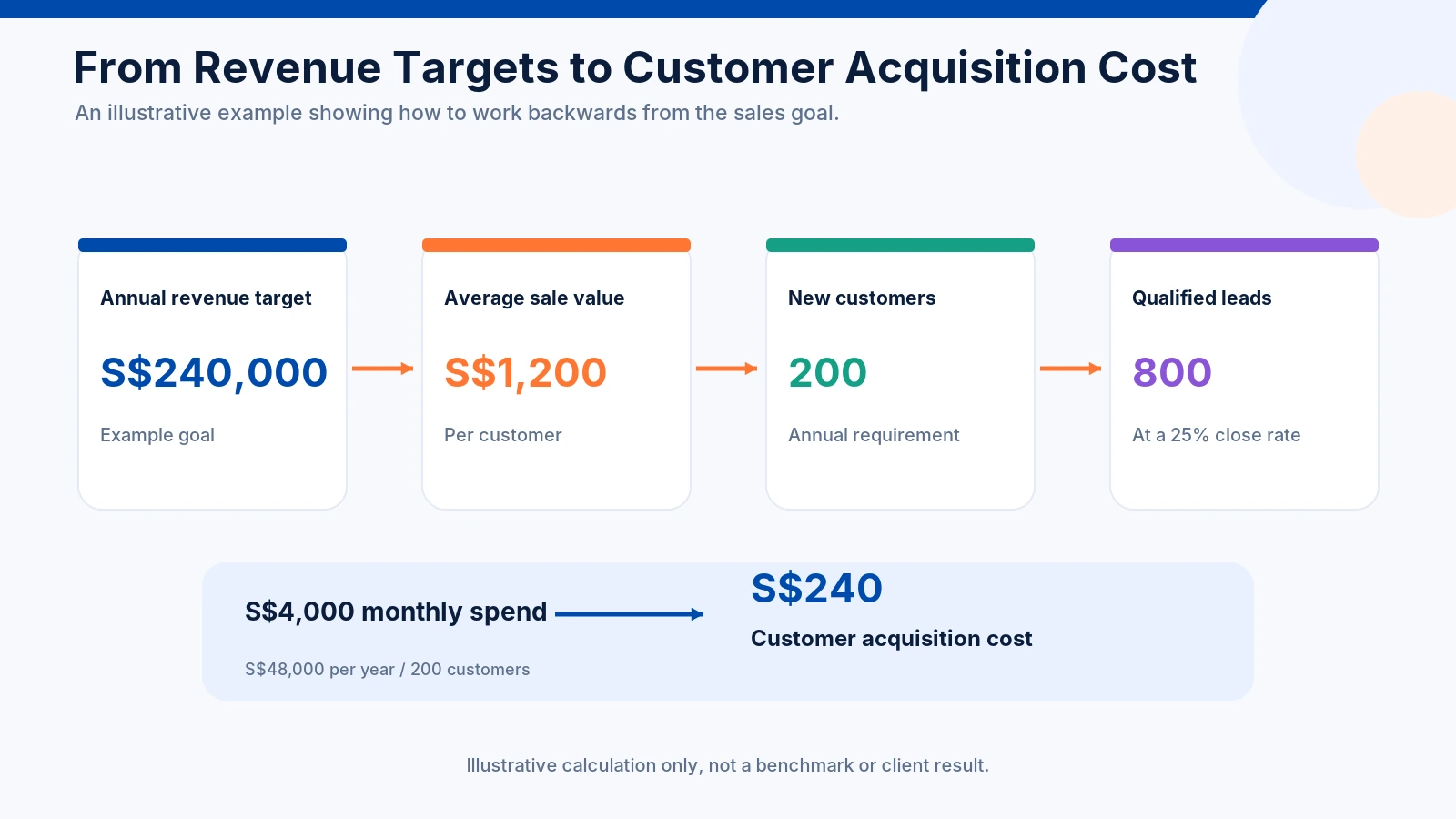
Start with the number the business already tracks: the revenue it needs from new customers in a year. Divide that by your average sale value to get the number of new customers required. Then divide that by your expected close rate to find how many qualified leads you must generate.
A simple chain looks like this:
- Revenue target from new customers, for example, S$240,000 a year.
- Average sale value, for example, S$1,200 per customer. This figure gives 200 new customers.
- Lead-to-customer conversion rate, for example, 25 percent. This means 800 qualified leads a year, or about 67 a month.
- Customer acquisition cost (CAC): total marketing and sales spend divided by new customers. If the budget is S$4,000 a month, the CAC is S$240 per customer.
CAC tells you whether marketing is worth it. Compare it with the profit a customer generates. If an average customer yields S$400 in gross profit over their relationship with you, a S$240 CAC is viable but thin. If the margin is S$150, the same budget loses money.
Be strict about what counts as a lead. A form fill is not a lead until someone qualifies it. Ask any provider to report leads your team has confirmed as genuine prospects and to report how many became paying customers. Agencies often report form submissions because that number is easy to grow. Your own sales records are the only reliable check.
Choosing metrics that matter at each stage of growth
Not every metric deserves attention at every stage. A first-year business needs to know whether anyone is buying. A business with steady sales needs to know which channel costs the least per customer. Use a short set of metrics that matches the stage.
| Stage | Primary metric | Supporting metrics | Metric to ignore for now |
|---|---|---|---|
| Testing (first 3 months) | Cost per qualified lead | Click-to-enquiry rate, cost per click | Brand reach, follower count |
| Establishing (months 4 to 12) | CAC by channel | Lead-to-customer rate, sale value | Total impressions |
| Scaling (after first year) | Return on ad spend, payback period | Repeat purchase rate, customer lifetime value | Impressions without a sales link |
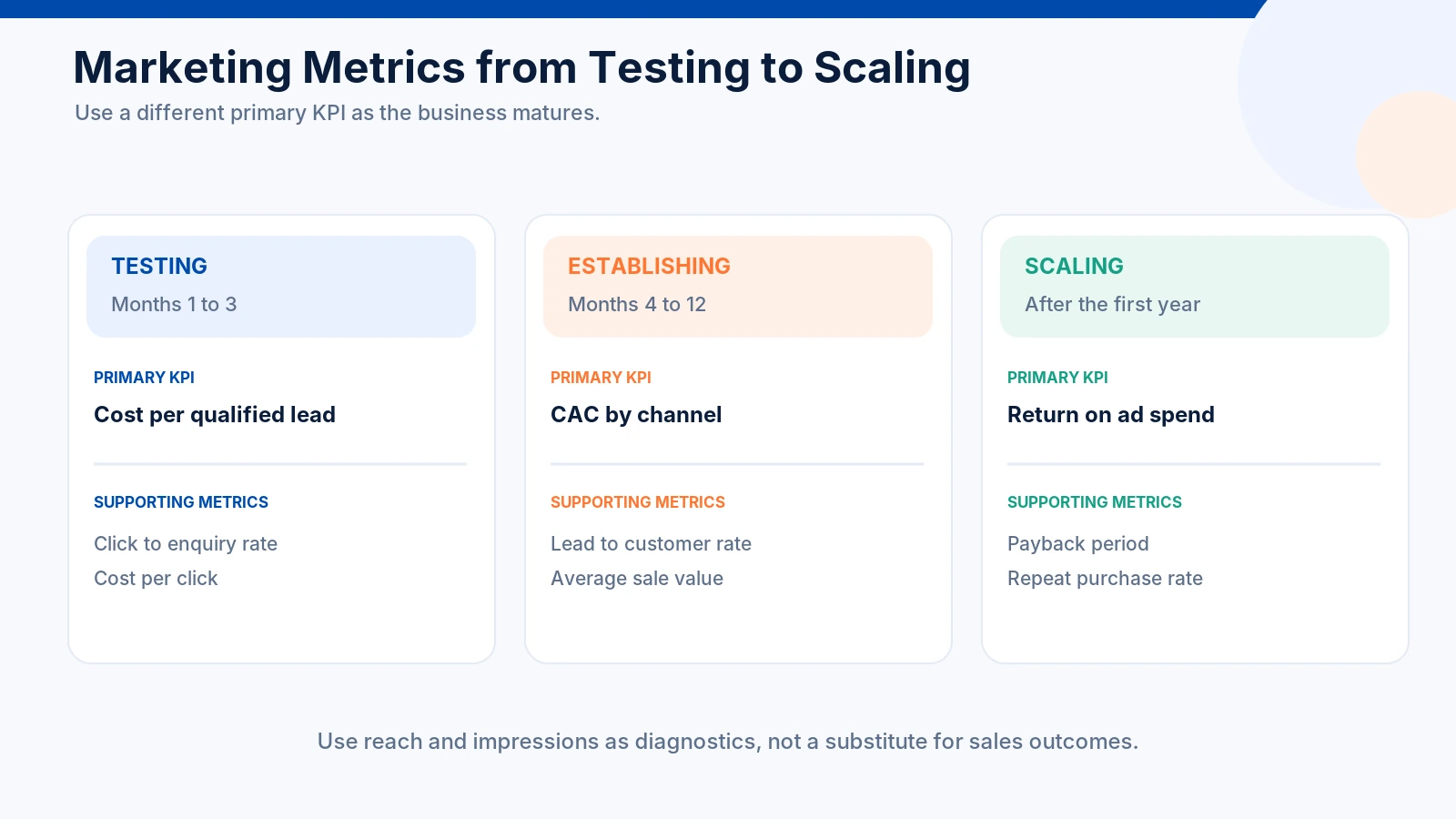
The early stage rewards cheap, fast evidence. The middle stage rewards cost discipline. The later stage asks whether a channel can grow without its cost rising faster than the revenue it brings in.
Vanity metrics such as likes, reach and impressions can be useful diagnostics, but they should never justify spend on their own. Conversions, revenue and ROI are the real proof that social media drives business results, not just likes or followers.
A worked example for a Singapore F&B or professional services firm
The example below is hypothetical. The figures are assumptions chosen to show the method, not results from a real business.
Consider a three-outlet café group in the Central region or a two-partner accounting practice in Singapore. Both sell repeat or high-value services and track walk-in or enquiry volume.
Assume the café group wants S$20,000 more in monthly revenue from catering orders, with an average order value of S$400. That means 50 extra orders a month. At an assumed 40 percent quote-to-order conversion rate, it needs 125 catering enquiries a month. If the marketing budget is S$3,000 a month, the target cost per enquiry is S$24, and the customer acquisition cost is S$60 per order.
Now apply a scope, budget and proof test to two candidate services. Search ads aimed at “catering Singapore” in the café’s delivery postcodes reach people already looking to order. The provider can report cost per click, enquiries and confirmed orders each week. Social media management targets awareness and is harder to link to orders, so the provider reports engagement monthly. Search ads score higher on proof, which makes them the better first test for a fixed budget. The team can handle social content in-house, for example by posting photos of catering setups and replying to comments.
The professional services firm follows the same logic with a different sale. Assume an average client is worth S$6,000 in fees, and the firm wants two new clients a month. At an assumed 8 percent close rate, it needs roughly 25 qualified enquiries. A S$2,500 monthly budget then implies a target cost per qualified enquiry near S$100. A Google Business Profile, kept up to date by the owner, supports local discovery for both businesses. Google’s Business Profile help pages set out what the listing includes and how to manage it.
The numbers will differ for your business. The point is that each decision starts from a revenue figure and ends in a metric the owner can check.
Counterpoint: Is a tight KPI set too narrow?
A reasonable objection is that narrow KPIs miss brand-building work whose payoff arrives years later. That can be true for businesses with long purchase cycles or strong existing reputations. For most SMEs buying their first or second channel, though, unmeasured brand work is hard to verify. Keep one or two brand metrics as watch items, and do not let them carry the budget until the revenue-linked channels are working.
Attribution: how the CAC figure changes with the model
Customer acquisition cost depends on how you credit a sale to a channel. Last-click attribution gives all credit to the final touchpoint before purchase. Assisted-conversion reporting also credits earlier touchpoints, such as a search ad that prompted a later branded search. Last-click tends to make search ads look stronger, and assisted reporting tends to make awareness channels look stronger.
Trust last-click for a short-cycle business with simple buying paths, such as a café taking catering orders. Trust assisted-conversion data for a longer cycle, such as a consultancy where a prospect may read several pages before enquiring. Whichever model you use, keep it fixed for a full quarter before comparing channels, so the figures are comparable.
Government Support, Grants and Funding Options for Singapore SMEs
Government funding can offset part of your digital marketing spend, but it doesn’t replace a budget decision. Treat any grant as a discount on a service you already chose for a measurable goal, not as a reason to buy a larger bundle.
Enterprise Singapore is the main agency that funds business development for local enterprises, and its programmes change over time. Enterprise Singapore usually administers schemes that support digital adoption, such as digital tools and capability support, through its website. Some are delivered alongside partner agencies. Scheme names, funding caps, and co-funding ratios change, so check the current list on the Enterprise Singapore website before you plan a budget around any of them.
Two points matter more than the scheme name. First, most support is reimbursement-based, so you pay the provider first and claim afterwards. Second, many schemes cover only approved items. A bundled retainer may not qualify in full even when the total looks eligible. Ask the provider which line items fall under an eligible category before you sign.
Local search tools also matter here. A Google Business Profile is free to set up, and its insights show how often customers find your listing, call it, or request directions. Use those figures to judge local discovery, rather than relying on a provider’s summary.
Checking eligibility and application steps
Eligibility criteria typically cover company registration, local ownership, staff headcount, and annual turnover. Confirm each one against the scheme’s own page rather than a summary, as the thresholds differ between programmes.
Use this sequence before committing money:
- Shortlist two or three schemes that match your activity, such as digital tools, marketing capability or productivity.
- Read the eligibility page and note the criteria your business must meet at the time of application.
- Ask each shortlisted provider whether they are an approved vendor or whether their invoice format meets the scheme’s requirements.
- Obtain a written, itemised quote that separates eligible items, such as a specific tool subscription, from ineligible ones, such as general management time.
- Apply and receive approval before you place the order, since many schemes will not fund work that started earlier.
- Keep the claim window in mind, because late claims are commonly rejected.
If a provider cannot give you an itemised quote or confirm eligibility, treat the situation as a warning sign. The grant then adds administrative risk without adding certainty to the decision.
Keeping records that make claims easier
Missing paperwork, not ineligibility, most often delays claims. Set up a simple record system from day one:
- Store every quote, signed contract, invoice and proof of payment in one shared folder, named by date and vendor.
- Record the scope of each item so you can demonstrate which task it covers.
- Keep before-and-after evidence for any tool or capability you claim, such as a setup confirmation or a dashboard export.
- Note the approval reference for each scheme application and the deadline for each claim.
- Reconcile invoices to bank transfers monthly to catch gaps early.
A clean folder also gives you the spend-by-channel records you need to judge whether each service is producing a readable result. That test should decide whether to renew a provider.
Data Protection, Consent and Compliance in Singapore
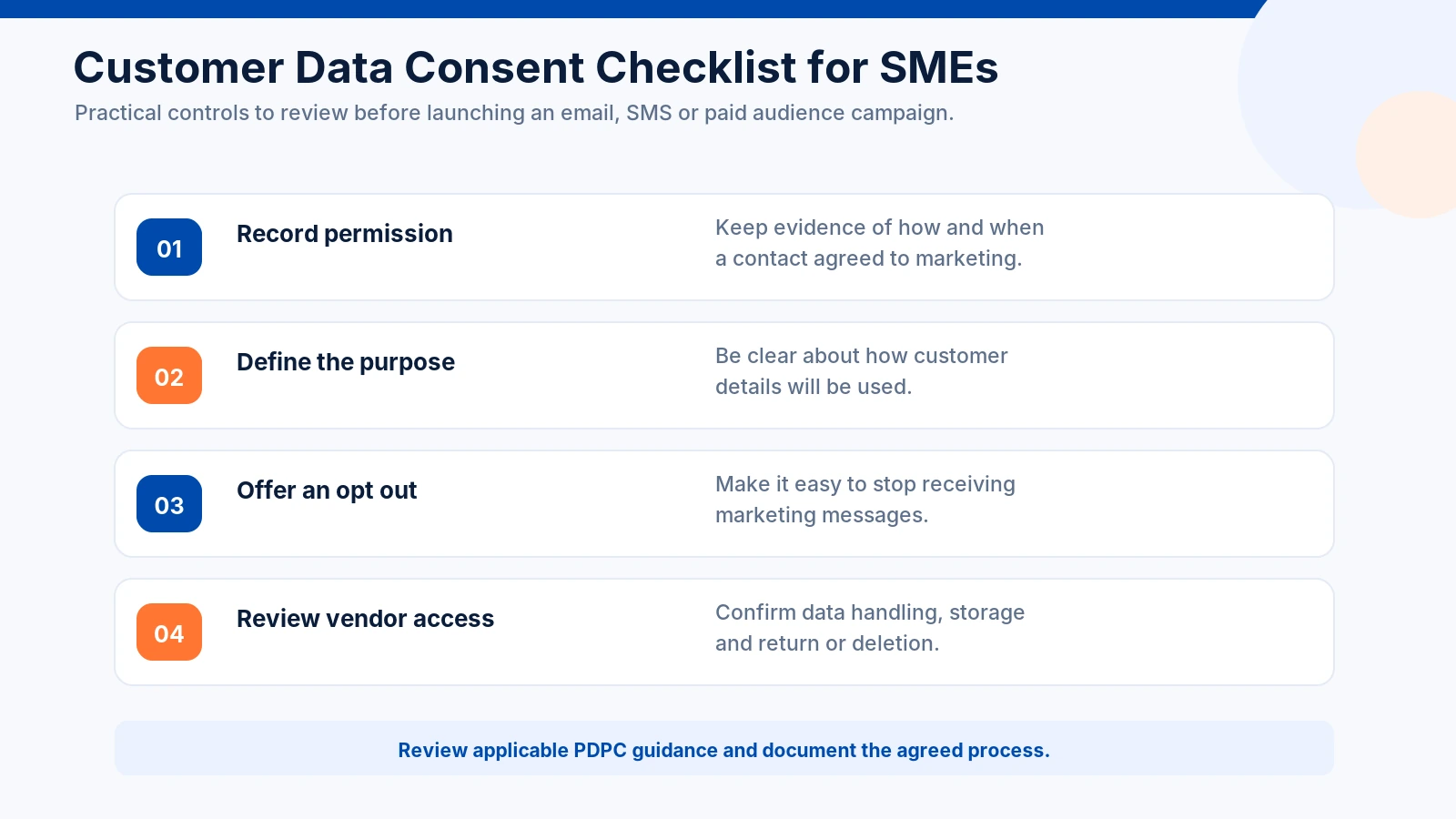
Customer data is where many SME marketing plans quietly go wrong. A campaign can look successful on a dashboard and still rely on contact lists collected, shared, or messaged without permission. This section covers what that means for a small team and what to check before any vendor touches your customer records.
Data protection is a legal matter, and this guide does not cover it in depth. Check the current rules with the official sources before you act on any point below.
What the Personal Data Protection Act requires of marketers
The Personal Data Protection Act 2012 governs how organisations in Singapore collect, use and disclose personal data. That includes names, phone numbers, email addresses and purchase histories. The Personal Data Protection Commission administers the Act and publishes guidance on its obligations.
For marketing, three obligations matter most:
- Consent: collect personal data with the individual’s consent and use it only for the purposes they agreed to.
- Purpose limitation: a contact who signed up for a newsletter has not agreed to be added to a retargeting list or passed to a partner.
- Access and correction: individuals can ask what data you hold about them and request corrections.
Many businesses assume a business card, a lead form, or a shared WhatsApp number automatically permits later marketing messages. Often it does not. Consent is tied to the context in which the data was given, so record where and when each contact opted in.
Consent works differently by channel, and SMEs often treat them all the same.
| Channel | What to check before sending | Practical tip |
|---|---|---|
| Email newsletter | The contact opted in through a form or checkout box that stated email marketing | Keep the opt-in record (date, source, wording shown) in your CRM |
| SMS or messaging app | The contact gave a number for marketing, not only for delivery updates | Use a separate opt-in tick box, and include an unsubscribe route in every message |
| Website cookies | Non-essential cookies (analytics, ad pixels) are set only after the visitor chooses | Use a consent banner that makes accepting and declining equally easy |
| Paid audience uploads | Customer lists uploaded to ad platforms were collected for that purpose | Upload only contacts who agreed to marketing, and exclude former customers who opted out |
Two practical rules help most SMEs. First, make unsubscribing as easy as subscribing, and honour requests quickly. Second, avoid buying contact lists. A purchased list usually has no traceable consent, and a single complaint can damage your sender’s reputation and your customer relationships.
For cookies, the PDPC’s guidance focuses on whether individuals have a genuine choice. A banner that offers only “OK” is weak practice, even though it is common.
Action to take: record the source and wording of every opt-in before any campaign goes live.
Working with vendors who process customer data
When an agency or freelancer handles your customer contacts, your data protection duties do not disappear. Under the Act, the organisation that collects the data generally remains responsible for it, and vendors that process data on your behalf must also protect it. Before signing, please request the following in writing:
- A clear description of what data the vendor will handle, such as customer lists, enquiry form submissions or analytics data.
- Where that data will be stored and who on the vendor’s team can access it.
- Whether the vendor will use your data for its purposes, such as training models or building audiences for other clients. Refuse the request unless you have agreed to it explicitly.
- How data is deleted or returned when the contract ends.
- Notify you of any data breach within a stated timeframe so you can meet your obligations.
Please include these points in the contract’s data-processing clause and retain a copy of the vendor’s security practices. You are not expected to audit the vendor’s systems. You should, however, be able to explain to a customer who holds their information and why.
In short, collect only what you need, record consent in a way you could later prove, and treat every vendor as an extension of your own responsibility for the data.
Action to take: add a data-processing clause to every vendor contract before sharing any customer list.
Conclusion: Building a Digital Marketing Function That Fits Your Business
Most Singapore SMEs do not need a bigger marketing bundle. They need one service, bought for one business outcome, on a budget they can sustain long enough to see the result. Score each candidate service on the outcome it targets, the minimum monthly spend it needs, and whether the provider will report that outcome in a form you can check. Anything that scores low on proof is excluded, however persuasive the pitch.
After a test period of around three months, you should be able to say which channel produced which enquiries, what each paying customer cost you, and whether that cost sits below the margin you earn on the sale. If you cannot answer those questions, the service was usually scoped too broadly to measure, or reporting was never tied to revenue.
Build the function in stages, and let each stage earn the next. Start with one acquisition channel. Keep low-cost, trust-building tasks in-house, such as replying to reviews and keeping your Google Business Profile accurate. Add a second channel only once the first shows a readable cost per customer. Before you expand, review your contract terms and make sure you own your ad accounts, content files and customer data.
A function built this way grows with the business. You can hand it off to a larger agency later, bring it in-house when volume justifies it, or keep it small because it already pays for itself. That flexibility, rather than a larger retainer, is what a sound digital marketing function looks like for a business of your size.
Frequently Asked Questions
How much does digital marketing cost for a small business in Singapore?
Costs vary widely, so ask any provider for an itemised quote in S$ rather than relying on a published rate card. Separate the agency management fee from the media spend, because providers often blend the two into one invoice. Decide the monthly acquisition budget first, then assess whether that amount can produce a readable result on one or two channels. If a provider cannot show how the money is split, treat that as a warning sign.
Do SMEs need an agency, or can they manage marketing in-house?
Many SMEs can run part of their marketing in-house and outsource only work that requires specialist skills, such as search ad setup or technical SEO. Routine tasks like replying to Google reviews or keeping the Google Business Profile current are usually cheap to keep internal. An agency makes sense when the owner lacks the time or skills to properly test and measure channels. Start with one outsourced channel tied to a clear outcome, rather than a full-service retainer.
What is the difference between SEO and paid search for a small business?
Paid search (Google Ads) buys placement at the top of results, so visibility starts quickly and stops when the budget stops. SEO improves organic rankings over several months and keeps working without ongoing ad spend, but results take longer and are harder to predict. Businesses with urgent enquiry needs usually get faster proof from paid search. Businesses with a steady budget and time to wait can lower their long-run cost per enquiry with SEO.
Are government grants available to cover digital marketing costs?
Singapore’s government support for SMEs is mainly administered through Enterprise Singapore, which lists current schemes and eligibility on its website. Schemes change over time, so check the current criteria before budgeting around a grant. Keep itemised invoices, proof of payment and a clear description of the work from the start, since these records make any claim far easier to support.
How long does it take to see results from digital marketing?
Paid search and paid social can generate enquiries within days, though the first few weeks are usually spent learning which audiences and keywords respond. SEO and content typically need several months before rankings and traffic show a clear trend. A fair test period is around three months per channel, measured against one agreed outcome such as qualified enquiries or cost per customer. Stop a channel only when that test gives a readable result that falls short of the target.
What should I include in a digital marketing contract?
Set out the scope of work, the single outcome you are targeting, the monthly fee, and any media spend billed separately. Cover reporting frequency and the metrics reported, plus the notice period needed to end the contract. Make clear who owns the ad accounts, website access, content and customer data, and what happens to them when the relationship ends. Make sure the provider allows you to measure results before committing to long minimum terms.