
| AI Summary
An SEO marketing budget in Singapore typically ranges from S$500 to S$5,000 or more per month, depending on business goals, competition, website condition and required services. Technical SEO audits generally cost S$800–S$4,000, while local SEO setup ranges from S$800–S$2,500. Businesses should separate one-off expenses from recurring costs and allocate funds to technical improvements, content optimisation and performance monitoring. To justify SEO spending, measure qualified leads, customer acquisition costs and return on investment (ROI). Singapore businesses should also review the EDGE Grant, which replaced PSG, EDG and MRA on 30 September 2026. A sustainable SEO budget should reflect commercial priorities, realistic timelines and measurable business outcomes. |

A realistic SEO marketing budget for a Singapore business can start around S$500 per month for limited ongoing work, while competitive campaigns may cost S$5,000 or more. The useful number is not the cheapest advertised package. It is the amount needed to address your website’s problems, reach valuable customers and measure commercial returns.
We recommend budgeting for an initial assessment, priority fixes and sustained optimisation. A small local business may need a focused programme. An ecommerce retailer with thousands of pages will require broader technical and content support. Both should connect their spending to leads, sales and profit rather than rankings alone.
This guide explains 2026 Singapore SEO prices, service costs, pricing models and return-on-investment calculations. It also corrects an important grant change: the Productivity Solutions Grant (PSG) stopped accepting new applications in September 2026, so businesses planning new projects must check the replacement EDGE Grant instead.
Key Takeaways
- Budget by scope, not averages. Price the website audit, required fixes, content and ongoing management before choosing a monthly figure.
- Separate setup from recurring fees. Otherwise, a low retainer can conceal significant additional costs.
- Use Singapore prices as benchmarks. Published ranges are indicative quotations, not regulated rates or guaranteed outcomes.
- Measure qualified demand. Organic leads, conversion rates and contribution margin reveal more about value than keyword positions alone.
- Allow time for results. Assess technical delivery early, then commercial progress over an appropriate longer period.
- Check current grant rules. PSG, EDG and MRA ceased on 29 September 2026; EDGE launched on 30 September. Ordinary SEO invoices should never be assumed eligible.
How Much Should You Budget for SEO in Singapore in 2026?
For initial planning, a modest local campaign may fall within S1,000–S2,500 per month. Growing businesses in competitive sectors often need S2,000–S5,000 or more, particularly when content production and technical development are substantial. These are planning illustrations, not minimum required spends.
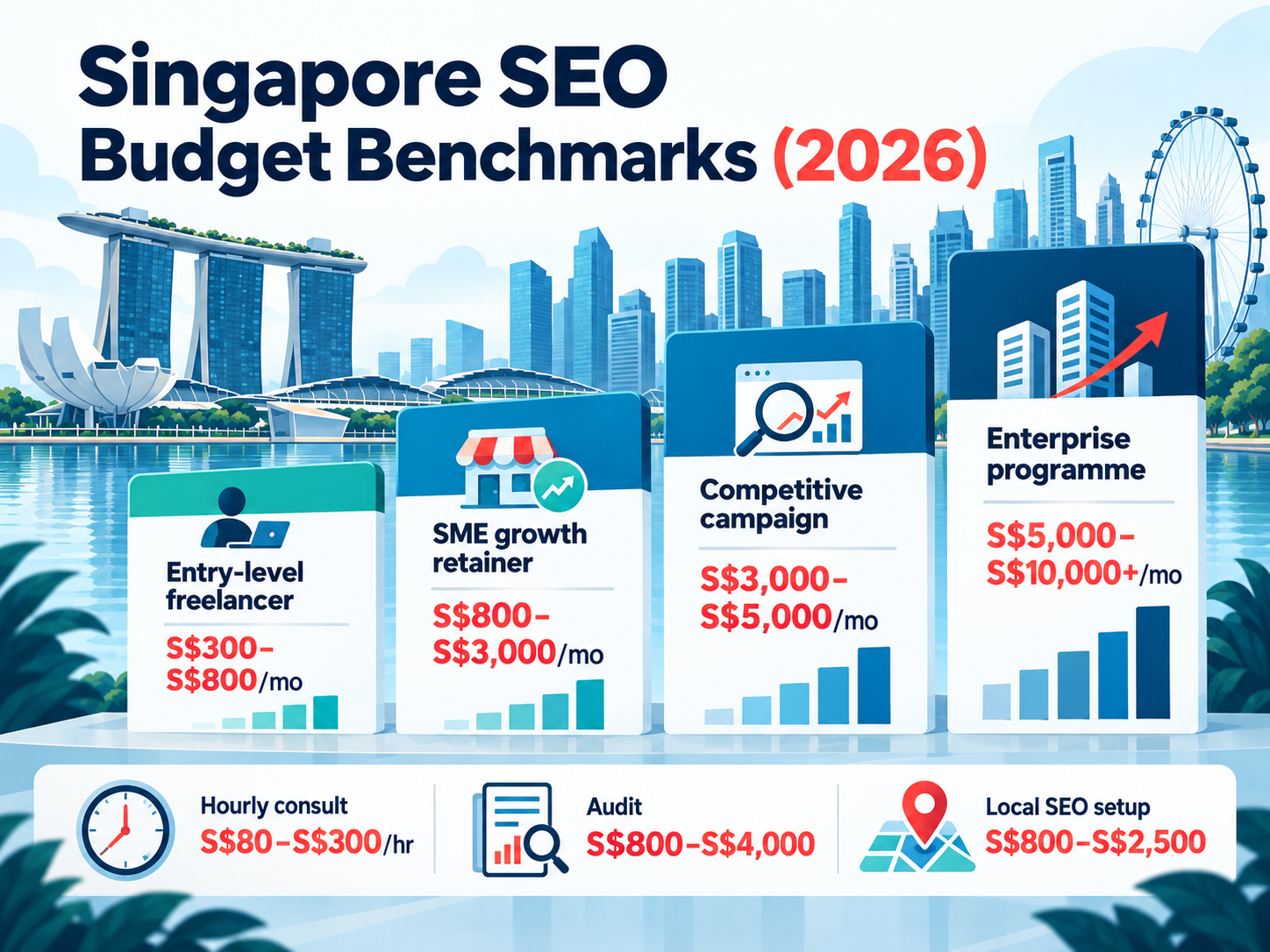
Singapore agency Roots Digital’s October 2026 pricing guide places ongoing retainers broadly at S500–S5,000 or more. It also lists entry-level freelancer work at S300–S800 and enterprise engagements reaching S$10,000 or higher monthly. Providers define packages differently, so we would not treat any band as a standard price.

| SEO engagement | Indicative cost in Singapore | Typical purpose |
| Entry-level freelancer | S300–S800/month | Limited on-page work and monitoring |
| SME growth retainer | S800–S3,000/month | Ongoing technical, content and reporting work |
| Competitive campaign | S3,000–S5,000/month | Broader content and specialist support |
| Enterprise programme | S5,000–S10,000+/month | Large websites, complex teams or markets |
| Hourly consultation | S80–S300/hour | Defined expert advice |
| Technical SEO audit | S800–S4,000/project | Diagnosis and prioritised recommendations |
| Local SEO setup | S800–S2,500/project | Profile and location optimisation |
These figures reflect one agency-published market guide, not a representative census of Singapore providers. The technical audit range is S800–S4,000 in the updated guide; older copies cited S$3,500 as the upper end. Get current written quotations for your website before committing funds.
International surveys offer context but cannot replace local quotes. In Ahrefs’ survey of 439 SEO providers, updated in August 2024, 78.2% offered monthly retainers. That survey covered multiple countries and its US-dollar averages should not be presented as Singapore market prices.

What determines your actual SEO cost?
We look at the work required before recommending a budget. A five-page service website, a multilingual corporate site and an ecommerce catalogue have different technical demands even when all three want more traffic.
Competition and search intent. An established financial-services market may require specialist content and stronger evidence of expertise. A neighbourhood service provider can often prioritise location pages and its Google Business Profile. Search volume alone does not reveal how difficult or valuable the opportunity is.
Website condition. Incorrect redirects, inaccessible pages, duplicate templates and poor internal linking create extra work. If the site needs development changes, ask whether the agency can implement them or merely document recommendations.
Content requirements. Updating ten useful service pages is a different assignment from creating forty researched articles. Subject-matter interviews, compliance reviews, design and approvals can affect both price and delivery speed.
Geographic coverage and capacity. One Singapore location requires a narrower approach than multiple outlets or regional markets. The fee should also reflect who performs the work, how much time is committed and what support is included.
Build Your SEO Marketing Budget From the Work Required
A useful budget starts with a baseline audit and a task list. From there, split expenditure into one-off projects, ongoing work and internal costs. This prevents surprises when development or content production falls outside the agency’s monthly package.

1. Technical assessment and implementation
A technical SEO audit checks whether search engines can discover, crawl and understand important pages. It may examine indexing controls, redirects, internal links, structured data, site performance and mobile usability. The report should rank issues by commercial impact rather than provide an unfiltered list of warnings.
An audit fee does not necessarily include fixes. Development work may involve your existing website contractor or a separate implementation budget. We recommend requesting estimated hours, responsible owners and acceptance criteria for every high-priority recommendation.
Google’s SEO Starter Guide explains the fundamentals of helping search engines understand website content. Not every technical warning is a ranking emergency, so avoid paying to resolve low-impact issues while important sales pages remain inaccessible.
2. Content creation and optimisation
Content is often a major recurring expense because valuable pages require research, writing, editing and periodic updates. A credible proposal should specify how many new pages and revisions are included, together with the level of subject-matter input expected from your team.
We would first improve important pages that already attract impressions but convert poorly. Next, we would address unanswered buying questions and gaps in the service offering. Google’s people-first content guidance favours information that serves readers rather than pages produced mainly to manipulate rankings.
Budget for factual reviews when dealing with legal, medical or financial topics. Research and expert sign-off may cost more than drafting, but publishing inaccurate advice can create business risk. Ask whether quoted content fees include images, uploads, internal links and revisions.
3. Local SEO and Google Business Profile
Local businesses should budget for accurate business information, relevant landing pages and ongoing profile management. A one-off setup can correct important omissions, but hours, services, photographs and customer reviews may need continued attention.
Avoid paying for mass directory submissions without a clear reason. A better local SEO plan focuses on information consistency and genuinely useful location content. Businesses with multiple outlets should confirm whether pricing is per location or across the entire organisation.
Local SEO does not always require a large content retainer. For a small site competing in a narrow service area, targeted maintenance may be a better use of available funds than publishing articles every week.
4. Authority building and digital PR
Relevant mentions and editorial links can help prospective customers discover your business. However, paid link packages sold by volume are not a reliable shortcut. Review the intended publication, audience relevance and disclosure practices before approving outreach spending.
Google’s spam policies identify buying links primarily to manipulate rankings as link spam. Legitimate advertising and sponsorship links need appropriate qualifying attributes. We therefore favour useful research, partnerships and genuine editorial coverage over promises of hundreds of backlinks.
5. Reporting, tools and internal time
Analytics software, SEO platforms, dashboards and specialist subscriptions may be included in a retainer or charged separately. Establish who owns each account and whether you retain access after the contract ends. Your business should control its website, Google Search Console and Google Analytics property.
Internal costs matter too. A marketing manager may spend hours briefing writers, reviewing drafts and coordinating developers. Even when those hours do not appear on an agency invoice, they consume resources and belong in a complete budget.
Compare SEO Pricing Models Before You Commit
The pricing model shapes how much financial uncertainty your business accepts. We recommend selecting one based on the work’s duration, your internal capabilities and the clarity of the proposed deliverables.
Monthly retainers
A retainer charges a recurring fee for an agreed programme. It is appropriate when keyword research, technical improvements, content production and performance monitoring need sustained attention.
Ask for monthly work schedules and the process for adjusting priorities. Fixed fees improve cost predictability, but a retainer becomes poor value if the provider reports activity without completing meaningful tasks.
Project-based fees
A project fee covers a defined outcome, such as a technical audit, website migration or initial local SEO setup. This works when requirements and acceptance criteria can be agreed before work begins.
Project budgets should distinguish diagnosis from implementation. An audit delivered as a document will not automatically improve your website. Include the cost of applying its recommendations.
Hourly consulting
Hourly billing suits specialist advice, troubleshooting and training. Request an estimated hour range, approval threshold and written summary of completed work.
Hourly pricing can be inefficient for open-ended programmes because expenditure becomes difficult to predict. It works better when your internal team can perform most implementation and needs occasional expert direction.
Performance-based fees
Some providers tie payment to rankings, enquiries or revenue. This can align incentives, but only when the outcomes are defined properly and independently measurable.
We advise caution with guaranteed rankings. Google’s guidance on hiring an SEO states that nobody can guarantee a number-one ranking on Google. Agree on attribution, baseline performance, payment limits and verification methods before considering performance-based pricing.
| Pricing model | Budget predictability | Best fit | Main limitation |
| Monthly retainer | Generally high | Continuous improvement | Deliverables can become vague |
| Fixed project | High within agreed scope | Audits and defined projects | Implementation may be separate |
| Hourly consulting | Depends on approved hours | Specialist advice | Costs can expand |
| Performance-based | Depends on outcomes | Carefully tracked programmes | Attribution and incentives can conflict |
For many SMEs, we favour a defined assessment followed by a retainer sized to the priorities identified. However, businesses with strong internal marketing and development teams may find periodic consulting sufficient.
Calculate Your First-Year SEO Budget: A Worked Example
Consider a Singapore service business investing in organic lead generation. Its website needs an audit, initial local improvements and twelve months of ongoing SEO. The figures below are illustrative calculations, not market quotes or promises of results.
| Budget line | Illustrative calculation | First-year total |
| Monthly SEO retainer | S$2,000 × 12 months | S$24,000 |
| Initial technical audit | One-off | S$2,000 |
| Local optimisation setup | One-off | S$1,000 |
| Additional specialist content | Four pieces × S$600 | S$2,400 |
| Subtotal | S$29,400 | |
| Contingency allowance | 10% of subtotal | S$2,940 |
| Total planning budget | S$32,340 |
This example assumes the four specialist pieces sit outside the retainer. If they are already included, remove that cost rather than count them twice. Likewise, the contingency is a reserve; you do not automatically spend it.
An annual view exposes the true commitment. Confirm whether goods and services tax (GST) applies to quotations and whether your organisation can recover input tax.
How to spread expenditure across the year

Months 1–3: Establish the baseline. Prioritise analytics checks, technical blockers, critical service pages and local accuracy. Measure completed improvements alongside search visibility, rather than insisting on immediate sales growth.

Months 4–6: Build relevant coverage. Improve content around buyer questions, strengthen internal navigation and review which pages attract qualified interest. Assess whether the work is being delivered at the agreed pace.
Months 7–12: Optimise and reassess. Refine pages with commercial promise, maintain existing content and compare incremental leads with the cost of acquiring customers elsewhere. Funding should follow evidence, not the original plan blindly.
How to Justify SEO Spending With Revenue and ROI
Finance teams need a commercial case, not a list of ranking improvements. Start with customer value, contribution margin and the number of incremental customers required to cover the investment. Use conservative assumptions and show where uncertainty remains.
Calculate your break-even customer target
Suppose the business in our example earns S$1,200 in contribution margin from each new customer within the measurement period. This means revenue after the variable costs directly associated with serving that customer, not total sales revenue.
Break-even customers = SEO investment ÷ contribution margin per incremental customer.
Using S$32,340 as the maximum first-year planning budget gives S$32,340 ÷ S$1,200 = 26.95. The business therefore needs 27 incremental customers to cover that amount, assuming each contributes the stated margin during the same period.
If the sales team closes 25% of qualified leads, approximately 108 incremental qualified leads would be needed to generate 27 customers. Across twelve months, that averages nine extra qualified leads per month. Actual acquisition may be uneven, particularly early in the campaign.
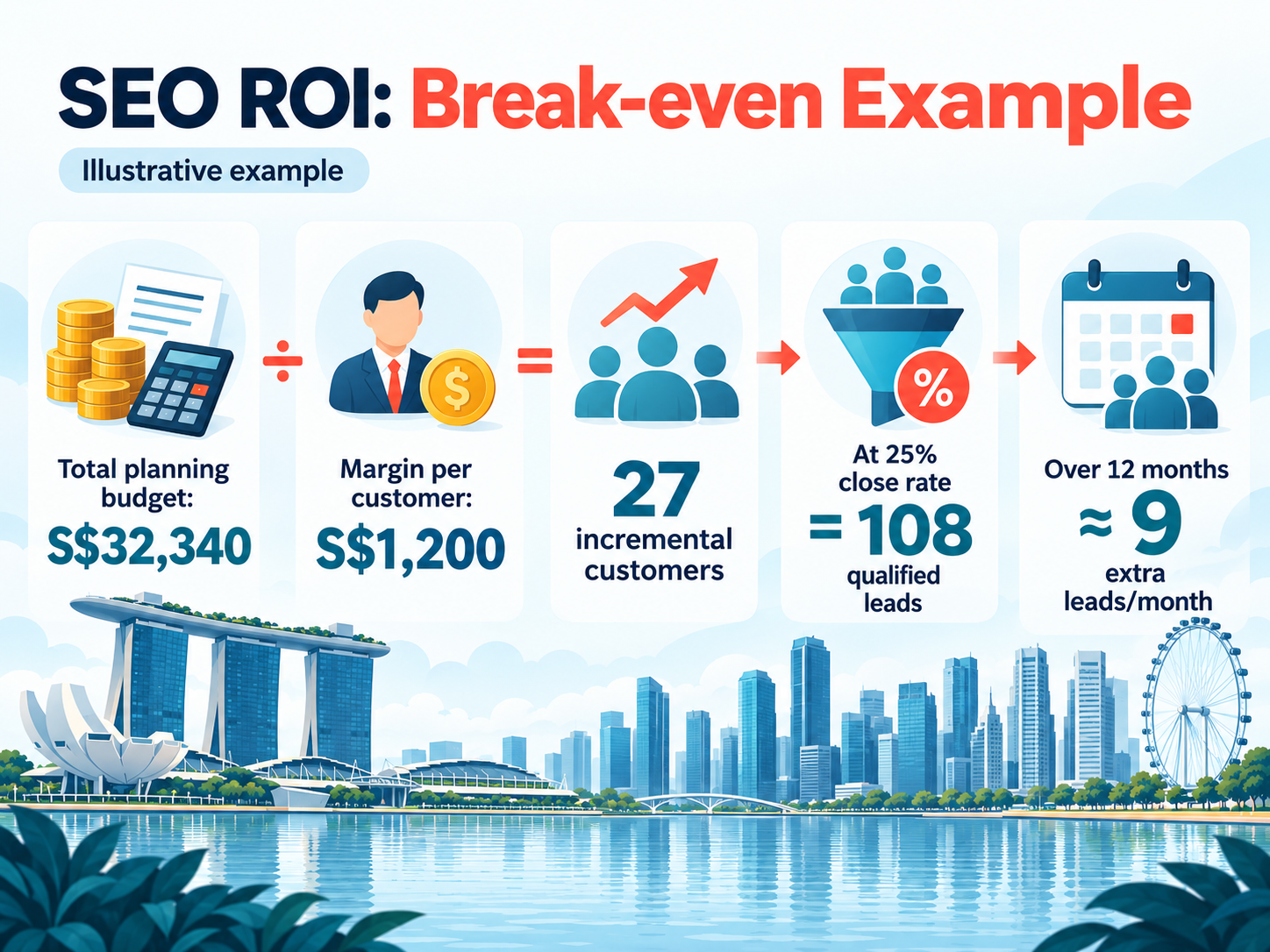
This calculation illustrates a target, not a forecast. It excludes any customer value beyond the measured period and assumes organic search receives appropriate credit for the incremental business generated.
Forecast traffic without pretending it guarantees sales
Work backwards from qualified leads. If 3% of relevant organic visits become qualified enquiries, 108 leads would require about 3,600 additional visits across the period. That is a modelling assumption, not an industry-standard conversion rate.
Avoid using search volume as though every search will become a visit. Visibility, click behaviour, competing results and AI-generated search experiences can influence actual traffic. Google’s AI features guidance confirms that established SEO fundamentals remain applicable to AI Overviews and AI Mode.
Measure the right outcomes
Track Google Search Console performance to understand impressions, clicks, click-through rate and changing search demand. Use Google Analytics 4 key events to monitor important website actions such as submitted enquiries or completed purchases.
Then connect leads with customer relationship management (CRM) records where practical. Separate enquiries from qualified opportunities and confirmed sales. We recommend comparing organic performance with a historical baseline while allowing for seasonality, promotions and other marketing activity.
Do not attribute every branded search to SEO agency work. Some visitors search your company name after seeing an advertisement or recommendation. Reporting should explain attribution limitations instead of treating every organic conversion as newly created demand.
Compare SEO with paid search fairly
Paid search and SEO serve different timelines. Advertising can begin generating visits quickly, but requires continued media spending. Organic pages may attract visitors after their initial production, although rankings and content still need maintenance.
Compare the channels on incremental cost per qualified lead, contribution margin and a common evaluation period. A low organic cost per click is not enough if enquiries are unqualified. Similarly, paid advertising should not be dismissed simply because each click carries a charge.
How to Allocate a Limited SEO Marketing Budget
When resources are tight, the answer is not automatically to buy the smallest package. We prioritise work according to commercial urgency and whether it clears a genuine obstacle. A deliberately narrow campaign can succeed where a vague, low-cost full-service package cannot.
Under S$1,000 per month: Focus on essentials
At this level, concentrate on measurement, important on-page corrections and a small number of service or location pages. Use a one-off audit or specialist consultation if there is a significant technical unknown. Avoid promising weekly content output and extensive outreach from the same small fee.
S1,000–S3,000 per month: Build a focused growth programme
Prioritise core landing pages, technical maintenance and content connected to conversion opportunities. Include a monthly review of search data and lead quality. Ask for a realistic work schedule that distinguishes new deliverables from ongoing monitoring.
Above S$3,000 per month: Increase depth where justified
A larger budget can support specialist writers, deeper technical work, digital PR and multiple commercial categories. Ecommerce sites may need category architecture, structured product information and collaboration with developers. Regional businesses may also need language and market-specific expertise.
Can Singapore Businesses Use Government Grants for SEO in 2026?
The Productivity Solutions Grant is no longer open for new applications. Enterprise Singapore states that PSG, the Enterprise Development Grant (EDG) and Market Readiness Assistance (MRA) ceased on 29 September 2026. Their replacement, the EDGE Grant, launched on 30 September 2026. Existing applications and approved projects under the earlier schemes can continue through their applicable processing and claims stages.
The official EDGE Grant overview describes funding for specified business activities, including digitalisation and capability development. Support percentages vary by activity, and claims are reimbursement-based. The scheme has an overall annual grant cap, but that does not mean every marketing expense qualifies.
Do not deduct a grant from your SEO marketing budget without confirming eligibility. An agency may advertise grant-supported digital solutions, yet ordinary SEO retainers, writing fees and link building are not automatically approved expenses. Eligibility depends on the exact activity and its published conditions.
We recommend checking the official EDGE frequently asked questions and the relevant activity listing before signing or paying for a project. If you cannot identify an eligible activity that explicitly covers the intended purchase, build the budget without a subsidy.
How to Evaluate SEO Agency Quotes Before Signing
Three agencies might each quote S$2,000 per month while proposing entirely different work. We advise using a common request for proposal that identifies your goals, target markets and existing website concerns. Ask every provider to respond to the same questions.
- Scope: Which specific pages, technical tasks and content deliverables are included?
- Implementation: Who makes website changes, and what happens if developer support is required?
- People: Who manages the account, writes content and approves technical recommendations?
- Measurement: Which lead and revenue indicators will be reported, and how are they defined?
- Commercial terms: Are setup fees, software, GST, revisions and exit conditions clear?
- Ownership: Will your business retain website access, content rights, tracking accounts and data?
- Risk: How does the agency handle paid links, unrealistic promises and unexpected changes?
Request examples of relevant completed work and ask how results were measured. The provider’s answers should show whether the proposed scope reflects your business or simply follows a standard package.
Frequently Asked Questions
How much should a small business spend on SEO each month?
An initial Singapore planning range is roughly S1,000–S3,000 per month for a focused SME programme, although simpler tasks can cost less. We recommend basing the final amount on website condition, competition and deliverables rather than assuming every business needs the same package.
Is an SEO retainer better than paying for a one-off audit?
They solve different problems. An audit establishes what needs attention, while a retainer funds ongoing implementation, content and monitoring; businesses with capable in-house teams may need only project or advisory support.
How long does SEO take to generate results?
There is no guaranteed timetable. Google’s Search guidance explains that some changes can take effect quickly while broader improvements may need several months, so we recommend monitoring delivery early and judging commercial impact over a longer period.
Is SEO always cheaper than Google Ads?
No. Costs depend on competition, conversion quality, ongoing maintenance and the period measured. Compare incremental qualified leads and contribution margin rather than assuming organic traffic is free or paid traffic is automatically expensive.
Can the EDGE Grant pay for my SEO campaign?
Do not assume it can. EDGE supports specified eligible activities, so verify whether your exact proposed expense is covered through Enterprise Singapore’s official guidance before including any grant in your financial plan.
Should I hire an SEO freelancer, agency or employee?
A freelancer can handle a narrow scope, while an agency can coordinate several specialist functions. An employee makes sense when SEO is closely integrated with daily operations; compare the full cost and available skills of each option.
What should an SEO monthly report include?
We expect progress against agreed tasks, organic search visibility, relevant page performance and qualified conversion outcomes. The report should explain changes, limitations and the next decisions instead of presenting rankings without commercial context.
Set an SEO Marketing Budget You Can Defend and Sustain
A defensible SEO marketing budget begins with the work required to reach a measurable business goal. Price technical foundations and one-off setup separately, then fund content, maintenance and reporting at a level your team can sustain. Use conservative assumptions to estimate break-even customers and revisit those assumptions as real data arrives.
For Singapore businesses, published retainers provide helpful price anchors but cannot tell you whether a proposal offers good value. We recommend asking providers to justify each major cost against an expected deliverable, a business priority and a clear measurement plan. Budget without an assumed government subsidy unless eligibility is confirmed for the exact EDGE activity.
If you are reviewing SEO quotes or planning next year’s spending, our Singapore SEO team can help scope the necessary work and establish meaningful performance measures. The objective is a programme your business can evaluate, adjust and fund with confidence.