| AI Summary
A content marketing funnel connects educational content, comparisons and purchase information around customer questions. This guide explains how to plan those connections, choose content for each stage and measure where readers stop. A worked example shows how a business can improve existing pages before adding more articles. |
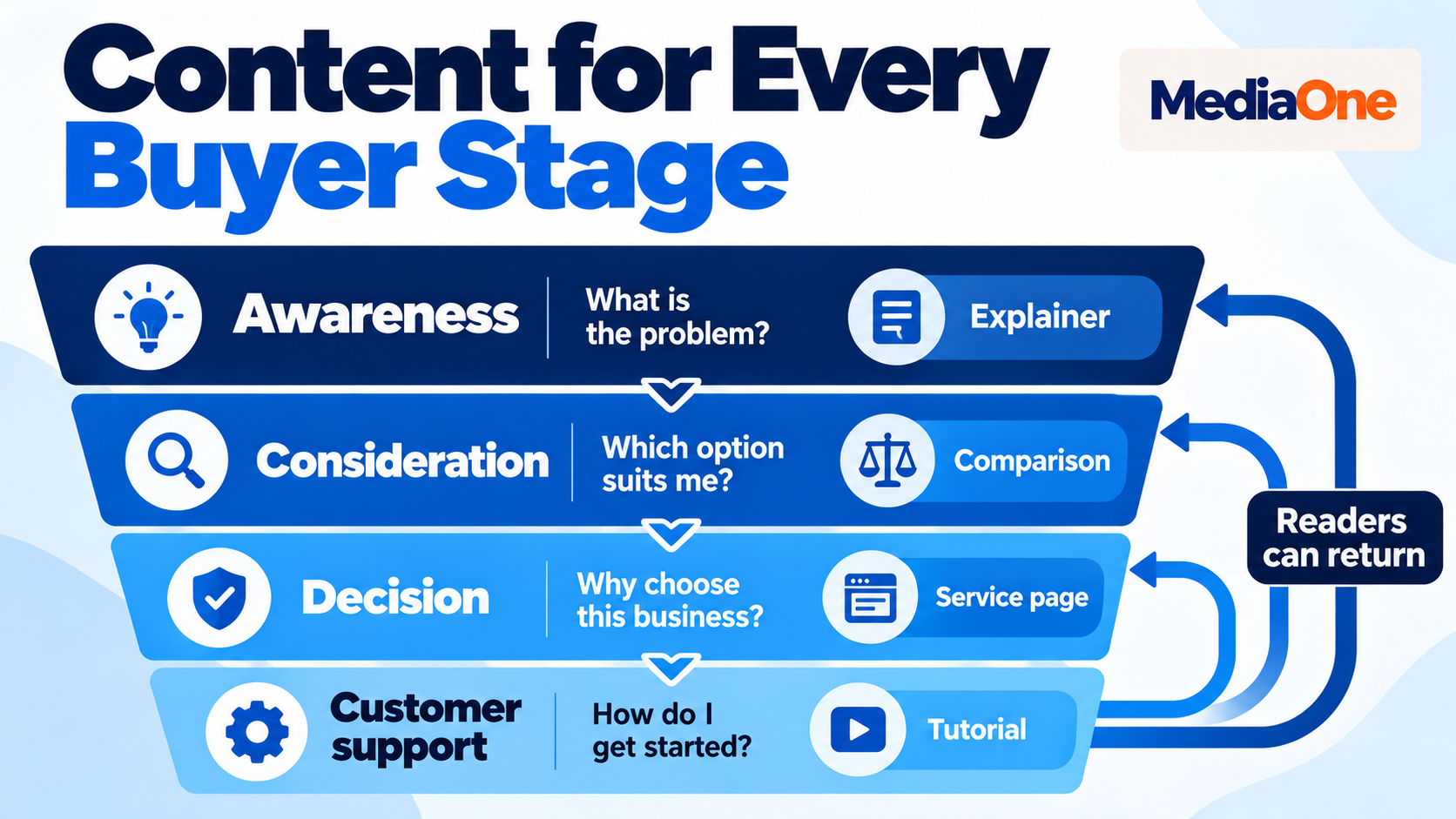
A content marketing funnel is a plan for content that helps people move from learning about a problem to choosing a product or service. Its main stages are awareness, consideration and decision. After purchase, onboarding and support content help customers get started, solve problems and return.
Key Takeaways
- Each page needs a buyer question, a purpose and a relevant next step.
- A comparison page can help readers who understand their problem but have not chosen a solution.
- Low conversion rates need investigation; missing information, technical problems and poor audience targeting require different fixes.
- Content budgets should reflect customer needs and business evidence, without a fixed split between stages.
- Small teams can begin with a connected set of existing pages and improve it over time.
A busy blog can attract readers without helping them buy. Someone learns about a problem, finishes the article and leaves because the website never answers their next question.
A content marketing funnel connects those missing answers. The aim is to help people understand their options and decide whether your business can help.
The best starting point is often an unfinished buying decision. A reader may need a cost explanation, an honest comparison or evidence from a similar customer. Your content plan becomes more focused when it addresses that need.
What is a content marketing funnel?
A content marketing funnel maps the information people need before and after buying. Each stage describes what a person is trying to understand, with content that helps them make progress.
A home renovation customer, for example, might first search for signs that a kitchen needs replacing. Later, they compare renovation approaches, check costs and look for a contractor.
Those questions require different answers:
| Buyer stage | Main question | Content that can help |
| Awareness | “What is causing this problem?” | Explainers, checklists and educational videos |
| Consideration | “Which approach should I choose?” | Comparisons, buying guides and case studies |
| Decision | “Can this business meet my needs?” | Service details, pricing explanations and process pages |
| After purchase | “How do I get started?” | Welcome information, tutorials and support articles |
The stages describe intent, not a required reading order. A returning customer may go straight to a service page. Another person may revisit a comparison several times before contacting you.
Your broader marketing strategy sets the business goal. The content funnel identifies the information needed to support that goal.
Content funnels and sales funnels serve different purposes
A content funnel organises customer information needs. A sales funnel tracks commercial progress, such as an enquiry, consultation, proposal and purchase.
The two should connect. A guide might explain service options before a consultation, while a case study might answer a concern raised during a sales call.
However, reading an article does not automatically make someone a qualified lead. Their needs, location, budget and buying plans still affect whether your business can serve them.
A funnel also needs room for customer support
A purchase creates new questions. Customers may need preparation instructions, account setup help or an explanation of their first appointment.
Those answers deserve a place in the plan. A business selling software might need setup tutorials, while a service business might need a welcome pack.
A seven-stage model is not essential. Awareness, consideration and decision can remain the main planning groups, with separate content for onboarding and ongoing support.
Which content belongs at each funnel stage?
Content belongs at the stage where it answers a buyer’s question. A blog post can introduce a problem, compare solutions or explain a purchase concern. Its purpose depends on the subject and answer.
The same applies to video, email and social posts. Format alone does not tell you whether someone is ready to buy.
Awareness content helps people understand a problem
Top-of-funnel content, often shortened to TOFU, introduces a problem or explains something the audience wants to understand.
A Singapore office cleaning company might publish “Why does office carpet smell after cleaning?” The reader may need an explanation before considering another cleaning service.
Good awareness content usually includes:
- A direct answer near the beginning.
- Signs or examples readers recognise.
- Practical information they can apply.
- A relevant connection to a deeper explanation.
Google’s description of people-first content centres on information created to benefit readers. An awareness article should therefore answer the question fully, including when the answer does not lead to an immediate sale.
A broad topic can attract attention from people outside your market. An office cleaning provider may gain more relevant readers from workplace cleaning questions than from general household tips.
Consideration content helps readers compare options
Middle-of-funnel content, or MOFU, serves people who understand their problem and want to assess possible solutions.
The cleaning customer might now compare carpet extraction with low-moisture cleaning. Their questions concern drying time, disruption and suitability for their premises.
Relevant content could include:
- Side-by-side service comparisons.
- Explanations of different methods.
- Case studies with documented outcomes.
- Buying checklists.
- Answers to common objections.
A comparison earns trust when it describes limitations as well as benefits. A service that requires a longer drying period should explain that requirement.
Your marketing messaging strategy helps keep these explanations consistent. The service names, benefits and limitations should mean the same thing across articles, emails and sales conversations.
Decision content explains the offer and buying process
Bottom-of-funnel content, or BOFU, helps a person assess your business and take a commercial step.
The cleaning customer may now want to know whether you serve their area, work outside office hours and provide quotations after a site visit.
Decision pages should answer questions such as:
- What does the service include?
- Which factors affect the price?
- What information does the business need?
- What happens after an enquiry?
- Which evidence supports the service claims?
A pricing explanation can help even when every project needs a quotation. Customers can understand the factors affecting cost without receiving an invented starting price.
The next action should match the offer. A service page might invite a quotation request, while an online shop might provide delivery details beside the purchase button.
Customer content supports the experience after purchase
Post-purchase content helps customers receive what they bought and understand what to do next.
For an office cleaning service, this could include preparation instructions, access requirements and aftercare information. These details should reflect the actual service.
Support content can also reveal earlier gaps. Repeated questions about drying time suggest that the comparison or service page needs a better explanation before customers book.
Five steps to build a content marketing funnel
A practical content marketing funnel starts with one audience and one business goal. A smaller, connected plan is easier to assess than a large collection of unrelated topics.
The five steps below turn customer questions into a working set of pages.
1. Define the audience and commercial goal
A useful audience description explains the buying situation. “Office managers arranging cleaning around working hours” gives a writer more direction than “professionals aged 30 to 50”.
Customer interviews, enquiry emails and sales notes can reveal:
- The problem that prompted the search.
- Previous attempts to solve it.
- Concerns that delayed a decision.
- People involved in approval.
- Information needed before an enquiry.
A content plan also needs a business outcome. For a service company, that could be qualified quotation requests. For a retailer, it could be completed orders for a product range.
The goal shapes the pages you need. A business selling a complex service may need detailed comparisons, while a familiar product may need stronger delivery and purchase information.
2. Research questions and audit existing pages
Customer questions and keyword research work together. Customer conversations reveal concerns, while search research shows how people express related needs online.
Google’s Keyword Planner provides keyword ideas and search estimates. Its advertising focus means those figures need context when informing an editorial plan.
Meanwhile, the Search Console Performance report shows search queries, clicks and impressions associated with your website. These can reveal questions that existing pages partly address.
A simple content audit records what already exists:
| Buyer question | Existing content | Gap | Possible action |
| Why does carpet smell? | Educational article | Missing explanation of drying problems | Improve the relevant section |
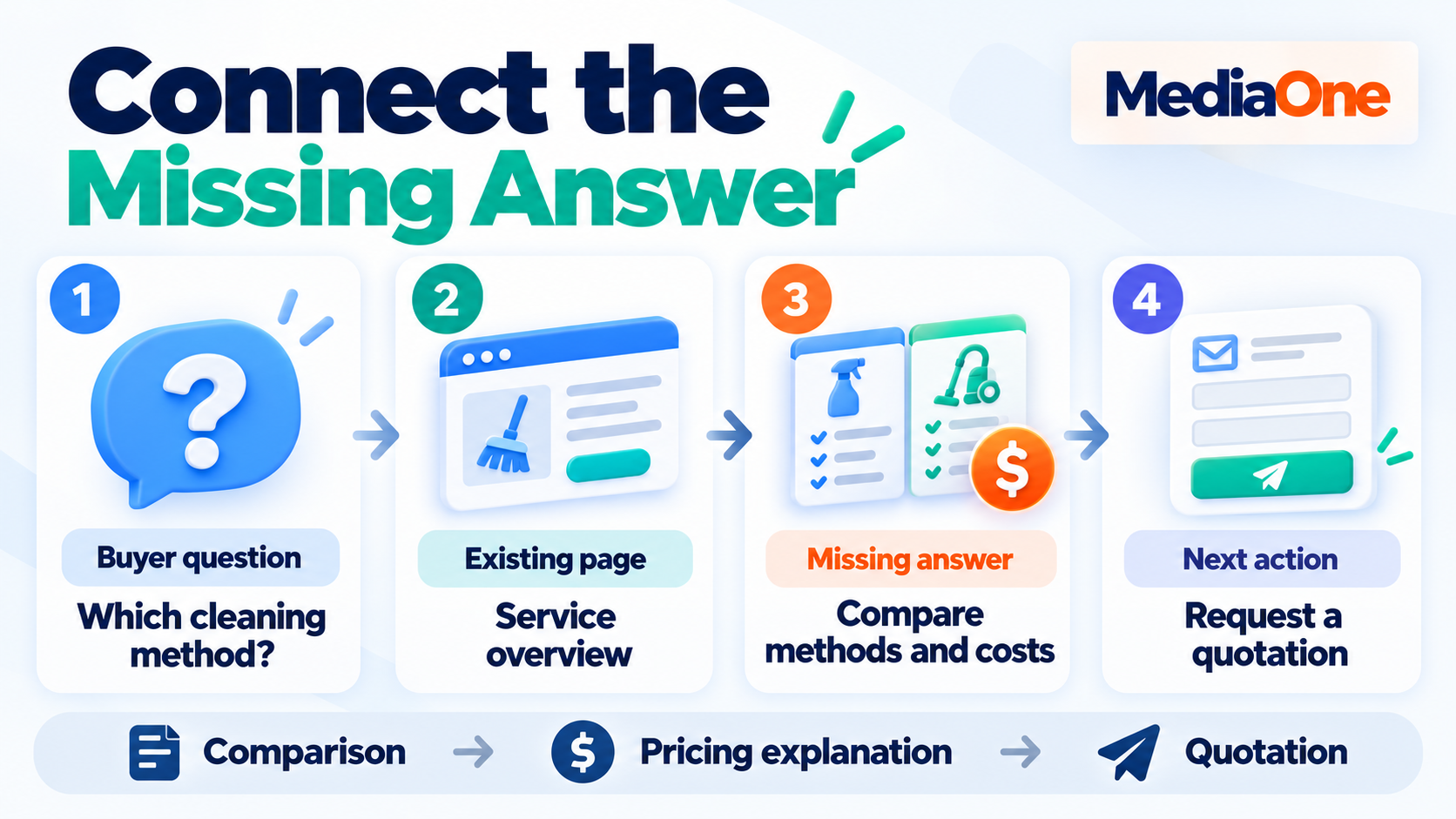
| Which cleaning method suits an occupied office? | General service page | No method comparison | Create a comparison |
| What affects the quotation? | Contact form | Cost factors unexplained | Add a pricing explanation |
| How should staff prepare? | Information shared by email | Customers cannot find it independently | Publish preparation information |
A gap does not always require a new article. An existing page may need a better answer, an example or a connection to another resource.
3. Give each page one main job
Every planned page needs a main question and a purpose. A guide explaining cleaning methods should help readers compare those methods before introducing a quotation request.
A short content brief can include:
- Audience: Who needs the answer?
- Main question: What should the page resolve?
- Evidence: Which sources or business facts support it?
- Next step: What might the reader need afterwards?
- Measure: Which action would indicate progress?
Two pages can mention the same subject without serving the same purpose. An introductory article might explain carpet cleaning, while a comparison examines methods in detail.
However, pages answering the same question for the same audience may compete for attention. Each proposed topic should add a distinct answer or decision aid.
4. Choose formats and distribution channels
A content format is the way information appears. A channel is how people find it.
For example, a comparison table can sit on a website, appear in an email and become a short video. The core answer stays consistent, while its presentation changes.
Your choice of internet marketing channels should reflect audience behaviour and the task:
| Task | Possible format | Possible distribution |
| Explain a common problem | Article or short video | Search and social media |
| Compare service options | Comparison page or webinar | Search, email and sales follow-up |
| Explain the offer | Service page or demonstration | Website navigation and relevant campaigns |
| Prepare customers | Checklist or tutorial | Welcome email and customer support |
A small team can begin with the website and one supporting channel. Consistent distribution is more manageable when the plan matches available staff time.
A focused social media strategy can extend the reach of those answers without requiring a separate topic for every post.
5. Set ownership and a review schedule
A plan needs someone responsible for each page, its accuracy and its next review. Otherwise, a finished article can remain connected to an outdated offer or broken form.
The working content calendar should record the owner, publication date, related pages and intended action. A review can then check both the writing and the customer experience.
A manageable publishing check covers five points:
- The page answers its main question.
- Business details and evidence remain accurate.
- Related links lead to relevant destinations.
- Forms and buttons work on mobile.
- Tracking records the intended action.
Content marketing platforms can help organise these tasks as a team grows. A spreadsheet may be enough for the first connected set of pages.
How do you connect content without pushing readers?
Relevant connections follow the reader’s next likely question. A person learning why a problem occurs may welcome an explanation of possible solutions. An immediate sales form may ask for a decision they have not reached.
Internal links, page sections and calls to action should make the next step understandable.
Internal links should explain the destination
An internal link works best when its wording describes information the reader needs.
For example, an article about cleaning costs could explain that “the quotation depends on floor area, access and the chosen cleaning method”. A link on “cleaning method” would belong naturally if it leads to a comparison.
A link should also fulfil its promise. An anchor about pricing should not send readers to a broad homepage with no cost information.
Useful checks include:
- The destination answers a related question.
- The link appears beside the relevant explanation.
- The anchor makes sense without extra sales wording.
- The page remains understandable without opening the link.
Calls to action should describe the next step
A call to action tells the reader what they can do next. Its wording should reflect the level of commitment involved.
A comparison guide might lead to service details. A service page might offer a quotation request. A customer tutorial might link to support.
The surrounding copy can explain what happens afterwards. An enquiry form might state which project details to include and how the business handles the request.
Specific wording also helps readers assess whether they are ready. “Request an office cleaning quotation” says more than a general “Learn more” button.
Email should continue the conversation
A follow-up email can address the next concern raised by the content someone requested.
For example, a buyer who downloads a cleaning checklist may later receive an explanation of methods. Someone who requests pricing needs a response about their requirements.
Those are different situations. A single sales sequence for every subscriber can overlook the reason each person contacted the business.
Campaign links can carry UTM parameters, which help identify referring campaigns in Google Analytics. Consistent naming makes the resulting reports easier to compare.
How do you measure a content marketing funnel?
A content marketing funnel needs measures that match each page’s purpose. Search visibility can show discovery, while enquiries and purchases show different kinds of progress.
A single traffic total cannot explain the whole process. Your reporting should connect audience activity with the business goal.
Define the actions before reading the results
A service business might measure a sequence from educational article to comparison, service page and completed enquiry.
Google Analytics funnel exploration can analyse defined sequences and show where recorded users stop completing them. Open funnels allow entry at different steps; closed funnels require entry at the first step.
The setup affects the answer. A report requiring readers to visit a comparison page will exclude customers who move directly from an article to an enquiry.
Your chosen sequence should therefore reflect a behaviour you want to investigate. It should not claim to represent every customer journey.
Separate reading activity from business outcomes
A page view, a download and a completed enquiry represent different actions. They should remain distinct in reporting.
A simple measurement plan could look like this:
| Content role | Immediate measure | Business check |
| Educational article | Relevant visits and onward clicks | Whether it reaches the intended audience |
| Comparison page | Visits to related service details | Whether enquiries show stronger understanding |
| Service page | Completed enquiry or purchase | Lead quality or completed orders |
| Customer tutorial | Task completion or support feedback | Whether customers resolve the issue |
Google Analytics key events identify actions particularly important to a business. A completed enquiry may qualify; a routine page view may serve as a supporting measure.
Sales records still need to show what happened after the form. More enquiries do not necessarily mean more suitable customers.
Compare like-for-like results
A transition rate expresses the share of people completing the next measured step:
Transition rate = people completing the next step ÷ people reaching the current step × 100
The comparison needs consistent counting. Users, sessions and total event counts are different measures and should not be mixed in the same calculation.
A monthly review should also account for campaign changes, seasonal demand and the time customers need to decide. Ten visitors and one enquiry produce a 10% rate, but that small sample provides limited evidence.
Attribution provides context, not proof
A customer may read an article, return through email and buy after searching for the brand. Giving all credit to one visit can hide earlier activity.
Google Analytics attribution models assign credit across recorded interactions according to the selected model. Those reports describe observed activity; they do not prove that a particular page caused the purchase.
Your content marketing ROI assessment can combine this evidence with production costs, customer records and commercial outcomes. The funnel review itself should identify where an answer or connection needs work.
Where does the content marketing funnel lose readers?
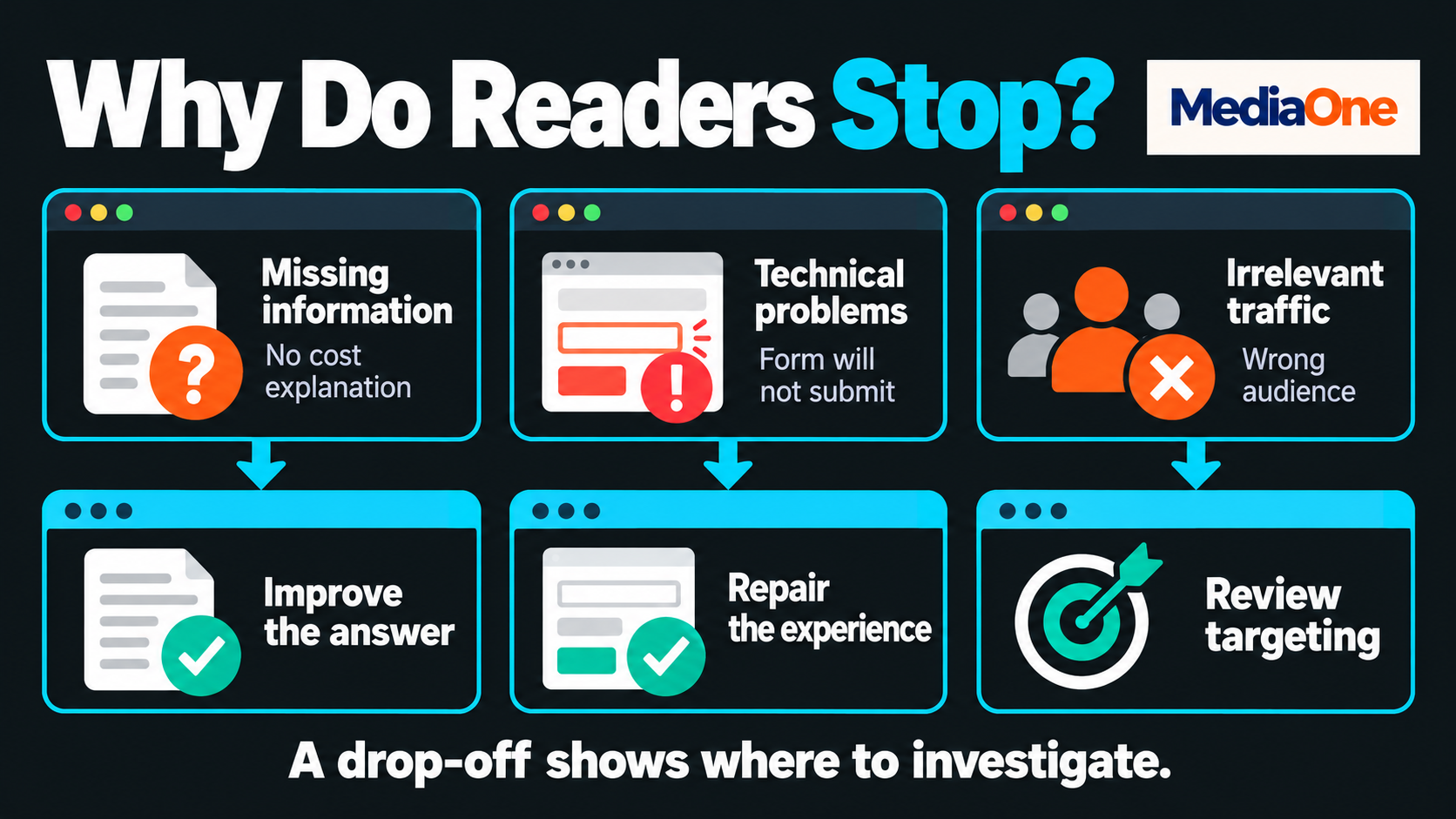
A drop-off shows where to investigate. It does not identify the cause on its own.
A reader may leave because the page answers their question completely. Another may leave because the next page is confusing or a form fails.
A worked example: finding the missing answer
The figures below are hypothetical. Each row represents a separate transition measured among eligible users, not one continuous group.
| Transition | Users reaching the page | Users taking the next step | Rate |
| Educational article to comparison | 5,000 | 300 | 6% |
| Comparison to service details | 600 | 180 | 30% |
| Service details to completed enquiry | 400 | 8 | 2% |
The 2% rate needs investigation, but it does not automatically make the service page the best investment. The business should compare similar periods and inspect the page.
Possible findings include:
- Mobile users cannot submit the form.
- Customers cannot tell which locations the business serves.
- The page omits factors affecting price.
- Visitors come from a campaign aimed at the wrong audience.
Each finding requires a different response. A new case study will not repair a broken form.
Missing answers need content; technical faults need repair
A service page may leave readers uncertain about cost, scope or preparation. Those gaps call for more precise information.
A difficult form needs a different check. The W3C’s accessible forms tutorial explains the value of labels, instructions and requesting only information needed for the process.
A test enquiry on a phone can reveal problems that a traffic report misses. The confirmation message, email delivery and customer response process also belong in that check.
Priorities should reflect evidence and effort
A practical review can rank issues by the number of relevant people affected, the importance of the missing answer and the effort required to resolve it.
An inaccurate service area deserves attention because it misleads customers. A missing comparison may deserve the next content brief if sales conversations repeatedly raise that question.
A fixed publishing ratio cannot make those decisions. The business needs its own evidence about customer needs, existing content and commercial capacity.
Conclusion: Build a content marketing funnel around buyer questions
A content marketing funnel gives each page a role in a customer decision. The first review can focus on one offer, the questions surrounding it and the connections between existing answers.
MediaOne’s content marketing services support content planning and creation. Our team can discuss how your articles, comparisons and service pages work together through a content marketing consultation.
FAQs about content marketing funnels
Can a small business build a funnel without specialist software?
A small business can begin with a spreadsheet, its existing website and basic reporting tools. The first requirement is a connected set of answers. Specialist software becomes more relevant when approvals, publishing tasks and reporting become difficult to manage manually.
Should a business hide guides behind a form?
A form can suit a resource that offers enough value to justify sharing contact details. Essential information about the offer should remain easy to access. A business can test whether a gated resource attracts suitable enquiries or simply reduces readership.
Can one website serve several customer groups?
One website can serve several groups when visitors can identify the information meant for them. Separate industry examples or service sections may help. A new page is warranted when a group has distinct needs, not simply because it has a different job title.
Who should write a case study when customers cannot be named?
A writer can create an anonymised case study from documented work when the business has permission to share the relevant details. The page should explain that identifying information has been withheld. Invented customers, quotations and results should never appear as real evidence.
Does a funnel require paid advertising?
A funnel can attract readers through organic search, referrals, email and other channels without paid advertising. Advertising adds a distribution cost and requires its own assessment. The decision depends on the audience, available budget and value of the intended action.
Can AI help create funnel content?
AI can help organise research, suggest structures and simplify drafts. A person still needs to check sources, business details and claims before publication. Customer interviews and documented service experience give the content information that a general drafting tool may lack.