

Most Singapore SMEs run marketing without a clear plan. A marketing strategy is a written plan that defines your target audience, what you want them to do, and the channels and budget you need to achieve your goals. HubSpot research found that nearly a quarter (24%) of Singapore companies doing digital marketing aren’t confident in their team’s ability to use it effectively. The main problem is usually that no one ever writes down, owns or reviews the strategy.
This guide argues that a written plan beats channel spend. It follows a Singapore bakery-café chain with three outlets that wants more corporate catering orders.
Key Takeaways
- A strategy only works when you write it down. Marketers who document their strategy are 313% more likely to report success.
- Set a numeric, time-bound goal first. A target like growing online revenue by 20% gives every channel a clear benchmark.
- Define your audience by who buys. Singapore has four official languages, Malay, Mandarin, Tamil and English, so segment by need and language habits.
- Evaluate your current marketing performance honestly. This article’s own heuristic: 6 or less out of 10 – suggests fixing the foundations before adding channels.
- Tie every campaign to a business result. Shares and reach are not sales.
- Review quarterly. A fixed review date keeps your marketing strategy on track.
What Is a Marketing Strategy? Definition, Components and Types
A marketing strategy is a written plan that answers three questions: who you are selling to, what you want them to do, and which channels and budget will get you there. It is not a plan of tactics alone. A list of social posts and email blasts is a set of actions, not a strategy, because it doesn’t explain why they exist or which goal they serve. The main types are growth, retention, positioning and brand awareness.
Tactics, such as a social post or an email campaign, are the individual actions. The strategy explains how they connect to one business goal. Good strategies start with market research that shows who your customers are and what they need before you commit any budget. A strategy also helps your team decide which products or services to highlight and which price points suit each audience.
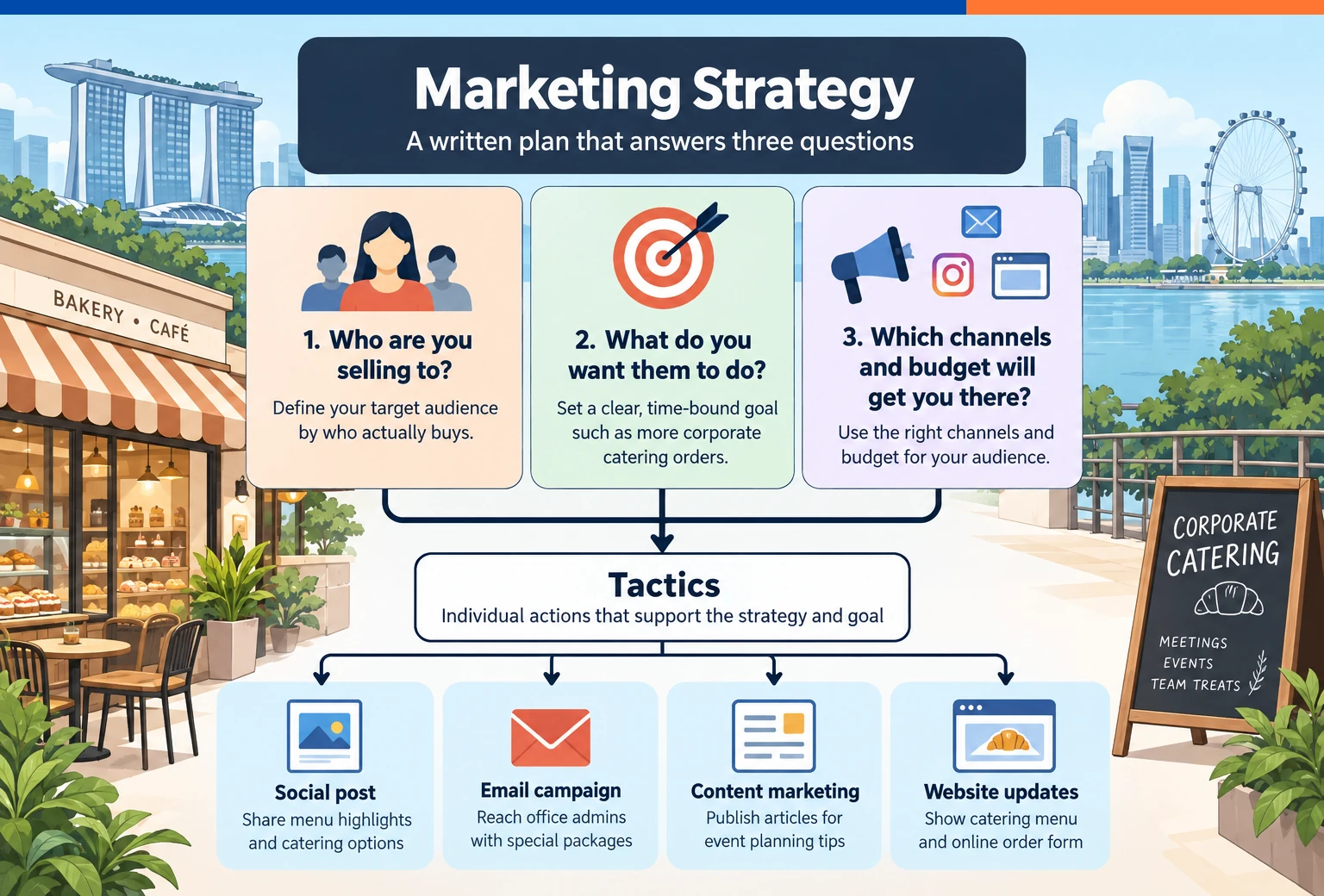
Before approving any campaign, ask whether it serves a stated goal and a defined audience.
Components of a marketing strategy
A working strategy usually covers five parts:
- Goals and objectives: a numeric, time-bound target, such as growing online revenue by 20%.
- Target audience: defined by who actually buys, not who you hope will buy.
- Positioning and messaging: the right reason a customer should choose your brand.
- Marketing mix and channels: the few channels your target market already uses, such as content and digital marketing.
- Budget and measurement: how much you will spend and which key performance indicators show whether effective marketing is working.
For the bakery-café, the goal is corporate catering, the audience is office admin managers who order for their teams, and the message is reliable same-day delivery for meetings.
Types of marketing strategies
Most strategies fall into four approaches. Growth means acquiring new customers. Retention means keeping your customer base. Positioning means differentiating from competitors. Brand awareness means becoming known. The bakery-café is in growth mode, so its plan focuses on acquisition, with retention added once it secures its first corporate accounts. An early question is which approach your business is really in and how it will attract and retain the right customers in that market.
Strategy examples for Singapore SMEs
- Growth: a bakery-café with three outlets targets office admin managers for corporate catering.
- Retention: a tuition centre emails parents a term-end offer to re-enrol their children.
- Positioning: a Tanjong Pagar florist sets itself apart as the same-day option for hotels.
- Brand awareness: a Bugis cafe shares its story on Instagram in Mandarin and English to reach nearby shoppers.
How to Build a Marketing Strategy, Step by Step
Most strategies fail at the start because the goal is vague. “Grow sales” cannot be checked. A goal to grow online revenue by 20% is measurable. Set one main goal, a review date at six or twelve months, and a threshold that counts as a miss. Tie the goal to a specific product or service, and align it with your digital marketing and online presence. The bakery-café sets one goal: win 15 recurring corporate catering accounts within twelve months, with a review at month six, so the right customers stay on track to be attracted and retained.

Define the target audience by who actually buys from you. Build simple personas from customer records, enquiry logs and five or six short customer interviews. Segment by the problem each group is trying to solve, not just by age or income, so each segment reflects a real customer base. In Singapore, also note each group’s language and platform habits to reach the right people in each market. Map each segment to one of your core marketing strategies so every channel has a clear audience to serve.
Segmentation and persona template
| Segment | Core problem | Language and platform habits | Buying role |
|---|---|---|---|
| Office admin managers | Feeding meetings on time | English, LinkedIn and email | Places team orders |
| Mandarin-speaking families | Weekend treats for home | Mandarin, Instagram and WhatsApp | Buys for the household |
| Event planners | Reliable bulk orders | English, email and phone | Approves budgets |
Persona template: Name and role | Daily problem | What they search for | Platforms they use | Objection to overcome | The one message that answers it.
Worked example: “Siti, office admin manager in One-North, orders lunch for 30 staff each Friday. Her problem is a late supplier. She searches “same-day corporate catering Singapore” on her phone and checks LinkedIn for recommendations. Her objection is cost per head, so the message is a fixed weekly bundle with guaranteed delivery times that help her choose the right option.
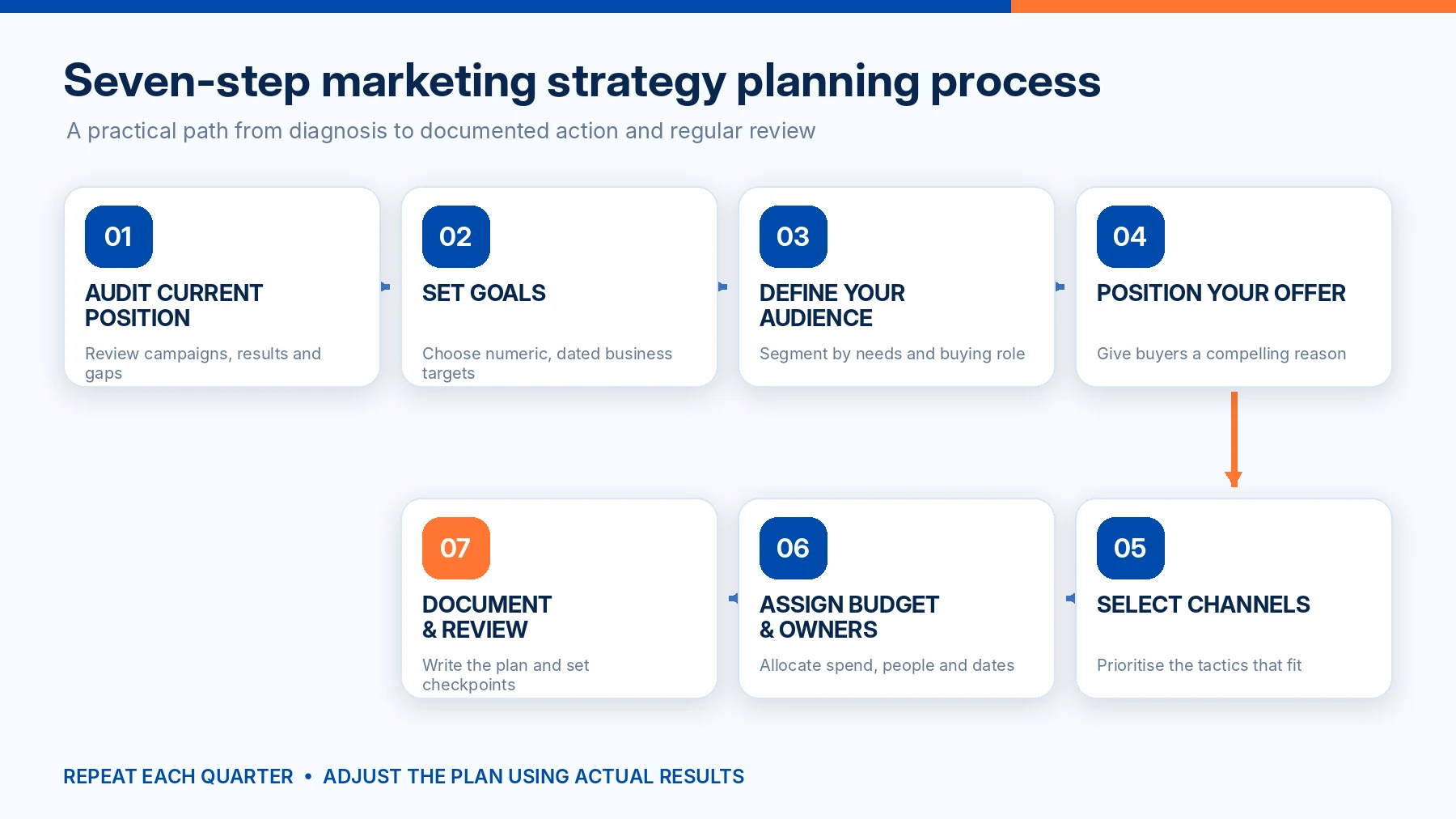
The core process runs in seven steps:
- Audit your current position and results.
- Set goals and success metrics.
- Identify and segment your target audience.
- Choose positioning and core message.
- Select channels and tactics.
- Set budget, owners and timelines.
- Document the strategy and schedule reviews.
Step 7 matters most. HubSpot reports that marketers who document their strategy are 313% more likely to report success. Each step needs an owner and a date, or it stalls. A written plan also gives every business unit and brand team a shared reference point and helps your team stay aligned as the market shifts.
Choosing Marketing Channels and Tactics
Every channel competes for the same limited budget, so the real question is which one best supports your business goals. Start with your marketing strategies and marketing plan, then match each channel to its role within the broader marketing mix. Choosing the right channel is important, and the right products or services make each one easier to justify.
| Channel | Best use | Typical cost level | Time to results |
|---|---|---|---|
| Website, blog and SEO | Capturing demand from people already searching | Low to medium | Six months or more |
| Email marketing | Retaining and re-engaging existing customers | Low | Weeks |
| Paid social media | Reaching a defined audience quickly | Medium | Days to weeks |
| Digital ads (search and display) | Capturing high-intent buyers | Medium to high | Days |
During expansion, it’s worth building the website, blog, and SEO early. HubSpot’s 2026 State of Marketing Report shows that websites, blogs and SEO (27%) and paid social media content (26%) deliver some of the strongest ROI during expansion. Content keeps working after you stop paying for it, and effective market research will tell you which channels your buyers actually use.
The bakery-café faces this trade-off directly. Paid ads bring quick enquiries, mostly for single birthday cakes. A corporate catering landing page and two email sequences to office managers take longer but target the orders that matter, and they strengthen the brand with buyers who place repeat orders.

Competitor analysis and the marketing mix (4Ps)
Before choosing channels, list the three or four competitors your buyers already compare you with. For each, note their product range, price, placement (where they sell) and promotion (how they reach buyers). The bakery-café found that rival caterers compete on price but rarely promise delivery times, so it chose reliability as its promotion. It then checked the other three Ps: a fixed weekly bundle for product, a mid-range price for price, and its three outlets for place, which helped it decide which products or services to feature in each channel.
Content marketing strategy
Plan content around the buyer’s journey: awareness articles for people with a problem, comparison pages for those weighing options, and case-style pages for buyers ready to decide. Review each piece after about six months. Refresh pages that still rank but have lost traffic, and retire pages that attract no qualified visitors.
Social media marketing strategy
Choose the one or two platforms where your target market already spends time. The bakery-café uses LinkedIn for office buyers and Instagram for its Mandarin-speaking outlet customers. Use organic posts to build familiarity, and paid social to reach beyond your followers once you have a clear offer and a landing page that presents your product clearly. Clear, consistent messaging matters and helps people understand what you offer.
Measuring and Documenting Your Marketing Strategy
A strategy that lives only in the owner’s head cannot be measured, corrected or handed to anyone else. Documentation turns intention into accountability and keeps brand voice consistent across the team. A written marketing plan also shows whether each product or service reaches the right buyers in the target market and whether your digital marketing efforts support your marketing goals.
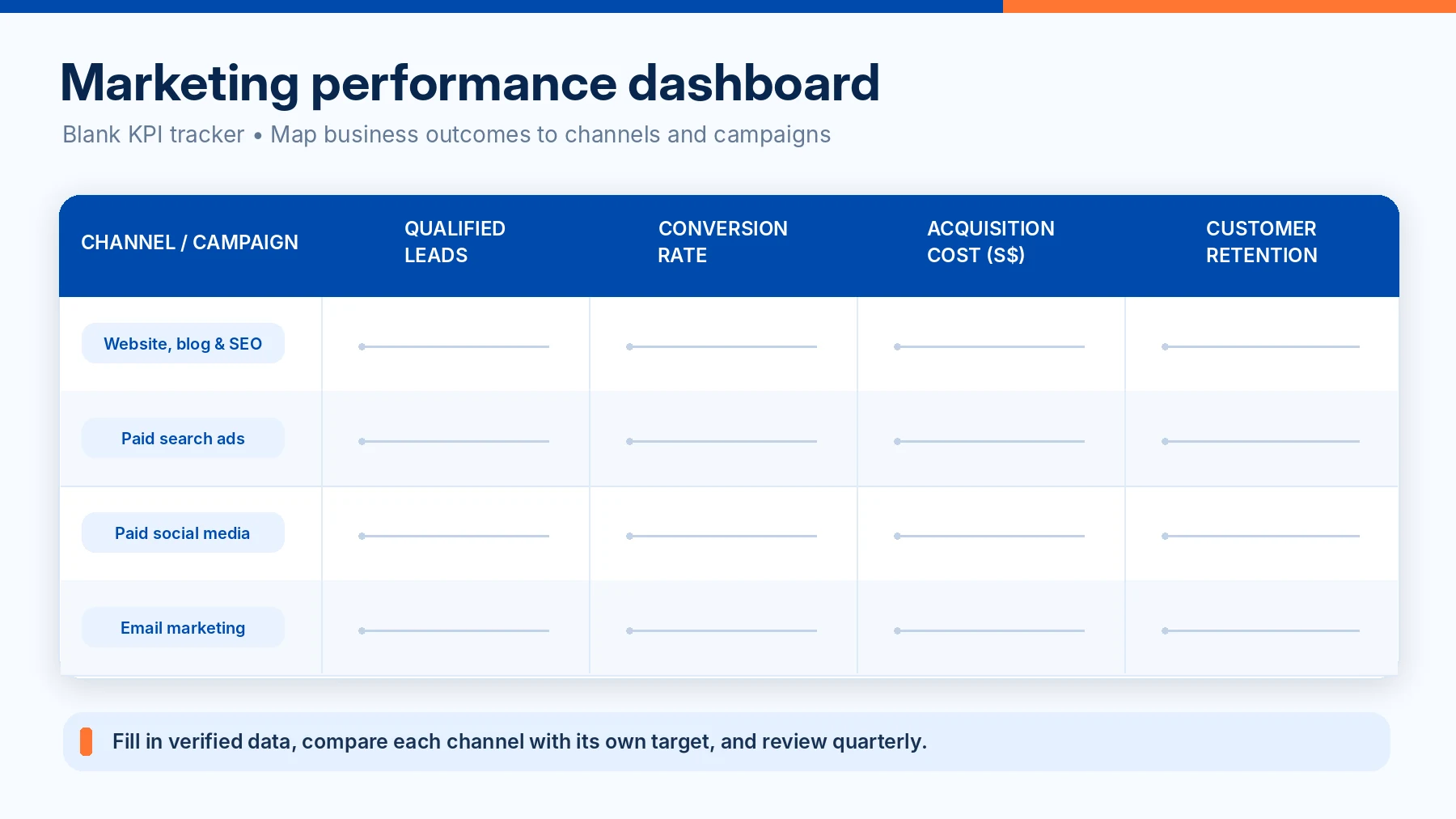
Track a small set of key performance indicators tied to your business goals: qualified leads, conversion rate, customer acquisition cost and retention. Map each to a single channel or campaign. Different channels show different results, so compare each against its own target; this method is the most effective way to see which channel is working.
Worked scoring example
The bakery-café scores its strategy on five questions, each worth 0 (no), 1 (partly), or 2 (yes). Its answers: numeric and dated goal (2), buyer-defined audience (2), channels tied to a result (1), owners named (1), and plan written and shared (2). Total: 8 out of 10. The score points to the gap: channels without a clear result. The chain’s next step is to set a measurable enquiry target for each channel before adding budget. This article uses a score of 6 or less out of 10 as its own guideline, not an industry standard, to indicate that foundations need work before channels are added. Keeping this assessment important in every quarter helps the team spot problems early.
Use this diagnostic table when results slip:
| Symptom | Likely cause | Corrective action |
|---|---|---|
| Traffic rises, enquiries stay flat | Wrong audience or weak offer | Revisit audience definition and core message |
| Enquiries rise, few sales close | Poor follow-up or unclear pricing | Tighten sales process and response times |
| Acquisition cost climbs each quarter | Channel saturation | Reallocate budget to your best-converting channel |
| Customers do not return | Weak post-purchase experience | Build retention offers and email follow-up |
Quarterly review checklist:
- Compare results against each numeric goal.
- Score the strategy against the five questions above. If the score is below 6 out of 10, please address the foundational issues first.
- Drop or pause any channel without a measurable outcome.
- Record decisions and owners in the written document.
Conclusion: Turning Strategy into Action
A written strategy is what turns marketing spend into business results. Start with one numeric goal, define your buyers, pick the channels that match them, and review every quarter.
Most marketing problems in small and medium businesses come from one gap: the strategy lives in someone’s head. Writing it down, tying it to a numeric goal and reviewing it on a fixed date closes that gap. HubSpot found that marketers who document their strategies are 313% more likely to report success. That is a correlation, and it does not prove documentation causes the result.
For Singapore businesses, a missing strategy means spending the budget on channels that don’t bring in buyers. A written marketing plan shows which channels earn their place in the market. Regular reviews keep that plan honest and align marketing efforts with what actually sells, which is what it takes to attract and retain customers.
Start this quarter with the checklist below. First, score your current marketing, then close the gaps in order. A short written plan helps your team agree on priorities before committing any budget, and getting those priorities right matters for every later decision.
- Write one numeric, time-bound business goal on a single page.
- Describe your target market by who actually buys, using enquiries and customer data.
- Assign each active channel one measurable outcome, such as online enquiries or repeat orders for each product or service.
- Share the written strategy with everyone who carries it out.
- Book the next review date now. This article uses a score below 6 out of 10 as its own guideline for the first thing to fix. It is not an industry benchmark.
Frequently Asked Questions
What is the difference between a marketing strategy and a marketing plan?
A marketing strategy sets direction: who you serve, what you want to achieve and why you are the right choice for them. A marketing plan turns that direction into dated actions, budgets and owners. Write the strategy first, or the plan becomes a list of tactics with no shared goal.
What are the four basic marketing strategies?
The four basic approaches are growth (winning new customers), retention (keeping existing ones), positioning (owning a distinct place in buyers’ minds) and brand awareness (making people aware you exist). Most businesses prioritise one of these at any given stage.
How long should a marketing strategy cover?
Break it into quarterly goals. The direction should hold longer than any single campaign, but channels and budgets should change as results come in. Set a fixed review date when you write it so you revisit the document rather than shelve it.
How do I know if my marketing strategy is working?
Tie each channel to one measurable outcome, such as qualified leads, conversion rate, customer acquisition cost or repeat purchases. Compare results against the target you set at the start, not against shares or impressions alone.