Most brands have a messaging problem because they have not decided which buyer problem they own or what they promise before writing copy.

A marketing messaging strategy settles those questions first. It is the documented set of choices every ad, email and sales script is built from. This guide covers a build process, a draft-scoring check and where the approach breaks down.
Key Takeaways
- Messaging sets direction. It defines the buyer problem you own, your words and your promise.
- Score drafts before channel work. Our practical Message Alignment Scorecard rates each draft from 1 to 5. Revise anything below 3.
- Tie messages to goals. Each draft needs a named business objective and a way to track it.
- Include internal audiences. Staff need the same core message as customer-facing teams.
- Test under pressure. Draft crisis responses before a product or service problem arises.
- Start small. Draft a focused first version, then validate it with customer evidence.
Why Inconsistent Brand Messaging Loses Buyers
Brands can produce plenty of messages, but few that a buyer remembers. The problem is not always the volume or the content itself. The team may not have decided, before writing, which problem the brand owns, for whom, and in what words. Without agreed key messages, every channel is left to improvise its own version of the brand’s story.
A strong positioning statement still needs proof. A message can sound sharp in a meeting and still have no evidence behind it. Positioning may attract attention, but proof helps a buyer evaluate the brand’s story.
What a Marketing Messaging Strategy Includes
A marketing messaging strategy is the documented record of those decisions: the problem your business owns, the target audience, the words and the promise. It gives every ad, email and sales script a shared foundation and helps teams write from one brand voice. It should also state clearly what the product or service does for the buyer.
For teams aligning brand messaging with a wider identity, MediaOne’s branding strategy services cover positioning, purpose and brand promise.
How Consistent Messaging Supports Conversions
Teams that treat messaging as the last step let each channel drift. A paid search ad promises speed, the landing page promises savings and the sales deck leads with features. Buyers can notice the gaps, and social media posts that repeat a different version of the story add to the confusion.
The mechanism is friction. When a buyer sees one problem named one way, they can match it to their own situation quickly. When each channel names it differently, they must work out whether the offer still fits, which can interrupt the buying process. Consistent messaging reduces that work and helps the buyer follow the brand’s story from first contact to purchase. Google Ads also advises advertisers to match ad claims to landing-page content.
When decisions are made once, tested before production and kept consistent, prospects hear the same problem named the same way at every touchpoint.
Who Needs a Marketing Messaging Strategy
This guide is for marketing leaders, founders and product marketers who need consistent results across channels, whether they sell to businesses or consumers. It also helps anyone who writes brand content and needs a clear standard to check it against.
You will get the Message Alignment Scorecard, which rates each draft on audience specificity, value clarity, proof availability and goal linkage before channel work begins.
Five Marketing Messaging Strategy Components
A messaging strategy has five parts: audience, core message, value proposition, voice and goals. Each part limits the others. The audience decision limits which problems you can credibly claim, and the value proposition decision limits which proof you need.
Treat the five parts as a chain. If one link is weak, the rest carry that weakness forward. Every piece of content should make sense to a reader who has never seen the rest of the brand’s materials, which is the key messages test in practice.
The five components below add goals as the test that holds the other four accountable. For a related view of positioning and brand identity, see MediaOne’s brand strategy framework.
Defining the Primary Buyer Audience
Name one primary buyer and describe their situation in their own words. For example, ‘Operations managers at Singapore logistics firms who lose hours each week to manual invoice matching’ is usable. ‘Businesses that want efficiency’ is not.
Setting the Core Message and Brand Promise
The core message is the single idea you want remembered. The brand promise is the commitment behind it. Keep the promise narrow enough that you can keep it.
Distinguishing the Value Proposition From the USP
The value proposition states the outcome a specific buyer gets. The USP states why that outcome comes from you rather than a competitor. A USP without a grounded outcome is just a slogan.
Defining Brand Voice and Tone
Voice is the consistent personality across all messages. Tone shifts with context: reassuring in a support email, confident in a launch announcement. Define voice with three to five adjectives plus one example of what the brand would never say.
Linking Messages to Business Goals
Every message should tie to a measurable outcome: a demo request, a renewal, fewer support calls, or an employee understanding a policy. A message that cannot be linked to a named goal does not belong in the strategy yet.
| Component | Question it answers | Failure sign |
| Audience | Who exactly is this for? | Messages fit ‘everyone’ |
| Core message | What must they remember? | Three ideas compete |
| Value proposition | What outcome do they get? | Lists features only |
| Voice and tone | How do we sound? | Each channel sounds different |
| Goals | What should this change? | No metric to judge it |
Customer Research for Brand Messaging
Messaging can fall short before anyone writes a word when the team guesses who the buyer is and what worries them. Audience research replaces those guesses with evidence. When local context shapes buyer decisions, use a Singapore brand marketing approach to check assumptions about language and customer needs.
Building Decision-Based Buyer Personas
A useful persona describes a decision, not a demographic. Focus on the question the person is trying to answer and who else must agree before they buy. Start with your last closed deal: who started the search, who signed off, and what they nearly chose instead.
For each persona, record:
- The trigger: the event that started the search.
- The job to be done: the outcome, in the buyer’s own terms.
- The obstacle: what stopped them buying before, such as budget, internal risk or switching effort.
- The decision group: who influences or approves.
- The proof they need: the evidence that would convince a sceptical reader.
Start with a small set of decision-based personas. Add more only when the buying process differs meaningfully. Every persona should map to a distinct business decision, so the research stays tied to revenue rather than to abstract profiles.
Finding Buyer Language in Customer Feedback
Customers’ words are usually better than the ones a marketing team invents. Sales calls, support tickets and reviews hold the vocabulary people actually use, so they are useful raw material for key messages and brand voice. Pull the same phrases from your public-facing website reviews and forms, since they show how prospects describe their problem before they ever speak to sales.
- Export a manageable sample of recent items from each source.
- Highlight phrases that describe the problem, the desired result or a comparison with alternatives.
- Group phrases that repeat across sources. Repeated patterns offer better evidence than one vivid quote.
For example, a finance software firm might say ‘reconciliation automation’ while customers say ‘month-end is killing my weekends’. The second phrase names the pain and belongs in the headline.

Mapping Messages to Buying Stages
One message rarely works at every stage. Match your content to what the buyer needs at each point.
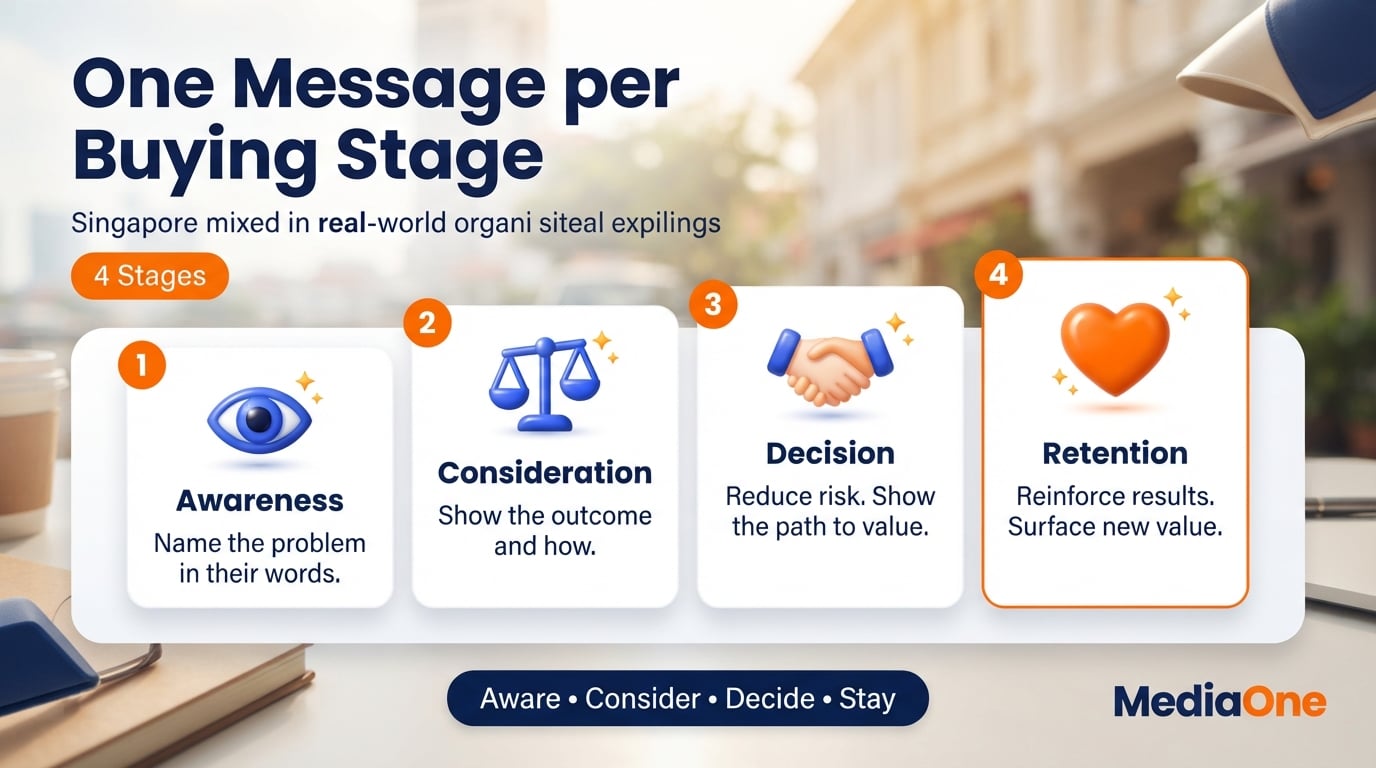
| Stage | Buyer question | Message job | Typical proof |
| Awareness | ‘Is this a problem I need to solve?’ | Name the problem in the buyer’s words | Data on the scale of the problem |
| Consideration | ‘Which approach fits my situation?’ | Explain the outcome and how you deliver it | Case studies, comparisons |
| Decision | ‘Can I justify this choice?’ | Reduce risk, show the path to value | References, pricing clarity |
| Retention | ‘Am I getting what I paid for?’ | Reinforce results, surface new value | Usage reports, outcome reviews |
If every asset sits in the consideration column, you are missing the awareness messages that bring new buyers in.
Developing a Customer-Led Value Proposition and USP
A value proposition states the specific outcome a buyer gets, in the words that buyer already uses. A unique selling proposition (USP) explains why your business offers that outcome differently from its competitors. Start with customer evidence, then work outward. Customer language helps readers recognise the problem the offer addresses.
Drafting a Value Proposition From Buyer Evidence
- Collect raw customer language. Pull recent reviews, support tickets and sales call notes. Highlight sentences that describe the problem, the result the buyer wants, or the moment they decided to buy.
- Group outcomes, not features. Sort highlights into themes such as ‘saves time on month-end reporting.’ Discard themes that appear only once.
- Pick the outcome that recurs most and has the greatest business value. Rank by how often it appears and by revenue impact, where you know it. Focus on the pain points buyers name most often.
- Write a one-sentence draft. Use the buyer’s own words and promise only one outcome. Test the wording with the target audience to confirm it reads as relevant to them.
Score the draft on the Message Alignment Scorecard. Rate audience specificity, value clarity, proof availability and goal linkage from 1 to 5 as an internal review method, not a validated performance metric. Any score below 3 sends the draft back for revision.
[IMAGE: Example customer-language spreadsheet with phrase, source and theme columns]
Testing USP Claims Against Competitors
| Test | Question to ask | Pass condition |
| Substitution | Could a named competitor make this claim tomorrow? | No, or only after a major product change |
| Evidence | Do we hold data, a process or a customer result that proves it? | Yes, documented |
| Buyer relevance | Does a buyer in our segment rank this above other factors? | Yes, supported by deal notes or research |
| Durability | Will this still be true in the coming years? | Yes, tied to something hard to copy |
Place your USP beside each competitor’s homepage headline. If their headline could sit in your place unedited, your USP is generic. ‘Fastest’, ‘easiest’ and ‘best service’ fail for this reason. Check the same USP across every channel your buyers use, from search results to social media posts, so the claim holds wherever it appears. Keep the claim consistent across every website page and piece of content a buyer might encounter.
Supporting Brand Promises With Proof
A brand promise is what the business commits to every time. Proof points show the promise is kept. In Singapore, the Singapore Code of Advertising Practice calls for truthful advertising and cautions against misuse of research and statistics, so treat proof as a prerequisite, not an add-on. Consistent brand messaging depends on proof that every team can point to, and a clear message strategy keeps those proof points aligned across channels.
For each promise, list three proof types:
- Quantitative: a measured result, with the measurement method noted.
- Process: a documented step that makes the outcome repeatable.
- Testimonial: a named customer quote, approved for use.
If you cannot fill at least one category for a promise, rewrite the promise to match what you can prove. Ask your team which proof points would help a sales rep answer an objection on the spot.
How to Build a Marketing Messaging Strategy
Most teams start by drafting taglines. The steps below run in the opposite order: audit what exists, listen to buyers, draft candidate messages, test them, then lock them down. Each step produces an artifact the next one depends on. A structured process keeps the marketing strategy from resting on untested assumptions, and it gives the content a single, tested message strategy to build on.
Step 1 Audit Messaging Across Channels
Collect everything the business already says: homepage, product pages, email sequences, paid ads, sales decks, proposals and social bios. Read it end to end, as a buyer would.
Look for contradictions (a website promising speed while the sales deck leads with price), repetition (the same generic claim on every page) and gaps where buying-process stages have no message. Record each finding in a table with the channel, the claim, and whether it is specific, consistent and supported by proof. This brand messaging inventory shows exactly where the current copy helps buyers and where it does not.
Step 2 Interview Customers and Internal Teams
Interview internal teams (sales, customer success, product, leadership) about what customers buy and which objections they hear most. Divergent answers are useful.
Then speak with recent customers, lost prospects and buyers who chose a competitor. Record the exact phrases these people use to describe their problem, because those phrases become raw material for every later draft. Aim for enough conversations per segment to hear recurring patterns, then check them against other customer evidence.
Step 3 Draft and Score Core Messages
Write three to five candidate core messages. Each one should name one audience problem, one outcome and why the business can deliver it. Score each with the Message Alignment Scorecard, rating 1 to 5 on four criteria:
| Criterion | The question to ask | Revise if below 3 |
| Audience specificity | Does it name the buyer’s situation in their language? | Swap generic nouns for Step 2 phrases |
| Value clarity | Does it state one outcome? | Cut secondary benefits |
| Proof availability | Can you back the claim with evidence you hold? | Find a case study or metric, or drop the claim |
| Goal linkage | Does it map to a stated business objective? | Tie it to a named target, or remove it |
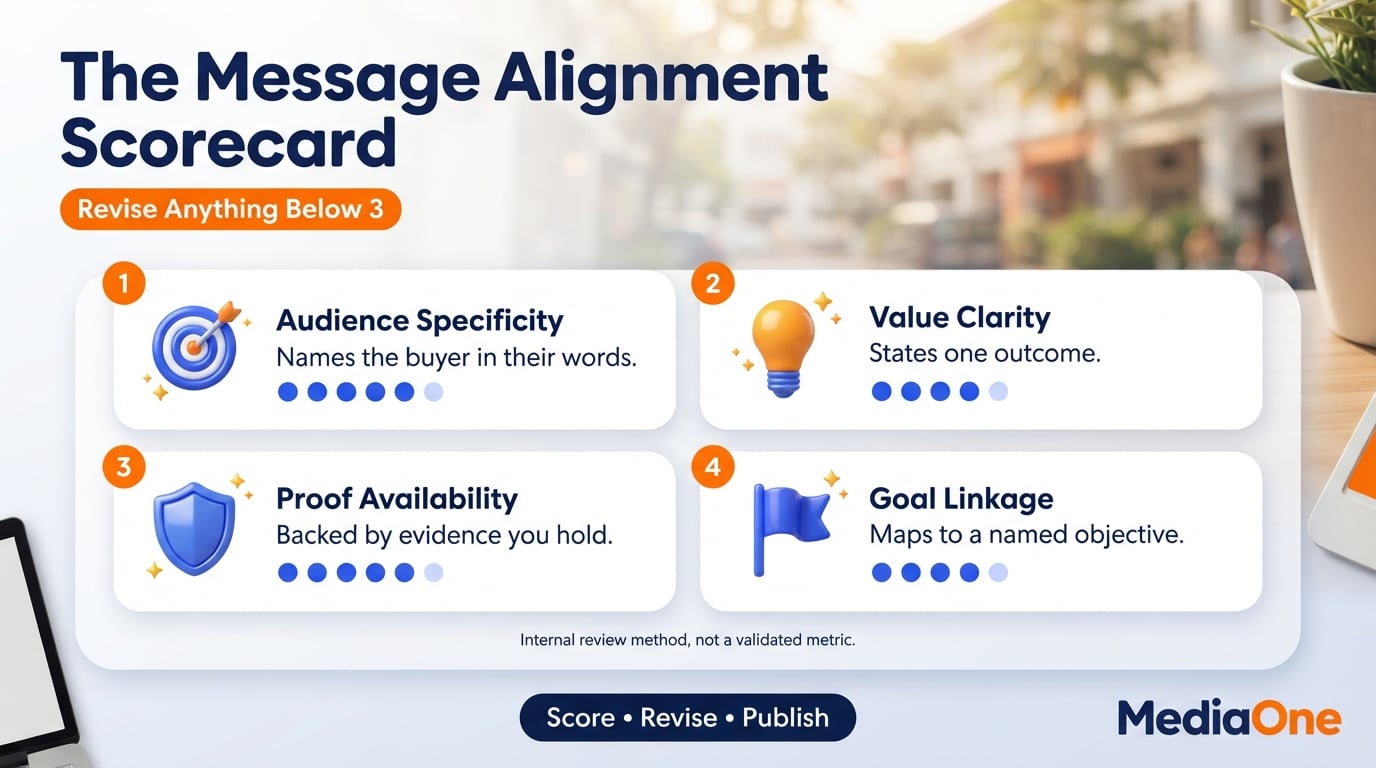
Any score below 3 sends the message back for revision. The strongest survivor becomes the core message, and it should speak to the brand’s promise in terms the audience already uses.
Step 4 Test Messages With Prospective Buyers
Show a few candidate messages to prospective buyers and ask them to explain, in their own words, what the company does and why it is relevant. If their explanation differs from your intent, the message is not yet clear.
Run a short paid test on one channel to compare click-through rate and form completion between two headlines. Google Ads recommends testing ad variations to refine creative messages. Treat the result as directional and confirm it with a sufficiently large sample.
Step 5 Document and Maintain the Framework
Turn the approved work into one reference document covering the core message, pillars, proof points, approved phrasing, words to avoid, and an owner for each channel. A new hire should be able to read it in one sitting.

Roll out in order of commercial impact: website and sales materials first, then paid media and email, then social. Brief every customer-facing team before launch.
Assign one owner, set a quarterly review and log every change. Revisit the framework whenever the product, pricing or target market shifts materially.
Aligning Internal Teams With Brand Messaging
A messaging strategy also applies inside the organisation. Leadership, HR and operations teams risk saying too much and meaning too little, and a clear message can help them stay aligned.
If employees cannot repeat the core message, customer-facing communication can become inconsistent. Share the framework with internal teams and check whether they can explain it.

Test internal drafts with the Message Alignment Scorecard. ‘Operational excellence’ fails because staff cannot picture their work in it. ‘Cut refund approval steps from three days to one’ passes because it names an outcome the team owns.
Stress-Testing Crisis Messaging
A messaging strategy that only works in planned campaigns is incomplete. A difficult test comes when a product or service fails or a complaint spreads on social media, and the team must respond quickly. Test the brand story and key messages against likely failure scenarios before they happen, and include crisis messaging in routine planning.
[IMAGE: Crisis messaging paths for normal conditions, critical coverage and competitor responses]
The Tylenol brand history records the introduction of tamper-evident packaging in 1982. The example shows a concrete safety response, but it does not establish that messaging alone restored customer trust. Pre-approved positions on hard questions help spokespeople respond consistently, and a shared messaging approach keeps those positions aligned across channels.
Build a crisis layer into your marketing messaging strategy:
- List the three most likely failures, such as an outage, a safety question or a billing error.
- Draft a holding statement for each, using your everyday pillars and proof.
- Name the approver and the internal channel used to brief staff first.
- Check each statement against the scorecard. A statement without available proof damages trust faster than silence.
Creating a Reusable Messaging Framework
A messaging framework is the document every team writes from. Without one, each channel invents its own version of the business. The framework holds the decisions still while the wording flexes by channel, so every piece of content stays consistent and the brand speaks with one voice.
Organising Positioning, Pillars, Proof and Phrasing
Build the framework in four layers, from most stable to most flexible:
- Positioning states the category you compete in, the audience you serve and the single outcome you deliver. Review it regularly and change it when the business position changes.
- Pillars are three to five themes, each a claim repeated in every channel.
- Proof is the evidence behind each pillar, such as case results, customer quotes or certifications. Every proof point needs a named source.
- Phrasing is the approved wording, including headlines, boilerplate and vocabulary to use or avoid.
Run the Message Alignment Scorecard as the gate between layers. Any draft that scores below 3 on proof availability goes back for revision.
Using a Message House Across Marketing Teams

A message house is one useful visual layout for this structure. The roof holds the core message, the pillars form the walls and the proof forms the foundation. MediaOne’s branding strategies guide also outlines how messaging pillars fit into brand guidelines.
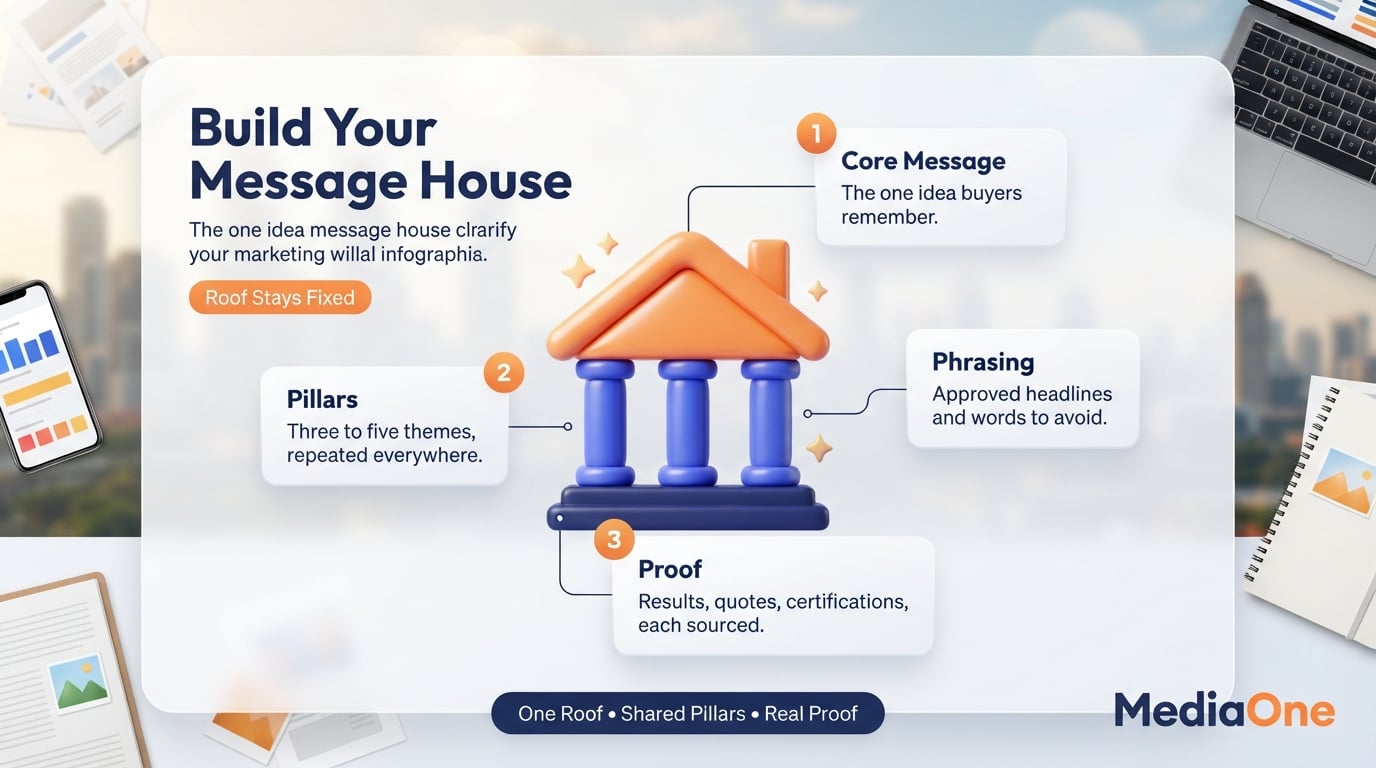
- Writers start from the roof and choose the pillar that fits the asset.
- Reviewers check that each sentence maps to a pillar and that its proof exists.
- Channel owners adapt the phrasing across each channel but cannot change the roof or pillars without formal review.
Keep the house to one page, and make sure the key messages it contains are the same ones every channel reuses.
Adapting B2B Messages for Buying Committees
B2B purchases rarely have one decision maker. For example, a Singapore B2B deal may involve a finance approver, a technical evaluator, an end user and an executive sponsor. Each asks different questions and weighs the product or service against their own pain points. A clear customer story helps each of them see their part in the outcome, and the same key messages should reach each of them in a form that fits their role in the buying decision.
Adapt the house in two steps:
- Map roles to pillars. The technical evaluator may weigh integration and security proof. The finance approver weighs the payback period against an approved budget.
- Write role-specific phrasing under a shared roof. The core message stays identical. Only pillar emphasis and proof change.
A practical check: if a finance approver and a technical evaluator can each name the business outcome in one sentence after reading the same asset, the framework is working.
Putting Your Messaging Strategy to Work
A marketing messaging strategy works best as a guide that helps teams make consistent choices. Before briefing any campaign, define the buyer problem you own, the words customers use for it, and the outcome you can prove.
Use the Message Alignment Scorecard as a gate. Score each draft from 1 to 5 on audience specificity, value clarity, proof availability and goal linkage. Revise anything below 3 before adapting it for a channel.
Review the framework on a fixed cycle. Alignment with company goals depends on revisiting the strategy as the business changes.
Frequently Asked Questions
How does a value proposition differ from a USP?
A value proposition states the outcome a customer gets from working with you, written around their problem. A unique selling proposition (USP) states why your offer is preferable for a specific buyer compared with alternatives, including doing nothing. Check both against the Message Alignment Scorecard, including proof availability, because a claim of difference needs evidence.
How long does it take to build a messaging strategy?
Timing depends on how quickly the team can reach customers, collect evidence and test drafts. Start with audience research and customer language, then draft candidate core messages and validate the strongest before rollout.
How often should a messaging strategy be updated?
Review the core framework on a set schedule, and sooner when your market, pricing, product or main competitor changes. Keep the brand promise stable, but refresh proof points and customer language more often.
Does messaging strategy change for B2B and B2C?
The core process is the same, but the audience changes. B2B messages must work for a buying committee, where a finance lead, a technical evaluator and an executive sponsor each need a different reason to say yes. Build a shared core message, then add role-specific pillars.
How can I measure messaging performance?
Link each message to one measurable goal before launch. Track conversion rate, sales-call conversion and message recall, and A/B test alternative wording. If a message underperforms, check its proof and audience fit before changing the core promise.