Influencer marketing in Singapore has moved from a niche tactic to a central part of many brands’ digital strategies. As social media continues to shape how consumers discover products, creators have become powerful voices in shaping buying decisions.
In Singapore, where internet usage and social media adoption are among the highest in Southeast Asia, influencer campaigns now play a key role in brand visibility, product launches, and online engagement.
Brands across industries are investing more heavily in influencer partnerships because audiences increasingly trust recommendations from creators they follow. Instead of relying solely on traditional digital advertising, companies are working with influencers to build credibility and create content that resonates with local audiences.
This shift has accelerated the growth of influencer marketing campaigns in Singapore across platforms such as Instagram, TikTok, YouTube, and emerging social commerce channels.
However, as campaigns become more complex, many brands are finding that managing influencer collaborations internally can be challenging. Identifying the right creators, coordinating campaigns, and measuring results requires specialised expertise.
This is why more businesses are working with agencies specializing in influencer marketing in Singapore. For companies seeking a top influencer marketing agency in Singapore, partnering with experienced specialists can help run effective campaigns while maintaining brand consistency and achieving measurable results.
Key Takeaways
- Influencer marketing in Singapore has become a major digital marketing channel as consumers increasingly trust creators for product recommendations and discovery.
- Brands face challenges with influencer selection, campaign management, and ROI tracking, which has increased demand for specialised agencies.
- Influencer marketing agencies provide structured campaign planning, curated creator networks, and performance analytics that help brands run more effective campaigns.
- Trends such as micro influencers, short-form video, social commerce, and long-term creator partnerships are shaping the future of influencer marketing in Singapore.
What Is Influencer Marketing in Singapore?

Influencer marketing is a strategy in which brands collaborate with social media creators who have built loyal audiences. These creators promote products, services, or experiences through content that feels authentic to their followers.
In the context of influencer marketing in Singapore, campaigns are often designed to reach highly connected and digitally active consumers who rely heavily on social media for product discovery.
Unlike traditional advertising, influencer marketing focuses on trust and relatability. Followers often view influencers as credible sources because they share personal experiences, lifestyle content, and honest opinions. When a creator recommends a product, their audience may perceive it as a genuine endorsement rather than a promotional message.
In Singapore, influencer marketing has evolved rapidly due to the country’s strong digital infrastructure and high smartphone penetration. Brands use a variety of platforms to reach audiences, including Instagram for lifestyle content, TikTok for short-form video, YouTube for in-depth reviews, and Xiaohongshu for cross-border lifestyle and beauty recommendations.
Because Singapore’s population is multilingual and culturally diverse, influencer marketing campaigns in Singapore often involve creators who can communicate effectively with different audience segments.
Key Characteristics of Influencer Marketing Singapore Campaigns
Several factors shape how influencer marketing Singapore strategies are executed:
- High social media penetration means a large portion of Singapore’s population is active online daily. This creates opportunities for brands to connect with audiences through creators who already have established communities.
- Multilingual audiences also influence campaign planning. Influencers may create content in English, Mandarin, or other languages depending on their audience demographics.
- Micro and nano influencers play a significant role in the local ecosystem. While these creators may have smaller audiences, their followers are often highly engaged and more likely to trust their recommendations.
- Data-driven collaborations are another defining feature of influencer marketing in Singapore. Brands increasingly rely on analytics to identify creators whose audience demographics align with their target customers.
Why Influencer Marketing in Singapore Is Growing So Fast
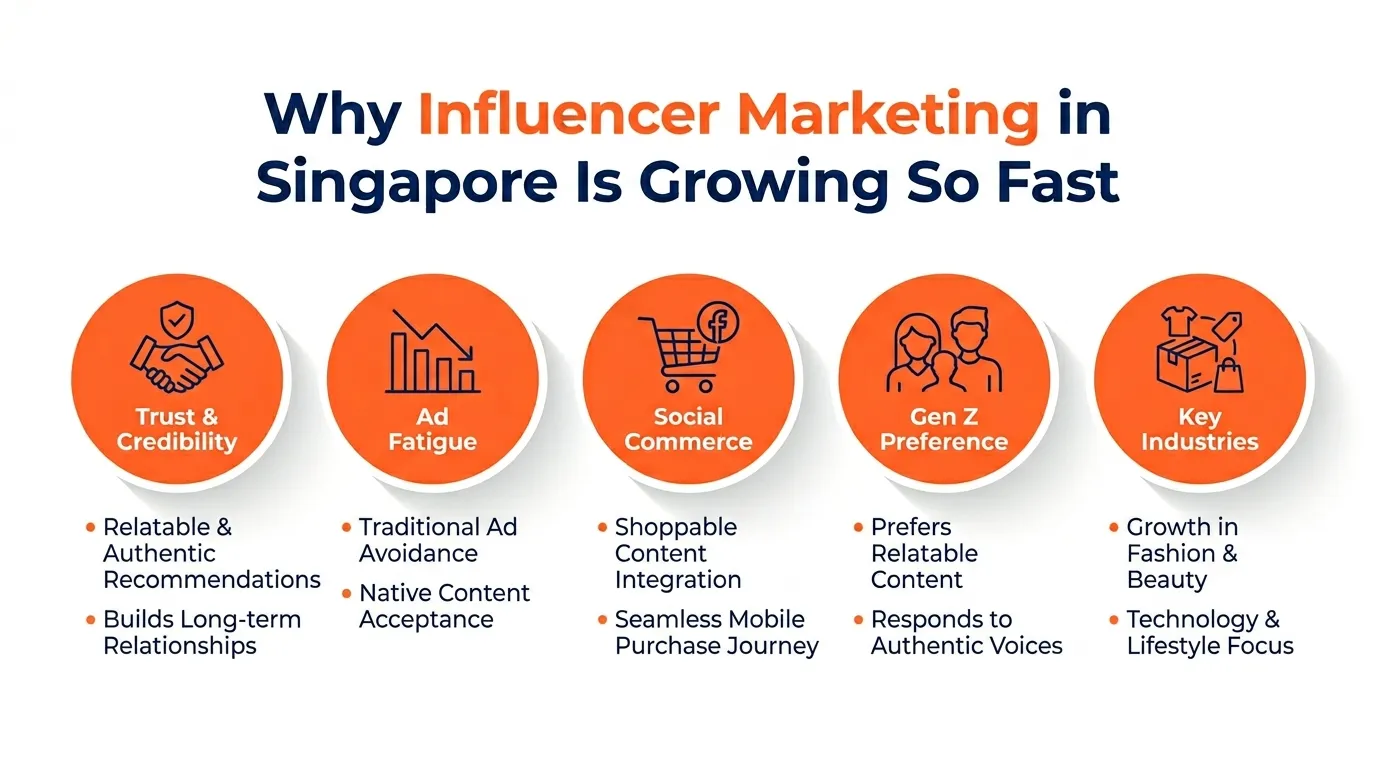
The rapid growth of influencer marketing in Singapore is driven by shifts in consumer behaviour and how people interact with digital content. As social media platforms become the main channel for discovering brands, influencers now play a key role in bridging the gap between businesses and consumers.
Stronger Consumer Trust
One of the biggest drivers is trust. Consumers are more likely to consider products recommended by creators they follow than those in traditional advertisements.
Influencers often share personal experiences, making their content feel more authentic and relatable. This level of credibility is especially important in Singapore, where audiences are highly discerning and value transparency.
Declining Effectiveness of Traditional Ads
Traditional digital advertising is becoming easier to ignore. Many users are familiar with banner ads and sponsored placements, which can lead to “ad fatigue.”
In contrast, influencer marketing campaigns in Singapore blend naturally into social media feeds. Because the content feels organic rather than disruptive, users are more likely to engage with it.
Rise of Social Commerce
Social commerce has significantly accelerated influencer marketing growth in Singapore. Platforms like TikTok and Instagram now allow users to purchase products directly through embedded links. Influencers introduce products in ways that encourage immediate action, shortening the journey from discovery to purchase and improving conversion rates.
Influence of Younger Audiences
Gen Z and younger millennials rely heavily on influencers when making purchasing decisions.
In Singapore, industries such as beauty, fashion, technology, and lifestyle actively collaborate with creators because audiences expect recommendations from familiar online personalities rather than brands themselves.
The Challenges Brands Face With Influencer Marketing in Singapore

Influencer marketing Singapore offers strong potential, but execution is rarely as simple as it looks from the outside. Many brands start with high expectations, only to find that results vary depending on how well the campaign is planned, managed, and measured.
The local landscape adds another layer of complexity. Singapore has a dense, highly active creator ecosystem, which means opportunities are high but so is competition for attention. Without a clear framework, brands can easily invest time and budget without seeing consistent returns.
Below are the most common challenges, along with practical context on why they matter:
Finding the Right Influencers in Singapore
At first glance, discovering influencers seems straightforward. Platforms are filled with creators across every niche. The difficulty lies in identifying which ones actually influence behaviour rather than simply attract views.
A strong fit goes beyond follower count. Brands need to assess:
- Whether the influencer’s audience matches their target demographic
- How consistently the creator engages with followers
- The tone and positioning of past content
- Signs of inflated or inactive audiences
There is also the question of brand alignment. An influencer may have strong engagement but still be the wrong fit if their content style or values do not align with the brand’s positioning. In Singapore’s market, where audiences are relatively discerning, this mismatch becomes noticeable quickly.
Managing Influencer Campaigns at Scale
Once the right influencers are selected, coordination becomes the next hurdle. A single collaboration is manageable. Running a campaign with multiple creators introduces complexity that grows with each additional partner.
Each influencer operates differently. Some prefer structured briefs, while others work best with creative freedom. Posting schedules vary. Content formats differ across platforms. Even response times can be inconsistent.
Brands often find themselves juggling:
- Outreach and relationship management
- Negotiation of deliverables and timelines
- Content approvals and revisions
- Monitoring live posts and engagement
What starts as a marketing initiative can quickly turn into a resource-heavy operation. Without clear processes, delays and inconsistencies can affect campaign performance.
Measuring ROI From Influencer Marketing Singapore Campaigns
Engagement metrics are easy to track, but they only tell part of the story. A post with high likes and comments does not automatically translate into business results. The real challenge is connecting influencer activity to outcomes such as:
- Website traffic
- Lead generation
- Product purchases
- Brand recall over time
This requires more than platform analytics. Brands need tracking mechanisms such as unique links, discount codes, or integrated analytics tools.
Even with these in place, interpretation can be nuanced. A campaign may indirectly influence purchasing decisions, making it harder to attribute results to a single touchpoint. This is where many brands struggle to assess true return on investment.
Compliance and Advertising Transparency in Singapore
Influencer marketing Singapore operates within a framework of advertising standards that prioritise transparency. Sponsored content must be clearly disclosed so that audiences understand when a post is part of a paid collaboration.
For brands, this introduces both a responsibility and a risk. They need to ensure that:
- Influencers disclose partnerships appropriately
- Messaging remains accurate and not misleading
- Campaigns align with local advertising guidelines
Failure to meet these standards can lead to reputational damage. In a market like Singapore, where trust plays a central role in consumer behaviour, even minor lapses can affect brand perception.
Why These Challenges Matter for Strategy
Each of these challenges points to the same underlying issue. Influencer marketing is not just about finding creators and publishing content. It requires structure, consistency, and a clear understanding of how each part of the campaign contributes to overall goals.
Brands that treat influencer marketing in Singapore as a strategic channel tend to see stronger, more predictable outcomes. Those who approach it as an ad hoc tactic often encounter the same friction points repeatedly.
Understanding these challenges is the first step. Building systems to manage them effectively is what turns influencer marketing into a reliable growth channel.
Why Brands Are Turning to Influencer Marketing Agencies in Singapore

As influencer marketing in Singapore continues to mature, the expectations around campaign performance have changed. Brands are no longer experimenting with one-off collaborations. They are building structured, multi-channel campaigns that require planning, coordination, and measurable outcomes.
This shift has made influencer marketing more complex. It now involves audience analysis, creator selection, content alignment, compliance, and performance tracking. For many companies, managing all of this internally can stretch both time and resources.
That is why more brands are choosing to work with specialised agencies that can oversee the process from strategy to execution. Below is a closer look at what is driving this move:
Access to Curated Influencer Networks
One of the most immediate advantages of working with an agency is access to a pre-vetted pool of creators.
Influencer marketing agencies typically maintain active databases of influencers across different niches, platforms, and audience segments. These are not just lists of names. They are structured networks built from ongoing relationships and past campaign data.
This changes how brands approach sourcing. Instead of manually searching through profiles, reviewing engagement, and reaching out individually, agencies can quickly narrow down suitable options based on:
- Audience demographics and location
- Engagement quality rather than follower count
- Content style and brand alignment
- Past campaign performance
This level of filtering saves time, but more importantly, it reduces the risk of mismatched collaborations. Brands are not starting from scratch. They are working from a curated ecosystem that has already been assessed.
Strategic Campaign Planning
Effective influencer marketing campaigns in Singapore rarely succeed through isolated efforts. Sending products to creators without a clear framework may generate visibility, but it often lacks consistency and measurable impact.
Agencies approach campaigns differently. They begin with structure. A typical planning process includes:
- Defining campaign objectives, whether that is awareness, engagement, or conversions
- Mapping out the target audience and identifying where they are most active
- Selecting the right mix of influencers based on niche relevance
- Aligning messaging across creators to maintain consistency without losing authenticity
This is where agencies add depth. They do not treat influencer marketing as a standalone tactic. Instead, they integrate it into a broader digital strategy, which may include paid social, content marketing, or PR. The result is a campaign that feels coordinated rather than fragmented.
Data-Driven Influencer Marketing Singapore Campaigns
Data has become central to how influencer campaigns are planned and evaluated.
Agencies use analytics tools to assess both influencers and campaign performance. These tools provide visibility into:
- Audience demographics such as age, location, and interests
- Engagement patterns across different types of content
- Historical performance of previous collaborations
- Indicators of audience authenticity
This allows agencies to move beyond surface metrics. A large following alone is no longer considered sufficient. Instead, decisions are based on whether an influencer’s audience is likely to respond to a specific campaign.
During and after the campaign, data continues to guide optimisation. Agencies track:
- Engagement rates and interaction quality
- Traffic generated through tracked links
- Conversions and attributed sales where applicable
These insights make it easier to refine future campaigns. Over time, brands build a clearer understanding of what works, rather than relying on assumptions.
End-to-End Campaign Management
Influencer marketing campaign management involves more operational work than many brands initially expect. There are multiple stages, each with its own requirements:
- Outreach and communication with influencers
- Negotiation of deliverables, timelines, and fees
- Contract management and compliance checks
- Content review to ensure alignment with brand guidelines
- Scheduling and coordination across multiple creators
- Performance tracking and reporting
Managing these elements internally can be resource-intensive, especially when working with multiple influencers simultaneously.
Influencer marketing agencies in Singapore handle this end-to-end process. This does not just reduce workload. It also introduces consistency and accountability at each stage. For brands, this means:
- Fewer administrative bottlenecks
- Clear timelines and deliverables
- More reliable campaign execution
It also allows internal teams to stay focused on higher-level strategy rather than day-to-day coordination.
A More Structured Approach to Growth
What ties all of this together is structure. As influencer marketing in Singapore evolves, success depends less on isolated wins and more on repeatable systems. Agencies provide that structure by combining curated networks, strategic planning, data analysis, and operational management into a single workflow.
For brands looking to scale their efforts, this approach offers a more stable path forward. Instead of testing ideas in isolation, they can build campaigns that are designed, executed, and refined with consistency over time.
How Influencer Marketing Agencies in Singapore Deliver Better Results

Running influencer campaigns in-house can work, but it often becomes complex as soon as you scale. Coordinating multiple creators, aligning messaging, tracking performance, and maintaining consistency across platforms requires both time and experience.
This is where influencer marketing agencies in Singapore tend to deliver stronger and more predictable results. They do not just connect brands with creators. They build structured campaigns designed to maximise engagement, improve targeting, and generate measurable outcomes.
Professional Campaign Strategy That Goes Beyond One-Off Posts
An experienced agency approaches influencer marketing as a system rather than a series of isolated collaborations.
Instead of relying on a single creator, agencies often design campaigns that involve multiple micro influencers with complementary audiences. This allows brands to reach different segments while maintaining a consistent message across all touchpoints.
A well-structured campaign typically includes:
- Clear audience segmentation based on demographics, interests, and behaviour
- A mix of creators who bring different perspectives to the same product or service
- Content planning that aligns timing, messaging, and platform strengths
Over time, agencies may also recommend moving beyond short-term campaigns into longer partnerships. Ambassador programmes, for example, allow influencers to feature a brand repeatedly in a natural way. This repeated exposure builds familiarity and trust, which often leads to stronger engagement and higher conversion rates.
Stronger Influencer Relationships That Improve Execution
One of the less visible advantages of working with an agency is access to established creator networks.
Agencies typically maintain ongoing relationships with micro influencers across different niches. These relationships are built over multiple campaigns, which means there is already a level of trust and understanding in place. This has several practical benefits:
- Influencers are more responsive and easier to coordinate
- Content guidelines are understood more quickly, reducing back-and-forth
- Negotiations are more efficient, often leading to better value for brands
Because the working relationship is already established, influencers are also more likely to produce content that aligns with expectations while still maintaining their authentic voice. That balance is difficult to achieve in first-time collaborations.
Performance Tracking That Moves Beyond Surface Metrics
A common challenge in influencer marketing campaigns in Singapore is measuring what actually works. Likes and impressions provide visibility, but they do not always reflect business impact.
Agencies address this by building reporting frameworks that connect engagement to outcomes. Typical reporting includes:
- Engagement metrics such as comments, shares, and saves
- Reach and impressions across platforms
- Click-through rates and traffic driven to landing pages
- Conversions, where trackable through links or codes
More importantly, agencies interpret these metrics rather than just presenting them. They identify which types of content perform best, which creators drive the most meaningful engagement, and where adjustments are needed.
This allows brands to:
- Refine targeting for future campaigns
- Allocate budgets more effectively across creators
- Scale what works instead of repeating ineffective approaches
Why This Approach Produces Better Results
When strategy, relationships, and data are aligned, influencer campaigns become more than promotional activity. They turn into a repeatable channel for engagement and growth.
Agencies bring structure to a process that can otherwise feel fragmented. They reduce inefficiencies, improve collaboration quality, and provide clarity on performance.
For brands operating in a competitive market like Singapore, this level of coordination often makes the difference between campaigns that simply reach audiences and campaigns that actually influence behaviour.
Influencer Marketing Singapore Trends Shaping the Future

Influencer marketing in Singapore is moving quickly, shaped by changing consumer behaviour and platform innovation. What worked a few years ago no longer delivers the same results. Audiences are more selective, content formats are evolving, and brands are expected to be more intentional in their collaborations with creators.
Understanding these shifts helps brands stay relevant and build campaigns that continue to perform over time.
Rise of Micro and Nano Influencers
There is a clear shift towards smaller creators, particularly micro- and nano-influencers. These creators tend to have tighter communities and more consistent interaction with their followers.
What makes them effective is not just their size, but how they engage:
- Followers are more likely to comment, ask questions, and share content
- Recommendations feel grounded in real experience rather than promotion
- Content is often tailored to a specific niche, which improves relevance
For many brands, working with several smaller creators now produces better engagement than relying on a single large influencer.
Long-Term Creator Partnerships
One-off collaborations are becoming less common, especially for brands focused on building trust. Instead, there is a growing preference for long-term partnerships.
When influencers work with a brand over time, their content evolves naturally. They become more familiar with the product, and their audience becomes more receptive to repeated exposure.
This approach tends to result in:
- More credible endorsements
- Consistent brand visibility across multiple posts
- Stronger audience trust is built through repetition
It also allows brands to refine messaging based on what resonates, rather than starting from scratch with each campaign.
Growth of TikTok and Short-Form Video
Short-form video has become central to influencer marketing campaigns in Singapore, with platforms like TikTok leading the shift.
The format encourages content that is quick, engaging, and easy to consume. More importantly, TikTok’s algorithm allows content to reach beyond an influencer’s existing followers. This creates new opportunities:
- Smaller creators can achieve significant reach with the right content
- Creative storytelling becomes more important than production quality
- Trends and formats can be adapted quickly for brand messaging
Brands that understand how to work within this format tend to see stronger engagement and faster traction.
Social Commerce and Live Selling
The line between content and commerce is becoming less defined. Social platforms are increasingly integrating shopping features directly into the user experience.
Live selling, in particular, is gaining traction. Influencers can showcase products in real time, respond to questions, and guide viewers through purchasing decisions.
This format works because it combines:
- Demonstration, which helps audiences understand the product
- Interaction, which builds trust and addresses concerns immediately
- Convenience, as viewers can purchase without leaving the platform
For brands, this shortens the path from discovery to conversion.
AI and Data Analytics in Influencer Marketing Singapore
Technology is playing a larger role in how campaigns are planned and optimised. Data is no longer limited to basic metrics. It is now used to inform decisions at every stage.
Advanced tools can help brands:
- Identify emerging micro influencers before they become saturated
- Analyse audience sentiment to understand how content is received
- Predict which types of campaigns are likely to perform best
This shift allows influencer marketing strategies in Singapore to become more precise and less reliant on guesswork.
What These Trends Mean for Brands
Taken together, these trends point to a more structured, data-informed approach to influencer marketing.
Success is less about chasing visibility and more about building sustained engagement. Brands that adapt to these changes, particularly by working with the right mix of creators and formats, are better positioned to stay competitive in a crowded digital landscape.
How to Choose the Right Influencer Marketing Agency in Singapore

Selecting an influencer marketing agency is not just about finding a vendor who can connect you with creators. It is about choosing a partner who can translate your business goals into campaigns that deliver measurable results. In a market like Singapore, where competition is high and audiences are digitally savvy, this decision directly impacts performance.
Key Factors to Consider
A structured evaluation process helps ensure that the agency you choose can support both short-term campaigns and long-term growth.
Relevant Industry Experience
An agency that understands your industry will already know which types of creators resonate with your audience. This reduces trial-and-error and improves campaign efficiency from the start. For example, the approach used for a skincare brand will differ significantly from one used for a B2B service or a local F&B business.
Look for:
- Past campaigns within your sector or adjacent industries
- Familiarity with your target audience’s behaviour and preferences
- Case examples that demonstrate measurable outcomes
Quality of Influencer Network
The strength of an agency’s network goes beyond the number of creators they can access. What matters is whether those creators have built genuine relationships with their audience.
A strong network should include:
- Micro influencers with consistent engagement, not inflated follower counts
- Creators who produce content aligned with their niche
- Profiles that show authentic interaction rather than generic comments
This directly affects how your campaign will be received. A well-matched influencer can drive meaningful engagement, while a poorly matched one may only deliver surface-level visibility.
Data and Reporting Capabilities
Without clear data, it becomes difficult to understand what is working and what needs to change. Agencies should provide reporting that connects influencer activity to business outcomes.
Strong reporting typically includes:
- Engagement metrics such as comments, shares, and saves
- Traffic and click-through data linked to campaigns
- Conversion tracking, where applicable
More importantly, the agency should be able to interpret this data and provide recommendations. Insights should guide future campaigns rather than simply summarise past performance.
Questions Brands Should Ask Agencies
Before committing to an agency, it is worth having a detailed discussion about how they operate. The answers you receive will often reveal how structured and transparent their approach is.
How do you vet influencers and verify audience authenticity?
This question helps you understand whether the agency has a process for identifying fake followers or inflated engagement. A reliable agency should be able to explain how they assess audience quality and maintain standards across its network.
How do you measure campaign performance?
It is important to clarify which metrics will be tracked and how success is defined. Some campaigns focus on engagement, while others prioritise conversions or lead generation. The agency should align metrics with your specific goals.
What platforms do you specialise in?
Different platforms require different strategies. An agency with strong TikTok experience may approach content very differently from one focused on Instagram or YouTube. Understanding their strengths ensures that your campaign is built around the right channels.
How do you structure campaigns over time?
This question reveals whether the agency focuses only on one-off activations or takes a longer-term view. Agencies that plan for sustained engagement, such as through ambassador programmes or recurring collaborations, are often better positioned to deliver consistent results.
Making the Final Decision
Choosing the right influencer marketing agency in Singapore comes down to alignment. The agency should understand your audience, communicate clearly, and demonstrate a structured approach to both execution and measurement.
When these elements are in place, influencer marketing becomes more predictable, scalable, and effective as a long-term growth channel rather than a series of isolated campaigns.
The Future of Influencer Marketing Singapore
Influencer marketing in Singapore is moving into a more mature phase. It is no longer treated as an experimental channel or a one-off tactic. Instead, it is becoming part of a broader marketing ecosystem where content, community, and conversion are closely linked.
As social media continues to shape how people discover brands, compare options, and make decisions, creators will play an even more influential role. The difference is that audiences are now more selective. They pay attention to who is speaking, how often they promote products, and whether those recommendations feel credible.
Authenticity Will Continue to Drive Performance
Authenticity has always been important, but it is becoming non-negotiable. Audiences are quick to disengage when content feels overly scripted or disconnected from an influencer’s usual style. On the other hand, when a product fits naturally into a creator’s lifestyle, engagement tends to follow.
You can expect to see:
- More selective brand partnerships from creators
- Content that blends seamlessly into everyday routines
- A stronger emphasis on storytelling rather than direct promotion
For brands, this means choosing influencers based on alignment, not just reach. The closer the fit, the stronger the response.
Smaller Creators Will Gain More Strategic Importance
While large influencers will continue to have a role in awareness campaigns, micro and even nano influencers are expected to become more central to engagement strategies.
Their ability to maintain close relationships with their audience gives them an advantage that is difficult to replicate at scale.
As a result:
- Campaigns will increasingly involve multiple smaller creators
- Niche targeting will become more precise
- Engagement quality will matter more than follower count
This shift reflects a broader move towards community-led marketing rather than broadcast-style promotion.
Technology Will Shape Planning and Measurement
Advancements in analytics are changing how influencer marketing campaigns in Singapore are evaluated.
Brands are moving beyond surface metrics and looking at how influencer content contributes to actual business outcomes. This includes tracking user journeys from content discovery to conversion.
Emerging tools are helping brands:
- Attribute sales and leads more accurately
- Compare performance across different creators and platforms
- Identify which content formats drive the strongest results
As measurement improves, decision-making becomes more data-informed. Campaigns can be refined in real time rather than adjusted after the fact.
Agencies Will Take on a More Strategic Role
As the landscape becomes more complex, agencies are evolving alongside it. They are no longer just managing outreach or coordinating posts. Increasingly, they act as strategic partners, connecting creative execution with performance insights.
Their role is expanding to include:
- Campaign architecture and long-term planning
- Creator selection based on data and audience alignment
- Ongoing optimisation using performance insights
This shift is important because it helps brands move from isolated campaigns to sustainable influencer strategies.
What This Means for Brands
Influencer marketing in Singapore is becoming more structured, more measurable, and more integrated with overall marketing goals.
Brands that adapt to this shift will focus less on one-time visibility and more on building consistent engagement through the right creators, supported by a clear strategy and reliable data.
Those that do not may still reach audiences, but they are less likely to influence them meaningfully.
Why Brands Trust Agencies that Handle Influencer Marketing in Singapore

As influencer campaigns grow more complex, brands increasingly rely on specialised agencies to manage strategy, creator partnerships, and performance tracking. Agencies bring structure to influencer collaborations by combining data insights, industry relationships, and campaign planning.
This allows brands to focus on broader marketing objectives while ensuring that influencer partnerships remain consistent, compliant, and aligned with business goals.
Working with an experienced agency also provides access to vetted creators, clearer campaign measurement, and more efficient campaign execution. These capabilities help brands reduce risk while improving the chances of reaching the right audiences through authentic content.
For companies planning their next influencer marketing campaign in Singapore, speaking with a specialist team can offer valuable insights into strategy, creator selection, and performance measurement.
If you want to explore how structured influencer campaigns can support your marketing goals, contact MediaOne to discuss your objectives and learn how a top influencer marketing agency in Singapore approaches campaign strategy and execution.
Frequently Asked Questions
How much does influencer marketing cost in Singapore?
The cost of influencer marketing in Singapore varies widely depending on the influencer’s reach, platform, and campaign requirements. Micro-influencers may charge a few hundred dollars per post, while well-known creators can charge several thousand dollars per campaign. Pricing also depends on content type, exclusivity terms, and usage rights for brand advertising. Many agencies structure campaigns using multiple creators to balance reach and budget.
Is influencer marketing regulated in Singapore?
Yes. Influencer marketing in Singapore is guided by the Singapore Code of Advertising Practice and industry guidelines issued by the Advertising Standards Authority of Singapore. Sponsored content must be clearly disclosed so audiences understand when a post is a paid promotion. Influencers often use labels such as “Ad” or “Sponsored” to maintain transparency with their audience.
How do brands measure the success of influencer marketing campaigns?
Brands usually measure influencer marketing campaigns using a combination of reach, engagement, and conversion metrics. Engagement metrics include likes, comments, shares, and saves on social media posts. More advanced campaigns also track website visits, referral traffic, and sales generated through tracking links or discount codes. These metrics help brands understand whether influencer collaborations contribute to marketing objectives.
Which platforms are most effective for influencer marketing in Singapore?
Instagram, TikTok, and YouTube are among the most widely used platforms for influencer marketing in Singapore. Instagram is commonly used for lifestyle, fashion, and beauty campaigns, while TikTok is popular for short-form video and viral product discovery. YouTube works well for detailed product reviews and tutorials. The most effective platform depends on the brand’s target audience and campaign goals.
Why do brands work with influencer marketing agencies?
Brands often work with influencer marketing agencies because managing campaigns can involve significant coordination and expertise. Agencies maintain networks of vetted creators and provide tools for audience analysis, campaign tracking, and performance reporting. They also manage negotiations, contracts, and content approvals, which can simplify the process for brands running large campaigns.