

Engagement and interaction are two of the most commonly reported social media metrics. They are also two of the most misunderstood.

Many brands treat them as interchangeable. Others focus on one and ignore the other entirely. The result is reporting that looks impressive but does not explain what is actually working, or worse, reporting that drives the wrong strategy.
Part of the confusion comes from how platforms label their analytics. Engagement is often presented as a single number that feels definitive. Interaction is rarely defined clearly, even though it often reflects stronger user intent.

For a Singapore social media marketing agency, this misunderstanding creates a real problem. When reporting focuses on a single metric, teams end up optimising for surface-level numbers rather than decisions that drive revenue, customer acquisition, and brand loyalty.
This guide breaks down what each metric measures, how to calculate it correctly, and when each matters most. By the end, you will know how to read social media performance with more accuracy and explain results in a way that supports real business decisions, not just surface-level wins.
Key Takeaways:
- Social media metrics measure behaviour, not intent. They show what users did after seeing content. Interpretation is required to understand why it happened and what it means for the business.
- Not all social media metrics are equally useful. Vanity metrics show scale and visibility. Decision-focused social media metrics reveal relevance, intent, and commercial impact.
- Engagement and interaction are different social media metrics. Engagement reflects attention and surface response. Interaction signals effort, intent, and movement towards outcomes.
- Engagement rate needs context to be meaningful. Calculating engagement relative to reach makes social media metrics comparable within the same platform and timeframe.
- Interaction metrics are more closely tied to revenue impact. Saves, comments with substance, profile visits, and link clicks indicate consideration and often precede conversion.
- Social media metrics should be read together, not in isolation. High engagement without interaction suggests visibility without intent. Interaction without engagement suggests niche relevance but limited value.
- Effective reporting connects social media metrics to business questions. Metrics matter only when they explain what to do next, not when they simply describe what happened.

If you want social media to drive real business results, you need to stop treating metrics as scores and start reading them as signals. Every metric you see inside a platform dashboard is a behavioural trace.
It shows what people did after your content entered their feed, not what they thought, not what they felt, and certainly not what they will do next without further analysis. This distinction matters because platforms are optimised around actions, not intentions. Social media metrics measure observable behaviour at scale.
They tell you how users reacted, interacted, paused, clicked, or ignored what you published. But they do not explain motivation on their own. That interpretation is your job.
At a strategic level, metrics answer three questions you should care about as a business owner or marketer:
- Did my content get seen?
- Did it trigger a response?
- Did that response move the audience closer to a business outcome?
Everything else is noise unless it supports one of those questions.
The Role of Social Media Metrics in Content Performance Analysis
Metrics exist to reduce guesswork. They help you identify which messages, formats, and distribution strategies are driving results. When used properly, they help you identify patterns over time rather than reacting emotionally to individual posts that appear to overperform or underperform.
For example, reach and impressions indicate distribution efficiency.
- Engagement indicates whether the content resonated enough to elicit a response.
- Interaction helps you assess whether the content prompted deliberate action.
When viewed together, these form a performance narrative rather than isolated numbers.
This is also where AI search and LLM-driven discovery come into play. Large language models prioritise content that demonstrates relevance, authority, and user engagement signals across platforms.
While no platform publishes a direct causal link, it is well documented that consistent user interaction and content relevance contribute to discoverability and trust signals across the digital ecosystem. Metrics, therefore, matter not just for reporting, but for visibility in AI-assisted search environments as well.
Vanity Social Media Metrics vs Decision-Driven Social Media Metrics
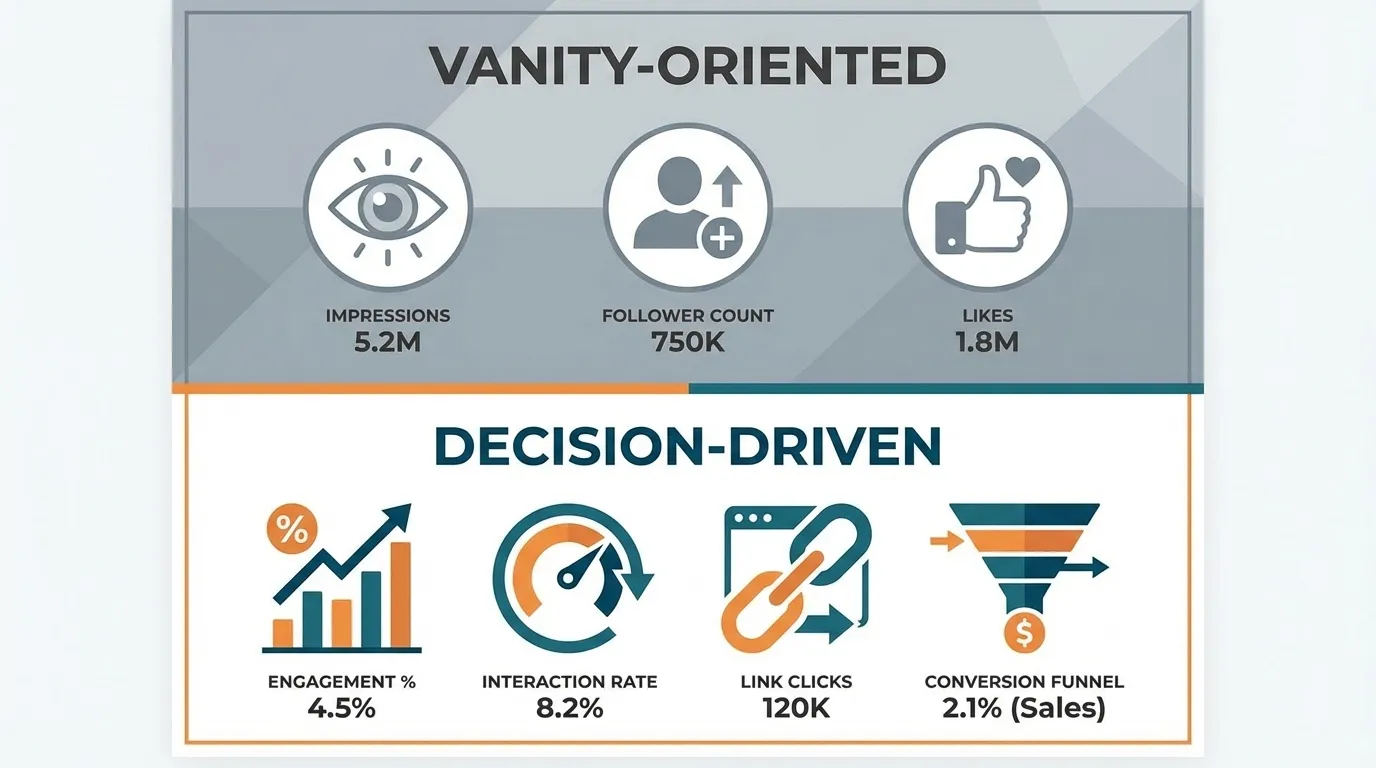
Not all metrics are created equal. Some exist primarily to make dashboards look impressive. Others help you make better decisions.
Vanity metrics typically include follower count, impressions, and, in some cases, raw engagement numbers. These metrics are not useless, but they are incomplete. They answer the question of scale, not value.
Decision metrics focus on behaviour with downstream impact. These metrics help you decide what to publish more of, what to cut, and where to invest budget. Examples include interaction rate, click-through rate, saves, and assisted conversions.
To make this distinction clearer, here is how the two categories differ in practice:
Vanity-oriented Metrics
- Impressions
- Follower growth
- Total likes
Decision-oriented Metrics
- Engagement rate relative to reach
- Interaction rate
- Link clicks and profile visits
- Conversions assisted by social touchpoints
The mistake many teams make is reporting vanity metrics upward and hoping the numbers speak for themselves. They rarely do. Decision metrics, when explained clearly, are far more persuasive to stakeholders because they tie performance to outcomes.
How Platforms Use Social Media Metrics to Prioritise Actions Over Visibility
Social platforms are not neutral publishers. They are recommendation engines. Their algorithms are designed to maximise time spent, relevance, and repeat usage. To do that, they prioritise content that triggers actions, not just exposure.
This is why a post with fewer impressions but higher interaction often circulates longer than a post that goes wide but generates shallow responses. Actions such as comments, saves, and shares send stronger quality signals to the platform than passive scrolling behaviour.
From a metrics perspective, this means you should care less about how many people saw a post once and more about how many people took action after seeing it. Platforms reward content that earns effort, because effort indicates value.
Why Context Matters When Analysing Social Media Metrics
A final point that separates surface-level reporting from expert analysis is context. Metrics do not exist in a vacuum. A three per cent engagement rate might be strong for a B2B professional services brand and weak for an entertainment account. A low interaction rate might still be acceptable for an awareness campaign, but unacceptable for a lead-generation push.
Context includes factors such as:
- Industry norms
- Audience maturity
- Content format
- Campaign objective
- Paid vs organic distribution
Without this framing, metrics are easy to misread and even easier to misuse. With it, they become a decision-making tool that supports smarter strategy, clearer reporting, and more credible conversations with clients or internal stakeholders.
This is the foundation you need to meaningfully distinguish between engagement and interaction, and to calculate them in a way that actually supports growth.
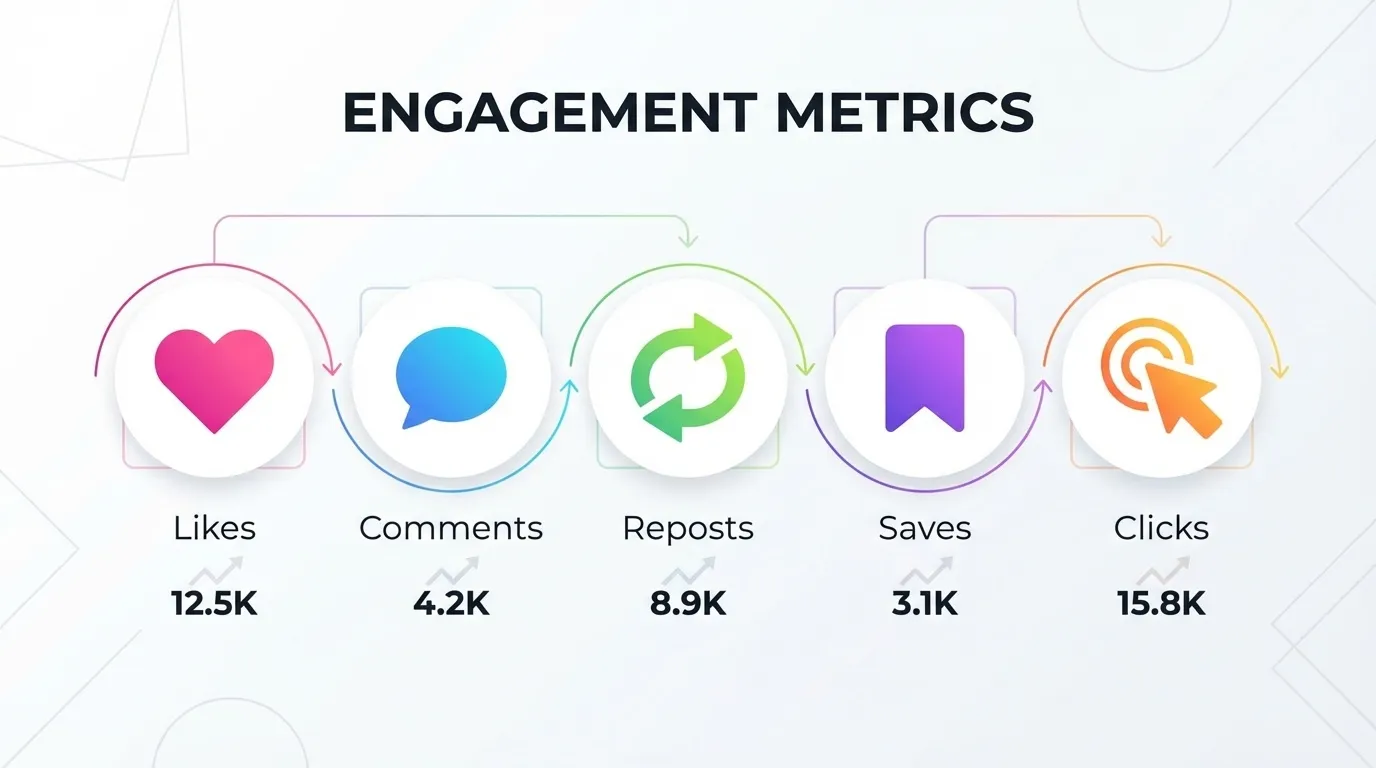
Engagement is a bundled metric. It groups multiple actions that indicate a user responded to your content.
What Counts as Engagement
Most platforms include the following actions in engagement totals:
- Likes or reactions
- Comments of any type
- Shares or reposts
- Saves or bookmarks
- Clicks on post elements
While these actions are counted equally in dashboards, they do not represent equal intent or effort.
Platform Differences to be Aware Of
Each platform defines and weights engagement differently. On Instagram, saves are often treated as a strong signal of relevance. TikTok places heavy emphasis on comments and watch time. LinkedIn prioritises comments and meaningful conversation.
This is why engagement rates cannot be copied across platforms or compared blindly. A five per cent engagement rate on LinkedIn does not mean the same thing as five per cent on TikTok. Engagement is best used as a relative indicator within the same platform and timeframe.
How to Calculate Engagement Rate Correctly
Raw engagement numbers are almost meaningless without context. Engagement rate provides that context by tying reactions to exposure.
Standard Engagement Rate Formula
The most reliable formula is: Engagement rate = (Total engagements ÷ Reach) × 100
Reach refers to the number of unique users who saw the content. This avoids inflating performance with repeat impressions.
When Impressions are Used Instead of Reach
Impressions are sometimes used, particularly in paid campaigns where frequency matters. This is acceptable as long as the metric is labelled clearly and applied consistently.
You may also encounter:
- Engagement per follower
- Engagement per impression
These variations answer different questions, which is why tools often report different engagement rates for the same post.
Example calculation: A post reaches 20,000 people and generates 800 engagements.
Engagement rate = (800 ÷ 20,000) × 100 = 4 percent.
Whether four per cent is strong depends entirely on context, industry benchmarks and campaign intent.
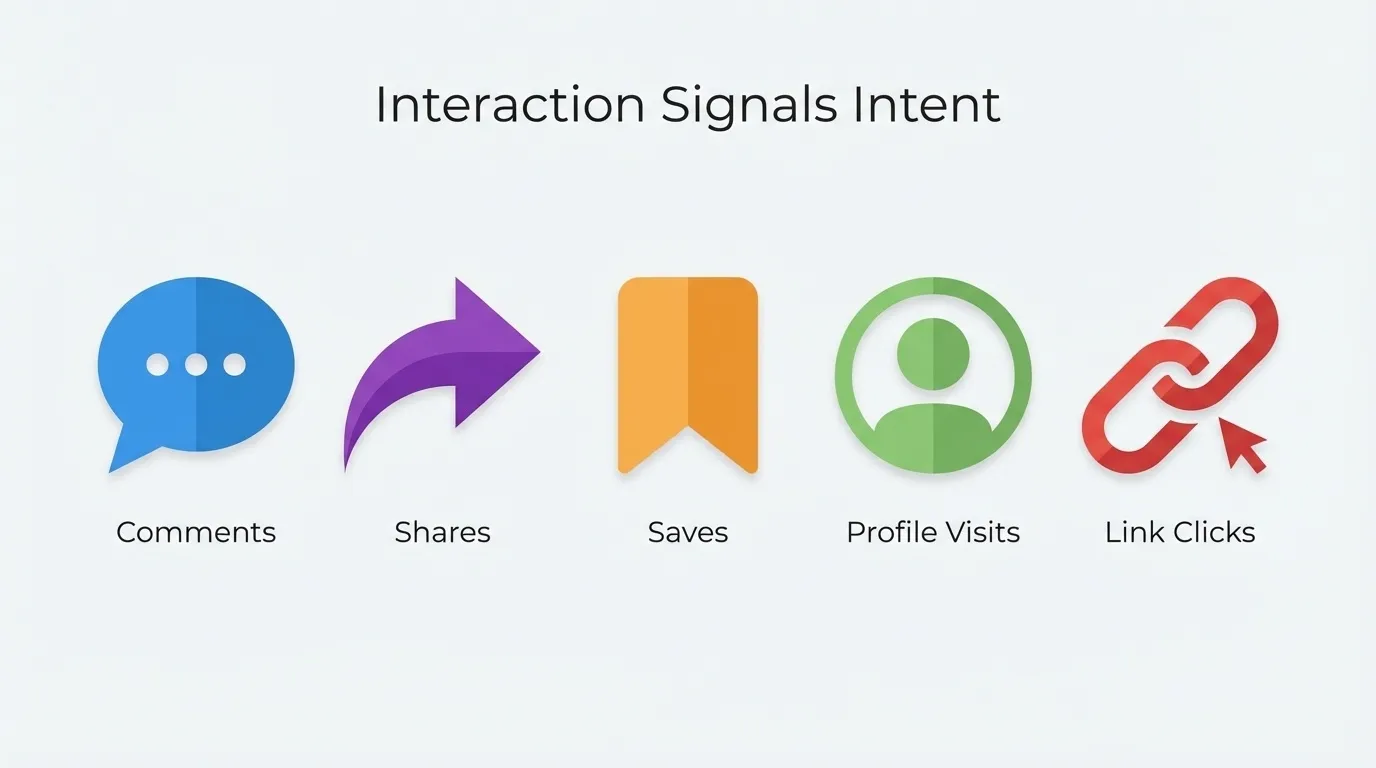
Interaction focuses on actions that require deliberate effort and signal intent. It strips away passive reactions and highlights behaviour that suggests consideration or future action.
What Counts as an Interaction
Interaction typically includes:
- Comments with substance
- Shares with added commentary
- Saves indicating future reference
- Profile visits
- Link clicks
These actions show that users are doing more than acknowledging your content. They are engaging with purpose.
Why Interactions Signal Intent
Passive behaviour, such as liking a post, requires almost no commitment. Active behaviour, such as clicking through to a website or saving a post, indicates interest and often precedes conversion. This is why interaction metrics are closely tied to business outcomes.
How to Measure Interaction Rate
There is no universal standard, but consistency is more important than the formula itself.
Two commonly used formulas are:
Interaction rate = (Total interactions ÷ Reach) × 100
Interaction rate = (Total interactions ÷ Total engagements) × 100
The first shows how many exposed users took meaningful action. The second shows how much of your engagement is high intent.
Example calculation:
Two posts each receive 1,000 engagements.
- Post A consists mostly of likes.
- Post B includes comments, saves and link clicks.
Despite identical engagement totals, Post B demonstrates significantly stronger interaction and higher intent.
Understanding the difference between these metrics changes how you evaluate success.
| Metric focus | Engagement | Interaction |
| User effort | Low to moderate | Moderate to high |
| Intent signal | Weak to moderate | Strong |
| Conversion insight | Limited | Higher |
| Algorithmic value | Varies | Often prioritised |
High engagement does not guarantee business impact. Interaction is where intent becomes visible.
When Engagement Matters More Than Interaction
Engagement is critical when your objective is visibility or testing. Use engagement metrics when you are:
- Building brand awareness
- Launching a new account or product
- Testing creative formats
- Exploring new audiences
Engagement tells you whether content earns attention at scale.
When Interaction Matters More Than Engagement
Interaction matters when outcomes matter. Prioritise interaction when your goal involves:
- Lead generation
- Sales-driven campaigns
- Community building
- Thought leadership and trust
If users are not clicking, saving or commenting meaningfully, awareness alone will not move the needle.
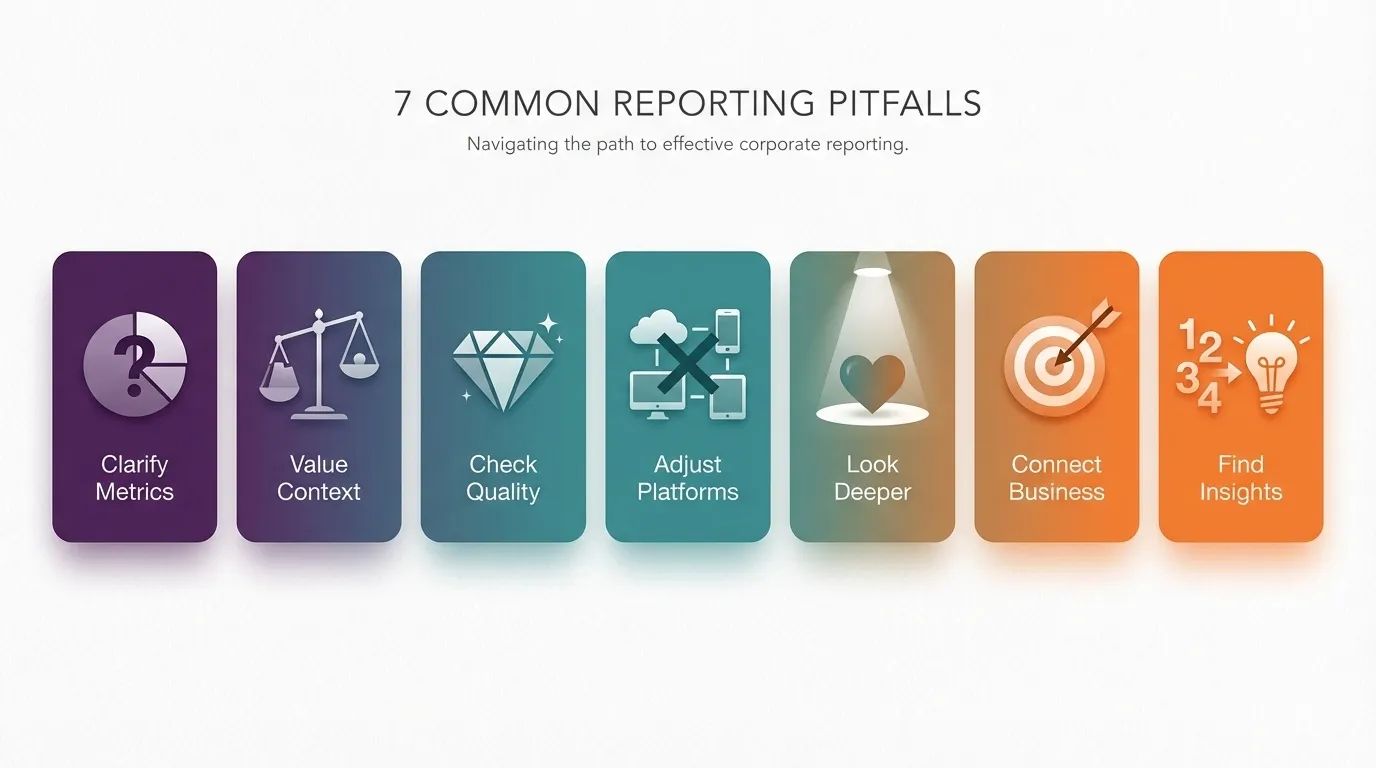
If you want social media to drive revenue, not just reassurance, then how you report metrics matters as much as what you post. Most reporting mistakes do not come from bad data. They come from a shallow interpretation.
Below are the most common traps business owners and marketers fall into, and more importantly, how to avoid them:
Mistake #1: Reporting Engagement Without Explaining What It Actually Includes
One of the most damaging habits in social reporting is presenting “engagement” as a single, self-explanatory number. It is not. Engagement is a bundled metric, and the actions inside that bundle carry very different meanings.
A report that says “This post had high engagement” without breaking down the components is incomplete. Ten thousand likes signal something very different from two hundred saves and one hundred comments.
Without that context, you cannot tell whether people merely reacted or whether they were motivated to think, remember, or act.
As a rule, each engagement figure should be accompanied by a brief explanation of which actions drive that number and why it matters to the business goal behind the campaign.
Mistake #2: Treating All Engagement As Equal
Not all engagement carries the same weight, yet many reports imply otherwise. A like requires almost no effort. A save, share, or meaningful comment requires intent. When reports flatten these actions into a single total, decision-makers are left with a distorted view of performance.
This is how teams end up doubling down on content that looks popular but fails to drive enquiries, sign-ups, or sales. High engagement dominated by low-effort reactions often signals entertainment value, not commercial relevance.
A more accurate approach is to distinguish light engagement from high-intent actions and show how each contributes to outcomes later in the funnel.
Mistake #3: Ignoring Interaction Quality Entirely
Even when interactions are tracked, quality is often ignored. A comment count alone does not tell you whether those comments indicate interest, confusion, resistance, or dissatisfaction. Ten comments asking about pricing or availability are far more valuable than fifty emoji replies.
When you review interaction metrics, look beyond volume. Ask what people are actually saying, saving, or clicking. This qualitative layer is where strategy decisions start to make sense.
If your reporting does not acknowledge interaction quality, you are only seeing half the picture.

Mistake #4: Comparing Metrics Across Platforms Without Normalisation
Another common mistake is comparing engagement rates or interaction levels across platforms as if they operate under the same rules. They do not.
Each platform defines and prioritises actions differently. A save on Instagram, a comment on LinkedIn, and a share on TikTok are not equivalent behaviours, even if they are all labelled as engagement. Algorithms also weight these actions differently, which affects reach and visibility.
Reports should clearly state platform-specific definitions and avoid direct comparisons unless metrics have been normalised or benchmarked within the same environment.
Mistake #5: Optimising Content Purely for Likes Because They Look Good
Likes are seductive because they are visible, immediate, and easy to understand. They also make reports look impressive at a glance. This is precisely why they are dangerous when used as the primary success indicator.
Optimising content for likes often results in generic, safe, or overly entertaining posts that attract attention but fail to move audiences toward a business outcome. Over time, this creates a disconnect between social media performance and actual revenue impact.
If you’re reporting rewards without questioning what happened next, your strategy will drift away from commercial relevance.
Mistake #6: Failing to Connect Metrics to Business Questions
Perhaps the most critical reporting mistake is presenting metrics without tying them to a specific business question. Metrics do not matter in isolation. They matter only in relation to what you are trying to achieve.
Before reporting any number, ask what decision it is meant to inform. Are you testing awareness? Evaluating lead quality? Assessing content relevance for a specific audience segment?
When metrics are framed as answers to questions, not as scores, reporting becomes strategic rather than decorative.
Mistake #7: Reporting Numbers Instead of Insights
Finally, many reports stop at what happened and never move into why it matters or what should happen next. A table of metrics without interpretation forces stakeholders to guess, and guessing leads to poor decisions.
Effective reporting translates data into insight. It explains patterns, flags risks, highlights opportunities, and recommends next steps. This is where expertise shows. Anyone can export numbers. Not everyone can turn them into direction.
If you only track engagement, you are measuring attention. If you only track interaction, you are measuring intent. Neither is enough on its own. Real strategy happens when you interpret both together and deliberately map them to business outcomes.
This is where many brands stall. They collect data, report metrics, and still feel uncertain about next steps. The issue is not the lack of metrics. It is the lack of a framework for reading them in combination.
When you combine engagement and interaction, you move from surface-level reporting to decision-driven analysis.
Start With the Right Question, Not the Metric
Before opening your analytics dashboard, ask yourself one simple question: What decision am I trying to make?
Are you deciding whether to increase spending on a campaign? Are you deciding which content format to scale? Are you trying to justify ROI to a stakeholder or client? Each of these questions requires a different emphasis on engagement and interaction.
Engagement answers whether your content earns attention at scale. Interaction answers whether that attention turns into meaningful behaviour. If you skip this step, you risk optimising for the wrong signal.
Use Engagement as Reach Validation
Engagement is most useful when you want to understand whether your message resonates enough to be noticed. Think of engagement as a reach quality check. It helps you validate that your content is not just being served, but is actually prompting a response.
At this stage, you are asking questions such as:
- Is this topic relevant to our target audience?
- Does this creative format stop the scroll?
- Are we speaking the right language for this platform?
High engagement with low interaction is not a failure here. It confirms the message landed, but the call to action or value exchange may need refinement. This is especially important in top-of-funnel campaigns where the goal is awareness, recall, or message testing rather than immediate conversion.
Use Interaction as Intent Validation
Interaction is where strategy becomes commercially meaningful. Once engagement confirms visibility and relevance, interaction indicates whether people are motivated to act on your content.
This is where you should slow down and look closely at behaviour patterns rather than totals. For example:
- Are users saving educational posts for later reference?
- Are comments asking follow-up questions rather than leaving emojis?
- Are profile visits and link clicks increasing after specific posts?
These signals indicate consideration and interest. They often precede enquiries, sign-ups, or purchases. If engagement is high but interaction is flat, the issue is rarely distribution. It is usually clarity, positioning, or relevance to the audience’s next step.
Read the Metrics Together, Not in Isolation
The most useful insights come from pairing engagement and interaction side by side. Here is how to interpret common scenarios:
- High engagement and high interaction: This is your strongest signal. The content attracts attention and motivates action. These posts should be analysed closely and reused as strategic benchmarks.
- High engagement and low interaction: The content is visible and appealing, but not compelling enough to drive intent. This often points to weak calls to action, unclear value, or misalignment with audience needs.
- Low engagement and high interaction: This is rare but powerful. It suggests that while the content does not appeal broadly, it strongly resonates with a specific audience segment. This is often valuable for niche offers or B2B services.
- Low engagement and low interaction: This indicates a visibility or relevance issue. At this point, revisiting targeting, format, or platform choice is more effective than adjusting messaging alone.
Map Metrics to Funnel Stages
One of the most effective ways to use both metrics together is to align them with funnel stages:
- At the awareness stage, engagement is your primary signal. It tells you whether your brand or message is entering the conversation.
- At the consideration stage, interaction becomes more important. Saves, comments, and profile visits indicate that users are evaluating you.
- At the conversion stage, interaction metrics such as link clicks and enquiries matter far more than likes or reactions.
By mapping metrics this way, you avoid the common mistake of expecting conversion-level behaviour from awareness-stage content.
Decide What to Report and Why
If you report every metric, you communicate nothing. Smart reporting means selecting metrics that answer specific business questions.
- When reporting engagement, explain what it validates. For example, you might say that engagement growth shows increasing relevance within a defined audience segment.
- When reporting interaction, connect it to intent. Show how increases in saves, comments, or clicks correlate with leads, enquiries, or sales conversations.
This approach builds trust with stakeholders by showing you are not chasing vanity metrics. You are translating behaviour into business insight.

Use Combined Insights to Guide Action
The final step is turning interpretation into action.
- Use engagement data to guide creative direction. Scale formats and topics that consistently attract attention.
- Use interaction data to guide conversion strategy. Optimise calls to action, landing pages, and content depth based on what drives intentional behaviour.
When both metrics are read together, they tell you not just what happened, but what to do next. That is the difference between reporting performance and leading strategy.
Practical Checklist: What to Track Going Forward
Tracking everything creates noise. Tracking the right metrics creates clarity. This checklist is designed to help you focus on signals that actually inform decisions, not just numbers that look good in a report.
Use it as a working framework. Review it regularly and adapt it as your goals shift from visibility to intent to revenue.
| Tracking Frequency | Metric | What It Tells You | How to Use It |
| Weekly |
|
|
|
| Weekly |
|
|
|
| Monthly |
|
|
|
| Monthly |
|
|
|
| Ongoing |
|
|
|
| Ongoing |
|
|
|
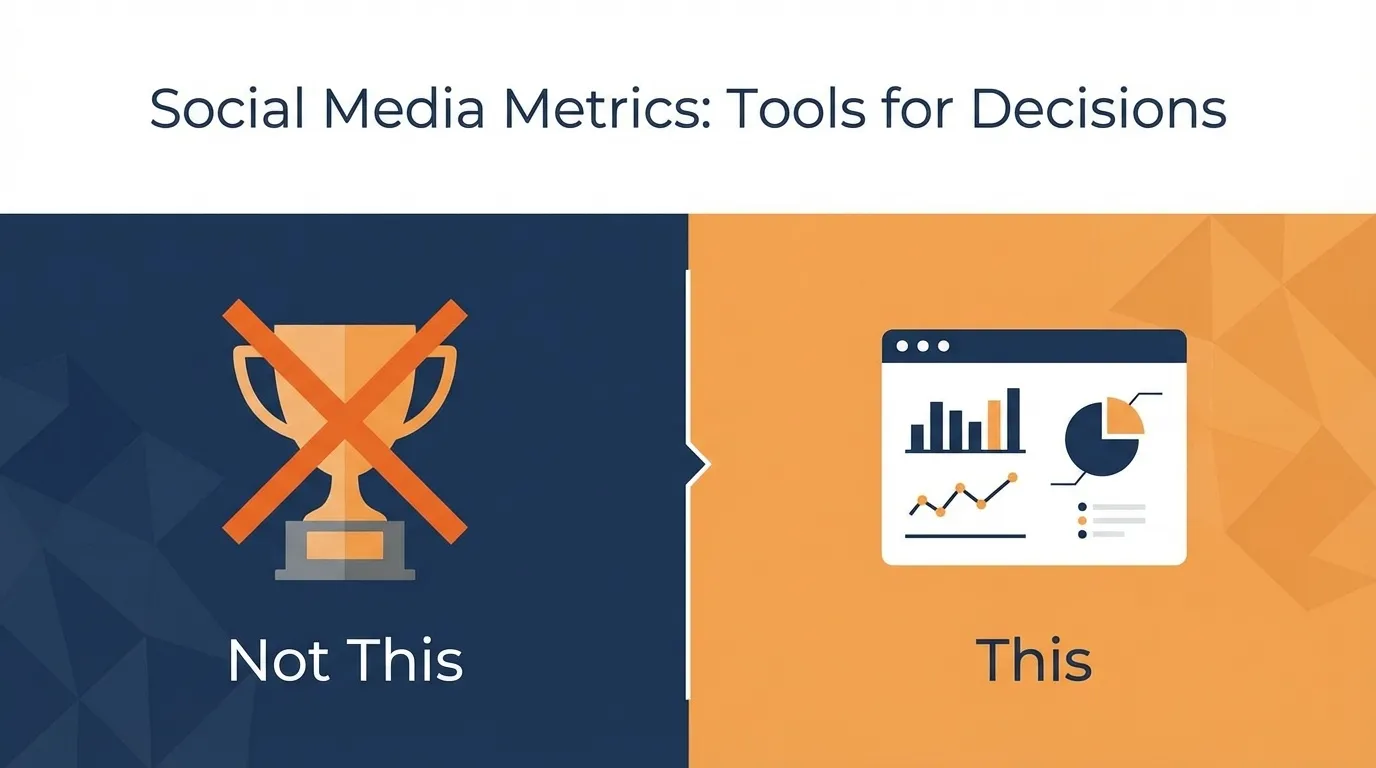
If there is one takeaway you should leave with, it is this. Metrics are not a scoreboard. They are instruments for making better decisions. Engagement shows you whether your message earns attention. Interaction shows you whether that attention turns into intent.
When you treat them as tools, you stop chasing surface-level wins and start building strategies that support growth, leads, and revenue.
Most businesses struggle not because they lack data, but because they lack interpretation and direction. This is where experienced guidance makes the difference. MediaOne helps brands translate social media metrics into clear actions, smarter campaigns, and measurable commercial outcomes.
If you want your social presence to work harder for your business, speak to MediaOne. Call us today to learn how professional social media management can turn your data into a results-driven strategy built on social media metrics.
Frequently Asked Questions
What are the most common types of social media metrics beyond engagement and interaction?
Social media metrics encompass categories beyond engagement and interaction. These include awareness metrics that show how many people discover your content, audience metrics that reveal demographic and behavioural changes over time, and conversion metrics that link social activity to actions such as sign-ups or purchases.
How do social media metrics help evaluate your audience’s behaviour?
Social media metrics help evaluate audience behaviour by showing how users discover, engage with and respond to content. Metrics such as reach and impressions indicate visibility, while others, such as click-through rates and follower growth, show how the audience evolves and interacts over time.
Can social media metrics measure return on investment (ROI)?
Social media metrics can be used to gauge return on investment when linked directly to business outcomes. Metrics such as conversion rates, lead generation, website traffic from social channels and revenue attribution help demonstrate how social activity drives tangible results.
Why is consistency important when comparing social media metrics over time?
Consistency matters because social media metrics can vary based on how they are calculated and reported. Changing the denominator, such as switching from reach to impressions, alters the context and makes comparisons unreliable. Using the same metric definitions and calculation methods ensures that trends reflect actual performance changes rather than measurement differences.
Do social media metrics differ between platforms, and why?
Yes, social media metrics differ across platforms because each platform defines and weights actions such as likes, comments, and shares differently. Algorithms also prioritise certain behaviours, so equivalent metrics across platforms can reflect different levels of user engagement or intent.