| AI Summary
Social media advertising helps Singapore businesses pay to reach people on platforms such as Facebook, Instagram, TikTok and LinkedIn. A first campaign needs one business goal, a defined audience, two versions of the ad and a budget tied to an acceptable cost per result. A pre-launch checklist catches problems with the offer, destination or tracking before spend begins. After launch, businesses can compare platform results with actual enquiries, bookings or sales. |
Social media advertising is the use of paid placements on social platforms to reach people and prompt an action. A campaign starts with a goal, an audience, an ad and a budget. Before launch, the team tests the destination and conversion tracking. After launch, it checks the cost of verified results.
Key Takeaways
- A low cost per lead can hide a high cost per sale. Lead quality belongs in the campaign report.
- A small first test is easier to interpret when one part of the ad changes at a time.
- The pre-launch scorecard covers the objective, audience, creative and budget. A broken form, checkout or tracking event holds up the launch at any score.
- When results drop, the first place to look depends on where people stopped. Falling clicks call for a different check from falling sales.
A bakery in Tampines pays to promote its weekend cake offer. The ad gets comments and clicks, but orders barely move. A quick check on a phone reveals that customers have to search the menu to find the cake in the ad. The campaign brought people to the shop’s website. The extra steps made the offer harder to buy.
Social media advertising gives business owners control over what they promote, where it appears and how much they spend. A campaign works better when the ad, the destination and the way the business counts results support the same goal. The bakery example follows those decisions from the first brief to the first report.
What Is Social Media Advertising?
Social media advertising pays for space in places people already use, such as a Facebook feed, Instagram Stories, TikTok or LinkedIn. A bakery can pay to show a cake offer to people in its delivery area. A software company can promote a demo to people in roles that help choose the software.
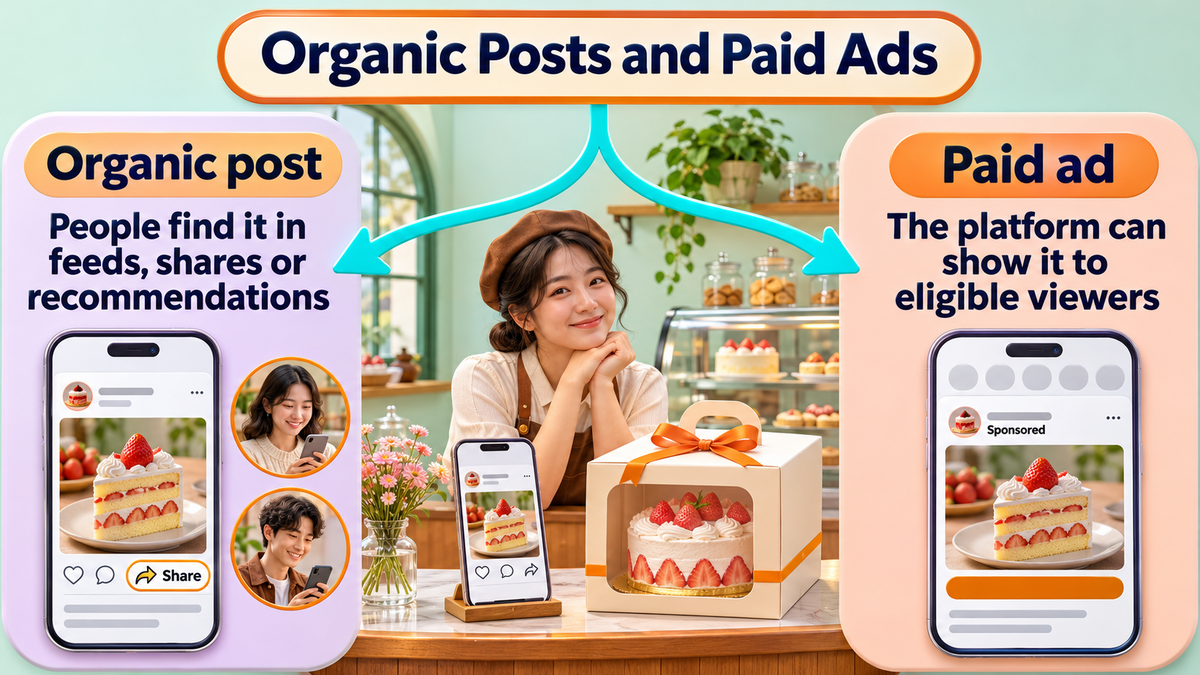
Organic social media covers posts a business shares without paying for placement. Followers can see those posts, and other people may find them through shares or recommendations. Paid ads can also reach people who have never followed the business, within the limits of the audience settings and the platform’s delivery rules.
The two can work together. A bakery’s organic post might reveal that people keep asking about collection times. The paid version can answer that question upfront and send people to the order page. The shop’s broader social media marketing still gives new customers a place to see the menu, find updates and ask questions.
How Do Social Media Ads Work?
What happens in an ad auction?
When an ad slot becomes available, eligible ads can compete for it. The platform considers which ads can appear in that slot and uses its own rules to choose what to show. A bid helps the platform decide how to compete for delivery. The budget controls how much the advertiser sets aside to spend. A team may set a budget and let the platform manage bids under the settings it chooses.
Auction rules differ by platform and buying method. The campaign objective also affects what the delivery system tries to achieve. TikTok’s advertising setup, for example, groups objectives around awareness, consideration and conversion. A campaign built for video views gives the system a different job from one built for sales.
How audience settings affect delivery
Audience settings describe who can see the ad. A business might start with people in a location it serves, then apply other options if the campaign and platform allow them. On some platforms, the team can also reach people who previously visited the website or exclude recent buyers from a first-order offer.
A campaign can start with a larger audience inside a real service area and let the offer do some of the work. A cake ad that says “Weekend collection in Tampines” gives nearby shoppers a reason to look. If the business divides that audience into many small groups, it can become harder to tell which differences came from the ads and which came from having too few results.
Which Platform Should a Singapore Business Test First?
The first platform should give the business a reasonable way to reach likely buyers and show the offer. A shop with customer photos and short product clips has different options from a software company with a sales team and a demo form. The best starting point also depends on what the team can produce and follow up on.
| Platform | A good first test | Example offer |
| A local offer that people can understand quickly | A workshop booking with the venue and date in the ad | |
| A product or service customers want to see before buying | A Reel that shows cake sizes and sends viewers to pre-order | |
| TikTok | A short demo that shows how a product works | A video that shows how a travel bag fits under a seat |
| A business offer for people in specific roles or industries | A software demo for operations managers |
An Instagram marketing strategy can give a retailer a starting point for paid creative. A product demonstration that already gets specific questions may be worth adapting into an ad. The paid version can answer the main question in the video and send the viewer to the relevant product page.
A company with a B2B social media strategy can use what its sales team knows about buyers to plan a LinkedIn test. LinkedIn’s targeting options include job title, company and industry. A team can begin with the few criteria that identify likely buyers and check the audience estimate before narrowing further.
One channel is enough for a first test. When a business tries a second platform, both campaigns need the same definition of a result for a fair comparison. A submitted lead form on one platform and a landing page visit on another count different actions, even if both appear under a column labelled “Results”.
How to Choose Ad Formats and Create Ads
Give each format one job
An ad format changes what people can see and do before they click. One photo can show a simple offer in seconds. A video can answer a question that takes movement to explain. A carousel can help someone compare products while staying in the ad.
| Format | What it can show | Example |
| Single image | One product, event or offer | A cake photo with the price and collection date |
| Short video | A product in use or a service in progress | A baker cutting a cake to show the layers and portion size |
| Carousel | Several options or steps | Cake sizes with serving counts on separate cards |
| Stories placement | A short, full-screen message | A vertical clip showing the order deadline and booking button |
The opening frame should give viewers enough context to understand the offer, even with the sound off. A bakery can show the finished cake first and use captions to explain the order deadline. The mobile preview also helps the team catch text covered by buttons or captions.
Test one change at a time
Two versions of a cake ad could use the same footage, offer and order page. One opens with a close-up of the cake. The other opens with the collection date. If the test changes only the opening, the shop has a better chance of learning which message led to more orders. Where available, a tool such as TikTok Ads Manager’s split testing can help separate the audiences and control the other settings.
Customer videos can also give the team ideas. A user-generated content strategy can help the business find the questions real customers answer in their own words.
When a creator makes a paid ad, the brief should spell out the usage period, what the brand can edit and where it can run the content. The Advertising Standards Authority of Singapore’s guidance on social media advertising covers disclosure of commercial relationships.
How to Set Goals, Audiences and Budgets
Choose the result before building the campaign
A campaign brief can start with one sentence. “The Tampines shop wants paid pre-orders for Saturday collection, and an order counts once payment goes through.” That gives the team an action to track and a date to work towards. A shop looking for more people to learn about a new branch would use a different goal, such as reaching people in the area.
The campaign objective should support the result in the brief. If the shop needs orders, the team can select an objective and conversion event that support purchases, where available. If it needs enquiries, it can track submitted forms or the start of a conversation, then check which enquiries turn into bookings. A lead generation process can help the team define a qualified enquiry before the first form arrives.
Base the audience on who can act
The bakery can start with customers who can collect in Tampines or receive delivery in the areas it serves. A service business can use the same approach by defining the districts it covers and the work it accepts. The ad can state those details upfront, so people can decide if the offer suits them before clicking.
The audience description can be short enough to share with the whole team. “People in our delivery area who need a birthday cake this weekend” gives the person writing the ad, the person setting up the campaign and the person taking orders the same brief. Details such as the price, deadline and delivery terms can then help buyers decide for themselves.
Set the budget from what a sale is worth
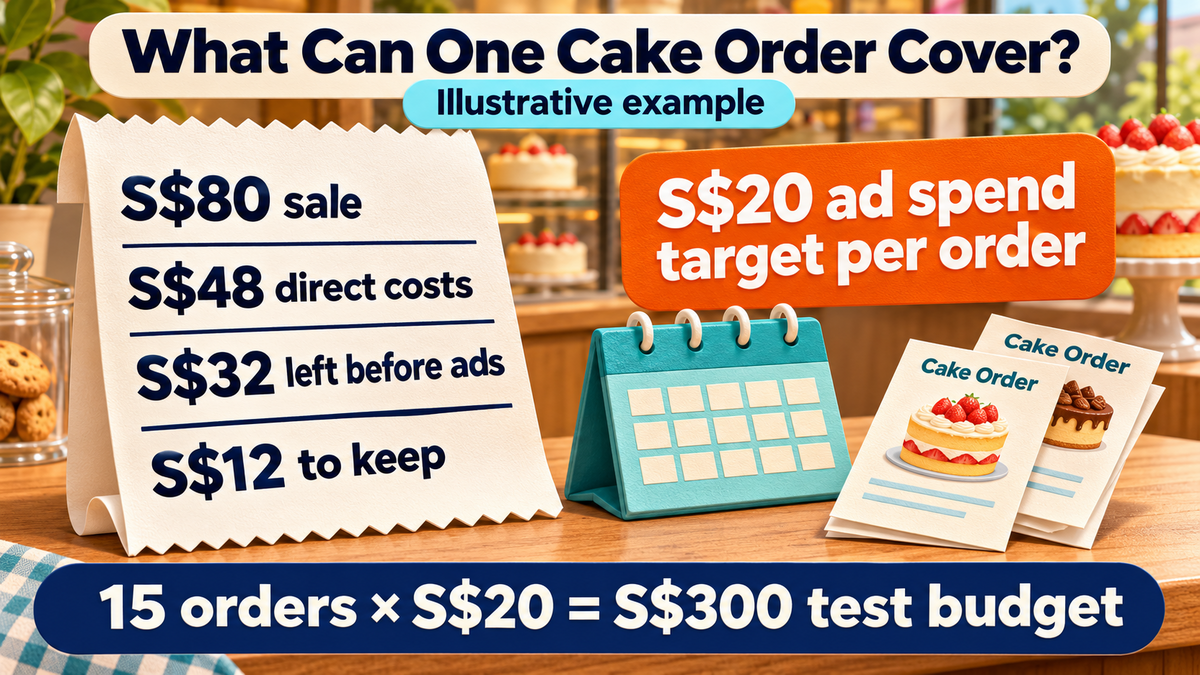
Start with the amount the business can afford to spend to gain an order or customer. Suppose a cake sells for S$80 and costs S$48 to make, pack and process. The shop has S$32 left before ad spend and other business costs. If it wants to keep S$12 of that amount, it can set a target of S$20 in ad spend per order for this example.
An illustrative test aimed at 15 orders at S$20 each would allow S$300 in media spend. The shop can afford to spend that amount on the test if it fits its cash budget. The calculation sets a spending limit and a target to check. The actual campaign might deliver fewer orders or reach the target at a different cost.
The budget should also cover the work needed to run the campaign. Ad spend pays for delivery. Photography, video editing, creator fees, website changes and staff time can sit in separate lines. Keeping the costs visible helps the business decide whether it can afford to run the campaign again, even when the platform reports a good result.
What to Check Before Launching Social Media Ads
The pre-launch scorecard gives an owner or marketer a short way to review the objective, audience, creative and budget. The score is a planning aid. It helps a team find gaps while there is time to fix them.
| Check | 1 point | 2 points | 3 points |
| Objective | The team has a broad aim | The team has named one result | The objective and tracking match the result |
| Audience | The audience is too vague to describe | The team has defined likely buyers | The location and settings match who can buy |
| Creative | The offer or next step is missing | One ad and its destination are ready | Two versions are ready and the offer matches the destination |
| Budget | The team has no spending limit | The team has set a spending limit | The limit reflects the target cost and the team has set a review date |
A score below 9 out of 12 is a reason to revise the campaign before launch. At 9 or above, the team can deal with any open items and test the full customer experience. A broken link, failed payment or missing conversion event needs attention at any score.
Test the ad as a customer would
- The destination opens on mobile. The right product, price, service area and deadline appear on the first page a customer sees.
- The form or checkout works. A test enquiry reaches the right inbox, or a test order reaches the confirmation page and order system.
- The key event fires at the right time. An order event fires after a successful purchase. A lead event fires after the person submits the form.
- The campaign details match the brief. The team checks the dates, budget, location, placements and ad copy in the preview.
- Someone owns the next step. A named team member handles replies, checks orders and reviews results on the agreed date.
Campaign links can use Google Analytics campaign parameters so website traffic reports show which platform and campaign sent the visit. Consistent names make it easier to compare ads later. A test conversion can also be checked in Google Analytics DebugView when debug mode is enabled. The team should check the ad platform and the order or lead system as well, since each has a different job.
The campaign can go live once the checks pass. The first review can focus on delivery and broken steps. If the bakery changes its collection hours, the ad and order page need the same update. If a test order suddenly stops appearing in reports, the team can pause spend while it checks the setup.
How to Measure Social Media Advertising Results
The first report should answer the question from the brief. Did the bakery gain paid cake orders? Did the software company get demo enquiries from businesses it can serve? Platform metrics can help explain how a campaign performed. Order records and sales notes can show what happened after people took the first action.
| Goal | Main figures | What the figures can reveal |
| Awareness | Reach, frequency and cost per 1,000 impressions | How many people saw the ad and how often it appeared |
| Website traffic | Landing page visits and cost per visit | How many people reached the destination and what those visits cost |
| Enquiries | Qualified enquiries and cost per qualified enquiry | Whether leads matched the service and were worth following up |
| Sales | Paid orders, cost per order and return on ad spend | How much spend went towards each order and how much sales revenue the campaign was credited with |
Compare the reported result with the business result
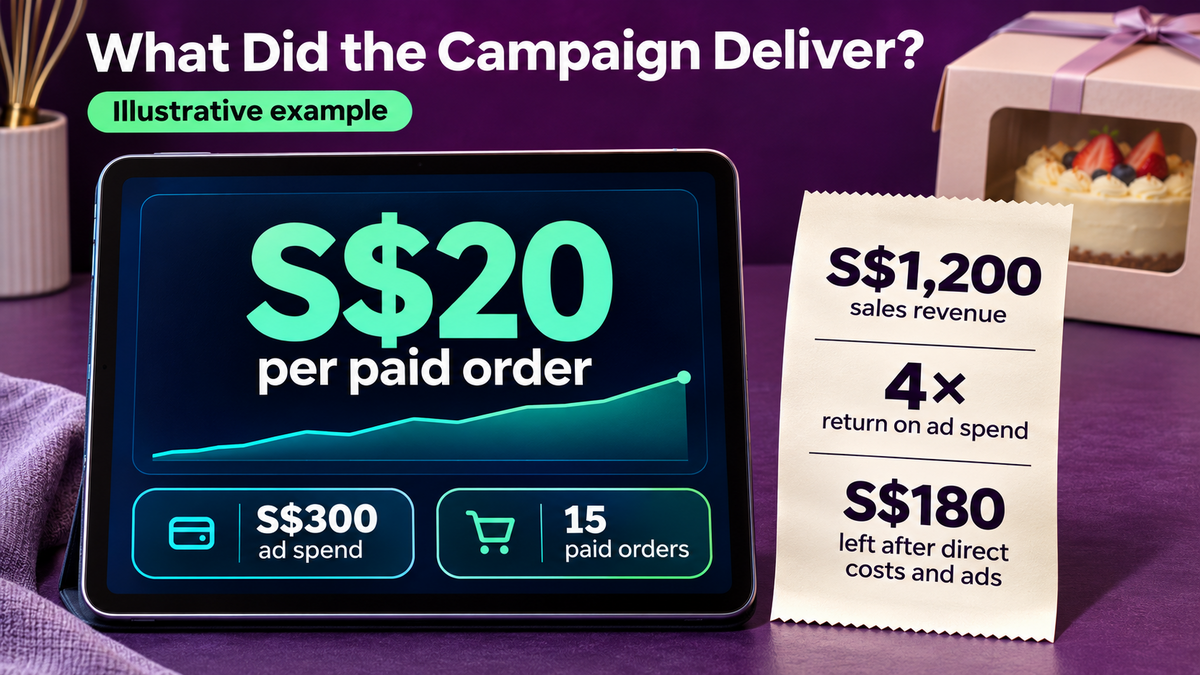
Suppose the bakery spends S$300 and records 15 paid orders linked to the campaign. That works out to S$20 per paid order. At S$80 each, those orders bring in S$1,200 in sales revenue. The return on ad spend, or ROAS, is 4× because S$1,200 divided by S$300 is four.
Profit takes another step. In this example, 15 orders cost S$720 to make, pack and process. That leaves S$480 before ads. After the S$300 in ad spend, the shop has S$180 left before other business costs. The revenue figure helps compare ad performance. The amount left helps the owner decide whether the campaign makes financial sense.
Lead campaigns need the same follow-through. A service company that spends S$300 for 30 forms pays S$10 per form. If only six people meet the service requirements, it pays S$50 per qualified enquiry. The reason the other 24 forms did not qualify can guide the next change. An unclear service area, for example, calls for a different fix from a slow reply.
Find the first step that needs work
- The ad shows but few people click. The team can check whether the opening image, offer and audience make sense together.
- People click but few reach the page. A test on mobile can reveal a slow page, a broken link or an unexpected sign-in screen.
- People reach the page but few buy. The price, delivery details or payment steps may need a closer look.
- People send forms but few qualify. The business can review the ad wording and form questions against the types of enquiries it can serve.
Ad platforms can take time to find people likely to complete the chosen action. TikTok’s learning phase can be affected by changes to settings such as budget or targeting. A team can fix delivery or tracking problems as soon as it finds them, then let the campaign gather enough comparable results before changing the test.
Launch a Social Media Ad You Can Measure
The bakery’s next campaign could start with a single weekend offer and two versions of a short video. One version could open on the cake, and the other could lead with the collection date. Both could send buyers straight to the same order page. That gives the owner one practical decision after the test: which opening is worth using for the next weekend offer?
A first campaign can sit within a wider social media strategy that connects organic posts, paid ads and customer follow-up. MediaOne’s social media advertising services can help Singapore teams set up paid campaigns, test creative and measure the results against their lead or sales goals.
FAQs About Social Media Advertising
Who should own the ad account if an agency runs the campaign?
The business should keep ownership of the ad account and any connected assets it will need later, such as its pages, catalogue and tracking setup. The agency can receive the access it needs to do the work. An owner should also know where to find billing records, campaign history and reports before the engagement ends.
Can a Singapore business run the same ad in English and Mandarin?
A business can prepare separate versions for the languages its customers use. The ad, landing page and follow-up should be consistent. A customer who clicks an ad in Mandarin may need the order instructions and support in Mandarin as well. Separate versions also help the team review the responses each one receives.
What happens to ad comments when a campaign ends?
Comment visibility depends on the platform and whether the ad used a public post. A business can save common questions and replies while the campaign runs, especially if they affect future offers. The answers can help staff handle similar questions in messages, on product pages or at the counter.
Some campaigns can send people to a form or message thread on the platform if the account supports that option. A training provider might collect requests for a callback while its booking page is being built. The team needs somewhere to record each request, a person to reply and a way to tell which enquiries became bookings.
The first step is to read the reason in the ad account and check the policy it points to. The issue can be in the wording, image, offer or destination. The team can correct the problem and submit the revised ad. If the business believes the rejection was a mistake, it can use the platform’s review process where available.