Quick decision rule: If you need enquiries within weeks and your sector’s cost per click is affordable against your order value, start with paid search. If you can wait six months or more and want visibility that keeps working after spending stops, build SEO. For most Singapore SMEs, the answer is to run paid search first and move budget into SEO as the search terms data matures.
Most Singapore business owners ask whether to pay for search ads or build organic rankings, as if only one can win. That framing costs money. Google holds 89.94% of the worldwide search engine market (StatCounter), so the real decision is how to sequence the two channels. This guide sets out a practical way to decide on SEO vs. SEM and where to start, how to test whether a paid click is affordable, and when to shift budget from paid to organic.
Key Takeaways
- Sequence beats channel choice. Start with paid search to buy speed and learn which keywords convert, then build SEO on that data.
- Paid results appear immediately. SEO typically needs 3 to 6 months by the common industry estimate; CMLabs puts it at least four months to a year.
- Singapore cost per click ranges from about $0.50 for basic e-commerce keywords to $15+ for competitive legal and web-design terms, so affordability depends on your sector.
- Work out your maximum affordable click cost from order value, close rate and maximum cost per acquisition before bidding.
- Meta leads cost roughly $35 to $80 for financial services (Stackmatix), so test paid social against Google search rather than assuming it is cheaper.
- Check grant eligibility: with PSG closed, SMEs now apply through the EDGE Grant for pre-approved digital solutions, subject to government criteria.
What SEO and SEM Actually Are
Search engine optimisation (SEO) is the work of getting your website’s pages to appear in the organic, unpaid results when someone types a query into a search engine. You improve how your site is structured, what its content says, and how other sites link to it, so that search engines understand what each page is about and rank it for relevant search intent. Nothing is bought per click. The cost is paid in content, technical fixes and time, and it forms a core part of any sound digital marketing strategy.
Search engine marketing (SEM) is paid placement in search results. You bid on keywords in an auction, usually through Google Ads, and pay each time someone clicks your ad. Paid results carry an “Ad” label and sit above and sometimes below the organic listings. Organic results are the ranked pages beneath them. The two compete for the same click, so businesses that hold a paid slot still need an organic presence to capture the clicks that skip the ads.
SEO and SEM differ first in how fast they produce results, and that single difference shapes most of the other trade-offs. Paid search can place a site at the top of the search results page as soon as an ad goes live. SEO works more slowly: CMLabs puts it at least four months to a year for Google to recognise a site’s relevance and value, while the commonly cited industry range for first measurable results is three to six months (Shopify’s month-by-month guide). Getting the right SEO strategy in place early means the organic ranking builds steadily while paid spend can be scaled up or down.
Core Differences Between SEO and SEM
Speed: instant versus delayed results
SEM buys visibility by the click, so the effect starts the moment the campaign runs. SEO compounds. Each page you publish, and each link you earn, adds to a base that keeps working, but that base takes months to build. For a business that needs leads this month, SEO alone is usually too slow.
Cost, time and effort compared side by side
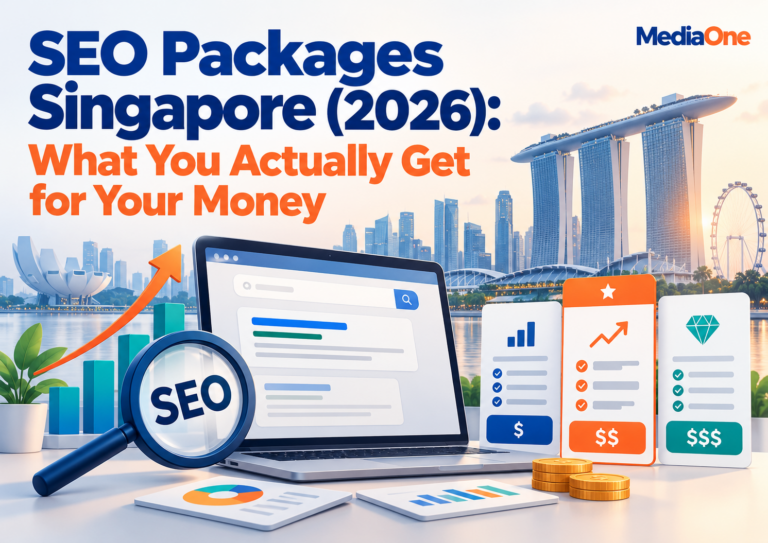
SEM costs are variable and immediate. Singapore cost per click ranges from about $0.50 for basic e-commerce keywords to $15+ for competitive legal and web-design terms, according to Terris’s Google Ads cost guide. SEO costs are mostly fixed and front-loaded: BestSEO.sg quotes retainers from about S$2,300 a month. SEM effort is mainly campaign management; SEO effort is content, technical work and link building that runs for a long time. A well-built website supports both approaches, but its structure and content shape how much each channel costs to run. The right balance depends on how much effort your team can sustain.
Short-term campaigns versus long-term strategy
SEM stops producing traffic the day spending stops. SEO keeps a share of its traffic after the work pauses, though rankings can slip if the content goes stale. Treat SEM as a campaign and SEO as an asset. Many businesses use SEM to test their marketing strategies quickly, then invest in SEO once they know which messages their audience responds to. A clear SEO strategy can then turn those proven messages into lasting organic visibility.
Comparison table: SEO vs SEM across the factors that matter
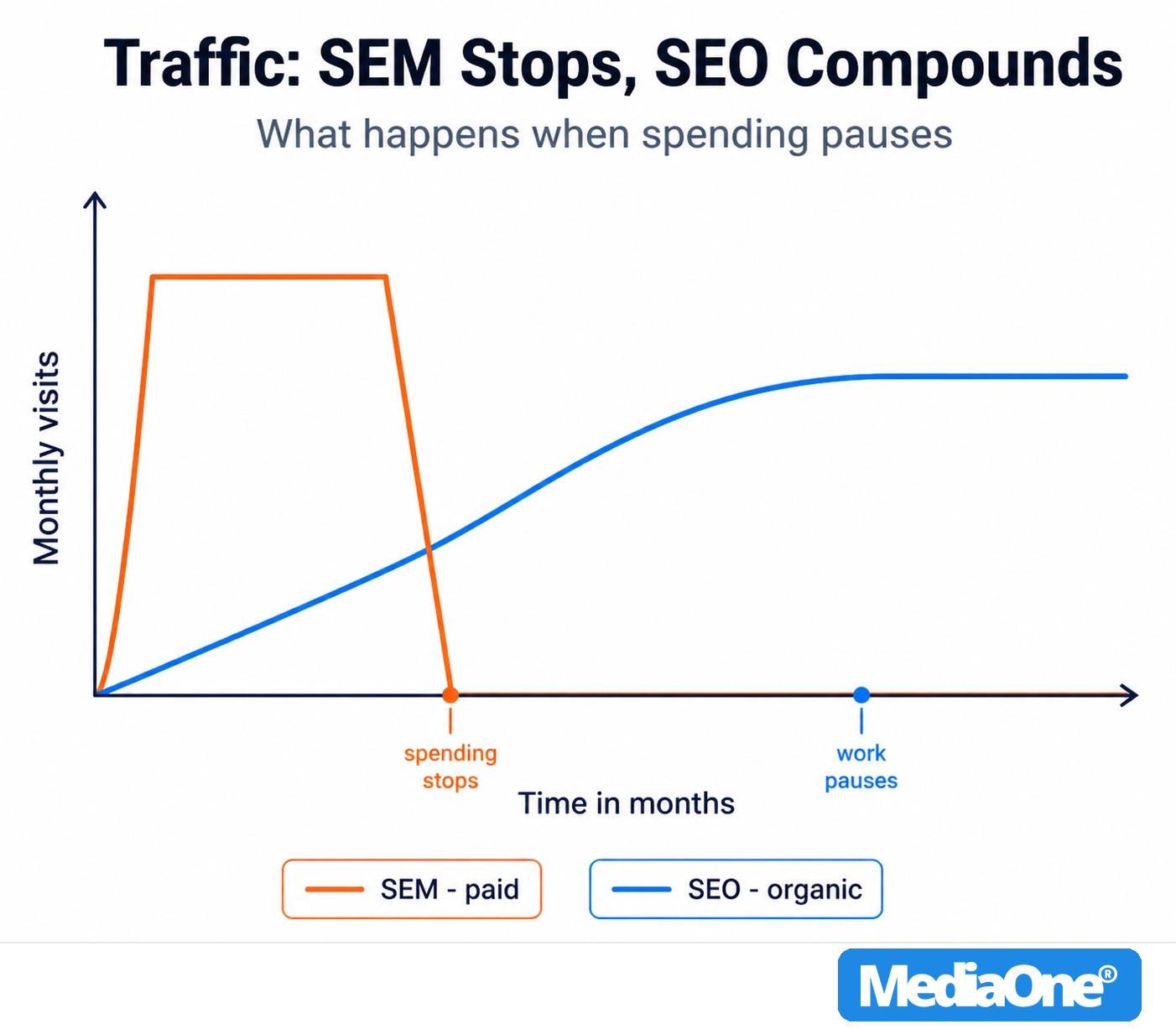
Figure 1: SEM buys traffic by the month; SEO builds an asset that outlasts the spend.

|
Factor |
SEO |
SEM |
|
Time to first results |
Usually 3 to 6 months; up to a year |
Immediate after launch |
|
Cost model |
Mostly fixed effort or retainer |
Pay per click |
|
Traffic after spending stops |
Largely retained |
Stops |
|
Main skill needed |
Content, technical and link work |
Bidding, ad copy and tracking |
|
Best use |
Long-term, compounding visibility |
Fast tests and urgent demand |
The Real Benefits of Each Channel
What SEO delivers: visibility, brand trust and compounding sales
SEO is slow to start but pays back over time. Organic results carry more trust than ads for many buyers, and a well-ranked website keeps returning visitors without a fresh bid each time. The delay is the cost. The reward is that each good page keeps earning clicks after the work is done, so the cost per visit falls as the months pass.
The compounding effect is the main reason to build an SEO strategy even when paid search is working. Every page you rank for a buyer-intent query is a sales asset that does not get more expensive as competitors bid up the auction.
What SEM delivers: quick results, measurable conversions and an adjustable budget
SEM buys speed. A campaign can put your business on the search results page within hours of launch, which matters when you need enquiries this month. Its other advantage is measurement: you see which keyword, ad and landing page produced each lead, and you can cut spend on what does not convert the same day.
The budget is also fully adjustable. You can pause a campaign, cap daily spend or shift money between keywords without any long-term commitment. For a small business with a fixed monthly marketing budget, that control is worth more than the per-click price itself. Our Google Ads budget guide covers how to structure that spend.
Singapore Market Considerations for SMEs
Singapore’s costs vary more than most SMEs expect. Terris puts Google Ads cost per click at about $0.50 for basic e-commerce keywords and $15+ for competitive legal and web-design terms, with finance and insurance around $3.50–$7.00. Costs also vary by bid strategy, so the same channel can be cheap for a florist and unaffordable for a law firm. Before committing budget, understand the difference between SEO and paid search: SEO builds organic visibility on search engines over time, while paid search buys placement in the search results immediately, at a per-click cost. Strong, useful content supports both channels, because landing pages that answer the buyer’s question convert clicks into enquiries. For a deeper comparison of what each channel returns, see our Google Ads vs SEO ROI analysis.
Working out your maximum affordable cost per click

Start with the economics, not the bid. Maximum cost per acquisition (CPA), meaning the most you can spend to win one paying customer, equals average customer value multiplied by close rate. Affordable cost per click equals maximum CPA multiplied by close rate, where close rate is the share of clicks that become paying customers.
Take a wedding photographer: a S$2,500 average booking and a 5% close rate give a maximum CPA of S$125, and applying the close rate again gives an affordable cost per click of about S$6.25. An S$8 top-of-page bid therefore sits just above the ceiling — the photographer needs a higher close rate or a larger booking value before bidding — and an S$60 bid in the same market would not come close, unless the close rate or order value rises substantially. Run this sum before you touch a campaign.
Maximum CPA = average order value x close rate
Affordable cost per click = maximum CPA x close rate
Use this checklist before you bid:
1. Write down your average order value in S$.
2. Measure your close rate: enquiries or sales divided by total clicks over a set period.
3. Multiply order value by close rate to get your maximum CPA.
4. Multiply maximum CPA by close rate again to get your affordable cost per click ceiling.
5. Compare the ceiling against the top-of-page bid for your target keyword.
6. Bid only where the bid sits below the ceiling, and recheck monthly.

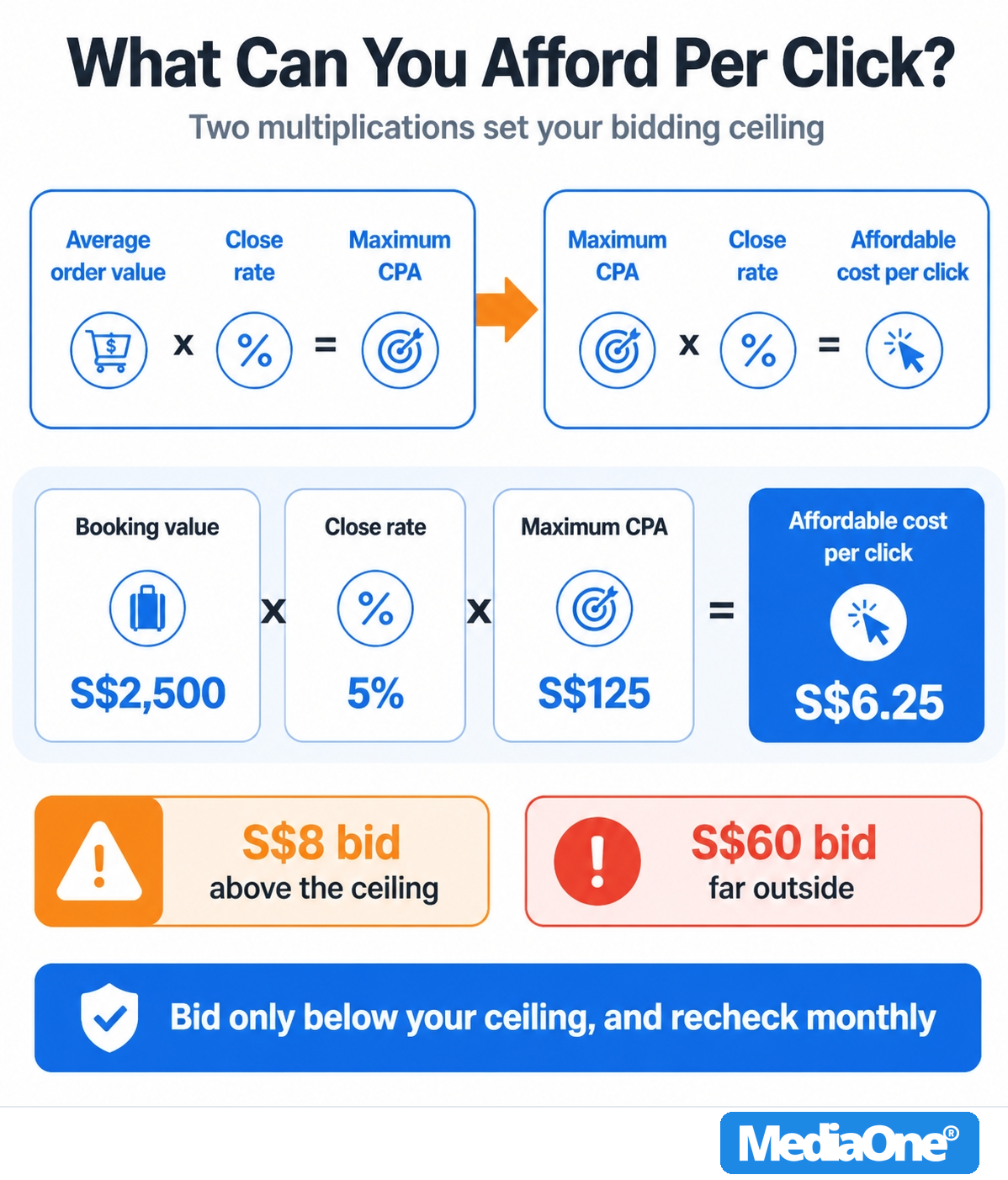
Figure 2: The affordable-CPC maths with a worked example — bid only below your ceiling.
Meta Ads and the Singapore audience
Meta is a different proposition from search. Meta CPMs (the cost per 1,000 ad impressions) in Singapore are roughly S$8 to S$28 per 1,000 impressions, according to Singapore Digital Marketing, with an average cost per click around S$0.55 to S$2.15. Lead costs on Meta vary widely: Stackmatix reports roughly $35 to $80 for financial services leads. Meta reaches people who are not looking for you, so it suits demand creation better than capturing existing intent, and the content in your ads needs to earn attention from people who did not ask for it.
Funding support for digital adoption
Singapore consolidated its business grant schemes in 2026: applications under the Productivity Solutions Grant (PSG), EDG and MRA closed on 29 September 2026, and new projects now run through the unified EDGE Grant, which supports pre-approved digital solutions for eligible SMEs with up to 50% support, subject to government criteria. MediaOne is a certified EDGE Grant digital marketing vendor. Check your eligibility with the relevant agency before you commit budget.
Why AI answers change the calculation in 2026
Many buyers now read the AI-generated answer at the top of the results and never scroll further. That shift is why paid search and organic visibility both matter in 2026, since neither channel can rely on the old habit of clicking through ten blue links on search engines. Well-structured content that AI systems can cite is becoming part of the calculation — our AI Overview optimisation guide covers what that means in practice.
Local search and Google Business Profile
For a Singapore SME with a physical location or a local service area, local search is often the cheapest visibility available. A complete Google Business Profile, with accurate opening hours, photos and reviews, can place a business in the map results for nearby queries without a bid. Google’s Business Profile Help explains how to claim and maintain a listing, and our Business Profile SEO guide covers the optimisation steps. A well-maintained profile is the right starting point for local products or services.
Keyword Strategy for Both Channels
Paid search and organic search are often treated as separate projects, each with its own keyword list. That wastes data. The fastest way to find out which terms are worth ranking for is to buy them first, using paid marketing as a testing ground before committing to a full marketing strategy.
Using paid search data to inform your SEO keywords
Every paid click returns a search terms report, which shows the exact queries that triggered your ad. Over four to six weeks, this report tells you which phrases bring enquiries and which bring window shoppers. Keep the terms that convert and turn them into SEO targets, since those are the phrases your audience already uses to find what they need. Our keyword research guide and keyword research service cover the full workflow.
Before-and-after keyword data shows the sequence working. A paid term that converts at a healthy rate is later targeted by a dedicated page, and over time the same query starts to appear in organic rankings, lowering the cost per enquiry for that term.
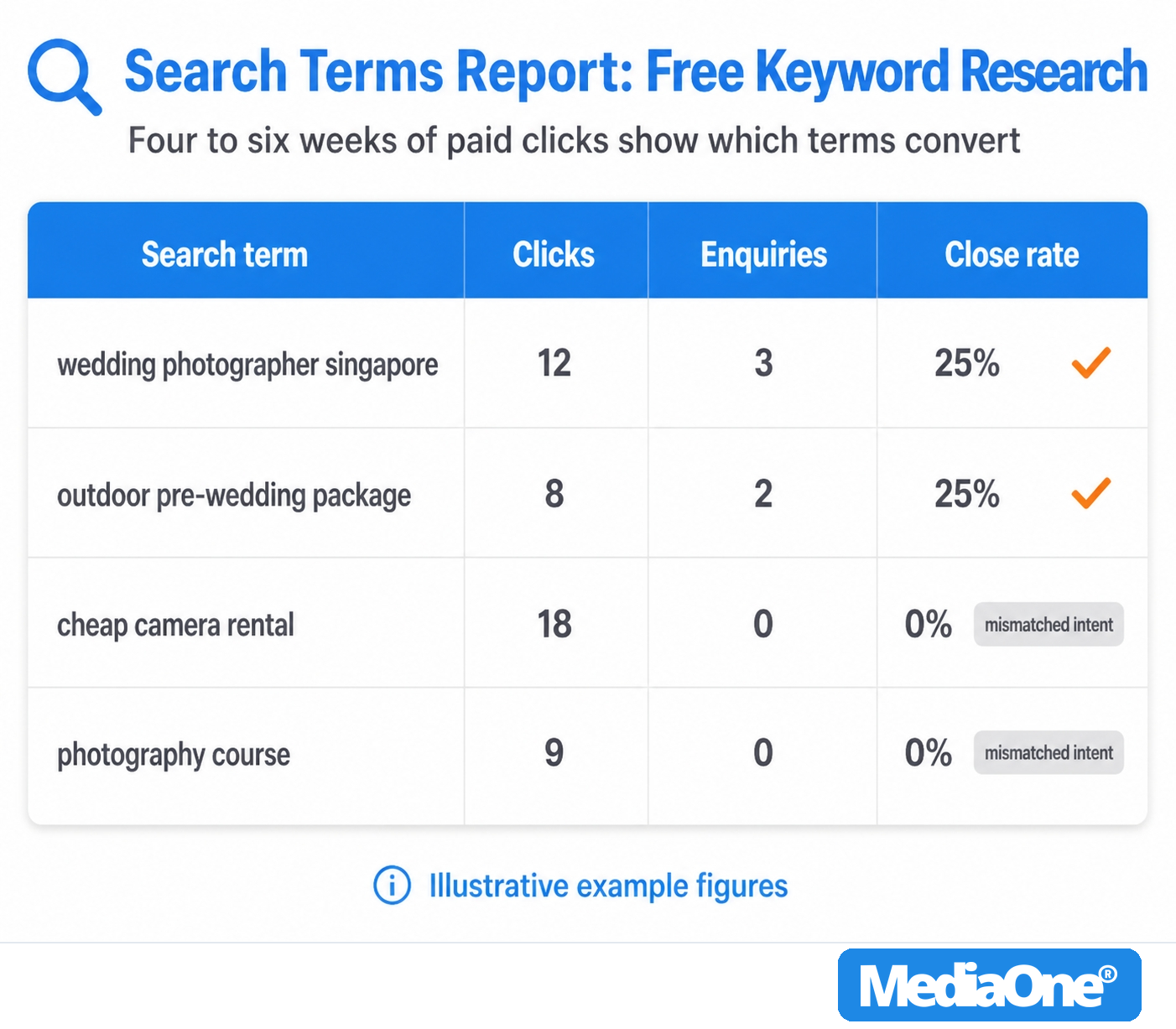
Figure 3: Illustrative search terms report — the queries that convert become SEO targets.
Two signals matter most. Search terms with a close rate above your average deserve a dedicated landing page. Terms with clicks but no enquiries are often a sign of mismatched intent, which SEO content should avoid targeting. Google’s Keyword Planner gives volume estimates, but your conversion data is the more reliable guide for a small business.
Long-tail keywords and where they fit
Long-tail keywords are longer, more specific phrases, such as “wedding photographer Singapore outdoor package” rather than “photographer”. They carry less search volume, but the buyer is further down the funnel, and competition is lower, so they are usually the realistic first rankings for a new website. Pairing them with sound search engine optimisation practice gives a new site its clearest route to visibility.
Use them where they match the page’s purpose: service pages for commercial phrases, blog posts for question-led phrases. Each page should target one primary long-tail phrase, with close variants placed naturally in headings and body copy, not repeated in lists.
Summary
For most Singapore SMEs, SEO versus SEM is the wrong either/or. The sequence matters more than the channel. Use paid search first to buy speed and to learn which keywords convert on your website. Then build SEO on that evidence, so you stop paying per click for traffic you could earn organically through search engine optimisation.
Use this checklist before you commit spend:
- 1. Set your urgency. If you need enquiries this month, start with paid search. If you can wait, start with SEO content.
- 2. Check your sector cost per click. Singapore cost per click ranges from about $0.50 for basic e-commerce keywords to $15+ for competitive legal and web-design terms (see Terris’s cost guide).
- 3. Calculate your maximum affordable cost per click from order value, close rate and maximum cost per acquisition (CPA, the most you can pay for one customer).
- 4. Switch to SEO once paid conversion data identifies the keywords worth ranking for, from around month 3 to 6. Those keywords should also appear in your search results targeting.
- 5. Plan cash flow for the lag. CMLabs puts meaningful SEO results at least four months to a year, so do not judge it by the first month.
Frequently Asked Questions
Is SEO or SEM better for a small business in Singapore?
Neither is better in every case. SEM is usually better for speed, because a well-set campaign can put your site in front of buyers within days. SEO is usually better for cost over time, because organic rankings keep returning traffic without a per-click charge. For most Singapore SMEs, start with SEM to learn which keywords convert, then build SEO on that data.
How long does SEO take to show results?
The commonly cited industry range is three to six months for first measurable results, and CMLabs puts it at least four months to a year for Google to fully recognise a site’s relevance and value. Newer sites in competitive sectors should expect the longer end. Plan your cash flow around that lag, not around the first rankings you see.
Can I run SEO and SEM at the same time?
Yes, and many SMEs do. Run paid campaigns from the start, then begin SEO from around month 3 to 6, using the keywords that already convert in your paid data. Our Google Ads vs SEO guide covers how the two channels share the work.
What does a Google Ads click cost in Singapore?
Costs vary widely by sector and bid strategy. Terris reports Singapore cost per click from about $0.50 for basic e-commerce keywords, through $3.50–$7.00 in finance and insurance, to $15+ for competitive legal and web-design terms. Test your own keywords before budgeting, because these figures are indicative.
Do I need a retainer to get started with SEO?
Not necessarily, but ongoing SEO work usually needs one. BestSEO.sg quotes SEO retainers from about S$2,300 a month. Ask any provider what each month’s work includes, and compare that against the price — our SEO pricing guide for Singapore shows the full market range.
Are there government grants for digital marketing in Singapore?
The Productivity Solutions Grant (PSG) closed to new applications on 29 September 2026. New projects now apply through the unified EDGE Grant, which supports pre-approved digital solutions for eligible SMEs with up to 50% support, subject to government criteria. Confirm whether a specific marketing service qualifies before you commit.