
Did you know that organic search remains the most critical source of website traffic for many businesses, with roughly 53% of all web visits coming from organic search results?

Search Engine Optimisation (SEO) is the backbone of any effective digital presence. Optimising your content, technical setup and site authority for both users and search engines helps you get noticed, attract qualified visitors and grow your business steadily. Many brands even partner with a professional SEO agency like MediaOne to accelerate results and ensure their strategies are data-driven and up to industry standards.
This guide is crafted to walk you from the fundamentals to advanced strategies. Whether you’re just starting out or looking to refine your SEO approach, these SEO guidelines will give you a clear roadmap to better organic traffic, improved user experience and long-term digital success.
Key Takeaways
- Effective SEO combines keyword research, on-page optimisation, technical performance and authority building to improve visibility and user experience.
- Mobile responsiveness, page speed, crawlability, structured data and site security ensure search engines can access and index your content effectively.
- Identify, analyse and map keywords to relevant pages to ensure your content answers real user queries and supports business goals.
- Clear heading hierarchies, well-organised content and engaging, high-quality material improve readability and search engine comprehension.
What is SEO?
Search Engine Optimisation (SEO) is the practice of improving your website so search engines can better understand it, helping it appear on the first page of search results for relevant queries.

SEO is a mix of strategies, including technical optimisation, content creation, improving user experience and building authority through links and reputation. The goal is simple: attract organic traffic, reach the right audience and drive actions such as sales, newsletter sign-ups and other key results.
Effective SEO balances the needs of users and search engines. Search engines use algorithms to rank content, but people are looking for information that’s useful, engaging and trustworthy. Today’s SEO is all about creating great content, organising your website clearly, ensuring it runs smoothly and demonstrating that your site is reliable and authoritative.

Key benefits of SEO include:
- Your website shows up more often in search results, helping people recognise your brand.
- More people visit your site naturally, so you don’t have to rely as much on paid ads.
- Your site becomes easier and more enjoyable to use for visitors.
- Good SEO keeps working over time, bringing in traffic for months or even years.
How Do Search Engines Work?
Search engines are like innovative librarians, helping people find the information they need quickly. To do SEO well, it helps to understand how they work. To put it simply, they do three main things: crawl the web to discover pages, index those pages to store information and rank them to determine which results appear first.
- Crawling: Search engines send automated programs, called bots or spiders, to crawl the web. These bots follow links from page to page, collecting information about your website’s content, layout and metadata. Having a well-organised site with clear internal links and a sitemap makes it easier for these bots to crawl your pages efficiently.
- Indexing: Once a page is crawled, search engines store its information in a vast database called the index. Indexed pages can appear in search results, while pages that aren’t indexed won’t be found at all. During this process, search engines evaluate your content, keywords and site structure, which is why proper indexing is crucial for SEO.
- Ranking: Ranking decides the order in which pages appear in search results. Search engines use intricate algorithms that consider hundreds of factors, like relevance, authority, content quality and user experience. Pages that rank higher are more likely to be clicked, making ranking a key SEO goal.
- Understanding Searcher Intent: Modern search engines want to give users exactly what they’re looking for. For instance, someone searching for “best Italian restaurants in London” expects local, practical recommendations, not a general article about Italian cuisine. Tailoring your content to match search intent helps your site get noticed and keeps visitors engaged.
Learning how crawling, indexing, ranking and search engine intent work lets website owners organise their content and technical setup to meet the needs of both search engines and users.
Keyword Research & Search Intent
Keyword research is the process of identifying the words and phrases users enter into search engines to find information, products, or services.
Keyword research is the backbone of SEO. It helps you plan your content, optimise your pages and shape your overall strategy. Knowing the keywords people use and why they’re searching helps ensure your content actually answers your readers’ questions.
The first step in keyword research is understanding search intent. Not all keywords are created equal. Modern SEO prioritises the reason behind a user’s query. Search intent typically falls into four categories:
- Informational: The user seeks knowledge or answers, for example, “What is SEO?”
- Navigational: The user is looking to visit a specific site, such as “Moz SEO guide.”
- Transactional: The user intends to purchase or convert, for instance, “buy DSLR camera online.”
- Commercial Investigation: The user is researching options before making a purchase, e.g., “best SEO tools 2025.”
Once you understand the intent type, the next step is to find keywords. Start with seed keywords, basic terms related to your topic and expand them using tools and strategies such as:
- Keyword research platforms like Google Keyword Planner, Ahrefs, or SEMrush.
- Google suggestions, “People also ask,” and related searches.
- Competitor analysis to uncover gaps or opportunities.
After gathering potential keywords, it’s essential to analyse them based on several factors:
- Search volume: How many internet users are searching for the term?
- Competition/difficulty: How challenging it is to rank for the keyword.
- Relevance: How closely the keyword aligns with your content and business goals.
With your keywords selected, the next step is to map them to content. Organise keywords into logical clusters and assign them to relevant pages:

- Pillar pages cover broad topics and serve as authoritative guides.
- Cluster pages focus on subtopics and link internally to pillar pages, creating a network of connected content that signals expertise and relevance to search engines.
Finally, optimise your content for keywords by incorporating them naturally into key areas, including page titles, headings, meta descriptions, URLs, body content, image alt text and anchor text. Avoid keyword stuffing; the primary goal is to create content that flows naturally for readers while remaining clear to search engines.
Doing keyword research while keeping search intent in mind makes sure your content matches what people are really looking for. This helps you attract exemplary visitors, keep them engaged and establish your website as a trusted source in your field.
On-Page SEO & Content Strategy

Image Credit: WordPress
On-page SEO refers to optimising individual web pages to improve their ranking and attract relevant traffic. This includes content, HTML elements and user experience. A well-optimised page makes it easier for search engines to understand your content while providing value to users.
SEO-Friendly Titles, Meta Tags & URLs
- Page Titles: Should be clear, descriptive and include the primary keyword. Keep your titles under 60 characters to avoid truncation in search results.
- Meta Descriptions: Summarise the page’s content in 150–160 characters, using a compelling call to action when appropriate. While meta attributes do not directly impact search rankings, they do influence click-through rates.
- URLs: Keep your URLs concise, readable and keyword-rich. Avoid long strings of numbers or irrelevant parameters.
Example: www.example.com/seo-guide is preferable to www.example.com/page?id=12345.
With a solid on-page foundation, you can ensure that search engines correctly interpret your content and users easily navigate your site, paving the way for technical optimisation. On-page SEO involves optimising individual web pages to improve visibility in search engines while delivering value to visitors. A well-structured page starts with a clear hierarchy of headings.
The H1 should reflect the main keyword and build the page’s primary topic, while H2 and H3 headings break content into scannable sections, making it easier for your readers to navigate and for search engines to understand.
Content quality is the bread and butter of on-page SEO. Pages should provide original, informative material that fully addresses user queries. Supporting content with samples, case studies, statistics and actionable insights increases credibility. While paragraphs explain concepts and context, certain elements can be highlighted for clarity and emphasis:
- Visual optimisation: Images should have descriptive file names and alt text, be compressed for fast loading and include relevant charts or infographics.
- Multimedia support: Videos and interactive content with metadata and transcripts can increase your site’s engagement and accessibility.
- User experience enhancements: Mobile-friendly design, readable fonts, clear calls-to-action and intuitive navigation keep visitors engaged.
Maintaining content freshness can help sustain search engine rankings. Keeping your statistics, examples and links up to date helps your content stay relevant. Outdated pages should be merged or archived with proper redirects so you don’t lose any link value.

Using related terms and organising content around topics also helps build your site’s authority. Incorporating associated terms, synonyms and contextually linked phrases signals depth to search engines, while internal linking connects related pages, reinforcing topic clusters and improving site navigation.
With on-page SEO optimised for content, structure, and user experience, the next priority is technical SEO. This ensures your website performs efficiently, is fully crawlable, and meets modern search engine requirements.
Technical SEO
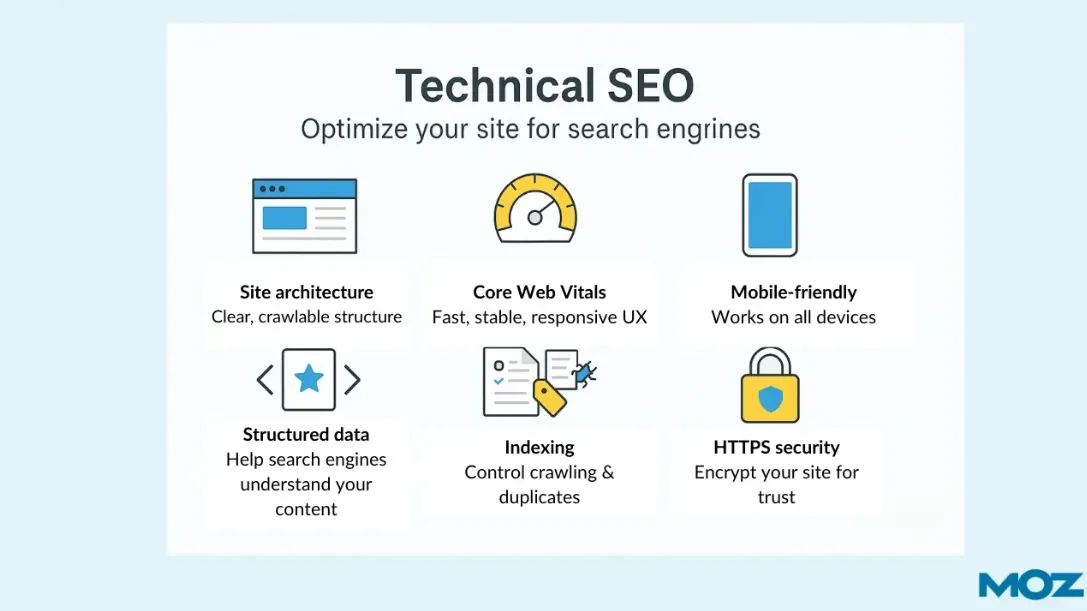
Image Credit: Moz
Technical SEO ensures that your website meets the technical standards required by search engines, improving crawlability, indexability and overall performance. Even the best content can underperform if search engines cannot easily access or understand it, making technical optimisation a crucial step in your SEO strategy.
A key aspect of technical SEO is site performance and speed. Slow-loading pages can frustrate users and increase bounce rates, while fast, responsive pages enhance both user experience and rankings.
Core Web Vitals are metrics that assess loading speed, interactivity and visual stability, which should be monitored and optimised regularly. Strategies include:
- Compressing images and optimising CSS and JavaScript to reduce render-blocking issues.
- Using caching and content delivery networks (CDNs) to deliver content efficiently.
- Minimising unnecessary scripts and plugins that slow page load time.
Mobile-first design is another essential consideration. Google primarily uses mobile versions of websites for indexing, so ensuring your site is fully responsive, with readable text, appropriately sized buttons and intuitive navigation, is vital for SEO and user engagement.
Crawlability and indexability determine how search engines discover and understand your site. Submit an XML sitemap, maintain a clean robots.txt file and use canonical tags to prevent duplicate content issues. A clear site hierarchy ensures that important pages are easily reachable and indexed correctly.
Structured data and schema markup can enhance search visibility by helping search engines interpret content context. Implement JSON-LD or microdata for articles, products, FAQs and reviews, which may also enable rich results in search listings. Security is a further ranking factor; switching your site to HTTPS establishes trust with both users and search engines. Ensure your SSL certificates are valid and consistently maintained.
Finally, for global and local optimisation, technical SEO extends to:
- Using hreflang tags for multilingual or international websites.
- Maintaining consistent NAP (Name, Address, Phone) information for local SEO.
- Applying local schema markup to improve visibility in location-based searches.
With technical foundations optimised for performance, security and search engine understanding, the next stage is authority building and off-page SEO, which focuses on establishing credibility and trustworthiness through external signals.
Authority Building & Off-Page SEO

Image Credit: Tops Technologies
Off-page SEO focuses on actions taken outside your website to improve its authority, credibility and search engine ranking. While on-page SEO optimises your content, off-page SEO signals to search engines that your website is trustworthy, valuable and relevant.
One of the most important aspects of off-page SEO is high-quality backlink building. High-quality backlinks from authoritative, relevant sites act as “votes of confidence,” signalling that your content is credible. Modern SEO emphasises quality over quantity, with a natural and diverse link profile being far more effective than numerous low-quality links. Strategies to build links include:
- Guest posting: Contributing articles to reputable websites in your niche that link back to your content.
- Resource page outreach: Suggesting your content as a valuable addition to curated lists on relevant websites.
- Broken-link building: Identifying broken links on authoritative sites and offering your content as a replacement.
- Linkable assets: Creating research reports, infographics, guides, or tools that naturally attract backlinks.
Brand mentions and social signals also contribute indirectly to your authority. While social engagement does not directly influence rankings, consistent mentions, shares and interactions help increase visibility, traffic and credibility across the web.
Avoiding link-building pitfalls is crucial. Purchasing links, participating in link farms, or using irrelevant directories can lead to penalties and long-term ranking issues. Focus instead on acquiring links that are relevant, trustworthy and naturally earned over time.
Finally, establishing topical authority and E-A-T (Expertise, Authoritativeness, Trustworthiness) is essential for building long-term SEO success. Demonstrate expertise through well-researched content and author credentials, strengthen authority with mentions and backlinks from reputable sources and ensure trustworthiness by maintaining transparency and accuracy.
Successfully building authority and external credibility sets the stage for ongoing success, but SEO is never a one-time effort. Monitoring, optimising and adapting your strategy ensures sustained growth and long-term results.
Quick-Start SEO Checklist
This checklist is designed to help you implement essential SEO practices quickly and efficiently. Use it as a reference when optimising new or existing pages:
On-Page SEO:
- Optimise page titles and meta descriptions with relevant keywords.
- Structure headings (H1, H2, H3) for readability and SEO.
- Include internal links to relevant pages.
- Optimise images with descriptive file names and alt text.
- Ensure content answers user intent fully and includes statistics or examples.
Technical SEO:
- Ensure the website uses HTTPS.
- Submit XML sitemap to search engines.
- Optimise page load speed and Core Web Vitals.
- Implement structured data where relevant.
- Ensure mobile-friendly and responsive design.
Keyword Research & Content Strategy:
- Identify target keywords using research tools.
- Map keywords to appropriate pages or clusters.
- Optimise content naturally with primary and secondary keywords.
- Monitor and update content for accuracy and freshness.
Authority & Off-Page SEO:
- Build backlinks from authoritative, relevant websites.
- Avoid spammy links and black-hat tactics.
- Monitor brand mentions and social signals.
- Showcase expertise, authoritativeness and trustworthiness (E-A-T).
Monitoring & Optimisation:
- Track rankings, traffic and click-through rates regularly.
- Perform periodic SEO audits.
- Adjust content and technical elements based on performance metrics.
- Following this checklist ensures your website is fully optimised for search engines while remaining user-friendly.
Master SEO Through Our Comprehensive SEO Guidelines
SEO is no longer just about keywords; it’s about creating a website that delivers value, authority and a seamless user experience. Implementing the strategies outlined in this guide positions your site for long-term organic success.
Whether you are a small business or a large enterprise, staying ahead in SEO requires constant monitoring, adaptation and an understanding of emerging trends. From optimising on-page content to building authoritative backlinks, each step contributes to stronger visibility, higher traffic and better conversions.
Partner with MediaOne to elevate your SEO strategy. Our team of experts can audit your website, optimise your content and implement a tailored SEO plan to help your business rank higher, reach more customers and achieve measurable results. Contact us now!
Frequently Asked Questions
How long does it take to see results from SEO?
SEO is a long-term strategy. While some improvements may be visible in a few weeks, substantial results typically take 3–6 months, depending on competition, website authority and the consistency of your efforts.
Can I do SEO without technical knowledge?
Yes, basic SEO can be implemented without coding skills, such as optimising content, headings and meta tags. However, for technical issues like site speed, structured data, or crawlability, professional support is recommended.
How important are internal links for SEO?
Internal linking helps search engines understand your site structure, distributes link equity and improves user navigation. Well-planned internal links can enhance rankings for key pages.
While social signals (likes, shares) do not directly influence rankings, social media drives traffic, brand awareness and backlink opportunities, which indirectly benefit SEO.
Should I target multiple keywords on a single page?
Yes, but prioritise relevance. Focus on a primary keyword and include secondary or related keywords naturally. Avoid keyword stuffing, which can harm rankings.