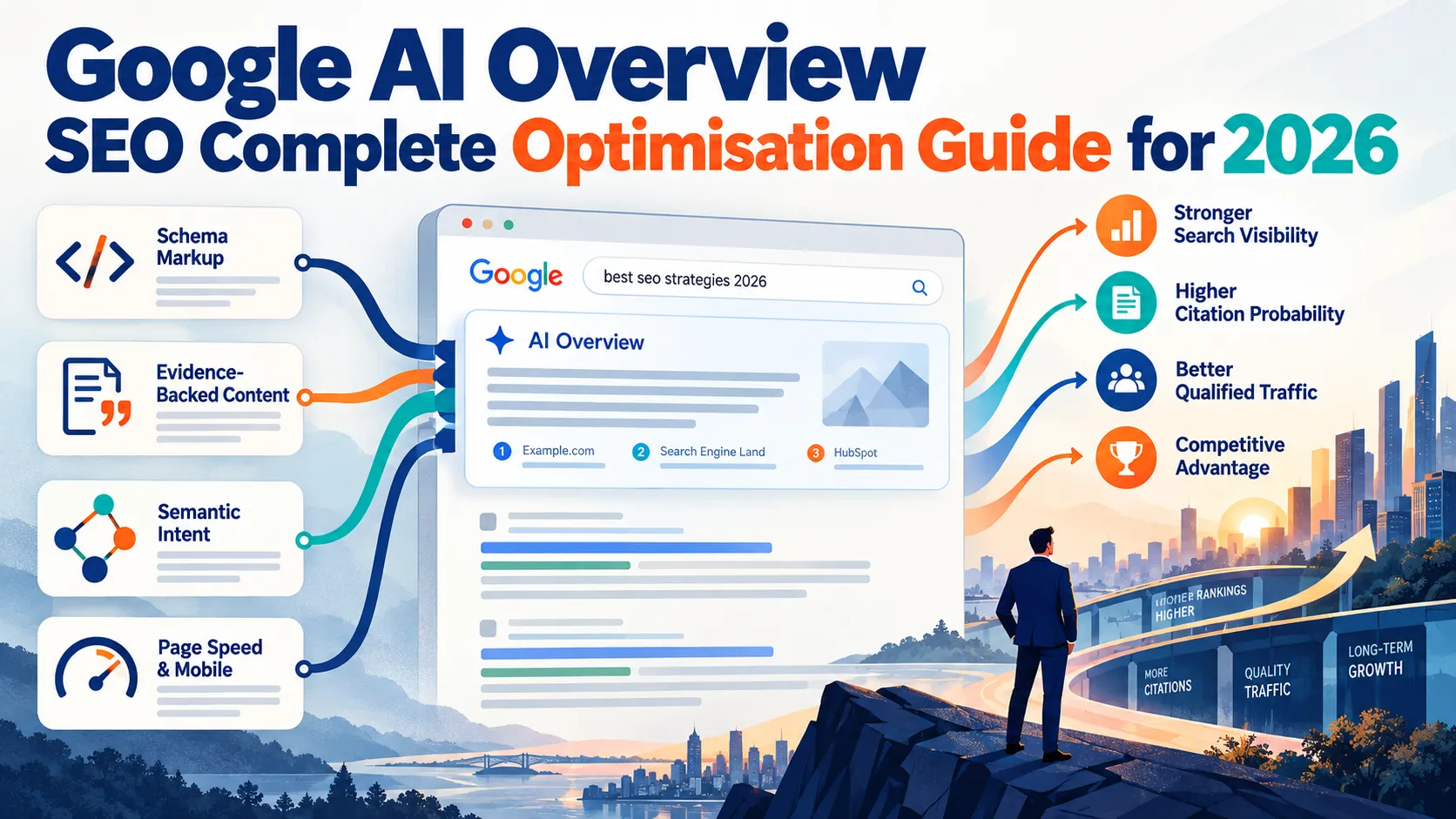
Search is changing faster than SEO playbooks can keep up. Google’s AI now generates answers for a significant portion of search queries, yet most businesses remain invisible in those answers. This guide shows you why that gap exists, how AI Overviews select sources, and exactly what to fix to get your content cited.

The opportunity is real and measurable. Analysis of commercial search terms has found that only a small fraction of URLs appearing in AI Overviews match page-one rankings. This means the content Google’s AI chooses differs from what traditional SEO prioritised. Businesses that understand this gap have a genuine window to recapture visibility. Some analysts predict that AI search will influence a significant share of organic search interactions over the next few years. Getting this transition wrong risks traffic loss. Getting it right is tactical and learnable.
What you’ll learn in this guide:
- Why AI Overviews reward different content than traditional rankings
- How to implement schema markup for AI visibility
- Content rewrite frameworks that boost citation probability
- Page speed and mobile optimisation requirements
- A 30 to 90 day implementation roadmap you can start today
- How to evaluate your AI Overview readiness as a business
Table of Contents
Why Google AI Overviews Are Reshaping SEO in 2026
The scale of AI-driven search visibility
Google’s Search Generative Experience now appears across a substantial volume of queries. Yet the URLs cited in those AI summaries did not necessarily reach the top of traditional rankings. This means traffic routes are migrating and older optimisation playbooks are becoming outdated.
The shift is live today.
What’s at stake for your business
Your business’s search visibility now depends on two separate systems: traditional ranking and AI citation. A page ranked number 5 that does not meet the AI’s extraction criteria will be invisible in AI Overviews. A page ranked number 20 with evidence-backed claims and clean structure will be cited. Your ranking position no longer guarantees visibility.
Most AI results pull from sources that were not ranking on page one before AI Overviews launched. This reveals an asymmetry: the content Google’s AI chooses to cite differs from what conventional SEO prioritised. Businesses that understand this gap have a window to recapture visibility they may have lost or never had. The competition is not as entrenched. The rules are still being written.
Key takeaways:
- AI Overviews pull sources that were not page-one rankings, so visibility now depends on content extractability, not ranking position alone.
- Schema markup is no longer optional. It tells Google’s AI what your content is about and makes citation more likely.
- Page load speed significantly impacts selection. Pages that load slowly are less likely to be chosen for AI Overviews.
- Businesses that optimise now gain a head start on competitors still using traditional SEO tactics.
What’s fundamentally different from traditional SEO
Core principles remain intact: relevance, authority and user experience form the foundation. Page speed, mobile-friendliness, HTTPS security and core web vitals still drive rankings. Backlinks still signal authority. Keyword research still informs strategy.
But the application has shifted. Traditional SEO optimised for the ranking algorithm by asking: “How do I get this page to position one?” AI-era SEO asks: “How do I make this content extractable and citable to an AI system?”
A page can rank well without being suitable for AI extraction, and vice versa. AI Overviews prioritise extractability over ranking position. Your page ranked at position 8 can appear in an AI Overview if its content is clearer, more directly quotable and evidence-rich than pages ranked 1 to 3.
Schema markup, which was optional in traditional SEO, is now critical. Structured data tells the AI what your page is about without requiring inference. E-E-A-T signals (Experience, Expertise, Authoritativeness, Trustworthiness) are now read by AI systems directly, making author credentials and cited sources more visible to the algorithm than before.
Research has found that including citations, quotations and statistics increases source visibility in AI-generated responses. This is the core insight: AI Overviews reward content that is evidence-backed and reference-rich by default.
The strategic implication
You now need to optimise for two systems simultaneously: rank well and get cited in AI Overviews. These are not the same problem. Traditional SEO optimises for the ranking algorithm’s signals (links, page speed, topical authority). AI SEO optimises for the AI system’s extraction criteria (quotability, evidence density, schema clarity).
The best strategy layers both. Write for people (which AI systems read as helpful-content quality), structure it with schema (which AI systems parse directly), and cite evidence (which AI systems cite when generating answers). This layered approach is designed to improve visibility in both traditional and AI search.
How AI Overviews Actually Work: The Search Visibility Bridge
What happens when Google generates an answer
When a user triggers a query, Google’s AI engine scans multiple sources, extracts relevant information, and synthesises an answer. This answer appears in a summary box at the top of the results page, often with citations linking back to source pages. Unlike a traditional snippet, an AI Overview can pull from lower-ranking pages, newer content or unexpected domains, provided the content meets the AI’s relevance and authority checks.
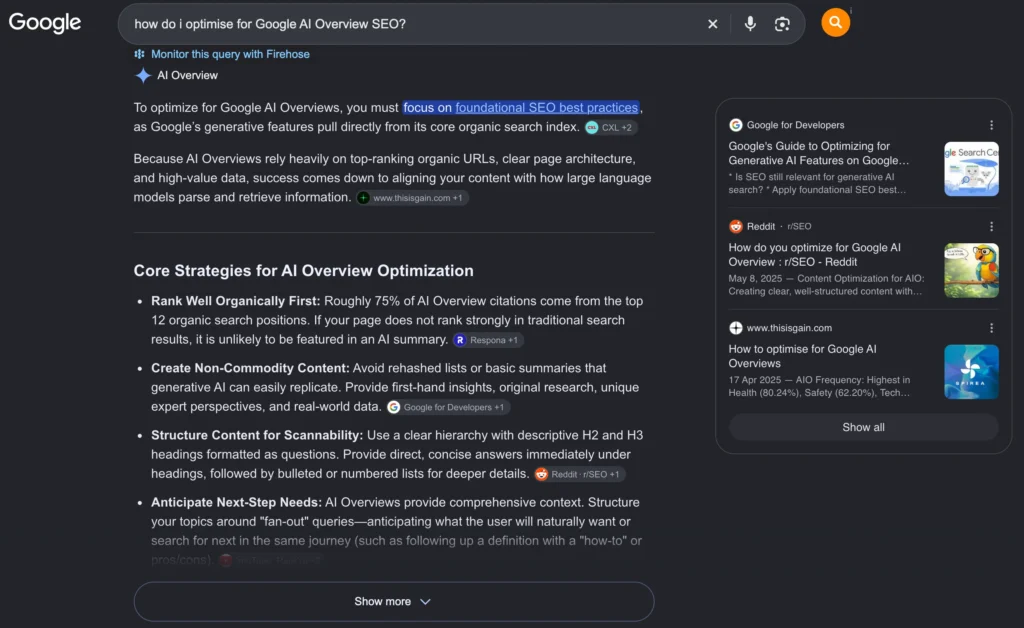
The mechanics work like this. Google’s algorithm identifies what the user actually wants to know (semantic intent). It then retrieves passages from indexed pages that satisfy that intent. The AI system synthesises these passages into a cohesive paragraph or list, attributes sources by name, and displays the result prominently. A user searching “how to optimise for Google AI Overview SEO” will see a generated answer citing multiple sources, each linked back to the original page.
This differs fundamentally from traditional search results. A snippet is always verbatim text from a single high-ranking page. An AI Overview is a new answer, synthesised from multiple sources, regardless of their ranking position.
Why most businesses don’t appear in AI Overviews
Most businesses fail to appear in AI Overviews for structural reasons, not because of insufficient authority. Your content might lack quotable, standalone passages the AI can cite. A paragraph buried in marketing language is invisible to extraction systems. You may not be using schema markup or structured data that signals what your content is about. Without schema, the AI has to infer meaning instead of reading it explicitly. Your pages load too slowly. Page load speed significantly impacts mobile user retention. On mobile, pages that load in over 3 seconds lose a substantial share of visitors. You haven’t optimised for what users actually want (semantic intent), only keyword matching. A page targeting “AI SEO tools” is invisible if the user’s actual intent is “how do I optimise my content for AI search?”
Each of these is fixable. The barrier to AI Overview visibility is not ranking position or domain authority. It is clarity, speed and extractability.
The citation-first content strategy
Research has found that content with citations, quotations and statistics increases visibility in AI-generated responses. This is the core insight: AI Overviews favour content that is already evidence-backed and reference-rich.
When you embed a statistic or quote your source by name, the AI system recognises that passage as citable and credible. It becomes a candidate for inclusion in the AI-generated answer. Content without citations is treated as opinion and deprioritised. Content with citations is treated as fact and elevated.
This inverts a core principle of traditional SEO. Old-school optimisation prioritised volume and keyword density. AI-era optimisation prioritises specificity and attribution. You are no longer writing for an algorithm that counts keywords. You are writing for a system that extracts and cites evidence. That shift changes everything about content strategy and opens a genuine advantage for businesses willing to adopt it before competitors do.
How AI Overviews Actually Work: How to Choose Your AI Overview Strategy
Evaluating your readiness
Before implementing changes, assess where your business stands. Use the following numbered steps to evaluate your AI Overview readiness and decide which optimisation areas to prioritise.
1. Does your content appear in AI Overviews today?
Search your target keywords on Google and check whether AI Overviews appear. If they do, is your business cited? This tells you whether the market even generates AI Overviews for your keywords. Some low-volume or local queries don’t trigger AI Overviews at all.
2. How well does your schema markup describe your content?

Audit your current schema implementation. Are you using schema types relevant to your industry? Do those schemas include the fields that AI systems extract (author, citation, structured evidence)? Poor schema clarity is an easy problem to fix and high-impact.
3. What is your current page speed score?
Check your Core Web Vitals score in Google Search Console. Pages scoring below 50 (poor) will struggle to appear in AI Overviews regardless of content quality. If your mobile speed is below 50 on Google’s scale, prioritise speed improvements first.
4. Is your content evidence-rich or opinion-heavy?
Review your top pages. Count how many include citations, statistics, quotations or attributed claims. If most pages are opinion-led or lack evidence, citation-first content rewriting is your biggest opportunity.
5. Are you competing in a space where AI Overviews are common?
Commercial queries, “how-to” questions, and comparison searches trigger AI Overviews frequently. Local, brand and navigational searches often do not. Match your effort to market reality.
Reference checklist: AI Overview readiness assessment
| Readiness Signal | Your Status | Priority | Action |
|---|---|---|---|
| AI Overviews appear in my keyword results | Yes / No / Some | High | Proceed to content audit; skip if no |
| Schema markup on 80%+ of pages | Yes / Partial / No | High | Implement schema across site |
| Mobile page speed score 75+ | Yes / Below 75 / Unknown | High | Measure and improve speed first |
| 60%+ of pages have citations or evidence | Yes / Partial / No | High | Rewrite top pages with sources |
| Business operates in commercial search space | Yes / Local / Branded only | Medium | Focus effort on high-value keywords |
Table of Contents (Revised for Completeness)
- Why Google AI Overviews Are Reshaping SEO in 2026
- How AI Overviews Actually Work: The Search Visibility Bridge
- Schema Markup and Structured Data: The AI Visibility Foundation
- Content Optimisation for AI Search: Beyond Keywords
- Getting Your Business Listed in AI Overviews: A Tactical Checklist
- Frequently Asked Questions
- Summary: The Path Forward for AI-Era SEO
Schema Markup and Structured Data: The AI Visibility Foundation
Why structured data matters now
Structured data markup like JSON-LD Schema tells Google’s AI what your page is about directly, without forcing the AI to infer meaning. This explicit labelling increases the probability your content is selected for AI Overviews. It is the difference between a computer having to guess your content’s meaning and you stating it plainly.
In traditional SEO, schema markup was optional. For AI Overviews, it is foundational. When Google’s AI system scans your page, schema signals act like metadata tags that reduce ambiguity. The AI can parse what entity your page covers (a person, product, organisation, article), what the key claims are, and how fresh the information is. Pages without schema force the AI to work harder to extract meaning, which reduces selection probability.
This shift reflects a broader change in how search engines prioritise content. Instead of ranking pages by domain authority and backlinks alone, AI Overviews reward clarity and how easy content is to pull out. A well-marked-up page on a smaller domain can outrank a poorly-marked page on an authority site.
Which schema types drive AI visibility
For most businesses, start with these core schema types:
Article schema – Essential for publishers, blogs and news sites. Signals publication date, author, headline and body content. Includes fields for word count, headline image and content category.
FAQPage schema – Directly supports AI-generated answers. FAQs are frequently cited in AI Overviews because they already provide question-and-answer pairs the AI can extract and present as fact.
BreadcrumbList schema – Helps the AI understand your site structure and content hierarchy, making it easier for the model to contextualise individual pages within your domain.
Product schema – For e-commerce sites. Includes price, availability, reviews and rating. All are signals of credibility and relevance for AI aggregation. Missing product schema means your e-commerce content is harder for the AI to evaluate.
LocalBusiness schema – For service businesses seeking location-specific visibility in AI Overviews. Includes address, phone number, opening hours and service area, critical for location-based queries.
NewsArticle or BlogPosting – Timestamps and author metadata influence freshness signals. The AI model uses publication and modification dates to assess whether content is current.
Choose the schema types that match your content. A blog post uses Article schema. A product listing uses Product schema. A contact page uses LocalBusiness schema. Do not mix schemas on a single page unless the content genuinely spans multiple entity types.
Implementation step-by-step
- Audit your site’s current schema coverage using Google’s Rich Results Test or a schema validator tool. Check your homepage, top service pages and three recent blog posts. Note which pages already have schema and which do not.
- Prioritise templates for your top 20 pages, usually homepage, key service or product pages, and your highest-traffic blog posts. These pages generate the most search volume and have the highest impact if they appear in AI Overviews.
- Add JSON-LD markup in the page <head> or as a data block in your CMS. Use the official Schema.org documentation or a template generator. JSON-LD is the preferred format because it separates markup from HTML, making it easier to maintain.
- Test each page in Google Search Console’s Rich Results report after deployment. This shows whether your schema is valid and whether Google can parse it correctly. Fix any errors before moving to the next batch.
- Monitor impressions in AI Overview coverage over 30 days. Use Search Console’s new “AI Overview” filter under Performance. Track which pages appear in AI Overviews and which queries trigger them. This data reveals which content the AI model finds most extractable and authoritative.
If your site uses a CMS like WordPress, Shopify or a custom platform, use built-in schema builders first; they reduce manual error. For custom implementations, involve a developer or an SEO professional.
The entire implementation, audit to deployment across 20 pages, typically takes 2 to 3 weeks. This is foundational work that improves visibility across all AI-driven features, not just Overviews.
Content Optimisation for AI Search: Beyond Keywords
Semantic SEO and user intent as the north star
Optimising for AI means optimising for what a page is about, not how many times a keyword appears. Semantic SEO, meaning-based optimisation, is the framework. A page should comprehensively answer the user’s underlying question.
If someone searches “how to optimise for Google AI Overview SEO,” they need to understand why this matters, what the mechanics are and how to implement it. Keyword density becomes irrelevant. Instead, focus on intent alignment: does your page answer the specific problem the searcher is trying to solve?
If your audience wants to know how to get listed in AI Overviews, walk them through the steps. Do not just mention that AI Overviews exist. This semantic clarity is what AI systems read as relevance. Google’s AI extracts meaning from context, not from keyword frequency.
The citations-and-evidence principle
Embed quotations, statistics and attributions throughout your content. Instead of saying “Page speed matters,” cite evidence: when load time hits 5 seconds, mobile bounce rates increase significantly. This approach does three things:
- It provides the AI with an extractable, citable passage
- It signals authority to the AI model
- It demonstrates to readers that your claims rest on research
Evidence-backed claims are more likely to appear in AI-generated responses. When you embed a statistic or quote, you make your content more extractable. AI models are trained to recognise and cite sources. Name your sources when possible. “According to Google’s research” is stronger than “studies show.” Dated statistics are stronger than undated ones. Specific numbers are stronger than vague language.
Content quality and depth expectations
Google’s helpful content assessment now explicitly weights originality, expertise and genuine insight. Filler and generic language waste words. Each section should answer its heading completely. Content should be long enough to cover the topic comprehensively but short enough to respect the reader’s time.
For competitive keywords in the AI search space, aim for 2,000 to 3,500 words. For long-tail or niche queries, 1,000 to 1,800 words is sufficient. Length alone does not create quality. A 3,000-word article filled with padding ranks lower than a focused 1,500-word article that answers the question completely.
Write at a level that assumes intelligence but no specialised knowledge. Use short sentences. Prefer active voice. Define technical terms when they first appear. Remove any sentence that could be deleted without losing meaning.
E-commerce and product optimisation
If you sell products, AI Overviews may return comparison tables, reviews or recommendations. Your product pages must meet higher standards for content and technical performance. Ensure every product page includes:
- Complete product schema markup (name, price, availability, reviews, rating)
- At least 150 words of unique description per product (not manufacturer copy)
- Customer reviews with dates and ratings, marked up as structured data
- High-resolution images with descriptive alt text that identifies the product
- Mobile page load time under 3 seconds (faster load times reduce abandonment)
Product schema tells Google’s AI what you are selling and at what price. Customer reviews provide credibility and extractable passages. Unique description signals that you understand the product’s value, not just listing specifications. Fast load time ensures the AI crawler can access and index your page efficiently.
Freshness and update signals
Refresh high-value content every 6 to 12 months. Update publication dates and timestamps when you add new data or research. Google’s AI models favour content that signals it is current and actively maintained, not archived.
Pages that have not been updated in two years appear stale to AI systems, even if the information is still accurate. A simple refresh, adding one new statistic, updating a date, or expanding a section with recent developments, signals that you prioritise accuracy and recency. This improves the probability your content is selected for AI Overviews.
Getting Your Business Listed in AI Overviews: A Tactical Checklist
Pre-launch audit
Before optimising, establish a baseline.
Search your brand name and top five keywords in Google. Note whether AI Overviews appear. If they do, check whether your domain is cited. If not, you now know which queries to prioritise.
Open Google Search Console and navigate to Performance. Filter by the same keywords. Identify which pages currently generate impressions for these queries; these are your starting points for optimisation, not your lowest-priority pages.

Check whether schema markup is already installed on your site. Use Google’s Rich Results Test to scan your homepage and your top 10 pages. Enter each URL separately. If schema is missing, the test will tell you which types are absent.
Measure mobile page load time using Google PageSpeed Insights or WebPageTest. Record the result for your homepage and three high-traffic pages. Page load speed significantly impacts mobile user retention. If your pages exceed 3 seconds on mobile, page speed will be your first blocker to AI Overviews.
Finally, search your top competitors for the same keywords. Look at their pages appearing in the AI Overview. Which content types do they use (blog posts, guides, product pages, FAQs)? What schema can you see in the page source? This gives you a tactical roadmap.
Implementation roadmap (30–90 days)
Week 1–2: Schema markup installation
Install schema markup on your top 20 pages. Prioritise your homepage, key service or product pages, and top-performing blog posts. Use JSON-LD format, placed in the page <head>. Test each page in Google’s Rich Results Test before publishing.
Schema markup may improve citation probability by making your content more extractable. When AI systems scan your page, structured data helps them identify and pull key information accurately.
Week 3–4: Content rewrite for extractability
Rewrite the top five pages to include citations, statistics and evidence-backed claims. Aim for at least three cited sources per 500 words. Restructure using clear H2 and H3 headings so AI can parse sections independently.
Make your content quotable. When an AI engine reads your page, it should find ready-made passages it can cite by name. Avoid context-dependent claims that lose meaning when extracted. Write precise language where caveats and conditions appear within the sentence itself, not in surrounding text.
Week 5–8: Page speed optimisation
Compress images without quality loss. Defer non-critical JavaScript. Minify CSS and HTML. Target: under 3 seconds on mobile, under 2 seconds on desktop. Test again with PageSpeed Insights after each change.
For service-based businesses seeking local AI visibility, ensure location schema is correctly structured.
Week 9–12: Monitor and repeat
Monitor Google Search Console’s Rich Results report weekly. Note which queries now trigger your content in AI Overviews. Compare AI Overview impressions to your traditional organic impressions. Identify which content types and topics perform best. Repeat the entire cycle (schema, content, speed) for pages 21–40.
Ongoing signals to track
AI Overview impressions appear in Search Console’s Performance tab when you filter by “AI Overview” results. This metric shows how often your content appears in AI-generated answers. Rising impressions here indicate successful optimisation.
Click-through rate from AI Overviews often differs from traditional organic CTR. AI citations may drive lower-intent or research-stage traffic, or higher-intent traffic depending on your content type. Track this separately so you understand how AI-driven visitors behave.
Authority and E-E-A-T signals remain influential. Backlinks to your domain, author credentials (byline, bio, expertise markers) and publication recency all influence whether the AI model selects your content. Maintain a current author bio on every article. Refresh high-value content every 6–12 months and update the publication date.
Singapore-specific considerations
Businesses in Singapore should note compliance and structural factors that affect AI visibility locally. The Personal Data Protection Act (PDPC) governs how you collect and display customer data in your content and schema markup. Ensure any personal information referenced in your structured data complies with PDPC consent requirements.
ACRA disclosure rules apply if you mention financial claims, performance metrics or testimonials in your content. AI systems extract and cite these claims directly, so accuracy and proper attribution are essential to maintain regulatory compliance and credibility.
Singapore-based platforms and local search behaviour differ from global patterns. Optimise for location schema that identifies your business correctly within Singapore’s postal code system and regional classifications. This helps AI systems understand your local relevance for queries mentioning Singapore or specific regions (central, east, west, north).
Frequently Asked Questions
What is the difference between Google AI Overviews and traditional search snippets?
AI Overviews are generated by large language models and synthesise information across multiple sources into a new answer. Traditional snippets are single, verbatim excerpts from one page. AI Overviews can cite sources that don’t rank on page one, and they shift based on query intent. Traditional snippets always come from high-ranking pages.
This distinction matters. A page ranked number 8 can appear in an AI Overview if its content is clearer and more evidence-rich than pages ranked 1 to 3. Your ranking position no longer guarantees visibility in AI-generated answers.
How do I know if my content is appearing in AI Overviews?
Check Google Search Console, navigate to the Performance tab, then filter by “AI Overview” results. You will see which queries trigger your content in AI summaries, how many impressions you generate and how many users click through to your page.
Alternatively, manually search your top keywords and look for your domain name in the AI-generated answer box at the top of the results page. This manual verification confirms what Search Console reports and helps you spot patterns in which content types get cited.
Does optimising for AI Overviews hurt traditional SEO rankings?
No. Optimising for AI Overviews (semantic clarity, schema markup, evidence-rich content) improves your on-page quality signals and helps with traditional rankings too. However, it is possible to rank well without being cited in AI Overviews, or vice versa.
The best strategy improves both simultaneously. This layered approach is designed to improve visibility in both traditional and AI search systems. You are writing for people and machines at once, which is what Google’s helpful-content assessment now explicitly rewards.
Which schema markup types are most important for AI Overviews?
Article schema (for blogs and guides), FAQPage schema (for Q&A content), Product schema (for e-commerce) and LocalBusiness schema (for services) are highest priority. Start with these; other schema types like BreadcrumbList and NewsArticle are supportive but secondary.
Test each in Google’s Rich Results Test before deploying to your live site. Prioritise your top 20 pages first to see which schema types generate the fastest results in your niche.
How long does it take to see AI Overview visibility after optimising?
Typically 30 to 60 days. Google’s crawlers need time to discover your updated schema and content changes. Monitor Search Console weekly to track progress.
Some queries may show AI Overview impressions within two weeks; others take longer depending on query volume and competition level. Expect variation: high-volume commercial keywords often take longer to shift than long-tail or informational queries.
Can small businesses compete in AI Overviews against large competitors?
Yes. Unlike traditional ranking, position and domain authority are less decisive in AI Overview selection. A small business with clear, evidence-backed content and proper schema can be cited over a large competitor with outdated content or no schema markup.
The playing field is more level in AI Overviews than in traditional search. This represents a meaningful opportunity: businesses that move fast now can recapture visibility they lost or never had in the traditional ranking era.
What happens if my content appears in an AI Overview but generates no clicks?
Low click-through rates from AI Overviews can signal a mismatch between the AI’s extraction and user intent. The AI may be citing your content for a query where users don’t need to visit your page (for example, a definition query where the AI’s answer is self-contained).

Appearing in AI Overviews builds brand authority and awareness even without clicks. Track these queries separately. If the pattern persists across multiple queries, review whether your content fully answers the user’s intent or whether the AI is pulling a section out of context. Adjust your content structure if needed.
Is it true that AI Overviews will eventually replace traditional organic search results?
Unlikely in the near term. AI Overviews currently appear in a significant portion of search queries, but users still click through to websites for detailed information, product comparisons and purchasing.
The two systems will likely coexist: AI Overviews handle quick-answer queries, traditional organic results handle deep-research and transactional queries. Your strategy should optimise for both simultaneously. Businesses relying on either system alone will lose visibility in the other.
How do I avoid having my content misrepresented or misquoted in AI Overviews?
Write in clear, stand-alone passages that are difficult to misinterpret. Avoid context-dependent claims that lose meaning when extracted. Use precise language and specify conditions or caveats explicitly within the sentence, not in surrounding text.
For example, instead of writing “Page speed is critical” in one paragraph and then explaining conditions in the next, write “Page speed affects mobile user retention significantly.” When the AI extracts the sentence, it carries its full meaning.
Additionally, monitor your AI Overview citations in Search Console. If misquotes appear consistently, update the relevant passages to be more robust to extraction.
What’s the difference between optimising for Google AI Overviews versus other AI chatbots like Perplexity or ChatGPT?
Google AI Overviews rank and cite content based on Google’s search index, so optimisation focuses on factors Google’s algorithm measures: schema, page speed, topical authority and E-E-A-T signals. Perplexity and other AI search engines have different indexing and citation logic.
However, the core principles overlap: clear structure, cited evidence, fast load times and semantic clarity improve visibility across all AI systems. If you optimise for Google AI Overviews using this guide, you will automatically improve visibility in other AI search systems. The reverse is also true: optimising for extractability helps everywhere.
Do I need to pay for visibility in AI Overviews, or is it organic like traditional SEO?
AI Overview visibility is purely organic. Google does not offer paid placement in AI Overviews. You cannot bid for visibility. Citations are determined by the language model’s assessment of relevance, authority and extractability.
There is no shortcut to AI Overview visibility, but the barrier to entry is structural and learnable, not financial. Any business, regardless of marketing budget, can optimise their content for AI Overviews and compete fairly against larger competitors.
Summary: The Path Forward for AI-Era SEO
Google’s AI now answers a significant portion of search queries. Yet most businesses remain invisible in those answers. This invisibility, however, is fixable.
Unlike ranking algorithms, which are opaque and shift constantly, AI Overview selection follows clearer, more predictable rules: semantic clarity, evidence richness, schema markup and page speed. You can influence whether your content gets cited because the criteria are structural, not hidden inside an AI model.
The three-pronged approach that works across all business types:
Optimise for clarity. Rewrite pages so they answer the user’s actual question comprehensively, in plain language, with evidence-backed claims. Each section should stand alone as content that can be easily extracted. Remove filler and unnecessary preamble. Research suggests that including citations, quotations and statistics improves the chances that AI systems will cite your content in generated responses.
Mark it up. Add schema markup to every high-value page. This tells the AI what your content covers without making it guess. For e-commerce, use complete product schema with images and reviews. For publishers, add FAQPage schema on guide-style content and author credentials on every article. For service businesses, ensure LocalBusiness schema is present and accurate.
Cite and link. Include quotations, statistics and attributable sources throughout your content. This makes your material extractable and trustworthy to AI systems. A page ranked number 8 with rich citations often outperforms a number 1 page with generic language in AI Overview selection.
Businesses that act now, conducting the discovery audit, installing schema, and refactoring their top 50 pages for AI extraction, will gain a competitive lead over competitors still optimising for traditional SEO alone.
The opportunity is measurable. The window is open. Start with your highest-traffic pages and expand from there. The businesses that adapt first will see visibility gains across both traditional search and AI Overview results.