

If you’ve requested SEO quotes from Singapore companies, you’re likely to see three proposals with very different prices. Each claims “we will improve your rankings” and offers just enough detail to sound credible, but not enough to enable meaningful comparison.

SEO can range from light page edits to full technical fixes, content refreshes, authority-building, and tracking. When you clarify the scope, pricing becomes predictable instead of a guessing game.
This guide breaks down typical SEO company costs in Singapore, what actually drives them, and the red flags that often lead to wasted spend. You will also learn what a good SEO company should deliver in the first 30 days and what you should receive each month on a retainer.
For a quick reference on typical full-service engagements, use this SEO agency guide as you move into the specifics covered below.
Key Takeaways
- Pricing in Singapore varies because SEO can range from basic page edits to comprehensive technical, content, and authority-building services. Local guides cite monthly ranges from a few hundred to several thousand dollars, with enterprise work at the higher end.
- Judge retainers by clear deliverables and timelines. Vague deliverables create risk through uncertainty, not just increased cost.
- Top pricing drivers: competition, technical debt, site size, content needs, authority gap, and tracking complexity.
- Month 1: validate tracking, audit and prioritise backlog, ship quick wins, and create a realistic roadmap.
- If an SEO company can’t specify required access or implications of limits, expect delays and blame-shifting.
Typical SEO Company Pricing in Singapore
Most published Singapore pricing guides place typical SME retainers in the SGD 500-3,000 per month range, with broader market ranges extending higher for competitive, e-commerce, or enterprise engagements.
Before the table, one clarity point that improves your decision-making fast:
What is an “SEO company” (and how it differs from a freelancer)
An SEO company (or agency) typically brings together multiple skill sets under one umbrella: technical SEO, content strategy, on-page optimisation, authority building, analytics, and project management.
A freelancer can still be excellent, but you are often constrained by time, tooling, and breadth. This matters because pricing is often just a proxy for the amount of specialist time and execution capacity you are actually buying.
Pricing snapshot table (monthly retainers)
| Monthly range (SGD) | Typical fit | What you should expect to get monthly | What often goes missing |
| 300 to 800 | Micro sites, low competition, basic needs | Light on page fixes, basic reporting, and limited recommendations | Limited technical depth, limited content work, weak conversion tracking, slow change velocity |
| 800 to 1,500 | SME sites with clear service pages | On-page optimisation, basic technical checks, some content refresh, and monthly reporting | Vague content scope, authority work without transparency, reporting focused on rankings only |
| 1,500 to 3,000 | Competitive SMEs, more constraints | Deeper technical diagnostics, content refresh plan, prioritised backlog, more consistent execution | Scope stress if the site is large or the platform is restrictive, heavy dependency on dev approvals |
| 3,000 to 6,000+ | Competitive categories, ecommerce, and larger sites | More specialist hours, technical backlog support, stronger content systems, tighter QA, better reporting | Often limited by internal approvals and release cycles, not agency effort |
| 6,000 to 10,000+ | Enterprise, multi-location, complex stacks | Governance, QA, cross-team coordination, advanced reporting, broader workstreams | Little downside except access, approvals, and internal decision speed |
These ranges align with Singapore pricing guides, which cite monthly retainers from SGD 500 to SGD 5,000+, depending on scope. Intermediate- to advanced-scopes are usually above SGD 1,500.
What these ranges usually exclude (or price separately)
- Website redesign or full rebuild work
- Platform migrations and URL restructuring work
- Heavy technical clean-up projects that require development sprints
- Large-scale net new content production across dozens of pages
- Complex attribution and CRM integration work
Quick sanity check
If the SEO company cannot explain, in plain language, what you will receive and what they will ship each month, the price is not the real risk. The uncertainty is.
Ask for:
- A sample monthly deliverables tracker (task list, ticket list, or deliverables log)
- A sample monthly report that ties work to landing pages and leads, not only rankings
SEO Pricing Models Used by Companies in Singapore
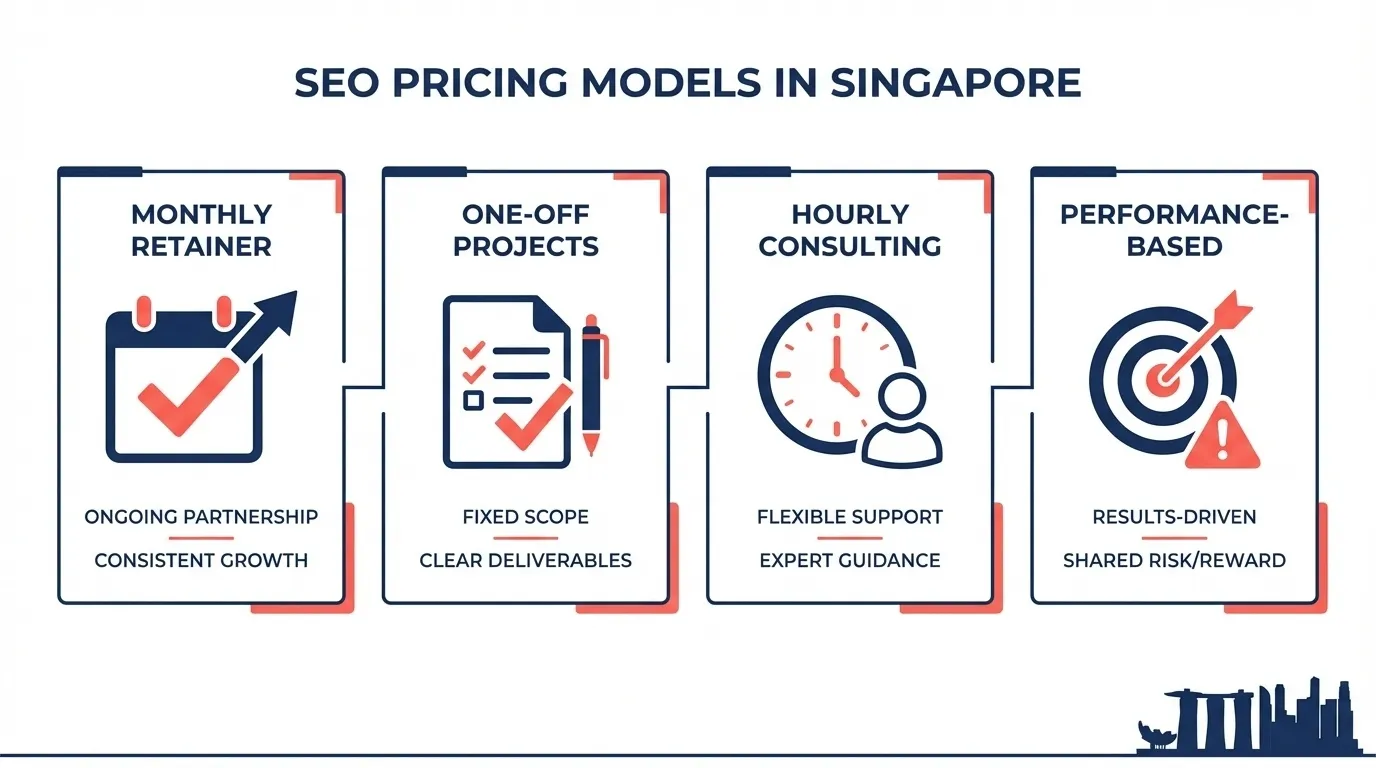
Before you compare prices, compare how the pricing is structured. Two SEO companies can quote the same monthly figure, but one is selling ongoing execution while the other is effectively selling a recurring report.
In Singapore, SEO is typically priced in a few common models. Each model suits different situations, budgets, and internal capabilities, so the “best” option depends on whether you need strategy only, implementation support, or end-to-end delivery.
Monthly retainer
This is the most common model. Singapore pricing guides explicitly state that monthly retainers are prevalent and provide broad scope-based ranges. A good retainer is monthly shipping: fixes, improvements, content upgrades, and measurements.
One-off projects
Projects make sense when:
- You want a roadmap before committing to a retainer.
- You are redesigning or migrating.
- Your tracking is broken, and you need a reliable measurement first.
Hourly consulting
Hourly can work well if you have an in-house team that can implement. It often fails when the advice is correct, but no one ships the changes, or when approvals take months.
Performance-based SEO
Be cautious. If a company guarantees outcomes without being clear about scope, quality controls, and dependencies, treat it as a risk signal. A global benchmark places typical SEO agency monthly fees in the USD 2,000-20,000 range, underscoring how quickly costs rise when significant execution capacity is required.
What You Are Actually Paying For When You Hire an SEO Company
If you want to compare proposals intelligently, stop comparing slogans and start comparing workstreams. Below is what you typically pay for when the scope is executed properly.
Strategy and prioritisation

This is where good companies separate from busy ones. Strategy is not a deck. It is decision-making: what to fix first, what to publish next, and what to ignore for now.
A strong strategy workstream usually includes:
- Keyword and intent mapping to ensure each page has a clear purpose.
- Which queries should each page target
- Whether the page is meant to generate enquiries, educate, or support conversion
- How pages avoid cannibalising each other (two pages competing for the same intent)
- Competitor and SERP gap analysis to set realistic targets
- What the top results are doing better (content depth, formatting, authority, UX)
- What Google is rewarding in that category (guides, lists, product pages, local packs)
- Where you can win faster (underserved intents, weak competitor pages, content gaps)
- A prioritised roadmap that sequences work by impact and feasibility
- A backlog with impact, effort, owner, and dependencies
- Quick wins vs structural fixes vs longer-term content builds
- A “this will take time” list so stakeholders stop expecting miracles in week two.
What to look for in proposals: strategy should translate into a backlog and a monthly shipping plan, not just “keyword research” as a line item.
Technical SEO and implementation support

Technical SEO is not “speed talk”. It is about ensuring search engines can crawl, understand, and trust your pages, and ensuring users can actually use the site without friction.
A proper technical workstream typically covers:
- Crawl and index diagnostics
- What Google can and cannot access
- Index bloat (too many low-value URLs) and wasted crawl budget
- Coverage and sitemap issues that slow down discovery
- Site architecture and internal linking structure
- Whether important pages are buried too deeply
- Whether link equity flows to commercial pages
- Whether navigation and categories support how people search
- Template and duplication controls
- Canonicals, redirects, parameter handling
- Duplicate and near-duplicate pages (common on e-commerce and CMS-heavy sites)
- Thin pages that dilute topical authority
- Core Web Vitals prioritisation
- Not just “make it faster”, but identifying what is actually causing poor user experience
- Prioritising fixes based on impact and feasibility (template fixes often matter more than chasing perfect scores)
What to look for in proposals: technical SEO should include both diagnostics and a practical plan to implement fixes, including how the agency works with your developer or CMS limitations.
Content work that compounds
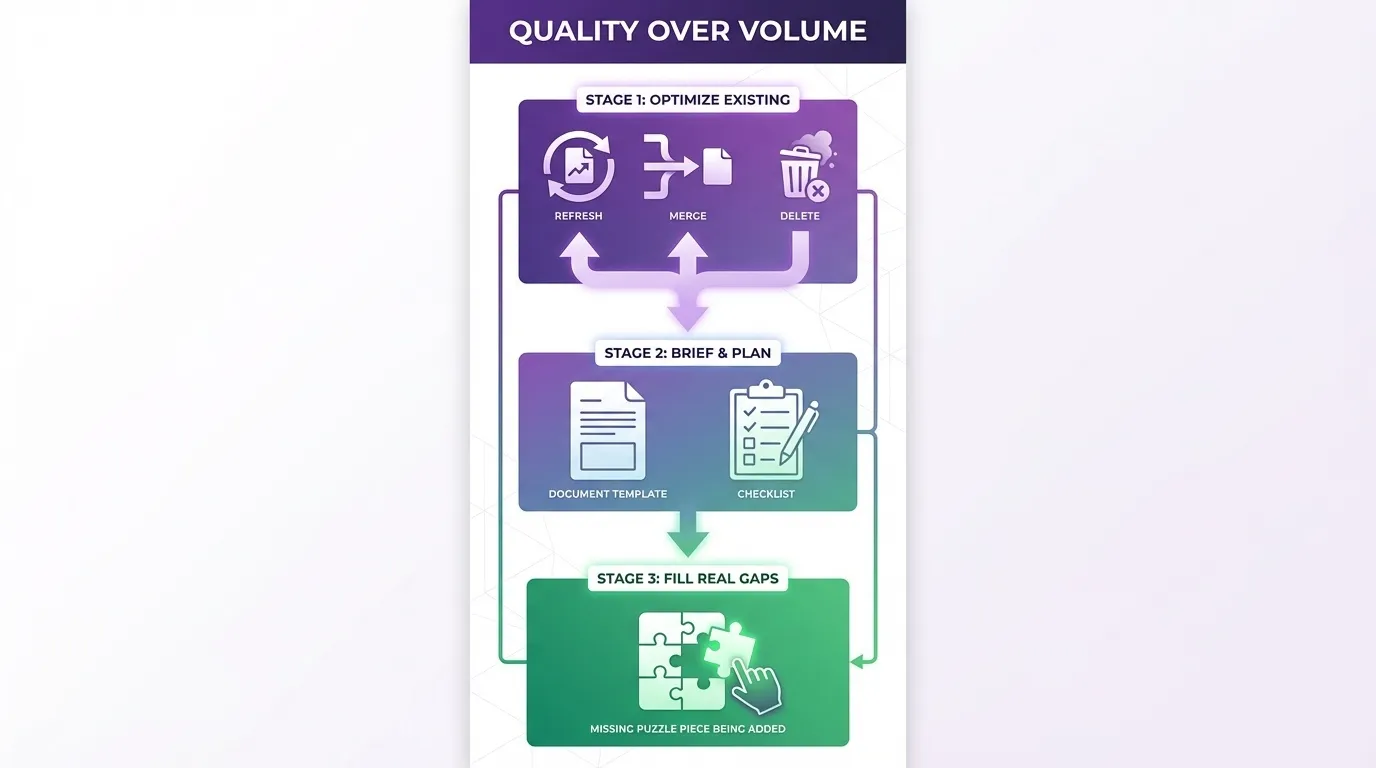
In 2026, content output is not an advantage. Useful, well-structured coverage is. Most websites do not need more content. They need better content that matches intent, answers questions clearly, and is easy for search engines and users to parse.
A good content workstream usually includes:
- A refresh programme for existing pages
- Update: improve relevance, add missing subtopics, tighten structure
- Consolidate: merge overlapping pages to reduce cannibalisation
- Prune: remove or noindex pages that add no value and dilute the site
- Content briefs that reduce guesswork
- Primary intent and secondary intents
- Suggested headings and information hierarchy
- Internal links to include (and which pages need support)
- Evidence requirements, examples, and source expectations
- Selective creation of new pages only when they fill real gaps
- New pages are created because they serve a missing intent, not because “we need blogs”
- Content is planned to build topical coverage, not random topics.
What to look for in proposals: if the content plan is only “X blog posts per month”, you are buying volume. A stronger plan is “refresh these priority pages first, then create new pages to fill these gaps”.
Authority building and trust signals

Authority is not just backlinks. It is credible signals that the site deserves to rank. In competitive industries, authority often becomes the difference between hovering on page two and breaking into the top results.
A credible authority workstream includes:
- Quality-focused link earning
- Emphasis on relevance and editorial standards, not bulk link volume
- A plan for how links are earned (digital PR, partnerships, content-led outreach)
- Risk controls and transparency
- Clear reporting of what was acquired or earned and where it came from
- Avoiding shortcuts that may cause long-term damage (spam links, private networks, rented links)
- Brand and entity signals were relevant.
- Consistent brand presence across credible platforms
- Strengthening signals that support trust and legitimacy in Google’s ecosystem
What to look for in proposals: you should be able to understand what they are building, why it is safe, and how it supports your specific goals.
Measurement and reporting
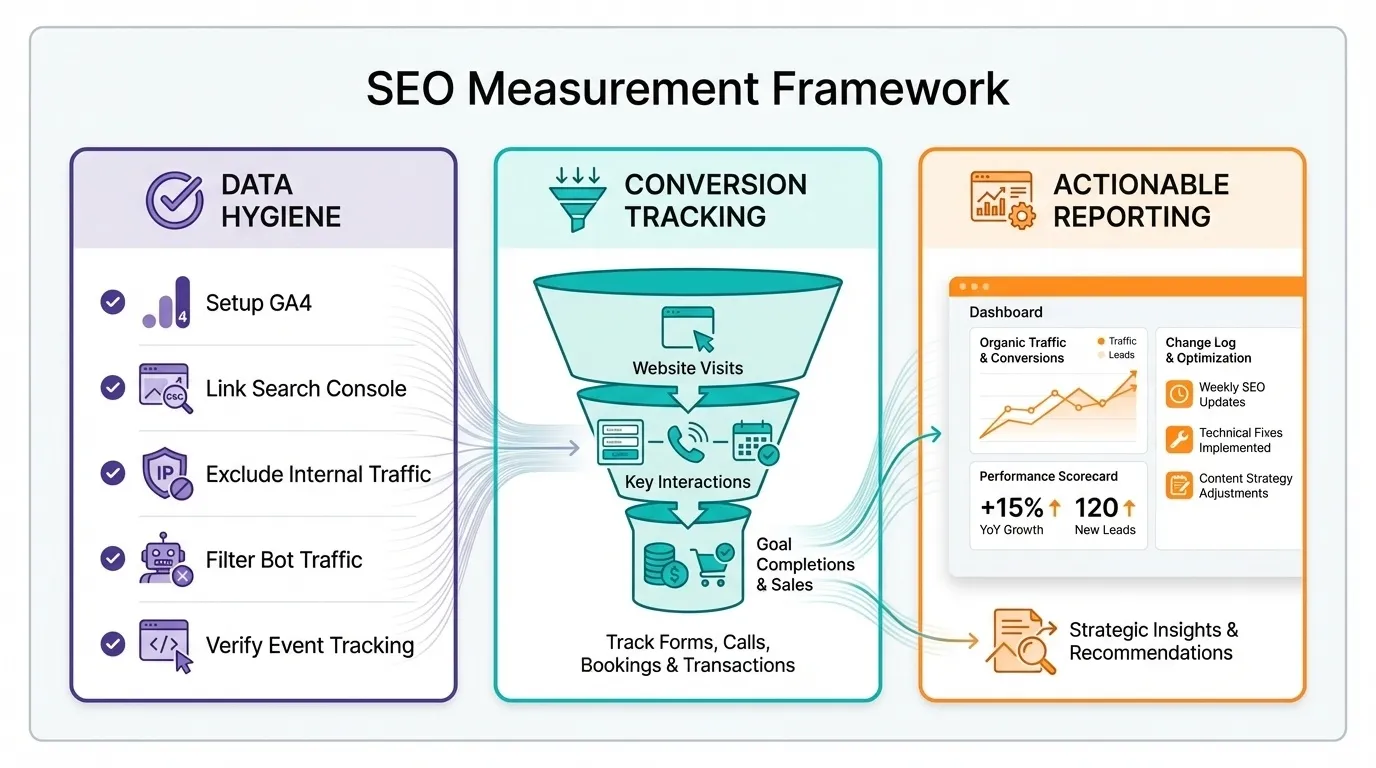
If you cannot measure it, you cannot improve it. Reporting is not a monthly PDF to justify the invoice. It is the feedback loop that tells you what is working and what to adjust next.
A proper measurement workstream typically includes:
- Search Console and GA4 hygiene
- Correct property setup and access
- Reliable baselines and consistent reporting views
- Clear segmentation to avoid mixing organic performance with paid or referral noise.
- Conversion tracking for real lead actions
- Forms, phone calls, WhatsApp clicks, booking actions
- Making sure the “lead” definition is consistent and not inflated
- Reporting tied to landing pages and lead outcomes
- Which pages drove enquiries and why
- What changes were shipped, and what moved after those changes
- What did not move, and what will be tested next
What to look for in proposals: insist on a monthly change log and landing-page reporting. If the report is only rankings, it is too easy to hide behind “we are still waiting for Google”.
Quick buyer sanity check
When you review a proposal, ask yourself:
- Can I see the workstreams clearly, or is it vague?
- Does it include both diagnosis and shipping, or only recommendations?
- Is measurement tied to leads and landing pages, or vanity metrics?
If those answers are unclear, request a more explicit list of deliverables before you commit.
What Drives SEO Company Pricing (and how to estimate your band)
Pricing rises as competition, technical complexity, site size, content demands, and measurement requirements rise. That is why two businesses in Singapore can both be “doing SEO”, yet one can succeed on a lighter retainer while the other needs a much more involved scope.
Singapore pricing guides often highlight the level and scope of competition as key drivers of SEO costs.
The simplest way to think about pricing is this: you are paying for a blend of specialist hours and execution friction. The more specialised work you need and the harder it is to ship changes to your site, the higher your monthly band tends to be.
1) Competition level and SERP strength


If the top results are dominated by strong brands with deep content and authority, you need more depth and more consistent execution to displace them.
What does this change in scope:
- More intensive content work: deeper coverage, better formatting for intent, and a stronger refresh cadence
- Higher authority requirements: credible mentions and links matter more in competitive SERPs
- More testing and iteration: you may need to refine pages multiple times rather than “publish once and hope”
Quick self-check:
- Are the top 5 results national brands, marketplaces, or long-established players?
- Do the top pages look genuinely useful and comprehensive, not thin?
If so, expect pricing to fall within a higher band, as “basic on-page SEO” is rarely sufficient.
2) Technical debt and platform constraints

Messy redirects, duplicate URLs, index bloat, locked templates, and slow releases increase time-to-ship. This is often the biggest reason SEO gets expensive, not because the work is complex, but because implementation becomes slow and coordination-heavy.
Common technical debt examples:
- Redirect chains and messy URL histories.
- Multiple versions of the same page (duplicate content issues)
- CMS limitations that block proper headings, metadata, or schema
- Slow templates that hurt Core Web Vitals
- Over-indexing of low-value pages (tag pages, parameter URLs)
What does this change in scope:
- More audit and backlog work: because issues are intertwined
- More implementation support: working with devs, staging, QA, and release planning
- Longer timelines: because fixes depend on deployment cycles
Quick self-check:
- Do you frequently hear “we cannot change that because the template is locked”?
- Do fixes take weeks because releases are batched?
If so, pricing rises because shipping is more difficult.
3) Site size and complexity

More pages mean more QA, more governance, and more chances for duplication and cannibalisation. A 20-page service site and a 5,000-URL ecommerce catalogue do not operate on the same workload.
Examples of “complexity” beyond page count:
- Many page templates (category, product, blog, location pages)
- Faceted navigation and filters that generate lots of URLs
- Multiple languages or subfolders
- Multiple business locations with local landing pages
What is the change in scope:
- Governance and QA: Every change must be rolled out safely
- Internal linking and architecture work: bigger impact, more effort
- More ongoing maintenance: to stop new pages from creating duplicate issues
Quick self-check:
- Are you managing hundreds of URLs, multiple categories, or many locations? If yes, you are paying for scale and governance.
4) Content needs

If you already have pages sitting on page 2, refresh work can be efficient. If coverage is thin, you need a stronger content system.
Two common scenarios:
- Refresh-heavy (often cheaper and faster wins): you have good pages that are close, but need better intent match, structure, and proof points
- Build-heavy (usually more expensive): you are missing key pages entirely and need new coverage
What does this change in scope:
- Refresh programme: update, consolidate, prune
- Briefing system: intent mapping, headings, internal links, evidence requirements
- Content velocity: more creation is needed if the site lacks coverage
Quick self-check:
- Do you already have pages ranking between positions 11 and 30 for important queries?
- If yes, you may achieve strong returns by refreshing the work first.
5) Authority gap
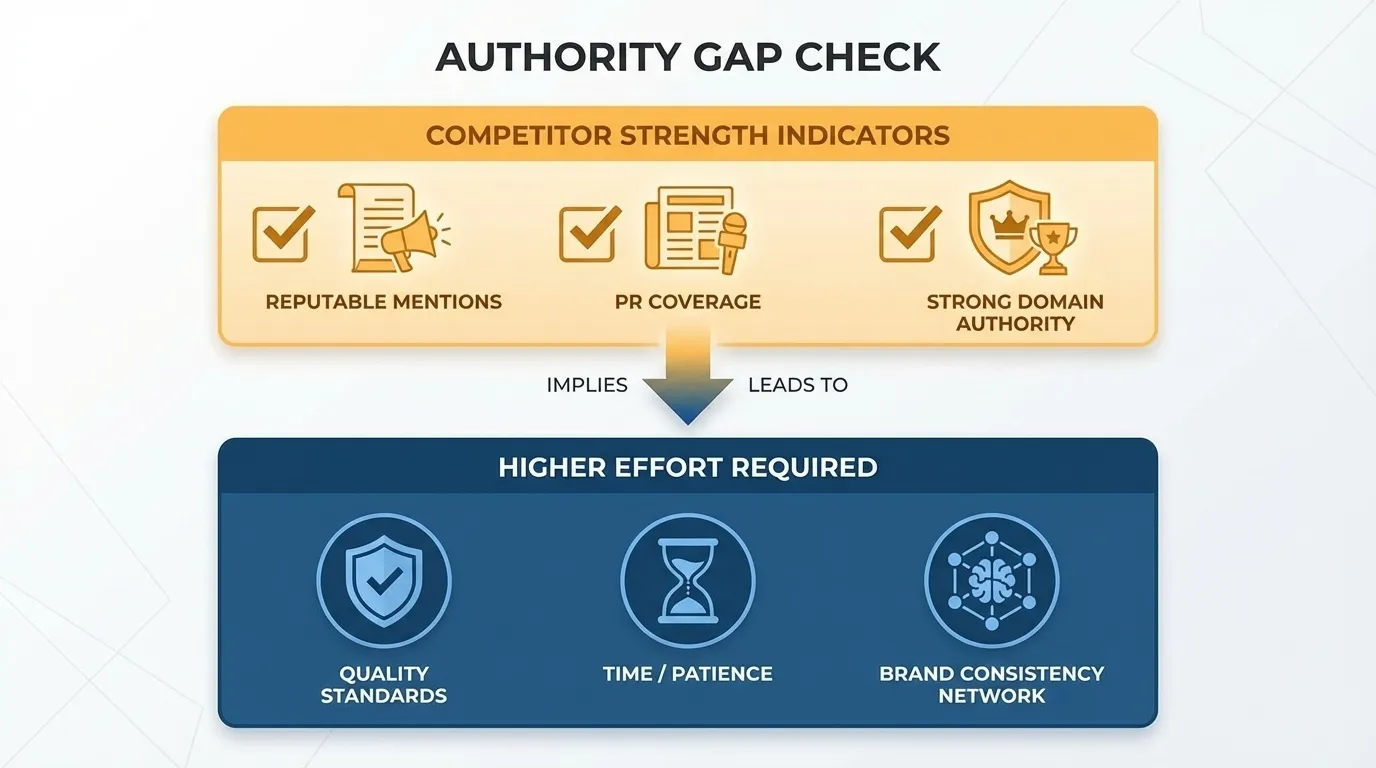
If competitors have significantly stronger credible mentions and links, you need higher-quality authority work and a longer runway. In many competitive Singapore categories, authority is what separates “we did everything right” from “we still cannot break into the top 3”.
What does this change in scope:
- Higher standards for link earning: relevance, editorial quality, real sites
- More time required: authority compounds slowly
- More emphasis on brand signals: consistency across credible platforms
Quick self-check:
- Do competitors have numerous reputable mentions, PR coverage, and strong domain authority signals?
- If yes, expect higher effort to close the gap safely.
6) Tracking and attribution requirements
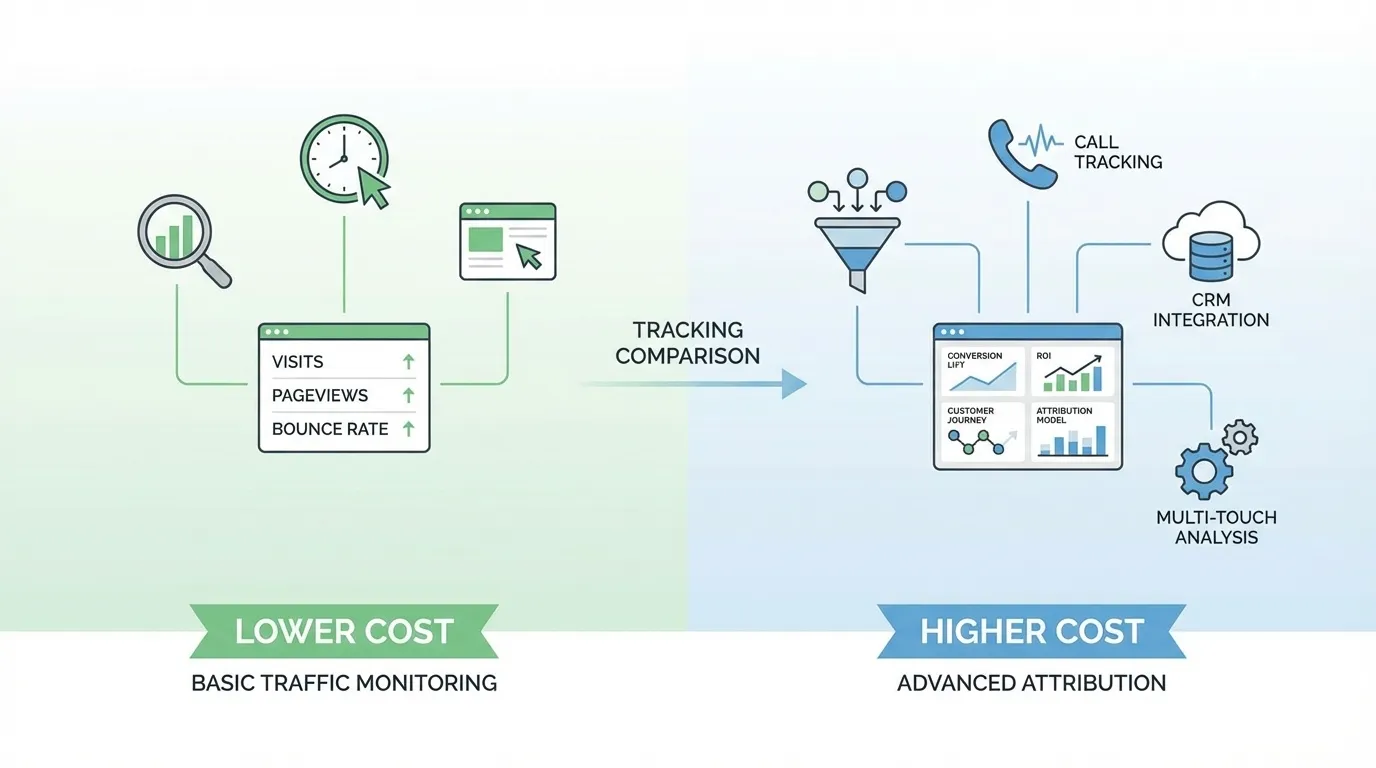
If you need lead quality reporting, call tracking, or CRM attribution, the analytics effort increases. This is usually worth it because it prevents SEO from being judged on “traffic” rather than outcomes.
What does this change in scope:
- GA4 and Tag Manager setup
- Event tracking for enquiries (forms, calls, WhatsApp clicks, bookings)
- Lead quality reporting (not just “conversion count”)
Quick self-check:
- Do you need to prove SEO impact on the actual sales pipeline or booked appointments?
- If yes, measurement complexity rises, so pricing rises.
7) Execution constraints
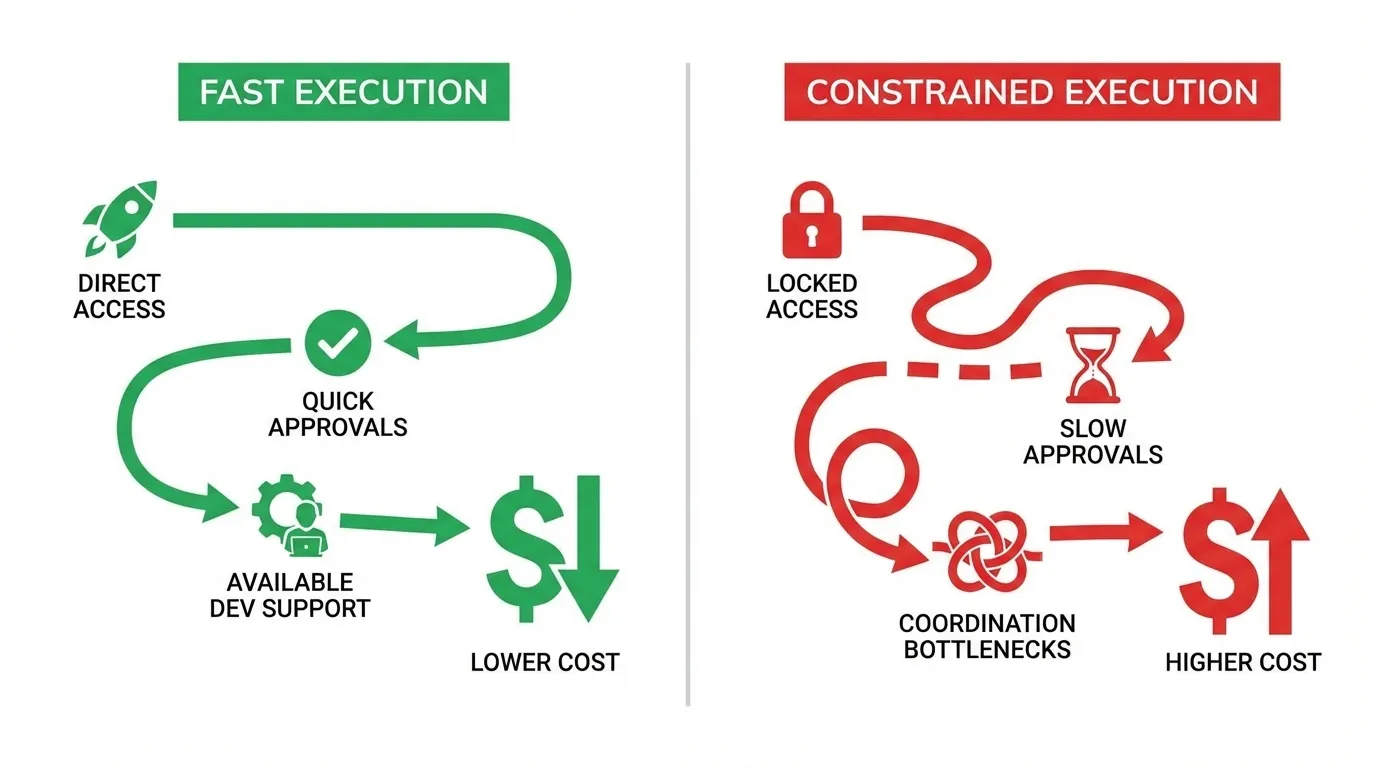
Limited access, slow approvals, and no dev support can push you into a higher band because effort becomes coordination-heavy. This is the hidden factor that many quotes ignore.

Common constraints:
- You cannot grant admin access to the CMS
- A developer is not available or is outsourced with long lead times
- Every change needs multi-step internal approval
- Content reviews take weeks
What does this change in scope:
- More project management overhead
- Slower shipping cadence
- More time spent on documentation and stakeholder alignment
Quick self-check:
- Can changes be made within days, or do they take weeks?
- If it is weeks, pricing may need to account for the coordination load.
What You Should Receive Each Month on a Retainer (deliverables, not promises)
This section is your scope protection.
Month 1 deliverables
- Tracking validation and baseline report
- Audit and prioritised roadmap
- Quick wins shipped, with a change log
- A clear monthly cadence for delivery and reporting
Months 2 and 3 deliverables
- Shipping the backlog in priority order
- Content refresh work on pages that can win faster
- Internal linking improvements tied to priority pages
- Template and technical improvements that remove repeat blockers
- Authority works with transparency and quality controls
- Reporting tied to landing pages and lead outcomes
Ongoing monthly rhythm
A healthy retainer usually has:
- A steady flow of shipped changes
- A refresh cadence for existing pages
- New content only where it fills a proven gap.
- Ongoing technical monitoring and governance
- Reporting that shows what changed, what moved, what did not, and what gets tested next
Red Flags to Watch For in SEO Company Quotes
These are patterns that frequently lead to wasted spend. A good rule of thumb is this: if the proposal makes SEO sound effortless, fast, or “guaranteed”, it is usually hiding the real constraints that determine results.
Below are the most common red flags, why they matter, and what you should ask to clarify before signing.
1) Guaranteed rankings or fixed timelines
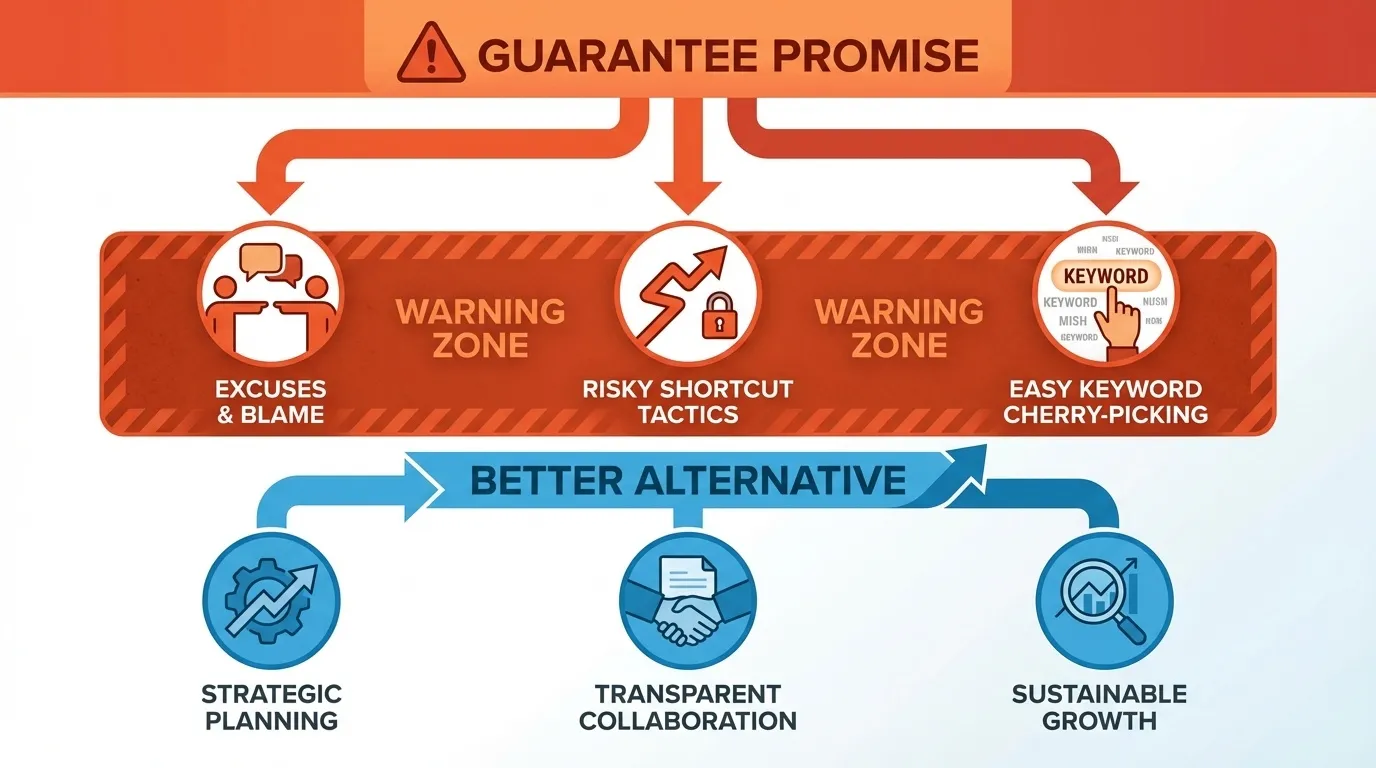
No one controls Google, your competitors, or your internal shipping speed. Even if the SEO company is excellent, results depend on what can be implemented and how the search landscape changes.
What this usually leads to:
- Blame shifting later (“Google updated”, “your competitors did something”, “we need more budget”)
- Corner-cutting tactics to “force” results
- A focus on easy, low-value keywords to claim wins
What to ask instead:
- What controllables will you implement in the first 30 days?
- What leading indicators will you track (indexation, clicks, landing page improvements)?
- What assumptions are you making about access and dev support?
2) Pricing based only on the number of keywords
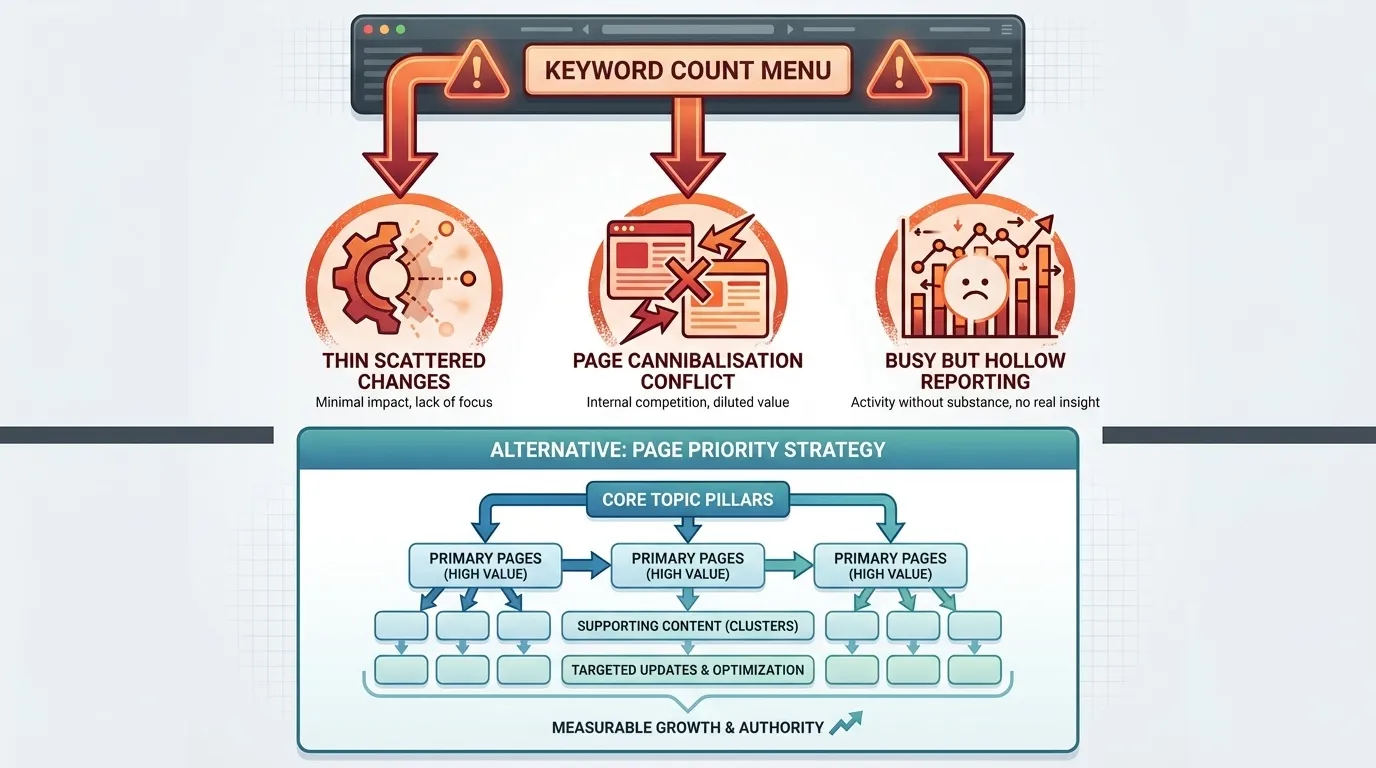
SEO does not work like a menu. Keywords map to pages, intent, and content depth. If the pricing model ignores the work required per page or per template, the execution will too.
What this usually leads to:
- Chasing dozens of unrelated keywords with thin changes
- No clear page strategy, leading to cannibalisation
- Reporting that looks “busy” but does not build compounding value.
What to ask instead:
- Which pages are you prioritising and why?
- How will you map keywords to pages and avoid cannibalisation?
- How many priority pages will be improved each month?
3) Vague deliverables and heavy promises
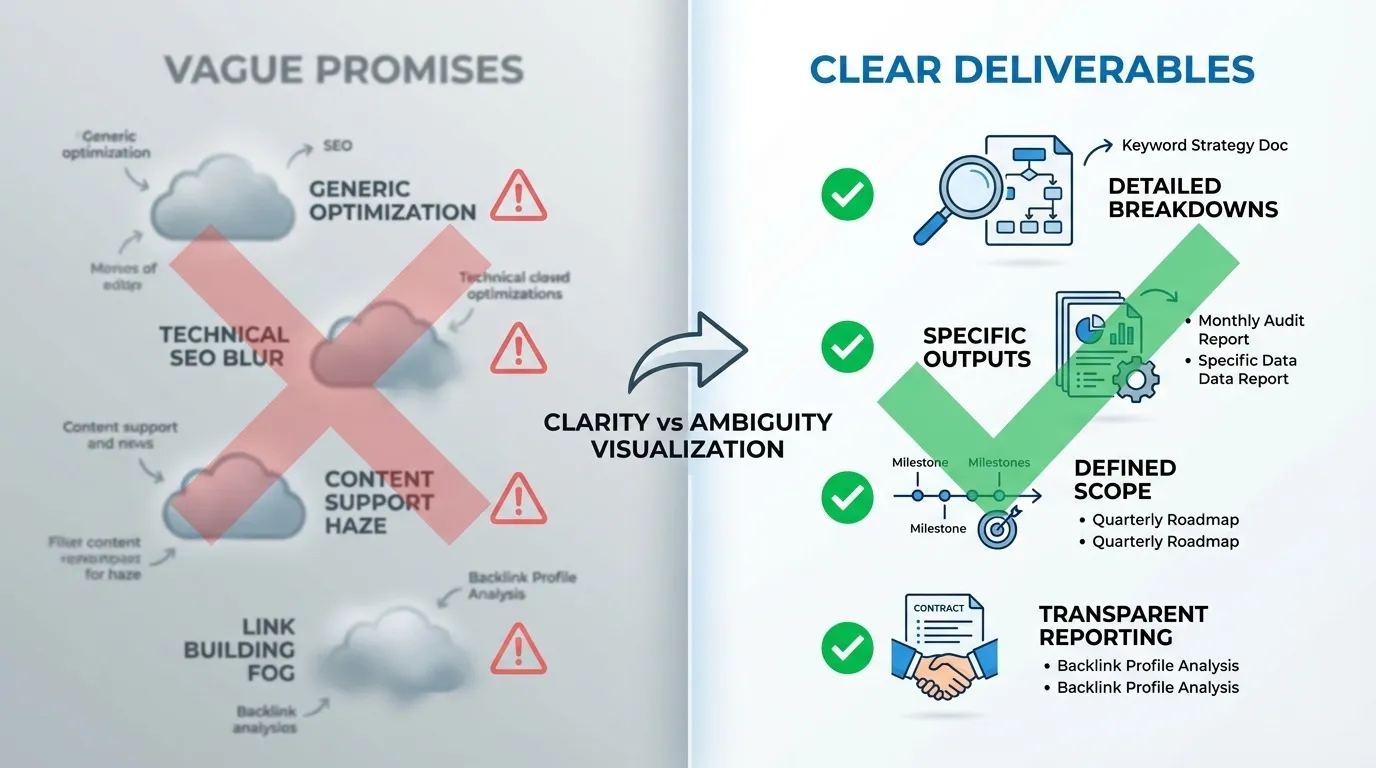
If the quote is full of goals but light on monthly outputs, you will pay for ambiguity. SEO only works when tasks are shipped consistently.
Common vague phrases to watch:
- “On-page optimisation” with no breakdown.
- “Technical SEO” with no mention of crawl, indexation, or templates.
- “Content support” without a refresh plan or brief process.
- “Link building” without quality standards.
What to ask instead:
- Can you show a sample deliverables tracker from an active client?
- What exactly will you deliver each month (tasks, pages, outputs)?
- What is included vs excluded (and what becomes a separate project)?
4) Backlinks positioned as the main deliverable with no transparency

Authority matters, but uncontrolled link tactics create long-term risk. If the SEO company will not explain where links come from, what standards they use, or what will be reported, you are walking into reputational and algorithmic risk.
What this usually leads to:
- Low-quality links that may work briefly, then decay or harm trust.
- Links you cannot verify
- “Rented” placements that disappear when you stop paying
What to ask instead:
- Will you provide a monthly list of acquired links and placements?
- What are your quality criteria (relevance, editorial standards, traffic signals)?
- Do you use any networks or paid placements, and how do you manage risk?
5) No mention of Search Console, GA4, or conversion tracking

If the measurement is missing, you are buying opinions. Search Console and GA4 are the minimum requirements for diagnosing problems and proving whether changes improved outcomes.
What this usually leads to:
- Reports that look impressive but cannot connect to enquiries
- Decisions made based on guesses rather than evidence
- “We think it is working” conversations instead of performance reviews.
What to ask instead:
- Which conversions will we track (forms, calls, WhatsApp, bookings)?
- Will you validate tracking in the first month?
- What will the monthly report include beyond traffic and rankings?
6) Reporting focused only on rankings
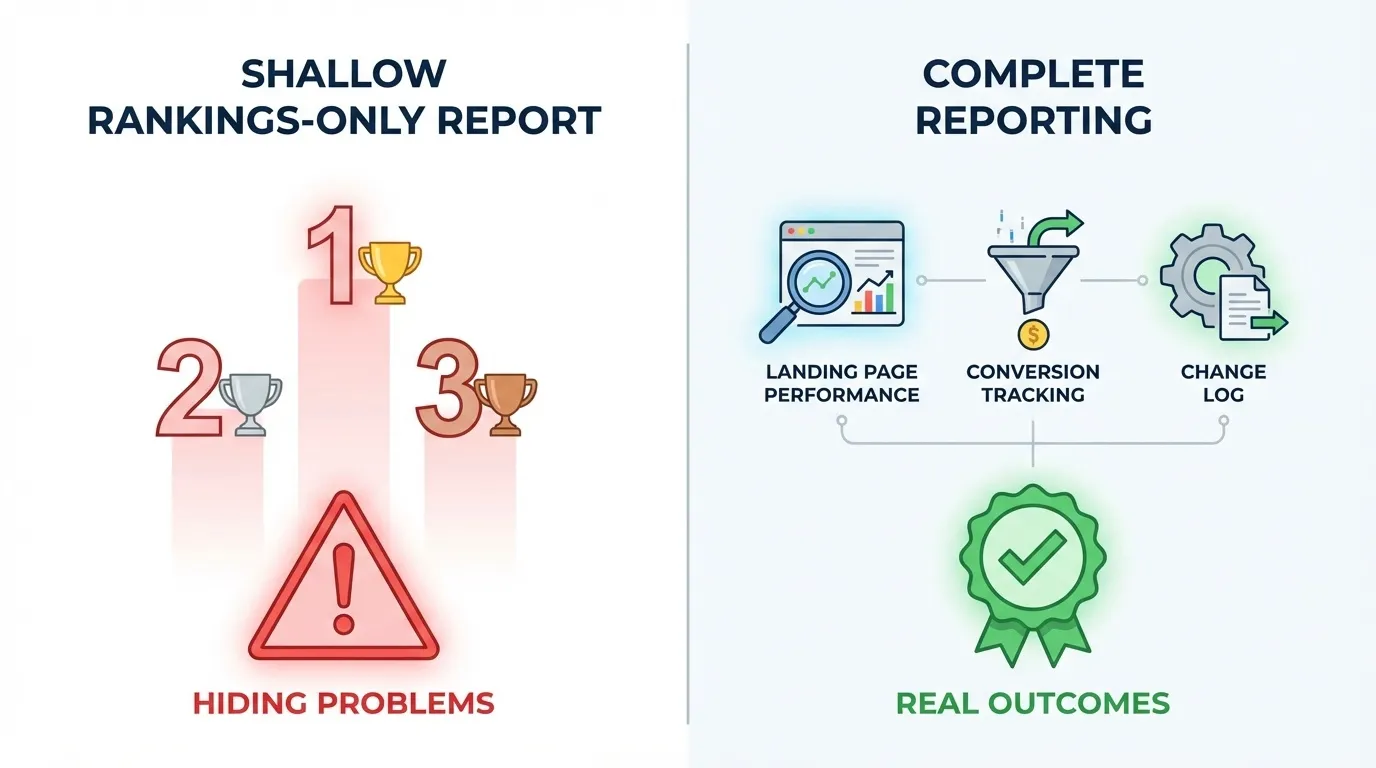
Rankings without a landing page and lead outcomes can hide a failing programme. You can rank for irrelevant queries, or rank while conversions drop due to poor intent match or UX friction.
What good reporting should include:
- Landing page performance for organic traffic
- Enquiries and conversion rate by landing page
- Search Console clicks and impressions for priority pages
- A monthly change log: what was shipped and what moved after it shipped
- What did not move, and what will be tested next
What to ask instead:
- Can you show a sample report that ties SEO work to landing pages and leads?
- How do you decide what to test next when results are flat?
7) No clarity on access required (or they downplay it)
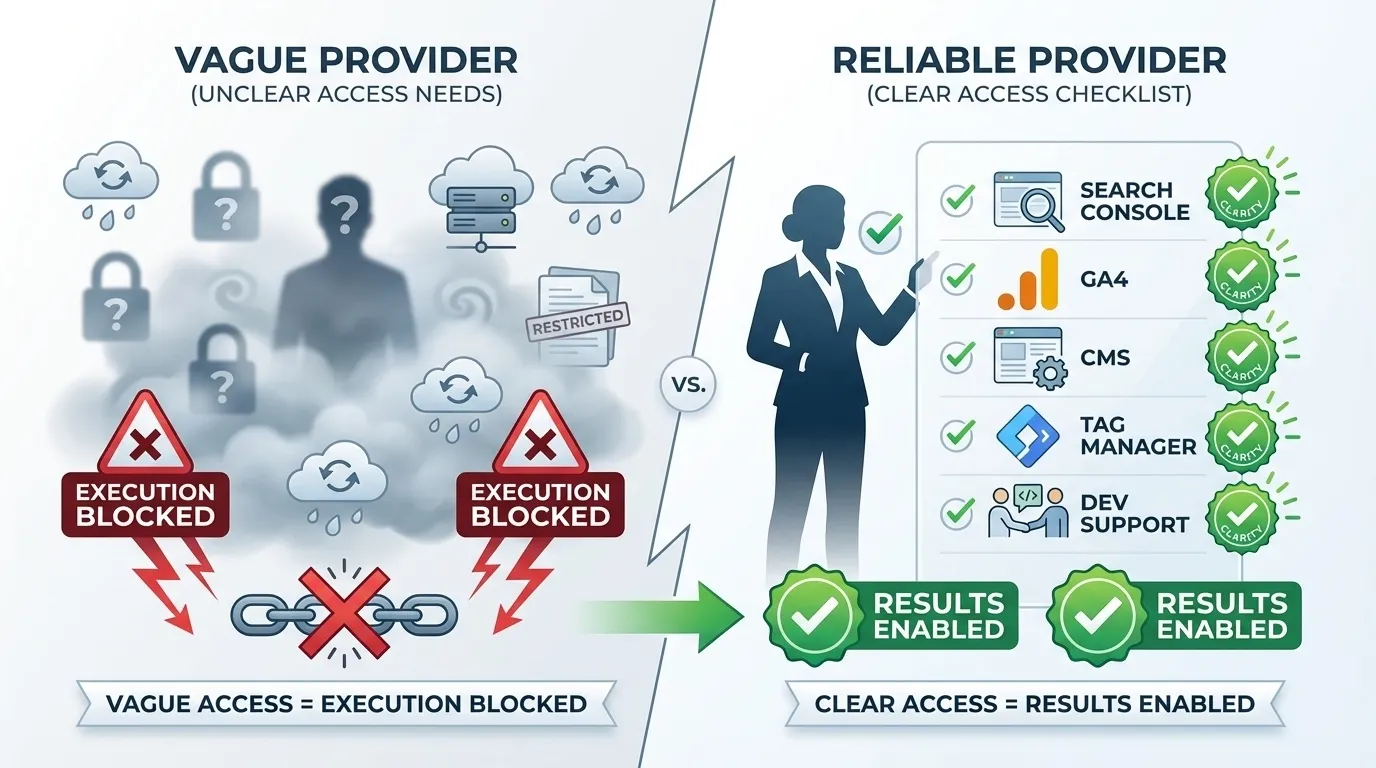
A reliable provider can explain the access they need, why they need it, and the changes that would occur if access were limited. SEO is execution-heavy. If you cannot implement changes, you cannot get results.
Minimum access that should be discussed upfront:
- Google Search Console
- GA4
- CMS access or a defined workflow to implement changes
- Tag Manager access if conversion tracking matters
- Developer support expectations (even if part-time)
What to ask instead:
- What access do you need in week 1?
- If we cannot provide full CMS access, what is the workaround?
- How will you handle implementation if our dev resources are limited?
How to Compare SEO Company Proposals Without Getting Misled by Price
Price is only meaningful when you know what it includes. Compare proposals by the workstreams covered, the monthly deliverables, and how results are measured using landing pages and enquiries.
| Category | What “good” looks like |
| Deliverables clarity | Monthly outputs are specified, not vague goals |
| Technical plan | Crawl and indexation, Core Web Vitals priorities, backlog approach |
| Content plan | Refresh programme, briefs, internal linking plan |
| Authority plan | Transparent, quality-controlled, risk-aware |
| Reporting | Tied to landing pages and leads, not only rankings |
| Implementation reality | Clear access requirements, clear dependencies |
SEO Services Checklist for Singapore buyers
Use this checklist to quickly evaluate proposals.
- The proposal lists deliverables, not only goals.
- There is a clear first 30-day plan (audit, quick wins, roadmap, tracking).
- Technical SEO encompasses Core Web Vitals and indexing, not just “speed” talk.
- Content work includes a refresh plan for existing pages.
- Authority building includes quality controls and avoids risky shortcuts.
- Reporting is tied to leads and landing pages, not only rankings.
- The agency can explain what access they need and what happens if access is limited.
- You understand exactly what will be delivered each month.
Note: Ask for a sample monthly report and a sample deliverables tracker. If you want to benchmark what a full engagement typically covers from audit to monthly execution, this SEO agency guide breaks down the core workstreams.
Singapore-specific nuance buyers miss
Two practical notes that reduce confusion:
- Training subsidies are not for SEO services. Schemes like SkillsFuture and UTAP support training, not agency retainers, so do not assume you can claim your SEO invoice.
- Some industries face higher costs due to higher quality and compliance requirements. Healthcare, finance, legal, and high-value B2B niches usually require tighter content governance, stronger trust signals, and more review cycles.
Evaluate Your SEO Pricing For A Seamless System
SEO company pricing in Singapore only feels messy when you compare numbers instead of scope. Once you review the actual workstreams and what gets shipped each month, most quotes are easy to classify.
You are either paying for consistent execution and measurement, or for vague activity that is hard to audit and even harder to hold accountable.
Use the practical filters from this guide: set clear monthly deliverables, include a first 30-day plan with tracking and quick wins, and report performance tied to landing pages and enquiries. Then pressure-test the quote using the red-flag list.
The best SEO programmes are boring in the right way. They follow a repeatable process, they ship improvements consistently, and they use data to decide what to do next. Pick the SEO company that shows you the system up front, and you will usually get better results than the one with the lowest price or the loudest pitch.
If you would like a second opinion before committing, MediaOne can review your current SEO quotes, clarify what is actually included, and recommend the scope that makes sense for your site and goals. Contact us today!
Frequently Asked Questions
Should I hire a local Singapore SEO company or an overseas agency?
A local team usually understands Singapore search behaviour, local competitors, and practical constraints like approvals and timelines, which can speed up execution. An overseas agency can work if they are strong on process and communication, but you will want extra clarity on local relevance, time zones, and who handles implementation.
Who owns the content, backlinks, and accounts created during the SEO engagement?

You should own your website content, your analytics properties (GA4, Search Console, Tag Manager), and have admin access from day one. For backlinks and PR placements, insist on transparent reporting and clarity about what is earned versus “rented,” and what happens if you stop the engagement.
What KPIs should be included in an SEO company’s monthly report besides traffic and rankings?
Ask for landing page level performance, conversions or qualified enquiries by channel, and Search Console metrics like clicks and impressions for priority pages. A good report also shows what was shipped, what moved after those changes, and what is being tested next.
How do SEO companies handle websites in regulated industries in Singapore (for example, healthcare or finance)?
They should build a compliance-friendly workflow with claim-safe wording, stronger review processes, and clear source referencing for sensitive topics. Expect longer approval cycles, more emphasis on trust signals, and tighter control over content changes.
What happens if I pause SEO after 3 months? Will rankings drop immediately?
Not always, but results can stall quickly if competitors keep improving while you stop shipping updates and content refreshes. The bigger risk is gradual decay over months as pages become outdated, links stop growing, and technical issues accumulate.