| AI Summary
Lookalike audiences help advertisers find potential customers from patterns in their existing customer data. This guide explains how to choose a source audience, prepare customer records, compare platform options and test results. Singapore businesses can use these checks to connect audience decisions with sales and qualified enquiries, while accounting for automated targeting and customer-data requirements. |
A lookalike audience is a group an advertising platform builds by finding people who resemble a source audience, such as existing buyers. Advertisers provide the source data, select the available audience settings and run ads to reach potential customers. Results depend on the source, campaign goal, advertising content and measurement.

Key Takeaways
- Purchases, accepted sales enquiries and repeat orders provide different signals. Each seed should reflect the outcome the campaign needs.
- Uploaded rows, matched accounts and people available for advertising are different counts.
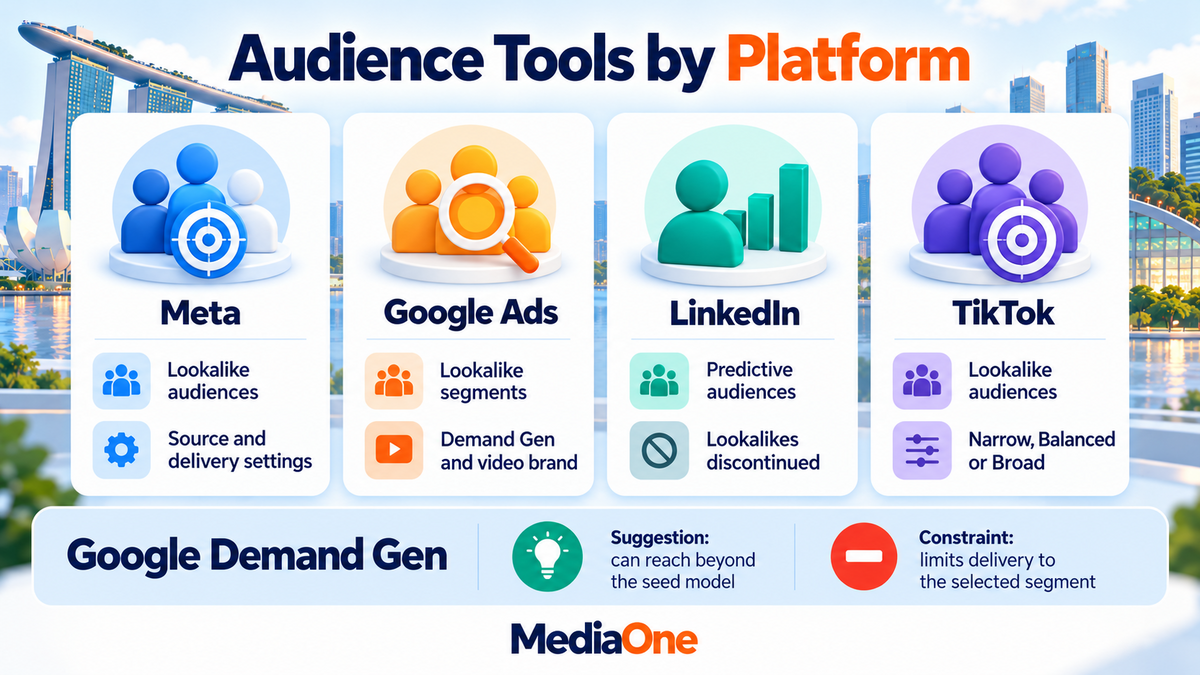
- Platform tools differ. Meta and TikTok offer lookalikes, Google supports specific campaign types, and LinkedIn uses predictive audiences.
- Audience percentages describe similarity and reach settings. They do not predict a conversion rate.
- A campaign comparison needs consistent ads, customer exclusions and reporting periods.
- Business results should guide expansion, including customer acquisition cost and the quality of new sales.
Lookalike audiences give advertising teams a starting point grounded in people who already buy or enquire. The platform studies that source audience and looks for others with shared characteristics.

The work begins before the upload. A list of repeat buyers tells a different story from a list of competition entrants. This guide starts with the seed, then explains platform choices, campaign testing and expansion for Singapore businesses.
What Are Lookalike Audiences, and How Do They Work?
A lookalike audience helps a business reach people beyond its existing customer list. The source audience, also called a seed, provides examples of the people the advertiser wants to attract.
The platform matches eligible source records to its users, identifies patterns and builds a modelled audience. Those patterns can include interests, behaviour and other platform signals. The resulting group contains potential customers who resemble the source; similarity does not guarantee that they will buy.
Custom audiences, lookalikes and retargeting
These terms describe different parts of audience planning:
| Term | Meaning | Example |
| Custom audience | A group built from customer records or interactions | People who bought from an online shop |
| Lookalike audience | A modelled group based on a source audience | New prospects resembling those buyers |
| Retargeting | Advertising to people who previously interacted with the business | Ads shown to previous product-page visitors |
| Broad targeting | Advertising with fewer advertiser-selected audience restrictions | A sales campaign across the business’s delivery area |
A custom audience can support retargeting or provide a source for lookalikes. The campaign goal determines how the business uses it. Facebook advertising brings these audience options together with the budget, ads and conversion goal.
When lookalike audiences can help
Lookalikes deserve a test when a business has a defined customer group and wants more people like it. Examples include an online retailer seeking first-time buyers or a software company seeking qualified demo requests.
The approach becomes harder to assess when records mix unrelated outcomes. A restaurant booking and a newsletter subscription may both show interest, but they represent different actions. A single combined seed makes the intended result harder to define.
How to Choose Seed Data for Lookalike Audiences
A seed should represent the action the campaign needs more of. Sales campaigns can begin with purchasers. Lead campaigns can begin with enquiries that the sales team has checked and accepted.
Audience segmentation helps separate these groups before upload. A retailer might compare recent buyers with repeat buyers. A business serving companies might compare all enquiries with enquiries that became paying accounts.
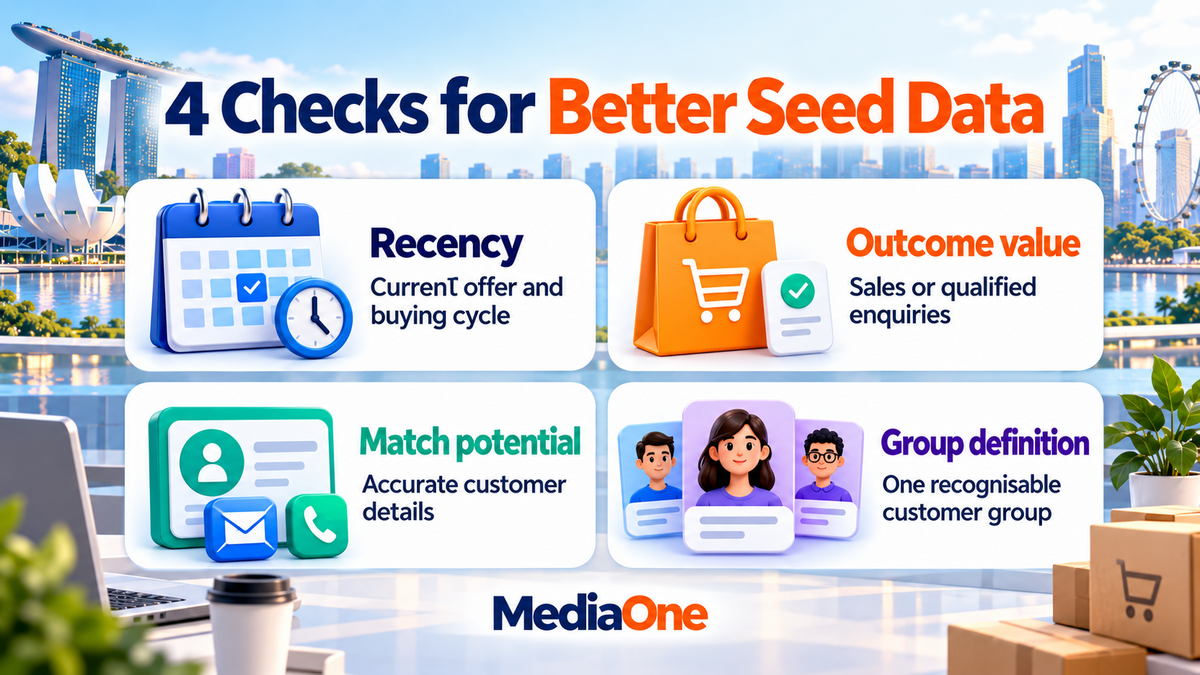
Four checks before choosing a seed
A seed review works best as a checklist. A score cannot prove that a seed will perform, and no universal pass mark applies across platforms.
| Check | What the team should examine | Example |
| Recency | Whether the records reflect today’s offer and buying cycle | Buyers of products the shop still sells |
| Outcome value | Whether the recorded action supports the campaign goal | Completed orders with refunds removed |
| Match potential | Whether eligible records contain accurate identifiers | Current email addresses and correctly formatted phone numbers |
| Group definition | Whether the source describes one recognisable customer group | Accepted enquiries for one service |
Recency depends on the purchase. A grocery delivery service may learn more from recent orders. A furniture retailer may need a longer period because customers buy less often. A fixed 30-day rule would treat those businesses as though they sell in the same way.
A source also needs enough variety to represent the customers the business wants. A list drawn from one unusual promotion may teach the platform about that promotion’s buyers. A review of product mix, purchase dates and acquisition offers can reveal whether the group reflects normal trading.
A seed-selection example
A hypothetical Singapore retailer has three lists:
- 1,400 customers with completed orders for its current range.
- 6,000 people who entered a prize draw.
- 450 repeat customers who bought without a discount.
The first list offers a practical purchase-based starting point. The prize-draw list reflects an interest in the prize. The repeat-customer list may support another test if it meets the platform’s requirements after matching.
None of these counts establishes a winner. The test should compare new-customer results and costs. A smaller seed can describe the desired customer more precisely, while a larger relevant seed can provide more examples for the platform to learn from.
High value needs a business definition
Customer value can mean order revenue, gross profit or repeat purchases. The team should decide which measure applies before exporting records.
A large order with high delivery costs may contribute less profit than several smaller orders. Likewise, a free consultation request has limited value if the person cannot use the service. Lead generation campaigns need an agreed definition of a qualified enquiry so the seed reflects sales potential.
How to Prepare Customer Data Before Upload
Customer-data preparation affects both matching and what the platform learns. A file can contain thousands of rows while representing far fewer eligible people.
Data quality and permission checks
A pre-upload review should cover:
- Duplicate contacts, test orders and staff records.
- Cancelled transactions, refunds and invalid enquiries.
- Missing identifiers and typing errors.
- Phone numbers that lack the required country code.
- People whose records must be removed following a withdrawal request.
- Fields the platform does not request or allow.
An email subscription does not automatically authorise every advertising use. Google’s Customer Match policy requires first-party customer information, appropriate privacy disclosures and consent where required. Singapore advertisers also need to meet applicable local data-protection requirements.
A customer file should contain only the fields needed for the permitted upload. Notes about personal circumstances, payment problems or health conditions do not belong in a routine audience file.
Hashing and match rate in everyday language
Hashing converts an identifier, such as an email address, into a coded value. The platform compares that value with its own records to find a match. Hashing does not remove the advertiser’s responsibilities for collecting and using the data.
Google’s customer matching process allows advertisers to hash specified fields themselves or let Google hash them during upload. Formatting requirements still apply. A team should follow the upload method for its platform; one file format does not suit every service.
A hypothetical upload of 2,000 eligible contacts might produce 1,200 matched accounts. That would give a 60% match rate: 1,200 divided by 2,000. The example describes matching alone. Campaign reach can differ because location, account activity and advertising eligibility affect delivery.
Audience names and refresh records
A name such as “SG | Completed orders | Last 180 days | Oct 2026” records the source, market and period. A version date helps the team trace later changes.
The audience log should also record who owns the export and when it needs refreshing. New purchases, refunds and removal requests can change which customers belong in the source. Google’s Customer Match tools support ongoing customer-list workflows, including updates from business records.
Which Platforms Offer Lookalike Audiences?
Platform names and controls differ. The same seed can produce different audiences because each platform has its own users, signals and campaign rules.
| Platform | Relevant audience option | Main planning point |
| Meta | Lookalike audiences | Audience settings and automated expansion affect delivery |
| Google Ads | Lookalike segments in Demand Gen and video brand campaigns | Behaviour depends on the campaign type and audience mode |
| Predictive audiences | The former lookalike audience product has been discontinued | |
| TikTok | Lookalike audiences | Narrow, Balanced and Broad options offer different reach levels |
Lookalike audiences on Meta
Meta supports lookalike audiences built from custom audiences. Its campaign setup documentation explains that legitimately acquired customer data can provide a source for finding people with similar characteristics.
Meta lookalike percentages describe audience similarity and size. A 1% selection represents a closer modelled match than a wider percentage within the relevant market. The percentage does not mean that 1% of people will convert, or that the audience contains 1% of Singapore’s total population.
A narrow percentage is a test option, not a guaranteed winner. Meta’s published FitXR example describes a business that tested audiences based on customer value and found stronger results from 1% lookalikes. That is one advertiser’s experience, not a benchmark for every account.
Lookalike segments on Google Ads
Google’s current tools differ from older “Similar Audiences” instructions. Its video lookalike documentation identifies support for Demand Gen and video brand campaigns. A lookalike option should therefore be planned around the supported campaign type.
Google is moving Demand Gen lookalike segments towards suggestion mode through a phased rollout during 2026. The seed and selected reach level guide the system, which may reach people outside the original similarity thresholds.
Google also documents an option to retain lookalikes as a targeting constraint. The campaign’s active mode determines whether the selected audience limits delivery or provides a starting signal. A report labelled “lookalike” therefore needs that context.
Google seed requirements depend on the audience mode
Google’s suggestion-mode update also removes the previous minimum of 100 users for creating those Demand Gen lookalike segments. Other source-list and account requirements still apply. A generic minimum copied from an older tutorial can therefore give the wrong answer for the campaign being built.
Predictive audiences on LinkedIn
LinkedIn discontinued lookalike audiences on 29 February 2024. New campaigns should use its current audience products.
LinkedIn’s predictive audiences can use supported sources such as contact lists, company lists, conversions and Lead Gen Forms. The system looks for people likely to take similar actions. Contact or company lists need between 300 and 300,000 rows. Conversion, Lead Gen Form and retargeting sources need more than 300 member accounts. These are eligibility requirements, not predictions of campaign success.
A business-to-business campaign could test a source drawn from sales-accepted demo requests. A general content-download list represents a different stage of interest and needs a separate evaluation.
Lookalike audiences on TikTok
TikTok’s lookalike audience options include Narrow, Balanced and Broad. Narrow prioritises greater similarity; Broad increases potential reach.
TikTok also provides a source inclusion setting. “Omit” leaves the source audience out, while “Contain” includes it. A campaign seeking new customers should account for that choice before comparing results with another platform.
How to Set Up and Test a Lookalike Campaign
Campaign setup should begin with one decision the test will answer. A small budget spread across many audiences can leave every result too thin to interpret.
A practical launch checklist
A first test can follow this sequence:
- Campaign goal: The brief names the desired result, such as a first order or an accepted enquiry.
- Source selection: The chosen list represents that outcome and passes the data review.
- Audience creation: The team selects the source and available lookalike or predictive option.
- Delivery settings: Locations, exclusions and audience expansion settings match the brief.
- Ad preparation: The advertising content explains the offer to someone meeting the brand for the first time.
- Tracking check: A test purchase or enquiry confirms that reporting captures the intended action.
- Test record: The team records the audience version, budget, dates and comparison method.
The campaign’s audience settings deserve a final check after the source finishes processing. An uploaded file and an audience ready for advertising are separate stages.
One comparison at a time
A retailer might compare a purchaser-based lookalike with a broad audience under the same sales objective. Another test might compare two seeds using the same audience size setting.
The comparison needs consistent conditions:
- The same offer and landing page.
- Comparable advertising content and placements.
- The same conversion definition and reporting window.
- Consistent treatment of existing customers.
- A budget and schedule that allow the business’s buying cycle to unfold.
A platform’s experiment tool can help separate test groups where available. Two independently launched campaigns may reach some of the same people and face different delivery conditions. Their results offer a comparison, but they do not automatically prove that the audience alone caused the difference.
Advertising content and landing pages
A lookalike prospect may resemble a customer while knowing nothing about the business. The ad needs to explain the product, price context and reason to consider it.
The landing page should deliver what the ad promised. Missing delivery information, a slow mobile page or a confusing enquiry form can reduce sales even when the audience responds. Conversion rate optimisation examines these barriers after the click.
How to Measure Lookalike Audience Performance
Audience reach describes how many people saw an ad. A business also needs to know what those people did and whether the outcome justified the cost.
Metrics that connect advertising with business results
The reporting view should match the campaign goal:
| Metric | What it shows | What to check alongside it |
| Cost per purchase | Advertising spend divided by attributed purchases | First-time customers, refunds and order margin |
| Cost per qualified lead | Spend divided by enquiries meeting agreed criteria | Sales acceptance and later sales |
| New-customer acquisition cost | Included acquisition costs divided by new customers | A stated cost scope and customer definition |
| Return on ad spend | Attributed revenue divided by ad spend | Direct costs and profit contribution |
| Frequency | Average ad impressions per reached person | Response trends and repeated exposure |
A cheaper enquiry is not automatically a better enquiry. In a hypothetical test,Audience A costs S$1,200 and produces 40 enquiries, with eight accepted by sales. Audience B costs S$1,500 and produces 30 enquiries, with 15 accepted.
Audience A costs S$30 per enquiry and S$150 per qualified lead. Audience B costs S$50 per enquiry and S$100 per qualified lead. The second audience costs more per form submission but less per accepted sales opportunity. Later sales still determine the commercial result.
Reporting periods and delayed sales
The review period should reflect how long customers take to buy. A daily report can catch a broken form, but a service enquiry may need several weeks to become a sale.
A cohort groups people by when they entered the campaign. Comparing both audiences after the same follow-up period avoids giving older leads more time to convert. A 30-day comparison can suit some businesses; it is not a universal rule.
Attribution and profit checks
An attributed sale is a sale that a reporting system credits to advertising. Attribution does not prove that every credited sale happened because of the ad. Different platforms can also claim credit for the same order.
The business should reconcile orders and customer records before adding platform totals together. A campaign with S$6,000 in attributed revenue and S$2,000 in ad spend has a 3:1 return on ad spend. That figure excludes product, delivery, staffing and other costs, so it does not establish profit.
How to Expand Lookalike Audiences Without Splitting the Budget Too Far
Expansion can mean a wider audience, a new seed, more spending or another market. Each change answers a different question. A social media advertising strategy should connect those choices with the campaign’s commercial goal.
Audience overlap and exclusions
Separate source lists do not guarantee separate lookalike audiences. A repeat-buyer source and a recent-buyer source can generate prospects who appear in both modelled groups.
Meta’s campaign optimisation documentation warns that too many ad sets with overlapping targets can divide data collection and slow learning. The response should follow the campaign’s purpose:

- A controlled comparison can use the platform’s experiment controls.
- A new-customer campaign can exclude eligible existing-customer audiences where supported.
- Similar ad sets with the same offer can be reviewed for consolidation.
- Separate markets or offers can retain their own budgets when business needs require them.
A blanket rule to give every lookalike a unique exclusion list creates extra complexity. Exclusions should serve a defined purpose, and the platform must support the intended control.
Wider audiences and budget decisions
A wider audience increases the pool of potential recipients. It does not automatically lower conversion quality. Results depend on the seed, advertising content, offer and delivery system.
A team can test a broader setting while keeping the original comparison available. Digital marketing budgeting should reserve enough spending for that test without removing the funding needed to assess current campaigns.

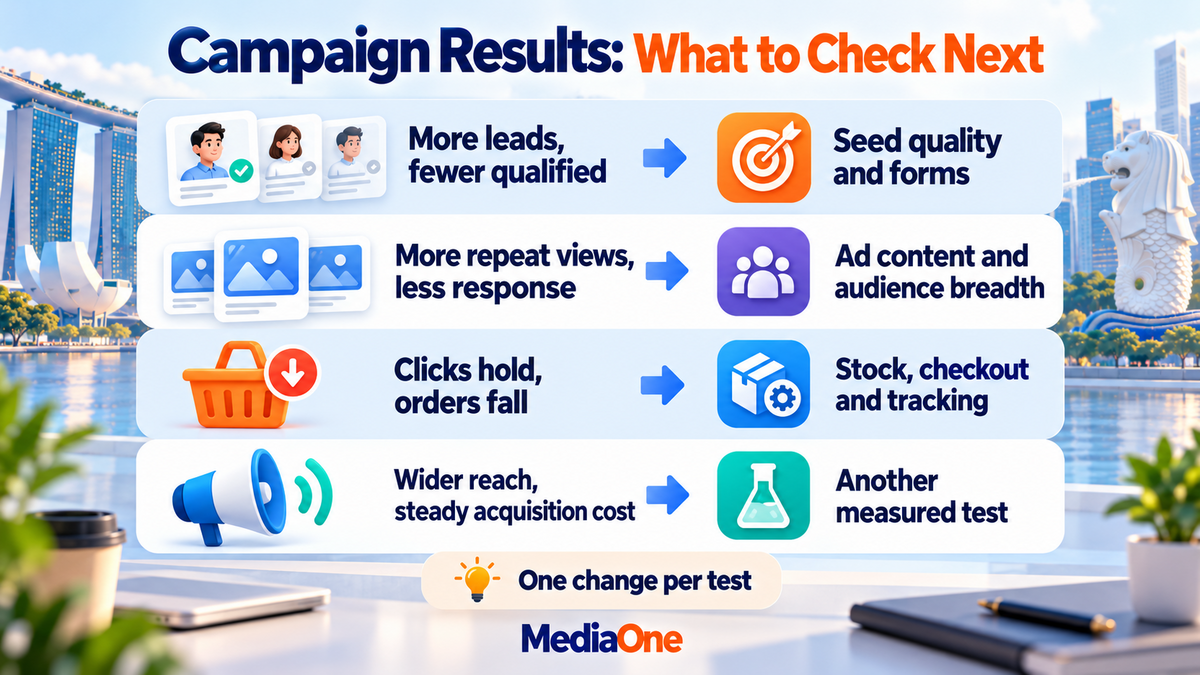
The next decision should reflect the evidence:
| Result | Next check |
| Enquiry volume rises but sales acceptance falls | Source quality and form qualification |
| Repeated exposure rises while response falls | Advertising content and audience breadth |
| Clicks remain healthy but orders fall | Stock, pricing, checkout and tracking |
| Wider targeting maintains acquisition cost | Another measured expansion test |
Better Lookalike Audiences Begin With Better Customer Evidence
Lookalike audiences turn customer records into a way to test new demand. A defined source and a recorded comparison give the team evidence it can use for its next spending decision.
MediaOne’s Google Ads services connect campaign planning, management and measurement. A conversation with our team can establish which audience test supports your next sales goal and how the business will judge its results.
FAQs about Lookalike Audiences
Can I see the names of people in a lookalike audience?
A lookalike audience is an advertising group, not a downloadable contact list. Advertisers receive audience and campaign reporting, without a list of the individuals selected by the model. The tool does not provide permission to contact those people outside the advertising platform.
Are lookalike audiences free to create?
Audience creation does not normally carry a separate platform fee. Advertising delivery still costs money. Data preparation, customer-management software and agency support can add costs, depending on how the business runs the campaign.
Can offline customers provide a source audience?
Offline customers can provide a source when the platform supports customer-list uploads and the records meet its requirements. A shop’s loyalty programme or a service business’s booking records may contain eligible identifiers. The business needs appropriate permission for the advertising use.
Does a lookalike audience replace market research?
Customer modelling does not explain every reason people buy. Interviews, sales feedback and product research can reveal concerns that an audience report cannot. Those findings help the business improve its offer and advertising message.
Can the same seed support expansion into another country?
A source from one market can inform a test elsewhere when the platform allows it. Similar customer traits do not establish local demand. Pricing, language, delivery and the sales process need to work in the new market, with results assessed separately from the original campaign.