A weak influencer campaign brief usually does not look like the problem at first. The creator seems right, the deliverables are agreed, and the campaign gets moving.
Then the drafts arrive. The messaging feels off, the content needs multiple rounds of changes, and the final output does not land the way the brand expected. In many cases, the issue is not the creator. It is the brief.
Influencer marketing now plays a far more commercial role than it used to. Global influencer marketing spend reached $32.55 billion in 2025, and stronger creator programmes are being treated as revenue-driving infrastructure rather than a soft brand exercise.
That shift matters because influencer content increasingly affects buying behaviour: 86% of consumers make an influencer-inspired purchase at least once a year, while 49% say they do so daily, weekly, or monthly.
At the same time, creators are asking for better working relationships, with 41% seeking supportive collaborations and open communication from brands. A stronger brief is no longer just a process document. It is a performance lever.
To move from insight to execution, we can help turn a strong brief into a more consistent creator workflow through our influencer marketing campaign management in Singapore, covering creator selection and approvals, reporting, and optimisation.
For brands in Singapore, that process matters even more because local creator campaigns now sit in a fast-growing, multilingual, platform-fragmented market where briefing quality directly affects both compliance and performance.
Key Takeaways
- A strong influencer campaign brief gives creators the clarity they need to produce content that aligns with the brand and supports the campaign goal, reducing unnecessary revisions. It sets the tone for smoother execution from the start.
- The best briefs balance clear direction with creative freedom. Brands need to define the non-negotiables while still leaving enough room for creators to create content that feels natural to their audience.
- High-performing briefs should cover more than deliverables. They should also include the campaign objective, audience, key messages, timeline, compliance requirements, usage rights, payment terms, and approval process.
- Many underperforming influencer campaigns are caused by weak briefing, not weak creators. Vague goals, unclear deliverables, and missing rights or KPI expectations often result in content that feels off or underperforms.
- Better briefs lead to better campaigns by improving alignment across the brand, the creator, and the campaign workflow. When the process is clearer, brands are more likely to get stronger content, faster approvals, and more consistent results.
What is an Influencer Campaign Brief?
This video gives a quick overview of what a strong influencer campaign brief is. It helps creators understand the campaign clearly and execute with fewer revisions. If you prefer a visual walkthrough before using the template below, this is a useful place to start.

An influencer campaign brief is a working document that outlines the campaign’s objectives, target audience, must-haves, must-avoids, and the collaboration’s timeline from briefing to publishing.
It is the document that aligns the brand, the creator, and the campaign objective before production begins. The brief is the foundation for stronger creator alignment and smoother execution.
A useful way to think about it is this: the brief sits between strategy and content. Strategy explains what the campaign needs to do. The creator turns that into audience-facing content. The brief is what connects those two parts. If it is too vague, the content usually misses the mark. If it is too rigid, the content often feels unnatural and performs poorly.
A good brief should answer the questions creators actually need answered before they can do good work. What is the objective? Who is the audience? Which platform matters most?
The Anatomy of a High-Performing Influencer Campaign Brief
A high-performing brief should clearly outline essential elements to guide creators while still allowing for authentic content.
Effective briefs typically include campaign goals, target audience, deliverables, messaging, review process, and payment information. Clarifying these components helps make the brief both informative and actionable for creators.
This level of clarity matters because execution is often where campaigns break down. Research shows that 70% of marketers face technical and workflow challenges when running influencer campaigns, which highlights how gaps in structure and communication can directly affect outcomes.
A well-built brief helps reduce these issues by aligning expectations early and making the process easier to manage.
Core sections every brand should include
| Section | What it should cover | Why it matters |
| Campaign objective | Awareness, engagement, conversions, content production, leads | Helps creators understand what success actually looks like |
| Target audience | Age, location, interests, buying stage, platform behaviour | Improves relevance and creative fit |
| Brand and product context | What the brand is, what is being promoted, and why it matters now | Gives creators the background needed to speak naturally |
| Key messages | Main points, proof points, CTA, tags, hashtags | Prevents inconsistent messaging |
| Deliverables | Platform, format, quantity, duration, caption requirements | Reduces confusion about output |
| Creative direction | Tone, references, do’s, don’ts, required inclusions | Gives structure without over-scripting |
| Timeline | Draft date, review rounds, posting window, campaign dates | Keeps production realistic and organised |
| Disclosure and compliance | Sponsored wording, platform labels, restricted claims | Reduces legal and reputational risk |
| Usage rights | Organic reposting, paid usage, whitelisting, duration | Prevents disputes after the content performs well |
| Compensation | Fees, product seeding, affiliate terms, payment timing | Sets commercial expectations clearly |
| KPIs | Reach, saves, clicks, conversions, CPA, content quality | Connects creator output to campaign outcomes |
| Approval workflow | Who signs off, how many review rounds, key contacts | Speeds up execution |
What strong briefs do differently
A weak brief often tells a creator what to post. A strong brief explains why the campaign exists, who the audience is, and how the content should help the audience move closer to action.
Modash specifically recommends aligning everyone around the primary goal or KPI and empowering the influencer with clear goals, messaging, and story context.
This is also where many brands get the balance wrong. They either over-explain the brand and under-explain the audience, or they over-script the creator, leaving no room for platform-native delivery. In practice, the best briefs separate non-negotiables from creative freedom.
Non-negotiables usually include compliance, restricted claims, key product details, and campaign CTA. Creative freedom usually includes the creator’s hook, structure, tone, and delivery style.
Weak brief vs strong brief
| Weak brief | Strong brief |
| A vague objective, such as creating awareness | Clear objective, such as drive serum trial among women aged 25 to 40 in Singapore |
| A generic audience, such as young women | Defined audience with location, interests, and platform habits |
| Deliverables only | Deliverables plus message priority and content context |
| No usage rights section | Rights for reposting, paid usage, and duration are stated clearly |
| No KPI guidance | Success metrics and campaign role explained |
| Over-scripted caption | Structured guidance with room for creator voice |
Influencer Campaign Brief Template Brands Can Actually Use
Brands do not need a bloated slide deck to produce a good brief. What they need is a clean structure that can be reused, adapted, and understood quickly by creators.
Practical influencer campaign brief template
| Brief section | What to include |
| Campaign name | Internal campaign title |
| Objective | What the campaign is trying to achieve |
| Brand overview | Short introduction to the brand and why this campaign matters |
| Product or service focus | What is being promoted and why now |
| Target audience | Who the content should speak to |
| Platform and format | Reel, TikTok, Story set, YouTube integration, carousel, etc. |
| Deliverables | Quantity, structure, links, tags, hashtags, and technical requirements |
| Key messages | Main talking points and CTA |
| Creative direction | References, tone, mandatory inclusions, exclusions |
| Compliance | Sponsored disclosure, regulated claims, restricted wording |
| Timeline | Draft date, feedback window, posting date |
| Usage rights | Organic reposting, paid ads, whitelisting, duration |
| Compensation | Fee, affiliate terms, gifting, payment timeline |
| KPIs | Reach, saves, clicks, conversions, and content quality |
| Contacts | Campaign manager, reviewer, escalation point |
Sample wording brands can borrow
- Objective: Drive awareness and product trial for a new hydrating serum among women aged 24 to 38 in Singapore through Instagram Reels and TikTok.
- Target audience: Skincare-aware women who care about sensitive skin, hydration, and ingredient-led beauty recommendations.
- Key message: Lightweight hydration for daily use, designed to support the skin barrier without feeling heavy.
- Usage rights: Brand may repost organically for 90 days. Paid usage and whitelisting require separate approval.
That level of specificity is often what turns a brief from generic to actionable, improving campaign outcomes.
How to Build an Influencer Campaign Brief from Scratch
The easiest way to build an influencer campaign brief is to work backwards from the result you want.
Start with what the campaign needs to achieve, then build the brief around the information a creator would need to deliver that result well. This keeps the document focused and helps avoid vague instructions, mixed priorities, and unnecessary back-and-forth later on.
That structure is more important than it looks. Research shows that marketers cite managing influencer campaigns as their biggest challenge, especially in coordination, timelines, and execution.
A clear, step-by-step briefing process helps reduce these issues by aligning expectations early and making campaigns easier to manage from start to finish.
Step 1: Define the campaign goal
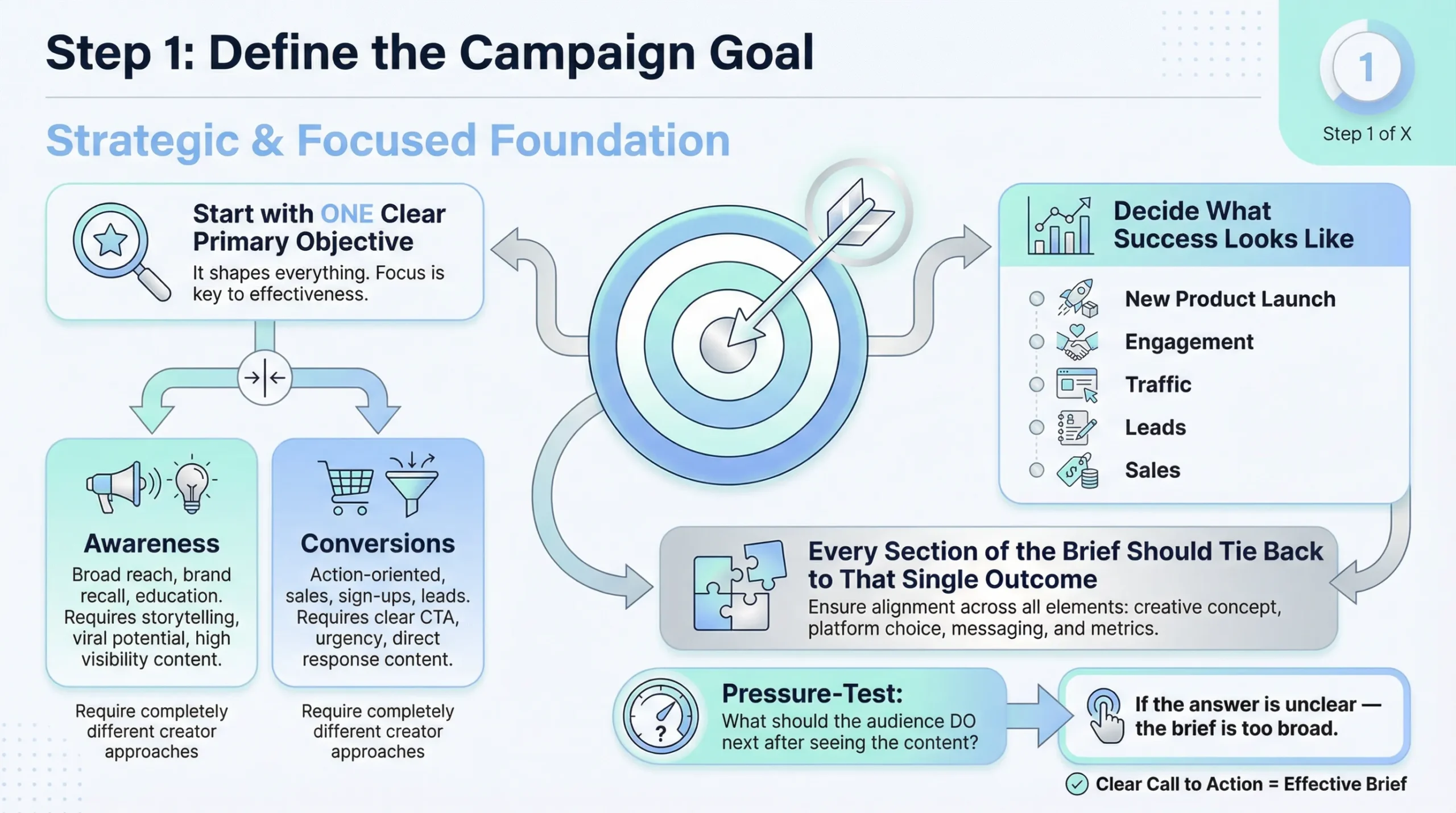
Start with one clear primary objective. That objective should shape everything else in the brief, from the content format to the messaging and the KPI you choose.
A campaign built for awareness needs a different creator approach from one built for conversions, and a brief that tries to prioritise everything at once usually ends up giving the creator no real direction.
At this stage, the brand should decide what success actually looks like. Is the campaign meant to introduce a new product, generate engagement, drive traffic, collect leads, or support direct sales? Once that is clear, the brief becomes much easier to write because every section can be tied back to that single outcome.
A simple way to pressure-test the goal is to ask: what should the creator’s content make the audience do next? If the answer is unclear, the brief is probably too broad.
Step 2: Identify the target audience
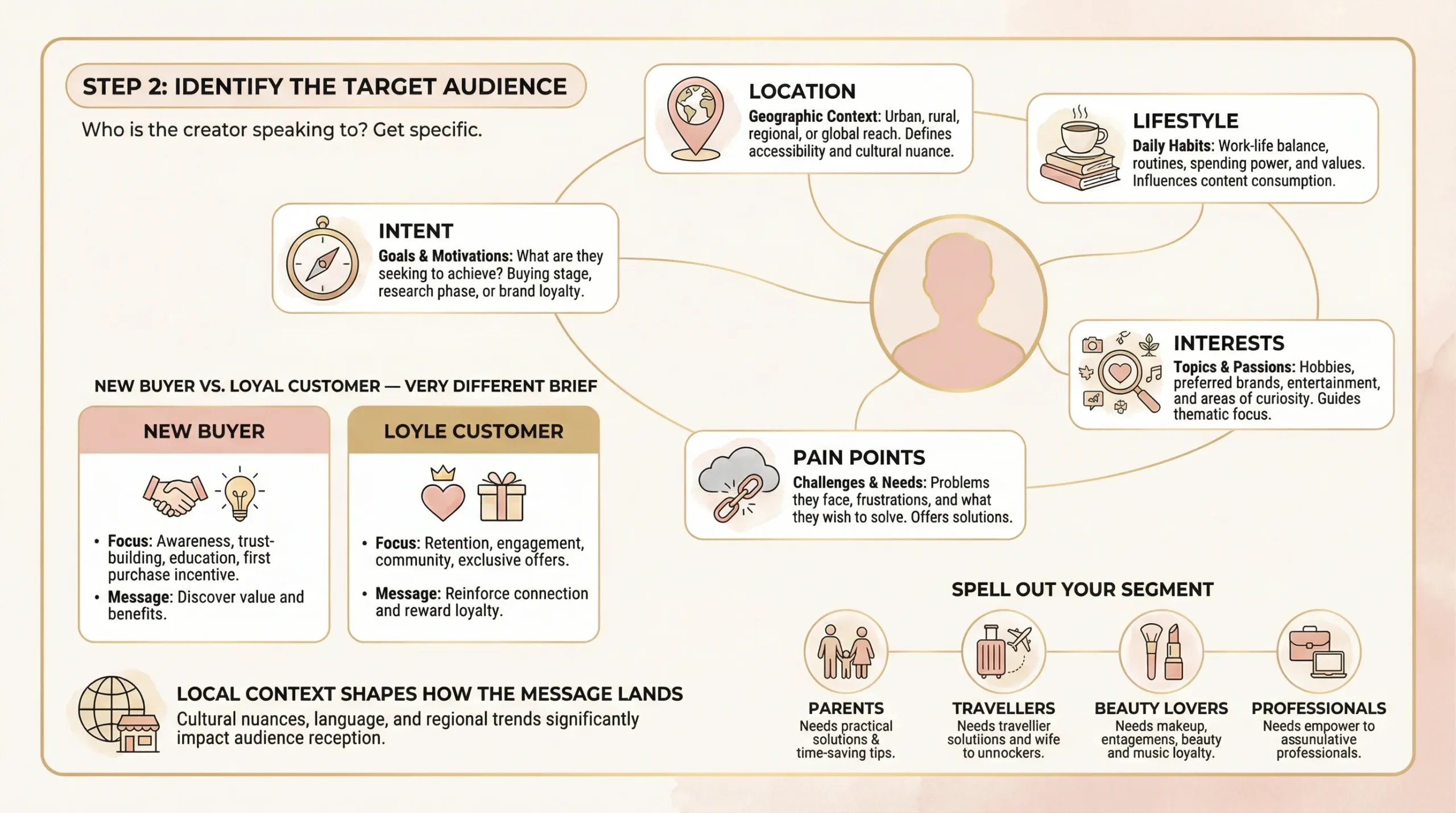
Once the objective is clear, define exactly who the creator is speaking to. This should go beyond broad customer descriptions like women aged 25 to 40 or young professionals. The more useful version includes details such as location, lifestyle, interests, pain points, purchase intent, and any cultural or seasonal context that could affect how the message lands.
This matters because creators do not just need to know what the brand sells. They need to know who the content is trying to persuade. A brief for first-time buyers will look different from one targeting loyal customers. A campaign aimed at price-sensitive shoppers will sound different from one targeting premium buyers.
The audience section is also where local relevance becomes important. If the campaign is for Singapore, say so clearly.
If the content needs to resonate with a specific segment, such as young professionals, parents, beauty-conscious consumers, or travellers, spell that out. A more defined audience almost always produces better content direction.
Step 3: Choose the platform and content format
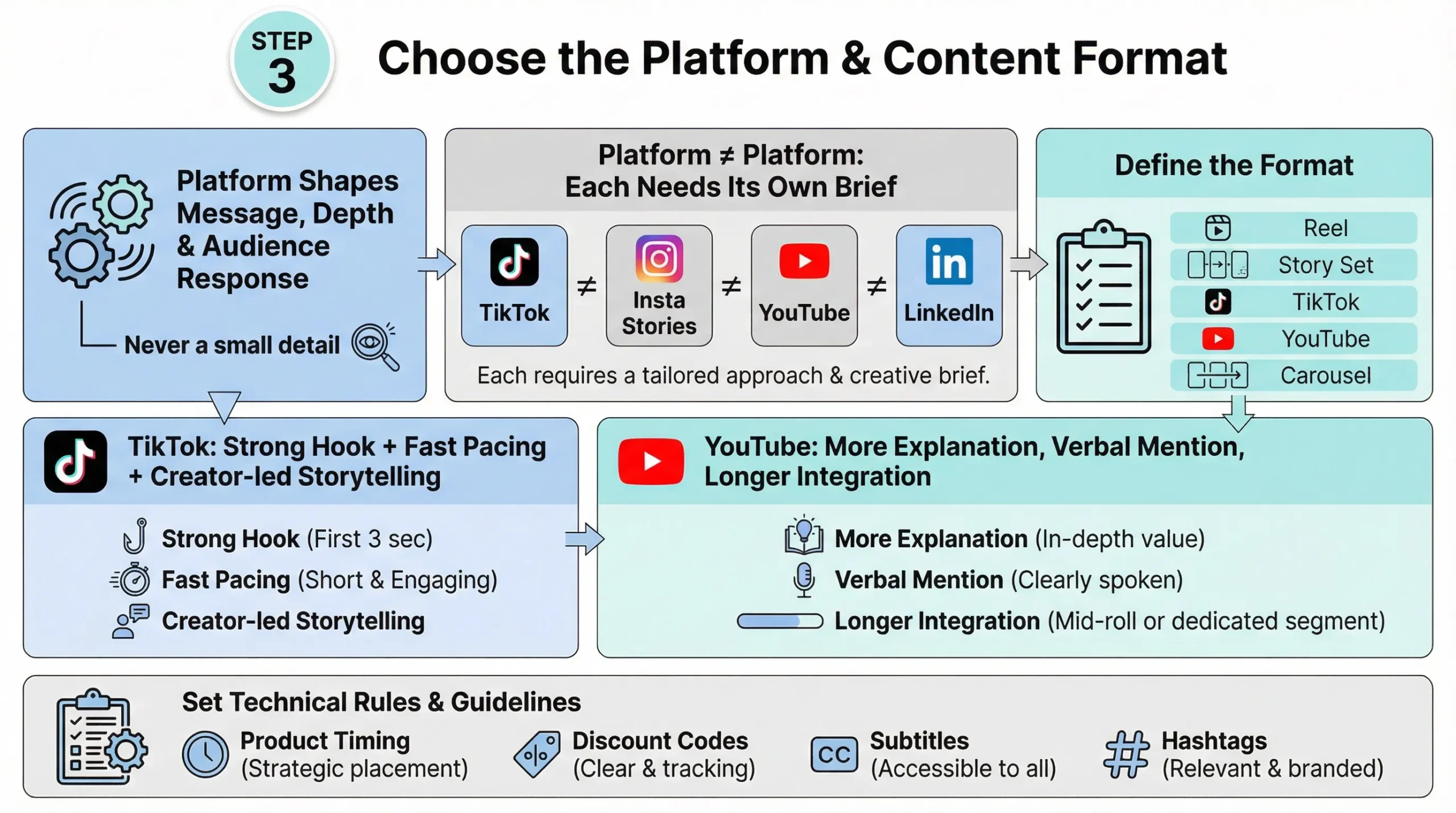
The platform should never be treated as a small technical detail. It changes how the creator should present the message, how much context they can include, and what kind of response the content is likely to generate.
A brief for TikTok should not read the same way as a brief for Instagram Stories, YouTube, or LinkedIn.
At this step, confirm which platform the creator will post on and what format the campaign needs. This could include a Reel, a Story set, a TikTok video, YouTube integration, a carousel post, or a combination of these.
Then define what the format needs to do. A Story sequence might need quick product education and a swipe-up CTA. A TikTok might need a stronger hook, faster pacing, and more creator-led storytelling. A YouTube integration may need more product explanation and a verbal mention.
This is also the point where brands should define any technical or structural expectations. For example, whether the product must appear in the first few seconds, whether links or discount codes are required, whether subtitles are required, or whether the creator needs to mention the campaign hashtag.
Step 4: Write the key messages and creative boundaries
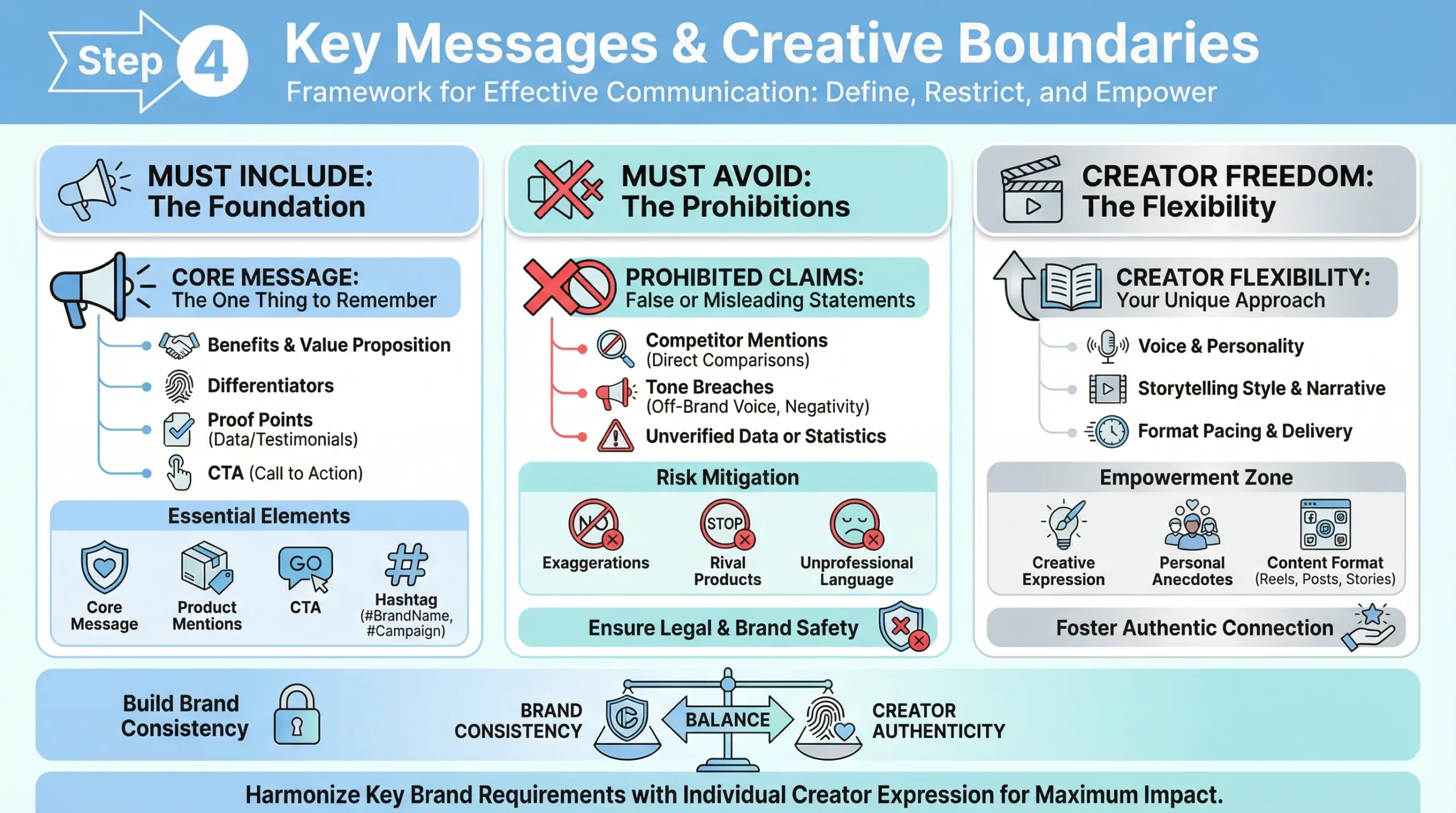
This is often the most sensitive part of the brief because it affects the balance between brand consistency and creator authenticity. The goal here is not to script the post line by line. It is to make clear what the creator must communicate, what they must avoid, and where they are free to shape the content in their own voice.
Start with the message hierarchy. What is the one thing the audience should remember after watching the content? Then add supporting points such as product benefits, differentiators, proof points, or CTA language.
From there, define the boundaries. This includes prohibited claims, competitor mentions, tone restrictions, compliance limitations, and brand safety issues.
The strongest briefs usually divide this section into three parts: what must be included, what should be avoided, and where the creator has flexibility.
That format makes it easier for creators to understand the assignment without feeling boxed in. It also helps prevent content that is on-brand but still feels natural for the platform.
Step 5: Add the process details
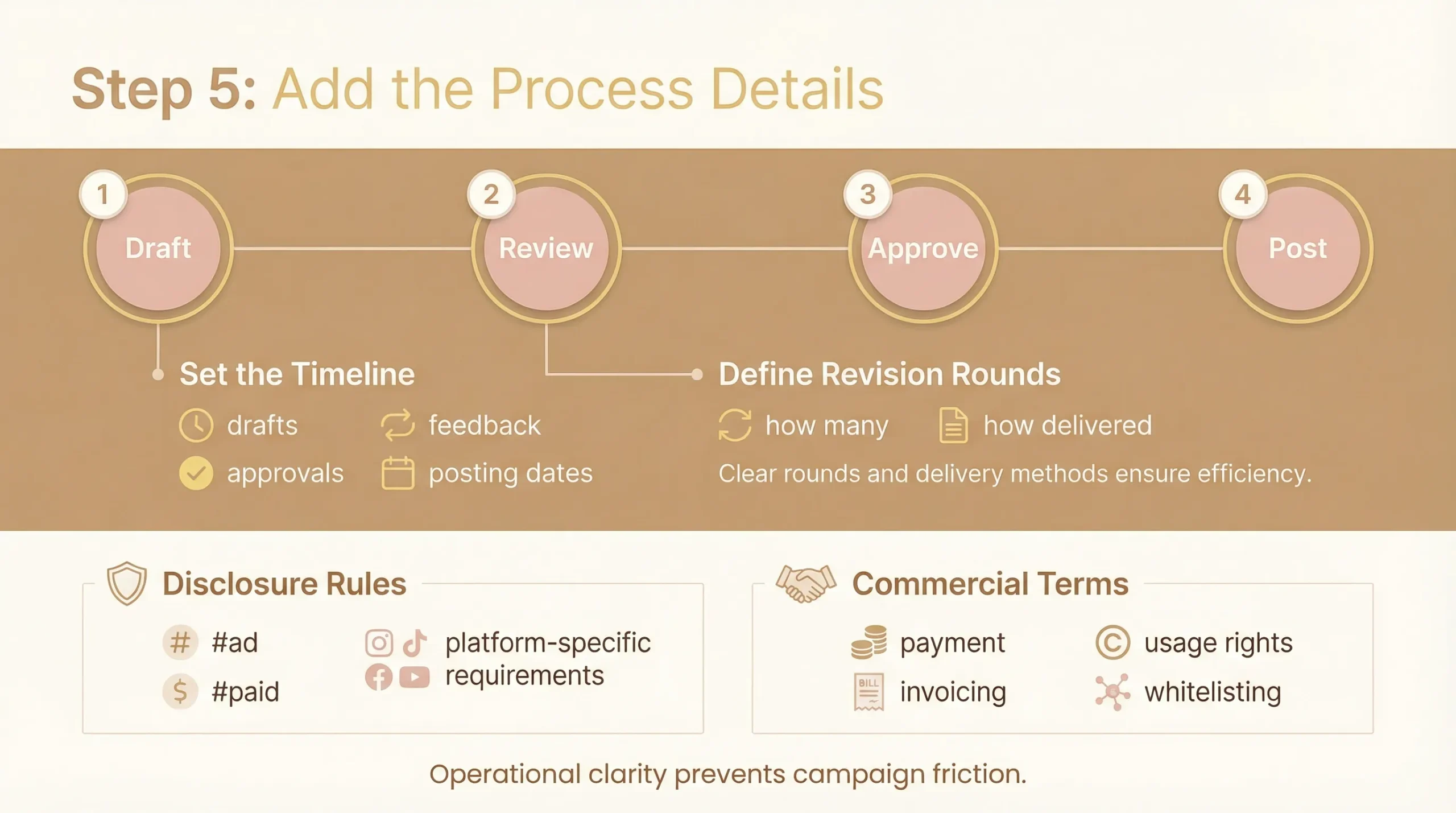
A surprising amount of campaign friction comes from operational gaps rather than creative ones. This is why the process section matters so much. It is where the brand sets expectations for timing, reviews, publishing, and commercial terms, so the creator knows exactly how the campaign will run.
This section should include draft deadlines, feedback windows, final posting dates, and any campaign embargoes or sequencing rules. It should also explain how many rounds of revisions are included, how feedback will be shared, and who the creator should contact for approvals or urgent questions.
It is also the right place to include disclosure requirements, payment timelines, invoicing details, usage rights, reposting permissions, whitelisting arrangements, and any other legal or commercial terms tied to the collaboration. These are the details that often get forgotten at the start and later cause delays or disputes.
Step 6: Finalise KPIs and approval flow
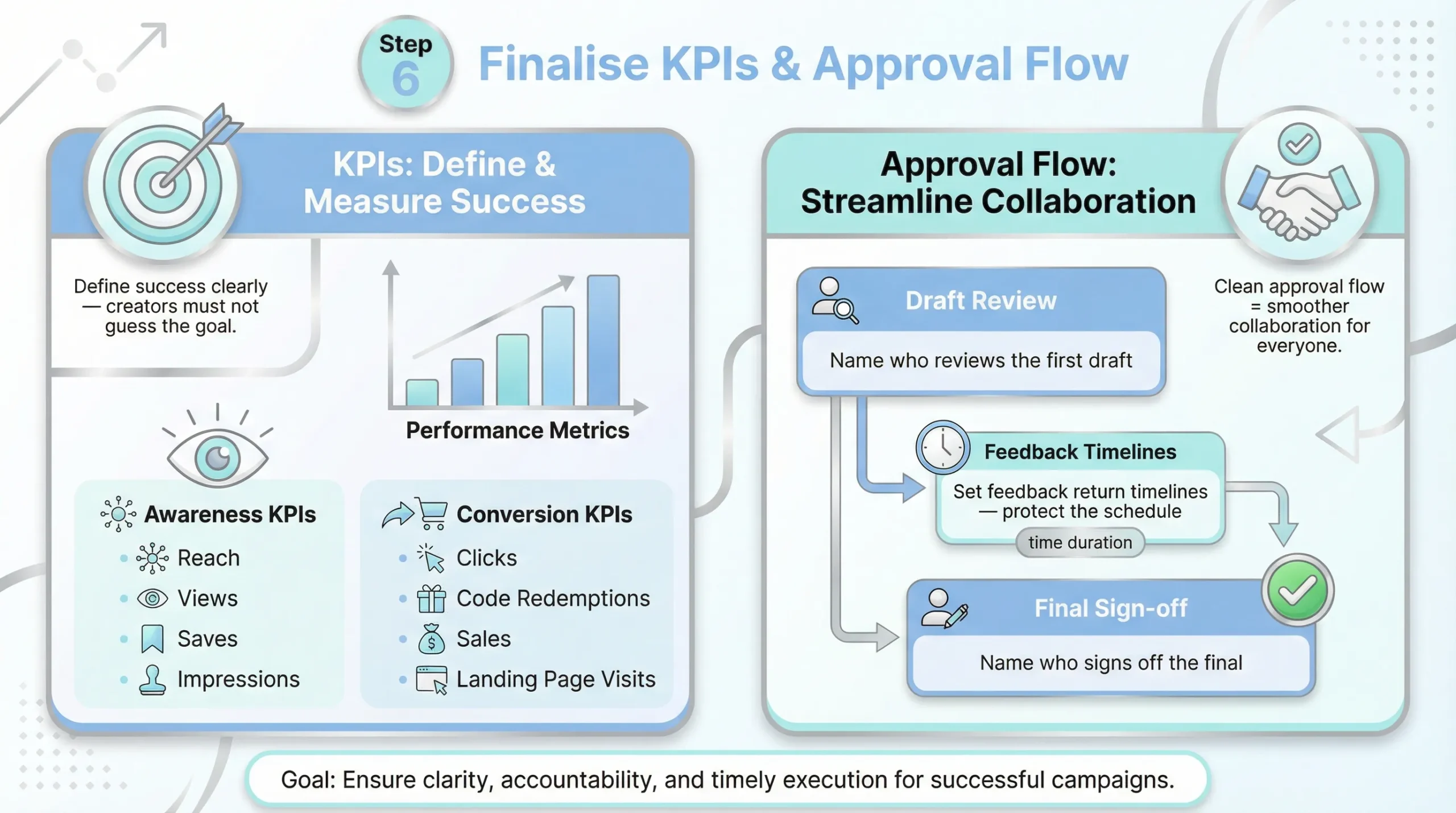
The final step is to define how the campaign will be judged and who has the authority to approve the work. A creator should not have to guess whether the brand is looking for reach, saves, clicks, code redemptions, content quality, or affiliate sales. If success is not clearly defined, the creator may optimise for the wrong thing.
At this point, confirm the primary KPI and any secondary indicators that matter. For example, an awareness-led campaign may focus on reach, views, and saves, while a conversion-led campaign may focus more on clicks, tracked sales, or landing page visits.
This does not mean the creator needs to see every internal reporting metric, but they should understand the main outcome the content is expected to support.
The approval flow should also be explicit. Name who reviews the first draft, who signs off on the final version, and how quickly feedback will be returned. A clean approval process protects the timeline and makes the entire collaboration easier to manage.
Quick build checklist
Before sending the brief, make sure these essentials are covered:
- Campaign objective confirmed
- Target audience clearly defined
- Platform and format selected
- Deliverables set
- Messaging hierarchy written
- Creative boundaries included
- Compliance section added
- Timeline and review flow added
- Rights and payment terms included
- KPIs agreed
- Approval contacts named
A good influencer brief should make the campaign easier to execute, not harder to interpret. If a creator can read it once and understand what the campaign needs, how the process works, and what success looks like, the brief is doing its job.
Example of a High-Quality Influencer Campaign Brief (Realistic Scenario)
To make this more practical, here is a simplified example of what a real influencer campaign brief could look like for a Singapore skincare launch.
Influencer Campaign Brief Example
Campaign Name
Barrier Repair Serum Launch Campaign
Brand
[Singapore Skincare Brand]
Campaign Objective
Drive product awareness and trial for a new barrier-repair serum among skincare-conscious women in Singapore.
Target Audience
Women aged 24 to 38 in Singapore who are interested in:
- sensitive skin support
- hydration and skin barrier care
- ingredient-led skincare
- practical daily routines
Platform(s)
TikTok and Instagram
Creator Profile
We are looking for five skincare creators who:
- create educational or routine-led beauty content
- have strong audience trust
- regularly generate good save rates and meaningful engagement
- can explain skincare benefits clearly without sounding overly clinical
Brand and Product Context
We are a skincare brand focused on ingredient-led, practical, and sensitive-skin-friendly solutions. This new serum is being launched as part of a wider brand push around skin barrier education.
The product is designed for users who want daily hydration and barrier support without a heavy or greasy texture.
Key Messages to Include
To make it easier for creators to execute, structure the message using Hook–Proof–CTA rather than listing talking points separately. Influencer Marketing Hub’s briefing guidance stresses that stronger briefs give creators clearer messaging hooks, visual proof cues, and examples of what success looks like, which helps reduce ambiguity and improve execution.
- Hook: define the opening angle or problem the content should lead with in the first few seconds to capture attention quickly.
- Proof: explain the key benefit through product demo, routine integration, ingredient explanation, or testimonial-style context, while following the message hierarchy in the brief.
- CTA: end with one clear action only, such as visiting the link in bio, using the discount code, swiping up, or commenting a keyword.
Where possible, include at least one high-performing example post from a past campaign, a brand asset, or a relevant competitor reference, so creators can see what good execution looks like in practice.
Influencer Marketing Hub specifically notes that creators need examples of what success looks like, and that vague briefs create avoidable execution problems.
Creative Direction
What to Do
- Show the product texture clearly on camera
- Include the serum in a real skincare routine
- Explain who the product is best for
- Keep the tone helpful, clear, and natural
- Make the content feel native to your usual style
What to Avoid
- Do not describe the serum as a medical treatment
- Do not claim it heals eczema
- Do not compare it to a named competitor
- Do not make exaggerated or guaranteed-result claims
Platform-Specific Guidance for an Influencer Campaign Brief
A good influencer campaign brief should not treat platform choice as a one-line detail. TikTok, Instagram Reels, Instagram Stories, YouTube integrations, and Xiaohongshu content all work differently, so the brief should adapt the hook, format, pacing, and CTA to match the platform.
Influencer Marketing Hub emphasises that creator briefs work better when expectations are tailored to platform mechanics rather than copied across channels.
Use the table below as a practical briefing guide:
| Platform | Hook Timing | Ideal Duration | Format Notes | Specific Brief Requirements |
| TikTok | First 1–2 seconds | 15–60 seconds | Vertical 9:16, fast pacing, native editing | Specify trending audio policy, whether Spark Ads or paid usage is allowed, and whether raw files are required |
| Instagram Reels | First 3 seconds | 15–90 seconds | Vertical 9:16, visually polished but still native | Confirm whether the Reel is paired with Stories, whether link stickers are needed in follow-up Stories, and whether organic reposting rights apply |
| Instagram Stories | Immediate | 3–5 frames | Vertical 9:16, tap-through sequence | Specify frame order, product placement by frame, sticker use, CTA link, and whether the final frame must carry an offer or swipe-up prompt |
| YouTube integration | First 30–60 seconds of the integration window | 2–10 minute mention | Horizontal 16:9, more explanatory and trust-led | Specify verbal talking points, product demo expectations, description links, pinned comment requirements, and timestamps if needed |
| Xiaohongshu (RED) | Image-first / title-first | 300–500 word note | Mixed media, search-friendly captions and notes | Specify Mandarin/English ratio, keyword usage in the note, product terms to include, and whether the creator should optimise for in-platform search |
These ranges are best used as briefing defaults, not hard rules. The point is to give creators enough structure to match platform behaviour without over-scripting the execution. A TikTok brief usually needs stronger direction on speed, hook style, and trend use.
A YouTube integration brief needs more guidance on talking points, trust cues, and where the product mention should sit within the longer video. An Instagram Stories brief needs tighter control over sequence and CTA flow.
This also affects KPI calibration. Later’s 2025 data, published via PR Newswire, found that Instagram Reels delivered the highest engagement at an average CPE of $2.65, while TikTok videos were strongest for discovery and product demos, with an average CPE of $14.61.
That means brands should not expect the same outcome from every platform. The brief should indicate whether the campaign is optimised for engagement, discovery, education, or click-throughs.
Influencer Campaign Brief Usage Rights and Affiliate Terms
Usage rights and affiliate terms should be brief but never vague. They affect how far the brand can use the content after the post goes live, how the creator is paid, and whether the content can later become a paid media asset.
That matters more now because Aspire reports that creator-driven affiliate revenue grew 71% year over year in 2025, while 57% of creators are raising their rates and 83% are still open to working with brands for product value alone if they genuinely like the brand or product.
A practical influencer campaign brief should clarify four common arrangements:
- Organic reposting: The brand reposts the creator’s content on its own channels. This often does not require a major additional fee, but the brief should still define the usage period (e.g., 30, 60, or 90 days) and clarify which brand-owned channels are included.
Since usage rights are commonly priced based on how long the content will be used and where it will appear, longer usage should be agreed upon up front.
- Paid whitelisting/allowlisting: The brand runs paid ads through the creator’s account rather than only through the brand account. Aspire notes that this typically adds 20% to 30% of the collaboration fee, so the brief should specify the duration, budget cap, targeting scope, platform, and creative approval rights before the campaign starts.
- Affiliate/performance terms: If the creator earns commission on tracked sales, the brief should specify the tracking method (e.g., promo code or UTM link), the commission structure, the attribution window, and the reporting method. This avoids confusion later and makes it easier to connect creator output to actual sales.
- UGC-only rights: The creator produces the content, but does not post it on their own channel. The brand then uses it on its own social channels or in paid ads. This should be stated clearly in the brief, as it completely changes the pricing model from audience access to content production and usage rights.
If the brand already expects to repost, boost, whitelist, or use the asset in paid media, that should be written into the brief from the start so pricing, permissions, and approval rights are aligned before production begins.
Set KPIs in an Influencer Campaign Brief
KPI setting is one of the most important parts of an influencer campaign brief because measurement is still where many campaigns break down. EMARKETER reports that 32% of marketers worldwide say measuring creator performance is their biggest barrier to successful influencer marketing.
A stronger brief addresses part of that problem by defining success before the campaign goes live, rather than judging results against vague expectations later.
The most useful KPI sections are tied to the campaign objective. An awareness campaign should not be judged like a conversion campaign, and a creator hired for engagement should not be measured like an affiliate-led partner.
For Singapore campaigns, GoViral Global reports average engagement of 2.2% on Instagram and 5.4% on TikTok, alongside average conversion rates of 3.8% on Instagram, 2.1% on TikTok, 3.4% on Xiaohongshu, and 1.8% on YouTube.
| KPI | Awareness Campaign | Engagement Campaign | Conversion Campaign |
| Reach | Primary metric. Set expectations based on creator tier, content format, and whether paid amplification is included. | Secondary | Secondary |
| Engagement Rate | Quality check. In Singapore, average engagement is about 2.2% on Instagram and 5.4% on TikTok. | Primary metric. Use platform averages as the baseline, then set a campaign target above that if justified. | Secondary |
| Save Rate / Share Intent | Secondary | Useful for value-led or educational content, especially when the goal is high-quality, memorable content. | Secondary |
| Link CTR | Secondary | Useful when traffic matters, but not always the main success metric. | Primary if the campaign is meant to drive visits to a landing page, store, or product page. |
| Conversion Rate | Secondary | Secondary | Primary. The Cirqle notes that 5% from click to checkout is gold. |
| ROAS / Revenue Efficiency | Secondary | Secondary | Primary where sales attribution is in place. GoViral Global cites an average ROI of about 5.8× for Singapore influencers. |
| CPA | Secondary | Secondary | Primarily, where customer acquisition matters. Define it upfront against your internal margin target or paid-media benchmark. |
The point of this table is not to force every campaign into the same reporting model. It helps the brand choose one primary KPI and two or three supporting metrics for each funnel stage.
An awareness-led TikTok campaign may prioritise reach first and use engagement rate as a quality check. A conversion-led campaign should be much tighter on CTR, conversion rate, CPA, and ROAS.
The brief should also explain how performance will be measured. If the campaign is sales-led, specify the tracking link, promo code, attribution window, and reporting cadence.
If the campaign is engagement-led, say whether the brand is prioritising saves, shares, comment quality, or another signal of content value. Without that clarity, creators may optimise for the wrong outcome, and brands may end up evaluating the campaign against the wrong standard.
Main Contact
For all draft submissions, questions, and approvals, please contact:
Campaign Manager: [Name]
Email: [Email Address]
Response Time: Within 1–2 working days
Why This Brief Works
This example works because it gives the creator enough context to understand:
- what the campaign is trying to achieve
- who the content is meant for
- what must be included
- what should be avoided
- how success will be measured
At the same time, it still leaves enough room for the creator to make the content feel natural to their audience. That balance is what makes a brief useful in practice.
Briefing for Singapore Campaigns: What’s Different
Singapore briefs need more local specificity than global templates. The market is growing quickly, with a 2025 influencer ad spend forecast at US$110.19 million, while broader 2025 market estimates place the Singapore influencer market at SGD 285 million, up 24% year on year.
That means a weak brief does not just create workflow issues. It can waste budget in a market where creator campaigns are becoming more competitive and more commercially important.
To make a Singapore campaign brief more effective, brands should account for the following:
- Platform priorities: Singapore is not a one-platform market, so the brief should be explicit about where the campaign is meant to win. Instagram is used by 87% of Singapore brands and is the primary platform for 52%, while TikTok is used by 76% and is primary for 28%. Xiaohongshu is already used by 41% of brands, which makes it especially relevant for beauty, fashion, lifestyle, and Chinese-speaking audiences. A brief should therefore state the lead platform, why it was chosen, and whether content needs to be adapted for secondary platforms.
- Platform-specific KPI targets: KPI targets should reflect how users actually behave on each platform. In Singapore, average engagement is reported at around 5.4% on TikTok versus 2.2% on Instagram, so it makes little sense to hold both formats to the same benchmark. A better brief sets realistic expectations by platform, content type, and campaign goal.
- Multilingual execution: Language decisions should not be left vague, especially in a multicultural market. Singapore has four official languages: Malay, Mandarin, Tamil, and English, so a brief may need to specify caption language, hashtag language, on-screen text, or whether dual-language content is required for the target audience. That is particularly important for campaigns tied to retail, beauty, food, education, or community-based segments.
- Local compliance requirements: Singapore briefs should also be tighter on compliance than generic global templates. At a baseline, campaigns should align with ASAS’s Guidelines on Interactive Marketing Communication & Social Media, which apply to advertising and marketing communication on social platforms. For regulated sectors, the brief should go further. Finance-related campaigns now face added scrutiny under MAS’s Guidelines on Standards of Conduct for Digital Advertising Activities, which took effect on 25 March 2026.
- KOL vs KOC briefing style: Not all creators should be briefed the same way. Larger KOLs are usually more useful for reach and brand credibility, so briefs can allow more creative latitude while protecting key messages and compliance points.
KOCs and smaller creators tend to be more effective when the brief is tighter on conversion hooks, product context, proof points, and CTA language.
Singapore market data also shows that smaller creators deliver stronger engagement: nano influencers average 5.8% engagement and micro influencers average 4.2%, which supports a more trust-led, action-oriented briefing style for these tiers.
A Singapore influencer brief should reflect the local platform mix, the realities of a multilingual audience, and the compliance landscape. The more local the campaign objective is, the more local the brief needs to be.
Compliance Essentials in an Influencer Campaign Brief
Compliance in an influencer campaign brief should be specific, practical, and easy to follow. Instead of vague instructions like ‘follow platform rules,’ the brief should clearly state what must be disclosed, where that disclosure should appear, and which platform tools must be activated before the content goes live.
In Singapore, ASAS requires marketing communication to be clearly identifiable and distinguishable from personal or editorial content. Where a commercial relationship may affect the credibility of an endorsement, that relationship must be disclosed. This applies not only to paid campaigns, but also to gifted products, affiliate arrangements, event invitations, and other sponsored collaborations. ASAS also states that disclosures should be clear, prominent, and shown as early as reasonably possible.
To reduce compliance risk, the brief should include platform-specific disclosure instructions such as:
- Instagram: use the Paid partnership with [Brand] label where applicable, together with a clear caption disclosure such as #ad or #sponsored
- TikTok: turn on TikTok’s content disclosure setting for brand, product, or service promotions
- YouTube: mark the video as containing paid promotion, and where relevant, include a clear verbal sponsorship mention
- Facebook: use Meta’s paid partnership or branded content tag, with written disclosure in the post copy where needed
This matters because creators may understand that disclosure is required, but still apply the wrong method if the brief does not spell it out. A brief that defines the correct disclosure format upfront reduces avoidable errors and protects both the brand and the creator.
For finance, investment, and fintech campaigns, the compliance section should be stricter still. MAS published its Guidelines on Standards of Conduct for Digital Advertising Activities on 25 September 2025, and these took effect on 25 March 2026.
Any finance-related influencer campaign brief should therefore include sector-specific wording, approval controls, and clear guardrails around risk disclosures and misleading claims.
The rule is simple: if a disclosure or claim control matters legally or reputationally, it should be written into the brief rather than assumed.
Common Influencer Campaign Brief Mistakes That Hurt Results
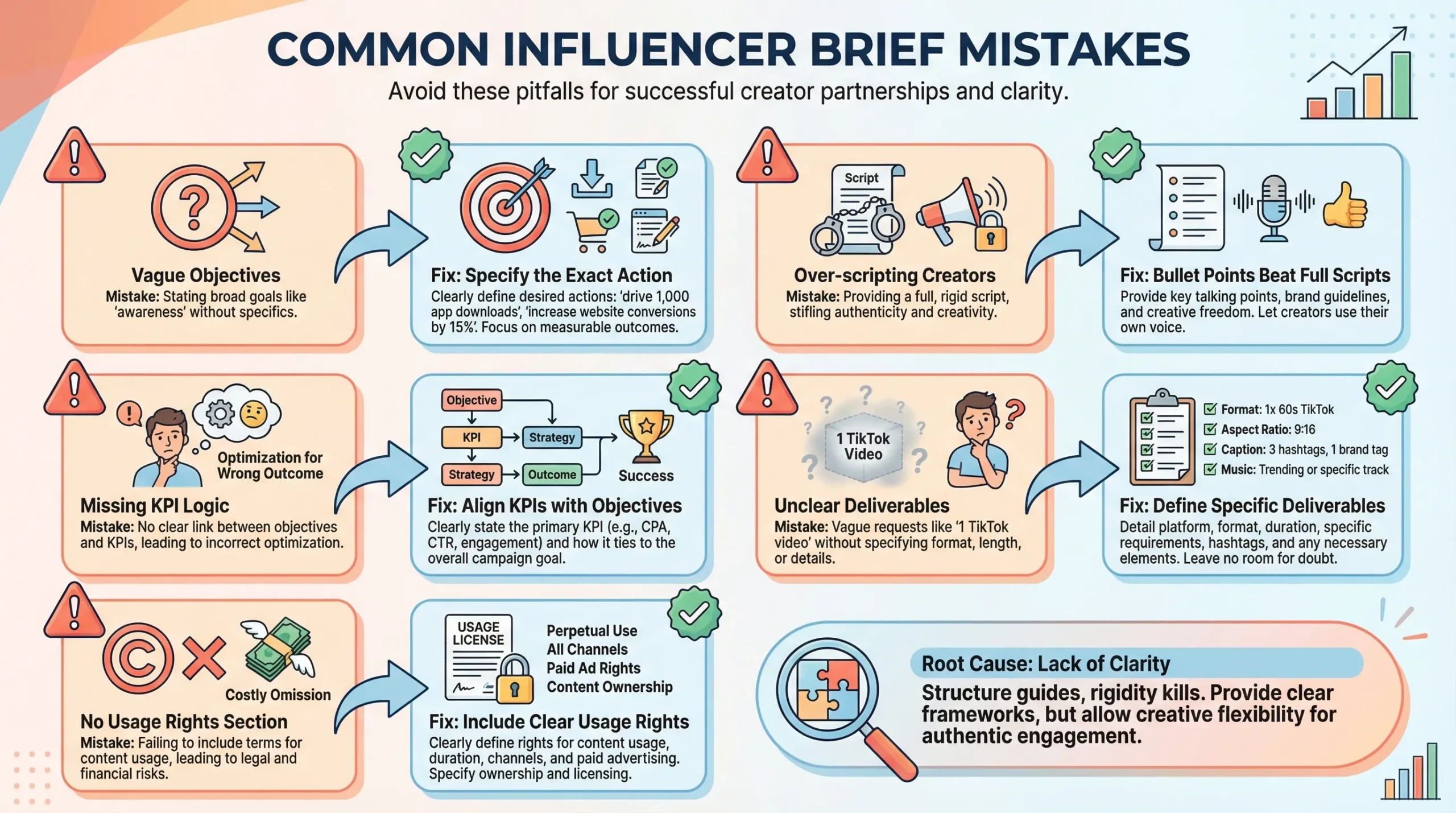
Even well-intentioned campaigns can underperform when the brief has gaps. Below are the most common mistakes brands make, along with how to fix them before they impact your results.
- Vague objectives: If the brief just says create awareness, the creator is left to guess what kind of content the campaign actually needs. That often results in polished content that looks fine but fails to achieve the brand’s desired outcome. Define one clear objective and tie it to an action. For example, instead of increasing awareness, specify driving product trial among first-time users through educational content or increasing landing page visits through creator-led demonstrations. The more specific the goal, the easier it is for creators to shape content that supports it.
- Over-scripting the creator: This is one of the most common mistakes. While it may feel safer to tightly control the message, overly scripted content often feels unnatural and performs poorly. Creators know how to communicate with their audience, and forcing a rigid script removes that advantage. Separate non-negotiables from creative direction. Provide key messages, product truths, and compliance requirements, but allow creators to decide how to deliver them. Use bullet points instead of full scripts, and include references or examples rather than exact wording.
- Missing KPI expectations: A creator brief without KPI logic can lead to misaligned content. If the creator does not know whether the campaign is focused on reach, engagement, or conversions, they may optimise for the wrong outcome. State the primary KPI clearly and explain what success looks like. For example, if the goal is to save and share, the content should be educational or value-driven. If the goal is clicks or sales, the content should include stronger CTAs and clearer product positioning.
- Unclear deliverables: “1 TikTok video” sounds clear until questions start coming in. Does it need a hook? Should the product appear in the first few seconds? Is voiceover required? Are raw files needed? Without clarity, creators make assumptions that may not align with the campaign. Define deliverables in detail. Include format, duration, structure, required elements, tags, links, and any technical requirements. A good rule is: if the creator could interpret it in multiple ways, the brief needs to clarify it.
- No usage rights section: This is one of the costliest omissions. Many brands realise they need usage rights only when a post performs well and they want to turn it into an ad. By then, negotiations become slower, more complex, and more expensive. Include a clear usage rights section upfront. Specify whether the brand can repost content, use it in paid ads, whitelist it, or repurpose it across channels. Also define duration and whether additional fees apply for extended usage.
Most of these mistakes come down to one core issue: lack of clarity. When the brief is unclear, creators fill in the gaps themselves. When it is too rigid, they lose the ability to create content that resonates.
The goal is to provide enough structure to guide execution, while still allowing creators to do what they do best.
Influencer Campaign Brief Checklist Before You Send It
Use this checklist before sending any brief to a creator.
Pre-send checklist
- The campaign objective is clear
- The target audience is defined
- Platform and format are specified
- Deliverables are concrete
- Key messages are prioritised
- Do’s and don’ts are included
- Disclosure requirements are stated
- Usage rights are clearly defined
- Timeline is realistic
- Payment terms are included
- KPIs are listed
- Approval flow and contacts are clear
Remember to tweak your checklist to align with your campaign goals and vision.
If the campaign is running in Singapore, the brief should also specify any ASAS disclosure requirements and any sector-specific restrictions under HSA rules where relevant.
Better Briefs Lead to Better Influencer Campaigns
A better brief not only reduces confusion but also improves clarity. It improves alignment, speeds up approvals, protects brand standards, and gives creators a stronger foundation for producing content that actually performs.
Expectation-setting is a practical way to improve content quality from the start, and Modash links better briefing to smoother workflows and better content.
It also supports stronger overall campaign execution. Even a clear brief can lose momentum if creator communication, approvals, revisions, and reporting are managed inconsistently. That is one reason many brands look for influencer marketing campaign management in Singapore when they want a stronger process from briefing through to live campaign reporting.
The simplest way to look at it is this: if the brief is weak, the content will usually be inconsistent. If the brief is too rigid, the content will usually feel unnatural. The best briefs sit between those two extremes. They are clear where clarity matters, flexible where creativity matters, and structured enough to support performance.
If you are ready to refine your influencer strategy and remove guesswork from your campaigns, get in touch with MediaOne for a tailored consultation. Our team at MediaOne will walk you through what a high-performing influencer campaign process looks like and where your current approach can be strengthened.
Frequently Asked Questions
What should be included in an influencer campaign brief?
A good influencer campaign brief should include the objective, target audience, brand, and product context, deliverables, key messages, timeline, compliance guidance, usage rights, compensation, KPIs, and approval process. Sprout Social and Aspire all include these core sections in their briefing guidance.
How detailed should an influencer campaign brief be?
It should be detailed enough to remove confusion, but not so detailed that it scripts the creator line by line. A strong brief provides the strategy, boundaries, and expectations, while still allowing the creator to translate them into audience-native content.
Do brands need to include usage rights in an influencer brief?
Yes. If a brand wants to repost content, use it in paid ads, whitelist it, or repurpose it after the original post goes live, those rights should be agreed in advance. This is one of the most commonly overlooked parts of the creator briefing.
Should brands include KPIs in an influencer brief?
Yes. KPI clarity helps creators understand whether the campaign is looking for reach, saves, clicks, conversions, or high-quality content for reuse. Modash specifically recommends aligning everyone around the primary goal or KPI.
What is the difference between a campaign brief and an influencer brief?
A campaign brief is usually broader and often created for internal teams or agencies. An influencer brief is creator-facing and focuses on what creators need to produce the right content.
Can a poor influencer brief affect campaign performance?
Yes. A poor brief can lead to unclear messaging, repeated revisions, delayed approvals, weak creator fit, and inconsistent content quality. Since influencers influence real purchase behaviour, briefing quality can also affect commercial outcomes. Sprout Social reports that 86% of consumers make a purchase inspired by an influencer at least once a year.
Do influencer briefs need compliance guidance?
They should. The brief should explain sponsored disclosure expectations, platform-specific labels, restricted claims, and any sector-specific legal limitations that apply to the campaign.
How can brands make creator briefs easier to work with?
Use headings, short sections, and practical wording. Separate non-negotiables from creative flexibility, and avoid burying important points in long paragraphs. A brief should be easy to scan, easy to understand, and easy to execute.
Do influencer briefs need compliance guidance?
Yes. A creator brief should explain what must be disclosed, how it must be disclosed, and where it must appear.
In Singapore, ASAS requires marketing communication to be identifiable and commercial relationships to be disclosed, including not only paid partnerships but also gifted products, affiliate arrangements, and sponsored event invitations.
The brief should also specify the correct platform tool, such as Instagram’s Paid partnership label, TikTok’s content disclosure setting, or YouTube’s paid promotion disclosure. For finance-related campaigns, the brief should go further and include MAS-specific conduct and approval requirements effective 25 March 2026.
How long should an influencer campaign brief be?
An influencer campaign brief should be detailed enough to avoid confusion but short enough to remain easy to use. For smaller creator campaigns, a concise brief is usually enough, while larger or more complex campaigns may need more room. Use clear headers, bullet points, and short sections instead of long paragraphs.
Should the brief be different for TikTok vs Instagram?
Yes, because TikTok and Instagram support different content styles and user behaviour. TikTok briefs usually need more direction on hooks, pacing, and trend use, while Instagram briefs often need more guidance on visual structure, captions, and supporting Story elements. A platform-native brief gives creators clearer direction and usually leads to better execution.
How do brands brief creators for live shopping campaigns?
Live shopping briefs need more structure than standard sponsored posts because the creator is guiding a real-time sales experience. The brief should cover the product demo order, Q&A handling, offer timing, and when the discount code or buying prompt should appear. This helps the session feel more organised, persuasive, and conversion-focused.
What is the difference between an influencer brief and a creator contract?
The brief covers the creative side, such as campaign goals, messaging, deliverables, and approvals. The contract covers the legal and commercial terms, including payment, use rights, disclosure obligations, and cancellation terms. In practice, the brief explains how the campaign should run, while the contract explains what each party is agreeing to.