
When I talk with business owners and marketing teams, many know SEO matters but are unclear on an SEO consultant’s day-to-day work. SEO is often described vaguely as rankings or keywords, making it hard for businesses to connect those terms to growth.

This question comes up a lot for a reason. Google handles over 5 trillion searches a year, and 15% of those are brand-new. People are always searching, and the search landscape is always changing.
That is why the right SEO consultant matters. If you have ever wondered why your pages are not ranking, why competitors outrank you, or why your content is not attracting the right traffic, you are not alone.
This guide breaks down what SEO consultants actually do, what you should expect, how they differ from agencies, and how to choose the right support for your business.
Key Takeaways
- An SEO consultant boosts search visibility through technical fixes, content optimisation, keyword strategy, and performance tracking. The real benefit is not just higher rankings, but a clearer path to qualified traffic and sustainable growth.
- Effective SEO begins with diagnosis; audits, keyword mapping, and prioritised action plans, so you target changes that drive measurable results.
- SEO consultants and agencies share similar goals but work in different ways. Consultants provide specialist guidance and focus, while agencies are better for broad execution and multi-channel support.
- Strong SEO delivers clear outputs. Expect audit reports, keyword strategies, optimisation plans, technical fix logs, content recommendations, and ongoing reporting, not just vague promises.
- Select your SEO partner for fit, clarity, and value, not just price. Good consultants set expectations, explain priorities, and tie work to measurable progress.
What is an SEO Consultant?
If you want a more practical view of what success in SEO consulting looks like, the video below is worth watching. In this episode of MozPod, Luke Carthy shares insights on what it takes to become a successful SEO consultant, from building expertise and trust to managing the real demands of client work.
An SEO consultant (Search Engine Optimisation consultant) is a digital marketing professional who plans, develops, and implements strategies to improve a website’s organic search performance.
Their main goal is to help you rank higher in Google, attract more qualified visitors, and grow your visibility, leads, and revenue.
Unlike general marketers, SEO consultants specialise in understanding:
- how search engines crawl and index content,
- what your target audience is searching for, and
- how to improve your site’s architecture, content, and authority.
They use data-driven tactics to diagnose issues, build a strategy, and measure long-term SEO performance, not just short-term metrics.
Roles and Responsibilities of an SEO Consultant
An SEO consultant does more than track rankings. They diagnose search issues, prioritise fixes, improve your content and technical foundations, and measure whether SEO is actually driving business growth.
Google’s own guidance supports this broader view of SEO, with strong emphasis on crawlability, helpful content, and page experience.
1. SEO Audits and Diagnostics
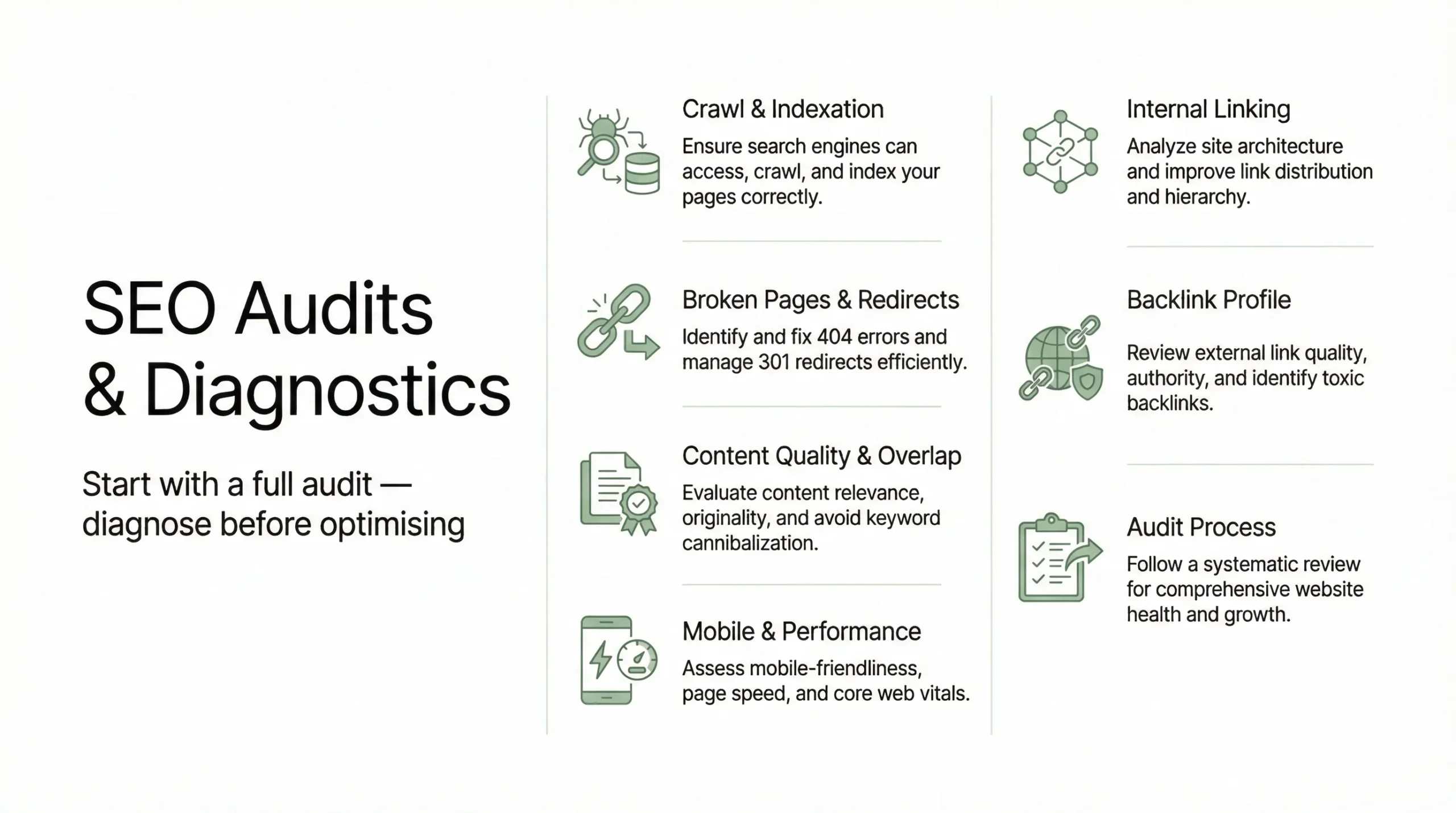
SEO consultants usually begin with a full audit because optimisation without diagnosis often leads to wasted effort. A proper audit helps uncover what is holding the site back, whether that is crawlability, indexation, poor content targeting, weak internal linking, or technical errors.
Google’s explanation of how Search works makes this clear: pages need to be discovered, crawled, indexed, and processed before they can appear in search results and perform.
A strong SEO audit often reviews:
- crawl and indexation issues
- broken pages, redirects, and duplicate URLs
- thin, outdated, or overlapping content
- mobile usability and performance gaps
- internal linking structure
- backlink profile quality
- visibility trends in Search Console and analytics
The real value of the audit is prioritisation. Instead of touching everything at once, the consultant can identify which issues are blocking growth now and which improvements are worth sequencing later.
If you want to get a quick sense of how your site is performing before committing to a full review, we offer a free SEO audit tool you can try here: Free SEO Audit Tool. It is a useful starting point for identifying key issues and opportunities across your website.
2. Custom SEO Strategy Development
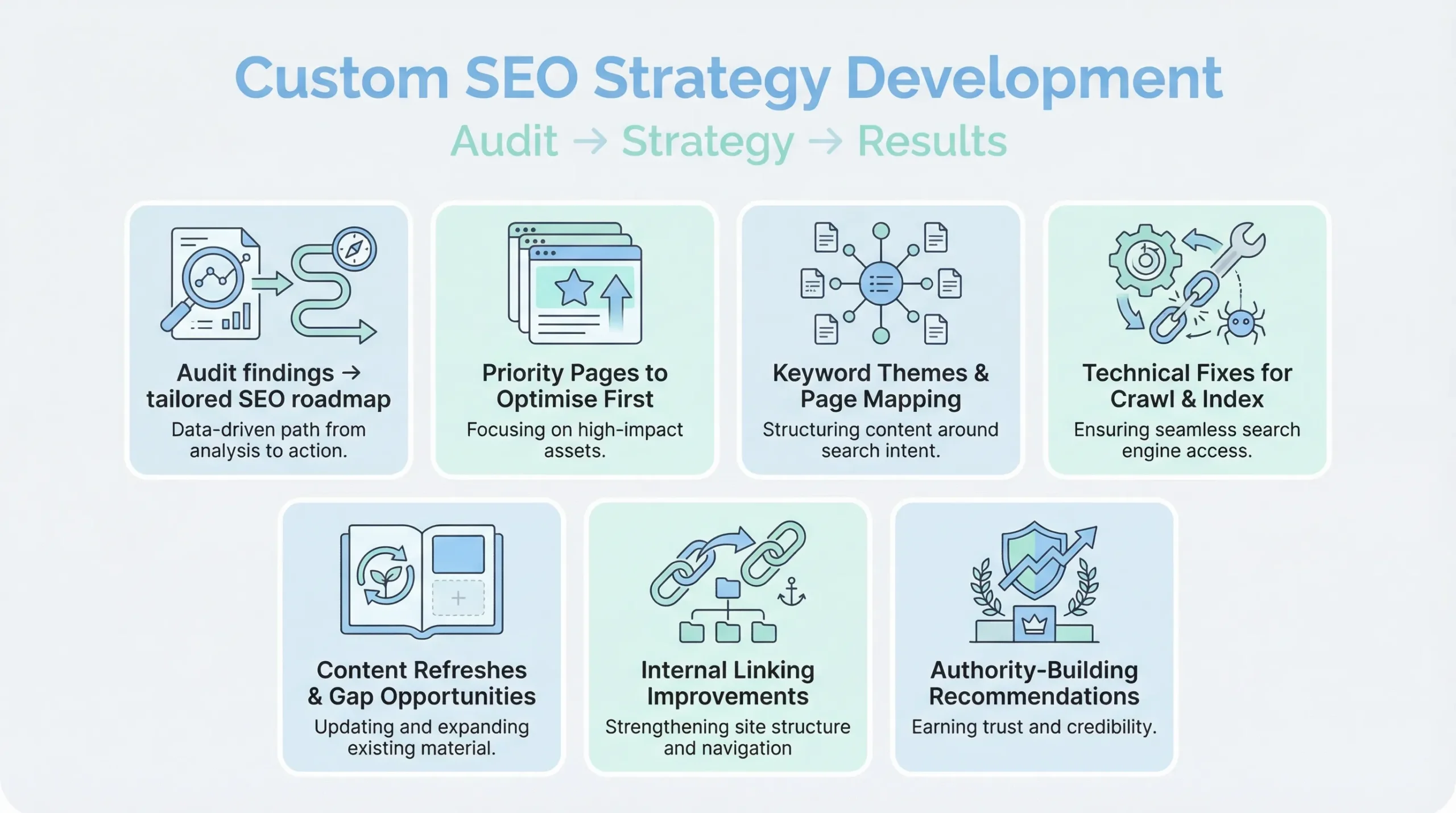
After the audit, the consultant turns findings into a tailored SEO roadmap. This is where SEO becomes strategic, not just reactive.
Instead of applying generic best practices blindly, the consultant aligns recommendations with business goals, site maturity, competitive pressure, and the types of searches most likely to lead to qualified enquiries or sales.
A custom strategy may include:
- priority pages to optimise first
- keyword themes and page mapping
- technical fixes that support crawling and indexing
- content refreshes or content gap opportunities
- internal linking improvements
- authority-building recommendations
- short-term wins and longer-term growth initiatives
This roadmap matters because not every SEO task has equal value. A good consultant helps you focus on the work that will improve visibility and results first.
3. Keyword Research and Competitive Analysis
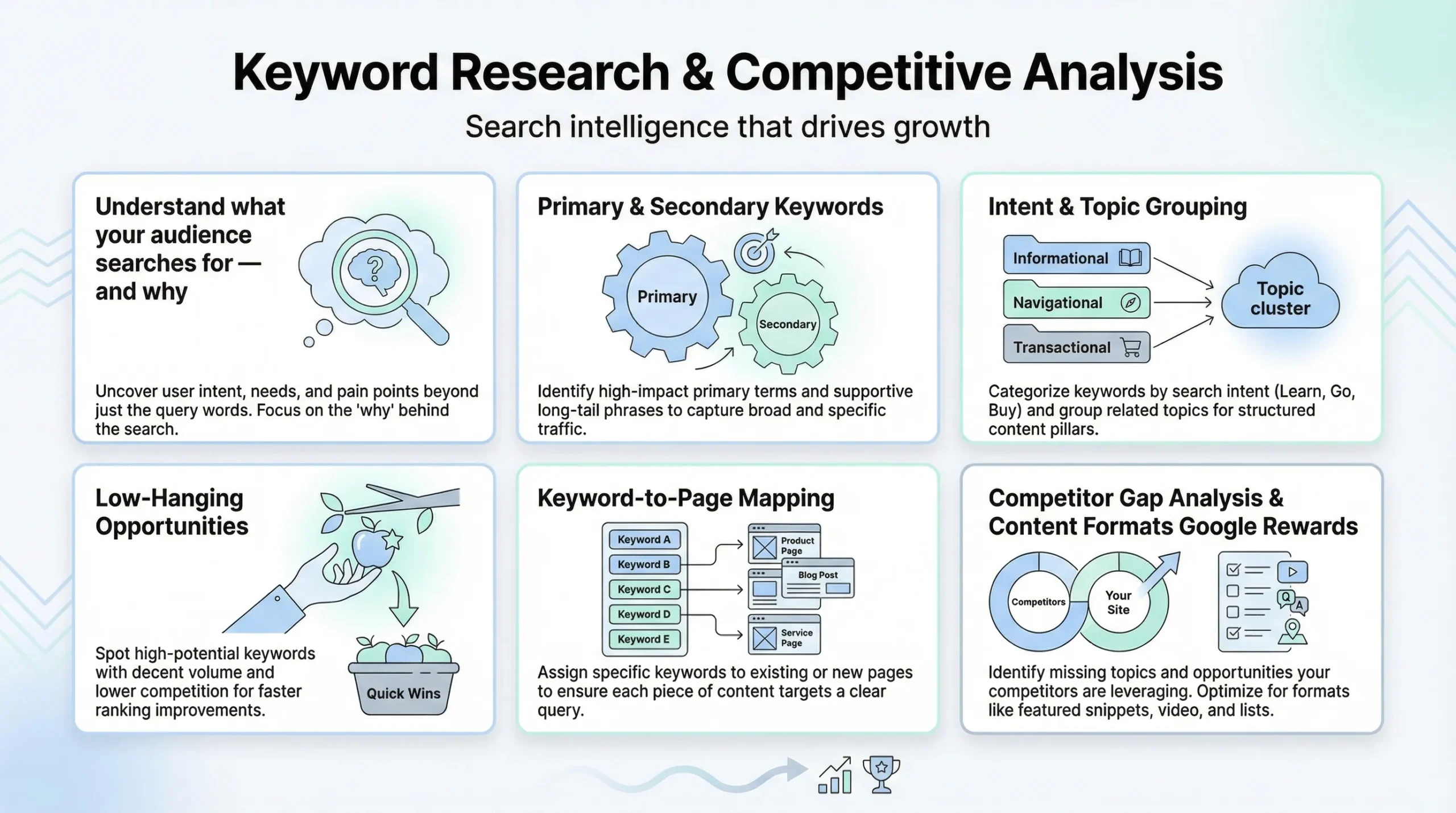
Keyword research is not just about high-volume phrases. It is about understanding what your audience is searching for, their intent, and which topics are worth targeting for your business.
Google recommends writing with the words users might actually search for in mind, which is why keyword strategy should influence titles, headings, copy, and internal links.
This work usually includes:
- identifying primary and secondary keywords
- grouping keywords by intent and topic
- spotting low-hanging opportunities
- mapping keywords to the right pages
- finding gaps where competitors rank, and you do not
- reviewing what type of content Google is rewarding for those searches
Competitive analysis fills in the gaps. Instead of guessing, the consultant studies what is already ranking, which content formats are winning, and where your site needs to build authority.
Because Google held 89.85% of the global search engine market share in March 2026, most SEO keyword and content decisions still tend to prioritise how Google interprets relevance, quality, and search intent.
4. On-Page and Content Optimisation
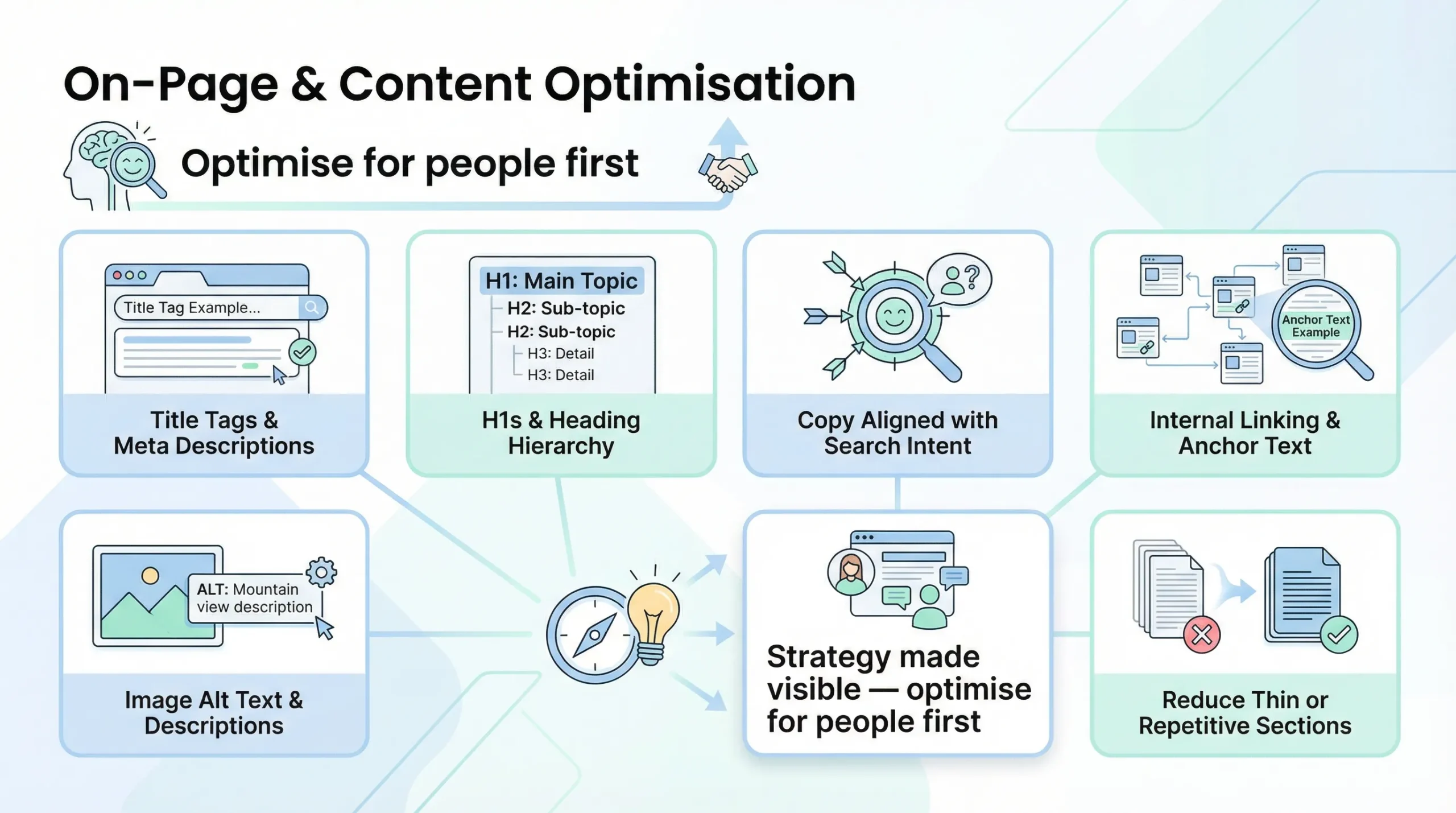
On-page SEO is where strategy becomes visible. Consultants improve your page structure, wording, and signals so both search engines and users understand it clearly.
This includes refining headings, metadata, image descriptions, internal links, and content flow to make the page more relevant to the query it targets. Google recommends using descriptive text in titles, headings, alt text, and links so both users and search engines can better understand the page.
Typical on-page and content optimisation work includes improving title tags, meta descriptions, H1S, heading structure, linking, copy alignment with intent, and alt text.
- strengthening H1S and heading hierarchy
- aligning copy more closely with search intent
- improving internal linking and anchor text
- reducing repetitive or thin sections
- adding supporting detail that makes the page more useful
- improving image alt text and descriptive elements
This is also where content quality matters most. Google’s helpful content documentation makes it clear that pages should be created to benefit people first.
A consultant should not just add keywords. They should make your pages more complete, clearer, and more useful to your audience.
5. Technical SEO and Site Architecture
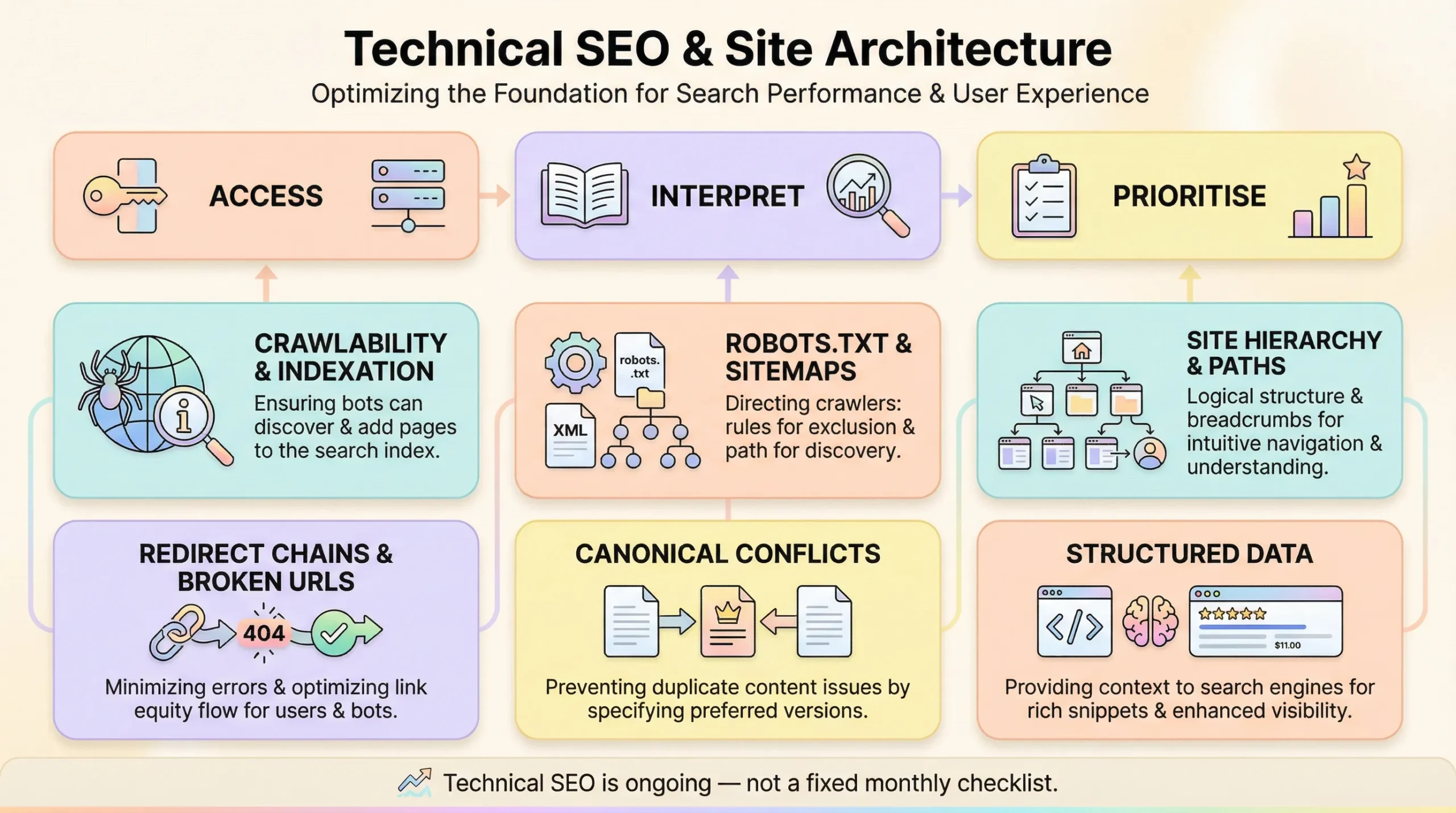
Technical SEO ensures that search engines can access, interpret, and prioritise the site properly. Even strong content can underperform if pages are blocked, duplicated, buried too deeply, or slowed down by technical problems.
Google’s documentation on crawling, indexing, and JavaScript SEO points to the same principle: if Google cannot properly crawl, render, or index a page, that page’s visibility in Search can suffer.
A consultant’s technical responsibilities often include:
- improving crawlability and indexation
- reviewing robots.txt and XML sitemaps
- resolving redirect chains and broken URLs
- fixing canonical conflicts
- improving site hierarchy and internal paths
- implementing or refining structured data
- reviewing JavaScript rendering issues
- improving mobile usability and page speed
Performance matters here, too. Since Google’s ranking systems use a variety of page-level signals and are updated over time, SEO refinement is best treated as an ongoing process rather than a fixed monthly checklist.
6. Off-Page SEO and Authority Building
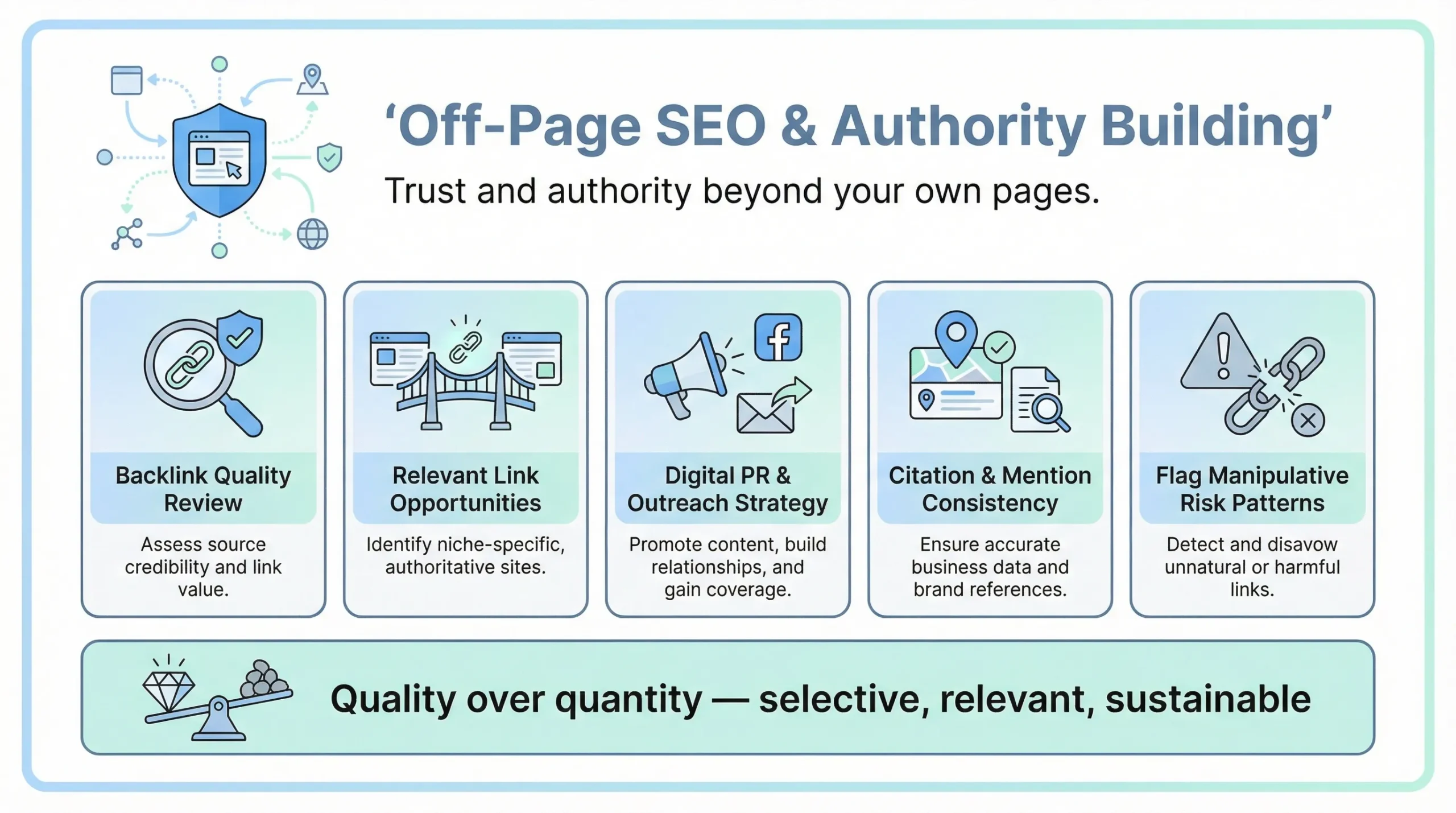
Off-page SEO focuses on signals that strengthen a website’s perceived trust and authority beyond its own pages. The most recognised of these signals is backlinks.
Google uses links to discover pages as a signal of page relevance and as one of the positive signals related to a site’s importance, which is why link profile quality still matters in competitive SEO spaces.
An SEO consultant may help by:
- reviewing backlink quality and risks
- identifying relevant link opportunities
- supporting digital PR or outreach strategy
- improving citation or mention consistency
- flagging manipulative patterns that could create risk
The goal is not to chase as many links as possible. Google has long warned against link schemes and other manipulative practices, so authority building should be selective, relevant, and sustainable rather than volume-driven.
7. Analytics, Reporting, and Refinement
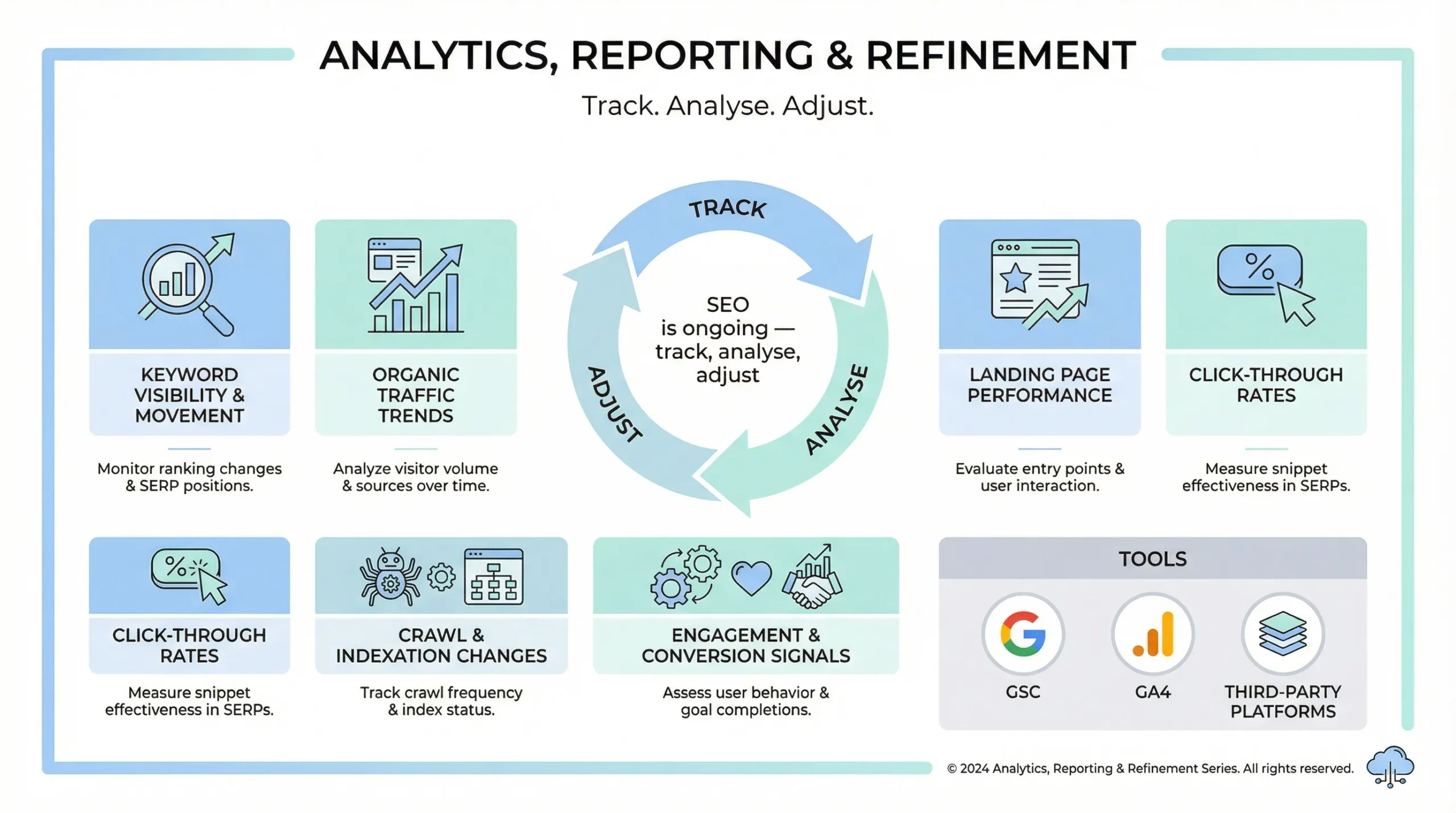
SEO is not a one-time task. It needs ongoing tracking, analysis, and adjustment. That is why analytics and reporting are core to an SEO consultant’s job.
They use tools such as Google Search Console, Google Analytics 4, and third-party SEO platforms to measure performance, identify trends, and inform the next round of priorities.
Google’s own search documentation and tools are designed to support exactly this kind of ongoing review.
A consultant will usually monitor:
- keyword visibility and movement
- organic traffic trends
- landing page performance
- click-through rates
- crawl and indexation changes
- engagement and conversion signals
- performance of newly optimised content
- emerging competitor movement
Good reporting does more than show charts. It explains what changed, why it changed, and what actions to take next.
Since Google’s ranking systems assess pages using multiple signals and continue evolving, SEO refinement is a continuous process rather than a fixed monthly checklist.
SEO Tasks and Deliverables: What to Expect
While the earlier responsibilities explain what an SEO consultant typically handles, the next question is what those responsibilities actually produce.
A strong SEO engagement should result in tangible deliverables that guide implementation, improve visibility, and make progress easier to measure. Typical SEO deliverables include the following:
1. Comprehensive SEO Audit Report
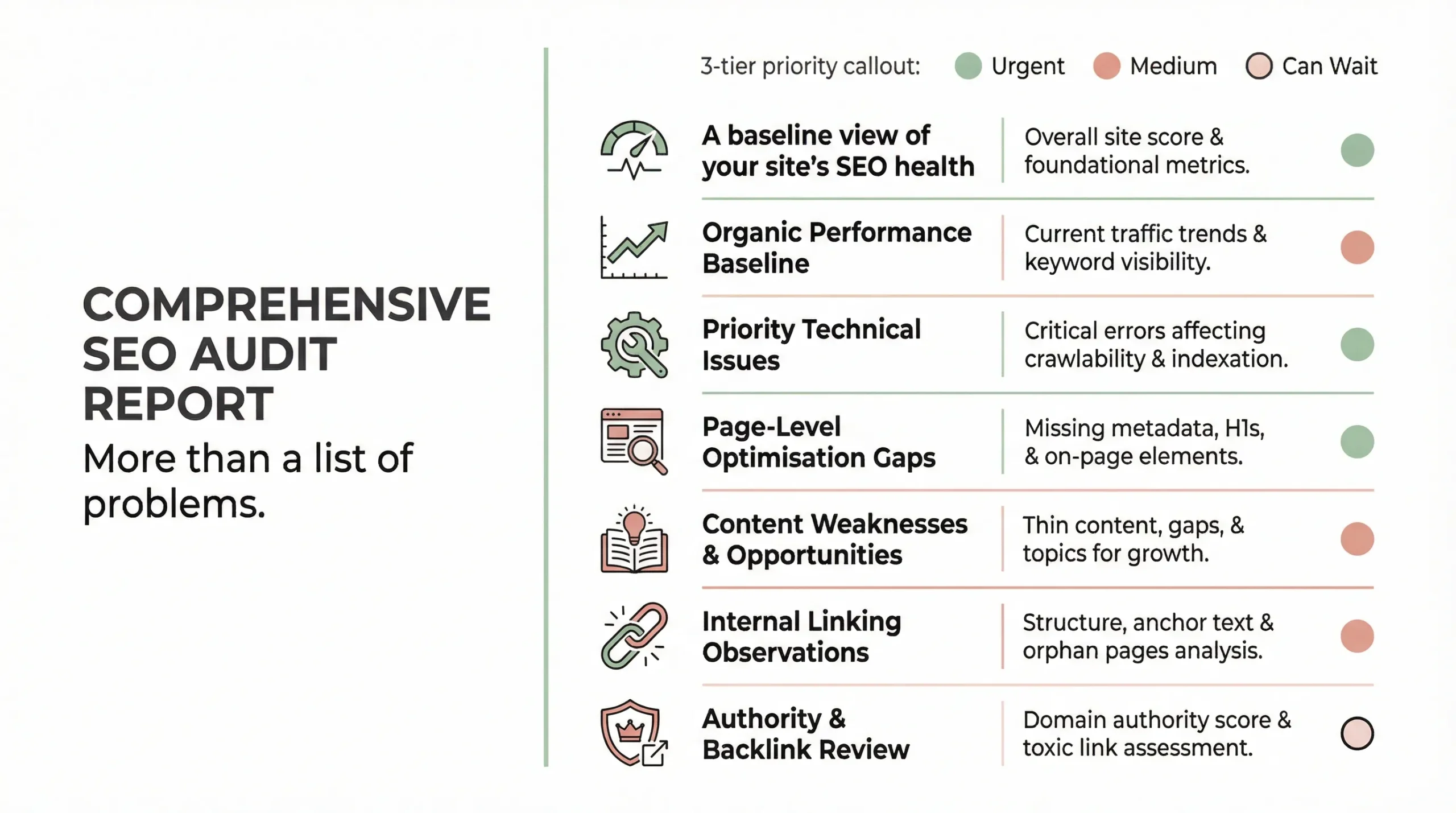
One of the first deliverables is usually a structured audit report. This gives you a baseline view of the website’s current SEO condition and highlights the main issues affecting visibility.
A strong audit report usually includes:
- current organic performance baseline
- priority technical issues
- page-level optimisation gaps
- content weaknesses or missed opportunities
- internal linking observations
- authority or backlink observations
- a prioritised list of recommended actions
The best audit reports do more than flag problems. They show which issues are urgent, which are medium priority, and which can wait.
2. Keyword Strategy Document
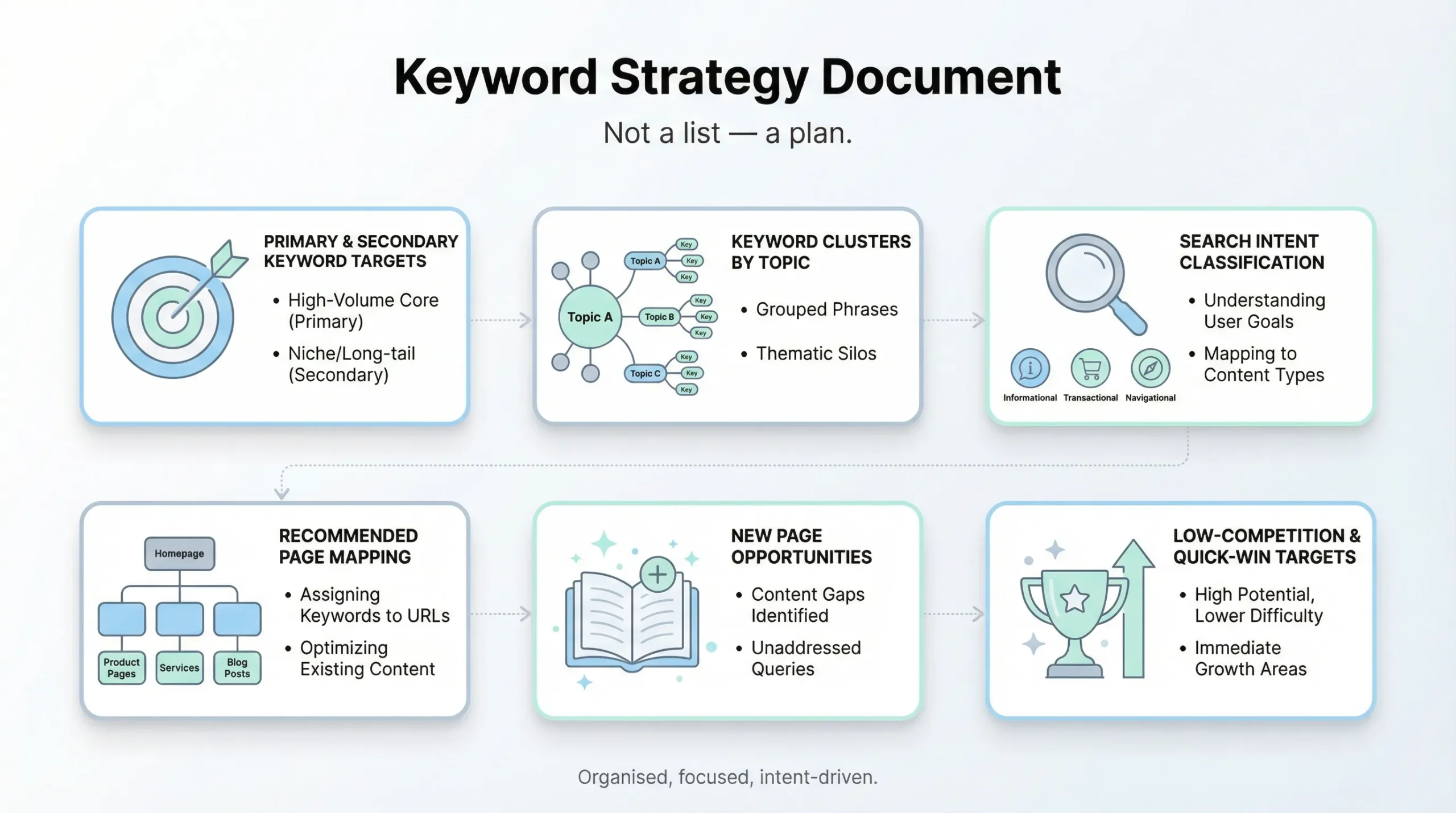
The keyword strategy document turns search demand into a practical targeting plan. Instead of a random list, it shows which themes matter, which pages should target them, and what intent those searches represent.
This deliverable often includes:
- primary and secondary keyword targets
- keyword clusters by topic
- search intent classification
- recommended page mapping
- new page opportunities
- low-competition or quick-win targets
This keeps your SEO effort organised and focused, not just based on isolated keyword choices.
3. Optimisation Action Plan
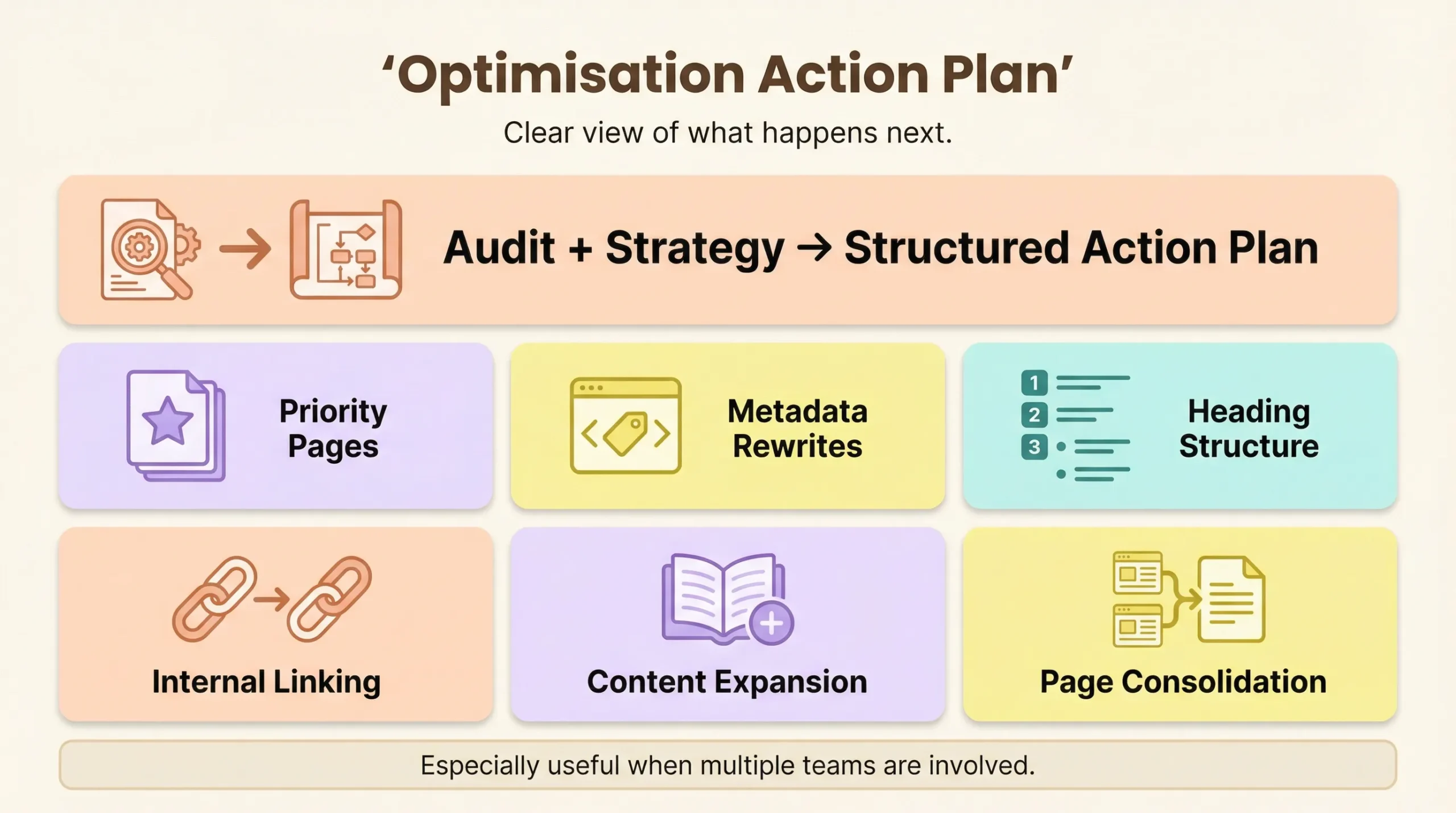
After the audit and keyword strategy, the next deliverable is a structured optimisation plan. This working document outlines the changes needed across your site.
It may include:
- priority pages to update
- metadata rewrites
- heading structure updates
- internal linking recommendations
- content expansion notes
- page consolidation recommendations
- image optimisation notes
- implementation order by priority
This document is especially useful when multiple teams are involved. It gives everyone a clear view of what needs to happen next.
4. Technical Fix Log
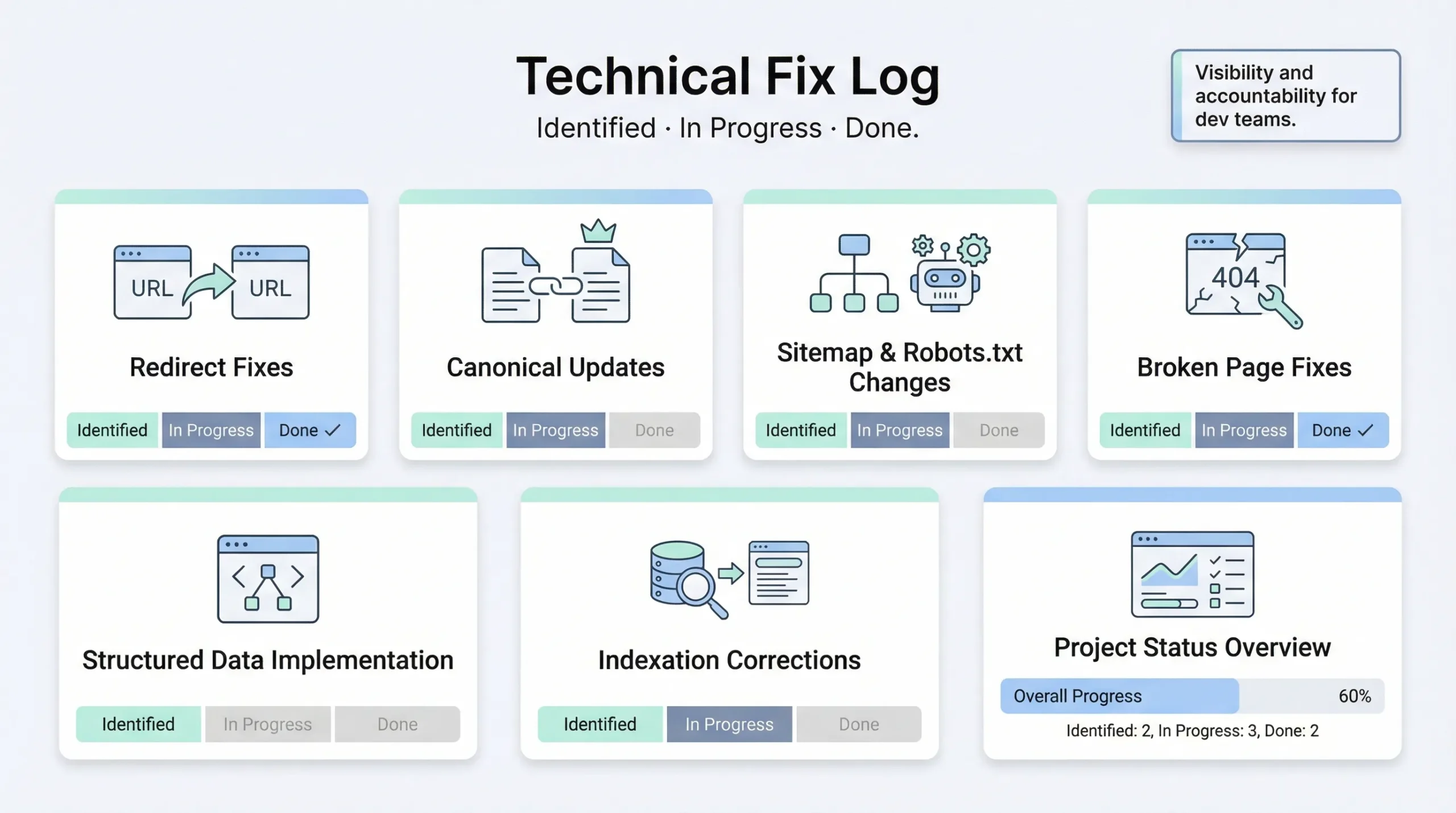
Technical work should not be lost in emails or informal chats. A proper SEO engagement includes a fix log or tracker that shows what has been identified, what has been done, and what is still pending.
This may track:
- redirect fixes
- canonical updates
- sitemap or robots.txt changes
- broken page fixes
- structured data implementation
- indexation corrections
- mobile or speed-related fixes
- validation status after deployment
The technical fix log helps create visibility and accountability, especially when SEO recommendations need to be implemented by developers.
5. Content Planning and Optimisation Notes
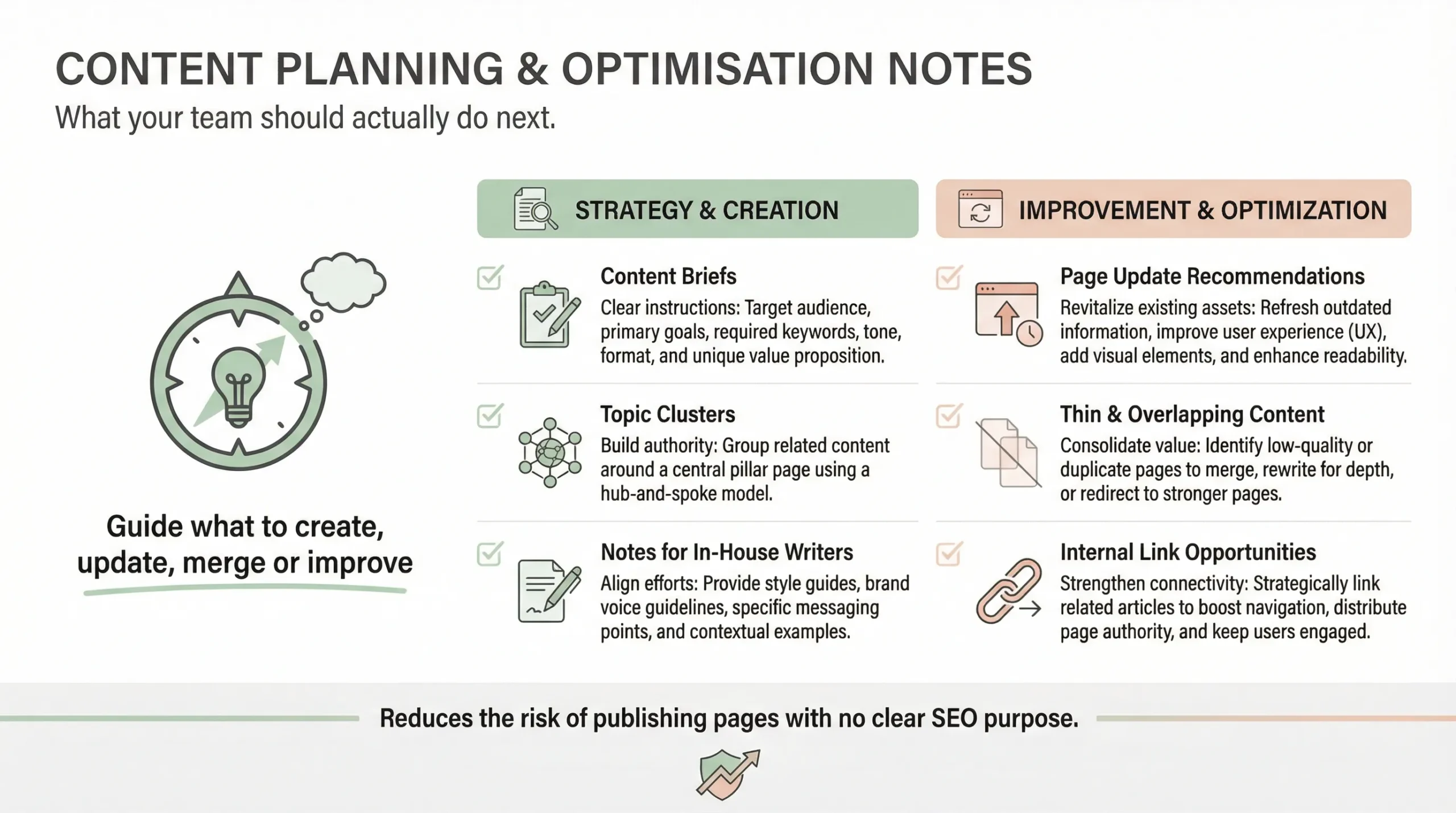
A consultant should also provide content deliverables that guide what needs to be created, updated, merged, or improved. This is about what your team should actually do next, not just theory.
These deliverables may include:
- content briefs for new pages or blog posts
- recommendations for updating existing pages
- notes on thin or overlapping content
- suggested topic clusters
- internal link opportunities between related pages
- optimisation comments for in-house writers
This keeps your content workflow focused and reduces the risk of publishing pages with no clear SEO purpose.
6. Link Building or Authority Development Plan
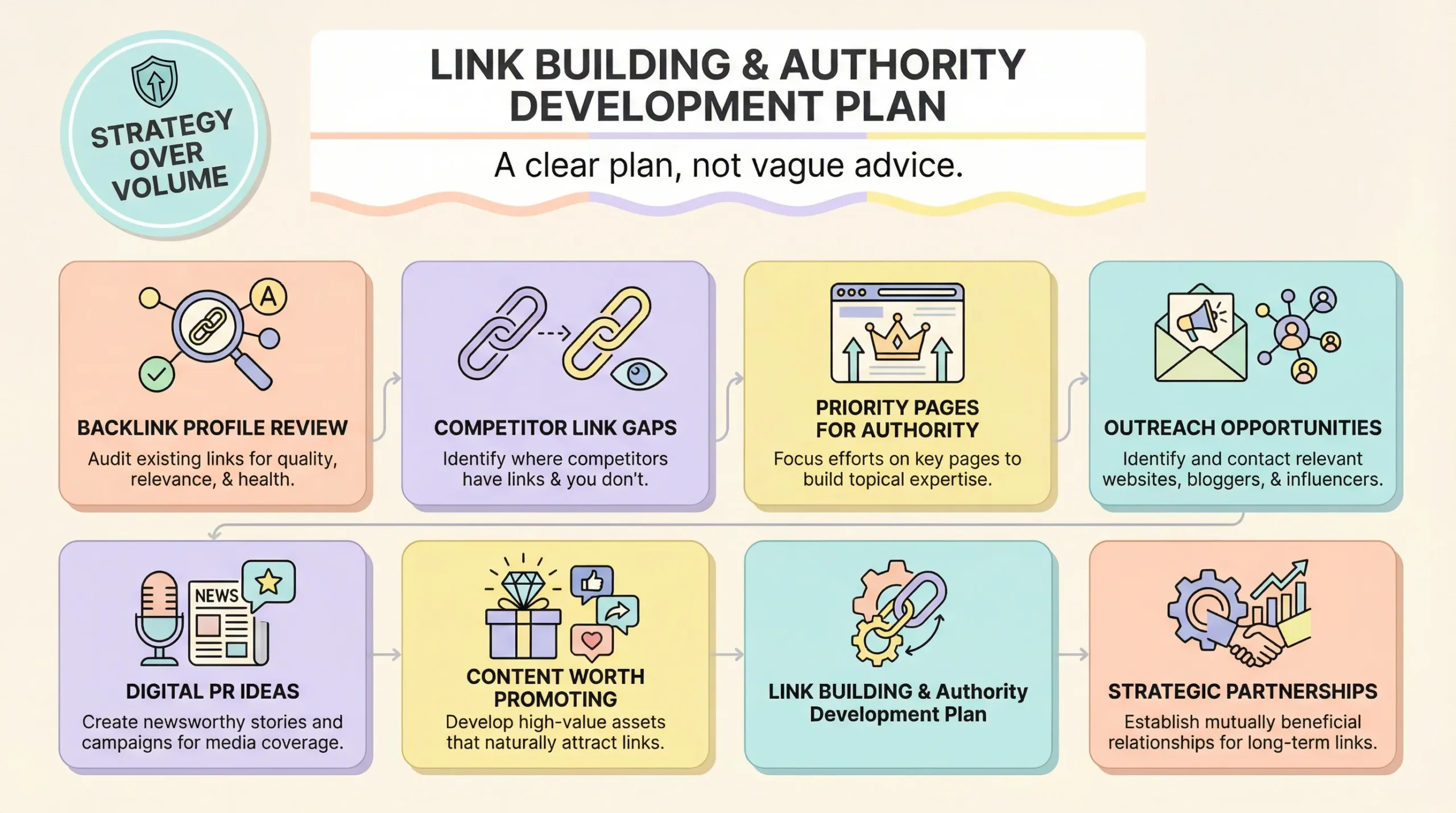
If authority development is within scope, the consultant should provide a clear plan rather than vague comments about needing more backlinks.
This may include:
- backlink profile observations
- competitor link gap findings
- priority pages that need stronger authority support
- outreach opportunities
- digital PR ideas
- content assets worth promoting
- link acquisition status, if outreach is included
This keeps authority-building efforts structured and measurable rather than reactive.

7. Ongoing Monitoring and Monthly Reporting
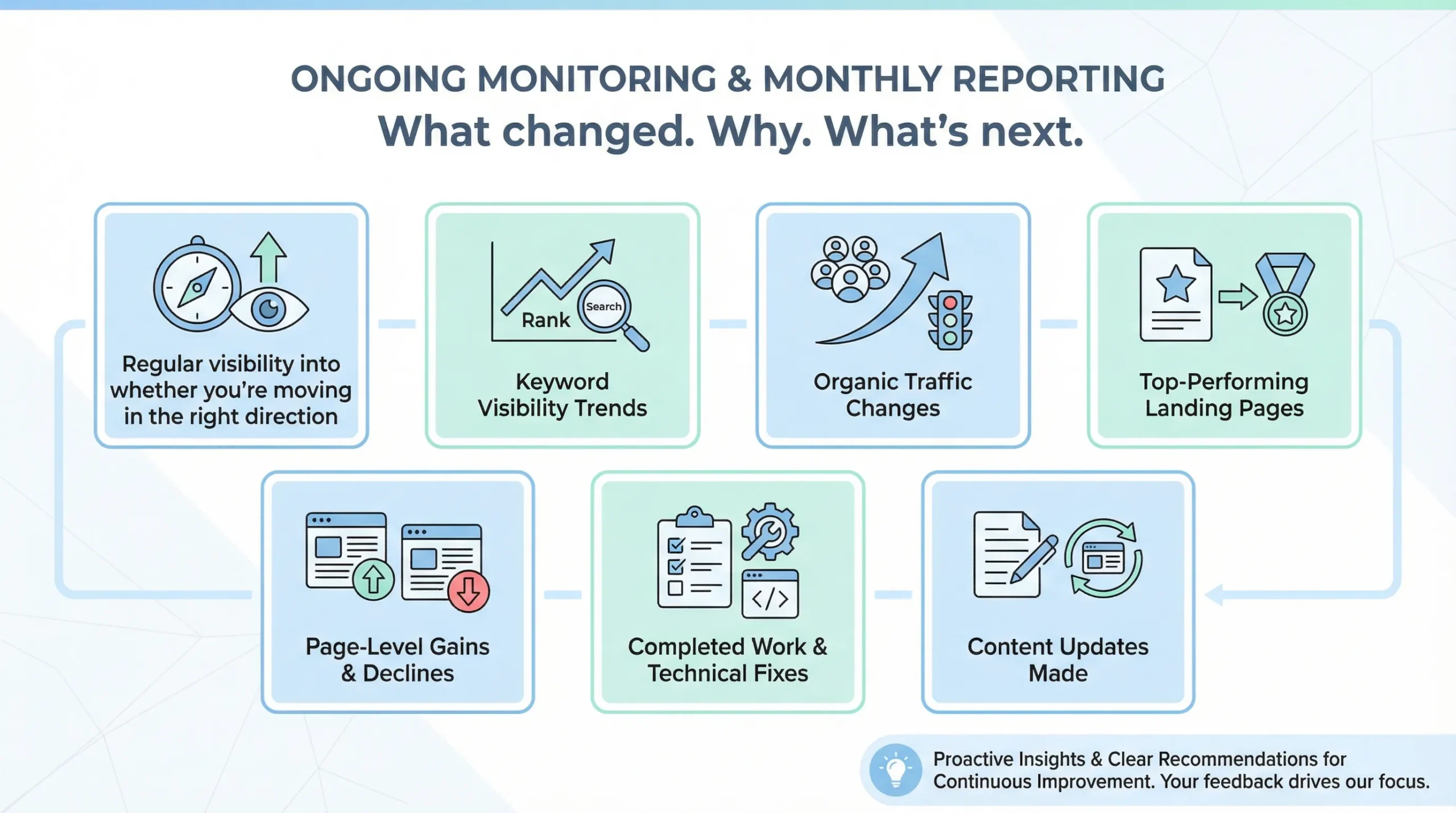
Ongoing SEO should give you regular visibility into performance. Monthly reporting is a clear deliverable because it shows if your site is moving in the right direction.
A strong monthly report often includes:
- keyword visibility trends
- organic traffic changes
- top-performing landing pages
- page-level gains or declines
- completed work for the month
- technical fixes completed
- content updates made
- next-step priorities
The best reports do not just show data. They explain what changed, why it happened, and what to do next.
What Good SEO Deliverables Should Look Like
The key test for any deliverable is whether it is actually useful to your business.
Good SEO deliverables should be:
- clear and easy to follow
- prioritised by impact
- actionable for internal teams
- tied to measurable progress
- specific to the site, not templated
That is what you should expect, but structured outputs that make SEO progress visible and easier to manage.
How SEO Consultants Differ From SEO Agencies
Hiring an SEO consultant is not the same as hiring an SEO agency. Both can improve organic search performance, but they typically differ in structure, scope, working style, and execution.
In simple terms, an SEO consultant is a focused specialist. An agency usually offers broader execution across more functions. The right fit depends on your resources, goals, budget, and the level of hands-on delivery you need.
| Key Difference | SEO Consultant | SEO Agency |
| Team Dynamics | Usually, a solo consultant or a small specialist team | Usually, a larger, multi-disciplinary team with specialists across different functions |
| Core Focus | More focused on strategic direction, audits, prioritisation, and high-impact recommendations | More focused on end-to-end delivery across SEO, content, technical work, and sometimes paid media or social |
| Working Style | Often provides highly tailored support based on a specific business need or problem | Often works through a broader service model with standardised workflows across multiple accounts |
| Implementation Support | Better suited for businesses that already have internal writers, developers, or marketers who can support implementation | Better suited for businesses that need both strategy and execution handled externally |
| Flexibility and Problem Solving | Can be more flexible and hands-on when solving a targeted issue, such as a rankings drop, migration planning, or content strategy | Can be more scalable for larger websites, larger teams, or brands managing ongoing campaigns across multiple channels |
| Cost Structure | Often more cost-efficient for focused projects, consulting retainers, or specialised guidance | Often better for companies that want one partner managing several digital marketing workstreams together |
| Access to Expertise | Usually offers direct access to the person doing the work and making the recommendations | May involve an account manager, strategist, and multiple execution team members, depending on the agency structure |
| Collaboration Style | Strong option when decision makers want deeper specialist input and closer collaboration | Strong option when the business needs capacity, speed, and broader campaign support |
| Control Over Execution | Works well when the business wants to retain more control over execution internally | Works well when the business prefers outsourced implementation and cross-functional coordination |
| Best Fit | Often ideal for targeted SEO improvement projects or strategic oversight | Often ideal for long term growth campaigns that require ongoing production, reporting, and execution support |
The main difference is usually not in quality but in how the work is delivered.
An SEO consultant is usually the better fit when you need:
- specialist diagnosis
- strategic guidance
- support on a focused SEO challenge
- more direct collaboration
- expert input while your internal team handles execution
An SEO agency is usually the better fit when you need:
- a larger delivery team
- ongoing implementation support
- content, technical, and reporting handled under one roof
- broader digital marketing alignment
- more scale across multiple pages, campaigns, or channels
Neither option is automatically better. A consultant is often the best choice if you already have an internal team and just need expert direction.
An agency is often better if you need both strategy and hands-on delivery at a larger scale.
When to Transition From Consultant to Agency (or vice versa)
You will not always need the same type of SEO support at every stage. What works early on may no longer be the best fit as your company grows, your site becomes more complex, or your resources change.
In some cases, a business may begin with an SEO consultant for specialist guidance, then move to an agency when execution needs expand.
In other cases, a business may shift from an agency to a consultant when it no longer needs a large delivery team and wants more focused strategic support.
The right transition usually depends on three things:
- how much internal execution support the business already has
- how broad the marketing scope has become
- whether the main need is scale or specialist depth
| Transition | When It Usually Makes Sense |
| Consultant → Agency | Best when the business has moved beyond a focused SEO need and now requires broader execution support across content, technical work, reporting, and possibly other channels |
| Consultant → Agency | Useful when the company is scaling quickly and needs multiple specialists working at the same time, rather than relying on one lead strategist |
| Consultant → Agency | A stronger fit when SEO is no longer a standalone initiative and needs to work closely with PPC, paid social, web development, CRO, or content production |
| Consultant → Agency | Suitable when the internal team lacks bandwidth to implement recommendations and needs an external partner to handle delivery more fully |
| Agency → Consultant | Best when the business already has in-house writers, developers, or marketers and only needs senior SEO direction rather than a full external team |
| Agency → Consultant | Useful when the company wants more direct access to specialist thinking and less layered account management |
| Agency → Consultant | A stronger fit when SEO growth has plateaued, and the business needs deeper diagnosis, sharper prioritisation, or a fresh strategic perspective |
| Agency → Consultant | Suitable when the business wants to reduce costs, narrow the scope, or bring more execution back in-house while keeping expert oversight |
Moving From Consultant to Agency
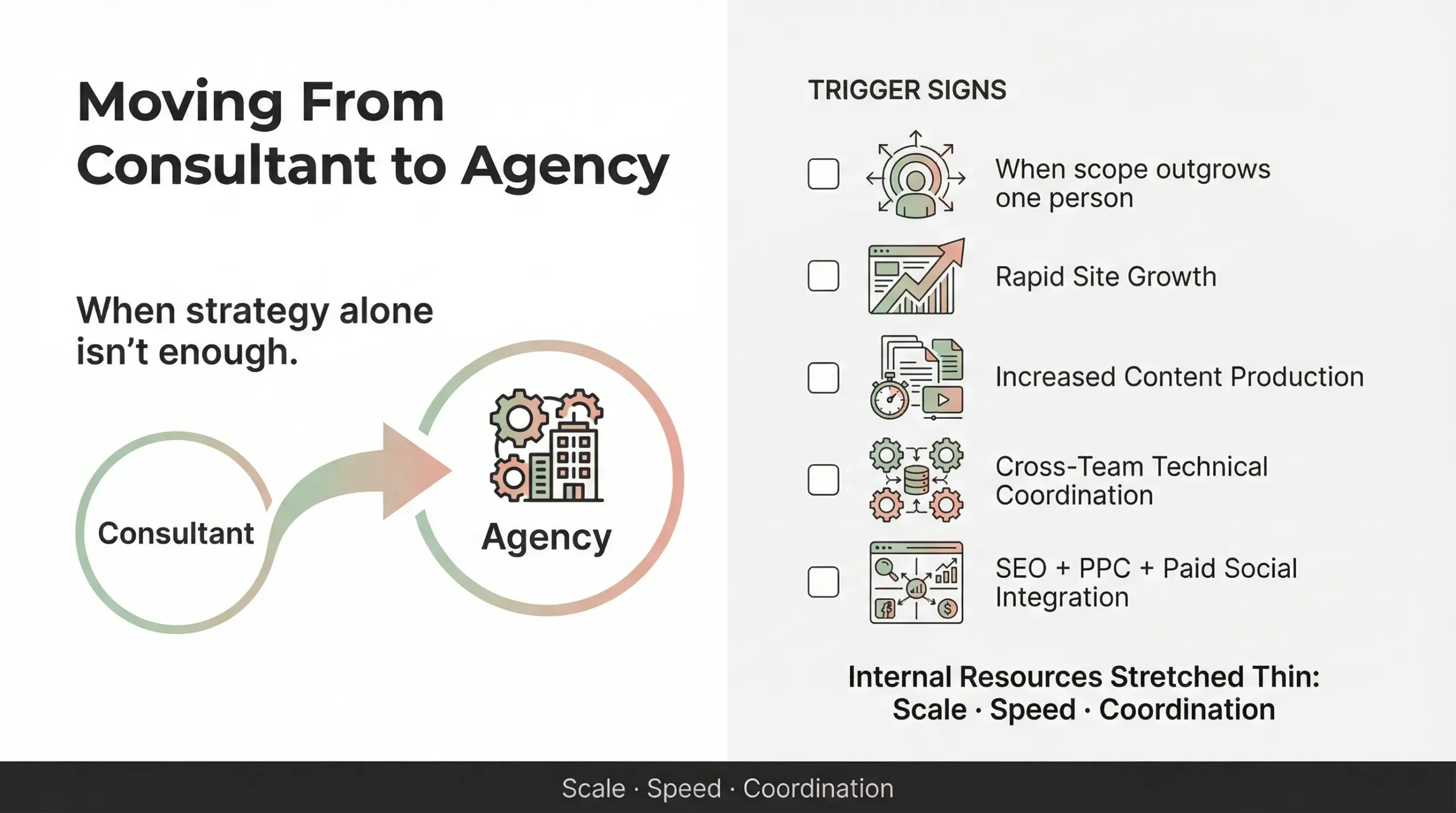
Many businesses start with a consultant to get clarity, fix a specific issue, or build a stronger SEO foundation. This works well when the scope is focused, and you can handle some execution internally.
The shift to an agency usually happens when you need more delivery capacity.
Common signs it may be time to move from consultant to agency include:
- the site is growing quickly and needs more ongoing implementation
- content production needs have increased significantly
- technical fixes require closer coordination across teams
- SEO now needs to work alongside PPC, paid social, or broader digital campaigns
- internal resources are too limited to execute recommendations consistently
At that point, the challenge is not just strategy. It is about scale, speed, and coordination.
Moving From Agency to Consultant
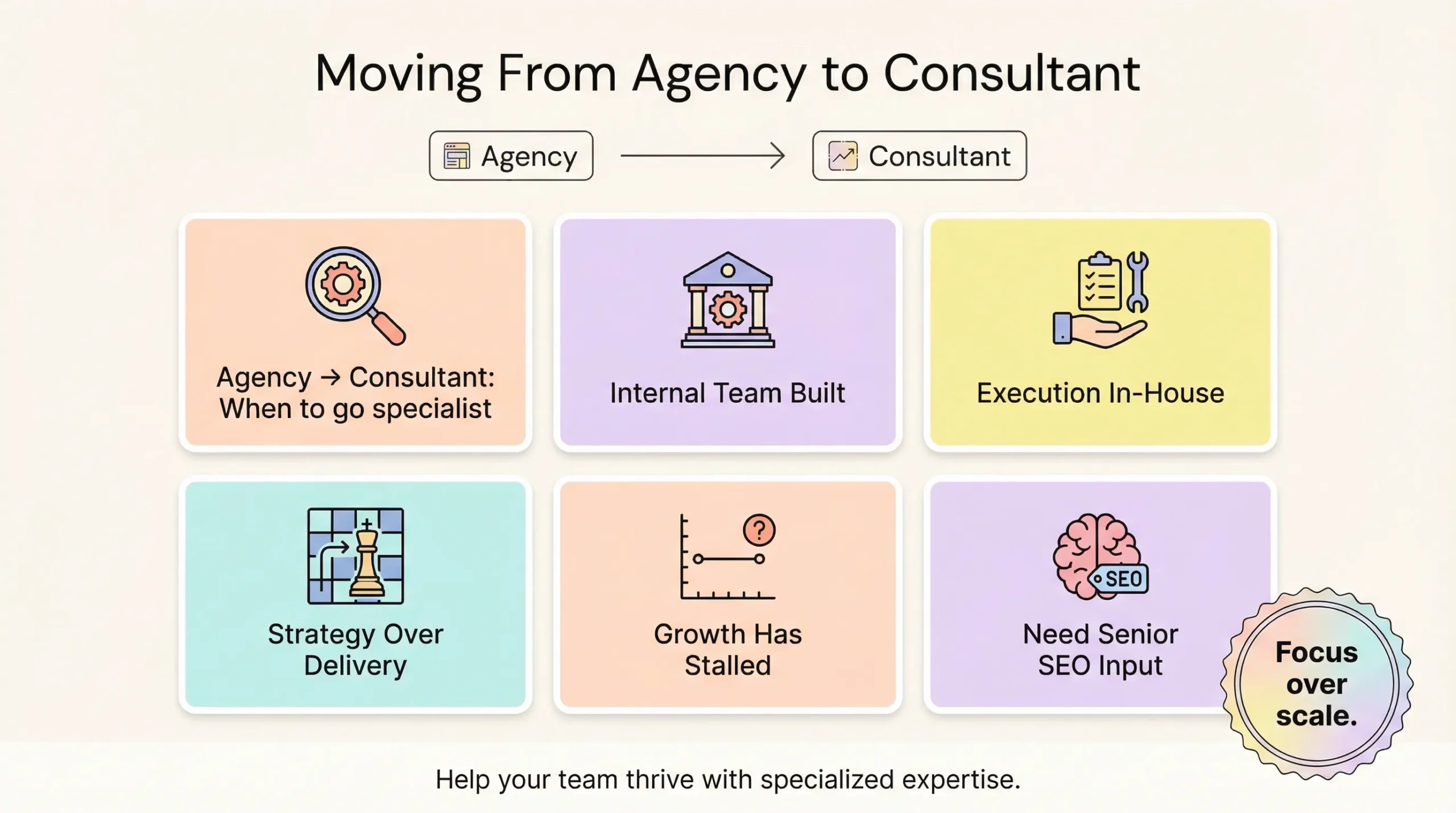
The opposite shift can also make sense. You may start with an agency for broad support, but later realise you do not need a large outsourced team.
If your internal capabilities improve or you want more specialised guidance, a consultant can be a better fit.
Common signs it may be time to move from agency to consultant include:
- the business has built an internal content or marketing team
- technical and content execution can now be handled in-house
- the main need is sharper SEO strategy rather than broad delivery
- growth has stalled and the business wants a fresh expert perspective
- the company wants more direct access to senior SEO input
- budget needs to be used more selectively on specialist guidance
In this situation, a consultant adds value by helping your team focus on the right priorities instead of spreading effort too thin.
How to Decide Which Direction Makes Sense
The decision usually comes down to whether you need more execution capacity or more specialist focus.
A move to an agency makes more sense when you need:
- broader implementation support
- faster delivery across multiple workstreams
- more cross-functional coordination
- a partner that can manage a larger ongoing programme
A move to a consultant makes more sense when you need:
- clearer diagnosis and prioritisation
- specialist SEO insight
- stronger strategic direction
- expert oversight while execution stays in-house
Transitioning from a consultant to an agency is often a sign of business growth, changing internal capabilities, or shifting priorities, rather than a problem with either model.
Knowing when to make that shift helps you allocate your budget more effectively, set clear expectations, and choose the support that best fits your current stage.
Why Your Business Needs an SEO Consultant
SEO is no longer something businesses can treat as optional or secondary. Separate BrightEdge research also continues to show organic search as the largest single source of trackable website traffic at 53.3%, ahead of other digital channels.
An SEO consultant uncovers search opportunities your competitors may be missing
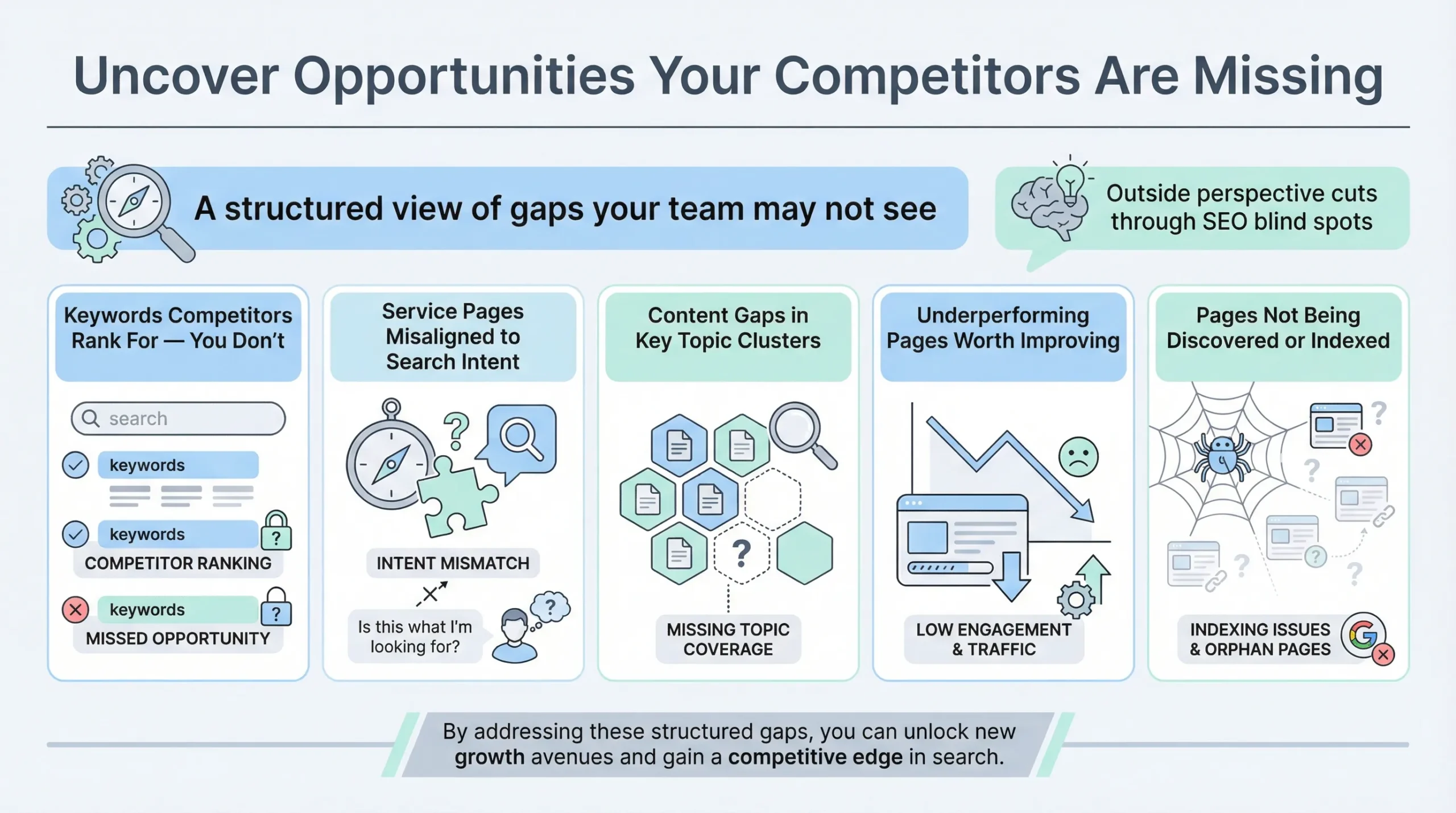
Many businesses publish content, optimise a few pages, and hope rankings improve. The problem is that they often do not know where the real gaps are.
An SEO consultant provides a more structured view of search demand, competitor coverage, and page-level weaknesses, enabling the business to focus on realistic, commercially useful opportunities.
This may include:
- keywords competitors rank for your site does not
- service pages that exist but are poorly aligned to search intent
- content gaps within important topic clusters
- underperforming pages that could be improved instead of replaced
- pages that are not being discovered or indexed properly
This outside perspective matters because SEO blind spots are common, especially when your team is close to the brand and site every day.
An SEO consultant improves both content and technical performance
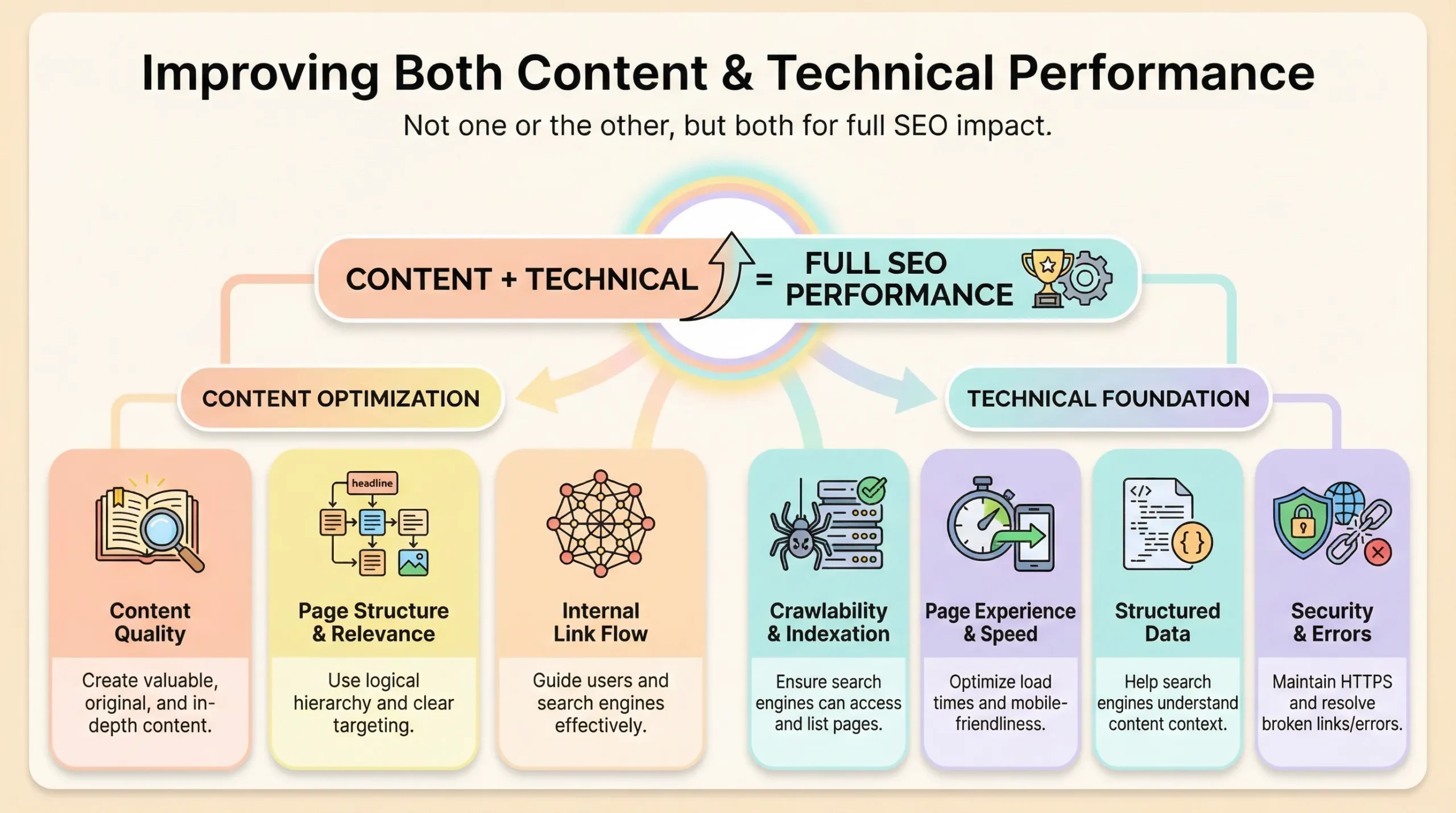
SEO performance is rarely driven by a single issue. A site may have strong services and useful content, but still underperform because of weak internal linking, indexation issues, poor metadata, duplicate signals, or pages that do not satisfy intent strongly enough.
Google’s guidance repeatedly reinforces that strong performance depends on both helpful content and technical accessibility, not just one or the other.
That is why a consultant typically looks across:
- content quality and completeness
- page structure and on-page relevance
- crawlability and indexation
- internal link flow
- page experience and performance
- structured data opportunities
- authority and trust signals
The benefit is not just more SEO activity. It is a more focused activity, with clear reasons behind each recommendation.
An SEO consultant helps you make better use of organic search as a growth channel
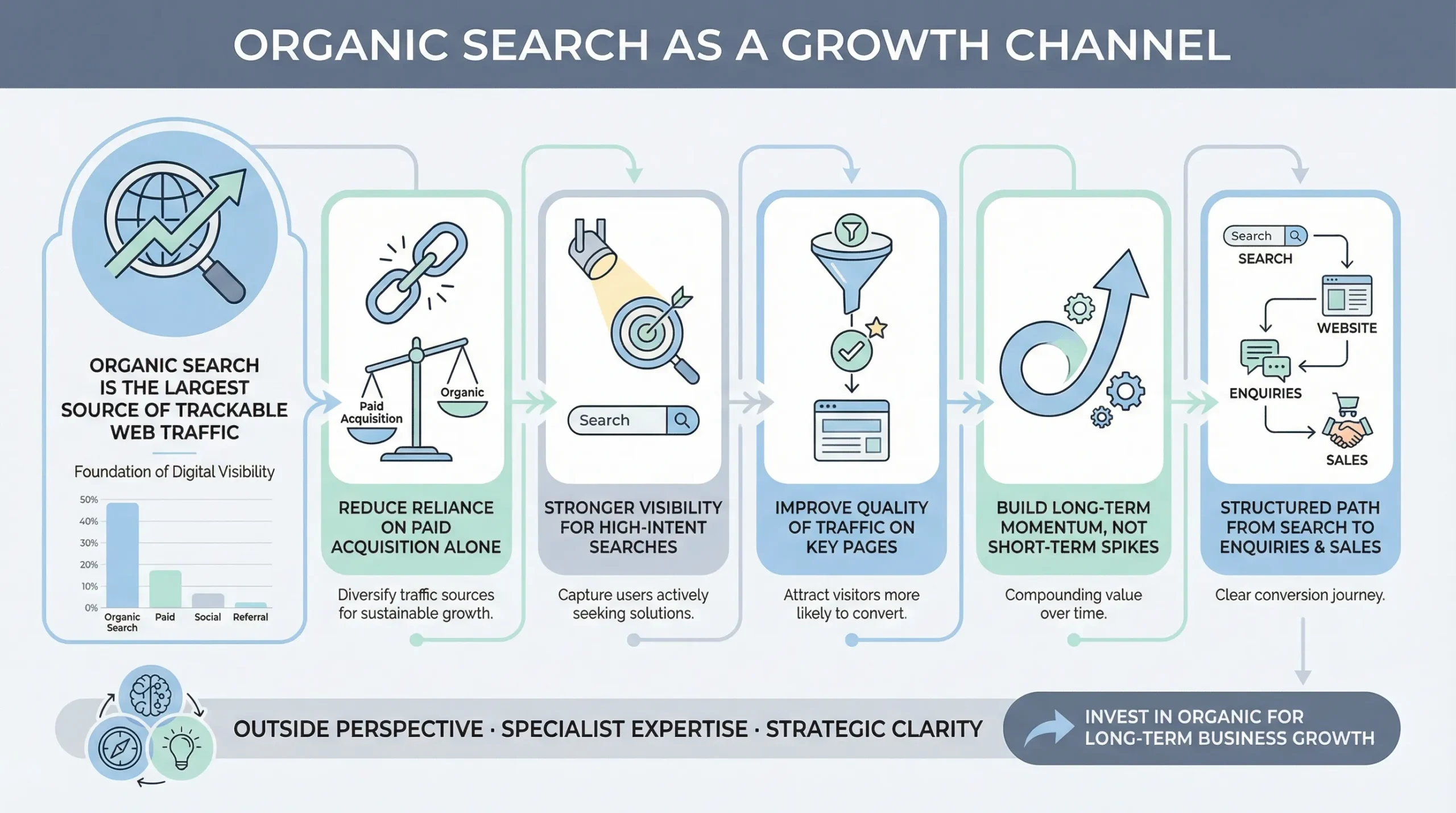
Organic search is still the largest source of trackable web traffic. Improving SEO can unlock a major part of your site’s discovery potential. Google’s market share shows that search visibility still matters in how users find and choose providers.
That makes an SEO consultant useful for businesses that want to:
- reduce reliance on paid acquisition alone
- strengthen visibility for high-intent searches
- improve the quality of traffic landing on key pages
- build long-term momentum rather than short-term spikes
- create a more structured path from search visibility to enquiries or sales
This does not mean SEO replaces paid media. It means SEO can become a stronger, more sustainable part of your growth mix when handled strategically.
Even if you have an in-house team, consultants bring outside perspective, specialised expertise, and strategic clarity to accelerate results.
Long-Term Benefits of Hiring an SEO Consultant
One of SEO’s biggest strengths is that its value builds over time. Unlike paid campaigns that stop when spending stops, strong SEO continues to support visibility, traffic, and leads long after the initial work is done.
Long-term benefits often include:
- more consistent organic growth as pages improve and expand their rankings
- stronger authority and trust as the site gains visibility across relevant searches
- better return on investment over time, especially when high-value pages continue attracting qualified traffic without ongoing media spend
A good SEO consultant helps create that momentum by improving the site’s foundations, strengthening content quality, and ensuring SEO efforts are focused on sustainable growth rather than short-term spikes.
How to Choose the Right SEO Consultant for Your Business
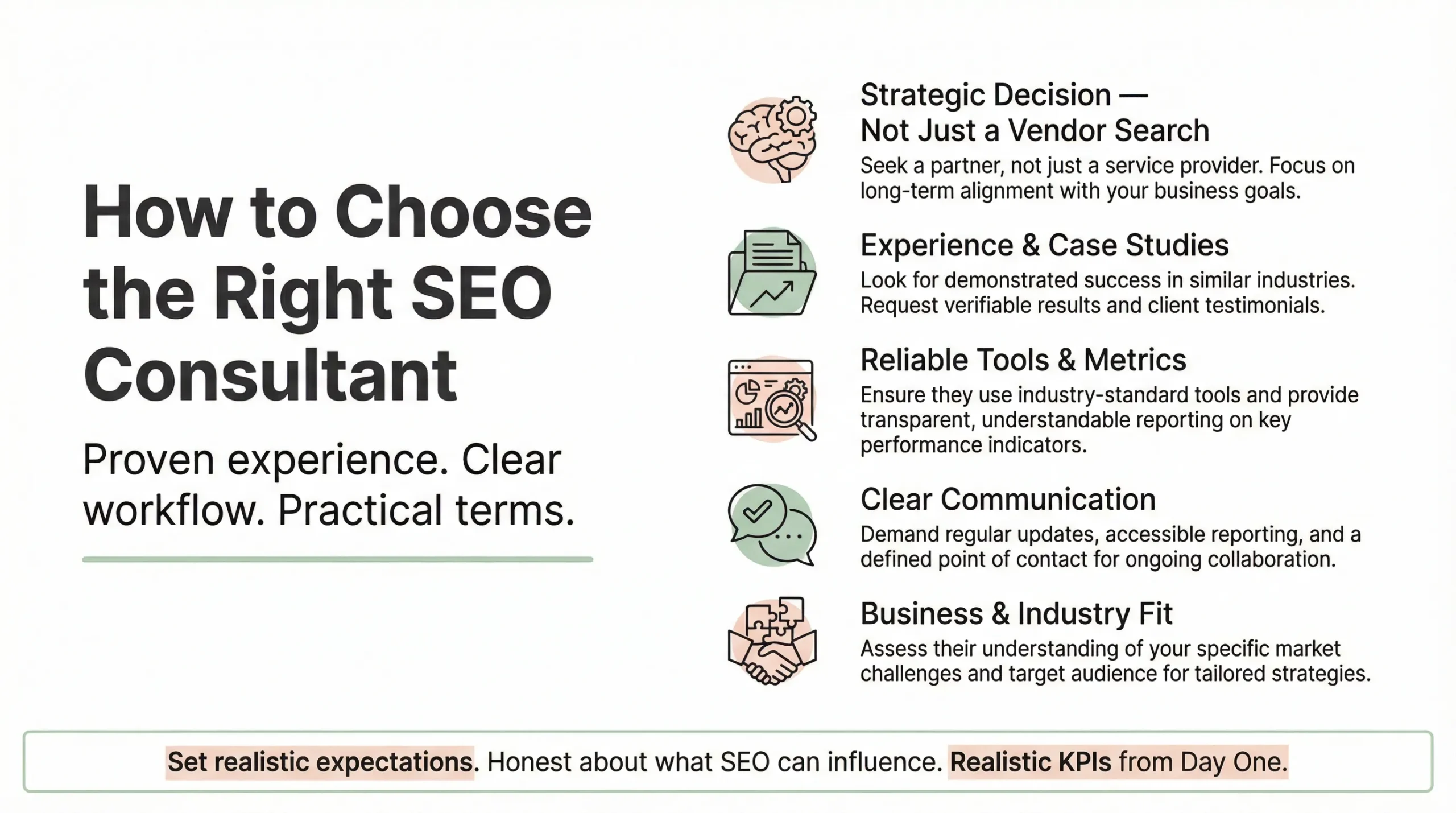
Choosing an SEO consultant is a strategic decision. Look beyond sales claims and check if the consultant can actually support your business goals.
The right fit should combine proven experience, a clear workflow, and the ability to explain SEO priorities in practical, measurable terms.
When evaluating an SEO consultant, look at:
- experience and case studies: ask for examples of past work, including improvements in rankings, traffic, leads, or revenue
- tools and metrics: check that they use reliable platforms such as Google Analytics 4, Google Search Console, and recognised SEO tools for research and tracking
- communication and transparency: reporting should be clear, consistent, and easy to understand
- fit with your business needs: the consultant should understand your industry, growth stage, and what success looks like for your business
A good SEO consultant will set realistic expectations, define measurable KPIs early, and explain what they can influence without overpromising guaranteed results.
SEO Consultant Pricing: How Much Should You Pay?
SEO consultant pricing in Singapore varies based on scope, experience, website complexity, and whether you need strategy only or ongoing execution.
Rates range from lighter monthly retainers to higher-cost ongoing campaigns, with hourly and project-based options also common.
| Pricing Model | Typical Range | Best For | What Usually Affects Cost |
| Basic monthly retainer | SGD 500 to SGD 1,500+ / month | Small businesses, local SEO, or lighter-scope advisory support | Limited deliverables, fewer pages, lighter reporting, narrower keyword scope |
| Mid-tier ongoing SEO support | SGD 1,500 to SGD 3,500+ / month | Businesses needing regular optimisation, content guidance, and ongoing reporting | More pages, stronger competition, technical work, content planning, and monthly refinement |
| Advanced or broader SEO campaigns | SGD 3,500 to SGD 5,000+ / month | Larger sites, more competitive industries, or businesses needing deeper SEO support | Site complexity, technical depth, broader content scope, higher reporting and strategic involvement |
| Hourly consulting | SGD 100 to SGD 350 / hour | Strategy sessions, troubleshooting, second opinions, and team training | Consultant seniority, niche expertise, problem complexity, consultation depth |
| Project-based SEO work | SGD 1,000 to SGD 4,000+ / project | One-off audits, migration support, keyword strategy, and technical reviews | Depth of audit, number of pages, technical complexity, level of detail in recommendations |
Pricing in Singapore varies depending on the consultant’s experience, the scope of work, website complexity, and whether the engagement covers strategy only or ongoing support.
In practice, pricing usually depends less on a flat market rate and more on the scope, including audits, keyword strategy, technical guidance, content support, implementation, and reporting.
Rather than focusing only on the cheapest option, businesses should compare:
- the depth of the audit and strategy
- whether technical and content recommendations are included
- The level of implementation support
- reporting frequency and clarity
- how success will be measured
Cheap SEO can look attractive, but if the scope is too narrow or templated, it rarely delivers real value. It is better to assess pricing against deliverables, business goals, and likely outcomes, not just cost.
Tools and Resources SEO Consultants Use
SEO consultants rely on a mix of analytics, search, research, and crawling tools to understand how a website is performing, where problems exist, and what opportunities to prioritise next.
No single tool gives a complete picture. That is why consultants use several tools together to diagnose issues, validate decisions, and track progress over time.
Google’s own documentation supports this workflow through tools like Google Analytics and Search Console, while dedicated crawling platforms help uncover technical issues at scale.
For readers who want to explore this further, MediaOne has also put together a more detailed guide to the best SEO tools here: Best SEO Tools Guide.
Find the Right SEO Consultant for Long-Term Growth
At the end of the day, hiring an SEO consultant is not just about chasing higher rankings. It is about getting clearer direction, stronger visibility, and a more focused plan for turning search demand into qualified traffic, leads, and long-term growth.
When SEO is handled well, it is much easier to see where your site is underperforming, where the real opportunities are, and what changes will actually move the needle.
If your business is seeking a more strategic, commercially grounded approach to SEO, MediaOne can help.
Our team works with businesses to uncover search opportunities, strengthen technical and content foundations, and build SEO strategies that are designed for long-term performance, not just short-term spikes.
Explore our SEO services to see how MediaOne can help you grow your organic visibility with more clarity and confidence. Contact us today!
Frequently Asked Questions
Can an SEO consultant help recover from a sudden drop in rankings?
Yes, an SEO consultant can help identify what caused the drop and what needs to be fixed first. Ranking declines can happen for several reasons, including technical issues, indexing problems, content changes, stronger competitor pages, or broader updates in how search engines evaluate content.
The value of a consultant here is in diagnosis and prioritisation. Instead of making random changes, they can review affected pages, check search performance data, and determine whether the problem is limited to a few URLs or affects the wider site.
Should I hire an SEO consultant before redesigning my website?
Yes, bringing in an SEO consultant before a redesign can save a lot of trouble later. Website redesigns often improve a site’s look and feel, but they can also hurt rankings if key pages, internal links, content structure, or URLs are changed without SEO planning.
An SEO consultant can help protect the parts of the site that already have search value. That usually includes reviewing redirects, preserving important content, checking metadata, and ensuring the new site structure does not inadvertently weaken visibility after launch.
Can an SEO consultant help with website migrations or domain changes?
Yes, and this is one of the situations where an SEO consultant can be especially valuable. Website migrations, redesign launches, and domain changes can pose SEO risks if redirects are missed, important pages are removed, or search engines struggle to understand the new structure.
An SEO consultant helps reduce that risk by planning. This may include reviewing URL mappings, checking redirect logic, preserving high-value content, monitoring indexation after launch, and ensuring the site retains as much of its existing search value as possible.
How soon can I expect to see measurable results from hiring an SEO consultant?
It depends on the website’s condition, the industry’s competitiveness, and the amount of work required. In some cases, early improvements such as better indexing, stronger page targeting, or technical fixes can show movement within a few weeks, but more meaningful SEO gains usually take a few months to build.
That is because SEO is cumulative. A consultant can quickly identify the right priorities, but rankings, traffic quality, and lead impact usually improve over time as changes are implemented, crawled, indexed, and measured.
Can an SEO consultant help improve local SEO for my business?
Yes, an SEO consultant can be very useful if your business depends on location-based searches.
Local SEO is not just about adding a city name to a few pages. It involves improving location relevance, strengthening local landing pages, aligning business details across platforms, and making it easier for search engines to connect your business with nearby search intent.
This is especially important for businesses such as clinics, law firms, tuition centres, retailers, and service providers. A consultant can help improve local page targeting, Google Business Profile signals, and the overall structure needed to compete in local search results.
Are there unique SEO considerations for businesses targeting local versus international markets?
Yes, the SEO approach can vary significantly depending on whether the business targets a local audience or multiple countries and regions. Local SEO usually places more emphasis on location signals, service areas, Google Business Profile optimisation, local landing pages, and search intent tied to a specific city or region.
International SEO is usually more complex because it may involve multiple markets, languages, site structures, and search behaviours.
That can bring in added considerations such as country targeting, content localisation, language handling, regional competition, and making sure the right version of a page is shown to the right audience.
Do SEO consultants work with developers and content teams?
Yes, very often. SEO recommendations often require input from multiple teams, especially when the work involves technical changes, on-page updates, content improvements, or site structure adjustments.
A good SEO consultant should be able to work well with developers, writers, designers, and internal marketers. That collaboration helps ensure recommendations are implemented properly and that SEO is integrated into the wider workflow rather than treated as a separate task.
How much of the recommended SEO work will require my team’s involvement versus the consultant’s?
That depends on the scope of the engagement and how your business is set up internally. Some consultants focus mainly on diagnosis, strategy, and recommendations, while others are more hands-on and may support implementation directly alongside your team.
In most cases, there is some shared responsibility. Your internal team may need to support content edits, development changes, approvals, analytics access, or business context, while the consultant provides the direction, prioritisation, and SEO guidance. The clearer this split is from the start, the smoother the engagement usually runs.
What should I prepare before hiring an SEO consultant?
It helps to prepare a few key things before the engagement starts. That includes your business goals, target audience, main services or products, and any known SEO concerns such as traffic drops, weak rankings, or poor-performing pages.
If possible, it is also useful to have access to tools such as Google Analytics, Google Search Console, and your website CMS. The more context the consultant has upfront, the faster they can properly assess the site and build a strategy that fits your business, rather than relying on assumptions.
What specific questions should I ask when interviewing potential SEO consultants?
It is worth asking questions that go beyond general experience and get into how the consultant actually works. You want to understand their process, how they define success, what deliverables they provide, and whether they can explain SEO clearly without hiding behind jargon.
Useful questions to ask include:
- How do you approach an SEO audit and prioritisation?
- What deliverables will I receive each month or per project?
- How do you measure success beyond rankings alone?
- What tools do you use for analysis and reporting?
- Can you share relevant case studies or examples of past work?
- What will you need from my team to make the engagement successful?
- How do you handle technical SEO, content strategy, and implementation support?
- What results can you influence realistically, and what can you not guarantee?
These questions help you separate consultants with a clear methodology from those making vague promises.
For a more detailed screening framework, see our article, “Questions to Ask Before Hiring an SEO Consultant (Checklist for Businesses)” here.
What are typical price ranges for different types of SEO consultant engagements?
Pricing varies based on scope, complexity, and the level of support involved. In practice, lighter advisory work or smaller monthly retainers tend to sit at the lower end, while deeper ongoing support, large-site SEO, or more technical engagements will naturally cost more.
Typical pricing structures often include:
- hourly consulting for strategy sessions or troubleshooting
- project-based pricing for audits, migrations, or keyword strategy
- monthly retainers for ongoing SEO support and reporting
The more useful question is not just what the engagement costs, but what is included. A good consultant should be able to explain the scope, deliverables, and expected level of involvement clearly so you can judge value rather than price alone.
Is an SEO consultant useful for e-commerce websites?
Yes, SEO consultants can be especially useful for e-commerce sites because they often have more moving parts than standard service websites.
Product pages, category pages, filters, duplicate content, crawl efficiency, internal links, and indexation all need to be managed carefully for the site to perform well in search.
A consultant can help bring structure to that complexity. They can identify which pages should be prioritised, reduce technical inefficiencies, improve category and product page targeting, and make it easier for the site to rank for high-intent searches that actually support revenue.