| AI Summary
How to rank in ChatGPT means improving the chance that a business appears in relevant answers or earns a linked citation. This guide explains how to check website access, assess citation gaps, strengthen evidence and review results. A five-part scorecard helps teams choose their next task. Search access supports eligibility, while accurate content and independent references help readers check a business’s claims. |
Businesses can improve their chances of appearing in ChatGPT by allowing search access, publishing specific answers, supporting claims with evidence and keeping company information accurate. A citation footprint review helps identify missing information. Repeated tests show whether changes coincide with more mentions or linked sources, without guaranteeing placement.

Key Takeaways
- Search crawling and model training have separate controls.
- The scorecard works best when each rating includes a URL or recorded finding.
- Original evidence gives a page information that copied summaries cannot provide.
- Accurate business details can use different wording across websites.
- Citation reports should distinguish a named brand from a link to its website.
- A recorded improvement needs repeated checks before it becomes a reporting claim.
A potential customer asks ChatGPT which Singapore supplier can deliver office furniture within a week. Several businesses sell desks and chairs. The customer wants delivery terms, stock details and reasons to trust the seller.
Your business may meet those needs. The next question is whether someone can find and verify that information online.
How to rank in ChatGPT starts with that practical check. The work involves the pages you publish, the evidence behind them and the information available elsewhere about your business.
This guide focuses on diagnosing gaps and deciding what to improve. The aim is to make your business easier to research, then measure whether ChatGPT includes it in relevant answers.
How Does ChatGPT Find and Cite Websites?
ChatGPT can answer from information learned during training or search the web for sources. OpenAI’s introduction to ChatGPT search explains how web answers connect users with relevant pages. A website citation refers to a linked source in an answer. A brand mention simply names a business.
Those outcomes need separate records. An answer might name your company while linking to a directory. Another answer might cite your research without recommending your services.
Search queries can differ from the customer’s words

OpenAI’s explanation of searching the web with ChatGPT says the service may rewrite a question into targeted searches and send additional queries to search providers. Location and saved memories can also influence a search.
For example, a question about office deliveries could lead to searches about delivery areas, installation and stock availability. Your page needs the facts behind the customer’s request, even when its wording differs.
Search visibility supports discovery without promising inclusion
OpenAI says ChatGPT uses multiple factors to find relevant, reliable information and does not guarantee placement. Its public documentation does not provide a complete formula for earning citations.
Google or Bing rankings can help diagnose discoverability. Neither a top position nor a particular heading format proves that ChatGPT will cite a page.
The practical task is to inspect available evidence. A missing delivery policy is something your team can fix. An assumed secret ranking factor gives the team little to test.
How Does Your Citation Footprint Compare?
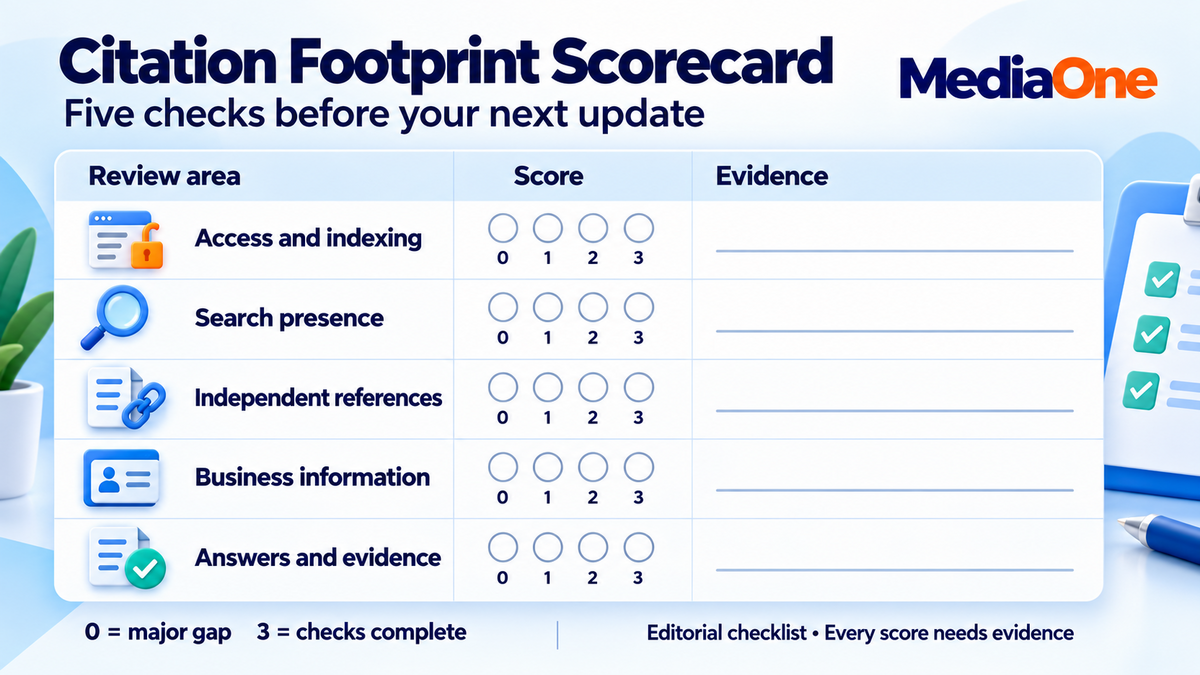
Your citation footprint is the information available about your business across its website and outside sources. The Citation Footprint Scorecard below is an editorial checklist for setting priorities. Its scores describe findings your team can verify; they do not predict ChatGPT placement.
Five checks help identify the next task
Each area receives a score from zero to three. The table describes the two ends of the scale.
| Area | Score 0 | Score 3 |
| Access and indexing | Important pages are blocked or have unresolved indexing problems | Core pages load, permit intended search access and have checked indexing status |
| Relevant search presence | Target customer questions have no suitable page | Relevant pages exist, and search reports show visibility for related queries |
| Independent references | The team finds no relevant outside coverage | Credible outside sources describe the business or its work with supporting detail |
| Business information | Important facts conflict across public profiles | Names, locations, services and contact details agree where they should |
| Answers and evidence | Pages make broad claims without support | Pages answer specific questions and connect claims to checkable evidence |
A score of one means a major gap remains. A score of two means most requirements are covered, with a recorded issue still to resolve. These are working definitions for your review, so everyone should apply them consistently.
Each score needs evidence
A rating becomes more helpful when it includes the page checked, the finding and the person responsible for the repair. “Access: one” says little. “Delivery page returns an error to the crawler” identifies a task.
The lowest score deserves attention, but the issue’s effect also counts. An inaccessible service page takes priority over a minor difference in a company description.
A business might have several accurate directory profiles and still lack evidence for its main service claim. Its next job is to support that claim on the relevant page.
The team should score a defined group of pages, such as its three main services. A strong homepage can otherwise hide problems in the pages customers need most. Each service may have a different weakness.
For example, the delivery page may explain its terms well but have an access problem. The installation page may load correctly yet omit what the service includes. Separate findings help the developer and editor work on the right repairs. A combined total would hide that distinction.
Can ChatGPT Access Your Important Pages?
Technical access is the first repair to investigate when a page cannot be retrieved. Your review should cover the homepage, main service pages and the articles that answer priority customer questions.
A technical SEO audit can uncover server errors, unwanted indexing restrictions and links that fail to reach the intended page. The findings should identify the affected URLs.
Search access and training access are separate
OpenAI’s crawler documentation distinguishes three relevant user agents:
- OAI-SearchBot supports discovery in ChatGPT search.
- GPTBot crawls content that may be used for model training.
- ChatGPT-User supports certain visits initiated by users.
A website can allow OAI-SearchBot while blocking GPTBot. Search eligibility does not require agreeing to model-training access. The website’s robots.txt settings and security systems need separate checks because a firewall can block a permitted crawler.
Your developer should verify the intended settings against OpenAI’s published instructions. A browser visit by a staff member cannot establish whether a search crawler receives the same access.
Indexing tools show different parts of the problem
Google’s URL Inspection tool reports on Google’s indexed version of a page and offers a live access test. Bing’s URL inspection provides its own crawl and indexing information.
These checks establish what those search engines can access. They do not provide a complete account of ChatGPT’s source selection.
For each priority page, the review should record:
- Page response: Does the URL load successfully?
- Public access: Can someone read the main information without signing in?
- Indexing status: Does the intended page appear in the relevant webmaster reports?
- Content access: Does the tested page contain its important facts as readable text?
- Internal links: Can visitors reach it from another relevant page?
Google’s link best practices explain why descriptive, crawlable links help discovery. A delivery article could link to the delivery policy where it mentions installation terms. The sentence supplies context for both the reader and the destination.
What Makes a Page Worth Citing?
A page needs a specific contribution. A definition, documented process, first-hand observation or well-explained comparison gives readers something they can check and apply.
Google’s people-first content principles emphasise original information, accurate authorship and value beyond copied summaries. Those are Google’s published standards. They also provide practical editorial checks for a page your business wants people to trust.
Customer questions should shape the headings
Your sales emails, enquiry forms and customer calls can reveal what people need before buying. Keyword research can add related search language, while those conversations supply the detail behind it.
A question such as “What does office furniture delivery include?” gives a section a defined job. Its opening can explain delivery, assembly and any exclusions. The following paragraphs can cover access restrictions or booking requirements.
Question headings are helpful when they match the subject. Statement headings also work. The goal is for a reader to understand the section before reading every paragraph.
Claims need context and an identifiable source
A sentence such as “Our customers save time” leaves the result unexplained. A documented example should identify the task, the period measured and the result.
Consider this hypothetical format: a supplier records how long assembly takes for one desk model across several deliveries. Its article explains the sample, the timing method and conditions that affected the work.
That example has limits. The result concerns the tested model and conditions. It cannot establish the assembly time for every product.
Original evidence can include:
- Demonstrations: Photographs or videos showing how a process works.
- Measurements: Results with units, dates and a stated method.
- Case studies: A starting condition, the work completed and the recorded outcome.
- Expert explanations: Named contributors discussing work within their experience.
A chart should identify its units and the period it covers. A caption can explain whether the figures describe one project or a wider sample. The surrounding paragraph should state the main finding so readers can understand it even when the image does not load.
An author’s biography should describe actual experience. Credentials belong beside claims they help the reader assess. A recognisable job title alone cannot verify a statistic.
Paragraphs should make sense outside their original position
A reader may land halfway down a page. Each section should name its subject and include the conditions needed to understand the answer.
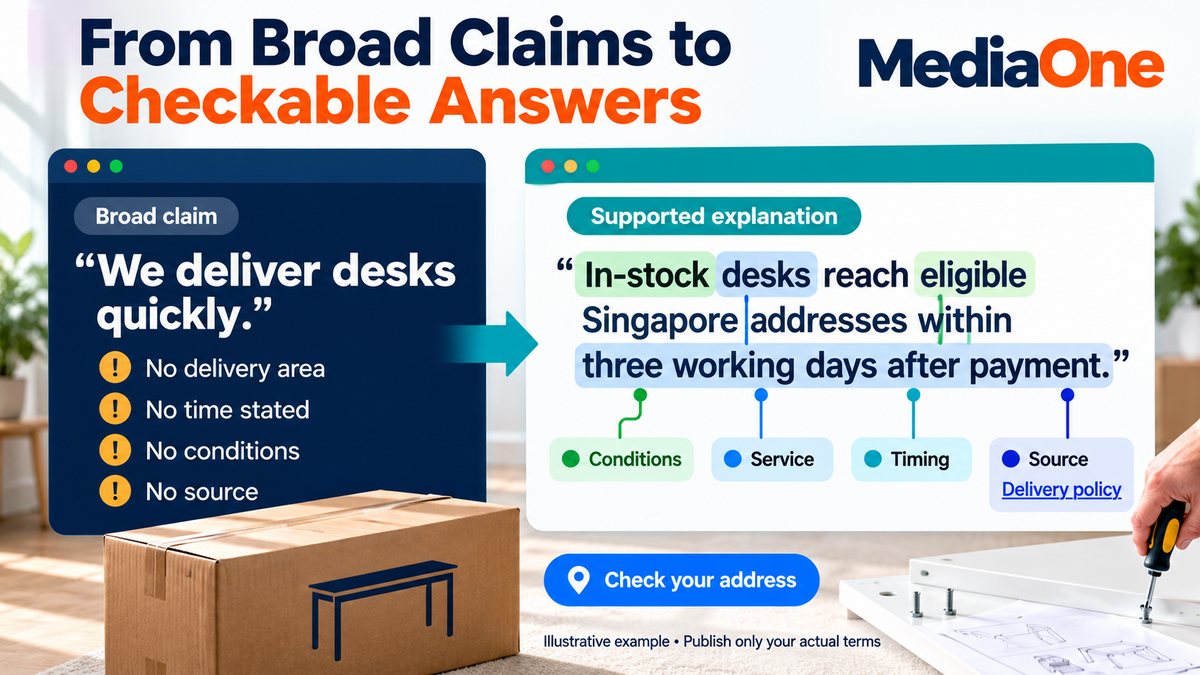
“It normally takes three days” leaves too much unstated. A hypothetical delivery policy could say, “In-stock desks reach eligible Singapore addresses within three working days after payment.” The business would publish that wording only if it reflects its actual policy.
Tables help when readers compare the same features. Lists help when order or separate requirements affect the task. Both formats need enough surrounding explanation to prevent a short label from becoming misleading.
Your content marketing plan should assign one main page to each distinct customer need. Existing material may need a stronger answer or better evidence before the business needs another article.
A quick reading test can expose missing explanations. Someone unfamiliar with the service should be able to say what the business offers, which conditions apply and what to do next. An unexplained term belongs beside a short definition or example.
An installation article, for instance, might mention a site survey. The next sentence can explain that the team checks room measurements and access before confirming the work. That small explanation helps a first-time buyer understand why the survey appears in the process.
Where Should Independent Brand Mentions Come From?
Independent references let customers compare a company’s own description with information from elsewhere. A trade association profile, genuine customer review or reported project can provide another account of the business.
No single website guarantees ChatGPT visibility. A reference deserves attention because it reaches the right audience and contains accurate information.
Relevant coverage should add verifiable detail
A directory entry can confirm contact information. An editorial feature can explain a project. A customer review can describe a first-hand experience. Each source has a different purpose.
Your review should ask who published the reference, what they know and whether their page supports the claim being assessed. A supplier’s claim that it handles complex installations needs more evidence than its inclusion in a general business directory.
Online reputation management can include checking inaccurate profiles and responding to customer concerns. The work should preserve genuine feedback and correct factual errors.
Google’s spam policies identify manipulative link practices as a search risk. Purchased coverage presented as independent approval can also mislead readers about the strength of the evidence.
Business facts should agree without identical wording
A company’s name, current address and service area should remain accurate across profiles it controls. Descriptions can vary naturally. A trade profile and a customer-facing website serve different readers.
For a local business, a local SEO audit helps organise checks on listings, locations and contact details.
The outside-reference review should record factual conflicts and missing context. A spreadsheet full of mentions offers little direction if nobody checks what those pages actually say.
New coverage should grow from something worth reporting. A supplier could contribute a documented maintenance explanation to a trade publication or share an approved project example with an industry association. The contribution should answer that publication’s readers.
A relevant source may decline the contribution or edit it independently. Your team should assess any resulting article for accuracy before treating it as supporting evidence. A copied company biography across several sites adds little new detail for a customer comparing suppliers.
Does Schema Markup Help With ChatGPT Citations?
Schema markup is code that labels information on a webpage. Its role should remain tied to the content people can see.
Google’s Article structured data describes fields such as the headline, author, image and publication date. The Organization vocabulary includes properties for describing a business and related information.
Neither resource establishes a ChatGPT citation formula. The editorial reason to check markup is accuracy: an old company name or incorrect author in the code creates another version of the facts.
Google’s structured data documentation says markup should describe the page and information visible to users. A CMS plugin can generate the code, but someone still needs to compare it with the published page.
A practical review checks the author, business details, dates and main URL. Duplicate output from several plugins deserves attention when it introduces conflicting information.
Google also says its generative AI search features require no special schema. That statement concerns Google Search. Your team should assess claims about ChatGPT against OpenAI’s documentation separately.
How Should You Review Content and Measure Progress?
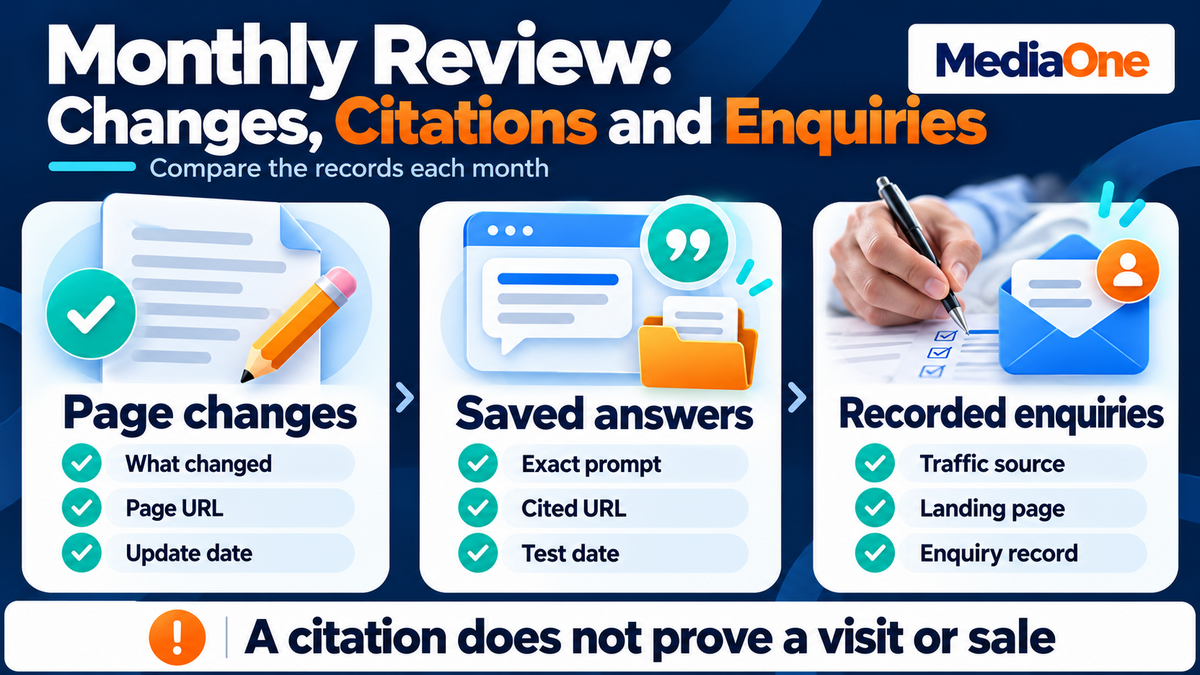
Content maintenance and measurement belong together. A change log records what the team edited. Saved answers show what appeared during later checks.
Content reviews should follow the rate of change
Prices, availability and delivery terms may need attention whenever operations change. A definition may remain accurate for much longer. A quarterly review can serve as a starting schedule, with faster checks for changing information.
A review date should reflect an actual review. The record can state that the team corrected a price condition, replaced a source or updated an example. A new date alone adds no new evidence.
A small set of prompts can establish a baseline
The first test should contain questions customers might ask without knowing your brand. Five to ten prompts can support an initial manual review; a larger set can follow when the team has time to check the answers.
Possible prompts for the furniture example include:

- “Which suppliers deliver office desks in Singapore?”
- “What should I check before ordering desks for a small office?”
- “Which office furniture suppliers include assembly?”
Each test should record the date, exact prompt, available model or mode, location assumptions and whether web search occurred. A new conversation and consistent settings reduce avoidable differences, although answers can still vary.
The prompt record also needs separate fields for a brand mention, a recommendation and a cited URL. AI citation tracking provides a broader reporting framework when the test grows beyond a basic review.
Citations and website visits need separate reports
A citation shows that a URL appeared in a saved answer. It does not show whether anyone clicked it or became a customer.
Google Analytics’ Traffic acquisition report includes session-level traffic sources. A report filtered for recorded sources containing chatgpt.com can help identify visits attributed to that source. Source and medium values should be checked in the property before creating reporting rules.
A data driven SEO framework connects visibility work with engagement and enquiries. Your enquiry records can add a voluntary “How did you hear about us?” response where appropriate.
Neither a manual prompt sample nor analytics captures every customer’s research. Reports should state what was measured and keep unverified influence separate from recorded visits.
A monthly review can compare the same questions and inspect which pages supported the answers. Additional test runs can help investigate an unexpected appearance or disappearance. A failed search belongs in the record as a failed test, since it cannot show whether the brand would have appeared.
Reporting should also separate branded questions from category questions. “What does this supplier offer?” already identifies a business. “Which supplier offers desk assembly?” tests discovery before the customer names one. Combining both groups can make performance look stronger without showing whether new customers would encounter the company.
Which Fix Should Your Team Make First?
The next task should address a recorded gap that affects an important customer question. A repair list becomes manageable when every item has an owner and a way to check completion.
| Finding | Next action | Completion check |
| A priority page cannot be fetched | Investigate the access restriction | A new test retrieves the intended content |
| An answer lacks key conditions | Add the missing service details | A reader can understand the offer and its limits |
| A result has no supporting record | Add evidence or narrow the claim | The published statement matches its source |
| An outside profile contains old facts | Correct the information through the platform | The public profile reflects current operations |
| A test produces inconsistent answers | Repeat under recorded conditions | The report preserves variation and sample size |
For example, a hypothetical supplier finds that ChatGPT names competitors for assembly-related questions. Its own website mentions assembly only in a downloadable quotation.
The team first checks the service page’s access. It then adds an accurate assembly explanation and links the relevant delivery terms. The update log records both changes.
Later tests can show whether that page appears. They cannot establish that one edit caused a citation. Other pages and search results may have changed during the same period.
This keeps the work focused on a specific missing answer. Broader AI agent search visibility work can extend the review to other buying questions after the initial repairs.
The repair log should record completed work separately from visibility results. The team can verify that a page now contains assembly terms on publication day. A later citation remains a separate observation, with its own date and saved answer.
That distinction helps when someone asks whether the project succeeded. The first report can show resolved errors and stronger information. Later reports can add observed citations, visits and enquiries as those results become available. Each statement then has evidence appropriate to the claim.
Conclusion: How to Rank in ChatGPT Starts With Checkable Information
How to rank in ChatGPT becomes a practical task when your team can name the gap it wants to repair. A blocked page, unsupported claim or outdated profile gives the business a concrete starting point. The scorecard helps assign that work, while saved tests provide evidence for later review.
MediaOne’s GEO services support businesses working on visibility in AI search. Our team can help assess your website content and identify priorities. A conversation with MediaOne can start with the customer questions your business wants to answer.
FAQs About How to Rank in ChatGPT
Can a business pay for an organic citation in ChatGPT?
Payment for advertising does not buy control over an organic answer. OpenAI’s advertising explanation says ads run separately and advertisers cannot shape, rank or alter ChatGPT’s responses. A paid placement should therefore appear separately in marketing reports from an earned citation.
Can AI help write content intended for ChatGPT visibility?
AI can assist with drafting and organisation, with a person responsible for checking the result. Google’s generative AI content standards emphasise accuracy, quality and relevance. Those are Google’s requirements; they do not establish a ChatGPT preference for AI-written or human-written text.
Does a website need an llms.txt file?
OpenAI’s published search-crawler instructions do not list llms.txt as a requirement for ChatGPT search. A business considering the file should identify the service it intends to support and the documented purpose. Existing access problems deserve attention before an optional file becomes another maintenance task.
Should an article be deleted if ChatGPT never cites it?
A missing citation alone is a weak reason for deletion. The article may serve existing customers, attract search visitors or answer questions after a sale. A content review should consider accuracy, duplication, audience demand and performance across channels before deciding whether to update, combine or remove a page.
Must a business publish private records to support its claims?
A public article should use evidence the business has permission to share. A process demonstration or approved summary may explain the work without exposing customer records. Any detail that cannot be supported publicly can be omitted or expressed as a narrower statement that the available evidence supports.