| AI Summary
AI citation tracking records when AI answers link to a website as a source. Businesses can measure citation rate, brand mentions and competitor share across a fixed set of customer questions. A spreadsheet supports a small test, while reporting tools and paid platforms support different monitoring needs. Consistent testing, saved answers and separate traffic reports help teams decide which pages need attention. |
AI citation tracking measures how often a website appears as a linked source in AI answers. Teams test a fixed list of prompts, record the cited URLs and compare results across engines and dates. The results show visibility within that sample, without proving traffic, sales or influence over every answer.

Key Takeaways
- A named brand and a linked source need separate columns in the report.
- Each percentage needs a stated sample size and counting rule.
- Engine coverage, saved answers and data exports help teams assess tracking platforms.
- Missing answers and failed tests need their own labels.
- Page updates need a recorded date, an owner and a later review.
AI answers can put a business in front of a customer before that person visits a website. The reporting challenge starts with a simple question: did the answer mention the brand, link to its content, or leave it out?
AI citation tracking helps answer that question. A Singapore payroll provider, for example, might test questions about payroll software, employee records and local support. The results can show which pages appear during those searches and which competitors appear alongside them.
A repeatable test turns those observations into evidence for content decisions. The method below covers the measurements, manual setup and tool checks needed to build that routine.
What Is AI Citation Tracking?
AI citation tracking records visible source references in answers from services such as ChatGPT Search, Perplexity and Google’s AI search features. A tracking record should identify the question, the service, the answer date and the linked page.
Citations and brand mentions measure different things
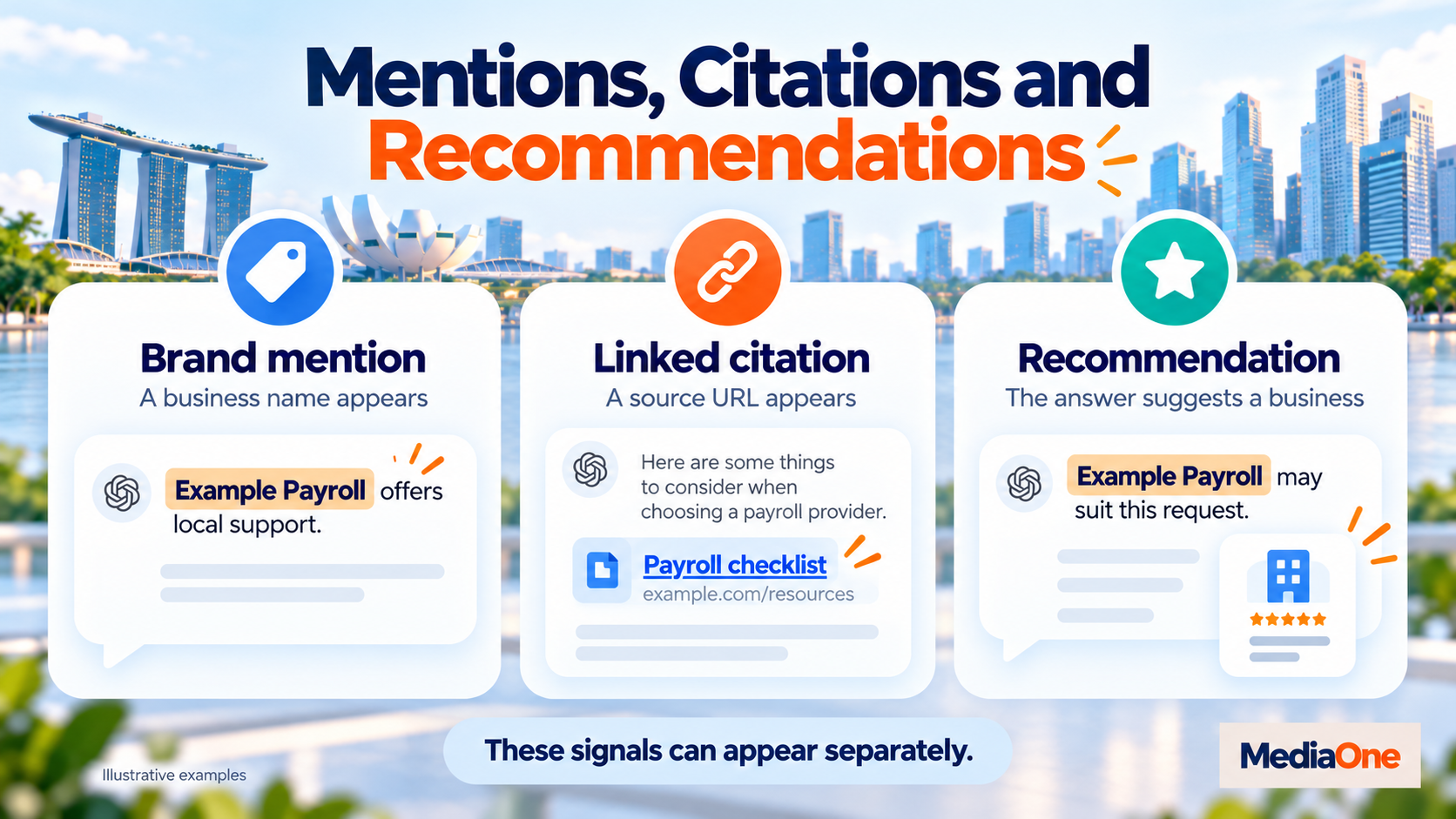
A brand mention means the answer names a business. A citation means the answer presents a link or source reference to a page. Either can appear without the other.
An answer might recommend “Example Payroll” without linking to its website. Another answer might cite that company’s payroll checklist without naming the company in the main text. The first counts as a mention; the second counts as a citation.
ChatGPT’s source links can appear within answers or through its Sources control. The actual linked destination provides stronger evidence than an answer simply saying it used a website.
Citation tracking complements search rankings
A ranking report records a page’s position in search results. Citation tracking checks whether an AI answer presents that page as a source. A high ranking alone does not establish that a page appeared in the answer being tested.
AEO and GEO describe related work on answer visibility and generative search. Citation tracking measures one visible outcome of that work. A citation also needs context: a linked article may support a definition without recommending the company behind it.
The Metrics Behind AI Citation Tracking
A small set of defined measurements makes reports easier to compare. Platform labels vary, so the calculation behind a score deserves attention before the score enters a management report.
Citation rate shows how often a domain appears
Citation rate is the percentage of completed answer runs that cite the tracked domain. Each run counts once for that domain, even if the answer links to several of its pages.
Citation rate = completed runs citing the domain ÷ all completed runs × 100.
For example, 30 prompts tested once on one engine produce 30 completed runs. If six answers cite the company’s domain, its citation rate is 20%.
Some platforms call this citation share or prompt coverage. The label is less important than using the same definition each time. Repeated tests also change the total used in the calculation: 30 prompts tested three times produce 90 runs.
Brand mention rate captures unlinked visibility
Brand mention rate uses the same structure but counts answers that name the company. A separate field records whether the wording recommends, compares or criticises it.
A company could have a 40% mention rate and a 10% citation rate in one sample. That combination shows different types of visibility. It does not establish that the engine read the company’s website.
Competitive citation share compares appearances across a chosen set of domains. One simple method counts each domain once per answer, then divides the company’s appearances by all appearances within that group.
| Domain | Answer appearances | Share within this group |
| Your company | 12 | 20% |
| Competitor A | 30 | 50% |
| Competitor B | 18 | 30% |
| Total | 60 | 100% |
These figures are illustrative. They describe the selected group, not the whole market. Adding another competitor changes the total used in the calculation, so reports need the same comparison group over time.
Citation retention shows whether appearances continue
Citation retention checks which previously successful tests still cite the domain in the next matched test. If 20 prompt-and-engine pairs cited it last month and 16 do again, retention is 80%.
An empty starting group makes retention unavailable. A missing current result needs a separate note. Neither belongs in the report as a zero without explanation.
Page coverage connects numbers to content
Page coverage counts the distinct pages cited during the review period. It helps teams see whether citations concentrate on one article or spread across service pages, comparisons and other content.
A broad SEO strategy needs this page-level detail. Ten citations to an unrelated article may support a different decision from ten citations to a page that answers a buyer’s question.
The report can include both counts, with the page topic beside each one. A total without that detail hides which parts of the website customers encounter.
An opening report can show the citation count, rate and leading pages for each engine separately. A combined figure needs consistent weighting. Otherwise, an engine tested more often could dominate the total even though the company’s visibility on other services has stayed the same.
A Manual Setup for Tracking AI Citations
A manual test can establish a starting point without a dedicated subscription. A manageable list of questions and a shared spreadsheet are enough to begin, provided the team records the same details each time.
Customer questions form the prompt list
A starting list of 20 to 30 prompts is a practical planning choice, not an industry standard. Sales conversations, enquiry forms and keyword research can supply the topics. The wording should resemble questions customers ask.
| Prompt type | Example for a payroll provider |
| Category | Which payroll systems serve small businesses in Singapore? |
| Problem | How can a small business reduce payroll errors? |
| Comparison | How does outsourced payroll compare with payroll software? |
| Requirement | Which payroll providers offer local customer support? |
Branded questions belong in a separate group. “What does Example Payroll offer?” tests recognition after the customer already knows the name. An unbranded question tests whether the business appears during discovery.
Prompt wording should stay fixed within a reporting period. New questions can enter a separate test group until the next planned update, preserving a comparable core list.
A topic label also helps. Payroll questions can belong to groups such as cost, accuracy or customer support. A topic report then shows where visibility concentrates. That makes it easier to see whether one successful subject hides weak coverage elsewhere in the customer’s research.
Each engine needs its own test record
ChatGPT Search, Gemini, Perplexity, Google AI Overviews and Google AI Mode represent different experiences. A Gemini app result should not be labelled as a Google AI Overview result.
A fresh conversation reduces carry-over from earlier messages. Consistent language, location settings and search mode also help comparisons. These steps reduce differences without making all accounts or sessions identical.
Gemini’s source controls can show related links, but some answers contain none. The log should distinguish a completed answer without links from a failed test.
Perplexity’s numbered citations link readers to sources. A reviewer can follow those links and record the destination pages instead of relying on the answer’s wording.
A spreadsheet preserves the evidence
Each row should represent one prompt, one engine and one run. The following fields support later checks:
- Run date, time and time zone.
- Prompt ID and exact wording.
- Engine, mode, language and location settings.
- Completion status and whether an AI answer appeared.
- Brand mention and domain citation, recorded separately.
- Cited URLs and competitor domains.
- Answer text or an approved screenshot location.
- A short note on how the answer describes the brand.
A separate page log can record which article or service page each URL belongs to. That prevents several versions of the same address from inflating page coverage.
A short written counting guide helps two reviewers classify the same answer consistently. For example, a link in the source list counts as a citation, while an unlinked company name counts as a mention. A few jointly reviewed rows can expose disagreements before the full test begins.
Repeated runs reveal variation
A monthly review is a reasonable starting schedule for a small programme. Teams that need more frequent evidence can test a smaller priority group weekly. The schedule should reflect available staff time and the decisions the report supports.
A few repeated runs of selected prompts can reveal whether sources change during testing. Those repeats need their own rows and must follow the counting rule used in the report.
A completed answer without the domain counts as an absence. A timeout, blocked request or unavailable service counts as missing data. Google searches without an AI Overview should carry a separate “no overview shown” status, so the team can report both overview availability and citations within displayed overviews.
Which Tools Can Support AI Citation Tracking?
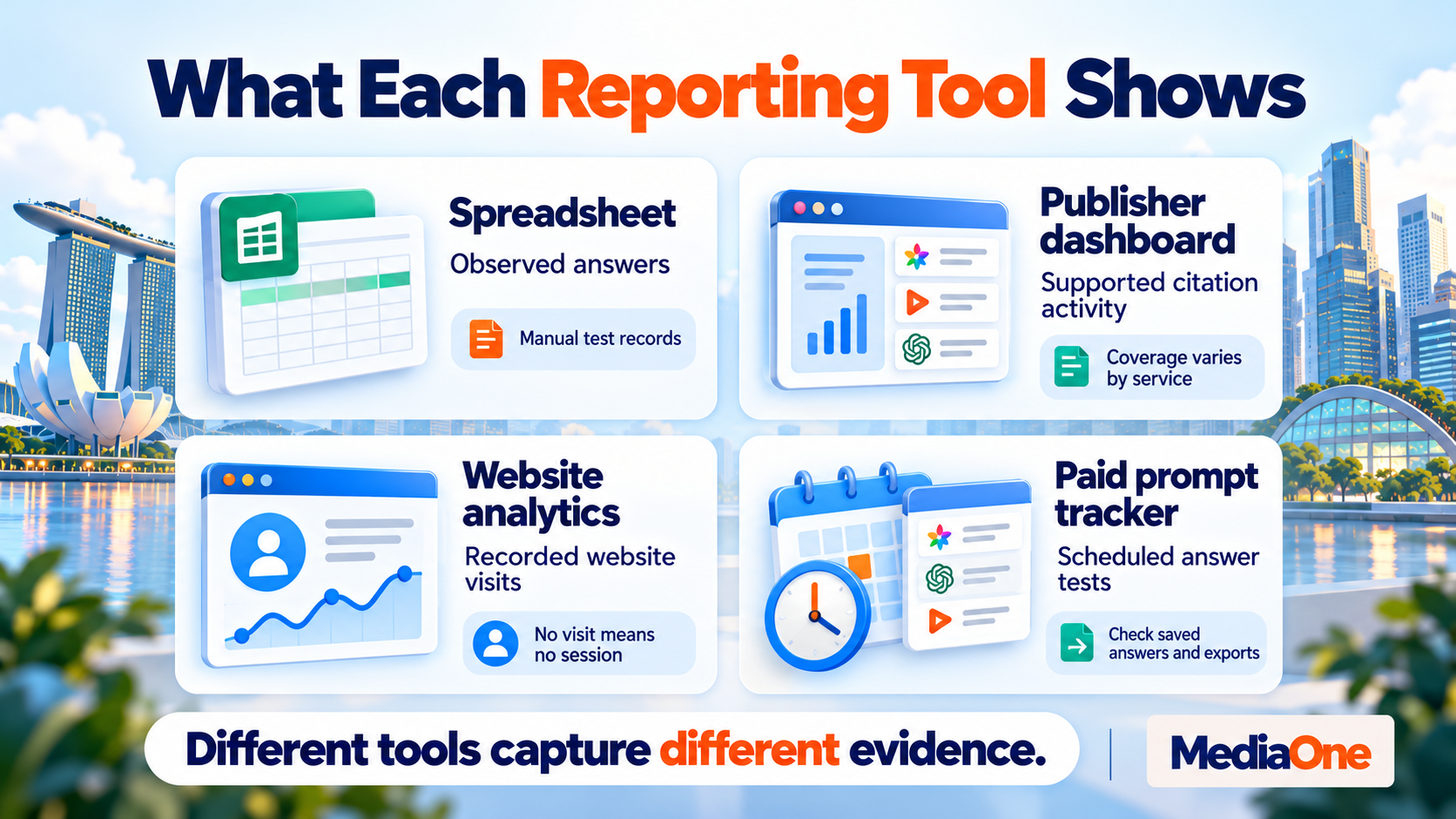
The right tool depends on the question the team needs to answer. A spreadsheet, a publisher dashboard and an analytics platform capture different evidence. No single total should combine their numbers without explaining how each was collected.
Free tools cover different reporting needs
Bing Webmaster Tools’ AI Performance report provides citation information across supported Microsoft AI experiences and selected partner integrations. Its coverage is specific to those experiences; it is not an all-engine citation report.
| Tool or method | Main purpose | Main limitation |
| Shared spreadsheet | Records a controlled set of manual tests | Staff must collect and review answers |
| Bing Webmaster Tools | Reports citation activity across supported AI experiences | Coverage does not represent every AI service |
| Google Search Console | Reports Google Search performance | Overall search totals cannot establish a complete citation history |
| Google Analytics 4 | Measures recorded website sessions and actions | Answers without a website visit produce no session |
| Paid prompt tracker | Automates tests and historical reporting | Results depend on coverage and collection methods |
Google includes traffic from its AI search features within Search Console’s Web reporting. That reporting supports search analysis, while a separate prompt log documents the specific answers a team observed.
Paid platforms need a practical trial
A trial should use the company’s own prompt list. A sales demonstration built around unrelated questions cannot show whether the service covers the buyer research the business needs to monitor.
The following checks help compare subscriptions:
- Engine coverage: The plan identifies each supported service and search experience.
- Collection method: The provider explains whether it tests the public app, a software connection called an API, or another environment.
- Source detail: Reports show destination URLs, alongside brand names.
- Evidence storage: Reviewers can inspect the answer behind a reported citation.
- Testing controls: Language, location, frequency and repeat runs are documented.
- Data access: Exports retain prompt IDs, dates, results and source links.
- Reporting access: User seats, client reports and historical retention match the team’s needs.
A small manual sample can test whether exported results match their saved answers. An exact match with a later live answer is not required, because the later run may differ. The important check is whether the platform accurately recorded its own captured answer.
A trial scorecard can mark each requirement as included, unavailable or untested. Missing URL exports may rule out a tool intended for page editing, even if its presentation looks polished. Another team may prioritise scheduled tests and shared access. The decision should follow the intended work.
A pilot also reveals the work outside the subscription. Someone still needs to check unusual results, correct domain matches and decide whether a page needs editing. Automated tests can increase that review workload when they produce answers that staff cannot inspect. The trial should include the people who will maintain the report each month.
Total cost depends on the testing workload
Subscription comparisons need the full monitoring cost, including engines, seats, exports and repeat runs. A hypothetical S$150 monthly plan covering 50 prompts costs S$3 per tracked prompt per month. An additional S$50 charge raises that figure to S$4.
Monthly prompt capacity and completed answer runs are different units. A schedule of 30 prompts across three engines, tested four times a month, creates 360 planned runs.
The provider’s billing rules determine how that workload consumes the allowance. A documented SEO marketing budget can account for the subscription alongside staff review and content updates. The lowest subscription price may still leave the team with substantial manual work.
The Limits of AI Citation Tracking Tools
Tracking reports describe the answers and services they observe. Their limits need to travel with the figures, especially when results move into presentations or monthly summaries.
A sample cannot represent every customer conversation
Answers can change with wording, conversation history, location, service settings and product updates. A fixed prompt list makes comparisons more controlled, but it cannot reproduce every customer’s experience.
A small sample also makes percentage changes look large. One additional cited answer in a 20-run panel changes the citation rate by five percentage points. The count beside the percentage helps readers judge the scale.

There is no universal number of weeks that proves a change is real. A repeated pattern, supporting page evidence and a consistent method provide a stronger basis for action than an isolated movement.
A citation cannot prove influence or accuracy
A visible link establishes that the answer presented a source. It does not reveal how much that source influenced the response, whether the system relied on other material, or whether the claim is correct.
Google’s AI search systems may conduct several related searches while preparing an answer. That process can bring together pages covering different parts of a question. A reviewer still needs to examine the statement beside each citation.
A payroll article, for example, might appear beside a claim about software pricing even though it discusses employee records. The citation exists, but the connection needs checking before the team treats it as a successful result.
Different dashboards can disagree
A publisher report may aggregate activity from real usage, while a prompt tracker runs a selected test list. Different coverage, dates and counting rules can produce different totals.
A shared reporting note should state the data source, included engines, sample size, missing results and calculation method. A custom visibility score also needs its formula, particularly when it assigns extra weight to certain questions.
Content Updates Based on Citation Data
Citation data becomes valuable when it leads to a specific page decision. The first review should examine what the customer asked and whether the business has a page that answers it.
Existing pages need an evidence check
A missing citation can have several explanations. The page may not cover the question, may contain outdated information, or may be unavailable to the relevant crawler. A single absence cannot identify the cause.
OpenAI’s crawler documentation separates OAI-SearchBot, which supports search, from GPTBot, which concerns model training. Search access and training permissions are separate settings. Technical access checks can therefore be specific to the search service being tested.
Google also requires pages to meet its search eligibility conditions for supporting links in AI features. Special AI markup does not guarantee inclusion.
Customer needs determine the edit
A page review can compare the customer’s question with the answer the page actually provides. Missing explanations, unsupported claims and hard-to-find details deserve attention before adding more text.
Google’s approach to people-first content centres on helping readers and providing reliable information. A payroll comparison could explain who handles employee changes, what support includes and which charges affect the total cost.
A focused content marketing programme can turn those gaps into page updates. Existing pages should receive missing details when they already serve the topic. A new article needs a separate reader need.
A change log supports later review
Each update should have a page URL, an owner, an edit date and a short reason. The same prompt group can then run again on the planned schedule.
A later citation increase supports further investigation, but it cannot prove the edit caused the change. Competitor updates and changes within the AI service may also affect results.
Incorrect brand descriptions need attention too. Online reputation management can include checking factual business information across the company’s website and relevant public listings.
How Do AI Citations Connect to Traffic and Enquiries?
Citations record visibility in answers. Website analytics records visits and actions after a person reaches the site. These measures belong alongside each other, with their separate limits explained.
The GA4 Traffic acquisition report includes session source and medium. Those fields can help identify visits from AI services when source information reaches the analytics setup.
A filtered landing page report helps show which pages those visitors first reached. Relevant enquiry or purchase events can then support an assessment of the recorded visits.
| Reporting layer | Question it answers |
| Citation log | Did the sampled answer link to the website? |
| Acquisition report | Which recorded visits came from an identified source? |
| Landing page report | Which pages received those visits? |
| Enquiry records | Which contacts met the business’s lead criteria? |
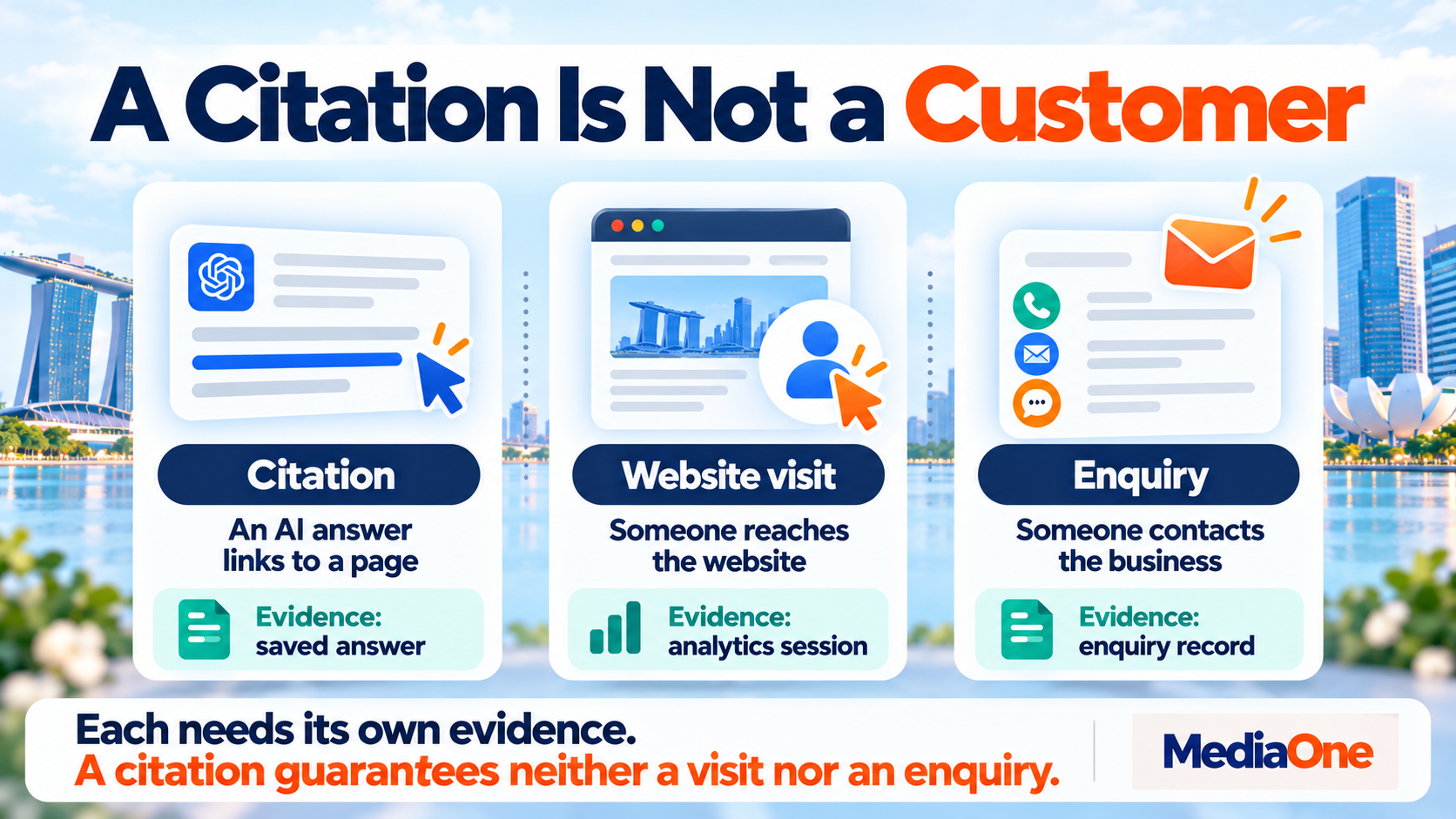
A citation may produce no click. A customer may also encounter an AI answer and return later through another channel. Reports should avoid assigning those later visits to AI without supporting evidence.
The monthly review can pair citation changes with recorded visits, relevant enquiries and page updates. That gives decision-makers a fuller account of the programme without claiming that every citation produced a customer.
A short review note can explain the main finding in everyday language: “Our employee-records checklist appeared in four of 30 completed tests. The previous matched test recorded two appearances. The team will check the saved answers before changing the page.” The count, comparison and next action keep the report grounded in observable evidence.
Conclusion: AI Citation Tracking Works Best With a Repeatable Review
AI citation tracking needs customer questions, consistent records and someone responsible for the next content decision. A manageable test can establish the starting point before a business commits to wider coverage.
A platform earns its place when it captures the evidence the team needs and reduces the work required to maintain it. Reliable exports and saved answers make that judgement easier.

MediaOne’s GEO services connect AI search work with website and content improvements. Businesses planning a measurement programme can discuss their audience, priority pages and reporting needs with MediaOne’s team.
FAQs About AI Citation Tracking
Does a link from another website count as a citation to our domain?
A third-party article that names the business counts as a citation to that publisher’s domain. The brand mention can still enter a separate visibility record. The destination URL determines which website receives the citation count, even when the linked article discusses another company.
Can AI citation tracking reveal whether a model trained on our content?
AI citation tracking cannot establish training history. A source link records what appears in an answer during a particular test. It does not prove that the page entered a training dataset. Search retrieval and model training involve different processes, so the report should avoid drawing that conclusion.
A reviewer should check identifying details such as the website, location, product or service. A matching name alone may refer to another business. Ambiguous mentions need an “unconfirmed identity” label until the available answer identifies the company sufficiently for the counting rule.
Should citations to PDFs count?
A publicly accessible PDF can count when the AI answer links directly to it on the tracked domain. The log should record the file address and document type. Separate PDF reporting helps teams distinguish citations to downloadable resources from citations to standard website pages.

Should old URLs and redirected pages count separately?
A report should preserve the cited address and record its final destination. Agreed rules can group redirected versions under one page when calculating page coverage. Historical records should retain the original URL so later reviewers can see exactly what the answer linked to at the time.