
| AI Summary
A local SEO audit checks how customers find and contact a business through Google Maps and local website results. It examines business profiles, reviews, listings, service pages, mobile access and search performance. The outcome is a ranked repair list supported by evidence. Singapore businesses should address contact failures and inaccurate information first, then measure enquiries alongside search visibility. |
A local SEO audit is a review of a business’s online presence in location-based searches. It checks Google Business Profile, customer reviews, business details, website pages, links and local rankings. Each finding should identify the problem, the repair needed and a way to check the result.

Key Takeaways
- A screenshot, page address and test date make each finding easier to verify.
- Separate records for Maps positions and website positions prevent misleading comparisons.
- A review total or speed score alone cannot decide whether an audit passes.
- Wrong phone numbers and broken booking forms deserve attention before cosmetic changes.
- Each repair needs an owner, a deadline and a follow-up test.
- A comparison across branches can reveal problems that a company-wide average hides.
A business can appear in local search and still lose an enquiry. An old phone number sends a caller nowhere. A booking button opens the wrong branch. A website describes a service the business no longer offers.
A local SEO audit traces those problems from search result to customer contact. It gives Singapore business owners a practical record of what needs attention and why.
The wider work of local SEO for businesses includes ongoing improvements. An audit supplies the starting evidence, so the team can repair confirmed faults and check whether the changes help.
What Affects Local Search Rankings?
Google’s local ranking factors centre on relevance, distance and prominence. Relevance describes the match with a search. Distance concerns the searcher’s location. Prominence reflects how well known a business is, including information from links and reviews.
An audit turns those principles into checks:
| Factor | Audit question | Evidence to record |
| Relevance | Does the business describe its actual services? | Categories, service details and page content |
| Distance | Where did the search take place? | Search location and business location |
| Prominence | What supports the business’s reputation? | Reviews and relevant referring websites |
Google does not publish a fixed percentage for each factor. A report should avoid presenting industry survey estimates as Google’s formula.
Local results also include different surfaces. The map section shows business listings, while ordinary search results show website pages. A business may perform differently in each.
A café that appears near its own street may appear less often several neighbourhoods away. That pattern needs context before the audit labels it a fault. The report should distinguish inaccurate information from normal differences caused by location.
The Local SEO Audit Checklist: Evidence to Collect
The audit needs a defined scope before testing starts. A single shop, a home-service company and a chain of outlets require different records.
A shared worksheet can hold the location, page address, finding, evidence, proposed repair and status. Separate tabs or filters help teams compare branches without mixing their contact details.
Access, locations and search terms
The business should gather access to its profile, Google Search Console and website analytics. Existing reports provide a baseline before anyone changes the website.

The location list should identify genuine outlets and actual service coverage. The search list should include the main services customers request, with relevant neighbourhood names.
For example, an aircon company might examine “aircon servicing Bedok” and “aircon repair Tampines”. Local keyword research connects those terms with customer demand and the pages intended to answer them.
Checks to include in the worksheet
| Audit area | Main check | Evidence |
| Business Profile | Accuracy and working links | Field values and screenshots |
| Reviews | Recent feedback and response handling | Review dates, themes and replies |
| Business listings | Wrong or outdated information | Listing addresses and errors |
| Website pages | Service and location relevance | Titles, headings and content |
| Indexing | Important pages available to Google | Search Console findings |
| Mobile access | Calls, forms and bookings work | Device tests and errors |
| Speed | Loading and response problems | Performance reports |
| Links | Relevant sources and broken destinations | Referring pages and URLs |
| Rankings | Visibility across the service area | Search terms and test locations |
| Results | Enquiries and completed business | Analytics and enquiry records |
A finding such as “website needs improvement” gives the team little to act on. “The Bedok booking button opens the Tampines calendar” identifies a specific fault.
The worksheet should also record checks that pass. That record prevents another reviewer from repeating completed work and gives the next audit a starting point.
The scope should also name any limits. A public review cannot show whether a form notification reaches staff, and a website crawl cannot confirm that an address accepts visitors. Those checks need direct testing or reliable business records. The report should separate observed faults from checks the reviewer could not complete, without turning an untested item into a confirmed problem.
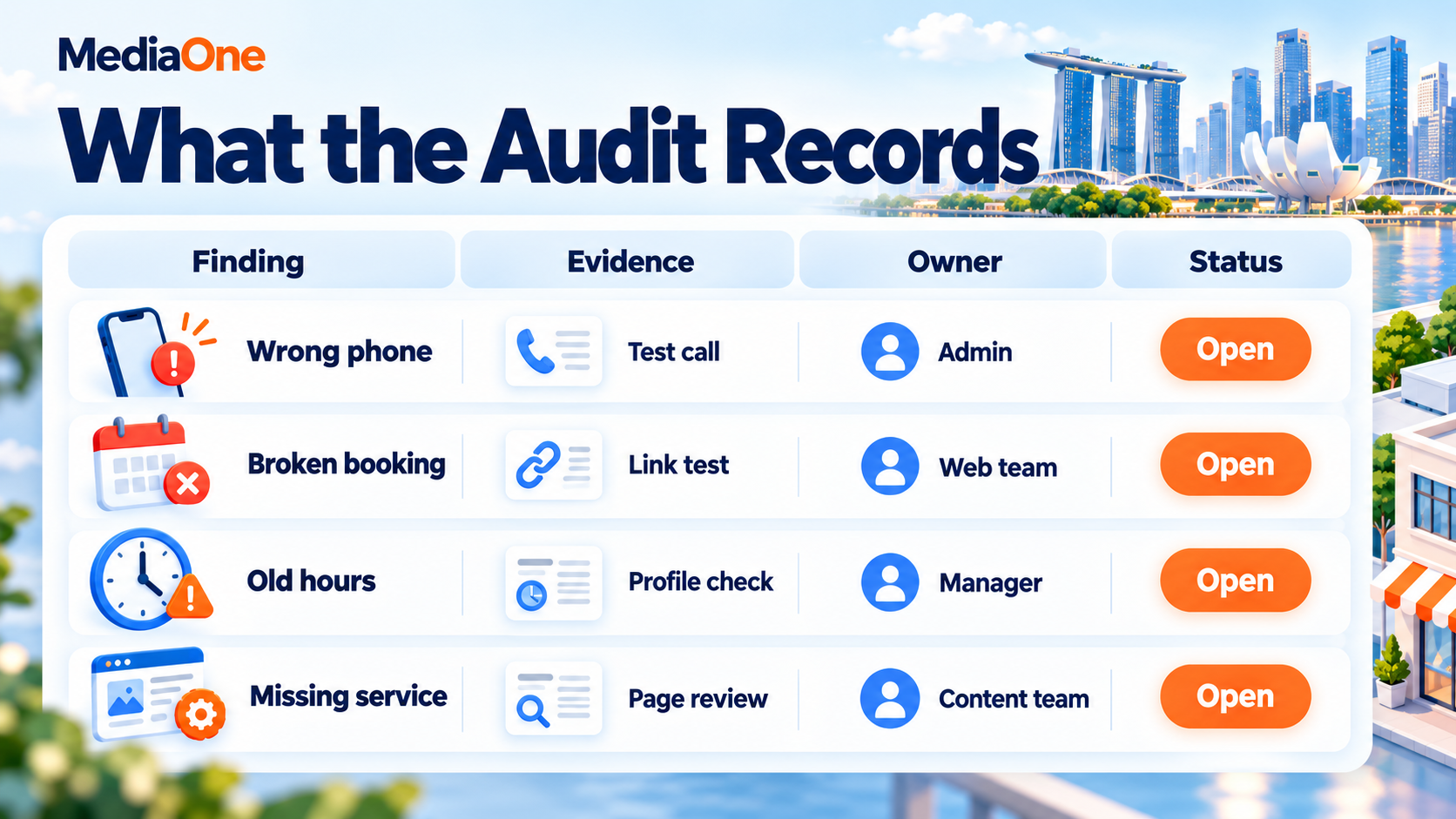
Google Business Profile: Accuracy Before Extra Activity
The profile review should compare what customers see with how the business operates. Google’s business representation rules require accurate real-world information, appropriate categories and eligible locations. Extra keywords should not replace the recognised business name.
Categories and customer information

Google’s business category settings affect local ranking. The primary category should describe the main business, while additional categories should reflect genuine activities. A category for every individual product or service is unnecessary.
The audit should examine:
- Name: The public name agrees with signage and branding.
- Hours: Regular hours and upcoming exceptions reflect actual opening times.
- Phone: A test call reaches the correct team.
- Website: The link opens the intended location or business page.
- Services: Listed services remain available.
- Attributes: Accessibility and facilities match the premises.
- Booking links: The customer can select the correct service and branch.
A café with accurate categories can still frustrate customers if its holiday hours remain wrong. The report should record that customer problem separately from category selection.
Service areas and public addresses
Google’s service-area requirements distinguish businesses that visit customers from those that receive visitors. A business that does not serve customers at its address should remove that address from its public profile.
A mobile cleaner’s audit therefore checks coverage and contact access. A walk-in shop’s audit also checks the map pin, unit number and entrance information.
Photos and updates
The photo review should look for outdated entrances, old branding or images of services no longer offered. A customer should recognise the business on arrival.
Posts can also contain expired offers or broken links. The audit should flag those errors without treating a particular posting schedule as a confirmed ranking requirement.
Each finding needs a specific field or item. “Profile incomplete” is less actionable than “Saturday hours missing.”
Reviews: Feedback, Recency and Replies
The review section should explain what the feedback reveals about the business and its response process. A total count alone cannot do that.
Review patterns to record
The audit should record the average rating, total reviews, recent review dates and response coverage. A short comparison period helps the team see whether feedback has stopped arriving.
The content deserves attention too. Repeated complaints about unanswered calls may explain lost enquiries better than a ranking chart. Praise for a specific service may reveal information missing from the website.
The review log should separate customer-service issues from search tasks. Staff training may resolve an appointment complaint; a profile edit cannot.
Nearby competitors can provide context for the review record. The comparison should involve businesses offering similar services in the same area. A small repair shop and a large department store attract different volumes of feedback. Their totals should not become interchangeable targets, and the audit should explain the comparison it uses.
Review requests without rewards
Google allows businesses to request genuine feedback through a review link or QR code. Its review rules prohibit rewards in exchange for posting, changing or removing reviews.
Google’s fake engagement policy also prohibits selectively requesting positive reviews or discouraging negative feedback. The audit should examine request messages and customer selection, not just the number received.
A neutral request can say, “Thank you for choosing our team. Your feedback about the service is welcome.”
Replies that address the experience
A response review should check whether replies answer the customer’s concern. The same copied sentence under every review may leave a complaint unresolved.
A practical response process assigns a staff member to monitor feedback and escalate service problems. A public reply should avoid personal or sensitive details.
Ongoing online reputation management connects those replies with service improvements. The audit should identify missing ownership, unanswered concerns and policy problems.
Business Details and Citations: Which Errors Need Repair?
NAP stands for name, address and phone number. A citation is an online reference to those business details, often in a directory or membership listing.
The audit should compare listings with an approved business record. That record should reflect the real business, including the correct unit number, active phone number and current website.
Customer errors come before formatting differences
A disconnected number is a direct contact problem. An omitted unit number can send a visitor to the wrong part of a building.
Minor punctuation differences do not deserve the same priority. “Road” and “Rd” alone do not prove that Google sees two separate businesses. The report should focus on inaccurate or ambiguous information.
| Finding | Practical response | Suggested priority |
| Disconnected number | Number replacement and test call | High |
| Former address | Listing and location-link correction | High |
| Two listings for the same business | Investigation before changes | Depends on the issue |
| Wrong website destination | Correct business-page link | High |
| Minor punctuation variation | Standardisation during routine updates | Low |
Listings worth checking
The search should begin with the business name, old address and former phone numbers. Relevant industry associations, customer-facing directories and major platforms deserve attention before obscure listings.
A citation does not always include a clickable website link. The audit should distinguish the business information from a backlink, since they require different checks.
Each correction should remain open until the public listing shows the revised information. An edit request confirms submission, not completion.

Website Pages: Can Customers Find the Right Service?
A profile helps people discover a business. The website needs enough detail for them to decide whether to enquire.
The page review should start with the homepage, main services, contact page and branch pages. Each should have a defined purpose.
Titles, headings and local information
The page title should identify the service and relevant location without repeating the same phrase. Headings should organise the questions customers need answered.
For example, a tuition centre’s branch page might cover subjects, age groups, class arrangements and how to reach the unit. Those details explain the offer better than repeated neighbourhood names.
A branch page also needs its own contact details and booking destination. A company-wide number may be appropriate, but the team answering it should know which outlet the customer needs.
Near-identical neighbourhood pages deserve review. Google’s doorway abuse policy addresses pages created for similar searches that funnel visitors onward without providing enough value.
Indexing and business markup
Indexing means Google has stored a page for possible inclusion in search results. Google Search Console’s URL Inspection tool shows information about Google’s indexed version of a page and offers a live test. An audit should investigate important service pages that Google has not indexed.
A technical finding should name the affected page and reported issue. One missing page requires a different response from a whole website blocked after a redesign.
The markup check compares business data in the page code with the visible content. Google’s LocalBusiness structured data can describe business information, but it does not guarantee enhanced search displays.
Specialist technical local SEO work can investigate indexing and markup faults. The audit should explain their customer or search consequence in everyday language.
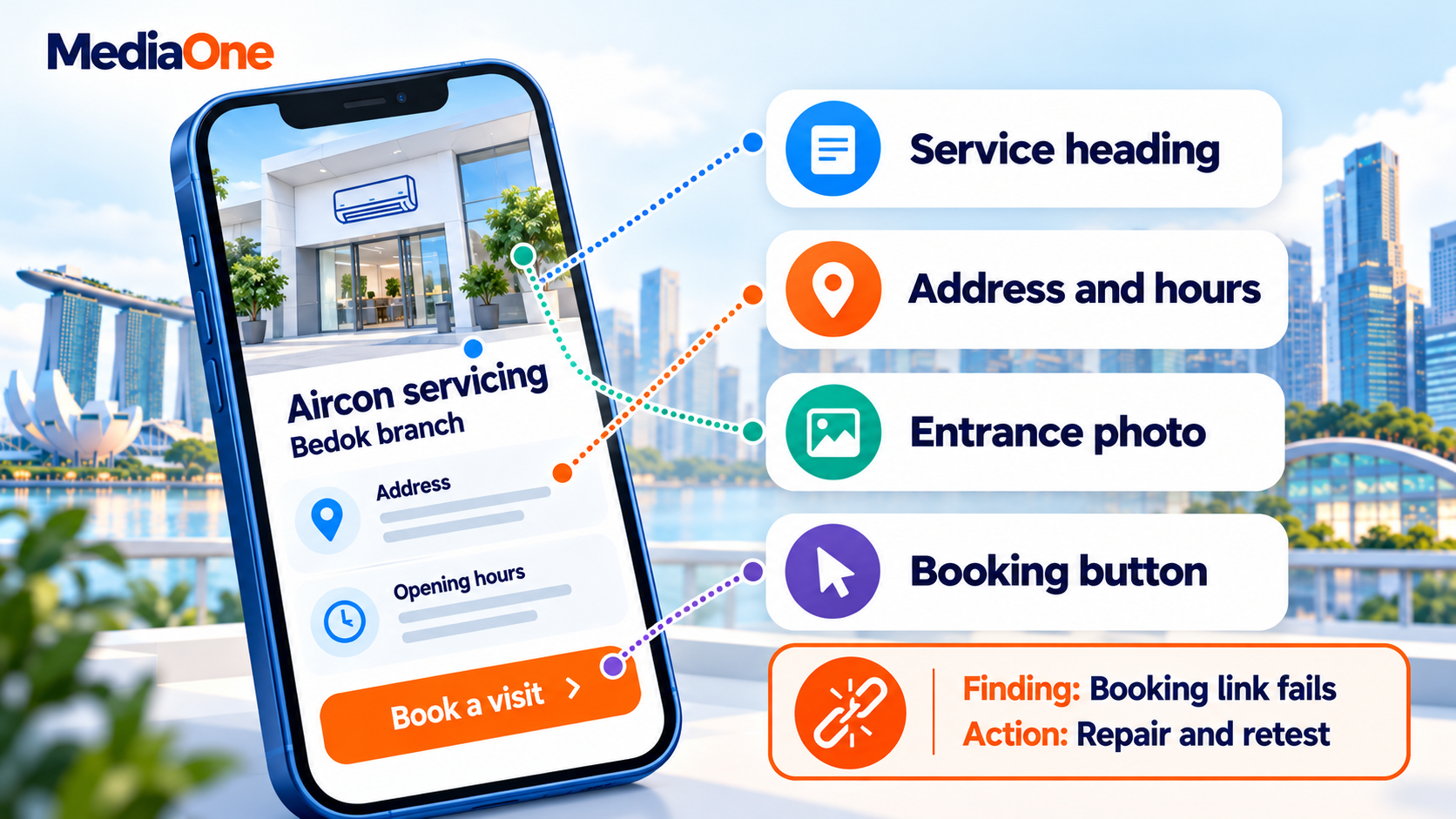
Mobile Experience and Page Speed
The mobile check should follow a real customer task from start to finish. A page can look attractive and still make booking difficult.
A reviewer should test a call, submit a test enquiry and complete the booking steps as far as practical. The business should confirm that the test message reaches the intended inbox.
Loading, tapping and completing a task
Common findings include:
- Contact buttons: The phone link dials an old number.
- Forms: A required field prevents submission.
- Menus: Important service links are difficult to open.
- Pop-ups: An overlay covers the booking button.
- Layout: Content moves while the customer tries to tap.
- Confirmation: The page gives no indication that an enquiry arrived.
These findings belong in the website design and development repair list with the device, page and steps needed to reproduce them.
Performance reports with context
PageSpeed Insights combines controlled tests with real-user data where available. A low-traffic page may lack enough real-user data, so the audit should record which evidence the report provides.
Google’s Core Web Vitals measure loading, response to interaction and visual stability. Good thresholds include LCP within 2.5 seconds, INP of 200 milliseconds or less and CLS of 0.1 or less, assessed at the 75th percentile. In everyday terms, at least three out of four recorded visits should meet each threshold.
The report should identify the affected experience and proposed repair. A number without an explanation gives the business little direction. A technical score also cannot replace a working enquiry test.
Local Rankings and Backlinks: Checks Beyond the Profile
Ranking checks need a repeatable method. A search from the owner’s office shows one location’s results.
Search positions across the service area
A grid report checks positions from several points on a map. The audit should record the keyword, grid area, spacing, device settings and date.
The report must also identify whether it measures Maps listings or ordinary website results. Mixing the two can create a misleading comparison.
A low-ranking area is a prompt to investigate. Distance, nearby competition or service relevance may help explain the pattern. The map alone cannot prove that a location page caused it.
A repeat check should keep the method consistent. Otherwise, a different grid or keyword set can look like improvement when the measurement changed.
Links from relevant websites
A backlink is a link from another website to the business website. The audit should examine the source, context and destination.
A local association linking to an active member’s page has a different purpose from a collection of unrelated sites selling links. Google’s link spam rules prohibit links created primarily to manipulate rankings.
The link record should identify:
- Relevant sources: Websites connected with the business, location or industry.
- Broken destinations: Links pointing to removed or moved pages.
- Past campaigns: Paid placements or arrangements that need review.
- Missing recognition: Genuine partnerships with inaccurate business references.
Focused off-page SEO work can address those findings. A suspicious-looking domain alone should not trigger a blanket removal campaign.
Which Local SEO Audit Findings Should Come First?
An audit should end with decisions. A long export of errors leaves the owner to interpret the work.
An impact-effort matrix is a planning tool for organising findings. It is not a Google ranking score.
Impact describes the likely customer or search consequence. Effort describes the work needed, including access, staff time and development support.
| Finding | Customer or search consequence | Work required | Action group |
| Wrong phone number | Customers cannot reach the team | Small edit and test | Immediate repair |
| Broken branch booking link | Appointments reach the wrong outlet | Link correction and booking test | Immediate repair |
| Important service page not indexed | The page may miss website search opportunities | Investigation and technical repair | Scheduled project |
| Outdated entrance photo | Visitors may struggle to recognise the unit | New photo and upload | Planned update |
| Small formatting difference | Little practical confusion | Routine edit | Maintenance |
A hypothetical plumbing business illustrates the approach. Its website phone link dials a disconnected number, while the printed number is correct. The audit records the exact link, assigns the repair and repeats the call test afterwards.
The evidence should support the proposed priority. A severe problem on a rarely visited page may need a different deadline from a booking failure on the main service page.
Every task needs an owner and a completion test. “Update contact details” remains vague; a tested number and corrected public listing provide an observable result.
The team should keep the original evidence after closing a task. A before-and-after screenshot helps explain the repair, while a dated test confirms what worked. A recurring fault needs a process change too. For example, branch managers can supply holiday hours before each public holiday, with one person responsible for publishing them.
Measuring Results and Planning the Next Audit
The baseline should include search visibility, website activity and actual enquiries. Each measure answers a different question.
Google’s Business Profile performance report includes applicable actions such as direction requests, website clicks and call-button clicks. A call-button click does not establish that staff answered or that a customer booked. The report can also include activity from Google Ads.
A compact reporting table can separate the stages:
| Stage | Measure | Question |
| Discovery | Local positions and website impressions | Can customers find the business? |
| Interest | Profile actions and website visits | Are people taking another step? |
| Contact | Completed forms and answered enquiries | Can customers reach the team? |
| Business outcome | Qualified enquiries and bookings | Is the activity relevant to sales? |
Comparison periods should account for business conditions. A promotion, reduced opening hours or a seasonal change can affect enquiries while SEO repairs are underway. A dated change log helps the team interpret those results. Several changes made together may prevent a reliable claim that one edit caused the outcome.
A monthly review can check profile accuracy, new feedback and unresolved repairs. A quarterly audit is a practical starting schedule for a stable business. A move, redesign or sudden decline deserves an earlier review.
Google’s AI search features do not require special additional markup or separate technical requirements. The audit can check accessible content, accurate business information and readable answers without promising an AI citation.
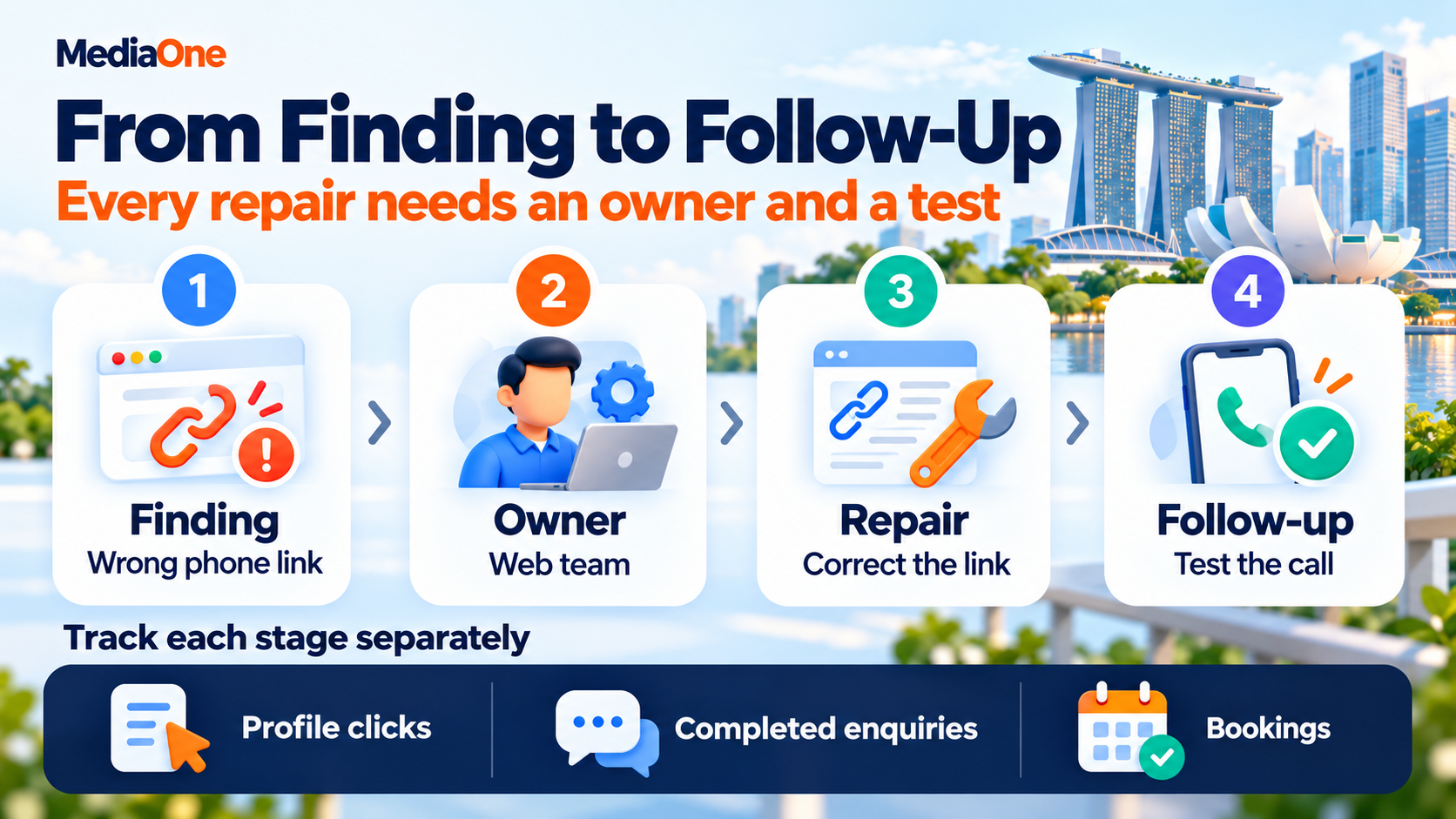
Conclusion: Turning Your Local SEO Audit Into a Repair Plan
A local SEO audit should leave the business with evidence, priorities and named responsibilities. The next task should be specific enough for someone to complete and test.
MediaOne’s local SEO services cover the profile, website and local search work behind those repairs. Businesses can discuss their locations and current problems through a local search consultation.

The first conversation should establish which findings need attention, who will handle them and how the team will check the result.
FAQs About Local SEO Audits
How long does a local SEO audit take?
The delivery time depends on the depth of the review. Several branches, a large website or missing account access can extend the work. The scope should state which locations, pages and platforms the reviewer will examine, so the delivery time reflects the actual checks.
Can a business complete an audit with free tools?
A business can check public profile details, test contact links and examine its own Search Console and performance reports without buying an audit platform. Paid tools may add coverage, reporting or location-based tracking. A free score alone does not replace a documented review.
How much should a local SEO audit cost?
The cost depends on the number of locations, website size, required access and depth of analysis. A quotation should list the checks, report format and whether it includes repairs. A low headline price reveals little when the proposed scope leaves out important pages or branches.
What if a former provider controls the Business Profile?
The owner should resolve access through Google’s profile ownership request process. Google provides procedures for requesting control of an existing profile. A new duplicate listing can create further problems, so access recovery should come before creating another record.
Can an online-only business have a Google Business Profile?
Google’s eligibility rules generally require in-person contact with customers through an eligible location or service-area operation. An online-only shop should not create a false storefront to qualify. Its audit should focus on the search channels appropriate to its actual business model.
Does completing an audit guarantee a higher Maps position?
An audit identifies problems and opportunities; the repairs and competitive conditions influence later results. Google states that businesses cannot request or pay for a better local ranking. A credible audit promises defined checks and evidence, with progress assessed after the work.