| AI Summary
Local SEO for businesses helps nearby customers find services through Google Search, Maps and location-related website results. Singapore small businesses need accurate profiles, genuine reviews and pages that explain their services and coverage. Google considers relevance, distance and prominence when ordering local results. A practical approach combines these search basics with working contact links and enquiry tracking, so businesses can assess whether visibility produces customers. |
Local SEO for businesses means improving a company’s presence in searches linked to a location. The work includes maintaining Google Business Profile, correcting business listings, collecting honest reviews and improving service or location pages. The aim is to help nearby customers find, assess and contact the business.

Key Takeaways
- Incorrect hours, phone numbers and booking links deserve attention before extra blog content.
- Service areas should reflect actual coverage; additional town names do not guarantee wider rankings.
- Review requests should welcome honest feedback without rewards or pressure.
- Each branch page needs information that helps customers visit or book that location.
- Reports should connect search activity with qualified enquiries and completed business.
A shopper in Tampines searches for a nearby optician on a Saturday morning. One listing shows the shop entrance, weekend hours and a working appointment link. Another leaves those details uncertain. The first shop gives the shopper fewer reasons to hesitate.
Local SEO for businesses supports that decision. The work helps people understand where a business operates, what it offers and how to take the next step. Singapore small businesses can begin with the information customers already need, then improve the website and track the results.
How Local SEO Helps Businesses Reach Nearby Customers
Local searches connect a service or product with a place. Examples include “aircon servicing Bishan”, “florist near me” and “shoe repair Toa Payoh”. Some people name a neighbourhood; others expect the search engine to recognise their location.
A local search can produce a map, business listings and ordinary website results. These appearances serve related purposes, but a strong website position does not guarantee the same position in Maps.
How Google ranks local results
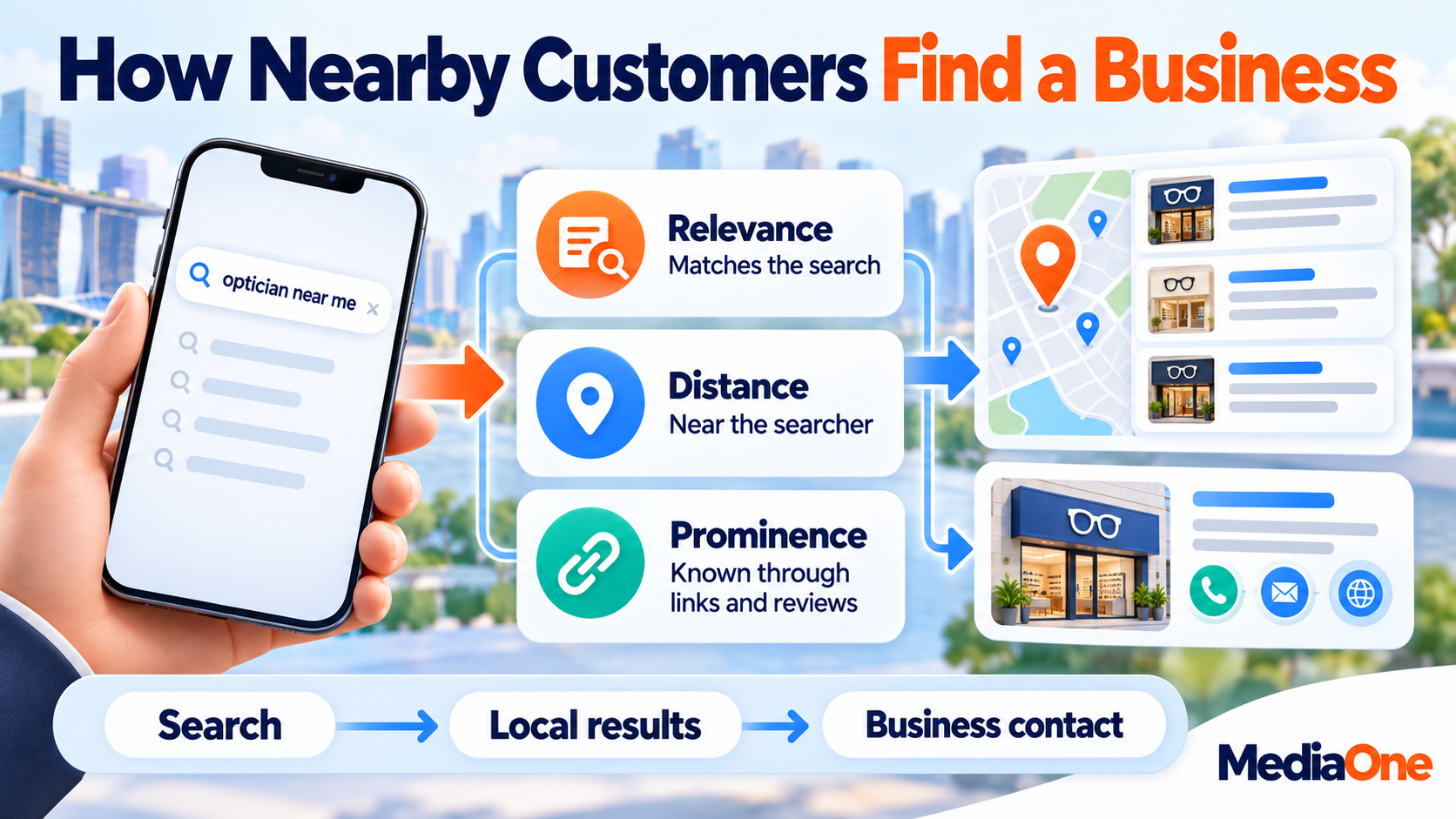
Google’s local ranking factors include relevance, distance and prominence. These describe the search match, the distance from the searcher and how well known the business is. Links and reviews contribute to prominence.
| Factor | Everyday meaning | Business action |
| Relevance | Does the business offer what the person wants? | Describe the main business and services accurately |
| Distance | How far away is the business? | Provide truthful location information |
| Prominence | How well known is the business? | Develop genuine reviews and credible recognition |
A coffee shop may appear for someone nearby but appear less prominently for someone across Singapore. That variation does not automatically indicate a problem.
Why Maps and website results need separate attention
A profile helps someone check opening hours or request directions. A website gives more room to explain services, prices and booking conditions. Both need to answer the customer’s immediate question.
For example, a repair shop’s profile may show its location, while the website explains which appliances it repairs. Strong Google Maps optimisation connects discovery with enough information to support a decision.
A business should first identify where customers encounter a problem. Missing map visibility, irrelevant website traffic and abandoned bookings call for different changes.
Google Business Profile Details That Help Customers Choose
Google Business Profile gives eligible businesses a presence on Search and Maps. The profile should represent the actual business, with details that staff can maintain as operations change.
Google’s business representation requirements cover business names, addresses and profiles. Extra service keywords in a business name can breach those requirements. A shop should use its recognised trading name, with service information in the appropriate fields.
Business information to check first
A profile review should cover the details below.

| Profile detail | What customers need |
| Business name | The name they recognise from the business |
| Address and map pin | The actual customer entrance or eligible business location |
| Phone number | A working number answered by the business |
| Opening hours | Normal hours and exceptions for holidays or closures |
| Services | The work or products available at that location |
| Website and booking links | A working destination relevant to the listing |
| Attributes | Accurate details about facilities and access |
A salon might have the right opening hours but a booking link that leads to a closed branch. That error deserves the same attention as a wrong address.
A short description can explain the core service, customer group and service coverage. Long strings of neighbourhood names make the description harder to read.
Categories that describe the actual business
Google’s business category settings affect local ranking and should describe what the business is. A specific primary category usually communicates the main activity more accurately than a broad label. Additional categories should cover genuine parts of the business.
A nail salon should select the relevant available category. A category chosen solely because another company uses it may misrepresent the service.
Category changes can require verification again. A business should record the reason for an edit and check its status before making further changes.
Photos and updates that answer practical questions
A customer approaching a shopping centre needs to recognise the entrance. A parent considering a tuition centre may want to see the classroom. Relevant photos can answer both questions.
Google’s Business Profile photo requirements emphasise images that represent reality. Current exterior, interior, product and service photos help customers understand what to expect.
Profile updates can communicate temporary arrangements, new services or events. A posting schedule should follow actual business activity. A posting calendar can keep updates organised, with customer needs determining what appears.
Service areas for businesses that visit customers
A plumber or cleaning company may travel to customers without receiving them at its own address. Google’s service-area requirements state that businesses which do not serve customers at their address should remove that address from public display.
Service coverage should match the locations the team can serve. Adding more areas does not create additional premises or guarantee rankings throughout those areas. Customers also need to know about travel charges or coverage limits before booking.
Accurate Business Listings and Local Directories
Local citations are mentions of a business’s name, address and phone number on other websites. A listing can count as a citation without linking to the business website.
Relevant local citations help people encounter business information beyond the company’s own channels. The immediate priority is accuracy wherever customers already search.
Which listings deserve attention
A small business can begin with its main map listings, established sector directories and relevant association profiles. A directory earns attention when customers use it or when it provides credible information about the trade.
Apple Maps business information can be managed through Apple Business. A business should also check review or booking platforms that already send visitors to its website.
An unrelated directory with little business information adds maintenance work. A large number of listings is a poor goal when the existing ones still show old details.
Errors to correct before minor formatting differences
Name, address and phone details are often shortened to NAP. A NAP consistency check should concentrate on information that changes who customers reach or where they go.
For example, an old phone number or incorrect unit number can send a customer elsewhere. “Street” and “St” do not automatically represent separate businesses. A standard format helps staff maintain records, but minor abbreviations should not distract from substantive errors.
A simple listing record can include:
- Platform name and listing URL.
- Business name, address and phone number shown.
- Website link and opening hours.
- Account access or the person responsible.
- Correction date and whether the change appeared.

The same record helps when a branch changes its contact details. Staff can identify affected listings without starting another search from scratch. Duplicate listings deserve investigation before deletion, because an apparent duplicate may represent a separate eligible business or department.
Genuine Reviews and Responses That Build Customer Trust
Reviews give customers another person’s account of the business. Their value comes from real experiences, including comments about service, communication and expectations.
A review process should make feedback easy to leave without directing what customers say. Google’s review policies prohibit incentives, fake engagement and selectively soliciting positive reviews.
Review requests without rewards or pressure
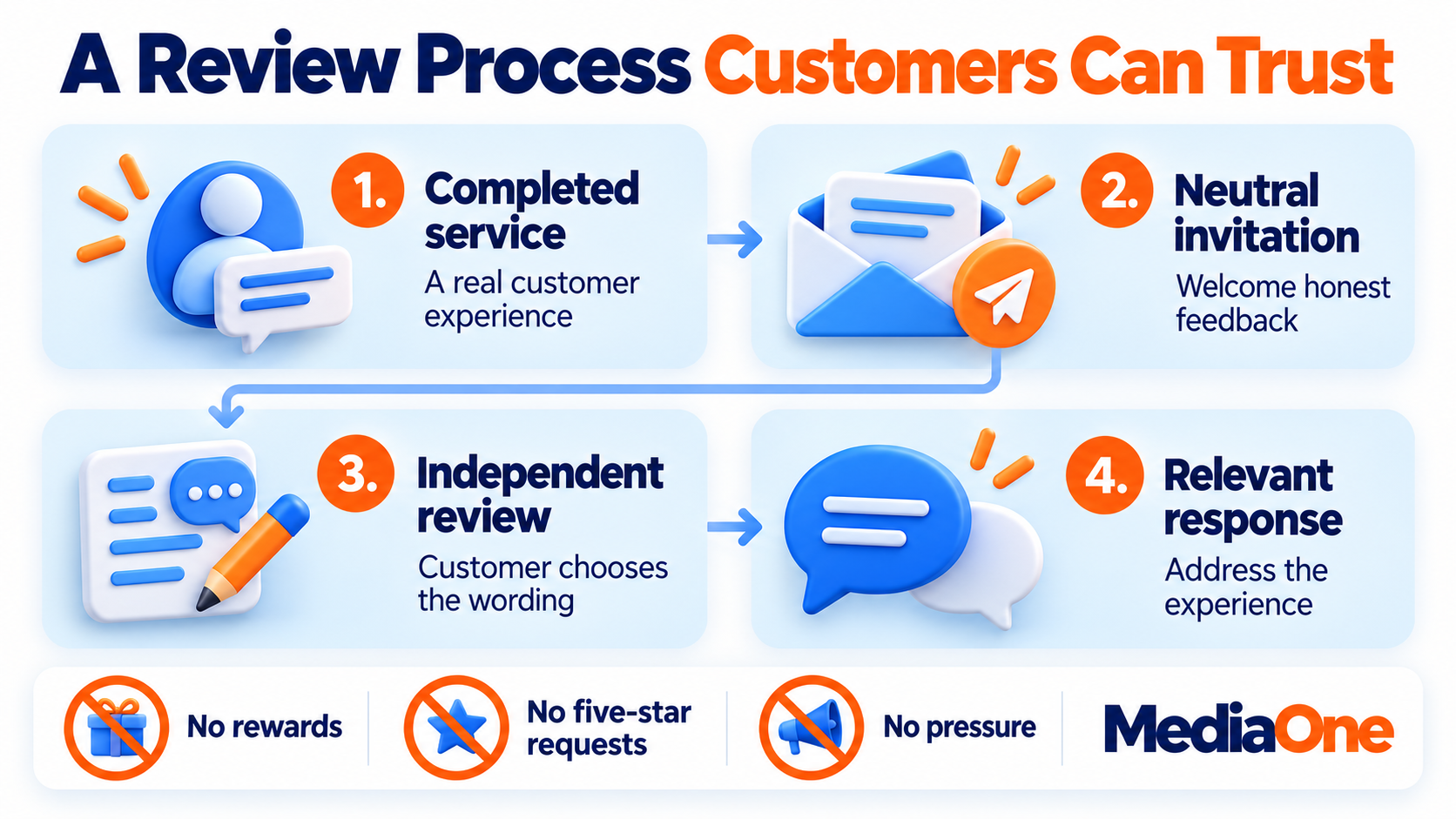
A business can send the same neutral invitation after a completed appointment or job. The invitation should welcome honest feedback from customers regardless of whether they seemed satisfied.
A short message can thank the customer and include the review link. Customers should choose their own rating and wording. Staff should avoid requesting particular keywords or pressuring someone to post while at the premises.
Google supports review links and QR codes, which reduce the steps needed to reach the review form. A receipt, follow-up message or counter display can provide access without repeated reminders.
An incentive remains an incentive when the business requests an “honest review”. Discounts or gifts should not depend on leaving, changing or removing feedback.
Responses that address the customer’s experience
Review replies work best when they address the issue described. A stock response pasted beneath every review can leave questions unanswered.
| Review type | Response approach |
| Positive | A brief thank-you that recognises relevant feedback |
| Mixed | Recognition of what worked and a response to the concern |
| Negative | A calm explanation and a private contact route where needed |
| Suspected policy violation | A factual report through the platform’s reporting tools |
For example, a complaint about waiting time calls for a response about waiting time. A general sales message does little to address that concern.
Public replies should protect privacy. Customer records, appointment details and personal contact information belong outside the review thread. Disagreement alone does not establish a policy violation.
Review tracking without arbitrary targets
Monthly checks can record new reviews, unanswered concerns and recurring service complaints. Customer volume provides context: a specialist handling a few projects will have different review opportunities from a busy café.
A reputation management process should connect feedback with action. Repeated comments about missed calls may point to a staffing issue. The response then belongs in the business’s operations as well as its public replies.
Local Keywords and Pages That Match Customer Needs
Website content should explain the service in the language customers use. A technically accurate service name may differ from the phrase someone types when a problem occurs.
For example, a customer may search “aircon leaking water Tampines” before considering a broader servicing package. The relevant page needs to explain whether the company handles that problem and serves that area.
Local keyword research from real enquiries
A practical keyword research process can begin with questions received by phone, email and booking forms. Existing search data can add evidence about the words people already use.
Common patterns include:
| Search pattern | Example | Information the page needs |
| Service and area | “curtain cleaning Bedok” | Service details and actual coverage |
| Problem and location | “locked out locksmith Jurong” | Availability, coverage and contact details |
| Product and place | “birthday cake Serangoon” | Product options and collection information |
| Visit-related question | “optician near MRT” | Location, directions and access details |
Each page should have a main purpose. An enquiry about emergency help needs different information from a comparison of routine maintenance services.
Keywords belong naturally in page titles, headings and explanations. Repeating “near me” or placing every Singapore neighbourhood in a footer makes the content harder to use.
Location pages for actual branches
A branch page should help someone decide whether to visit that branch. Relevant details include its address, opening hours, contact number, services, entrance and booking destination.
A tuition business with two centres could explain which subjects each centre teaches and which age groups it serves. Original branch photos and accurate transport details give visitors information that a generic company page cannot provide.
Travel times should be presented cautiously because routes and conditions vary. A named nearby MRT station and directions from the relevant exit can be more dependable.
Service-area pages with enough local detail
A company serving several neighbourhoods does not need a separate page for every town. Separate pages make sense when they answer different customer needs, such as coverage limits, service availability or booking arrangements.
Google’s doorway abuse policy covers substantially similar pages created to capture related searches and funnel visitors onward. Replacing only the neighbourhood name across many pages can create that risk.
A single service page with an accurate coverage section may serve readers better. Local examples should describe real work or be identified as hypothetical. Invented customers, addresses and branch locations should never fill content gaps.
Mobile Pages, Business Markup and Direct Answers
A customer arriving from a local listing may have little patience for a slow page or a hidden phone number. Website improvements should make the next action easy to complete.
Mobile checks before publication
A phone test should cover the full task, from opening the page to submitting an enquiry. Important checks include:

- Readable text and buttons with enough space around them.
- A tappable phone number that reaches the correct business.
- A booking link that opens the relevant service or branch.
- A short form with understandable field labels.
- Images that load without pushing contact buttons around.
Good website design supports these tasks. Google’s Core Web Vitals assess loading, responsiveness and visual stability, which describe parts of the visitor’s experience.
A large banner should not prevent a visitor from finding opening hours. Image compression and fewer unnecessary scripts can help reduce that delay.
Business information in structured data
Structured data describes page information in a format search engines can process. LocalBusiness structured data can describe details such as the business name, address and opening hours. The details should match the visible page.
Accurate local business schema markup supports that description, but it does not guarantee rankings or enhanced search displays. Hidden home addresses should not be published simply to complete markup fields.
Answers that readers and search systems can understand
A service page can answer immediate questions near the relevant information. Coverage belongs beside service availability; booking conditions belong beside the booking option.
Google’s AI search documentation says existing SEO practices remain relevant to AI Overviews and AI Mode, with no special schema required. Direct answers and accessible text support readers without promising selection by an AI system.
Local SEO Results to Track Beyond Rankings
Local SEO reporting should show whether people find the business and whether that attention produces enquiries. Rankings provide context, but customer actions need their own record.
Google’s Business Profile performance metrics include actions such as website clicks and direction requests. Its calls metric counts clicks on the call button, so it should not be labelled as completed phone conversations. Available metrics vary by business.
| Measure | What it helps assess |
| Profile views and search terms | How people encounter the profile |
| Website clicks | Interest in further information |
| Call-button clicks | Attempts to contact the business |
| Direction requests | Interest in reaching the premises |
| Completed enquiries | People who contacted the business |
| Confirmed bookings or sales | Recorded business outcomes |
A simple enquiry log can record the requested service, area, source and outcome. A question about an unavailable service is different from an enquiry that becomes a booking.
Monthly comparisons should consider holidays, closures, capacity and promotions. A business running Google Ads should also check reporting scope, because Business Profile performance can include activity associated with ads.
For example, a hypothetical cleaning company may receive more enquiries after improving its listing, yet find that many callers request a service it does not offer. The team can check which page or profile description caused that expectation. The correction should explain the available service before the next customer makes contact.
A second company may receive suitable enquiries but lose bookings because messages sit unanswered. That business needs a response process and someone responsible for follow-up. Tracking the enquiry outcome helps distinguish a search problem from a problem completing the sale. Both examples show why traffic totals need context from the people answering customers.
One search from the owner’s phone cannot represent visibility across Singapore. Reports should keep the search location and query consistent when comparing positions over time.
A Monthly Local SEO Routine for Small Businesses
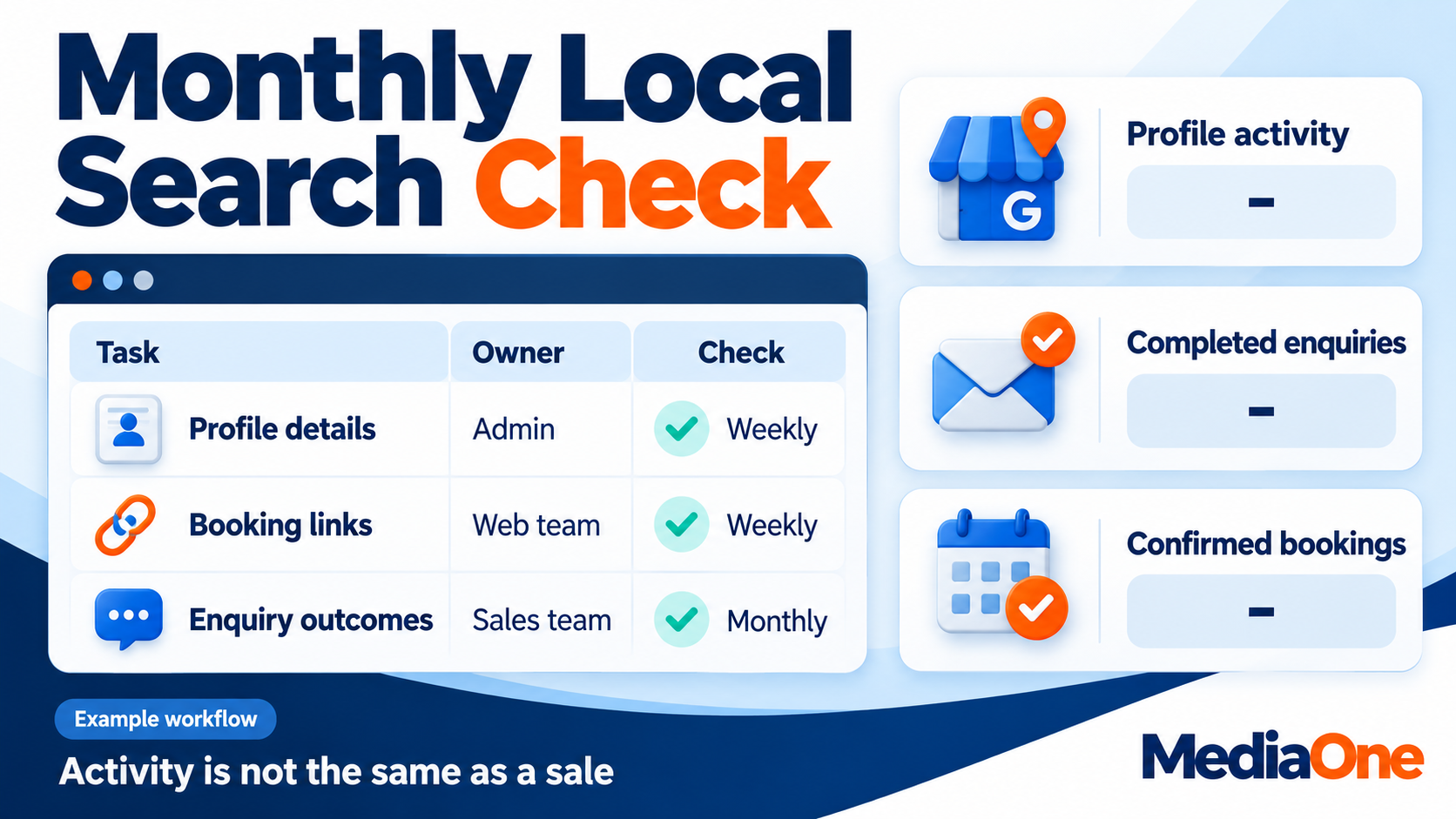
A manageable routine gives each task an owner and a next review date. Changes affecting customers, such as temporary closures, should be handled when they happen.
| Frequency | Task | Purpose |
| When operations change | Update hours, services and contact details | Prevent incorrect customer information |
| Weekly | Check reviews, profile edits and booking links | Catch problems before they persist |
| Monthly | Review enquiries and search activity | Identify work connected with business outcomes |
| Quarterly | Check directories and key website pages | Find outdated listings or content |
The schedule is a planning example. A business with frequent changes may need more checks, while a stable single-location shop may need fewer.
A small team can assign profile updates to an administrator, service information to an operations lead and website changes to its web provider. One shared record should show what changed and whether the change appeared correctly.
The next task should address a specific problem. Incorrect holiday hours need correction. Unanswered enquiries need follow-up. Another blog post cannot resolve either issue on its own.
Conclusion: Local SEO for Businesses Starts With Customer Access
Local SEO for businesses works toward a practical goal: helping nearby customers reach a business that can serve them. The next improvement should remove a real obstacle, whether that involves finding the entrance, understanding service coverage or completing a booking.
MediaOne’s local SEO services cover business profiles, location pages and related search work. Businesses needing support can discuss their local search priorities with MediaOne using their current listings, website pages and enquiry records as the starting point.
Frequently Asked Questions
Can a business have a Google Business Profile without a website?
An eligible business can maintain a profile without a website. A website still provides space for detailed service information and contact options. Eligibility depends on the business model and customer contact, not simply on owning a domain. Google’s Business Profile overview explains the free listing service.
What if a former employee or provider controls the profile?
The business can use Google’s profile ownership request process. The process differs for storefront and service-area businesses, so the business should follow the relevant route. Account access should remain under the business’s control, with named staff responsible for maintaining it.
Should a Singapore business publish pages in multiple languages?
Language choices should reflect the people the business serves and its ability to maintain accurate content. Separate language pages can help when customers search and read in different languages. Google’s multilingual website documentation recommends separate URLs for language versions. Each version needs consistent service details and contact options.
Does local SEO require a monthly Google advertising budget?
Local SEO does not require buying Google Ads. Advertising has its own budget and placement system. Businesses may use both channels, but they should assess their costs and results separately. Payment for ads does not purchase a better unpaid local ranking.
Can an agency guarantee first place in Google Maps?
Google does not offer a way to request or pay for a better local ranking. An agency can commit to defined work and reporting, but a fixed Maps position depends on factors outside its control, including the searcher’s location. A proposal should state deliverables and measurement methods without promising permanent first place.