| AI Summary
AI agent search visibility describes whether AI assistants mention or recommend a brand when answering customer questions. This guide focuses on the website content behind a buying decision: service details, pricing conditions, comparisons, evidence and business identity. Singapore businesses can organise these facts into pages that people can read and check. Accessible content supports discovery, but no page format or technical setting guarantees an AI recommendation. |
AI agent search visibility is a brand’s presence in AI-generated answers. A practical starting point is content that explains who the business serves, what its offer includes, what affects the price and which evidence supports its claims. Accurate service pages and consistent company information help customers evaluate the brand.

Key Takeaways
- A buyer’s requirements should determine which information a page contains.
- Service exclusions and eligibility conditions deserve space beside benefits.
- Custom-priced services can explain cost factors without publishing invented averages.
- Comparison tables need equal criteria and evidence for each provider.
- Case studies should separate recorded results from promises about future work.
- Public claims need matching evidence on the page where customers encounter them.
A Singapore retailer asks an AI assistant to recommend an accounting firm that handles payroll and inventory-related bookkeeping. Several firms describe themselves as experienced accountants. Only some explain whether they provide those services.
The missing detail creates a practical content problem. A website can describe a company warmly while leaving buyers unable to judge the offer.
AI agent search visibility gives that problem another context. Customers may now encounter a description of the business inside an AI answer before reaching its website.
The work begins with the facts a buyer needs. A page should explain the offer well enough for someone unfamiliar with the company to compare it fairly.
AI Agent Search Visibility Starts With a Specific Buying Question
A buying question combines a service with conditions. “Which accountant should a small retailer choose?” differs from “What is accounting?”
The first question calls for information about providers. The second calls for an explanation. A business needs content that matches the decision being made.
Customer requirements give the page its purpose
A shortlist question might mention:
- The customer’s business type or personal need.
- The work the provider must perform.
- The service area or delivery location.
- A budget or contract condition.
- A required qualification or capability.
A website cannot address every possible combination. Its priority should be the requirements that recur in real enquiries.
Keyword research can identify related searches, while sales and support conversations reveal details customers add before buying.
An office cleaning business, for example, may receive repeated questions about evening access and shared washrooms. Those subjects belong on its service page if they affect the offer.
A mention, a recommendation and a citation are different
A mention names a business. A recommendation suggests it for a stated need. A citation identifies a supporting source, often through a link.
A brand could appear in an answer without being recommended. Its website could also receive a citation for research unrelated to purchasing its services.
These distinctions help businesses avoid writing every page as a sales pitch. An educational article should answer its topic. A service page should explain an offer and the conditions attached to it.
Content improvements support existing SEO work
Google’s AI search documentation states that established SEO practices remain relevant to AI Overviews and AI Mode. No special optimisation is required. Pages must be indexed and eligible to appear with a search snippet to qualify as supporting links.
A business can therefore build these improvements into its SEO services work. The purpose is to publish accessible, relevant information, with no promise that an assistant will select it.
Which Facts Help Buyers Compare a Business?
A buyer comparing providers needs answers to several connected questions. The website should make those answers easy to locate without spreading one explanation across unrelated pages.
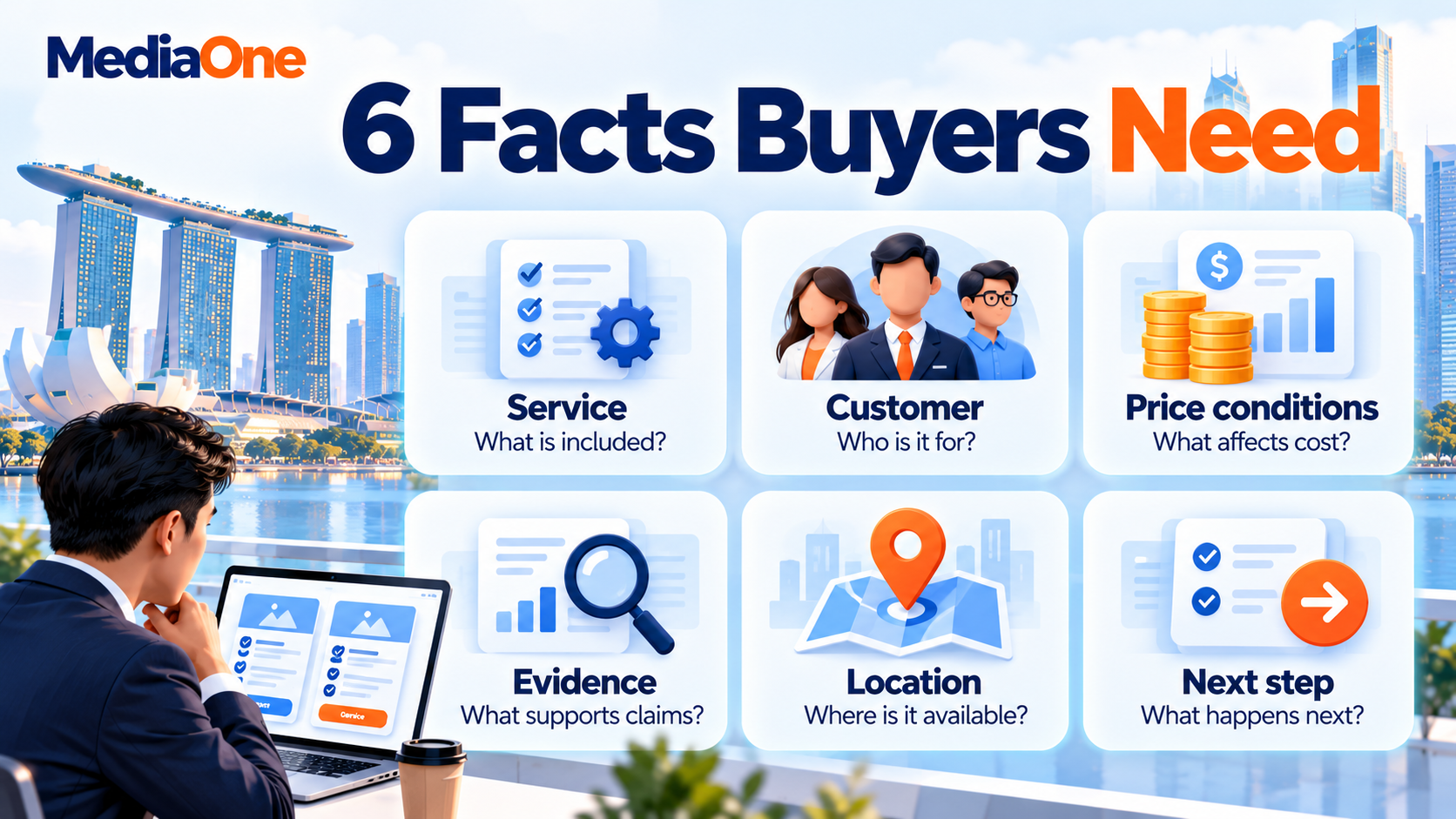
A simple information map connects each question to a suitable page.
| Buyer question | Information to publish | Main page |
| What does the business provide? | Named services and included tasks | Service page |
| Who can use the service? | Customer types, requirements and exclusions | Service page |
| What affects the cost? | Pricing units, cost factors and extra charges | Pricing page or service section |
| Why should a buyer trust the claim? | Relevant qualifications, evidence and examples | About page, team profile or case study |
| Where is the service available? | Actual locations, coverage and restrictions | Location or delivery page |
| What happens after an enquiry? | Required information and the next stage | Contact page or enquiry section |
The table is a planning tool, not an AI ranking model. A small website may answer several questions on one complete service page.
One main page should own each offer
A service should have a main page that explains its current terms. Related articles can link to that page when the service becomes relevant.
For example, a payroll article could explain payslip errors while the payroll service page describes the company’s actual support. The article does not need to repeat every package condition.
A content marketing plan can assign these roles before new pages are written. That prevents a company from publishing several broad articles while leaving its core offer unexplained.
Important facts should appear where the decision happens
A claim on a service page should have enough nearby context for the reader to understand it.
A statement about nationwide delivery needs any applicable limits. A statement about qualified staff needs details about the qualification and whose work it covers.

The reader should not need to infer that a condition on another page applies. A short explanation beside the claim can prevent a misleading impression.
Service Pages Should Explain the Offer and Its Limits
A service page should describe what the business actually does. Broad phrases such as “complete business support” leave too much open to interpretation.
Specific details give a buyer a basis for asking better questions.
The opening should name the service and customer
A direct opening can identify the service, intended customer and coverage in a few sentences.
A fictional provider might write:
Monthly bookkeeping support covers transaction recording and bank reconciliation for small retailers in Singapore. Payroll and inventory reporting are available as separate services.
The passage explains the offer and draws a boundary around it. It does not need a claim about being the best provider.
A longer description can follow with the process, required records and service options. Google’s people-first content principles support this focus on helping readers accomplish their purpose.
Included tasks and exclusions belong together
An inclusion list tells customers what they receive. An exclusion list explains where the agreement ends.
A maintenance package, for example, might include routine inspections but exclude replacement parts. A customer comparing the package needs both facts.
| Page element | Question it should answer |
| Included tasks | What work does the provider perform? |
| Exclusions | Which related tasks cost extra or remain outside the service? |
| Customer requirements | What must the customer supply or arrange? |
| Service frequency | How often does the work happen? |
| Deliverables | What does the customer receive? |
These details should reflect current operations. A business should not publish a process because it sounds reassuring if its team does something else.
Capability claims need boundaries
A company serving several customer groups should explain relevant differences between them.

A software provider might support retail shops and restaurants, but some features may apply only to particular plans. A page saying “for every business” hides those limits.
An honest explanation can identify supported use cases and the questions needed to assess an unusual request.
A qualification also needs context. A staff member’s credential should not imply that every employee holds it. A company award should not suggest approval of every service.
The next step should follow the explanation
A contact button becomes more meaningful when customers know what happens after clicking.
An enquiry section might explain that the team needs the service location, approximate workload and preferred start date before preparing a quote.
A website design review can place that section beside the relevant offer and check whether the form works on mobile.
The page should promise only a response process the business can maintain. Unverified response-time claims can be removed without weakening the offer.
What Should Pricing and Comparison Pages Explain?
Pricing content should explain how the business charges and which conditions affect the total. A fixed price is only one way to provide that information.
A custom service can describe its quote requirements and cost factors without inventing a typical fee.
Prices need units, conditions and scope
A figure has limited value unless the customer knows what it covers.
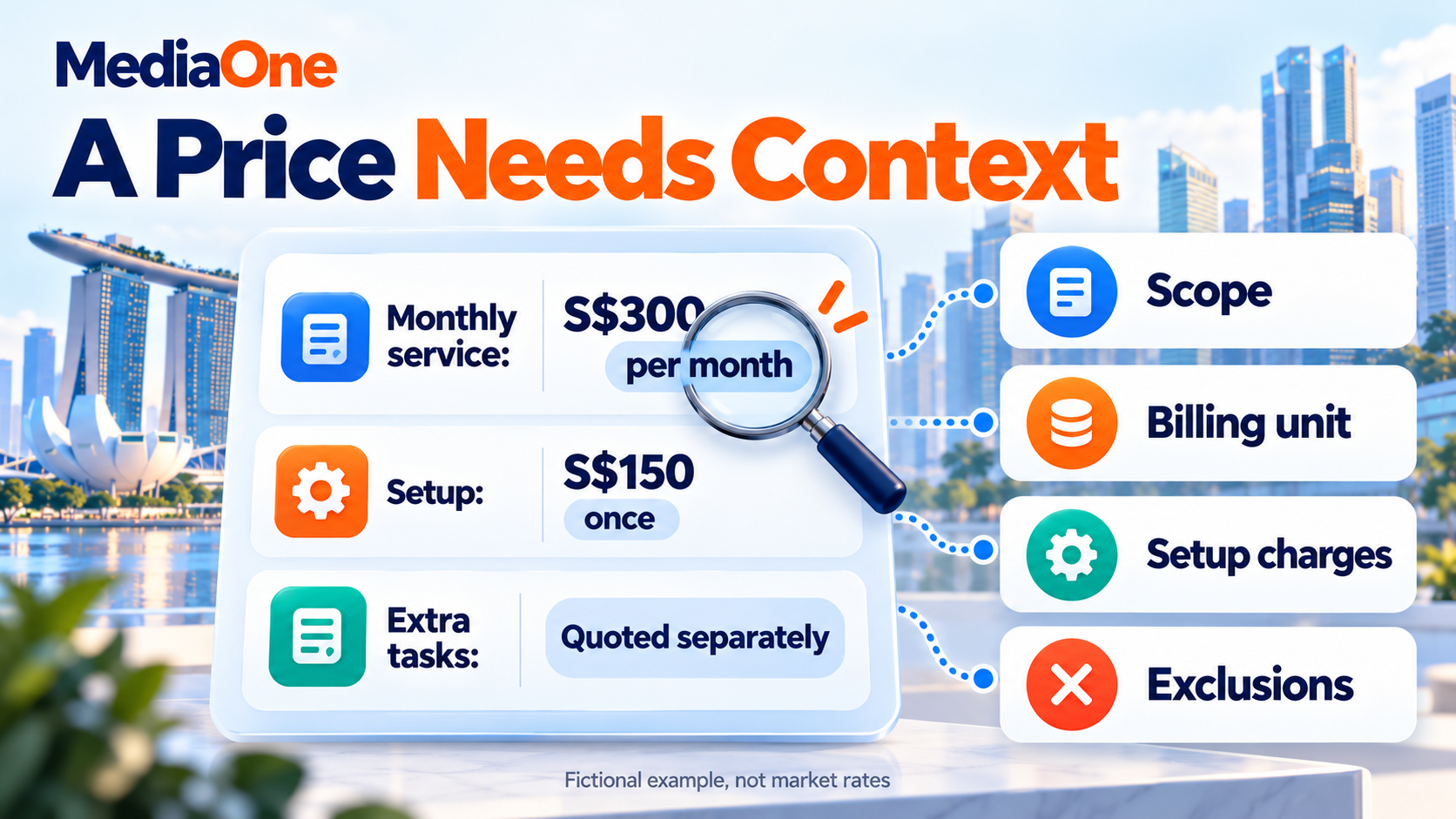
“S$300” could mean a monthly fee, one visit or an initial assessment. The page should state the unit and any applicable conditions.
The following example uses fictional amounts solely to show presentation.
| Fictional charge | Amount | What the label explains |
| Monthly service fee | S$300 per month | The recurring billing unit |
| Initial setup | S$150 once | A separate one-off charge |
| Optional extra task | Quoted separately | The task is outside the monthly fee |
A published offer would also need its actual tax treatment, inclusions and purchase conditions. These details should come from the business’s current terms.
The example is not a market price guide or a suggested charge.
Custom quotes can explain the calculation inputs
A commercial cleaning quote might depend on floor area, visit frequency, washroom count and access hours. A software implementation quote might depend on user numbers, data migration and training.
Those factors help customers understand why one job differs from another.
A pricing section can explain:
- The information required for a quote.
- The services included in that quote.
- The conditions that may change the price.
- The work that requires separate approval.
A starting price needs a description of the smallest service it buys. A range needs enough context to explain the difference between its lower and upper ends.
Comparison criteria should stay equal
A fair comparison applies the same questions to every option.
A table should not compare one provider’s full package with another provider’s entry-level fee while treating the offers as equivalent.
Suitable criteria include service scope, published contract terms, delivery options, support channels and stated eligibility. Each entry needs a source or an explanation of how the information was obtained.
A missing detail should remain “not published” when no reliable source confirms it. The absence of a published feature does not prove that the provider lacks it.
A company writing about its own service should make that relationship obvious. Readers should be able to distinguish a provider’s sales comparison from an independent review.
Alternatives can explain when a service is unnecessary
Some buyers are choosing between types of support, such as a one-off project and an ongoing agreement.
A comparison can explain when each option serves a different need. A business with an occasional maintenance task may want a single visit. A workplace requiring scheduled checks may want recurring support.
The page should identify the decision factors, including workload, required frequency and responsibility for follow-up. A provider can explain when its ongoing service would add unnecessary cost.
That information helps readers assess the offer honestly. It also prevents a comparison from becoming a list designed to favour the most expensive option.
Evidence Should Connect Each Claim to a Source
Evidence helps readers inspect a statement instead of accepting it on trust. Different claims need different kinds of support.
A company can document its own service terms. An industry-wide statistic needs research covering the population described.
The source should match the claim
A sentence claiming a service saves time needs evidence about that service and the conditions under which the saving occurred.
A broad research finding cannot establish the results of a particular provider. A customer’s experience cannot establish what every future customer will receive.
| Claim type | Appropriate supporting material |
| Current service scope | The provider’s published terms and operating information |
| Staff qualification | A relevant credential or issuing-body record |
| Completed project result | A documented case study with dates and method |
| Industry statistic | The original research and its stated population |
| Product capability | Current specifications or documentation |
The wording should remain within what the evidence establishes. A survey of ten customers should be described as a survey of ten customers.
Case studies need a starting point and method
A case study should explain the customer’s problem, work completed, measurement period and recorded outcome.
For example, a logistics company could describe a warehouse labelling project. Its report might compare recorded picking errors before and after the change.
The case study should explain how errors were counted and whether other operational changes occurred during the period.
A lower error count following the project does not, by itself, prove that labelling caused the full reduction. That limit belongs with the result.
An anonymous case study can still explain its method. Confidentiality should not become a reason to publish an impressive number without enough context to assess it.
Original information can answer questions others leave open
A business does not need a large survey to publish something worth reading. A documented inspection process, product compatibility chart or explanation of a recurring service problem can add value.

The information should come from work the company can substantiate. A fictional example belongs under an illustration label, not inside a claimed customer success story.
Author and reviewer information can also explain who prepared the material. A profile should state relevant experience and responsibilities without adding unsupported credentials.
Dates should explain the evidence
A statistic keeps the date of its source even when it appears in a newly published article.
A page update should reflect a real change or review. Replacing the year in a heading does not refresh the underlying evidence.
A short note can identify a revised service condition, updated specification or corrected calculation. That gives readers context when older versions remain elsewhere.
Business Identity and Outside Profiles Should Agree
A customer comparing providers needs to know which business the page describes. Similar names, former addresses and outdated profiles can complicate that task.
The website should distinguish its trading name, relevant company identity, contact details and actual service locations.
Business details should reflect current operations
Google’s business representation rules require accurate details and consistent real-world identity on Business Profiles. Address and service-area information should describe the operation correctly.
A local SEO programme can include maintaining eligible profiles and checking location details against the website.
A company serving an area should not describe it as a staffed branch unless that is true. Each real location may have different hours, services or enquiry arrangements.
Outside references should add checkable context
Relevant partner listings, industry memberships and editorial coverage can help readers inspect a company’s background.
The website should describe the relationship accurately. A paid directory entry does not establish an editorial endorsement. A supplier relationship does not imply certification.
Online reputation management can support corrections to outdated profiles and responses to customer feedback.
The goal is an accurate public record. No directory count or review total guarantees that an AI assistant will recommend the business.
Technical Access Should Support the Content
A well-written page still needs to be reachable. Technical checks should establish whether the intended systems can retrieve its content.
Search access and model training are separate choices
A crawler is a program that visits web pages automatically. Different crawlers serve different purposes.
OpenAI’s crawler documentation separates OAI-SearchBot, which supports ChatGPT search, from GPTBot, which gathers content that may support model training. A site can allow search crawling while restricting the training bot.
A technical review should examine the relevant permissions, server responses and security challenges. A rule allowing a crawler cannot guarantee successful retrieval or inclusion in an answer.
Important details should remain available as text
A price table saved only as an image makes its contents harder for some readers to access.
W3C’s accessible tables tutorial explains that data tables need properly identified headers and cells. Those relationships help assistive technology present the information in context.
A page should also be checked after its scripts load and in the initial response sent by the server. Google’s JavaScript SEO documentation explains its crawling and rendering process; other tools may handle scripts differently.
Structured data should describe the actual business
Google’s organisation markup documentation explains how structured data can help it understand company details and distinguish organisations. A schema markup review should check both the code and its factual content.
Google’s structured data policies require markup to represent the visible page accurately. The code should not contain a different price, invented reviews or unsupported claims.
Structured data adds labels to information. It does not turn missing evidence into a supported claim.
A Worked Example: Rewriting a Singapore Service Page
A fictional office cleaning company wants customers to understand whether its recurring service suits their workplace.
Its original page says:
Our experienced team provides quality cleaning solutions for businesses of every size. Flexible packages deliver excellent value.
The description offers no basis for comparing the service. A buyer still needs to ask what the team cleans, when visits happen and how pricing works.
A more informative version
The revised copy could say:
The recurring office cleaning service covers work areas, meeting rooms, pantry surfaces and washrooms at agreed visits. A quote depends on floor area, cleaning frequency and access requirements. Carpet extraction, high-level work and replacement consumables require separate confirmation.
The example remains fictional. Its purpose is to show how a page can describe scope and conditions without inventing a result or price.
A nearby enquiry section could request the office address, approximate floor area, required tasks and preferred visit times.
Supporting information around the offer
A short process section could explain how the company confirms access, agrees a task list and records changes to the service.
A genuine project example could describe a specific workplace and the work completed, with permission to publish the relevant information.
The page would then give customers several connected pieces of evidence: an offer, its conditions, an enquiry process and an example of delivery.
An assistant might still omit the company from a recommendation. The revised page nevertheless gives a reader more accurate information to evaluate if it is found or cited.
A Final Review Before Publication
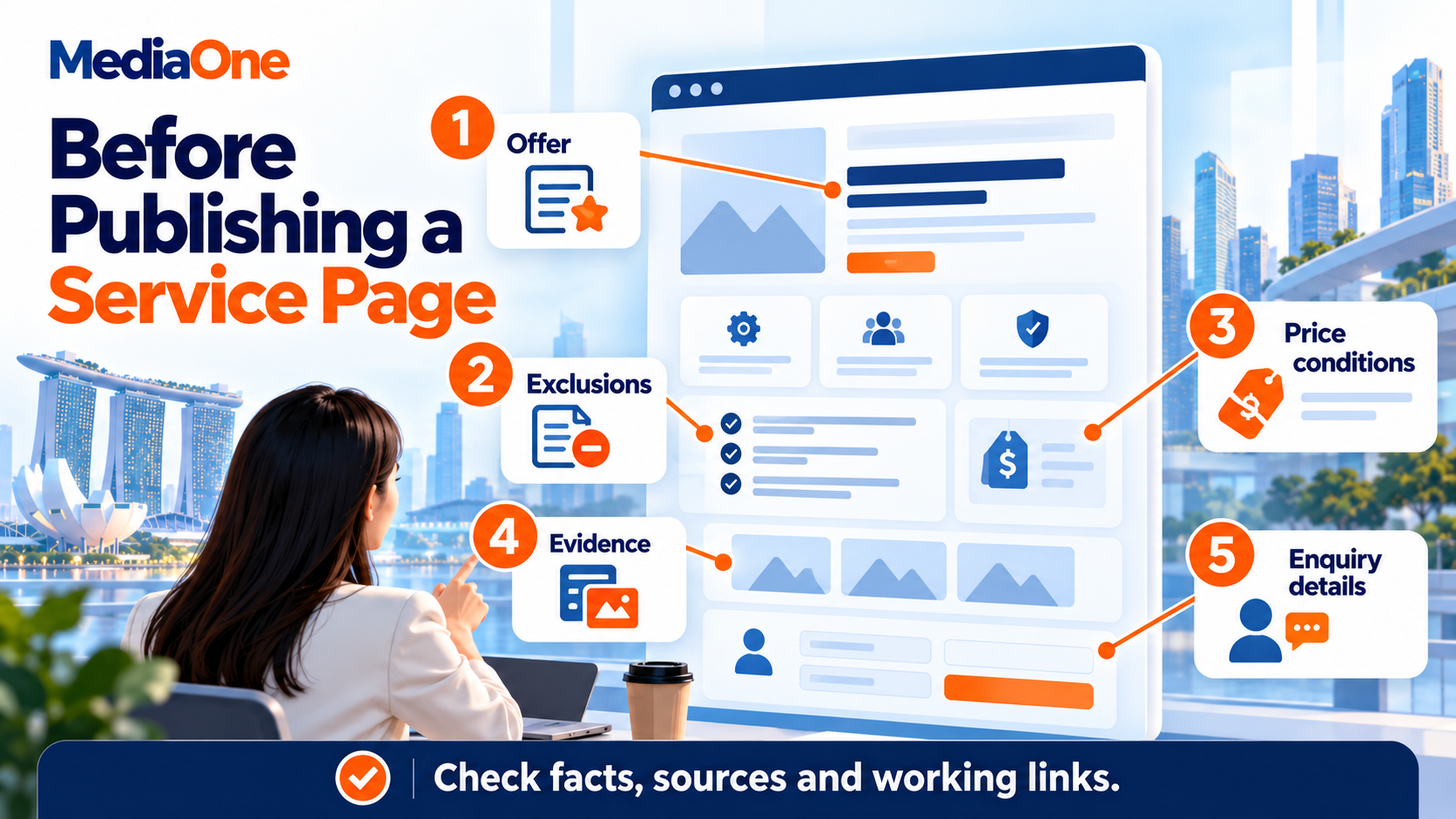
A publication review should check whether the page answers a real buying question and supports its own statements.
| Review area | Publication check |
| Offer | The page names the service and included work |
| Conditions | Exclusions and customer requirements appear beside the offer |
| Price | Amounts have units, scope and applicable conditions |
| Evidence | Claims match their sources and dates |
| Identity | Company and location details describe current operations |
| Access | Text, links and enquiry controls work as intended |
A small set of sample questions can test the page’s completeness. Someone outside the writing team can answer those questions using only the published information.
Any answer requiring private knowledge from the sales team reveals a possible information gap. The business can decide whether that detail belongs publicly on the page.
Conclusion: Build AI Agent Search Visibility Around Buyer Decisions
AI agent search visibility gives businesses another reason to explain their offers accurately. The immediate work is concrete: a service description, a pricing explanation, a fair comparison or evidence behind a claim.
MediaOne’s GEO services include AI visibility reviews and content improvements. A digital marketing consultation can focus on the customer questions a company’s current pages leave unanswered and the changes needed to address them.
FAQs About AI Agent Search Visibility
Should a business publish this information in several languages?
A business can provide versions in the languages its customers use. Each version should preserve the same service conditions and pricing meaning. Separate language pages need their own review, because a translated sentence can accidentally broaden a promise or omit an exclusion.
Does AI visibility require a separate website domain?
A business can start with its existing website. A separate domain adds another property to maintain and gives customers another company description to evaluate. Any decision to create one should follow a real business purpose, such as a separate brand or market.
An author’s name should identify someone responsible for the published material. AI assistance does not remove the need to verify facts, inspect sources and correct errors. An author profile should describe the person’s actual role.
What if an AI answer provides no source links?
An answer without links can be recorded, but its origin cannot be confirmed from the visible text alone. Its claims should be checked against current published records. The answer does not establish that a particular page caused the recommendation.