Local search is no longer just about ranking on page one. In 2026, your potential customer in Orchard, Tampines, or Jurong may never even see a traditional results page. They ask a question. An AI summary responds. A shortlist appears. A recommendation is made.

That shift is exactly why GEO vs SEO has become a boardroom conversation rather than a marketing tactic.
Search behaviour has changed. According to Google, 15 percent of searches each day are new and have never been seen before, which reflects how conversational and unpredictable queries have become.
You are no longer competing for a position. You are competing for inclusion.
If you are evaluating an SEO agency or even a specialised GEO agency, this guide will show you where your visibility actually comes from in 2026, and what you need to prioritise if you want to dominate local discovery in Singapore.
Key Takeaways
- Local visibility in 2026 depends on both ranking strength and AI citation authority, not on either alone.
- Structured data, semantic depth, and entity consistency directly influence AI-generated recommendations.
- Zero-click searches require you to measure influence, not just traffic and CTR.
- A hybrid GEO vs SEO strategy builds long-term authority and protects against algorithm shifts.
What Is GEO vs SEO? Understanding the Core Differences in 2026

If you are searching for an SEO agency in Singapore, you’re likely thinking about rankings, traffic, and leads. That is valid. But it is only part of the equation now.
The difference between GEO vs SEO lies in how search engines present information and how AI systems interpret your business.
What Is SEO Like in 2026?
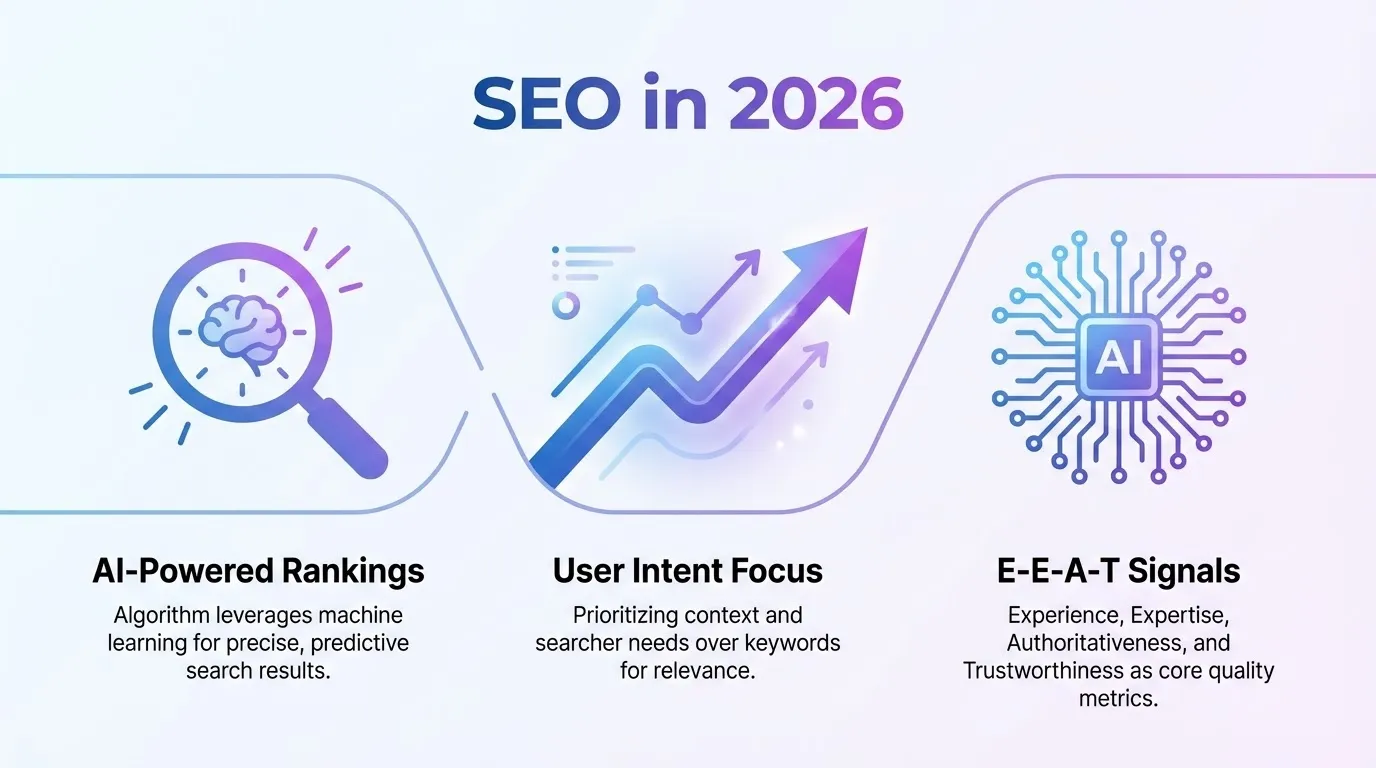
Search engine optimisation still governs:
- Google Search rankings
- Google Maps visibility
- Local pack placement
- Organic traffic flow
Google’s own documentation confirms that local ranking is determined by relevance, distance, and prominence. In practice, that means:
- Strong local intent signals
- Optimised on-page content
- Quality backlinks
- Reviews and citations
- Technical performance and Core Web Vitals
For example, if you run a dental clinic in Tanjong Pagar, your Google Business Profile, review velocity, and locally optimised service pages still directly influence whether you appear in the 3-pack. SEO still controls your discoverability inside structured results.
What Is GEO Like in 2026?
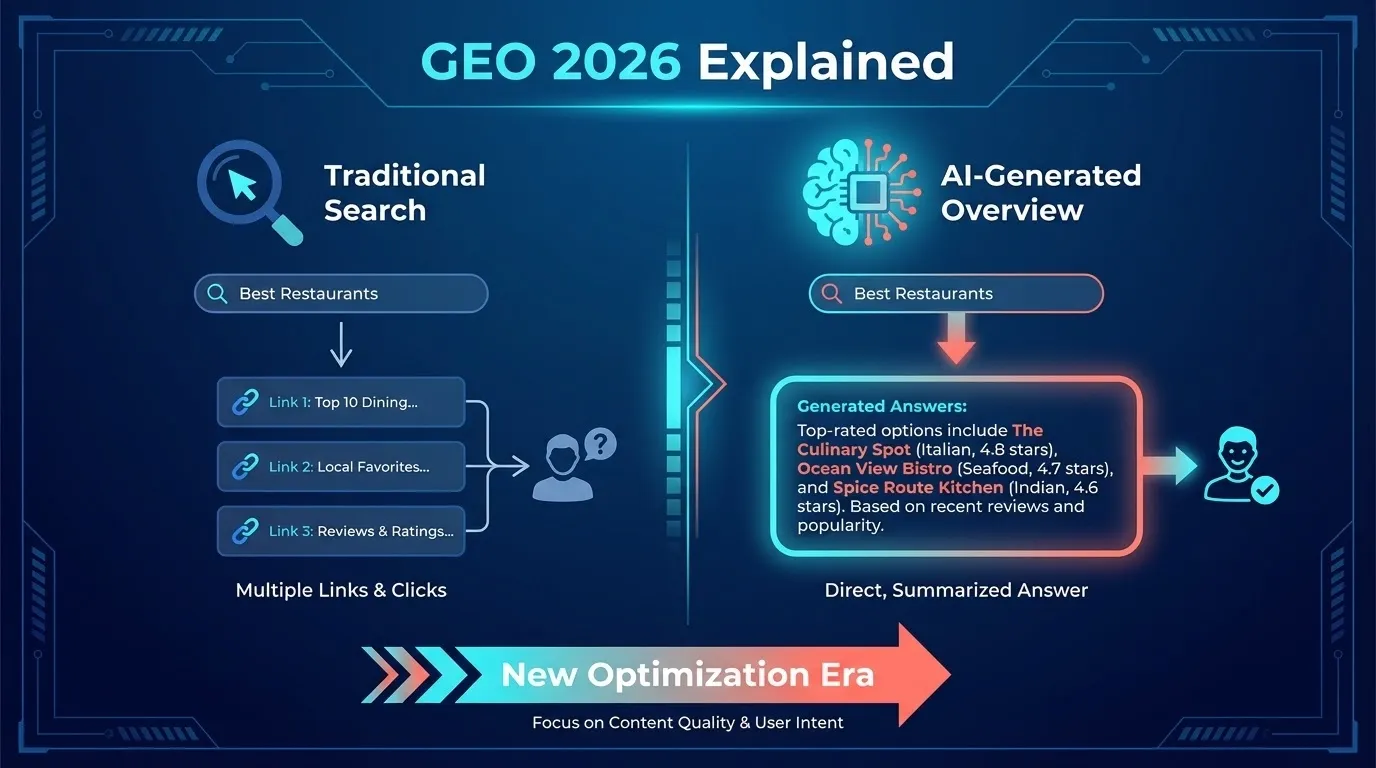
Generative Engine Optimisation influences whether your brand is cited or referenced in AI-generated answers. AI search experiences (such as Google AI Overviews) summarise multiple sources into a single answer.
According to Google’s official announcement at I/O 2023, the Search Generative Experience (SGE) (later rebranded as AI Overviews in 2024) is designed to synthesise information across sources rather than rank one page. That changes the game.
GEO focuses on:
- Structured data clarity
- Semantic coverage of topics
- Entity authority
- Brand mentions across reputable sites
- Consistent information architecture
If SEO gets you ranked, GEO gets you referenced.
GEO vs SEO: Fundamental Strategic Differences
Here is the comparison you need to internalise:
| SEO | GEO |
| Competes for ranking positions | Competes for AI citations |
| Click-driven visibility | Answer-driven visibility |
| Keyword optimisation | Topic and entity authority |
| CTR is a key metric | Mention frequency is a key metric |
In the middle of this transformation, understanding the difference between GEO and SEO means you stop chasing vanity rankings and start building visibility systems.
Why GEO vs SEO Matters for Local Businesses in 2026
Click-through rates are declining in many informational queries. According to SparkToro’s 2024 analysis of clickstream data, 58.5 percent of Google searches in the US result in zero clicks.
While that data is US-based, Singapore search behaviour mirrors global trends due to Google’s dominance, with a local market share of over 90 percent. When AI summaries answer questions directly, your website traffic may not increase even if your brand is visible.
Voice queries are also rising. PwC research from 2018 found that 71 percent of voice assistant users preferred voice search to typing.
If your content is not structured for conversational interpretation, you disappear from that layer of search.
Using GEO vs SEO for Local Search: How Google’s Local Ecosystem Has Changed
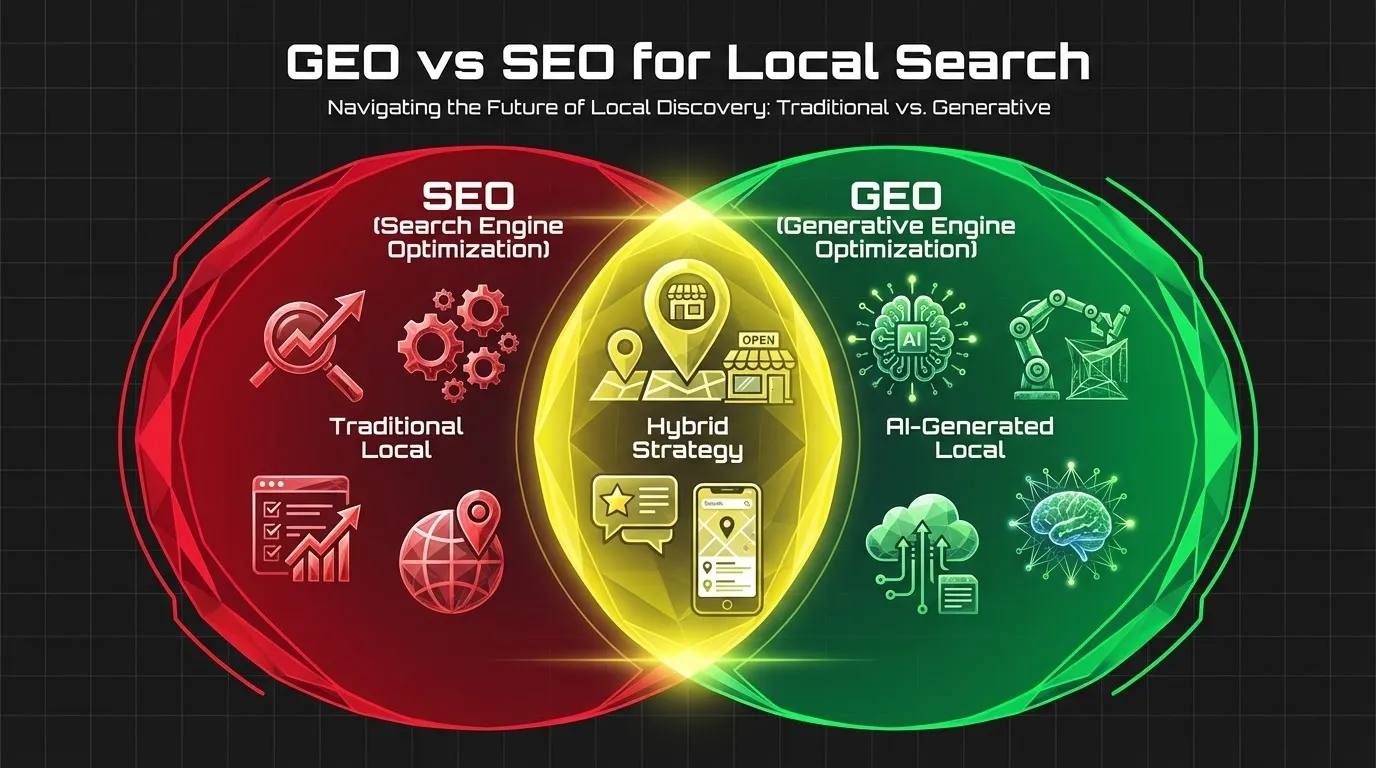
If you are still thinking about local visibility as a fight for the top three blue links, you are playing last year’s game. Google’s local ecosystem now operates on two parallel layers:
- The first is the traditional ranking layer, where your Google Business Profile, reviews, and proximity determine placement in the local pack.
- The second is the interpretive layer, where AI systems summarise, recommend, and sometimes decide on the user’s behalf.
You need to understand both layers because your prospects are interacting with both, often in the same search session.
SEO’s Role in Local Pack Rankings
Let us start with what has not disappeared. Local pack rankings are still governed by Google’s documented factors: relevance, distance, and prominence.
In practical terms, your local SEO foundation still depends on:
- Google Business Profile optimisation, including accurate categories and services
- Review count, review velocity, and star rating
- Proximity to the searcher’s physical location
- NAP consistency across directories
- Location-specific landing pages tied to real service areas
When someone in Tampines searches for “women’s clothing store near me”, Google Maps results are not random. They reflect structured listings, consistent citations, and brand signals.
Take Love, Bonito as a local example. Founded in Singapore, the brand has expanded regionally while maintaining a strong local presence and structured store listings. Their store locations consistently appear in Google Maps results, backed by accurate information and cohesive brand authority.
That is not accidental. It is the SEO infrastructure working exactly as designed. If you neglect this layer, no amount of AI optimisation will compensate for weak local signals. SEO still determines whether you are even in the competitive set.
GEO’s Role in AI-Generated Local Recommendations

Now we move to the second layer: AI-driven local recommendations do not simply replicate the local pack. They interpret data, synthesise information from multiple sources, and present curated suggestions.
AI systems evaluate the following:
- Structured schema markup that defines your business type, services, and location
- Website depth and semantic coverage of key topics
- Authoritative mentions in reputable publications and directories
- Consistency of your business entity across platforms
This is where GEO becomes strategic.
Imagine a boutique law firm in Raffles Place specialising in corporate compliance. If the firm is cited in reputable legal directories, mentioned in industry commentary, and publishes detailed service explanations on its website, AI systems are more likely to reference it when a user asks, “Which corporate lawyers in Singapore handle regulatory investigations?”
Authority compounds. The more consistently your expertise is reinforced across trusted platforms, the easier it becomes for AI systems to classify and recommend you.
Unlike traditional rankings, GEO does not require you to hold position one. It requires you to be clearly understood.
GEO vs SEO in Google’s AI Overviews and SGE Evolution
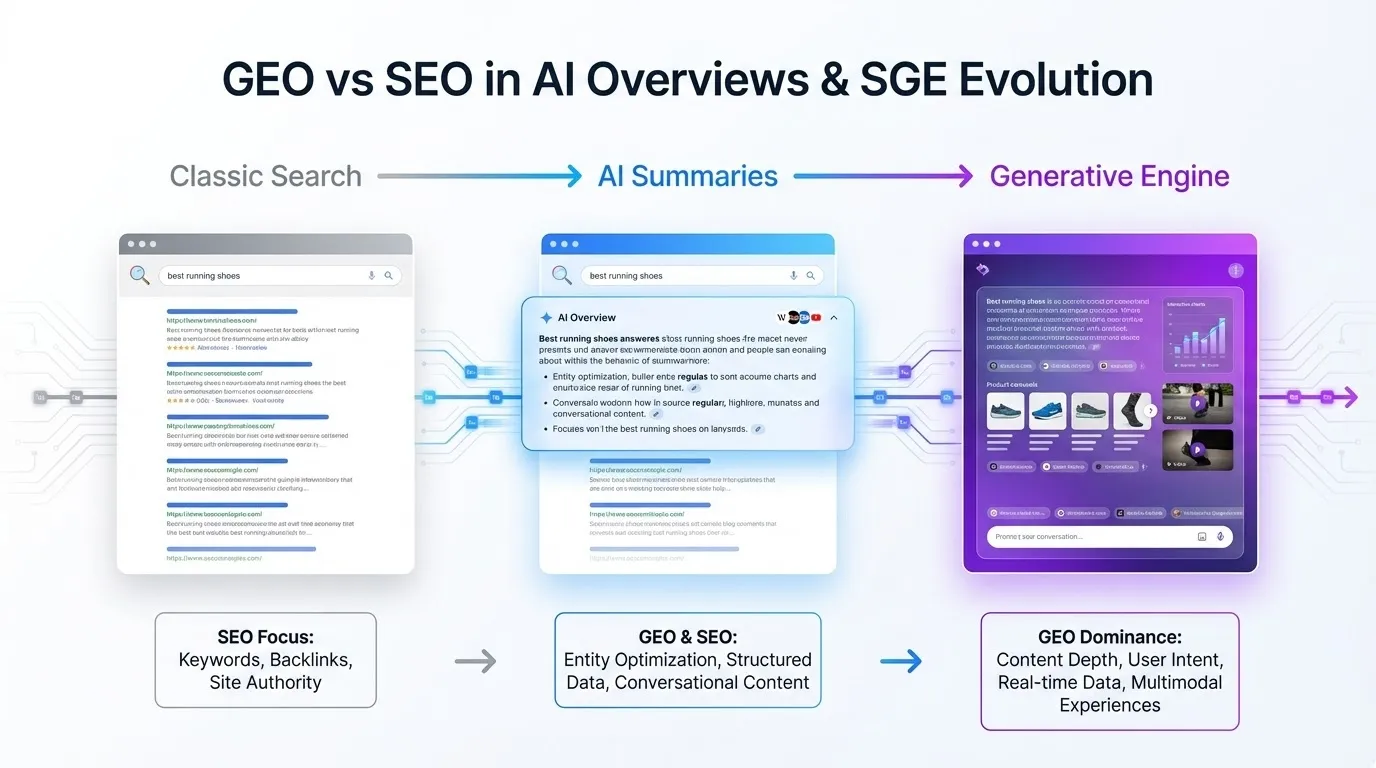
Google’s AI Overviews are designed to summarise information from multiple sources rather than promote a single page. Google confirmed this when it announced the integration of generative AI into Search in May 2023.
This shift creates three realities you cannot ignore:
- You can be mentioned in an AI summary without ranking first
- You can rank first and still not be cited
- Brand clarity directly influences inclusion
If your website content lacks depth or structured clarity, you may rank for a keyword but fail to appear in AI-generated answers. Presence now extends beyond page position. It depends on interpretability.
That is the real shift in the GEO vs SEO conversation.
GEO vs SEO Ranking Factors That Influence Local Visibility
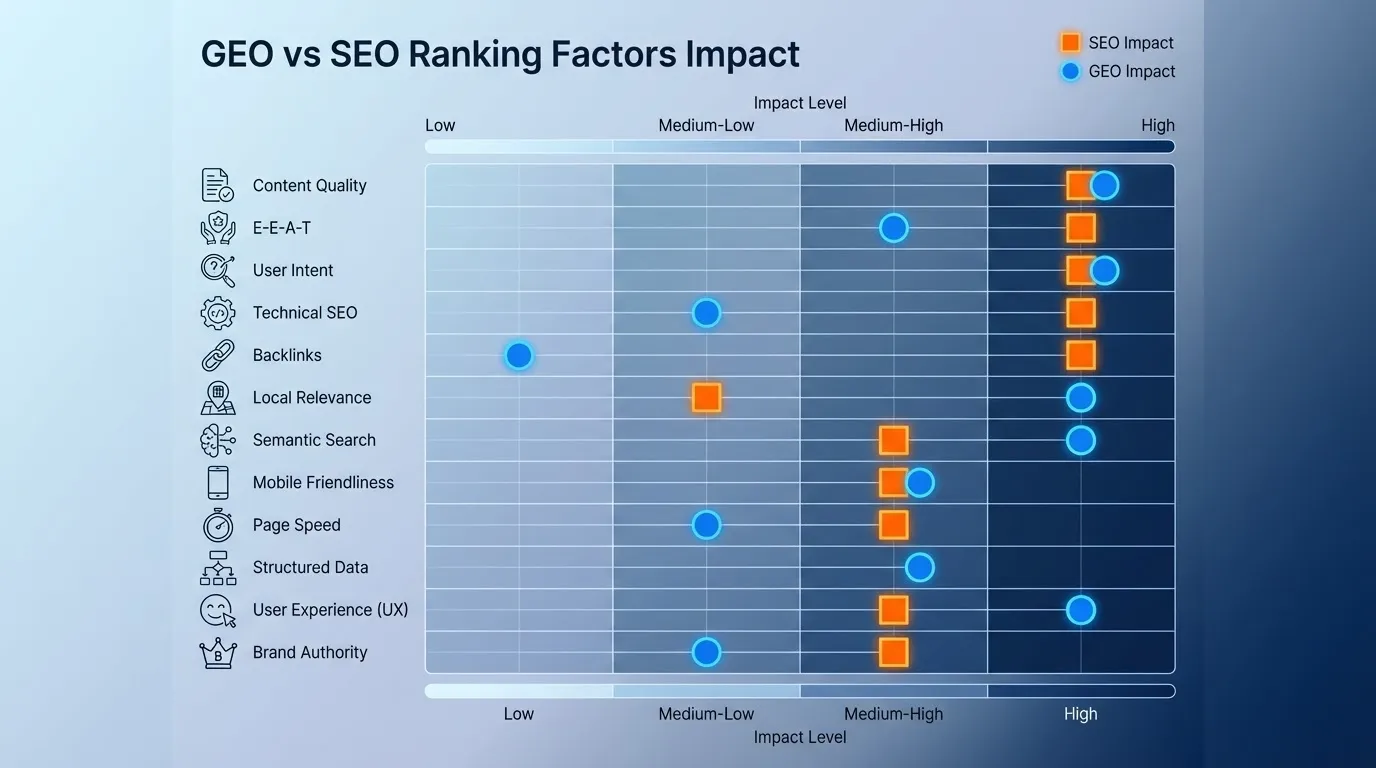
Local visibility in 2026 is not determined by a single signal. It is shaped by technical clarity, content depth, and trust reinforcement. Each layer feeds both ranking systems and AI extraction models.
GEO vs SEO: Technical Factors
Technical clarity underpins everything. Google confirms that page experience signals, including Core Web Vitals, are part of its ranking systems.
For both SEO and GEO, you need:
- Crawlable site architecture
- Clean indexation with no orphaned pages
- Fast mobile performance
- Structured data markup aligned with your business type
For SEO, these elements ensure eligibility for ranking.
For GEO, structured data becomes even more important because it improves machine interpretation. Schema markup tells AI systems what your business is, what services you provide, and how those services connect to user intent.
Without that clarity, you are harder to categorise. If you are harder to categorise, you are harder to recommend.
GEO vs SEO: Content Signals
SEO still rewards precise keyword targeting. A well-optimised page for “tuition centre in Bukit Timah” can rank if it satisfies intent and demonstrates relevance.
GEO, however, evaluates semantic breadth. Instead of a thin location page, you need layered content such as:
- Detailed programme breakdowns explaining curriculum and outcomes
- FAQs addressing parent concerns about class size, results, and teaching methodology
- Outcome data or testimonials that demonstrate credibility
- Clear subject authority positioning
This depth signals expertise. It also gives AI systems structured material to summarise. Google’s Search Quality Evaluator Guidelines emphasise E-E-A-T, which stands for Experience, Expertise, Authoritativeness, and Trustworthiness.
AI systems mirror these trust principles because they are trained to surface reliable information. If your content lacks demonstrated expertise, you reduce both ranking strength and citation potential.
GEO vs SEO: Authority and Trust Signals
Authority is the bridge between SEO and GEO. Strong authority signals include:
- High-quality reviews with descriptive content
- Citations in credible directories
- Digital PR coverage in reputable publications
- Topical clusters that reinforce subject expertise
For example, a physiotherapy clinic in Novena that consistently earns positive, detailed reviews and is mentioned in health-related publications builds prominence in Google’s local ranking framework. That same authority also strengthens AI interpretation because multiple sources confirm the clinic’s credibility.
One thing you have to remember is that trust is cumulative. It does not spike overnight.
GEO vs SEO and Zero-Click Local Searches
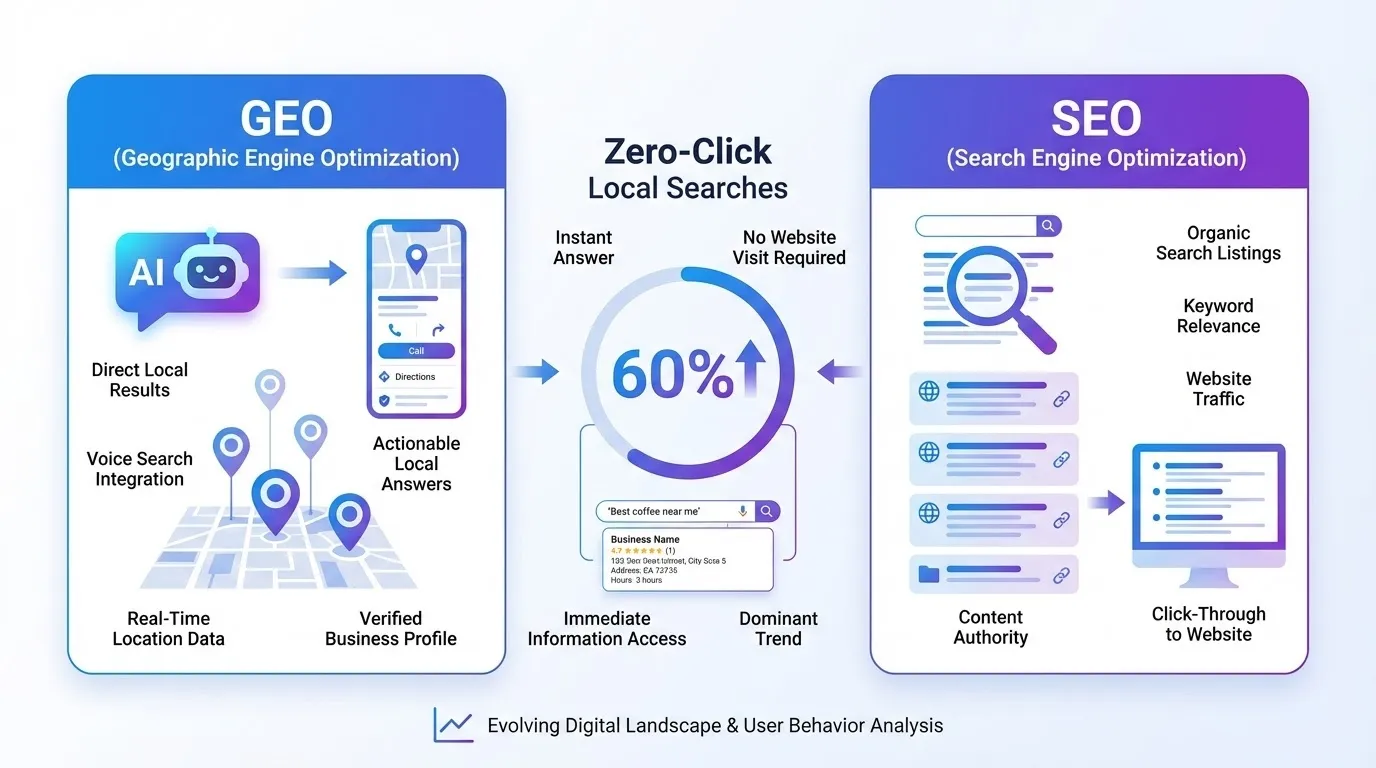
Zero-click searches are often misunderstood. SparkToro’s research indicates that nearly 60% of Google searches result in no click (58.5% in the US and 59.7% in the EU in 2024).
When AI summarises “best physiotherapy clinic in Novena”, the user may read the answer, note one or two clinic names, and then navigate directly to the brand site later.
If your brand is included in that summary, you influence the decision. If you are absent, you are invisible. That is why traffic alone is no longer a sufficient KPI.
To evaluate visibility properly, you need to track:
- Branded search growth in Google Search Console
- Direct traffic increases
- AI mention visibility through manual testing and monitoring
- Review velocity and sentiment trends
Zero-click does not mean zero impact. It means influence has shifted upstream. If you are serious about dominating local visibility in Singapore, you need to stop asking only where you rank. You need to ask where you are referenced, summarised, and remembered.
That is where the modern GEO vs SEO strategy converges.
How to Optimise for GEO vs SEO at the Same Time
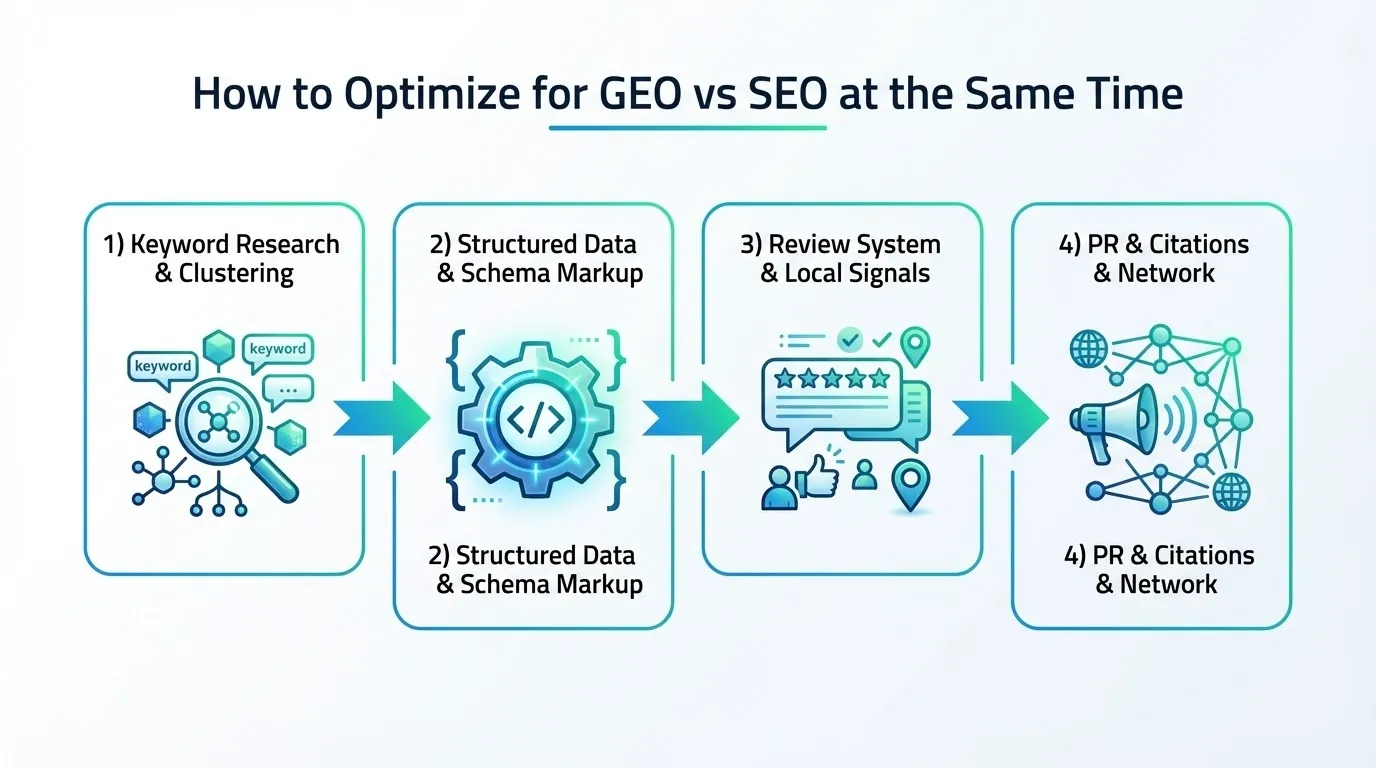
If you are still treating GEO and SEO as separate campaigns, you are creating unnecessary friction in your growth engine. In 2026, search visibility is layered.
Traditional algorithms determine rankings. Generative systems determine which brands are cited, summarised, and recommended. If you optimise for only one layer, you leave exposure on the table.
The goal is not balance for its own sake. The goal is alignment. Your content, technical structure, authority signals, and brand footprint should work in both environments without duplication or bloat.
Here is how you build that system properly:
1. Combine Keyword Research with Topic Clustering
Traditional SEO keyword research tells you what people search. Topic clustering tells you how those queries connect.
Instead of building isolated pages such as:
- “Best renovation contractor Singapore”
- “Kitchen renovation cost Singapore”
You structure a cluster:
- Pillar page: Complete guide to home renovation in Singapore
- Supporting pages:
- Kitchen renovation cost breakdown in SGD
- HDB renovation permit requirements
- Timeline expectations for BTO upgrades
- Contractor selection checklist
Why this works:
- SEO benefits from internal linking and topical depth.
- GEO benefits from semantic clarity and entity reinforcement.
When AI systems evaluate your site, they see structured authority, not scattered articles.
2. Implement Structured Data with Intent
Structured data is not a checkbox. It is a translation layer between your business and machine interpretation.
At minimum, ensure:
- LocalBusiness schema
- Service schema
- FAQ schema where appropriate
- Review schema with correct markup
This helps search engines understand what you offer, where you operate, and how customers rate you.
For GEO, structured data improves extractability. AI systems parse structured information more reliably than unstructured prose.
3. Build a Review Acquisition System, Not a One-Off Campaign
Reviews influence:
- Local pack ranking
- Click-through behaviour
- AI summary sentiment
You need a systematic process that encourages satisfied customers to leave feedback across platforms such as Google, Facebook, and relevant directories.
Consistency matters more than volume spikes. A steady stream of authentic reviews reinforces trust signals that both ranking systems and generative systems rely on.
4. Invest in Authority-Building PR and Citations
Backlinks still matter. Brand mentions matter even more in a generative environment.
Focus on:
- Industry publications
- Local media coverage
- Professional directories
- Thought leadership contributions
When authoritative sources consistently associate your brand with specific services or expertise, entity strength increases. AI systems draw from those external signals when forming summaries.
This hybrid model ensures that you are not merely visible. You are recognised.
Content Strategies That Support GEO vs SEO
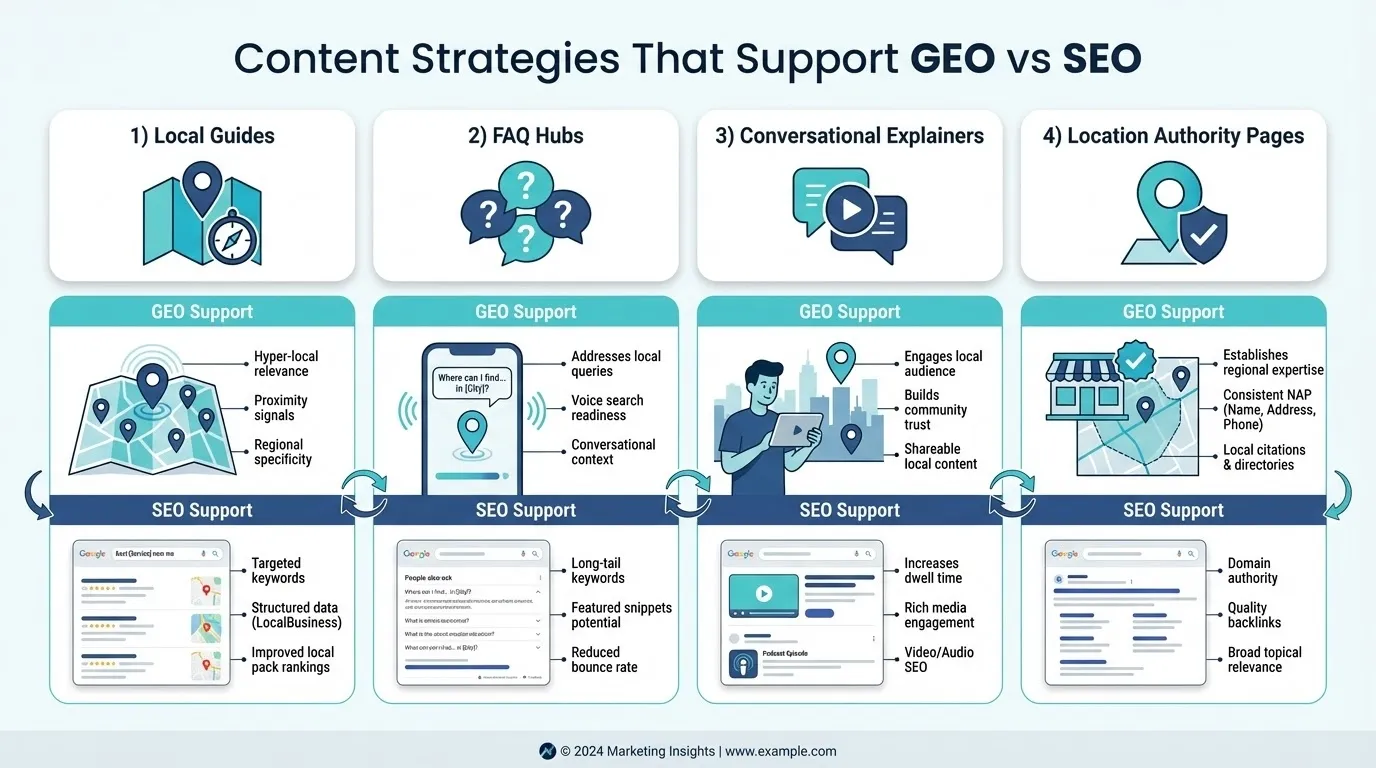
Content is where most businesses either excel or sabotage themselves. If your content is thin, repetitive, or overly optimised for a single keyword, you weaken both ranking and citation potential. Instead, build assets that serve humans first while remaining structurally clear for machines.
Here are four formats that consistently support both goals:
Local Guides
Create comprehensive guides tailored to specific areas.
For example:
- “Complete Guide to Hiring a Property Agent in Tampines”
- “What to Expect from a Dental Implant Procedure in Novena”
A strong local guide includes:
- Contextual details about the area
- Clear service explanations
- Cost ranges in SGD
- FAQs based on real customer concerns
This format signals local relevance for SEO and provides extractable information for AI summaries.
FAQ Hubs
FAQ sections are powerful because they mirror conversational queries. Instead of scattering short FAQs across multiple pages, build structured hubs organised by service category.
Ensure:
- Each question is written in natural language
- Answers are clear and complete
- Related questions are internally linked
This improves long-tail ranking and increases the likelihood of AI citation.
Conversational Explainers
Write content that anticipates real user concerns.
For example:
- “How long does a corporate tax filing take in Singapore?”
- “Is laser hair removal safe for darker skin tones?”
Avoid robotic formatting. Provide context, steps, and clarifications. AI systems favour content that resolves ambiguity.
Location Authority Pages
For multi-location businesses, create pages that are genuinely local. Each page should include:
- Unique service details
- Local testimonials
- Area-specific context
- Embedded maps
- Structured NAP information
Duplicated templates weaken authority. Distinct, well-developed location pages strengthen both ranking and entity clarity. Depth improves interpretability. Interpretability improves inclusion.
Technical Checklist for GEO vs SEO in 2026
Before you scale traffic campaigns, increase ad spend, or invest another SGD 10,000 into paid acquisition, pause and audit your technical foundation. You would be surprised how many Singapore businesses invest heavily in content and ads while their structural signals quietly undermine performance.
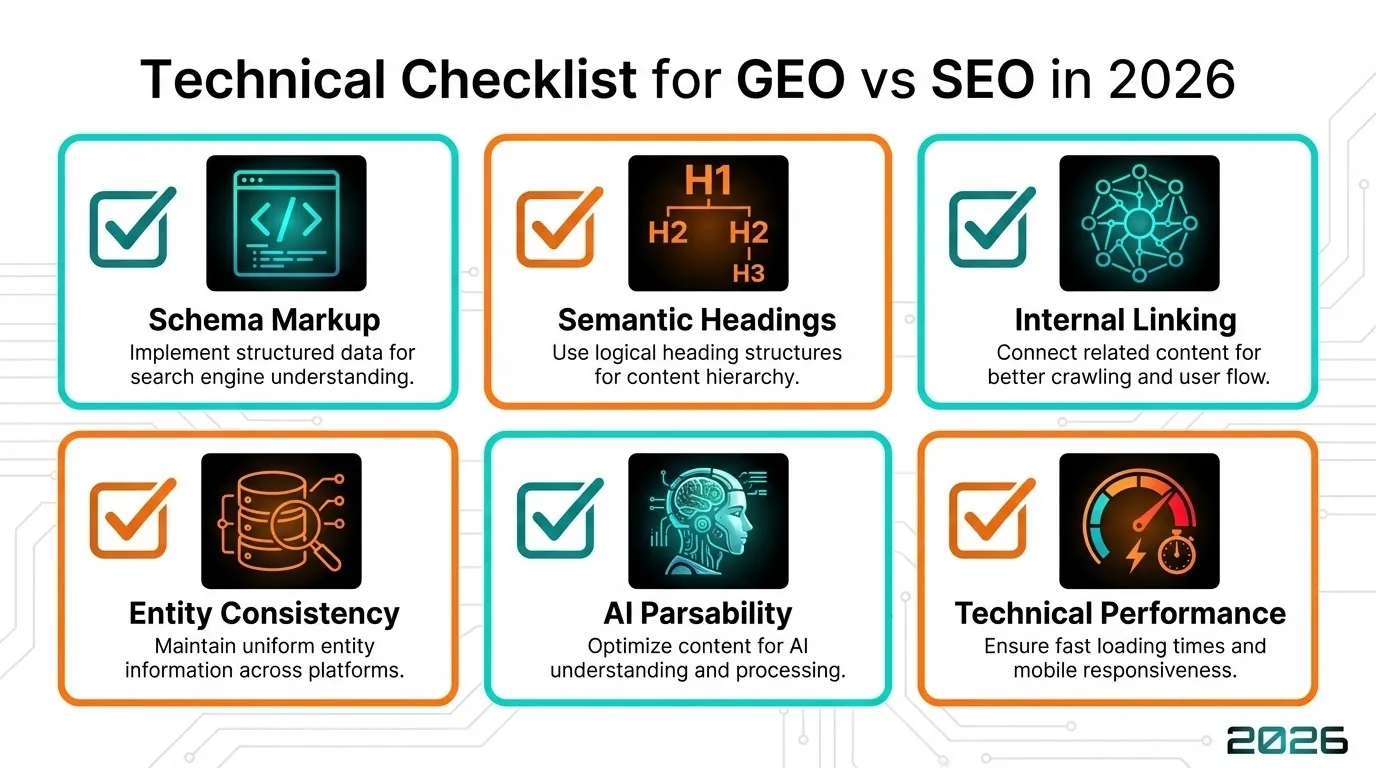
Even the strongest content strategy will struggle if search engines and generative systems cannot clearly interpret your site. In 2026, clarity is no longer optional. It is infrastructure. Below is a practical, field-tested checklist you should walk through before pushing growth:
1. Schema Markup Accuracy
Structured data is not decoration. It is a machine-readable context.
Search engines rely on schema markup to understand your business type, services, pricing signals, reviews, and location attributes. Generative systems rely on it even more heavily because it reduces ambiguity when synthesising answers.
Start with validation.
- Use Google’s Rich Results Test
- Use Schema Markup Validator
- Check Google Search Console for structured data errors
Beyond validation, ensure your implementation is logically accurate.
You should confirm:
- Your primary business category matches your actual service focus
- Sub-services are correctly mapped under relevant schema types
- There are no duplicate or conflicting business entities
- Review schema aligns with the visible on-page reviews
For example, if your company in Bishan offers “corporate tax filing,” it should not be generically marked as “Consulting Services.” It should reflect a specific and accurate service category.
Conflicting structured data creates confusion for crawlers and generative systems. When AI tools detect inconsistencies, they downgrade trust signals silently. You will not receive a warning. You will simply lose visibility.
2. Semantic Heading Structure
Your heading structure is not a design decision. It is a machine hierarchy map.
Large language models and search crawlers both use heading structures to determine topical depth and content relationships. If your structure is vague, your interpretation will be vague.
Avoid generic headings such as:
- “Our Services”
- “What We Do”
- “Learn More”
Instead, use headings that reflect search intent and semantic clarity. For example:
- “Corporate Tax Filing Services in Singapore”
- “Renovation Permit Requirements for HDB Flats”
- “Childcare Centre Licensing Process in Jurong”
Notice the specificity. Location signals. Service clarity. Contextual detail.
- Your H1 should define the primary topic.
- Your H2 sections should break down core themes.
- Your H3 sections should expand into supporting explanations.
When heading structures mirror topic hierarchy, both SEO and GEO systems process your site more efficiently.
You are not just formatting content. You are teaching machines how to read your expertise.
3. Internal Linking Architecture
Internal linking is one of the most underleveraged levers in modern optimisation. In 2026, internal links serve two purposes:
- Reinforcing topical authority clusters for SEO
- Clarifying semantic relationships for generative AI
You should not be randomly linking between pages. You should be constructing intentional content ecosystems.
A strong structure looks like this:
- A pillar page targeting a core commercial topic
- Supporting guides that expand into subtopics
- Contextual cross-links between related services
- Clear navigation paths between informational and transactional content
For example, if you operate a renovation firm in Singapore:
- Your pillar page could target “HDB Renovation Services in Singapore”
- Supporting pages might cover “HDB Renovation Permit Rules”, “BTO Renovation Timeline”, and “Estimated Renovation Costs in SGD”
- Each supporting guide links back to the pillar
- Related services such as electrical rewiring or carpentry reference each other logically
This creates a coherent authority cluster rather than isolated landing pages. Search engines reward topic depth. Generative engines reward relationship clarity.
When your internal linking reinforces semantic connections, you increase the probability that AI systems reference your content in contextual answers.
4. Entity Consistency Across Platforms
Inconsistent business data weakens trust faster than most marketers realise. Search engines build entity profiles for your brand. Generative systems rely on those entity profiles when summarising or recommending businesses.

You must audit consistency across:
- Website
- Google Business Profile
- Industry directories
- Local listing platforms
- Social media profiles
Specifically check:
- Business name format
- Address structure
- Phone number formatting
- Service descriptions
- Opening hours
If your website lists “ABC Accounting Pte Ltd” but directories list “ABC Accounting”, that inconsistency creates entity fragmentation.
If your Marina Bay office address is formatted differently across platforms, you introduce ambiguity. Small inconsistencies accumulate.

You are training machines to recognise your brand. Repetition builds authority. Variation weakens it.
5. AI Parsability and Content Formatting
Beyond traditional SEO, you must now consider AI parsability. Generative systems extract structured insights from your content. If your pages are large, unstructured text blocks without logical formatting, you reduce extraction accuracy.
Improve machine readability by:
- Using descriptive subheadings
- Adding concise explanatory paragraphs
- Incorporating FAQ sections where appropriate
- Structuring lists clearly
- Avoiding overly dense content blocks
This does not mean writing for robots. It means writing with structure. When formatting supports clarity, you improve both human comprehension and machine interpretation.
6. Technical Performance and Mobile Experience
Singapore has one of the highest mobile penetration rates globally at 166 percent. According to DataReportal, internet penetration in Singapore reached 98.4 percent as of late 2025.
Your audience is searching on mobile. Google confirmed that page experience and mobile usability remain ranking signals. You should test:
- Mobile responsiveness
- Page load speed
- Core Web Vitals
- HTTPS security
- Broken links
If your site is slow or unstable, AI systems may crawl it less efficiently. Users may abandon it faster. Both signals influence long-term visibility.
Why This Checklist Matters
Many businesses assume optimisation is about publishing more content or buying more backlinks. In reality, technical clarity compounds over time.
When your schema is accurate, your headings are semantic, your internal links are intentional, and your entity signals are consistent, you create a foundation that supports both ranking systems and generative systems.
Confusion compounds faster than clarity. When machines are uncertain about who you are, what you offer, or where you operate, they default to competitors with cleaner signals.
In 2026, optimisation is no longer about gaming algorithms. It is about removing ambiguity. The businesses that win in GEO and SEO are not necessarily louder. They are clearer.
GEO vs SEO: Leading Local Search Instead of Chasing It
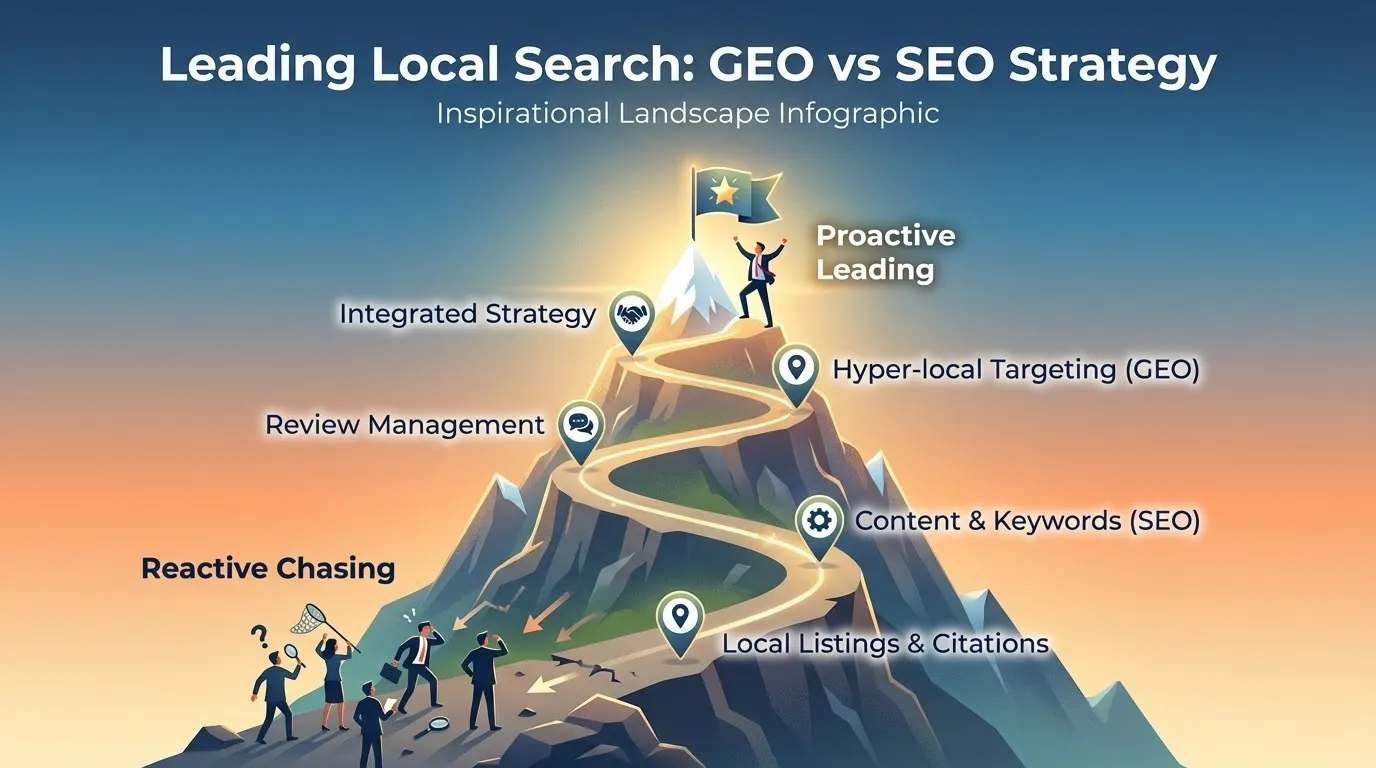
Local search in 2026 rewards clarity, authority, and strategic alignment. If you are still treating optimisation as a rankings game, you are already reacting to yesterday’s rules. The businesses that lead today design their visibility around how search actually works now.
That means building technical precision, semantic depth, and entity authority into your foundation from the start.
You do not need more scattered tactics. You need a unified system. One that strengthens your Google Business Profile, sharpens your content architecture, reinforces structured data, and increases your brand’s likelihood of being referenced in AI-generated answers. That is the difference between appearing occasionally and being consistently surfaced across touchpoints.
When you approach GEO vs SEO as a single strategic framework, you stop chasing fluctuations in rankings and start controlling how your brand is interpreted across search ecosystems. That shift is what protects long-term visibility.
If you are serious about strengthening your local search position in Singapore, speak with MediaOne. Our team builds integrated SEO and GEO strategies designed for measurable authority and sustainable growth.
Call MediaOne to discuss how a structured approach to GEO vs SEO can position your business ahead of competitors who are still optimising for yesterday’s search landscape.
Frequently Asked Questions
Is GEO replacing SEO in 2026?
No. Google has confirmed that its core ranking systems still operate alongside AI Overviews, which supplement traditional results rather than replace them. GEO influences how AI systems summarise and cite information, while SEO determines how pages rank. In practice, both systems operate simultaneously, meaning businesses need to optimise for ranking and AI interpretation.
How does AI decide which local businesses to recommend?
Google states that its systems evaluate relevance, distance, and prominence for local results. AI Overviews then synthesise information from multiple authoritative sources rather than relying on a single ranking position. This means structured data clarity, strong reviews, and third-party authority signals influence whether a business is referenced in AI-generated responses.
Does structured data improve AI search visibility?
Google confirms that structured data helps its systems understand page content and may enable enhanced search features. While structured data alone does not guarantee inclusion in AI summaries, it improves machine readability and reduces ambiguity. Clear schema strengthens both SEO signals and generative interpretation.
How do zero-click searches affect local businesses?
Independent clickstream research shows that a significant percentage of searches end without a click. This trend increases when AI summaries answer queries directly. For local businesses, this means visibility may grow even when traffic does not, making brand recall and impression tracking more important than raw clicks.
Should small businesses invest in AI-focused optimisation now?
Google continues to expand AI-generated experiences across search. Early adoption helps businesses build authority before competitive saturation increases. Investing in GEO alongside SEO ensures that your brand is visible in both traditional rankings and AI-curated responses as search evolves.