

Search has changed dramatically over the past few years, and if you are working in SEO today, you have probably felt it first-hand. Traditional link building tactics that once delivered predictable gains are now less reliable, harder to scale, and in some cases, risky. This shift is also reflected in industry sentiment, with nearly half of SEO professionals (48.6%) now viewing digital PR as the most effective link-building approach heading into 2026, ahead of traditional outreach and other link building strategies.
At MediaOne, we see this change playing out across industries and markets, particularly in Singapore where competition is intense and trust signals carry more weight than ever. This is where digital PR SEO has moved from a supporting tactic to a critical strategy for sustainable search performance.
Digital PR is no longer simply a branding exercise or a “nice to have” add-on. When executed strategically, it has become one of the most effective ways to earn authoritative backlinks, build brand credibility, and support long-term organic growth. This guide explores how digital PR for SEO works in today’s search landscape, why PR link building has overtaken traditional outreach, and how businesses can apply it strategically to remain competitive in the years ahead.
Key Takeaways
- Digital PR SEO focuses on earning high-quality editorial coverage that strengthens authority, not just building links at scale.
- PR link building differs from traditional link building because it relies on genuine newsworthiness, expertise, and trust.
- In 2026, search engines place greater value on brand mentions, editorial context, and topical relevance than on link volume.
- Digital PR supports SEO performance indirectly by reinforcing EEAT signals and brand credibility.
- Measuring success requires looking beyond backlinks to include visibility, referral traffic, and brand search growth.
What Digital PR SEO Really Means in 2026
At its core, digital PR SEO is about using public relations strategies to earn online coverage that genuinely supports search performance. This includes editorial backlinks, brand mentions, citations, and visibility across trusted digital publications. In 2026, however, the definition goes far beyond simply “getting links from news sites”.
Search engines are now far more sophisticated in how they interpret off-page signals. They assess why a brand is mentioned, where that mention appears, and how it connects to a wider topical narrative. A link earned because a journalist referenced original data, expert insight, or first-hand experience carries significantly more weight than a link placed through templated outreach or paid placements.
This is because effective digital PR SEO sits at the intersection of three distinct disciplines, each playing a specific role in building search authority.
Search engine optimisation
SEO provides the strategic foundation that ensures digital PR activity aligns with how search engines evaluate relevance and authority. This includes identifying priority topics, understanding keyword landscapes, and mapping earned coverage back to commercial or informational search intent. Without this layer, PR coverage may generate visibility but deliver little long-term SEO value.
Journalism and storytelling
Journalism shapes how a brand earns attention. Journalists are not looking for promotional content. They are looking for stories, insights, data, and expert perspectives that add value to their audience. Digital PR applies journalistic thinking to content creation, ensuring that campaigns are genuinely newsworthy rather than manufactured for links.
Brand authority building
Brand authority is what turns individual mentions into cumulative trust. Consistent coverage across reputable publications reinforces a brand’s expertise within a specific subject area. Over time, this creates a recognisable digital footprint that search engines associate with credibility, experience, and trustworthiness, even beyond individual backlinks.
When these three elements work together, the result is coverage that competitors struggle to replicate, remains resilient through algorithm updates, and delivers value that extends well beyond rankings alone.
Why Digital PR Has Become a Core SEO Strategy

SEO has always been about trust, even if we did not always describe it that way. In the early days of search, trust was often inferred through volume. The more links a website had, the more authoritative it appeared. Today, that approach no longer holds. Modern search engines evaluate trust through authority, relevance, and consistency across the wider web, rather than through link quantity alone.
Search engines such as Google now place greater emphasis on a specific set of off-page signals that digital PR is uniquely positioned to deliver.
Editorially earned links
Editorially earned links are links that exist because a journalist or publisher chose to reference a brand organically within their content. These links are not requested, traded, or placed through agreements. They are earned on merit.
From an SEO perspective, this matters because editorial links are embedded within meaningful content, surrounded by relevant context. They signal to search engines that a brand is being cited as a legitimate source, rather than promoted artificially. Over time, these links contribute to stronger domain-level trust and improved resilience against algorithm updates.
Mentions from authoritative publishers
Authority is not just about links. Being mentioned consistently by reputable publishers helps search engines understand which brands are influential within a given space. Mentions from trusted publications, industry platforms, and recognised media outlets reinforce brand legitimacy, even when a link is not present.
Digital PR increases the likelihood of these mentions by placing brands within credible editorial environments. This creates a pattern of recognition that supports SEO performance in ways that traditional link building often cannot replicate.
Contextual relevance to a brand’s expertise
Search engines now evaluate not only where a brand appears, but why it appears there. Contextual relevance refers to how closely a mention aligns with a brand’s actual area of expertise.
Digital PR campaigns that focus on expert commentary, data insights, and subject-specific analysis ensure that coverage is thematically consistent. This helps search engines associate a brand with particular topics, strengthening topical authority and improving visibility for related search queries.
Signals that indicate real-world credibility
Modern algorithms increasingly look for signals that suggest a brand exists and operates credibly beyond its own website. These signals include media coverage, expert attribution, consistent branding across trusted platforms, and recognition within an industry.
Digital PR contributes to these signals by demonstrating that journalists, editors, and independent publishers consider the brand worth referencing. This mirrors real-world credibility and supports trust at an algorithmic level.
Digital PR addresses all of these areas simultaneously. Unlike traditional SEO link building, which often focuses narrowly on anchor text optimisation or domain metrics, digital PR embeds a brand within credible narratives that search engines already trust. As a result, it aligns far more closely with how modern algorithms evaluate quality and authority.
For competitive markets like Singapore, where many businesses operate within crowded niches and face similar on-page optimisation challenges, digital PR SEO has become one of the few remaining ways to create a meaningful and defensible off-page advantage.
How PR Link Building Is Different From Traditional Link Building
Although both approaches aim to improve SEO performance, a good SEO agency in Singapore knows that PR link building operates under a completely different set of rules.
- Editorial intent versus transactional intent: Traditional link building is transactional by nature. Emails are sent with the expectation of a link in exchange for content, payment, or some other incentive. Journalists and editors do not operate this way. PR link building works because the content itself is valuable. Journalists link because it enhances their article, not because they were asked to. This editorial intent is exactly what search engines value most.
- Brand authority versus anchor text control: In conventional link building, anchor text optimisation is often a primary focus. In digital PR SEO, anchors are typically branded or natural. While this may seem less powerful on the surface, branded anchors contribute to trust signals that algorithms increasingly reward. Over time, strong brand signals make all of your pages more competitive, not just the ones receiving links.
- Why journalists are not link vendors: A common mistake businesses make is approaching journalists as if they were website owners open to link placement. Reputable publications protect their credibility carefully. Digital PR respects this by focusing on stories, data, and insights that journalists genuinely want to cover.
This distinction is crucial for sustainable PR link building.
The Role of Digital PR in EEAT and Trust Signals
Experience, Expertise, Authority, and Trustworthiness are no longer abstract concepts. They are reflected in how brands appear across the digital ecosystem.
Digital PR strengthens EEAT by:
- Positioning subject matter experts as credible voices
- Associating brands with trusted publications
- Reinforcing topical authority through consistent coverage
- Supporting reputational signals beyond your own website
Even unlinked brand mentions can contribute to this ecosystem. While they may not pass traditional link equity, they help search engines understand brand prominence and legitimacy, especially when repeated across authoritative sources.
Digital PR SEO Tactics That Work in 2026
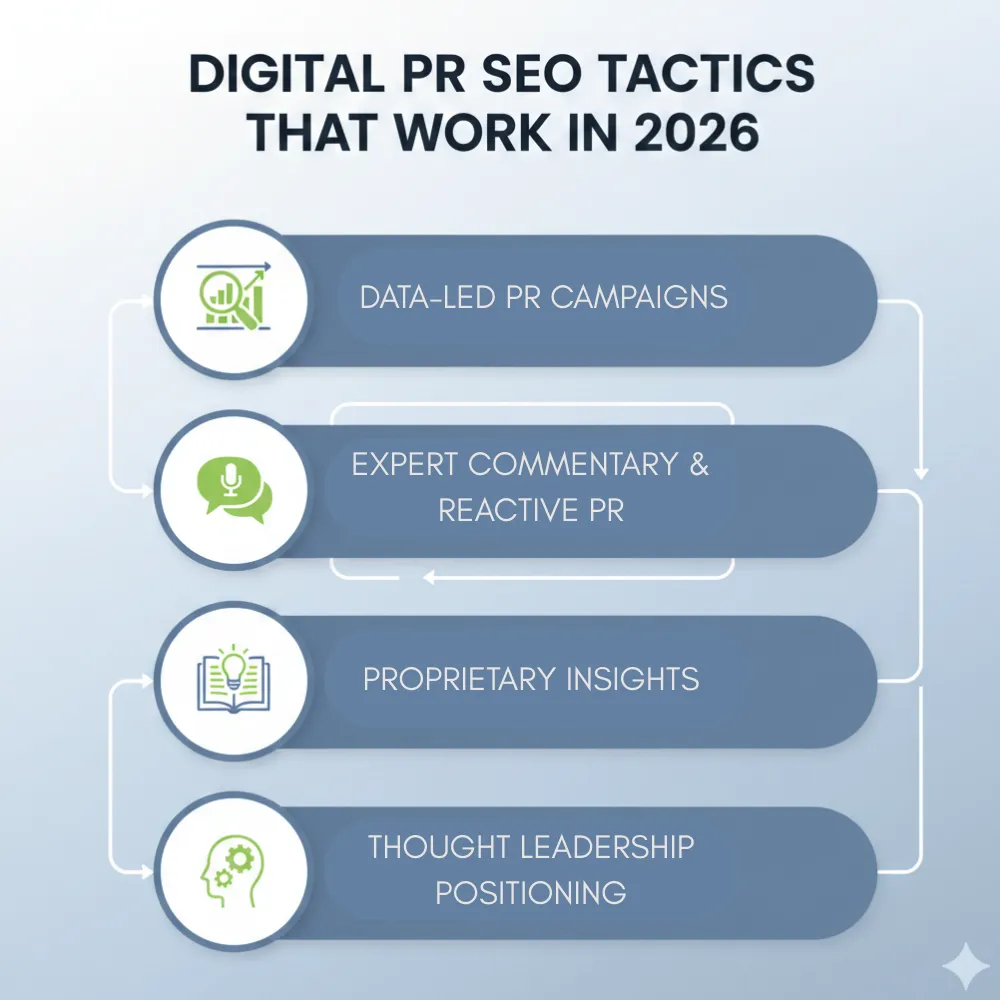
Digital PR has matured significantly, and not all tactics are equally effective. Below are approaches that consistently deliver SEO value today.
Data-led PR campaigns
Original data remains one of the most powerful digital PR assets. Journalists are constantly looking for statistics, trends, and insights that support their stories.
Examples include:
- Industry surveys
- Market trend analysis
- Consumer behaviour studies
- Aggregated anonymised internal data
The key is relevance. Data must align closely with your industry and expertise, otherwise coverage may not support SEO goals meaningfully.
Expert commentary and reactive PR
Becoming a reliable source for journalist queries is an effective way to earn recurring coverage. Expert commentary positions your brand as knowledgeable and current.
This tactic works particularly well when:
- Experts respond quickly
- Insights are specific and actionable
- Commentary adds clarity rather than promotion
Over time, this builds a strong association between your brand and particular topics.
Proprietary insights and first-hand experience
In 2026, first-hand experience matters more than ever. Content rooted in actual practice, observations, and outcomes stands out in a sea of generic material.
Sharing lessons learned, anonymised case patterns, or operational insights helps journalists tell more credible stories while reinforcing your authority.
Thought leadership positioning
Thought leadership is not about opinion pieces alone. It is about contributing perspectives that help readers understand complex issues.
Effective thought leadership:
- Addresses real challenges in the industry
- Offers informed viewpoints supported by experience
- Avoids promotional language
When published on reputable platforms, it strengthens both brand perception and SEO authority.
Proactive versus reactive digital PR
Reactive PR responds to existing news, while proactive PR creates stories worth covering. A balanced strategy uses both.
Reactive PR delivers speed and topical relevance. Proactive PR builds long-term authority through planned campaigns. Together, they form a resilient digital PR SEO approach.
How Digital PR Assets Compare for SEO Value
The table below outlines how different digital PR assets contribute to SEO outcomes.
| Digital PR Asset Type | SEO Value | Authority Signal | Best Use Case |
| Original data studies | Very high | Editorial trust | Authority building |
| Expert commentary | High | EEAT reinforcement | Ongoing visibility |
| News analysis | Medium to high | Topical relevance | Timely exposure |
| Thought leadership | High | Brand credibility | Long-term trust |
| Brand announcements | Low to medium | Awareness | Supporting role |
This comparison highlights why strategy matters more than volume. Not all digital PR coverage delivers the same SEO impact, particularly in regulated or trust-sensitive industries such as healthcare, law, and education. The value of each asset type depends heavily on how and why it earns coverage.
Original data studies
Original data studies deliver some of the strongest SEO value because they give journalists something genuinely new to reference. In regulated industries, this does not require publishing medical claims or legal advice. Instead, brands can share anonymised, aggregated, or observational insights.
For example:
- A healthcare provider may release anonymised data on appointment booking trends or common patient concerns over a specific period, without drawing diagnostic conclusions.
- A law firm could publish an analysis of publicly available court filings to highlight trends in employment disputes or family law cases in Singapore.
- An education provider might share survey results on student learning preferences or skills gaps identified by employers.
In each case, journalists reference the data as a source, earning editorial backlinks that signal authority and trust. From an SEO perspective, these links are powerful because they are rooted in original research rather than opinion.
Expert commentary
Expert commentary works particularly well in industries where credibility and experience matter. Journalists frequently seek professional perspectives to add depth to their stories.
For example:
- A medical specialist might provide high-level commentary on public health trends or patient education issues, without offering treatment advice.
- A lawyer could comment on the implications of new regulations or court decisions, focusing on interpretation rather than instruction.
- An education consultant may be quoted on curriculum changes, assessment trends, or student development challenges.
These mentions often result in branded or natural links, reinforcing EEAT signals. Even when links are not included, repeated expert attribution strengthens brand authority and supports SEO indirectly through recognition and trust.
News analysis
News analysis focuses on responding to current events or industry developments with informed insight. This is particularly effective when regulations, policies, or sector-wide changes occur.
For instance:
- A healthcare organisation might provide contextual analysis following changes to national screening guidelines, explaining what the change means at a high level for public awareness.
- A law firm could analyse the broader implications of a new compliance requirement for businesses.
- An education provider may comment on examination reforms or shifts in admission criteria.
From an SEO standpoint, news analysis builds topical relevance. Coverage is time-sensitive, but it helps search engines associate the brand with up-to-date, authoritative discussion within its field.
Thought leadership
Thought leadership focuses less on reacting to news and more on shaping industry conversations over time. This asset type is especially valuable for long-term SEO authority.
For instance:
- In healthcare, this may involve discussing challenges in patient education or healthcare accessibility without promoting specific services.
- In law, it could mean exploring ethical considerations, emerging risks, or future regulatory trends.
- In education, thought leadership might examine how learning models are evolving or how students can be better prepared for future careers.
These pieces are often published on reputable platforms or cited by industry media. While they may not generate immediate traffic spikes, they contribute to sustained brand credibility and long-term trust signals that support organic visibility.
Brand announcements
Brand announcements generally deliver the lowest SEO value on their own, but they still play a supporting role when used carefully. Examples include clinic openings, leadership appointments, accreditation milestones, or programme launches.
In regulated industries, announcements must be factual and non-promotional. While they rarely earn high-value editorial links, they help maintain a consistent digital footprint and can support brand awareness when picked up by industry publications.
From an SEO perspective, brand announcements work best when they complement stronger digital PR assets rather than replace them.
Measuring Digital PR SEO Success Beyond Link Counts
One of the biggest mistakes teams make is evaluating digital PR solely by the number of backlinks earned. While links remain important, they are only part of the picture.
More meaningful metrics include:
- Quality and relevance of referring domains: This looks at whether links and mentions come from authoritative publications that are contextually aligned with your industry, rather than from sites that exist purely to host links.
- Referral traffic and engagement: High-quality digital PR placements should send relevant users to your site who spend time engaging with content, not just inflate backlink reports.
- Growth in branded search queries: Increased searches for your brand name indicate rising awareness and trust, which are strong indirect signals that digital PR is improving overall search authority.
- Visibility across authoritative publications: Consistent mentions across respected media outlets help establish a recognisable and credible brand footprint that search engines associate with expertise.
- Assisted conversions and influence on buyer journeys: Digital PR often supports conversions indirectly by building familiarity and confidence earlier in the decision process, even if the final conversion happens through another channel.
Digital PR SEO often works indirectly. It supports discoverability, credibility, and conversion readiness over time rather than delivering immediate ranking jumps.
Common Digital PR Mistakes That Undermine SEO

Even well-intentioned campaigns can fall short if certain pitfalls are not addressed.
- Chasing quantity over relevance: A handful of relevant, authoritative mentions will almost always outperform dozens of low-quality placements. Relevance to your core topics is critical.
- Over-optimised messaging: Journalists are quick to spot promotional language. Overly branded messaging reduces coverage potential and credibility.
- Treating press releases as PR strategy: Press releases still have a place, but they are not a substitute for genuine digital PR. Search engines recognise the difference between earned editorial content and syndicated announcements.
- Ignoring topical consistency: Authority builds through repetition and focus. Scattered coverage across unrelated topics dilutes SEO impact.
Digital PR SEO is not a quick win, and that is precisely why it works. By earning trust gradually and authentically, brands create an off-page foundation that supports rankings, resilience, and reputation over time.
At MediaOne, we approach digital PR as part of a broader SEO ecosystem, ensuring that earned coverage aligns with on-site content, technical foundations, and long-term business goals. When executed strategically, PR link building becomes a powerful driver of sustainable organic growth rather than a standalone tactic.
If you are looking to strengthen your brand authority and future-proof your SEO strategy, digital PR is no longer optional. It is a core component of how search visibility is built in 2026 and beyond. Contact us today!
Frequently Asked Questions
How long does digital PR take to impact SEO?
Digital PR typically delivers gradual SEO benefits rather than immediate ranking changes. While some links may influence visibility quickly, the strongest impact comes from cumulative authority building over several months.
Can digital PR replace traditional link building entirely?
For many brands, digital PR can replace most traditional link building efforts. However, the best strategies often combine digital PR with selective technical and content-led SEO initiatives.
Are nofollow links from media sites still valuable?
Yes. Even when links are nofollow, they contribute to brand visibility, referral traffic, and trust signals that indirectly support SEO performance.
Is digital PR suitable for smaller businesses?
Smaller businesses can benefit from both local SEO and digital PR, especially when they focus on niche expertise, local insights, or specialised data that larger brands cannot easily replicate.
How often should brands run digital PR campaigns?
Rather than thinking in terms of campaigns alone, brands should view digital PR as an ongoing effort. Consistent participation, commentary, and insight sharing typically produce better long-term results than sporadic activity.