In 2026, staying up to date with digital marketing trends is critical for growth. HubSpot’s 2026 State of Marketing Report shows that over 92% of marketers already optimise for both traditional and AI search engines, reinforcing the deep integration of AI and search into strategy.

As search shifts to AI-generated summaries, conversational queries, and intent-based discovery, businesses must rethink how to achieve visibility and performance. Companies that align with digital marketing services convert tech change into an advantage.
This is also why many brands are working more closely with an SEO agency to adapt faster and turn search changes into a competitive advantage.
To navigate these changes, it’s crucial to understand which digital marketing trends, driven by AI and ongoing search evolution, will shape strategy and ROI. Next, we’ll break down the most important of these trends and highlight how businesses can respond strategically in 2026 and beyond.
Key Takeaways
- Digital marketing trends are increasingly shaped by AI, search evolution, and data intelligence rather than individual platforms. Businesses must adapt at the systems level, not just at the tactical level.
- Search behaviour has shifted from keyword matching to intent-driven and AI-assisted discovery. Building topical authority now matters more than chasing isolated rankings.
- First-party data, personalisation, and predictive analytics are becoming central to competitive advantage. Organisations that strengthen data infrastructure gain clearer visibility into ROI.
What Are Digital Marketing Trends?
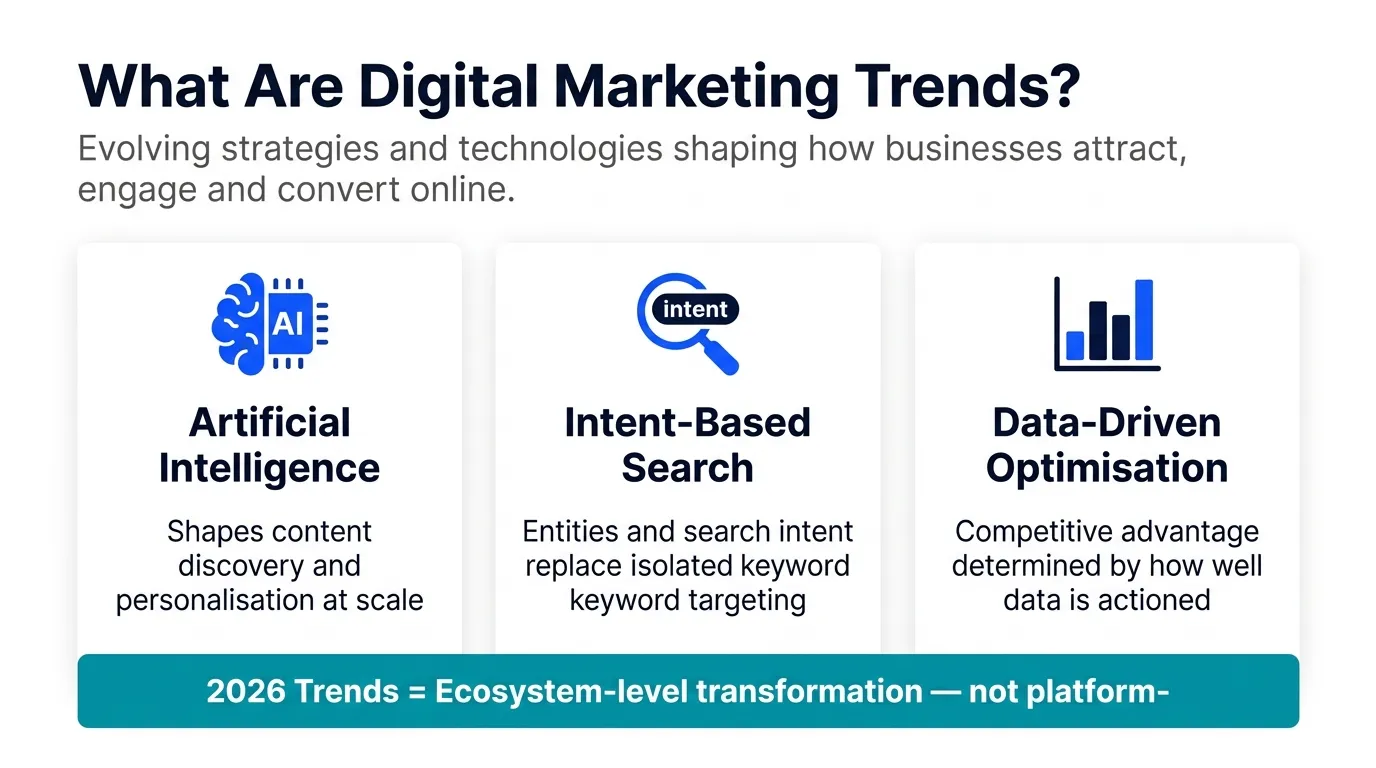
Digital marketing trends refer to the evolving strategies, technologies, and behavioural shifts shaping how businesses attract, engage, and convert audiences online. These trends reflect changes in consumer expectations, search engine algorithms, advertising platforms, privacy regulations, and advances in artificial intelligence.
In 2026, digital marketing trends are no longer defined solely by platform popularity. Instead, they are shaped by ecosystem-level transformation. Artificial intelligence influences content discovery. Search engines prioritise intent and entities over isolated keywords. Data-driven optimisation determines competitive advantage.
Understanding digital marketing trends is not about chasing hype. It is about identifying structural shifts that influence visibility, trust, and revenue.
Search Evolution and Its Influence on Digital Marketing Trends
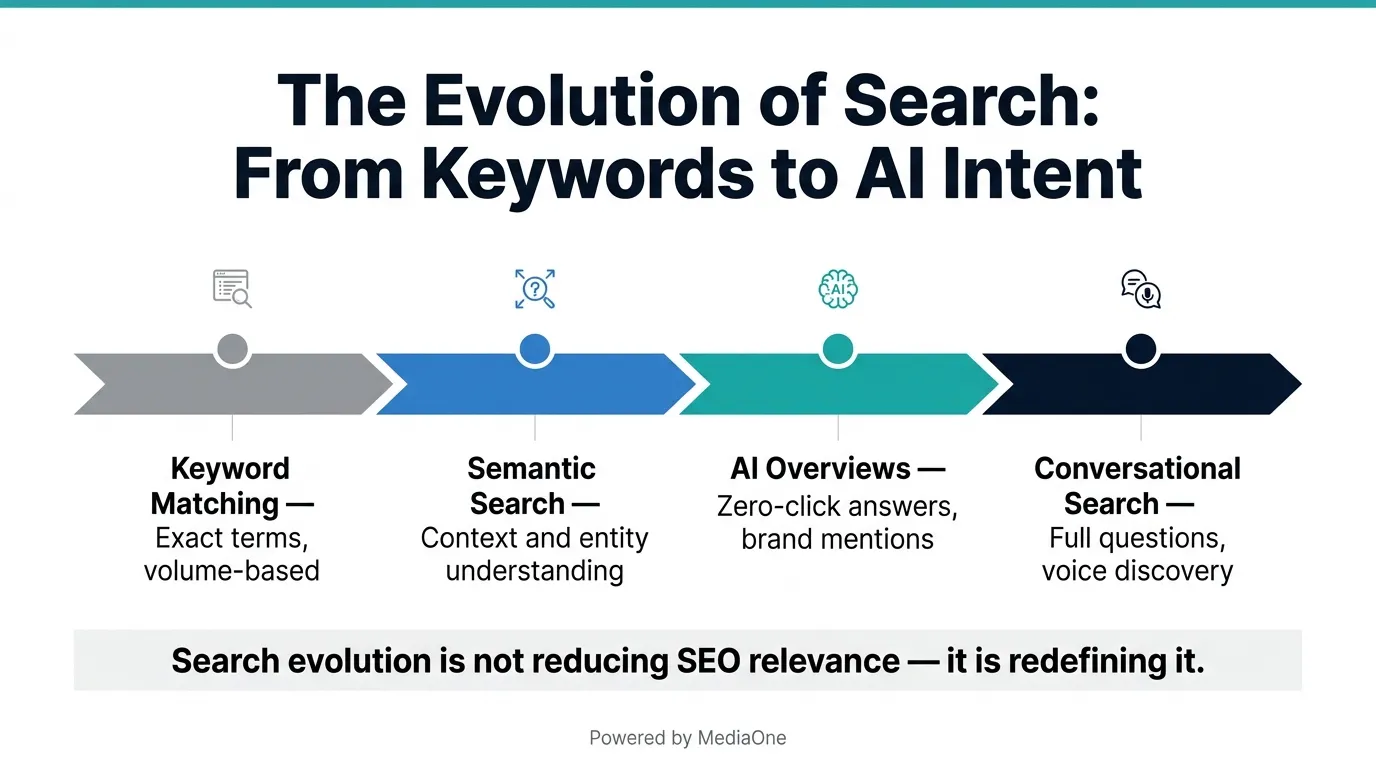
Search has evolved from keyword matching to AI-based intent interpretation, fundamentally reshaping digital marketing trends.
- From Keywords to Intent Mapping: Modern search engines analyse context, user behaviour, and semantics. Rankings now depend on topical authority, relevance, and structure, not just keyword repetition. Businesses must optimise for intent, not volume. Informational queries need depth. Transactional ones demand clarity and urgency. This trend favours content ecosystems over standalone posts.
- The Rise of AI Overviews and Zero-Click Search: Search results increasingly include AI-generated summaries, featured snippets, and knowledge panels. Many users receive answers without clicking through to websites. This trend means visibility now includes brand mentions, citations, and structured data. Businesses must optimise not only for rankings but for AI comprehension.
- Conversational and Voice-Based Discovery: Search is more conversational. Users ask full questions, not fragments. Content must use natural language to compete. Search evolution is not reducing SEO relevance. It is redefining it.
Core Digital Marketing Trends Transforming Business Strategy
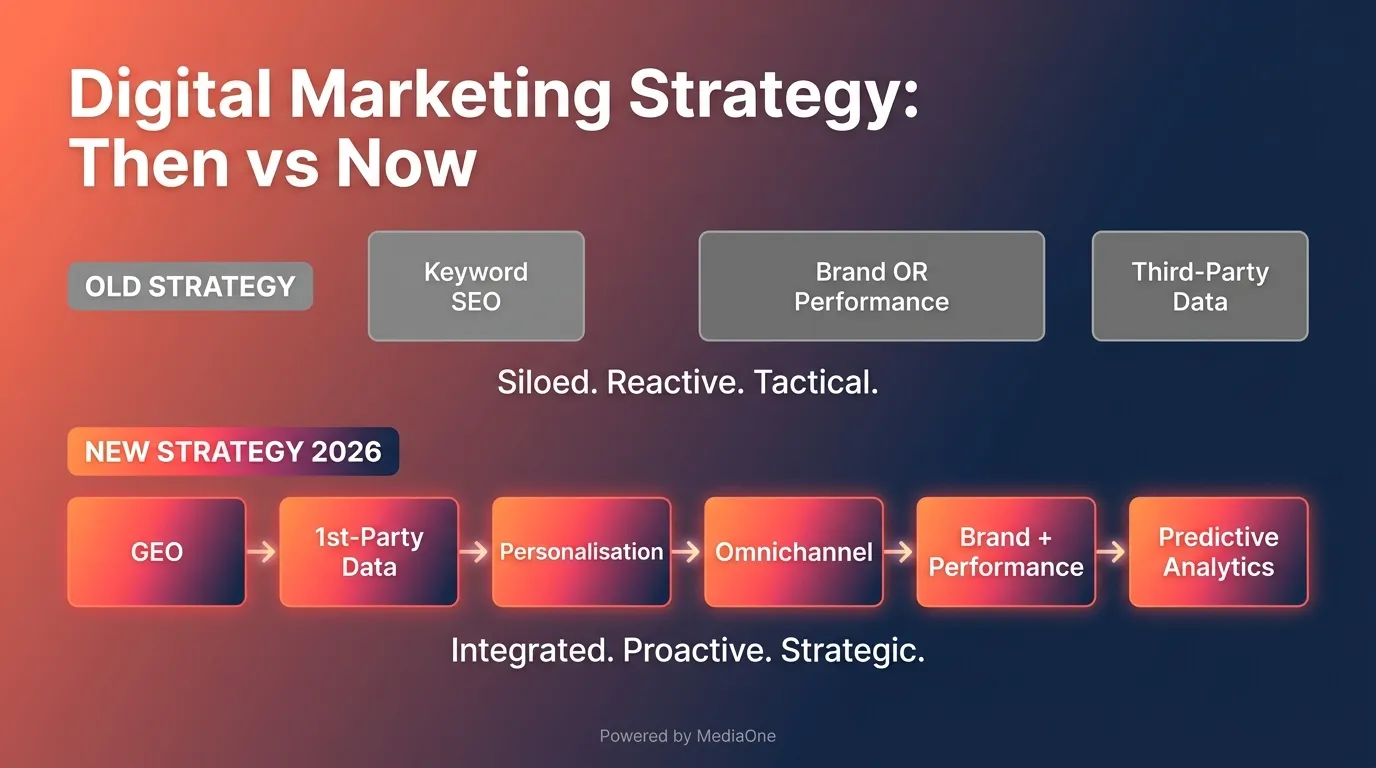
Digital marketing trends now reshape growth, budgets, authority, and competition in AI ecosystems. The most impactful trends change foundational strategy, not just tactics. Below are the core digital marketing trends currently transforming business strategy.
Generative Engine Optimisation
As AI-powered search engines and large language models influence discovery, businesses must optimise not just for rankings, but for AI comprehension.
Generative Engine Optimisation focuses on:
- Structuring content clearly for machine interpretation
- Building entity authority rather than isolated keyword targeting
- Earning brand mentions and credible citations
- Strengthening topical clusters
Rather than chasing individual rankings, businesses now compete for inclusion in AI-generated summaries and conversational search results. Visibility extends beyond traditional results into intelligent discovery.
First-Party Data as a Strategic Asset
With increasing privacy regulations and cookie limitations (restrictions on tracking user activity across websites), first-party data (information a company collects directly from its audience) has become central to competitive advantage.
Businesses are investing in:
- CRM systems
- Consent-driven data collection
- Customer lifecycle tracking
- Behavioural segmentation
Trends now favour organisations controlling their own data. First-party insights enable better targeting, personalisation, and retention.
Data ownership is no longer optional. It is foundational.
Personalisation at Scale
Consumers expect relevance. Static messaging loses effectiveness in competitive markets.
AI-driven segmentation allows businesses to:
- Deliver tailored product recommendations.
- Customise landing page messaging
- Adapt content based on visitor behaviour.
- Trigger a dynamic offer.
Personalisation deepens engagement and boosts conversions. As AI becomes more accessible, personalisation shifts from a luxury to a necessity.
Omnichannel Integration
Customer journeys cross multiple channels. A prospect might find a brand in search, check social proof, engage via email, and convert after retargeting.
Core digital marketing trends emphasise:
- Unified data tracking
- Cross-channel attribution
- Consistent messaging across platforms
- Coordinated campaign sequencing
Siloed efforts bring inefficiency. Integrated systems drive growth.
Businesses that align SEO, paid media, content, and conversion optimisation within structured digital marketing services frameworks achieve clearer ROI and greater performance stability.
Performance Branding Convergence
The old divide between brand and performance marketing is disappearing.
Brand trust directly influences conversion efficiency. Long-form authority content supports both search visibility and credibility. Educational assets nurture demand before transactional intent appears.
Digital marketing trends now favour hybrid strategies where:
- Brand authority strengthens organic performance
- Performance campaigns amplify high-intent demand.
- Content ecosystems support both awareness and conversion.
This convergence reduces acquisition cost over time by strengthening trust signals across the funnel.
Predictive Analytics and Decision Intelligence
Marketing strategy is becoming increasingly data-led. Predictive analytics enables businesses to forecast performance, allocate budgets more accurately, and anticipate shifts in consumer behaviour.
Instead of reacting to results after campaigns conclude, businesses can:
- Model expected ROI before launching initiatives
- Identify high-value audience segments.
- Detect performance decline early.
Predictive analytics moves marketing from reactive fixes to proactive planning.
Digital Marketing Trends That Directly Impact ROI and Budget Allocation

For decision-makers, the most important trends reshape budgets and ROI measurement.
Below are the trends with the strongest and most immediate impact on ROI.
AI-Driven Media Buying and Bid Optimisation
Modern advertising platforms increasingly rely on machine learning to optimise bids, placements, and audience targeting in real time. Instead of manual adjustments, AI systems analyse behavioural signals and dynamically adjust budgets.
This shift directly impacts ROI because:
- Ad spend is allocated toward higher-probability conversions.
- Low-performing segments are reduced automatically.
- Cost per acquisition becomes more efficient over time.
Businesses that supply high-quality data to these systems achieve greater efficiency.
Intent-Based SEO and High-Value Keyword Targeting
Organic traffic remains high-ROI, but the strategy has changed. Instead of broad keywords, leading organisations target high-intent queries.
Targeting transactional or solution-aware intent:
- Increases conversion probability
- Reduces wasted content production
- Improves revenue per visitor
When integrated within structured <a href=”https://mediaonemarketing.com.sg/”>digital marketing services</a>, intent-focused SEO reduces reliance on paid acquisition and improves budget efficiency.
Conversion Rate Optimisation Integration
Driving traffic without conversions limits ROI. A key trend is integrating acquisition and conversion.
Improving conversion rate:
- Lowers cost per acquisition
- Increases revenue per visitor
- Extends lifetime value potential
Rather than increasing ad budgets to grow revenue, businesses can optimise existing traffic to achieve better financial outcomes.
First-Party Data Monetisation
With privacy regulations reshaping digital tracking, first-party data is becoming a powerful lever for revenue.
Businesses that invest in data infrastructure can:
- Retarget high-value audiences more accurately
- Personalise offers based on behavioural insights.
- Reduce dependency on third-party data platforms.
This improves targeting precision and reduces wasted media spend.
Revenue-Based Attribution Models
Traditional last-click attribution often misrepresents channel performance. Modern digital marketing trends favour multi-touch or data-driven attribution models that reflect the full customer journey.
Accurate attribution allows businesses to:
- Allocate budget to truly influential channels.
- Reduce overspending on low-impact touchpoints.
- Identify profitable combinations of channels.
Clear attribution strengthens long-term planning and strategic decision-making.
How Businesses Should Respond to Emerging Digital Marketing Trends
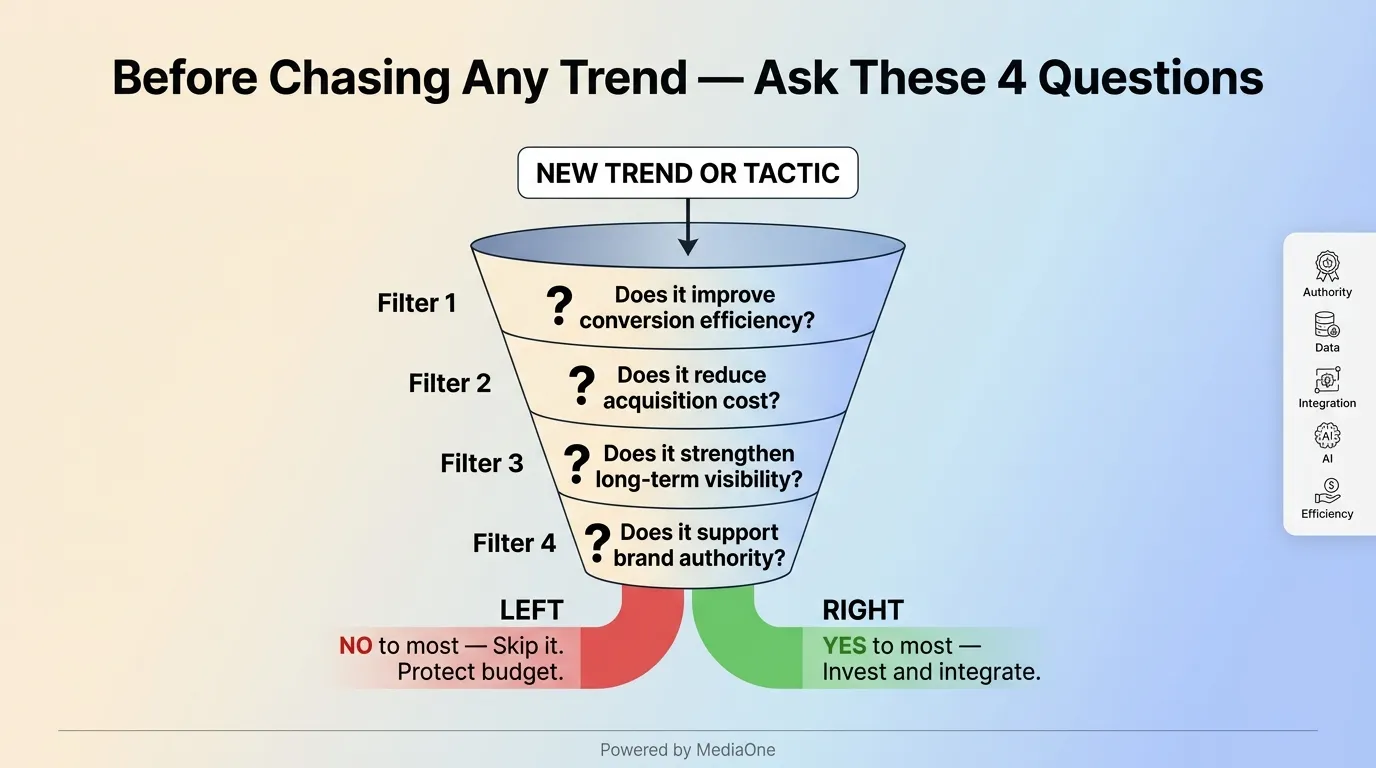
The businesses that benefit most are not those that chase every new platform, but those that respond with disciplined strategy and systems-level thinking.
Adapting effectively requires clarity, prioritisation, and integration.
Build Topical Authority, Not Just Content Volume
One of the most important responses to modern digital marketing trends is shifting from quantity-driven publishing to authority-driven ecosystems.
Instead of producing isolated blog posts, businesses should:
- Develop pillar content with supporting clusters.
- Cover topics comprehensively rather than superficially.
- Strengthen internal linking structures.
- Maintain consistent subject depth.
Search engines and AI systems reward structured expertise. Topical authority increases long-term visibility and reduces volatility caused by algorithm changes.
Strengthen Data Infrastructure
Data now drives nearly every major digital marketing trend. AI tools, predictive analytics, personalisation engines, and attribution models all depend on reliable data inputs.
Businesses should prioritise:
- Accurate conversion tracking
- CRM integration
- Cross-channel analytics visibility
- Clean data governance processes
Without reliable infrastructure, marketing decisions become reactive and inefficient. Data clarity strengthens forecasting, budget allocation, and optimisation.
Align SEO, Paid Media, and Conversion Strategy
Emerging digital marketing trends increasingly favour integrated ecosystems over siloed campaigns.
SEO builds visibility. Paid media accelerates demand capture. Conversion optimisation improves profitability. These functions must operate in a cohesive manner rather than independently.
When businesses coordinate acquisition and conversion under a unified <a href=”https://mediaonemarketing.com.sg/”>digital marketing services</a> approach, performance improves across all channels. Integration reduces duplication and strengthens overall ROI.
Invest in AI Literacy Across Teams
AI is no longer optional. It influences content generation, ad optimisation, data analysis, and customer engagement.
However, AI is a multiplier, not a replacement for strategic thinking. Businesses should:
- Train teams to use AI tools effectively
- Establish governance guidelines
- Combine automation with human oversight.
- Monitor outputs for quality and accuracy.
Competitive advantage increasingly belongs to organisations that understand how to leverage AI responsibly and strategically.
Prioritise Efficiency Over Trend Adoption
Not every new platform or tactic deserves immediate investment. Businesses should evaluate emerging digital marketing trends through one core lens: measurable business impact.
Before allocating budget, ask:
- Does this improve conversion efficiency?
- Does this reduce acquisition cost?
- Does this strengthen long-term visibility?
- Does this support brand authority?
Disciplined prioritisation prevents reactive spending and protects profitability.
Common Mistakes When Adapting to Digital Marketing Trends
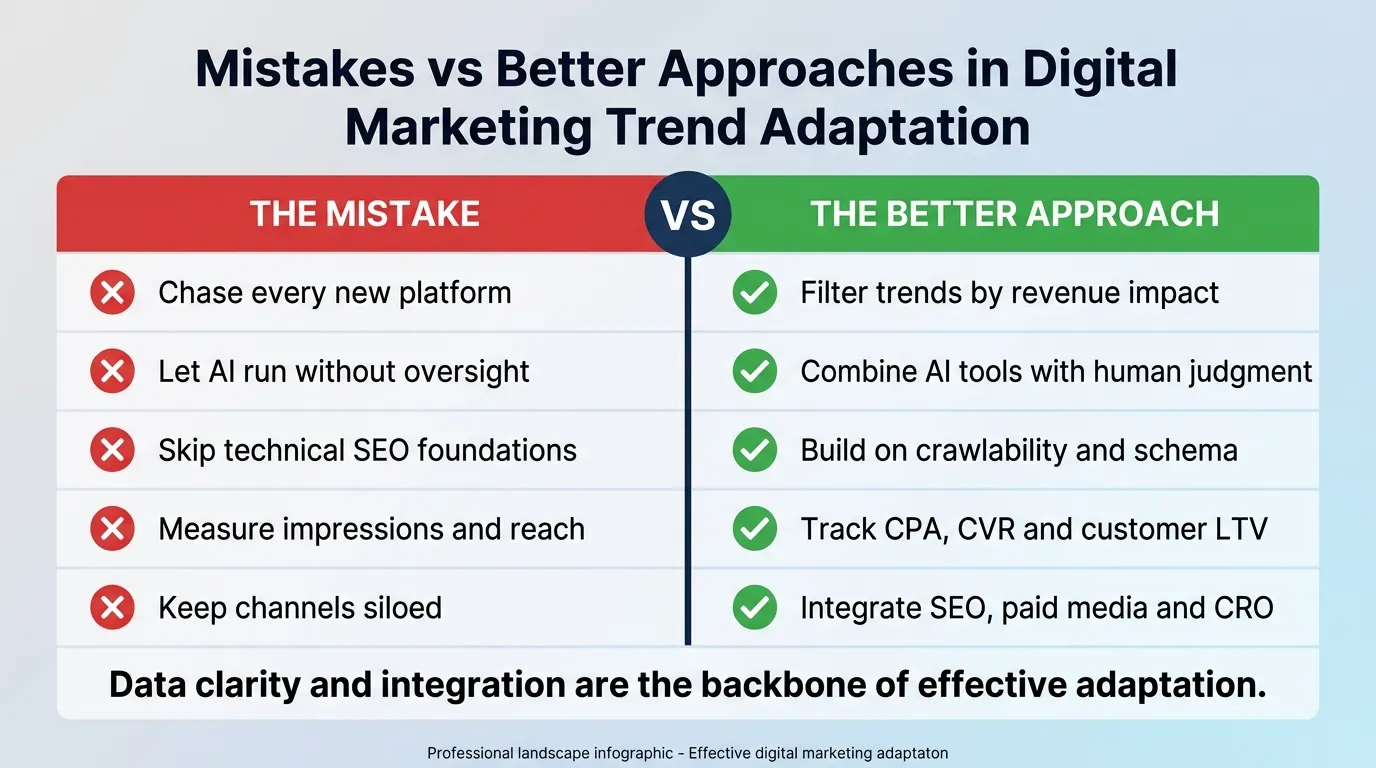
Instead of strengthening performance, reactive decisions often create inefficiencies, wasted budgets, and fragmented strategies.
Below are the most common mistakes organisations make when responding to evolving digital marketing trends.
Chasing Every New Trend Without Strategic Alignment
Not every emerging platform or tactic deserves immediate investment. Businesses often adopt new tools or channels simply because competitors do.
Without clear alignment to business goals, these initiatives rarely produce sustainable returns. Digital marketing trends should be evaluated based on revenue impact, audience relevance, and long-term scalability rather than hype.
Strategic filtering protects resources.
Over-Relying on Automation Without Human Oversight
AI tools are reshaping digital marketing trends, but automation alone does not guarantee performance.
Common errors include:
- Publishing AI-generated content without strategic editing
- Allowing automated ad systems to operate without data quality control
- Prioritising speed over accuracy
AI should enhance strategic execution, not replace it. Human insight remains essential for positioning, brand voice, and ethical judgment.
Ignoring Foundational Technical SEO
As AI-powered discovery evolves, some businesses mistakenly assume traditional SEO no longer matters.
In reality, technical structure, site speed, schema markup, internal linking, and crawlability remain foundational. Digital marketing trends build upon these fundamentals rather than replacing them.
Without strong technical foundations, advanced strategies underperform.
Measuring Impressions Instead of Revenue
Vanity metrics such as impressions, reach, and engagement rates can create a false sense of success.
Digital marketing trends that truly matter influence:
- Cost per acquisition
- Conversion rate
- Revenue per visitor
- Customer lifetime value
If new initiatives do not improve financial metrics, they may not justify continued investment.
Failing to Integrate Channels
One of the most damaging mistakes is maintaining siloed marketing operations.
SEO teams operate separately from paid media. Content teams operate independently from analytics. Conversion optimisation runs in isolation. This fragmentation reduces efficiency.
When digital marketing trends are integrated into structured digital marketing services, channels reinforce one another. Integration improves clarity and performance consistency.
Neglecting Data Infrastructure
Adopting advanced tactics without reliable data tracking leads to flawed decision-making.
Without accurate attribution, segmentation, and behavioural tracking:
- Budget allocation becomes speculative.
- ROI cannot be measured precisely
- Optimisation efforts lack direction.
Data clarity is the backbone of effective adaptation.
Reacting Instead of Planning
Digital marketing trends evolve continuously. Businesses that react impulsively to each update often lose strategic focus.
Instead of constant tactical shifts, organisations should:
- Establish quarterly review cycles.
- Prioritise long-term asset building
- Test strategically rather than randomly.
Disciplined planning creates stability in a changing environment.
Stay Competitive Amid Rapidly Changing Digital Marketing Trends
Digital marketing trends are no longer incremental updates. They represent structural shifts in how visibility is earned, how trust is built, and how revenue is generated. AI-driven search, predictive analytics, personalisation, and integrated attribution are not future concepts. They are active forces reshaping competitive advantage right now.

The businesses that thrive in 2026 will not be those chasing every new tactic. They will be the ones building systems. Systems that integrate SEO, paid media, data intelligence, and conversion optimisation. Systems that turn attention into measurable growth.
If your strategy still treats channels separately or reacts to trends instead of planning for them, you are leaving efficiency and profitability on the table.
At MediaOne, we help businesses translate digital marketing trends into structured, revenue-focused action. Our integrated digital marketing services are designed to future-proof your visibility, optimise your performance, and strengthen your ROI in an AI-driven landscape. Contact us today!
Frequently Asked Questions
How often do digital marketing trends change?
Digital marketing trends evolve continuously, but major structural shifts typically occur every 12 to 24 months. AI developments, search engine updates, and privacy regulations are currently accelerating the pace of change.
Do digital marketing trends affect B2B and B2C businesses differently?
Yes. B2B strategies often emphasise authority, long-form content, and lead nurturing, while B2C strategies may prioritise speed, personalisation, and emotional engagement. However, both sectors are influenced by AI-driven search and data intelligence.
How can businesses evaluate whether a digital marketing trend is worth investing in?
A trend should be assessed based on its impact on revenue, customer acquisition cost, and long-term scalability. If it does not improve efficiency or strengthen competitive positioning, it may not justify significant investment.
Are digital marketing trends replacing traditional marketing principles?
No. Core principles such as trust, clarity, positioning, and value proposition remain essential. Digital marketing trends enhance execution methods but do not replace foundational marketing strategy.
What role does content quality play in modern digital marketing trends?
Content quality is increasingly critical as AI systems evaluate context, authority, and expertise. High-quality, structured content improves both search visibility and user trust, supporting sustainable growth.