| AI Summary
Singapore businesses can apply for EDGE support for eligible digital marketing work. Funding depends on the selected activity, the company’s eligibility and the costs approved for the project. EDGE reimburses approved expenses after the work is complete and paid for. An itemised quote helps businesses separate potential grant support from the amount they need to budget. |
What is the digital marketing grant in Singapore? The EDGE Grant can help Singapore businesses pay for eligible digital marketing projects. For some activities, SMEs can receive up to 50% of qualifying costs and non-SMEs up to 30%. The rate and cap depend on the activity. Businesses submit a claim after completing and paying for the approved work.
Key Takeaways
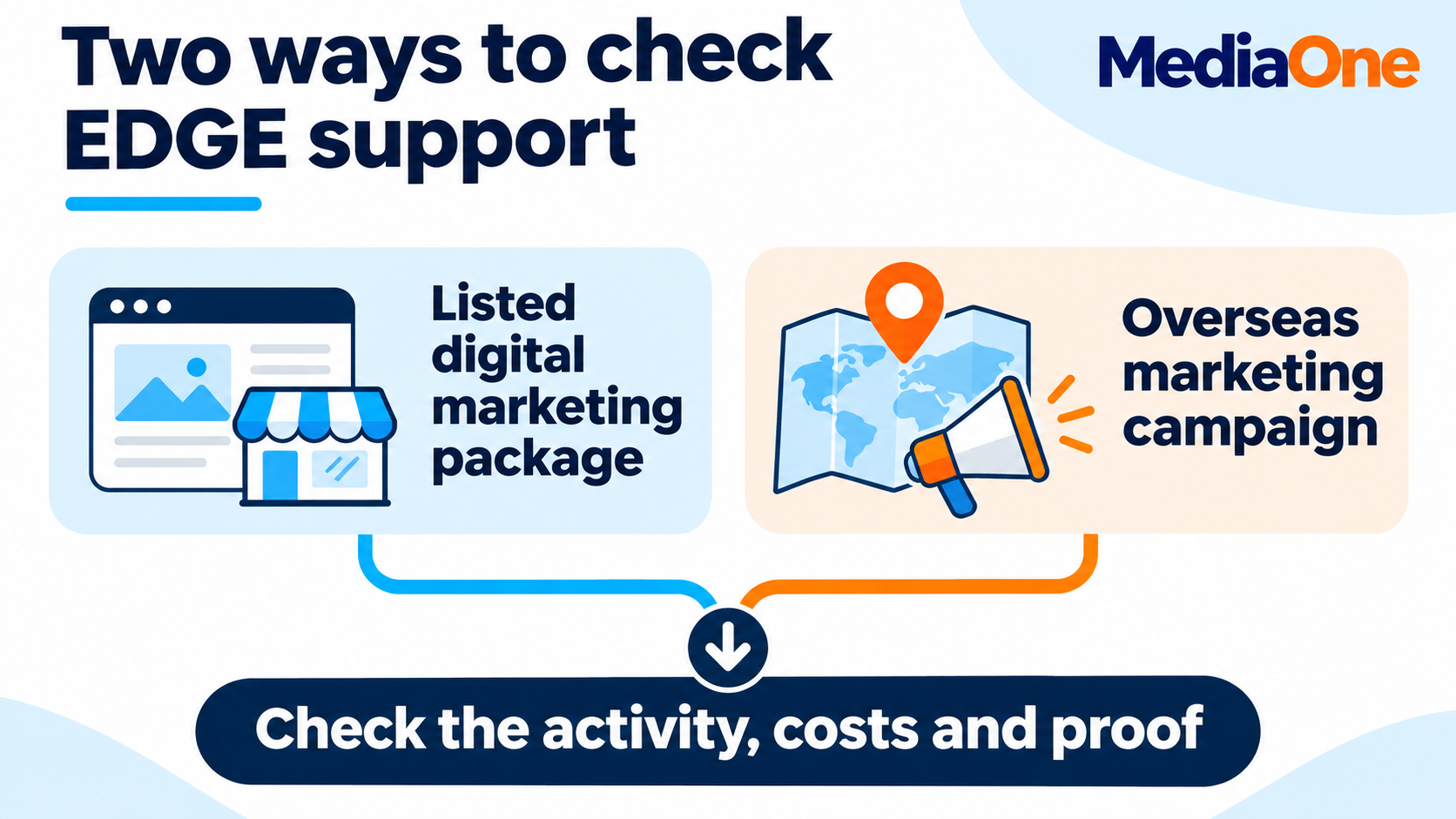
- Your project determines the funding rules. A listed digital marketing package and a campaign for an overseas market follow different requirements.
- EDGE has more than one spending limit. The S$100,000 annual company cap includes a S$30,000 shared limit for certain digital solutions and equipment.
- Application timing affects eligibility. Starting work or paying a vendor before submission can make the application retrospective.
- An agency quote and a grant offer serve different purposes. The quote lists what you will buy. The Letter of Offer sets out what the grant can support and what you must deliver.
- The invoice and the final cost belong in separate budget columns. Your business pays the invoice before it can claim reimbursement.
Two agencies quote S$15,000 for digital marketing. One includes search ads and reporting. The other includes a website update and a social campaign. The prices look the same, but the work can solve different problems and leave your business with different costs after reimbursement.
Singapore’s digital marketing grant can help pay for eligible work under EDGE. The first step is to find the activity that matches your project. From there, you can compare what each agency will deliver, which costs may qualify and how much cash you need before the grant comes through.
1. What does the EDGE Grant cover for digital marketing?
EDGE is Enterprise Singapore’s grant for activities such as adopting digital tools, improving how a business operates and expanding overseas. It opened on 30 September 2026, after the Enterprise Development Grant (EDG), Market Readiness Assistance (MRA) and Productivity Solutions Grant (PSG) closed to new applications on 29 September. Projects already submitted under those schemes continue under their original terms. The EDGE Grant overview sets out the activities available for new projects.
A digital marketing project starts with a business goal. A local enrichment centre might want more trial bookings. A Singapore food brand might want shoppers in Malaysia to recognise a new product. Both projects could involve social ads, but the business goals and the work behind those ads are different. Those details help you identify which EDGE activity to check.
Pre-approved digital marketing packages
Some projects start with a listed solution. The SMEs Go Digital programme lets businesses browse pre-approved digital solutions. The listing is where you check the vendor, package and included work. MediaOne’s EDGE digital marketing packages show how a provider can group search and social services into different packages.
The package name on the agency’s quote should match the one you select. A search package might include campaign setup and reporting. If you also want the agency to build a new landing page or run the campaign for another month, ask for those items to be priced separately. You can then check whether they appear in the listed package and decide if you want to buy them separately.
Marketing for an overseas market
The Overseas Marketing & Public Relations activity can support eligible professional services for campaigns aimed at overseas markets. Enterprise Singapore lists support of up to 70% for SMEs and up to 50% for non-SMEs for this activity. Campaigns intended to generate business in Singapore fall outside its scope.
An overseas campaign needs a defined audience and evidence that the work addresses that market. A Singapore skincare brand entering Malaysia, for example, might ask an agency to create a campaign around how customers shop there and what they want to know before trying a new product. A campaign plan can show which content the agency will adapt, where it will run and how the brand will track enquiries.
Brand strategy and campaign delivery
A company entering a new market may first need to decide how to position its brand. Under International Branding, eligible work can include developing a brand strategy for overseas expansion. Running campaigns, building a website and managing social accounts are listed as operating expenses outside that activity’s scope.
An agency may quote for strategy and delivery together. A separate price for each lets you see what it costs to plan the work, what it costs to carry it out and which part belongs in the grant application.
2. Who qualifies, and how much can EDGE cover?
Eligibility depends on both the company and the proposed work. A company can meet the ownership test while its chosen project falls outside the activity’s scope. Checking both before requesting a detailed proposal can save a round of quotes.
Singapore registration, ownership and SME status
Start with the company that will submit the application. This is especially relevant if you run several businesses under the same brand or if a parent company owns the company that will buy the service.
| What to check | What it means for your business |
| Singapore registration and operations | The applicant must be registered and operating in Singapore for the activities discussed here. |
| Local ownership | At least 30% must be held directly or indirectly by Singapore citizens or permanent residents, based on who ultimately owns the company. |
| SME status | A company meets the SME size test if its group has annual sales of S$100 million or less or employs 200 people or fewer. |
| Project requirements | The work must meet the rules for the selected activity. Check the package, vendor and project location where applicable. |
The SME test uses group figures. If your shop employs 12 people but belongs to a larger group, the shop’s staff count alone does not establish SME status. Non-SMEs can apply under activities that allow them, usually at a different rate. The BizSG grant recommender can help you identify activities to check against your company’s details.
The funding rate and the cap answer different questions
A funding rate tells you what share of eligible costs the grant may reimburse. A cap sets a limit on the amount of support. Many EDGE activities offer up to 50% for SMEs and up to 30% for non-SMEs. Some internationalisation and sustainability activities offer higher rates. The rate listed for your selected activity is the one to use when making a budget estimate.
| Funding limit | How to read it |
| Overall annual cap | A company can receive up to S$100,000 across EDGE activities per grant year. The cap resets on 1 April. |
| Shared limit for certain digital solutions and equipment | Up to S$30,000 of the overall annual cap can go towards single-function digital solutions, integrated enterprise systems and pre-scoped equipment. |
| Activity or package limit | The selected activity can set a lower limit. Your grant offer states the amount approved for your project. |
The limits overlap. For example, a company that has used S$24,000 of the shared S$30,000 limit has S$6,000 left within that limit for the grant year. The amount it can receive for another project in the same group of activities may be lower, depending on the activity, its remaining overall balance and its approval. The official EDGE FAQs explain how these caps work across activities.
3. How much will your agency quote cost after the grant?
The amount in large print on an agency proposal usually tells you what the agency charges. To estimate your own cost, you also need the eligible subtotal, the rate and the applicable cap. MediaOne’s EDGE package pricing breakdown shows how quotes can differ by channel, duration and work included.
Separate the package from the extras
A quote for “six months of digital marketing” gives you little to compare. A quote that shows the search campaign, reporting, website work and any separate ad budget lets you see what you are buying. It also gives you a list to check against the package description or activity rules.
| Quote line | What to ask the agency to show |
| Campaign setup and management | The platforms, number of campaigns, work included and dates of service. |
| Advertising spend | The amount paid to the platform, who pays it and whether the activity supports it. |
| Content and design | The number of pages, posts, ads or videos, plus any charges for extra work. |
| Website development and support | Which pages the agency will build or edit, and what maintenance costs after delivery. |
| Tracking and reporting | Which actions the agency will measure, who sets up tracking and how often you will receive results. |
The quote should distinguish items the agency expects to be eligible, items your business will cover and items that still need checking. An agency’s estimate helps you prepare a budget. The approved expenses in your Letter of Offer determine what can go into the claim.
Worked example: A S$15,000 invoice
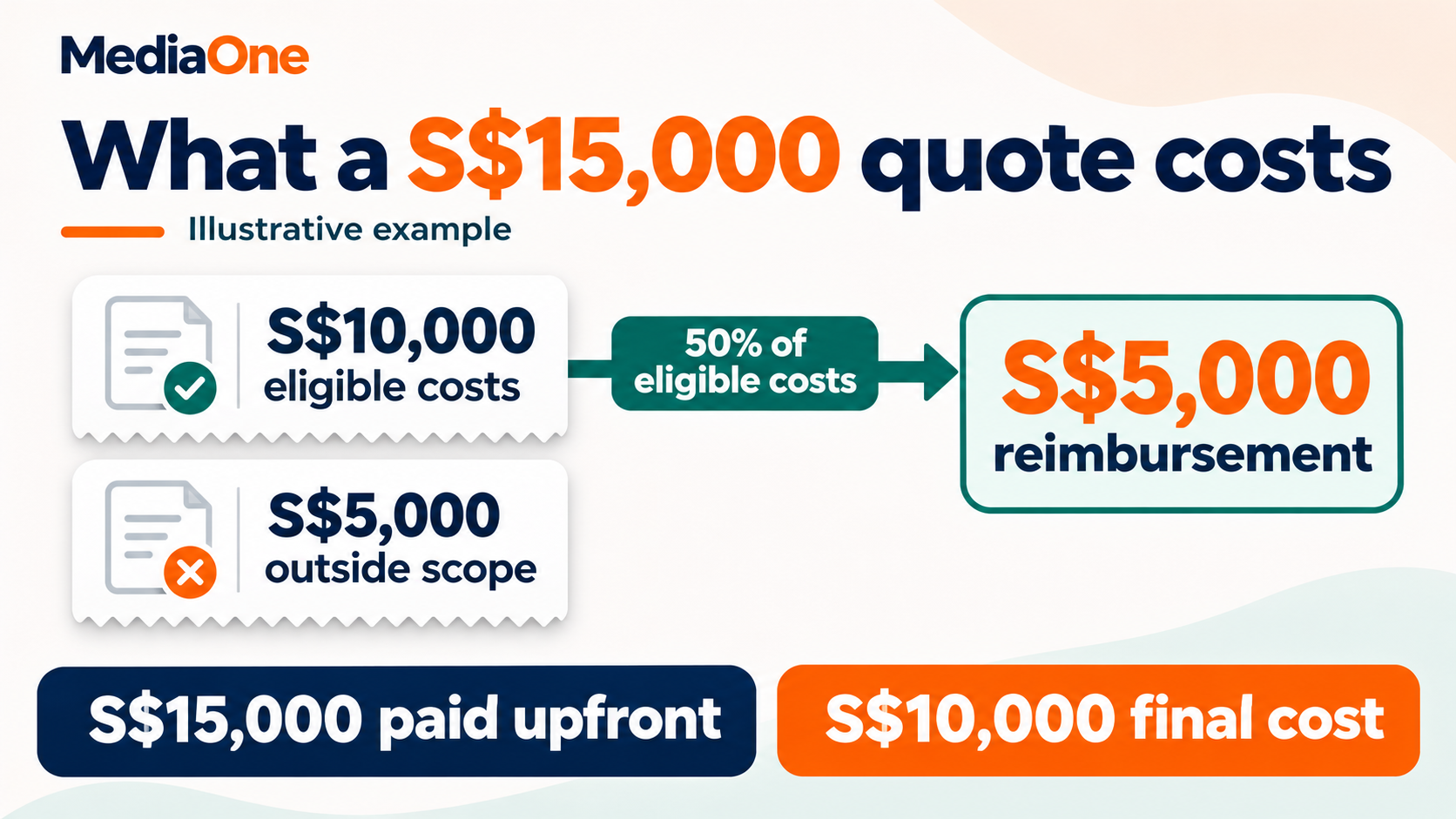
Suppose a Singapore SME receives an S$15,000 quote. The Letter of Offer approves S$10,000 of the costs at a 50% funding rate, and the applicable caps allow the full calculated amount. The remaining S$5,000 sits outside the approved scope. The figures below are illustrative.
| Cost or payment | Amount |
| Total invoice paid by the business | S$15,000 |
| Approved eligible costs | S$10,000 |
| Costs outside the approved scope | S$5,000 |
| Reimbursement after claim approval | S$5,000 |
| Final cost to the business | S$10,000 |
The business pays S$15,000 and later receives S$5,000 if the claim is approved in full. Its final cost combines S$5,000 of the approved work that it funds itself and S$5,000 for the items outside the grant. In this example, 50% support on eligible work covers one-third of the full invoice.
How to compare two quotes with the same price
Imagine a second agency also quotes S$15,000, but only S$6,000 of its work qualifies. At the same 50% rate, its estimated reimbursement is S$3,000, and its final cost is S$12,000. Your cash outlay is S$15,000 in both cases, while the second option costs S$2,000 more after reimbursement.
That S$2,000 buys something. It might pay for product pages your online shop needs, or it might pay for extra ads your team has little time to manage. Write down what the extra cost buys and decide if you would pay for it from your own budget. A grant estimate belongs alongside the value of the work when you compare offers.
4. How do you apply for and claim the digital marketing grant?
The application and the claim take place at different times. The application sets out the work you plan to buy. The claim shows what you completed and paid for. Enterprise Singapore’s activity page lists the documents and application steps for each type of project. MediaOne’s Business Grants Portal walkthrough explains the portal process in more detail.
Before submission: Get the scope and paperwork ready
- Choose the activity. Describe your project in one sentence, including the business goal and target market. Match it to the activity before ordering work.
- Get an itemised proposal. Ask the vendor to name the solution and show what is included, what costs extra and when the work will be delivered.
- Prepare the activity’s documents. A listed solution may need a matching package reference. An overseas marketing application may ask for the vendor’s experience in the target market and projections for overseas sales.
- Submit through the company’s Corppass account. The applicant company submits its own application. The Corppass user guides explain how to set up access for the person handling it.
Enterprise Singapore treats applications as retrospective if work has started or the business has paid a vendor, including a deposit, before submission. A submitted application still carries the risk of rejection or a lower award. Waiting for the decision gives you the approved amount, dates and conditions before you commit your budget.
After approval: Match the work to the offer
The Letter of Offer tells you the approved amount, the project dates and the outputs you must complete. Compare it with the agency’s proposal before work begins. If you expected three campaign reports and the offer requires a particular final report, your project lead can confirm early who will prepare it and what it must contain.
The person managing the project can keep one folder with the approved offer, quote, invoices, payment records and evidence of work. A shop running search ads, for example, might keep dated campaign reports and screenshots of completed tracking setup. The activity’s requirements and your offer tell you which records to submit.
After delivery: Pay in full and file the claim
- Match the invoice to the approved work. The service names and amounts should be easy to trace back to the project.
- Keep proof of payment. EDGE reimburses eligible costs after the project is complete and expenses are paid in full.
- Check for activity-specific steps. Overseas Marketing & Public Relations, for example, requires an auditor from Enterprise Singapore’s panel for the claim.
- Use the claim deadline in your offer. An agency’s last reporting date and your claim deadline are separate dates.
A grant can lower the final cost while leaving the full bill due during delivery. If your campaign runs across several months, put the agency’s invoice dates and any separate ad payments on a cash calendar. Your business needs enough cash to cover those payments while the claim is being reviewed.
5. How should you choose an agency and scope the work?
The right scope starts with one business problem. A dental clinic that wants more calls from nearby patients may need local search work and call tracking. An online shop with steady traffic and few orders may need to improve product pages or checkout before it pays to reach more people. The grant can help pay for eligible services. The business still decides which work is worth doing.
What five common digital marketing services cover
| Service | What the agency might deliver | What you can measure |
| Search engine optimisation (SEO) | Updates to service pages, website fixes or local search work. | Enquiries or sales from unpaid search. |
| Search engine marketing (SEM) | Paid search campaigns, keyword selection, ad copy and tracking. | Cost per booking, enquiry or sale from search ads. |
| Generative engine optimisation (GEO) | Website content and business information that answer common questions about your services. | Brand mentions across a defined set of AI search queries checked over time. |
| Social media marketing (SMM) | A content calendar, posts and scheduled publishing. | Relevant interactions, visits to service pages or enquiries from posts. |
| Social media advertising (SMA) | Paid campaigns, ad designs and tests on social platforms. | Cost per qualified enquiry or sale from social ads. |
These names describe services. Package listings and activity terms determine which work may qualify. If you compare SEO packages by deliverable, ask which pages the agency will work on and what it will fix. For paid campaigns, ask who sets the media budget and how the agency will check whether enquiries turn into real sales conversations.
Questions to settle before signing
- What will the agency deliver each month? A list of page updates, campaign launches or reports gives both sides something to check.
- What will our team need to provide? Product photos, prices and approval of ad copy can all affect the start date.
- Who will own the accounts and files? The proposal should say who has admin access to ad accounts, analytics, social profiles and the website.
- What happens at the end of the package? Ask for renewal costs and what your team will receive at handover.
- How will we judge progress? Agree on one or two measures the team can check, such as enquiries from the right postcode or bookings for a service you want to grow.
An agency can report more clicks while your sales team still gets the same number of relevant enquiries. If the project aims to bring in sales, agree on what counts as a qualified lead. A home renovation firm, for example, might count enquiries only when the customer requests a service the firm offers and gives a project location it serves. MediaOne’s EDGE agency comparison covers the differences between agency proposals, and its SEO budget breakdown explains what different levels of work can involve.

What to Check Before You Sign an EDGE Quote
A digital marketing quote is ready for a decision when it shows what the agency will deliver, how much your business must pay and which expenses you can put forward for support. If an extra service still needs checking, budget for it separately. Your team can then decide whether the project is affordable while the claim is under review.
A digital marketing consultation with MediaOne can help you turn a business goal into an itemised proposal. Your website, target market and the result you want are enough to start that conversation.
FAQs About the Digital Marketing Grant
Can my company submit two EDGE applications at the same time?
Yes. Enterprise Singapore allows a company to apply for different activities at the same time, with a separate application for each activity. Some solutions have limits tied to the company’s Unique Entity Number (UEN), so check the terms before planning a second purchase.
Does an older PSG, EDG or MRA award reduce my EDGE balance?
Earlier use of PSG, EDG or MRA does not count towards the EDGE caps. EDGE is for new projects, so a company that received support for an earlier project should use its EDGE balance for different work.
Can another government grant pay for the same expense?
Enterprise Singapore bars an EDGE application for the same eligible expenses once another government grant has approved those expenses. If a business is considering two schemes for a wider project, it should identify the expenses under each scheme before applying.
Can my company ask for more time to finish an overseas campaign?
For Overseas Marketing & Public Relations, a company can request a change to the project end date or the claim due date during the project qualifying period. Enterprise Singapore must approve the request. The business should use the existing dates to plan delivery until it receives that approval.
How does my company receive the reimbursement?
The payment arrangements depend on the activity. For Overseas Marketing & Public Relations, Enterprise Singapore lists PayNow Corporate and GIRO. It states that PayNow disbursement takes up to 14 working days after claim approval, while GIRO can take up to eight weeks. Those timelines start after the claim is approved.