Choosing an edge grant digital marketing agency in Singapore is hard enough without a government grant in the mix. Add the Enterprise Development Grant (EDG) and the decision gets more complicated, because the wrong package can leave you paying for work that is neither claimable nor aligned with your growth goal.
Our experience with Singapore SMEs shows the same pattern: buyers compare headline prices, then discover that two quotes labelled “digital marketing” cover completely different work. The right edge grant digital marketing agency is not the one with the lowest retainer or the biggest portfolio. It is the one whose package scope is itemised, whose reporting ties spend to measurable outcomes, and whose pricing is transparent enough to compare like with like.
Our thesis is simple: you should not choose a vendor on headline price. You should choose on whether the scope can be itemised, mapped to a goal and documented for a claim. This guide sets out that decision sequence, from eligibility through to a signed agreement, with the Scope-to-Goal Scorecard as the central tool. The scorecard works for any vendor, not only ours. If you are looking specifically for edge grant digital marketing support, the steps below apply directly.
Key Takeaways
- Compare packages line by line, not by headline price. A S$10,000 quote from one agency and a S$10,000 quote from another may buy very different work, so itemise the deliverables before you compare totals.
- Check the service mix against your actual goal. SEO plus SEM suits buyers who need both organic and paid visibility, SEO plus GEO suits buyers focused on AI search answers, and SMM plus SMA suits buyers who want social reach and engagement. Pick the mix first, then the vendor.
- Confirm whether GST and ad spend are included. Singapore quotes can differ on whether the S$ figure includes GST and whether media budget is billed separately, which can change the real cost by a wide margin.
- Score every quote before you sign. The Scope-to-Goal Scorecard is covered in its own section below, with the cut-off you choose to set for your own risk tolerance.
- Verify grant eligibility with the official source before budgeting. Confirm EDG rules directly with Enterprise Singapore, since eligibility and claim conditions can change and should not be assumed from a vendor’s pitch.
Table of Contents
Here’s Everything You Need To Know For EDGE Grant in Singapore
Watch this video to learn more about the EDGE Grant and what to look for when choosing a digital marketing agency in Singapore. Consider the agency’s experience, service capabilities, proposed deliverables, and understanding of your business objectives before deciding which partner is right for your project.
What the Enterprise Development Grant Covers for Digital Marketing (and What It Does Not)
What the Enterprise Development Grant (EDG) is and who administers it
The Enterprise Development Grant (EDGE) is a funding scheme administered by Enterprise Singapore, the government agency that supports local enterprises. It co-funds projects that help Singapore businesses build capabilities, upgrade operations or grow into new markets. For digital marketing, the EDG is relevant because it can offset part of the cost of approved projects, provided the project and the vendor meet the scheme’s conditions.
Eligibility rests on a few basics. The business must be registered and operating in Singapore, have at least 30% local shareholding, be financially viable, and have a clear business rationale for the project. Enterprise Singapore sets these criteria and revises them from time to time, so figures you see in older articles may no longer apply.
The funding rates and caps below were last verified against Enterprise Singapore’s published guidance in 2026, and they will change. The Enterprise Development Grant funds up to 50% of qualifying costs for SMEs, and up to 30% of qualifying costs for non-SMEs, according to Enterprise Singapore’s EDG page. Qualifying cost caps, approved solution provider requirements and claim procedures have also been adjusted over the years. Treat every figure in this article as a snapshot to verify on the official page before you budget anything.
Which digital marketing projects are typically eligible
In practice, EDGE-supported digital marketing projects tend to sit within broader digital transformation work. The categories most often associated with the scheme include:
- E-commerce set-up: building or migrating an online store, including the platform and its integration with payment and inventory systems.
- Digital marketing tools: software licences and subscriptions for marketing automation, analytics or customer relationship management, where they meet the scheme’s criteria.
- Search and social advertising set-up: the initial configuration of search and social advertising accounts, tracking and campaign architecture, rather than the media spend itself.
What is usually excluded matters just as much. Ongoing retainer fees for routine, recurring work are generally not claimable, since they look like operating costs rather than a one-off project. General operating expenses typically do not qualify. Media spend, meaning the money paid to platforms for ads, is typically not claimable either. Many business owners assume a full agency package is covered, only to discover that the claimable portion was a fraction of the invoice. Confirm the claimable categories on the official Enterprise Singapore pages before you sign.
The funding mechanics: co-funding, claimable costs and cash flow
The EDG works on co-funding. The government covers a percentage of the qualifying cost, and the business pays the balance. The percentage and the qualifying cost cap are set by the scheme and can change, so check the current figures on the official page.
The claim window is the part most often misread. Enterprise Singapore’s approval letter sets the date from which costs can be counted, so work or invoices that fall before that date usually cannot be claimed. Confirm the start and end dates stated in your approval letter, and match your vendor’s delivery schedule to them, rather than assuming the grant runs from the day you first spoke to the agency.
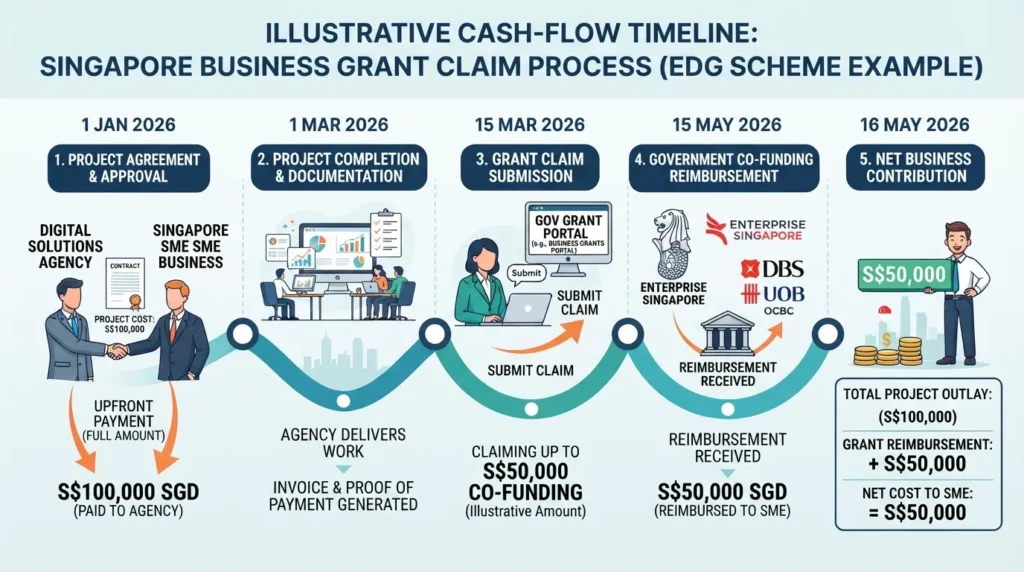
Consider a hypothetical project with a qualifying cost of S$10,000, a co-funding rate of 50 percent and a cap of S$20,000. Here the government share would be S$5,000 and the business would bear S$5,000. If the agency invoice is S$15,000 but only S$10,000 of it is claimable, the business still pays the non-claimable S$5,000 in full. These numbers are illustrative only and do not reflect a current EDGE rate.
Cash flow is the part most SMEs underestimate. Under the usual mechanics, the business pays the vendor upfront and submits a claim afterwards once the project is complete and documented. You fund the whole project in the meantime, and the reimbursement arrives later. Plan for this gap, confirm the payment terms with your vendor, and make sure your working capital can carry the full invoice until the claim is approved.
Verify the Vendor Before You Commit
Before we look at pricing or scoring, every shortlisted agency needs to pass a basic check. Most of the expensive mistakes in an edge grant digital marketing project happen at this stage, when a business signs first and asks questions later. Confirm the grant status of any edge grant digital marketing agency before the first invoice arrives.
Who qualifies as an EDG-eligible digital marketing vendor depends on the scheme’s current solution provider requirements, which Enterprise Singapore sets and updates. Confirm the agency’s status against the official criteria on the Enterprise Singapore EDG page rather than relying on a vendor’s description of itself.
Where the scheme requires an approved or appropriate solution provider, ask the agency to state its status in writing and then verify it yourself on the official Enterprise Singapore channels. Do not accept a logo on a website as proof.
Once the status is confirmed, ask for a written scope that maps each deliverable to a claimable category. A scope that lists “digital marketing support” as a single line gives you nothing to claim against. A scope that separates search engine optimisation, search advertising set-up, social media set-up and any analytics tooling gives you something you can document. Ask the agency which items it expects to be claimable, then check those items against the current EDG guidelines yourself. If the agency cannot explain the mapping, treat that as a warning.
Test the agency’s marketing track record
A portfolio shows what an agency has produced. It does not show whether the work moved a business metric. Ask for case studies that report measurable outcomes, such as enquiry volume, cost per lead, organic traffic growth over a stated period, or revenue attributed to a campaign. Then check whether those case studies cover Singapore small and medium enterprises, since a result for a regional e-commerce brand may not transfer to a local services business.
Ask for client references you can contact directly, and prepare specific questions first: what was the agreed scope, which deliverables arrived on time, how were results reported, and what happened when a campaign underperformed. A reference who will only say “they were great” has told you very little.
Be cautious of unverifiable claims such as “the top agency in Singapore” with no source behind them. For our own clients, we set out the scope and reporting structure at the proposal stage so that the same checks can be made on our work. That is the standard we would expect from any agency you shortlist, whoever it is.
Red flags that signal a poor or risky vendor
Some warning signs appear early and are easy to miss when a business is keen to start. Treat any of the following as a reason to pause:
- Guaranteed rankings or outcomes. No honest agency can guarantee a search position, because search engines control the ranking, not the agency.
- Pressure to sign before grant approval. Work started before approval may fall outside the claim window, so a vendor who pushes you to commit before you have confirmed eligibility is asking you to take a risk they will not carry.
- Vague invoices. An invoice that reads “marketing services, S$5,000” cannot be claimed or audited. Insist on itemised invoices that match the quotation line by line.
- Refusal to share reporting access. If you cannot see the data behind a report, you cannot verify it. Ask for read-only access to the analytics and advertising accounts, or at minimum a monthly export of the underlying figures.
Any one of these can be explained away in a single conversation. Two or more together should end the evaluation.
The Scope-to-Goal Scorecard
Most Singapore SMEs compare agency quotes by the bottom line. That habit makes sense on paper but often fails in practice, because two quotes at the same price can buy very different work. Choosing an edge grant digital marketing agency depends on three things: what is delivered, how it is measured and what you keep at the end. The scorecard below puts the comparison on those points.
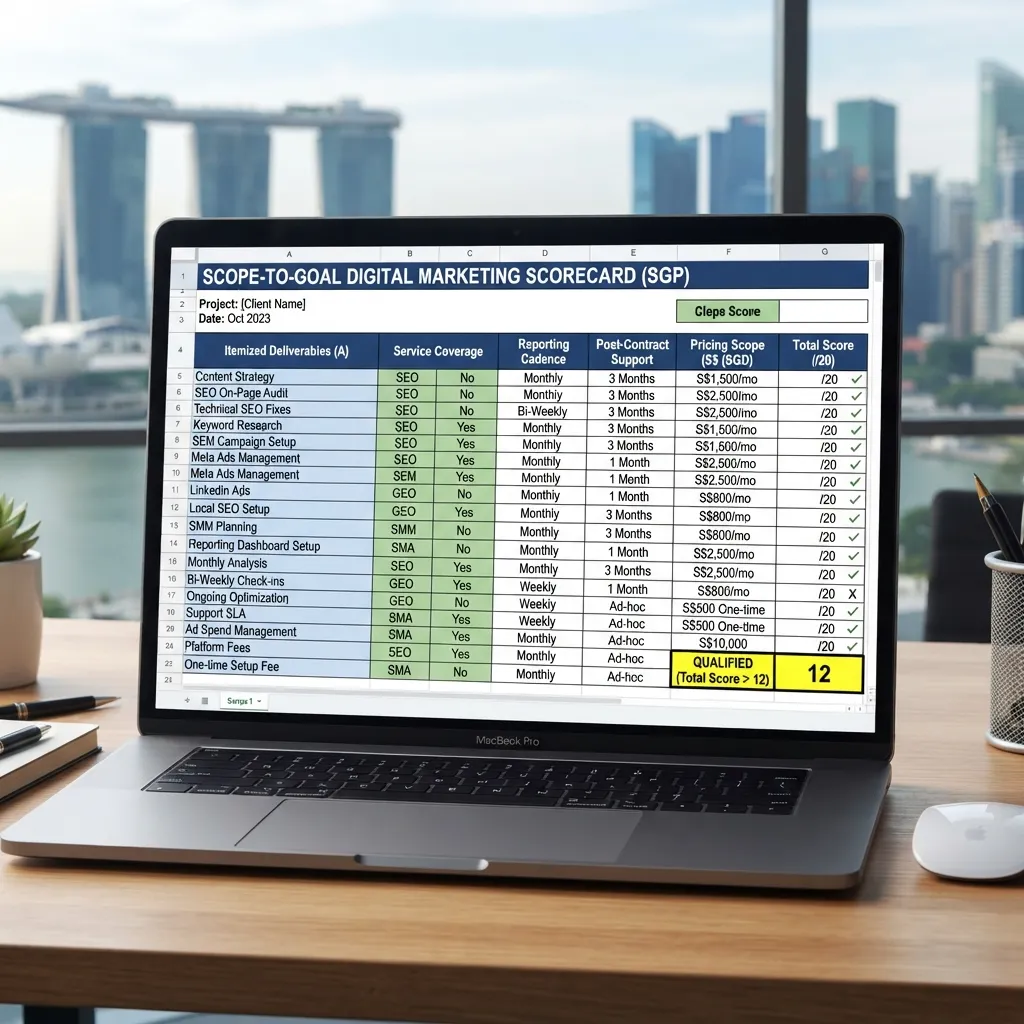
The scorecard is a 10-point checklist. Score each item 0, 1 or 2, for a maximum of 20.
- Itemised deliverables. Are quantities stated, such as keyword count, prompt count and months of SEM?
- Channel coverage. Is it explicit which of SEO, SEM, GEO, SMM and SMA are included?
- Channel fit. Does the service mix match your stated goal, and does the agency explain why?
- Reporting cadence. Is there a fixed schedule for reports and dashboard access?
- Reporting metrics. Are reports tied to outcomes you care about, not just activity?
- Post-contract position. Is it stated what happens to accounts, data and live campaigns after the contract ends?
- Ad spend treatment. Is it clear whether media budget is included or billed separately?
- GST treatment. Is it clear whether the S$ figure includes GST?
- Grant treatment. Does the agency map deliverables to claimable categories, and does it point you to official sources for verification?
- Named accountability. Is there a named account lead with defined response times?
A score below 12 is one suggested benchmark, not a fixed rule. It flags a package that needs clarification before signing. Set the cut-off higher or lower to suit your own risk appetite. Apply the scorecard to each shortlisted vendor’s quote side by side, and ask every vendor the same questions so the scores are comparable.
How to Choose: A Worked Example
The example below illustrates the method, not a recommendation of any one vendor. The scorecard applies to any agency. Each package is shown with its stated price and scored separately before any comparison. The packages are DM MediaOne’s, offered as a disclosed example.
Comparison of packages
| Package | Service scope | Price (S$) |
|---|---|---|
| Package A | SEO (30 Keywords) + SEM (3 Months) | 10,000 |
| Package B | SEO (15 + 5 Keywords) + SEM (3 Months) | 10,000 |
| Package C | SEO (15 + 5 Keywords) + GEO (10 + 5 Prompts) | 10,000 |
| Package D | SMM (2 Months) + SMA (2 Months) | 9,900 |
Applying the scorecard to this set:
- Packages A and B share the same price and service types but differ in keyword counts (30 versus 15 + 5). Ask how the split between core and secondary keywords is defined, and what each keyword actually includes in the work.
- Package C swaps SEM for GEO at the same price. This tests whether your priority is paid search or visibility in AI search answers.
- Package D has no SEO component. It suits a different goal and is scored on social channels rather than search.
Each package is scored separately before you compare them. A cheaper package that does not match your goal scores lower than a dearer one that does. Any package without itemised quantities or a stated post-contract position will typically fall below the benchmark and needs clarifying before further comparison.
Pricing, Scope and Contract Terms to Get Right
Two proposals with the same price can cover very different work, and two proposals with different prices can cover the same work. Before you compare numbers, you need to know what each number buys.
Understanding typical S$ pricing models
Singapore agencies generally price digital marketing in one of three ways.
| Pricing model | What you pay for | How it interacts with grant claims |
|---|---|---|
| Project fee | A defined deliverable, such as a website build, a keyword research sprint or a tool set-up | Usually easiest to itemise and document as a discrete claimable item |
| Monthly retainer | Ongoing work over a period, such as SEO, social management or search campaigns | Routine ongoing work is often excluded, so the claimable portion may be small or zero |
| Performance-linked fee | A base fee plus a bonus or commission tied to results | Harder to claim cleanly, because the fee depends on outcomes rather than a fixed deliverable |
Our packages are fixed-fee bundles rather than open-ended retainers. Fixed bundles make it easier to see what you are buying, but they still need close reading. The question is not whether a bundle is a retainer. It is whether each line item can be named, dated and evidenced.
Always check two things. First, whether the S$ figure includes or excludes GST. Second, whether ad spend is billed separately from the agency fee. Many SEM and SMA quotes show the management fee but not the media budget, so a package price can mean a much larger total cash outlay. Ask for the figure in writing with both points stated.
Contract clauses that protect your claim
A grant claim is only as strong as the paperwork behind it. The following clauses matter most.
- Itemised quotations. Each service should appear as its own line with its own price, scope and deliverables.
- Milestone deliverables. Each phase should have a defined output and a completion date.
- Data and account ownership. Your Google Ads account, analytics properties, social accounts and content assets should be registered in your name, with the agency given access rather than ownership.
- Documentation for audit. The contract should commit the agency to provide invoices, proof of delivery and reporting records on request.
- Termination terms. State the notice period, what is payable on early exit, and what happens to live campaigns and accounts.
Structuring the engagement to fit the grant timeline
Sequence the work so each claimable item is self-contained. Split the project into phases that map to separate invoices and deliverables: discovery and keyword research, technical SEO fixes, SEM set-up and launch, then ongoing management, flagged as non-claimable if it is routine work. Keep the start date of each phase in writing, and do not begin any work before you have confirmed the approval position for that item. Record dates, people and outputs in a shared folder from day one.
Step-by-Step: From Shortlist to Signed Agreement
Most Singapore SMEs start the wrong way round. They collect quotes first and only then ask what they are buying. This sequence reverses that order, so the vendor is chosen against a defined goal and a confirmed budget. It is the method we use with our own clients, and it is the sequence this guide recommends for any edge grant digital marketing agency selection.
Step 1: Define the business problem before the vendor
Write down the problem in one sentence before you speak to any agency. “We need more leads” is too vague to score a proposal against. “We need 40 qualified enquiries a month from search within six months” gives a vendor something to answer.
Work through this checklist:
- Goal: the single outcome that matters most over the next 6 to 12 months.
- Metrics: the numbers you will use to judge success, such as cost per enquiry or share of AI citations.
- Current baseline: what you measure today, even if the figures are rough.
- Channels already in use: which of SEO, SEM, GEO, SMM or SMA you already run, and how well each performs.
- Budget ceiling: the most you can spend in total, and whether that includes media spend.
- Decision owner: the one person who signs off the vendor and receives the reports.
If you cannot complete the first three rows, the vendor cannot scope the work for you.
Step 2: Confirm eligibility and funding headroom
Establish how much of the spend you can realistically fund and how. Check the current Enterprise Development Grant position directly with Enterprise Singapore or a qualified adviser, not with a vendor who has a commercial interest in the answer. Rules and funding rates change, so confirm them on the official site before you rely on them.
Put these questions to Enterprise Singapore or your adviser:
- Is our business eligible under the current criteria for turnover, headcount and track record?
- Which digital marketing activities fall under claimable categories, and which are excluded?
- Are retainers, staff costs and ad spend treated differently from project fees?
- What is the qualifying cost cap, and what co-funding percentage applies?
- What must be approved before we commit, and what is the claim window?
- What evidence do we need to keep for a claim?
Record the answers in writing, then work out your funding headroom: the claimable amount, the portion you pay out of pocket, and when you will pay it.
Step 3: Run a structured briefing and proposal round
Send the same brief to every shortlisted vendor. Without a common brief, you compare different assumptions rather than different agencies. The brief should cover your business summary, target customers, the goal and metrics from Step 1, your current baseline, channels to consider or exclude, budget ceiling, timeline, reporting expectations and grant status.
Ask every vendor for the same information in each proposal: an itemised quotation showing each deliverable and its quantity (for example “SEO: 30 keywords” rather than “SEO package”), exactly which channels are covered, the duration of each service, whether GST and ad spend are included, what happens after the contract ends, the reporting cadence, and the named account lead. Proposals that cannot itemise their price are telling you something. Note it and move on.
Step 4: Check references and run a paid pilot where sensible
Once you have narrowed the list to two or three vendors, check their claims before committing real money. Ask each vendor for two or three current clients in a similar sector or size, then ask those clients what they asked for and got, how accurate and timely the reports were, what happened when results were slower than expected, and whether they would hire the vendor again.
A pilot is worth running when the full engagement is large, the vendor is new to you, or you are unsure which channel will work. Keep it small and time-bound: one channel, one measurable goal, a written success measure and review date, a fixed scope, and a decision to scale, change or stop. SEO and GEO typically need several months before results are reliable, so a short pilot may tell you more about reporting quality and communication than about performance. Judge it on those points as well.
Step 5: Sign, document and track from day one
Signing is the start of the grant paperwork, not the end. Keep the following on file for every claimable item:
- [ ] Signed agreement with a clear scope, dates and termination terms
- [ ] Itemised quotation that matches the signed scope
- [ ] Vendor invoices showing service description, quantity, price and GST treatment
- [ ] Proof of payment
- [ ] Deliverable records such as keyword lists, published content, campaign set-up files and prompt sets for GEO work
- [ ] Monthly or milestone reports showing the work was carried out
- [ ] Written approvals for any scope changes
- [ ] Records of the grant pre-approval or application reference, where one applies
Reconstructing records months later, when a claim is being checked, is one of the most expensive mistakes a business can make.
Common Mistakes Singapore SMEs Make When Using EDG for Marketing
Most problems with EDG-supported marketing projects come from timing, from comparing quotes on the wrong basis, and from paperwork that was never set up to support a claim. Choosing an edge grant digital marketing agency is only one part of the process; the way the project is structured and documented matters just as much.
Starting work before approval or misreading the claim window
The most expensive mistake is starting a project before the funding decision is made. If work begins, or a binding commitment is signed, before the grant is approved, the costs may not be claimable at all. Confirm the current rules on the official Enterprise Singapore website before issuing a purchase order or signing a contract. The claim window, and the point at which costs become eligible, are set by the scheme, not by the agency. Approval letters state the dates that apply to your project, so the claim timeline should be read from your own letter.
A second risk is misreading the claim window. Some businesses assume a fixed period after the project ends, when the actual deadlines depend on the approval letter and the scheme terms. Missing a deadline can leave a fully delivered project unfunded while the business still owes the agency in full. Write the key dates into your project plan, tie each one to the approval letter, and confirm them in writing before work begins.
Choosing on price alone
Price is the mistake that looks most reasonable at the point of decision. A lower quote can cost more once you separate the claimable work from the work the scheme will not fund. Consider a simplified case. Vendor X quotes S$8,000 for a package that includes SEO, SEM set-up and a monthly retainer. Vendor Y quotes S$10,000 with itemised set-up and a shorter ongoing retainer. If the retainer element of Vendor X’s package is not claimable, and it makes up S$4,000 of the S$8,000, the business carries that S$4,000 on top of its co-funding share. Vendor Y’s claimable share of a higher total may leave the business with a lower net cost.
The expensive quote does not always win. A quote has to be normalised before it can be compared. Ask each vendor to split their price into claimable and non-claimable lines, state whether GST is included, and confirm whether ad spend is billed separately. The same logic applies to package comparisons. Our own Boost Up packages show this. Package A (SEO for 30 keywords plus three months of SEM) and Package B (SEO for 15 plus 5 keywords plus three months of SEM) are both priced at S$10,000, yet they buy different amounts of SEO work. Package C (SEO for 15 plus 5 keywords plus GEO for 10 plus 5 prompts) is also S$10,000, and Package D (two months of SMM plus two months of SMA) is S$9,900. A buyer comparing them on price alone sees a near tie, when the real questions are what the keyword split delivers and which portion can be claimed.
Weak documentation and reporting gaps
Claims depend on evidence. A reviewer will look for a clear line between each invoice, the quotation it came from, the proof of payment, and the deliverable it paid for. When any link is missing, a claim can be delayed or reduced, even if the work was done well. Reporting gaps are the most common weakness. A monthly report showing rankings without the underlying data, or without a link to the deliverable it covers, is hard to defend. Before signing, confirm the reporting cadence, the metrics, and the format of the raw files you will receive.
Counterpoint: Some businesses argue that heavy paperwork is a burden for a small team and that the vendor should simply handle it. A good vendor will help with documentation, but the business remains responsible for its own claim, so agree on who holds which records before work starts. Many buyers also believe a cheap package is the safe option. In practice, a low headline price with weak scope can cost more than a clearly itemised one.
Conclusion and Next Steps
Summary of the selection process
Choosing an edge grant digital marketing agency starts with the scope of work, not the headline price. Check that each deliverable is itemised, that reporting ties spend to measurable outcomes, and whether ad spend and GST are included. Run every shortlisted quote through the Scope-to-Goal Scorecard. A package scoring below 12 out of 20 needs clarification before you sign. A package that matches your growth goal beats a cheaper one that does not.
Where to get personalised help
Once you have a shortlist, a short conversation is the fastest way to test fit. You can read our guide to edge grant digital marketing, then bring your scored quotes to that conversation. Confirm all grant eligibility and claim conditions directly with Enterprise Singapore before you commit to any spend. Scheme rules and percentages change, so check them against the official source on the day you apply.
Frequently asked questions
Can I use EDG to pay for a digital marketing retainer?
Retainers are generally treated differently from project work. Ongoing monthly fees for routine tasks are often excluded, because the scheme favours one-off digital transformation costs. Some retainer-style engagements may still qualify if they fall within an approved project scope. Check the current EDG guidelines on Enterprise Singapore’s website before you sign.
Do I need to use an Enterprise Singapore-approved agency?
It depends on the solution category you are claiming under. Some EDG categories require the vendor or solution to be listed as an approved or appropriate provider. Ask the agency for its listing status in writing, then verify it through the official Enterprise Singapore channels.
How long does an EDG claim take to process?
There is no fixed processing time we can promise. Timelines depend on the claim type, the completeness of your documents and the scheme’s current workload. Check the official Enterprise Singapore site for stated timelines and plan your cash flow around a possibly longer wait.
Can a startup or sole proprietor apply for EDG?
EDG is generally aimed at Singapore-registered businesses that are operating, have at least 30% local shareholding, are financially viable and have a clear business rationale for the project. Startups and sole proprietors may or may not qualify depending on those criteria. Review the eligibility conditions on the Enterprise Singapore EDG page before budgeting around the grant.
What documents should I keep for an EDG claim?
Keep the signed contract, itemised quotations, invoices, proof of payment, and records of the deliverables you received, such as reports, keyword lists or campaign outputs. Store them in an organised folder from the start of the project.
Media spend, meaning the money you pay platforms to run ads, is typically not claimable. Agency service fees for setting up and managing campaigns may be treated differently. Confirm the treatment of ad spend with Enterprise Singapore, and ask your agency to quote agency fees and media spend separately.