| AI Summary
Online reputation services help Singapore businesses monitor brand mentions, manage customer reviews, address negative feedback and improve search visibility. Learn how to evaluate providers, compare service options, manage reputation risks and build a practical 90-day improvement plan. |
Online reputation services help Singapore businesses track public feedback, respond to customers, correct inaccurate information and strengthen what people find when they search for a brand. The right service depends on the problem: routine reviews need a reliable response process, while harmful search results may require specialist content and technical support.
We recommend starting with a reputation audit before signing an agency retainer. It identifies where customers encounter your business, which complaints remain unresolved and what your team can manage internally. This guide explains the services available, the rules that matter in Singapore and how to select a provider without paying for unrealistic promises.
Key Takeaways
-
Start with a five-channel Reputation Exposure Scorecard before choosing online reputation services.
-
Prioritise accurate information, genuine customer feedback and timely responses over attempts to hide criticism.
-
Use review monitoring and collection for everyday needs; reserve specialist recovery work for complex cases.
-
Never purchase fake reviews or offer rewards in exchange for Google reviews, revisions or removals.
-
Ask providers to define deliverables, reporting methods, approval rights and exclusions in writing.
-
Measure progress over time. Search visibility can change, but no agency can guarantee a particular ranking.
Why Online Reputation Services Matter for Singapore Businesses
A customer searching your brand may encounter a Google Business Profile, third-party reviews, forum discussions, news coverage and your own website. These results can influence whether someone makes an enquiry, applies for a job or considers a partnership. A strong reputation starts with accurate information and a genuine record of customer experiences.
Google accounted for 92.35% of search engine market share in Singapore in October 2026, according to Statcounter. That makes branded Google searches a sensible starting point, although customer journeys vary by industry. Marketplace sellers, for example, must also watch feedback on the platforms where transactions happen.
What online reputation management actually means
Online reputation management (ORM) is the ongoing practice of observing and addressing a business’s public digital footprint. Online reputation services are the external or software-supported activities used to carry out that work. They may include monitoring, review-request workflows, public response support, search engine optimisation (SEO), content development and crisis communications.
It is not the same as advertising. An advertisement can bring someone to your website, but independent feedback may determine whether they trust what they see. Nor is reputation management a legitimate way to erase every unfavourable opinion. Authentic criticism is part of the public record.
We recommend building these processes before a crisis. An established response owner, verified account access and a consistent record of reviews allow teams to act promptly without improvising under pressure.
The Four Core Components of Online Reputation Services
Most service packages combine four functions. Some providers specialise in one; others provide an ongoing programme. A smaller business may need only monitoring and review management, while a company facing widespread allegations may need coordinated communications and legal advice.
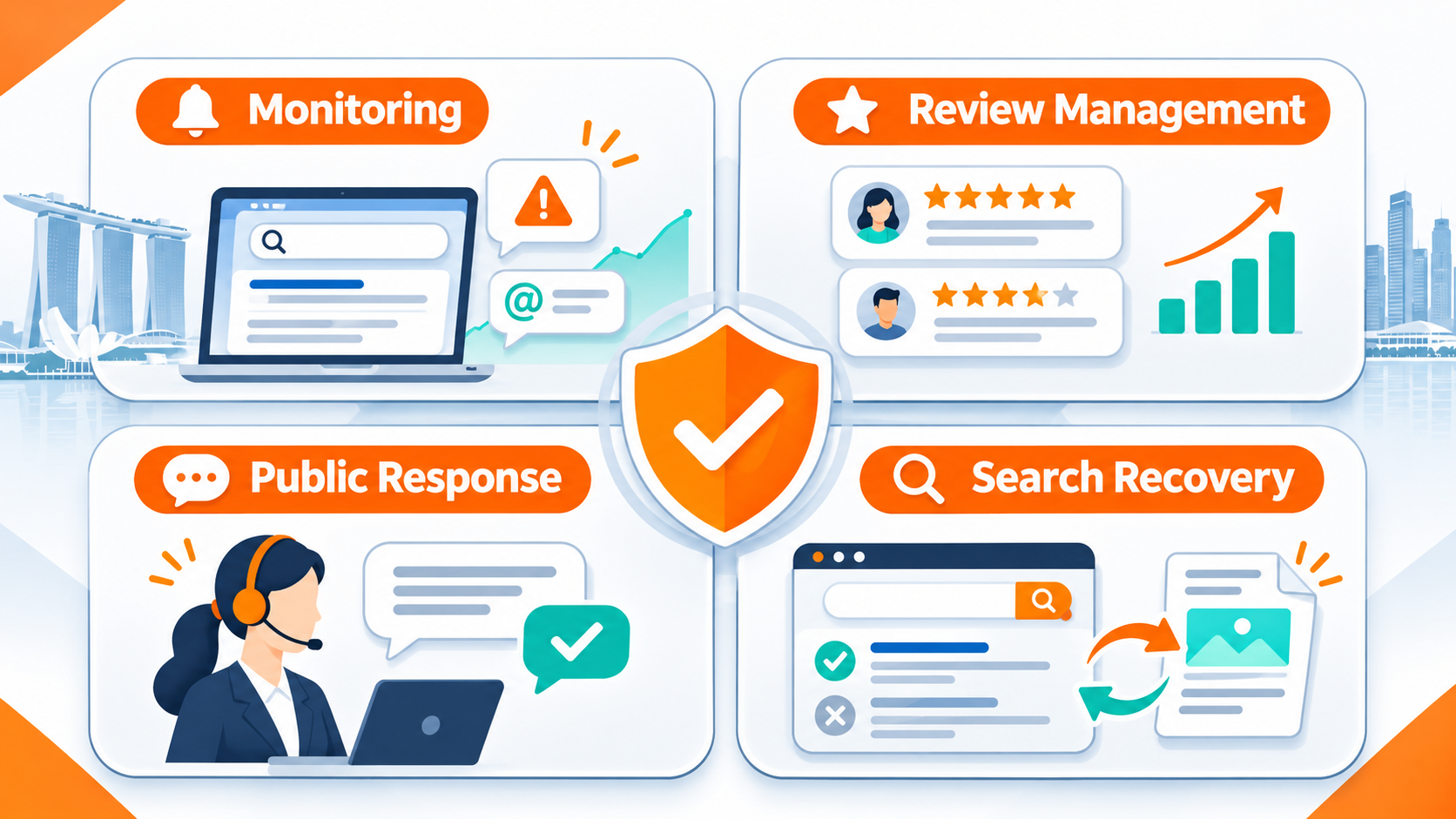
1. Monitoring brand mentions and search results
Monitoring tracks where your business is discussed and alerts the right person to emerging issues. Begin with branded searches, Google Business Profile, relevant review platforms, social channels and press or forum coverage. Add marketplaces or employment-review sites when they materially affect your audience.
A basic monitoring log should record the page URL, date discovered, issue category, urgency, assigned owner and next action. Save evidence before responding, especially when comments could be edited or deleted. Google Alerts can help locate some web mentions, but it does not replace direct checks of reviews or private social discussions.
Check active review channels frequently enough to meet your service standard. Weekly audits may suit a low-volume B2B firm, while a busy consumer business may need daily checks. We would not buy an expensive dashboard until the team can explain what it will do with each alert.
2. Review collection and management
A sustainable review programme invites genuine customers to describe their experiences without steering the outcome. Businesses can use Google’s review link or QR code after a real transaction and make requests part of a standard follow-up process.
Importantly, ask all eligible customers, not only those who seem happy. Google’s review policies prohibit selectively soliciting positive feedback, offering incentives for reviews and asking customers to change or remove negative reviews in exchange for benefits. This applies even when the business regards a review as unfair.
Do not set staff quotas that pressure customers to post particular ratings or mention employees by name.
3. Public response and service recovery
Replying to feedback gives other readers useful context and offers the reviewer a route to resolution. Google says business replies are public, should remain relevant and should protect customer privacy. A verified Business Profile is required to reply to Google reviews; see Google’s review management guidance.
The response process should connect directly with operations. If customers complain about delivery delays, the team needs to examine fulfilment records instead of repeatedly publishing apologies. A response without a genuine corrective action may make the company appear inattentive.
We favour an internal owner for factual checks and final approval. An agency can draft responses or manage a queue, but it should not invent explanations or promise refunds without authorisation.
4. Search visibility, correction and recovery
This work addresses inaccurate listings, outdated information and negative results visible for branded searches. It may involve contacting a publisher, updating an official page, correcting inconsistent business details or publishing relevant material that answers legitimate customer questions.
Search-result suppression means attempting to improve the visibility of accurate, useful pages so that less relevant results become less prominent. It cannot guarantee that a critical article will disappear. Google’s Search documentation makes clear that crawling, indexing and rankings are not guaranteed.
We would scope this work separately from routine monitoring. Content production, publisher outreach and technical SEO require different expertise and should have their own deliverables.
Use a Reputation Exposure Scorecard Before Buying a Service
A scorecard makes the purchasing decision less subjective. The following is our suggested planning framework, not an official industry standard or a statistically validated risk model. Its purpose is to help teams prioritise attention, rather than assign a scientific reputation score.
Review five channels: branded search results, Google reviews, industry or marketplace reviews, social mentions, and press or forum coverage. For each, inspect a consistent period, such as the previous 90 days. Record the number of relevant items, the share containing substantive criticism, unresolved issues, response speed and the person responsible.
| Channel | What to check | Typical owner |
|---|---|---|
| Branded search | Prominent results, accuracy, outdated pages | Marketing or SEO lead |
| Google reviews | New reviews, themes, unanswered concerns | Operations or location manager |
| Industry review sites | Ratings, authenticity, repeated issues | Customer service lead |
| Social platforms | Public mentions, complaints, misinformation | Social media lead |
| Press and forums | Reach, factual accuracy, escalation risk | Senior manager or communications lead |
How to interpret your findings
Give each channel a simple low, medium or high priority based on potential harm and your ability to respond. A single credible allegation involving safety or private information may deserve urgent attention even if mention volume is low. Ten routine complaints about delivery may justify operational changes without an external crisis specialist.
Do not rely on an automatic rule such as “40% negative mentions equals high risk”. Small samples distort percentages. Five comments with two complaints are different from 500 comments with 200 complaints, and neither reveals the severity of the underlying issue.
Choose the top two problems that the business can realistically address in the next 90 days. Repeat the scorecard quarterly using the same channels and measurement period. This helps you distinguish actual progress from a temporary dip in attention.
How to Handle Negative Reviews Without Damaging Trust
A negative review is not automatically a crisis. It may reveal a valid service failure, a misunderstanding or content that violates platform rules. Review the facts before deciding which route to take.
Triage the review before replying
Use three possible actions:
-
Respond publicly when a genuine customer raises an ordinary service concern. Acknowledge the issue and explain how they can obtain assistance.
-
Investigate privately, then respond cautiously when the claim involves personal information, employment issues, financial details or a disputed transaction. Avoid confirming private customer relationships in public.
-
Report a policy violation when a review includes prohibited content, such as spam, impersonation or a demonstrable conflict of interest. Preserve evidence and use the platform’s reporting mechanism.
A harsh review is not sufficient grounds for removal. Google’s review reporting guidance says only reviews that breach its policies qualify. Google does not adjudicate ordinary disagreements between a customer and a business.
We suggest a target of one business day for acknowledging straightforward complaints, with a faster escalation route for serious issues. This is an internal service target, not a requirement imposed by Google. Complex investigations may take longer, but someone should own the case.
Acknowledge, clarify and offer a private route
A useful reply briefly recognises the concern, corrects a material factual misunderstanding when necessary and gives the customer a way to continue privately. Keep the tone professional and avoid revealing order details, health information or contact records.
For example:
Thank you for raising the delay with your order. We understand that our updates were unclear, and we are reviewing how delivery changes are communicated. Please contact our support team through the details on our website so we can investigate your order privately.
Do not claim a change was completed unless someone has confirmed it. When the business made a mistake, acknowledge it. When the facts remain disputed, explain the next step without attacking the reviewer.
Different sectors need different safeguards
Retailers and hospitality businesses can often discuss general service standards openly. Healthcare, financial and legal businesses should restrict replies to neutral acknowledgements and private contact routes. Publicly confirming that a person is a patient or client can itself disclose sensitive information.
Singapore’s Personal Data Protection Act (PDPA) and sector-specific duties may apply depending on the facts. We recommend reviewing response templates with the relevant compliance or legal adviser rather than assuming a customer’s public post authorises the company to publish their records.
Can Negative Search Results or Reviews Be Removed?
Sometimes, but removal depends on who controls the content and which rules apply. Separate the issue into inaccurate information, content that violates a platform’s policies and truthful material that is simply unflattering.
Correct factual errors at the source
If an article lists the wrong director, address or business status, contact the publisher with the exact URL, disputed passage and supporting evidence. Request a correction rather than threatening removal. Keep copies of correspondence and check whether the amended page is later reflected in search results.
For details that have already been removed from a website but remain in Google’s displayed information, an appropriate outdated-content refresh process may help update search visibility. It does not provide a way to erase material that still exists on the source page.
Report content that genuinely violates policy
Google and other platforms provide routes for reporting certain prohibited content. For example, Google accepts reports concerning policy-breaking reviews and has separate processes for qualifying personal information and certain legal concerns. A search-result removal is not the same as deleting the underlying web page.
Google explains that removing a result from Search generally does not remove the source content. For potentially defamatory statements, threats or serious privacy breaches, seek qualified advice on the appropriate legal or platform procedure.
Build accurate branded content instead of promising suppression
Where a truthful critical page remains online, improve the usefulness of your own digital presence. Maintain your website’s company details, publish substantive service information, update relevant business listings and make legitimate customer-support information easy to find.
An agency may also help with structured content, press enquiries or search optimisation. These actions can improve the overall information available about a brand, but they cannot guarantee that a negative result will move to a specified position.
Avoid providers selling secret removal relationships, fake reviews or guaranteed first-page replacements. Ask them to show their proposed actions for each URL and explain the limitations before any work begins.
Singapore Rules: Fake Reviews, Consumer Trust and Privacy
Reputation management needs a compliance check, especially when a provider offers to generate reviews or handle sensitive complaints. The legal and platform consequences are distinct: behaviour may violate a website’s terms even when a particular statutory offence has not been established.
In September 2026, Singapore’s Competition and Consumer Commission (CCS) announced action against 45 businesses and a fake-review provider. The authority required the parties to stop the unfair practices, remove fake reviews and maintain public apologies for six months. This is a concrete warning against buying manufactured endorsements.
Under Singapore’s Consumer Protection (Fair Trading) Act, misleading commercial conduct can raise consumer-protection concerns. Whether particular conduct breaches the law depends on its facts. Do not assume that declaring an incentive automatically makes an incentivised Google review acceptable: Google’s rules separately prohibit such incentives.
Providers handling customer records should also have clear access controls, confidentiality terms and data-retention arrangements. Give agencies the minimum information they need. Avoid sending identifiable complaint records through unsecured channels merely to draft a public reply.
Choosing the Right Online Reputation Service Model
Not every business needs a full-service agency. We recommend matching support to the problem, existing staff capacity and the amount of specialist work involved. The following models can also be combined.
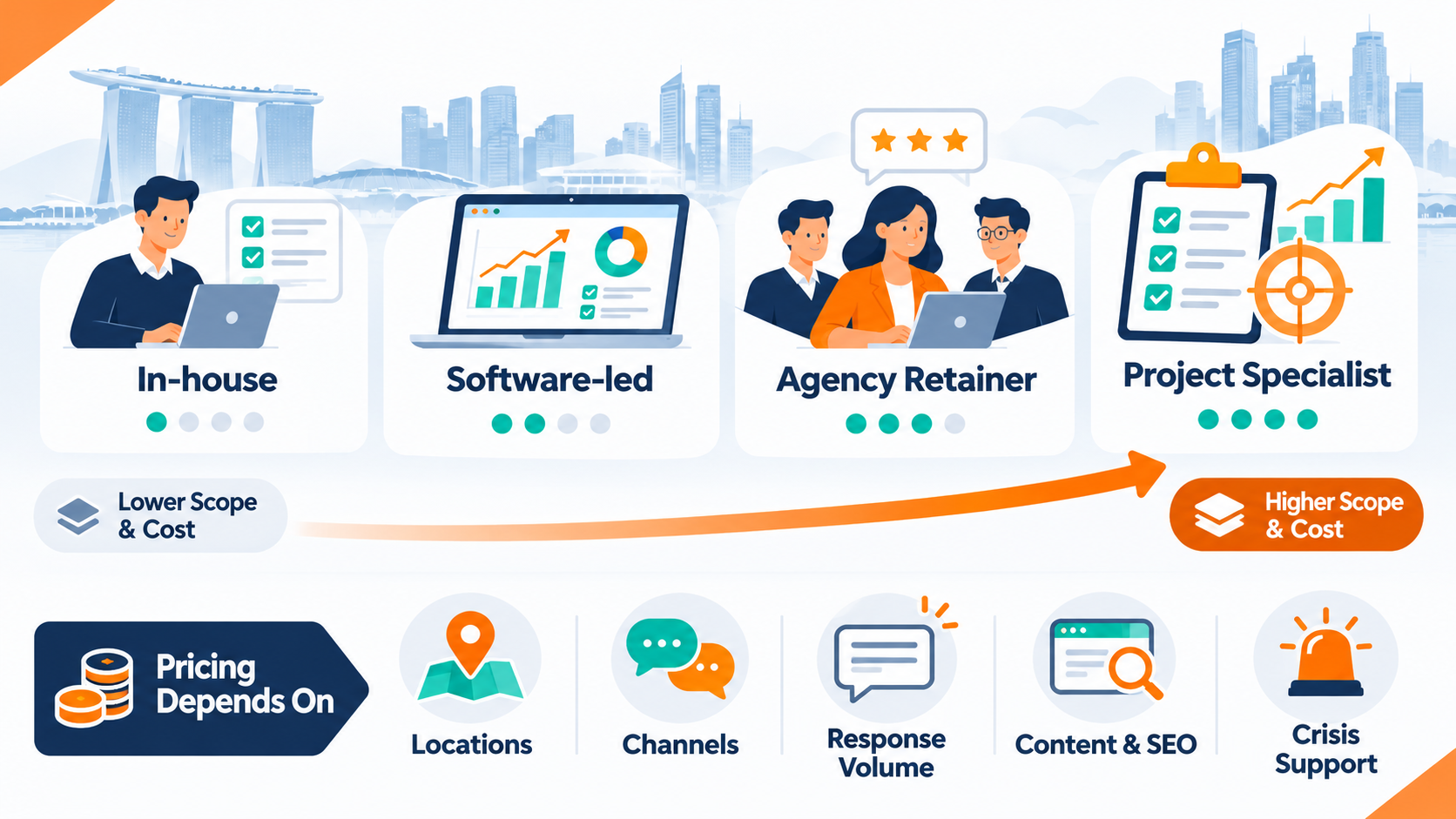
| Service model | Best fit | Main consideration |
|---|---|---|
| In-house | Manageable volume and clear staff ownership | Staff time and training |
| Software-led | Alerts, review invitations and reporting | Someone must act on the data |
| Agency retainer | Multiple active channels and steady workload | Monthly scope and approvals |
| Project-based specialist | Defined search issue or crisis recovery | Clear milestones and limits |
Keep routine ownership close to operations
For a single-location business with modest feedback volume, an operations manager may be able to monitor reviews, answer common questions and escalate difficult cases. A tool can reduce administrative work, but a dashboard cannot correct poor service.
A multi-location business may benefit from shared reporting, response templates and agency coordination. The internal team should still verify facts and retain control of official accounts. Never give a contractor sole ownership of the business’s profiles, passwords or recovery details.
When external specialists make sense
Outside help becomes useful when complaints arrive across several platforms, important search results contain inaccuracies or the organisation lacks SEO and communications expertise. A specialist can audit branded queries, improve content quality, coordinate legitimate correction requests and establish an escalation process.
What online reputation services cost in Singapore
There is no universal Singapore price for this work. A monitoring tool, a monthly review-management arrangement and a complex search-recovery project involve different labour and deliverables. Quoting one market rate without a defined scope would be misleading.
Ask each provider for an itemised Singapore-dollar proposal showing setup work, platforms monitored, number of locations, response volume, content production, reporting frequency and extra charges. Compare the effective cost of work your team genuinely needs rather than choosing the cheapest advertised package.
Be especially cautious about large upfront payments linked to guaranteed deletions. Legitimate technical work can be billed in advance, but the provider must separate its deliverables from results controlled by search engines or third-party publishers.
How to Evaluate Providers Before Signing
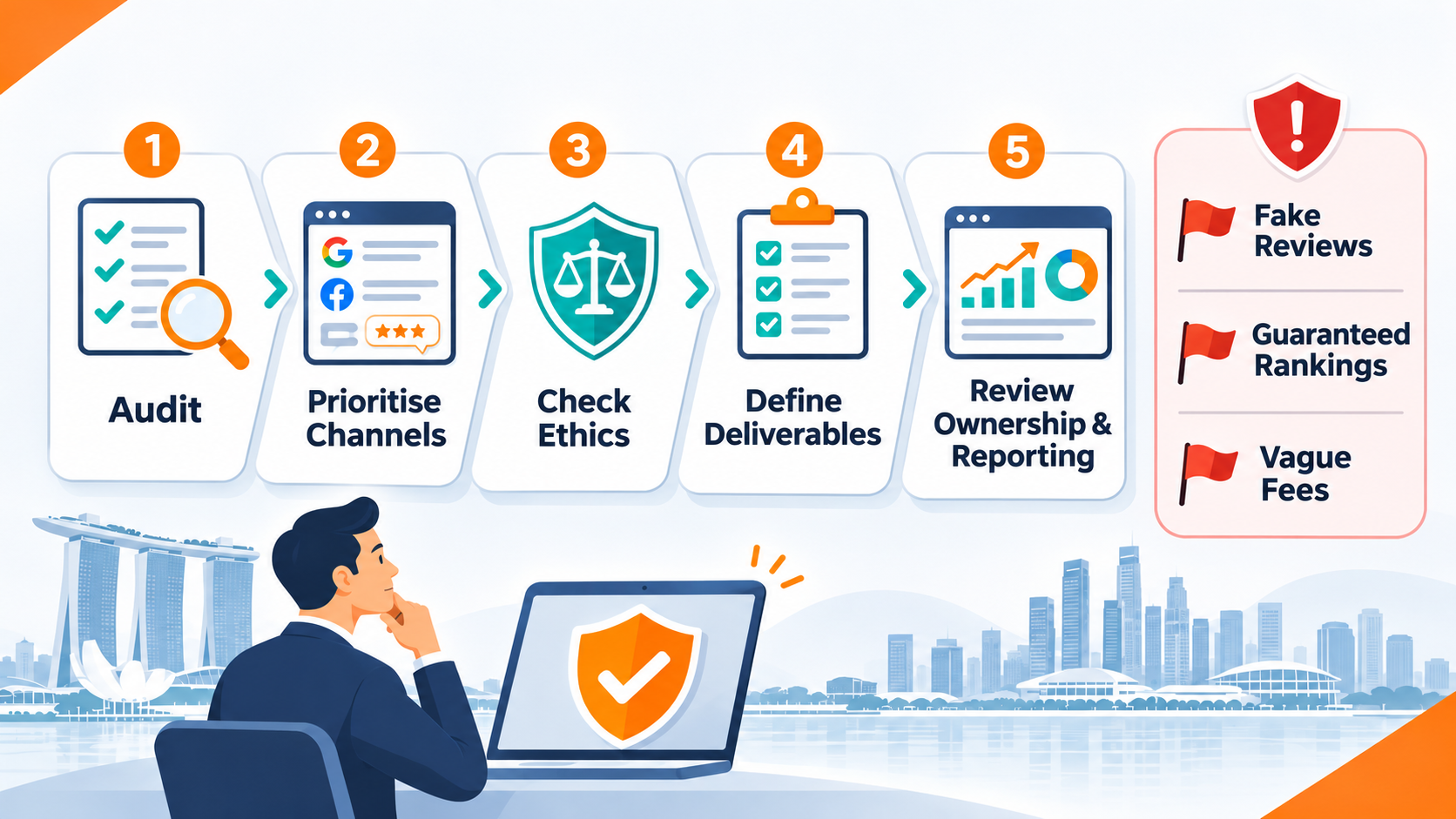
A credible provider should explain its process plainly and be willing to say what it cannot accomplish. We would compare proposals using the same questions rather than relying on polished case studies alone.
-
Which channels do you cover? Ask whether the scope includes Google, industry review platforms, social sites and relevant forums. Confirm exclusions.
-
Who writes and approves responses? Identify the internal decision-maker and the agency’s access level.
-
How are reviews collected? Require an ethical process that invites genuine feedback without selective positive solicitation.
-
What can you remove? Ask for a policy-based explanation for each proposed takedown or correction request.
-
What reports will we receive? Expect issue logs, response performance, outstanding cases and branded-search observations.
-
What happens if we terminate? Confirm ownership of accounts, content, records and any monitoring configuration.
Red flags that justify walking away
Reject offers to buy five-star reviews, suppress genuine complaints through intimidation or provide a guaranteed Google ranking. Also question vague “reputation repair” fees that come without a list of actions, approved channels or responsible staff.
A reputable agency should welcome reasonable oversight. If a provider refuses written methods or insists that your team cannot inspect its work, the risk may outweigh the promised benefit.
A Practical 90-Day Online Reputation Improvement Plan
The first three months should establish control and resolve visible problems. They are not a guarantee that search rankings or average ratings will change within that period.
Days 1–30: Audit and assign ownership
Search your exact business name and common branded variations. Record prominent results, review profiles, recent complaints, incorrect listings and unresolved customer issues. Use the Reputation Exposure Scorecard to identify the most consequential gaps.
Assign one person to each important channel and designate a senior approver for sensitive replies. Confirm ownership of your Google Business Profile, business social accounts and review-platform logins. Establish a shared issue log and response target.
Days 31–60: Improve responses and fix root causes
Start addressing outstanding feedback based on severity rather than star rating alone. Correct inaccurate business details and submit legitimate platform reports when evidence supports them. Introduce a neutral review request after completed customer interactions.
Meet with the teams responsible for repeated complaints. If delivery, billing or communication problems continue, operational corrections should take priority over additional content. Record which changes were implemented so public replies remain accurate.
Days 61–90: Review evidence and adjust the scope
Compare the latest period with your baseline. Look at outstanding complaints, time to first acknowledgement, recurring issues, legitimate new reviews and accuracy of branded results. A lower complaint count alone is insufficient if customers have simply stopped receiving a response.
Decide whether the workload now fits an internal process or whether specialist support remains worthwhile. Document lessons and schedule the next quarterly audit. This turns reputation management into a repeatable operating practice.
Measuring Results Without Misleading Metrics
A useful report separates actions the team controls from outcomes influenced by customers and platforms. Response time, outstanding cases and publishing accuracy are controllable. Star ratings, search positions and the number of complaints are not wholly within a provider’s control.
| Metric | What it tells you | Important limitation |
|---|---|---|
| Time to first response | Whether complaints receive prompt attention | Speed does not prove resolution |
| Unresolved issue count | Whether cases are being followed through | Requires consistent logging |
| Review volume and themes | What customers are experiencing | Small samples can mislead |
| Branded search visibility | Which pages appear prominently | Results vary by context |
| Repeat complaint categories | Whether underlying problems persist | Categories need consistent definitions |
We recommend reviewing the pattern across several indicators.
Frequently Asked Questions
What is the difference between online reputation management and online reputation services?
Online reputation management is the overall practice of monitoring and improving how a business is represented online. Online reputation services are the specific activities, tools or specialist support purchased to perform that work.
How much do online reputation services cost in Singapore?
Costs depend on the number of locations, monitored channels, response workload and whether search-related content or crisis support is included. Request a written quote in Singapore dollars with clear deliverables and exclusions.
Can an agency remove negative Google reviews?
An agency can help report reviews that violate Google’s policies, but it cannot require Google to remove genuine criticism. Disliking a review or disputing its conclusions does not automatically make it eligible for removal.
How long does online reputation improvement take?
Monitoring and response processes can be established quickly, while content visibility and trust develop at different rates. Any timetable for search rankings should be treated as an estimate, never a guarantee.
Is it legal to pay for positive customer reviews?
Fake or misleading reviews can raise concerns under Singapore consumer-protection law. Google independently bans incentives for posting, revising or removing reviews, so businesses should request genuine feedback without rewards or rating conditions.
Does a small business need an agency for online reputation services?
Not necessarily. If a staff member can monitor key channels and resolve complaints reliably, an internal system may be sufficient. Consider external support when issues become complex, frequent or spread across platforms.
Protect Your Reputation With a Clear Plan, Not Empty Promises
Effective online reputation services begin with listening, checking the facts and correcting problems customers actually experience. Choose monitoring and review support when day-to-day feedback is the main challenge. Bring in SEO or crisis specialists when the issue requires expertise your team does not have.
Our recommendation is to complete the five-channel scorecard, assign accountable owners and request proposals only for gaps you cannot address internally. If branded search visibility or content quality is part of that gap, MediaOne can help assess how SEO services fit into a wider reputation plan. The right outcome is a more accurate, responsive and trustworthy public presence—not a promise that criticism will disappear.