| AI Summary
Online branding helps Singapore SMEs build recognition, credibility and customer trust through consistent messaging, visual identity and digital experiences. This guide covers brand positioning, SEO, social media, customer reviews, budgeting, performance metrics and a practical 90-day action plan for 2026. |
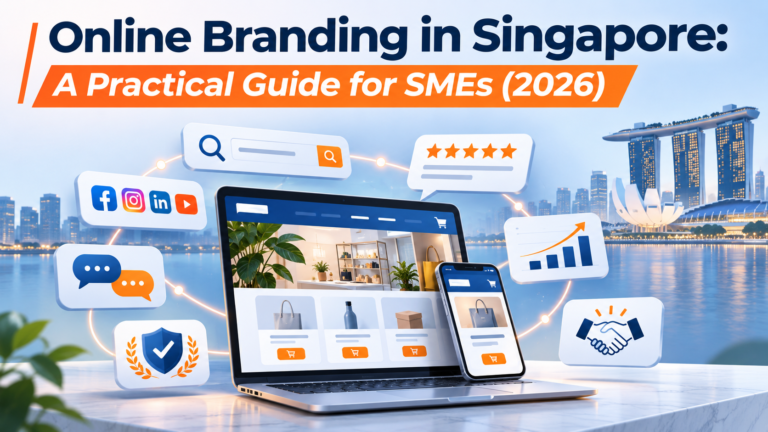
Online branding shapes how customers recognise, assess and remember your business across search results, websites, social platforms and customer conversations. For Singapore small and medium-sized enterprises (SMEs), the first priority is a clear promise that stays consistent wherever buyers encounter it.
You do not need to redesign everything. Start by identifying your ideal customer, checking your existing touchpoints and fixing the gaps that make your business difficult to understand or trust. We explain how to do that, where to invest and what to measure without stretching a small marketing budget.
Key Takeaways
-
Start with positioning: Define your customer, their main problem and the reason to choose your business.
-
Audit what already exists: Check your name, visuals, message and next step across customer touchpoints.
-
Prioritise owned assets: Make your website and customer contact process clear before increasing advertising spend.
-
Build visible proof: Use genuine reviews, useful content and accurate business information to support your claims.
-
Choose channels deliberately: Focus on where your customers research and buy, not where competitors post most often.
-
Measure outcomes: Connect search visibility, enquiries, conversions and repeat business to monthly decisions.
What Is Online Branding, and How Does It Differ From Digital Marketing?
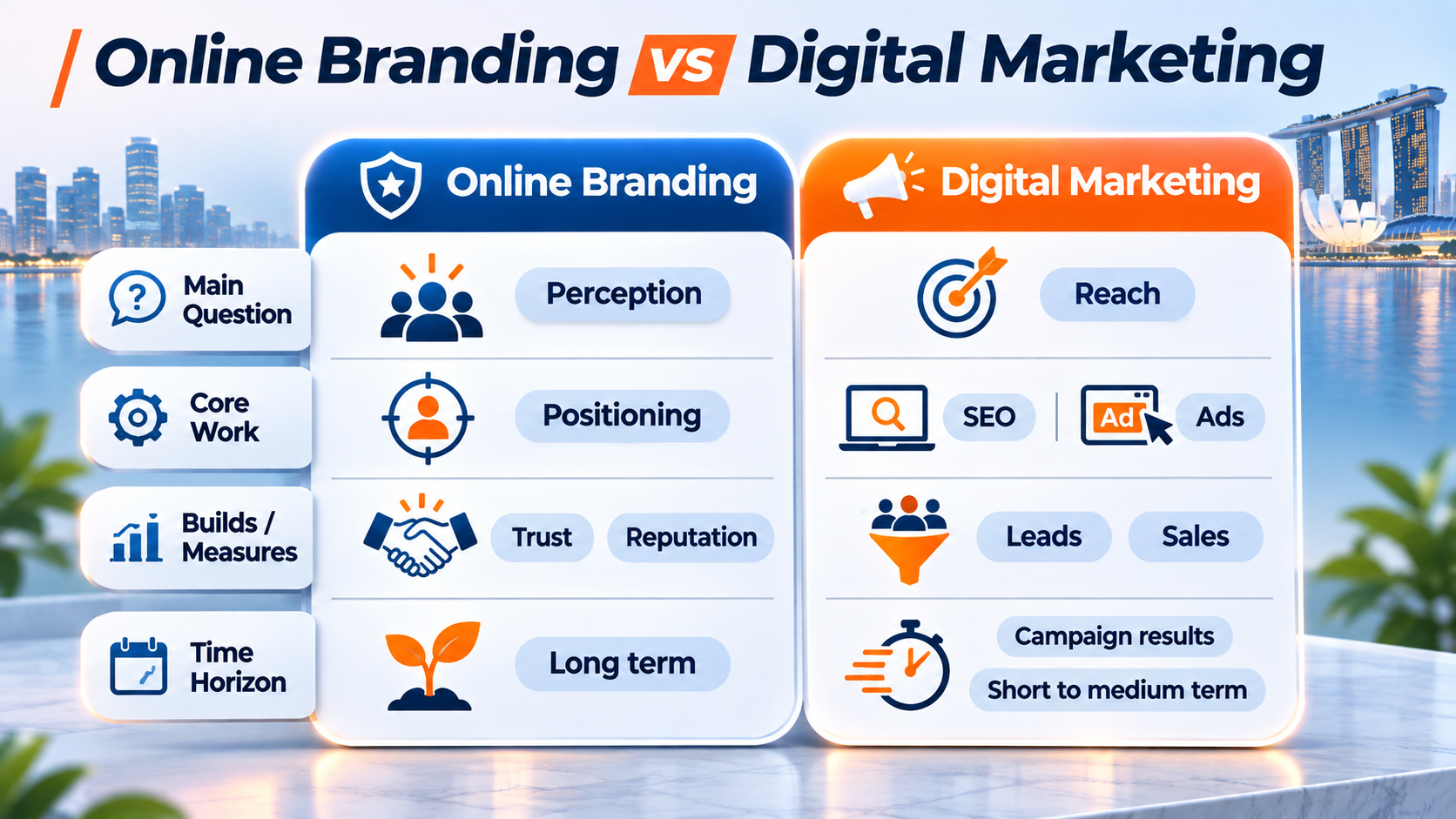
Online branding is the deliberate development of a recognisable identity and reputation through digital touchpoints. It covers how your business looks, sounds, explains its value and responds to customers. Your online brand also includes impressions you cannot fully control, such as independent reviews.
Digital marketing refers to activities that attract, engage and convert an audience. Search engine optimisation (SEO), advertising, email campaigns and social media distribution are examples. Branding shapes the message and experience those activities deliver.
| Area | Online branding | Digital marketing |
|---|---|---|
| Main question | Why should customers recognise and trust us? | How do we reach and convert customers? |
| Core work | Positioning, identity, messaging and reputation | SEO, campaigns, content distribution and ads |
| Typical indicators | Branded searches, customer feedback, recall and consistency | Traffic, leads, acquisition cost and sales |
| Time horizon | Ongoing, with gradual gains | Campaign and ongoing performance cycles |
The two should reinforce each other. An advertisement might promise transparent pricing, but a confusing landing page can undermine that claim. Conversely, a coherent brand without sufficient visibility may struggle to attract enquiries.
We recommend defining the brand promise before creating campaigns. Otherwise, each channel risks communicating a different reason to buy.
Why Online Branding Matters to Singapore SMEs in 2026
Singapore customers can encounter the same company through Google Search, Google Maps, Instagram, LinkedIn, marketplaces, email and messaging apps.
Across these journeys, clarity matters. Buyers want to know what you provide, whether you serve their needs and how they can contact you. Consistent branding reduces avoidable confusion; it does not guarantee trust or sales.
The competitive advantage often lies in specificity. “Quality solutions at affordable prices” could describe hundreds of businesses. “Next-day office chair repairs for Singapore companies” tells a particular buyer exactly what to expect, provided the business can deliver it.
Build Your Online Branding Strategy Around Five Foundations
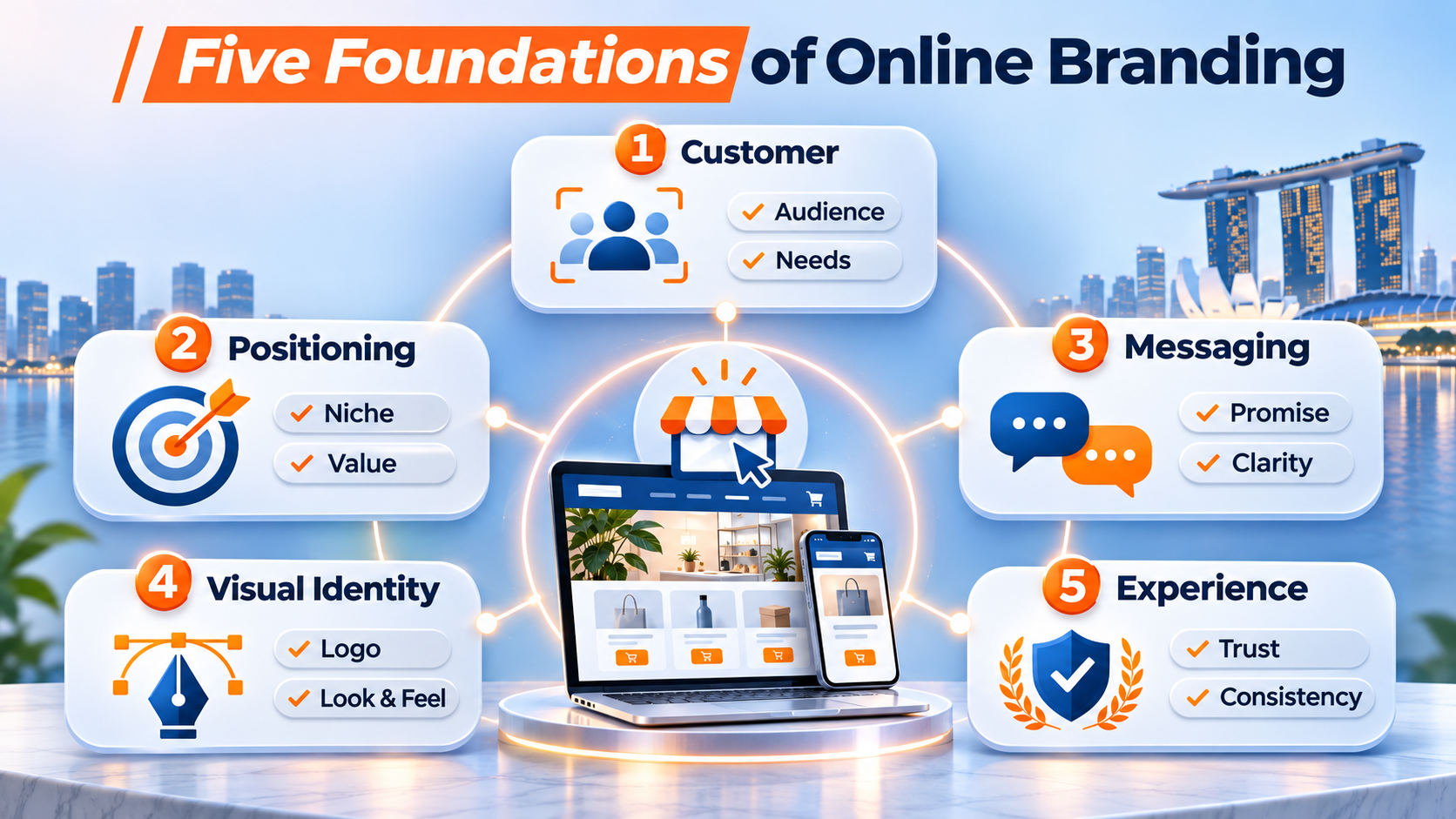
1. Identify the customer you want to win
Avoid describing your audience as “everyone in Singapore”. Select one priority group and study what triggers their purchase, which alternatives they compare and what could prevent them from enquiring.
A useful customer profile covers:
-
Situation: Who buys, where they are and what problem they need solved.
-
Decision: Their criteria, including price, convenience, expertise or speed.
-
Research: Where they look for information and which questions they ask.
-
Objections: What makes them delay, distrust or reject an offer.
-
Language: Which language and terminology they comfortably use.
For example, a commercial cleaning company may target office managers seeking reliable after-hours service. Its brand should emphasise scheduling, scope and accountability instead of generic cleanliness claims.
2. Define positioning and a credible brand promise
Positioning explains why a particular customer should choose you over alternatives. Good positioning addresses a real need and includes evidence. It should be narrow enough to guide decisions but flexible enough to support growth.
Write a one-sentence statement: We help [customer] solve [problem] through [specific approach], supported by [evidence]. Remove any claim you cannot substantiate.
Suppose a tutoring centre offers small-group mathematics lessons. “Small classes with a published lesson plan and regular parent updates” is clearer than “Singapore’s best tuition”. The former describes a service; the latter makes an unverified comparison.
3. Create a consistent voice and messaging framework
Choose three adjectives that describe your brand voice, such as practical, reassuring and direct. Define how those qualities appear in website text, social posts and customer replies. Include examples of language your business avoids.
Build a simple messaging sheet containing your main promise, supporting evidence, target audience, frequently asked questions and preferred call to action (CTA). A CTA is the next step you ask a reader to take, such as requesting a quote.
4. Standardise your visual identity
A small business rarely needs an elaborate brand manual to get started. A practical one- or two-page guide can specify the approved logo, colour codes, fonts, image style and rules for using each element.
Check that your website, profile images, proposals, invoices and email signatures use the same identity. Allow deliberate variations for dark backgrounds or small screens, but document them.
5. Assign ownership and protect the experience
A brand guide becomes ineffective when nobody maintains it. Name one person responsible for approving core changes, checking public listings and updating templates. This can be the owner in a two-person company.
Give customer-facing staff practical guidance on response times, refunds, escalation and handling complaints. A polished website cannot compensate for promises that are routinely missed.
Audit Your Online Branding Before Spending More
We recommend a Touchpoint Consistency Audit as a simple internal prioritisation tool. It is a suggested working method, not a recognised industry benchmark or a scientifically validated score.
List the places where customers encounter your business: search snippets, website pages, Google Business Profile where eligible, marketplace stores, social accounts, email templates and messaging replies.
Give each touchpoint one point for each question:
-
Identity: Is the trading name recognisable and the visual identity correct?
-
Message: Does it describe the same audience, offer and brand promise?
-
Proof: Does it provide appropriate, current evidence or accurate details?
-
Action: Can a customer clearly take the intended next step?
| Score | Suggested action |
|---|---|
| 4/4 | Maintain and review periodically |
| 3/4 | Fix the missing element during routine updates |
| 0–2/4 | Investigate promptly, especially on high-traffic touchpoints |
These thresholds are editorial rules of thumb. A wrong phone number or misleading price requires immediate correction even when the overall score is high. Rank issues by customer impact, not score alone.
Build a Website That Explains and Converts
Your website should work as the central source of truth for your offer. On mobile and desktop, the opening section should identify the service, intended customer and next action without requiring visitors to decipher slogans.
Prioritise these essentials:
-
A clear headline describing your main product or service.
-
Relevant service or product pages with scope, limitations and pricing information where appropriate.
-
A visible contact route, such as a working form, telephone number or business messaging link.
-
Evidence, including legitimate reviews, useful examples and company details.
-
Accessible layouts, readable content and reliable mobile performance.
Keep names, operating hours and offers aligned with your other channels. Test contact forms and buttons regularly. A broken booking link is both a conversion problem and a brand experience problem.
Use SEO to make your brand easier to find
SEO helps relevant customers discover your pages through search. Begin with the language they use, including service terms, locations and common questions. Create pages that directly answer those needs rather than forcing one keyword into every heading.
Google advises site owners to use descriptive wording in important page locations and publish helpful, people-first content. Its Search Essentials and helpful content guidance are useful starting points.
Use descriptive title tags, clear headings, internal links and accurate meta descriptions. There is no universal requirement to place exactly one keyword on each page. Check indexing, mobile usability and performance alongside editorial quality.
Keep Google Business Profile accurate when eligible
A Google Business Profile can support eligible businesses with face-to-face customer contact. It is not automatically available to every online-only company. Google excludes some arrangements, including ineligible virtual offices, under its Business Profile guidelines.
If you qualify, choose the correct category, enter your actual business name, confirm hours and add authentic images. Businesses visiting customers at their locations should generally hide an address that does not receive customers and specify the service area instead.
Do not add keywords to your official name or create duplicate listings to cover additional neighbourhoods. Maintain accurate information in relevant directories and marketplaces, but avoid listings that have no value to your intended audience.
Build Trust Through Reviews, Content and Customer Service
Make your credibility visible
Customers need evidence that a company can deliver. An About page should explain who operates the business, its relevant qualifications and how customers can reach it. Product pages should state what is included and any important exclusions.
Where relevant, explain payment terms, delivery arrangements, warranties and dispute procedures. Transparent policies can answer concerns that a logo or polished photography cannot resolve.
Manage customer reviews responsibly
Ask customers for honest feedback after a completed transaction. Do not script positive ratings, reward only favourable reviews or publish invented testimonials. Feedback should reflect real experiences.
Respond to reviews professionally, especially when someone reports a problem. A useful response acknowledges the specific issue, explains an appropriate next step and moves private account details into a secure channel.
Review trends matter as much as averages. Several recent complaints about missed appointments may point to an operational issue rather than a communications problem. Fix the service before launching a campaign about reliability.
Publish content that answers buying questions
Create content around recurring questions from real prospects. A renovation firm might explain timelines and quotation inclusions. A software provider might show implementation steps and common integration constraints.
For more on positioning before production, see our brand strategy guide and our branding strategies guide.
Choose Social Media, Email and Paid Channels by Customer Behaviour
Social media: focus on relevance and consistency
Do not assume Instagram or Facebook is automatically the best first channel for every Singapore SME. Consumer brands may benefit from visual demonstrations, while B2B companies may gain better conversations through LinkedIn, search or industry communities.
Choose one main channel by checking customer research habits, available content and your capacity to respond. Publish a manageable mix of educational posts, product explanations and credible evidence. Keep profile descriptions and contact information aligned with your website.
Email and messaging: earn permission and deliver value
Email can support enquiries, onboarding and repeat purchases without relying entirely on social-platform distribution. You do not need hundreds of subscribers before sending a useful, permission-based newsletter. A small relevant list can justify a simple programme.
Collect customer information responsibly. Singapore’s Personal Data Protection Act (PDPA) applies to the collection, use and disclosure of personal data, subject to its provisions and exceptions. The Personal Data Protection Commission’s guidance is the appropriate reference for consent and withdrawal requirements.
Marketing calls and texts to Singapore telephone numbers can also trigger Do Not Call rules. Check the applicable requirements before running campaigns, including where messages are sent through third-party services.
Paid advertising: amplify a message that already works
Paid search and social advertising can expose your business to relevant audiences. However, advertising cannot fix a confusing offer, poor service or inconsistent landing page.
Before increasing spend, check that the advertisement and destination agree on price, availability, benefits and next steps. Track qualified enquiries rather than clicks alone. Begin with a controlled budget and assess whether traffic converts profitably.
How Much Does Online Branding Cost in Singapore?
Costs depend on whether you need strategic research, a visual refresh, a website rebuild or ongoing content. There is no defensible single price for every SME, and agency quotations vary by scope and deliverables.
Separate your proposed budget into three categories: foundation (positioning and brand guidelines), implementation (website, profiles and content) and distribution (advertising or outreach). This prevents a large design project from consuming money needed to make the brand visible.
Are Singapore branding grants available in 2026?
Yes, eligible activities may qualify, but the scheme and activity matter. Enterprise Singapore states that the older EDG, MRA and PSG schemes ceased on 29 September 2026. From 30 September 2026, new applications fall under the EDGE Grant.
EDGE offers different support rates across eligible activities. Its official FAQ describes up to 50% for SMEs for standard activities and up to 70% for qualifying internationalisation and sustainability activities, subject to the relevant rules. These are maximums, not an automatic branding subsidy.
For instance, the International Branding activity supports certain overseas-expansion brand research, strategy and identity work. It excludes domestic lead-generation activity and operating expenses such as website development and social media management.
Check eligibility and supported costs before signing or paying a vendor. The official guidance says retrospective applications are not supported. We would not build a project budget around grant reimbursement until the specific activity and approval conditions are clear.
Measure Online Branding With Business-Focused Metrics
Good measurement separates recognition from commercial outcomes. No single metric proves that branding caused a sale. We recommend tracking a small group of indicators together and reviewing changes in context.
| Objective | Practical measure | Where to check | Decision it supports |
|---|---|---|---|
| Recognition | Branded search clicks and impressions | Google Search Console | Is branded search visibility changing? |
| Discovery | Non-branded search clicks | Google Search Console | Are new audiences finding useful pages? |
| Consideration | Enquiries and relevant page engagement | Analytics and enquiry records | Does the offer answer buyer questions? |
| Conversion | Qualified enquiries and sales | Customer relationship management or sales records | Are channels attracting suitable buyers? |
| Trust | Review themes and complaint resolution | Review platforms and support logs | Which service issues need attention? |
| Loyalty | Repeat customer rate | Sales records | Are customers choosing to return? |
Google’s Search Console branded queries filter became available to eligible sites in March 2026. It can separate branded and non-branded performance. Its classification may be imperfect, and Search Console reports search impressions and clicks rather than total search demand.
Google Analytics 4 (GA4) can help measure engagement and key events. Its engagement definitions should guide interpretation; time on a page alone does not establish satisfaction or purchase intent.
A Practical 90-Day Online Branding Plan for SMEs
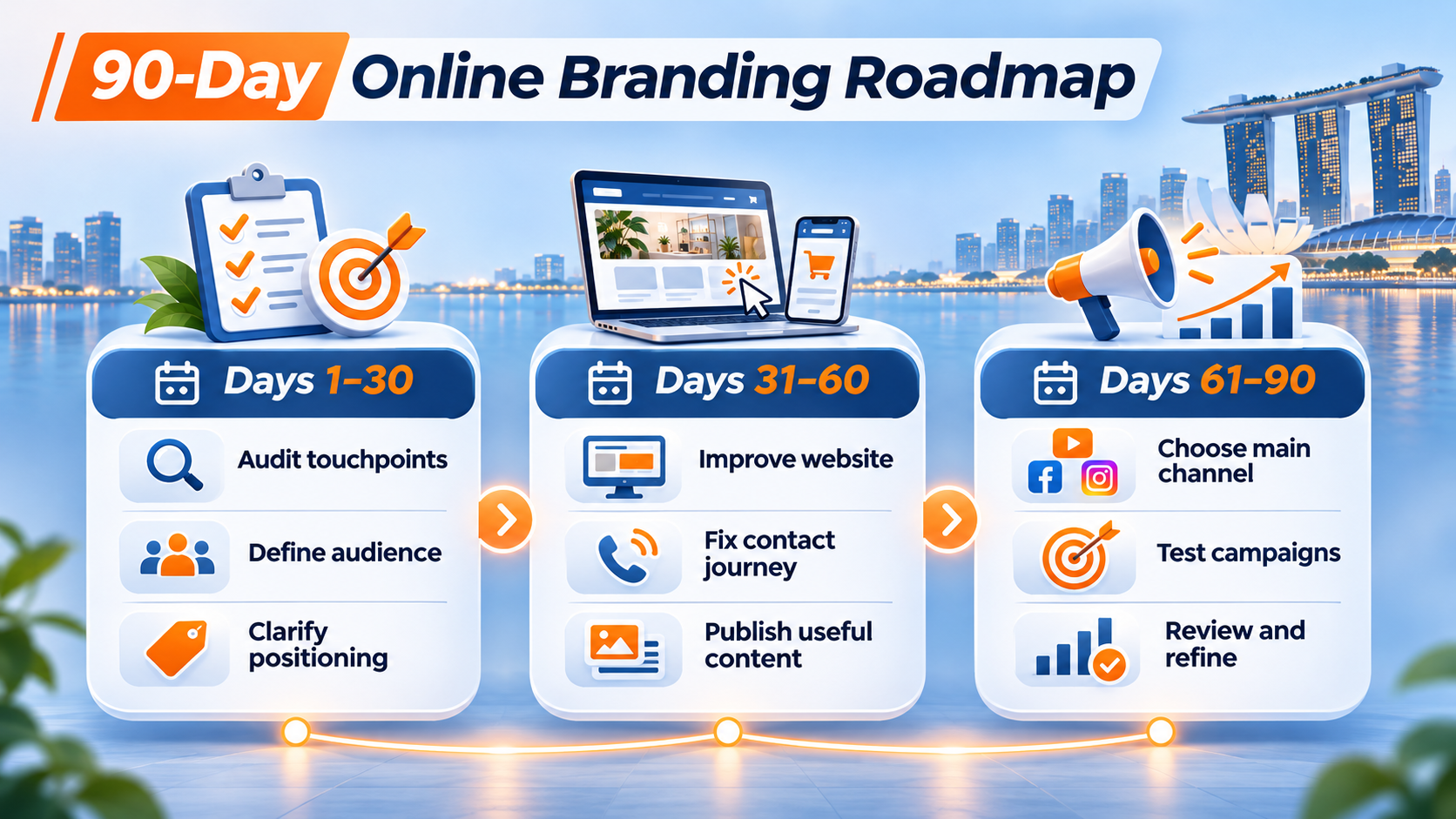
Days 1–30: diagnose and define
List every public touchpoint and complete the four-point audit. Interview a few recent customers or review enquiries to understand their real objections. Select your priority audience and write one clear positioning statement.
Correct inaccurate business details immediately. Then approve a short brand guide with core messages, visual rules and a named owner. Establish baseline measurements for branded search, enquiries, conversions and reviews.
Deliverable: A documented positioning statement, working brand guide and prioritised fix list.
Days 31–60: repair the customer journey
Rewrite your homepage opening section and highest-priority service pages. Check mobile layouts, contact forms and customer response templates. Update eligible business profiles and important social accounts.
Publish two or three useful pieces of content answering frequent buying questions. Invite honest reviews through your normal customer service process. Make sure the experience supports every claim you publish.
Deliverable: A consistent website-to-enquiry journey with relevant proof and functioning contact routes.
Days 61–90: distribute, test and refine
Choose one primary discovery channel and a realistic publishing schedule. Test a modest campaign only if the offer and landing page are ready. Review enquiry quality alongside clicks and reach.
Deliverable: A repeatable channel plan and a simple monthly performance dashboard.
Common Online Branding Mistakes to Avoid
- Starting with a logo redesign: A new logo rarely resolves unclear positioning. Confirm the offer and audience before paying for creative changes.
- Copying competitors: Similar colours and slogans make differentiation harder. Study the alternatives, then identify your own credible advantage.
- Opening every social account: Inactive profiles with old details can create confusion. Maintain the channels customers actually use.
- Treating reviews as decoration: Feedback may expose service problems. Address recurring complaints rather than hiding them beneath promotional content.
- Measuring only likes: Reach without suitable enquiries can mislead budget decisions. Connect channel reporting to customer and sales data.
- Changing everything at once: Uncontrolled changes make results difficult to interpret. Work through high-impact fixes and document decisions.
Frequently Asked Questions
What is the difference between online branding and digital marketing?
Online branding defines how customers recognise and perceive your business across digital channels. Digital marketing uses activities such as SEO, advertising and email to reach audiences and encourage action. The strongest plans connect both.
How much should a Singapore SME spend on online branding?
There is no standard amount. Begin with an audit, request itemised quotations and fund the most important gaps in positioning, website clarity and customer experience before expanding to additional channels.
How long does online branding take to show results?
Corrections to inaccurate profiles or confusing pages can improve the customer experience immediately. Recognition, reputation and commercial results may take months, depending on your audience, competition and activity. Compare trends rather than expecting a fixed deadline.
Does every SME need a brand style guide?
A short guide is useful even for a very small team. Record the official name, logo rules, colours, voice, promise and approved contact details so that everyone communicates consistently.
Is a Google Business Profile necessary for an online-only business?
Not necessarily. Google Business Profile eligibility depends on the business model and customer contact, so online-only businesses without qualifying in-person contact may not be eligible. Use your website and appropriate channels instead of creating an ineligible listing.
Which online branding metrics matter most?
Monitor branded search performance, qualified enquiries, conversion trends, customer feedback and repeat business. Read them together, because improved visibility does not automatically mean stronger customer trust or higher sales.
Make Online Branding a Consistent Advantage for Your Singapore Business
Effective online branding starts with a specific audience, an honest promise and an experience that supports it. The next step is not necessarily a new campaign. It may be correcting your contact details, clarifying your homepage or resolving the complaint customers mention most often.
We recommend running the Touchpoint Consistency Audit this week, choosing the three highest-impact fixes and assigning an owner to each. Use the 90-day plan to turn those fixes into a manageable routine. Then measure whether customers can find, understand and confidently engage your business.
If you need help connecting positioning with search visibility and digital campaigns, explore our brand strategy guidance before deciding which services and channels warrant investment.