Key takeaway: The headline “starting from” price tells you little. Compare packages on net cost per month and on scope.
Singapore SMEs usually ask one question first: “What will this cost me after the EDGE grant?” The answer is rarely a single figure. At DM MediaOne, our SEO, SEM, SMM and SMA packages differ in price, scope and length, so the headline price says little on its own. Our Boost Up package starts from S$4,950 after the grant. Our SEO and SEM package with landing page development is listed at S$9,900 before the grant. Those figures are not directly comparable, and this guide explains why.
This article sets out a simple way to compare packages on net cost and scope, using our published prices as worked examples. It also explains what the grant does and does not cover, so you can estimate your cost before you commit. Eligibility and funding levels are set by the scheme administrator and can change, so confirm both with them before you sign.
Key Takeaways
- The “starting from” price tells you little. Boost Up starts from S$4,950 after the grant, but the package you buy determines what you pay.
- Compare packages on cost per month, not total price. Package D (SMM + SMA, 2 months) is S$9,900 before grant, or about S$4,950 per month. Package A (SEO + SEM, 30 keywords, 6 months) is S$10,000 before grant, or about S$1,667 per month. Total price alone would mislead you.
- Match scope to your goal before you look at price. A social-only buyer and a buyer who needs search visibility are not shopping for the same thing.
- Confirm eligibility and funding levels before you sign. Funding criteria can change, and the grant does not reduce every package by the same proportion.
- Read each package as one row across scope, duration and price. The cheapest-looking option is not always the lowest-cost option per month of coverage.
Table of Contents
Watch Our Guide to EDGE Grant Costs in Singapore
Planning your digital transformation budget? Watch this MediaOne video to learn more about the EDGE Grant and explore the factors that can influence project costs, including service scope, implementation requirements, and business objectives. Review the latest grant conditions to understand the applicable funding arrangements before budgeting.
What the EDGE Grant Covers and Why Cost Depends on Scope
What “EDGE grant package” means in practice
The Enterprise Development Grant (EDG) is the Singapore funding scheme run by Enterprise Singapore. It co-funds qualifying projects for local small and medium-sized enterprises (SMEs). The scheme has since been reorganised into EDGE-branded packages, which are pre-defined bundles of solutions. Check which scheme is open to you on the Enterprise Singapore website, because the name on a brochure may not match what is accepting applications.
Net cost is the amount your business must actually find after the grant. It also includes the cash you need to bridge the wait for reimbursement. That is the figure that drives the decision. The headline grant percentage is only a starting point.
Digital marketing shows this clearly. Buyers usually ask “what does the package cost after the grant?”, not “what is the grant percentage?”. That is the right instinct. A grant percentage applied to an inflated base can still leave a higher net cost than a smaller base with a lower co-funded share.
Why the same package can cost very different amounts
Two businesses can buy what looks like the same package and pay very different sums. The reasons are mostly scope and selection, not the grant.
Project scope. A package is a template. The keywords tracked, the AI search prompts monitored, the length of the engagement and the channels included all change the price. A package covering search engine optimisation (SEO) and search engine marketing (SEM) with 30 keywords over six months is a different project from one with 15 keywords and a shorter run.
Provider selection. Vendors price their time differently, and not every provider is approved for every scheme. Choosing on price alone can cause eligibility problems later.
Number of components. Each added component widens the gap between total project value and the amount reimbursed, because the grant funds only qualifying components.
Approval type. Pre-approved packages follow a defined scope and pricing structure, so costs are easier to forecast. Bespoke projects are scoped around the business, but Enterprise Singapore assesses each application based on project scope, project outcomes and the competency of the service provider. Expect more uncertainty, and a longer wait, for bespoke work. Confirm with Enterprise Singapore which category applies before you sign.
The lesson is that a package name says little about cost. Scope, provider and approval status say far more.
Breaking Down the Cost Structure
Total project cost versus the grant-funded portion
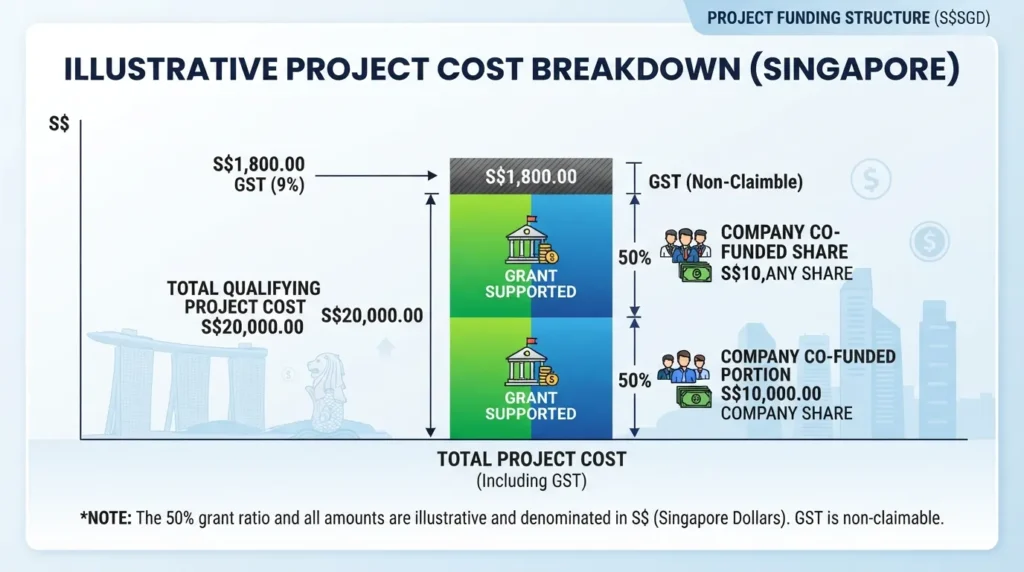
Total project cost is the full price of the agreed scope. The grant-funded portion is the share of qualifying costs that Enterprise Singapore co-funds. The rate and cap are set by the scheme administrator and can change. Confirm the current published ratio and cap on the Enterprise Singapore website before you calculate anything.
Calculate the net cost using this formula:
Net cost = Total qualifying cost − Co-funded amount + Non-qualifying costs
Use the current published ratio in place of any illustrative figure. The worked examples below use a hypothetical 50% ratio for arithmetic only. The real ratio must be checked, and the example does not imply eligibility.
Qualifying and non-qualifying costs
Qualifying costs are items the scheme accepts for co-funding. Non-qualifying costs are items it does not, and you pay these in full. Ask your vendor to split the quote into the two categories before you sign. Goods and services tax (GST) is a separate question. IRAS sets out how GST applies to each supply, so check the IRAS GST guidance and confirm your position with your accountant.
Upfront payment, claims and cash flow
Cash flow timing matters as much as the net figure. Most grants are reimbursed after the project is complete and claims are verified, so you pay the vendor first. Plan for that gap in your working capital. Enterprise Singapore’s guidance sets out the claim submission and disbursement steps, with timelines, and you should check them there before committing.
Typical EDGE Grant Package Costs in Singapore
The most useful number on a pricing page is rarely the headline “starting from” price. Package scope and duration change what a buyer actually gets, so compare quotes on those terms. The figures below are pre-grant prices from DM MediaOne’s own 2026 quotes, in Singapore dollars (S$).
Cost ranges by package type
We have grouped our packages by channel and length so you can compare like with like. The “after grant” figure appears only where we have published it. The co-funded share depends on eligibility and on how the scheme applies to your project, so confirm it directly with Enterprise Singapore.
| Package | Channels | Scope | Duration | Pre-grant price (S$, 2026) | Cost per month (S$, indicative) | Best fit |
|---|---|---|---|---|---|---|
| Boost Up (starting point) | Varies by package | Starts from | Varies | From 4,950 after grant | Varies | Entry budget, first-time buyers |
| Package A | SEO + SEM | 30 keywords | 6 months | 10,000 | About 1,667 | Search visibility plus paid ads, broad keyword set |
| Package B | SEO + SEM | 15 SEO + 5 SEM keywords | 6 months | 10,000 | About 1,667 | Tighter keyword focus, same price as Package A |
| Package C | SEO + GEO | 15 + 5 keywords, 10 + 5 prompts | 6 months | 10,000 | About 1,667 | Search plus AI answer visibility |
| Package D | SMM + SMA | Social media management and advertising | 2 months | 9,900 | About 4,950 | Short social campaign, single channel |
Packages A, B and C carry the same total price, so the choice comes down to scope and goal, not cost. Package D looks cheaper in total but costs roughly three times more per month of coverage. That is why we always show the monthly figure alongside the total.
Sources and dating: the package prices above are DM MediaOne’s own 2026 pre-grant quotes. The cost-per-month figures are our arithmetic (total divided by duration in months). The Boost Up “from S$4,950 after grant” figure is our own published starting price. Prices are indicative, subject to change, and must be confirmed with the vendor in writing before you rely on them.
Other options. Outside our own packages, two other starting prices are relevant when comparing quotes. DM Creative’s E-World Digital Marketing package starts from S$3,925, and DM Benchmarking’s social media packages start from S$5,500. These are starting prices only. Each provider sets out scope and duration in its own proposal.
Factors that push costs up or down
Four factors move a quote up or down more than any grant percentage does.
Company size and headcount. A business with more products, markets and sales staff usually needs more keywords, more ad groups and more reporting. A larger scope pushes the total up, even within the same package name.
Number of employees covered. Social media packages are priced around how many accounts, channels and content formats are managed. Adding a second brand or language adds cost, because the work is not shared.
Digital maturity. A business with clean analytics, a fast website and existing content usually needs less setup. A business starting from scratch pays for audits, tracking and content creation before campaign work begins.
Sector competition. Some sectors have many competing agencies and tight pricing. Regulated industries need specialist knowledge that costs more. Expect quotes to vary with the competitive pressure in your category.
Read the table with these factors in mind. Packages A and B cost the same, but a business with a narrow product range may get more value from Package B. A business with a wide range may need Package A’s 30-keyword scope.
How to sanity-check a vendor quote
Use this checklist before you accept any quote, including ours.
- Itemised pricing. Does the quote split the total into channels (SEO, SEM, GEO, SMM, SMA), duration and deliverables? A lump sum with no breakdown hides what you are paying for.
- Eligibility of each line item. Ask which items are claimable under the scheme. Software subscriptions, hardware and some third-party fees often fall outside it, so confirm each one.
- Scope and duration stated in full. Check the keyword count, prompt count, number of months and number of channels. A quote without these cannot be compared with others.
- Cost per month. Divide the total by the duration. This exposes a short package that looks cheap but costs more per month of coverage.
- Validity period. Note the date the quote expires. Prices quoted before a scheme change may not hold, so confirm them in writing.
- Whether the vendor is listed or approved. Check the scheme’s published list of approved providers and confirm the vendor’s registration and credentials in writing.
- Post-grant price. Ask for the exact figure you would pay after any grant support. A “starting from” figure is not the price of your package.
If a vendor cannot answer items 1 to 4 clearly, treat that as a warning sign before you consider the price at all.
Step-by-Step: Estimating Your Own Net Cost
Most buyers stop at the headline price. The steps below show how to work out what your business will actually pay, which is the number that matters for budgeting. The same five steps apply whichever package you choose.
Net cost is what your business pays after the grant is deducted. Estimating it is the most reliable way to compare a funding ratio (the share of the qualifying cost the grant covers) against the cash you must put up.
Step 1: Confirm eligibility and the current scheme
Before comparing prices, check that your business qualifies. The Enterprise Development Grant (EDG) and its EDGE-branded schemes set out core criteria that generally include:
- Being registered and operating in Singapore
- Being majority locally owned, as defined by the scheme
- Meeting staff headcount and annual turnover thresholds for SMEs
Thresholds and funding levels are reviewed from time to time, so confirm the figures on the Enterprise Singapore website before you commit. Note the scheme name, the criteria version and the date you checked. Keep a screenshot or saved PDF, because an approval decision depends on the rules in force at the time of application.
Step 2: Scope the project and collect quotes
Write down your goal first. Are you trying to rank for search terms, run paid search, grow social followers, or cover several channels? Then define the scope in measurable terms: how many keywords, how many AI search prompts, how many months, and which channels.
Ask for at least three quotes, and make sure each one covers the same scope. Compare them like for like:
| Scope item | What to check across quotes |
|---|---|
| Duration | Same number of months |
| Keywords or prompts | Same count and type (SEO keywords, SEM keywords, GEO prompts) |
| Channels | Same mix (for example, SEO plus SEM, or SMM plus SMA) |
| Reporting | Same frequency and format |
| Validity | Date the quote expires |
Our Boost Up packages are built this way: Package A covers SEO and SEM with 30 keywords over 6 months, Package B covers SEO and SEM with 15 plus 5 keywords over 6 months, and Package C covers SEO and GEO with 15 plus 5 keywords and 10 plus 5 prompts over 6 months. Lining quotes up against that kind of structure makes differences obvious.
Step 3: Separate qualifying from non-qualifying costs
Not every line on an invoice is claimable. Use the worksheet below to sort each item.
| Line item | Qualifying? | Notes |
|---|---|---|
| Digital marketing service fee (SEO, SEM, SMM, SMA) | Usually yes | Confirm with the scheme that the vendor and service are eligible |
| Keyword research and reporting tools | Check | Subscription costs may qualify only for the approved term |
| GST | No | Generally not claimable; see IRAS |
| Internal staff time | No | Your own team’s hours are not a qualifying cost |
| Ad spend paid directly to platforms | Check | Media spend is usually treated separately from service fees |
| Vendor not on the approved list | No | Check the vendor’s status before signing |
Mark each row “yes”, “no” or “check”, and resolve every “check” with Enterprise Singapore before you proceed.
Step 4: Calculate the co-funded amount and cash flow gap
The formula is simple. The cash flow gap is the amount you must fund until the grant is disbursed or claimed.
Net cost = Qualifying cost minus Grant amount, plus Non-qualifying costs
Worked example (hypothetical, using Package A pricing):
- Package A pre-grant price: S$10,000
- Assume all of it qualifies, and the grant covers 50% of the qualifying cost. This is a hypothetical rate used only for arithmetic. The real ratio must be checked on the official Enterprise Singapore site, and this example does not imply that your business is eligible.
- Grant amount: S$5,000
- Net cost to your business: S$10,000 minus S$5,000 = S$5,000
- If the vendor requires full upfront payment and the grant is paid later, your cash flow gap is S$10,000 until the claim clears
| Calculator | Amount (S$) |
|---|---|
| Pre-grant package price | 10,000 |
| Qualifying portion | 10,000 |
| Grant at 50% (hypothetical) | 5,000 |
| Net cost | 5,000 |
| Upfront cash needed | 10,000 |
Repeat the calculation for each quote, and compare net cost and upfront cash needed side by side.
Step 5: Check the claim requirements before you commit
Keep these documents for every claim:
- Approved quotation, dated before any commitment
- Itemised invoice matching the quotation
- Proof of payment (bank transfer record)
- Signed service agreement showing scope and duration
- Deliverable reports and milestone evidence
Milestones matter too. If a claim depends on completing a stage of work, record the completion date and the evidence for it. Missing evidence is one of the most common reasons claims are delayed or reduced.
Common Cost Mistakes and How to Avoid Them
Most businesses that get caught out by the Edge Grant do not misread the grant rate. They make a timing or budgeting error that quietly shrinks what they can claim. The three mistakes below account for most of the disappointment we see when buyers come to us after a project has already started.
Signing before approval
The most expensive mistake is committing to a package before the application is approved. Once a vendor contract is signed and work begins, costs incurred before approval may not be claimable, even if the project itself is eligible. The grant assesses the project as a whole, so a business that signs first has no guarantee that the approved scope will match what it already bought.
Our practice is to hold the contract until approval is confirmed in writing, and to tell clients plainly that a verbal go-ahead from the vendor is not the same thing. If a buyer needs to start sooner, the safer route is to ask the vendor for a quotation valid for a set period, then sign only after approval. The cost of waiting is usually a few weeks. The cost of an unclaimable invoice is the full amount.
Check the approval conditions with the scheme administrator, Enterprise Singapore, before signing anything. Eligibility rules and funding levels can change, so rely on the current official guidance rather than an older brochure.
Assuming the grant covers the full invoice
The second mistake is treating the grant as a percentage off the whole invoice. It is not. Three things reduce the amount you can actually claim.
First, GST. The Edge Grant generally does not cover GST, so the GST on a vendor invoice is an extra cost you carry yourself. The Inland Revenue Authority of Singapore (IRAS) sets out how GST applies to business purchases on its website. Confirm the treatment for your own situation with your accountant.
Second, non-approved vendors. The grant pays only for services from providers that meet the scheme’s requirements. An invoice from an unlisted freelancer or an overseas agency may be excluded entirely, even if the work is excellent.
Third, excluded items. Some line items fall outside the qualifying scope, so the reimbursable amount is smaller than the total you paid.
Consider how this works with a simple illustration. Suppose a package is quoted at S$10,000 before grant and the vendor adds GST on top. If one component is not on the approved list, the claimable base shrinks before the funding ratio is applied. The buyer’s real net cost can end up well above the figure they budgeted. Ask the vendor to split the quote line by line and mark each item’s eligibility before you compare it with another offer.
The third mistake is looking only at the package price and ignoring what it takes to run the project. Three hidden costs are routinely missed.
Internal staff time is the largest. Someone in your business must supply information, approve work, review drafts and answer questions. That time has a real cost even though it never appears on an invoice, and it is not claimable.
Change management comes next. New tools, new reporting and new ways of working often need training and a period of adjustment. Budget for this explicitly, because it rarely appears in a vendor proposal.
Ongoing subscription fees are the last. Many digital marketing projects rely on software, ad spend or tools that continue after the project ends. A package that looks affordable for six months can carry recurring costs that run long after the grant-supported period finishes.
When we scope a project with a client, we list these three costs in a separate column next to the package price. This makes the true cost visible before the decision, rather than as a surprise in month four. A realistic budget is the package price, plus the staff hours, plus the post-project running costs, minus the grant share you can claim.
Read the three mistakes together and the pattern is clear: the timing of your commitment, the eligibility of each line item and the costs outside the invoice all change what you end up paying. The headline figure tells you very little on its own.
Choosing a Consultant or Vendor With Cost in Mind
When we quote a Boost Up package to a client, the first question is rarely “what does it cost?” It is “what do I actually get, and for how long?” That shift in question is the core of this section. The EDGE grant does not cut the price of a digital marketing package by a fixed share. What you pay depends on the package you choose, whether that package qualifies, and how the support is paid out. So the way you compare vendors matters as much as the figure on the quote.
Pricing models to compare
Most vendors price their work in one of three ways. Each carries a different level of cost certainty.
| Pricing model | How it works | Cost certainty | Main trade-off |
|---|---|---|---|
| Fixed-fee | One agreed price for a defined scope and duration | High: you know the total before you start | Scope changes usually trigger extra charges, so define deliverables tightly |
| Day-rate | You pay per consultant day worked | Low: the total depends on how many days the work takes | Useful for open-ended advisory work, but hard to budget against a grant cap |
| Milestone-based | Payments released as set stages are completed | Medium to high: payments track visible progress | Requires clear milestones in writing, or “completed” becomes a dispute |
Fixed-fee pricing suits packages with a clear scope, such as a set number of keywords over six months. Our SEO and SEM packages are built this way, so a buyer can see the full cost before committing. Day-rate pricing can make sense for a short diagnostic, but it is harder to reconcile with a grant-funded budget because the final figure is unknown until the work ends. Milestone pricing sits between the two. It works well when each stage produces something you can inspect, such as a keyword map or a completed audit.
Before you sign, ask each vendor which model they use and what happens if the scope grows. A low fixed fee with an open-ended change process can cost more than a higher fee with clear limits.
Red flags in vendor proposals
Some warning signs show up repeatedly in proposals that look attractive at first glance. Watch for these four.
- Inflated quotes. A figure far above the typical range for a similar scope should prompt questions. Ask for an itemised breakdown so you can see where the money goes.
- Vague deliverables. Phrases such as “full digital support” or “ongoing optimisation” tell you nothing measurable. A sound proposal names the keywords, channels, reporting cadence and the number of months covered.
- Pressure to sign quickly. A vendor who insists you sign today, before your application is approved, is asking you to take on cost risk. Signing before approval can leave you paying for work the grant will not reimburse.
- Unrealistic grant promises. Be wary of any proposal that guarantees a specific reduction or says the grant “covers everything”. The grant funds a share of qualifying costs, and the eligible amount depends on the scheme and on approval. Confirm the position directly with Enterprise Singapore before relying on any figure.
When a proposal raises one of these flags, put the question in writing and compare the reply with at least two other quotes. A vendor who answers clearly will rarely mind the scrutiny. Use the Net Cost and Scope Matrix from this article to line up each proposal side by side, reading across each row for price, scope, duration and cost per month before you decide.
Conclusion: Plan for the Net Cost, Not the Headline Grant
The thesis to close on
The EDGE grant does not cut the price of a digital marketing package by a fixed share. Two buyers can receive the same grant and pay very different amounts, because the package they choose, its eligibility and the timing of the support all change what leaves their bank account. The number that matters is the net cost you pay over the life of the service, plus the cash you must find while a claim is pending.
A “starting from” price is a poor guide. Our own Boost Up offer starts from S$4,950 after the grant, but that is a starting point, not the price of the package a specific business will buy. The packages in our range differ sharply in scope and duration.
- Package A (SEO and SEM, 30 keywords, 6 months) is listed at S$10,000 before the grant.
- Package D (SMM and SMA, 2 months) is listed at S$9,900 before the grant.
Those two prices look close, yet Package D works out to about S$4,950 per month of coverage, against roughly S$1,667 per month for Package A. A buyer who compares only the sticker figures will pick the wrong package for their goal.
We use the Net Cost and Scope Matrix when advising clients. Each package sits on one row, with columns for pre-grant price, scope (keywords, prompts, duration and channels), cost per month, and fit with the stated goal. Read across the row before deciding. A cheaper headline price can hide a higher monthly cost, and a higher sticker price can give better value if it buys longer coverage across the channels you need.
The grant also changes the cash picture. Support is paid against approved, qualifying costs, so the period between paying a vendor and receiving reimbursement is a real budgeting question. Plan for that gap as well as the final figure.
Next steps and where to verify
Before you commit, work through this checklist:
- Confirm that your business meets the current eligibility criteria for the scheme, including registration, shareholding and staff thresholds.
- Confirm with the scheme administrator that the specific package you want qualifies. Do not assume eligibility from a vendor’s marketing.
- Compare packages on cost per month and scope, using the Net Cost and Scope Matrix, not on the headline price alone.
- Ask for the post-grant price of the exact package, not a “starting from” figure.
- Set aside working capital for the period before the claim is paid.
- Keep every invoice, proof of payment and approved quotation.
Current funding levels, caps and scheme status should always be checked against Enterprise Singapore, the authoritative source for the scheme. Check the tax treatment of GST on the IRAS website, since GST is generally not a claimable cost.
For guidance on managing the budget around these decisions, see our notes on SEO and SEM planning, and on SMA and SMM scope, so you can match channels to goals before you sign.
Frequently Asked Questions
Is the EDGE grant still available in 2026?
The Enterprise Development Grant has been restructured several times, so check the current scheme status on the Enterprise Singapore website before you commit. Scheme names, funding levels and eligibility criteria can change. Confirm the live position with Enterprise Singapore first.
How much of the project cost does the grant cover?
Funding ratios and caps vary by scheme and by the type of project, so there is no single fixed percentage. Enterprise Singapore publishes the current co-funding rate for each scheme. Use that published rate, not a figure quoted by a vendor, when you estimate your net cost.
Does the EDGE grant cover GST?
GST is generally not claimable as a qualifying cost, so budget for it in full. The IRAS guidance on GST sets out how it applies to business expenses. Treat GST as a cost you pay outright when you compare quotes.
Can I pay the vendor in instalments while the grant is pending?
Yes, but plan for the gap. Grant disbursement usually follows approval and claim submission, so you may pay the vendor before the grant reaches you. Agree a payment schedule with the vendor that matches your cash flow, and set aside working capital for the portion you must fund in advance.
Who decides whether my costs are eligible?
Enterprise Singapore is the approving body and decides whether your costs qualify. Ask for pre-approval before you sign any contract. Costs incurred before approval may not be claimable, so an early check protects you from paying for work the grant will not cover.
What documents do I need to claim the grant?
Keep the approved quotation, the itemised invoices and proof of payment for every qualifying cost. Retain these records in case Enterprise Singapore requests them during claim review. Missing or mismatched documents are a common reason claims are delayed or reduced.