A brand persona is a deliberately chosen human character that a brand uses to keep its marketing decisions consistent. Many brands write one as a list of flattering adjectives in a workshop and never check it against what customers experience. That kind of persona decorates a brand deck and changes nothing.


A persona earns its keep only when it reflects what the brand actually does, and the core values it expresses should be visible in real customer interactions. Used properly, it becomes a practical test for every new message, visual and channel decision in your marketing, and a useful tool for helping teams stay aligned. This article sets out that test, the Persona Consistency Test, and shows how to run it on your own assets in one sitting.
For a Singapore café owner in Tiong Bahru, the persona might be “a neighbourhood host who remembers your usual order”. That single line tells the team how to write the Instagram caption, how to greet a walk-in and how to reply to a review on Google.
The persona is the thread that makes those three touchpoints feel like one business, and it gives the café’s target audience of local regulars a consistent experience. Even a free loyalty card can carry the same persona, if the stamp card wording sounds like the host.
Key Takeaways
- A brand persona is a deliberately chosen character. It works only when it reflects behaviour customers already see.
- Most recognisable personas map onto one of 12 archetypes. Margaret Mark and Carol S. Pearson adapted these from the work of Carl Jung.
- Run the Persona Consistency Test: score each asset 0 to 2 for sounding, looking and acting like the character. Drop anything scoring 2 or below.
- Write the persona as one sentence covering the archetype, voice, core value and one thing it would never say.
- Check the persona against your staff and service delivery. A gap there breaks trust faster than any advertisement.
- A small business usually needs one persona. Add more only when its buyers or products genuinely differ.
What Is a Brand Persona?
A brand persona is a human character with a voice, a set of values and a recognisable way of behaving. Teams use it to keep every touchpoint consistent. A person writing a social media caption, designing a shop sign or briefing a sales agent works from the same picture of the brand, and a clear user persona can help teams tell whose needs each message is meant to serve.
Without a persona, channels drift. The social media team sounds playful, the website sounds corporate and the sales deck sounds like another company. A persona gives these decisions a common reference point. The reference only helps if it describes what the brand already does. Unlike an aspirational wish list, a persona anchored to real customer experience gives a business a test it can apply to any new message.
Why a Brand Persona Is Not a Logo or a Slogan
A logo and a slogan are outputs of the brand. A persona sits behind them and decides how they should look and sound. A slogan can be swapped in a month and a logo redesigned, but the persona governs those replacements. Progressive Insurance’s character Flo debuted in 2008 and has appeared in more than 1,000 advertisements since, while the advertising around her changed. The persona was the constant.
Brand Persona Examples: From Flo to Wendy’s
Vistaprint’s brand persona guide cites Flo from Progressive Insurance as a clear example. Viewers recognise Flo without a brand name on screen, which shows a persona working. Teams building a persona from a free template often start with a character sketch like this one, then test it against real customer messages.
[Suggested image – replace or delete: A captured screenshot of a Progressive Insurance advertisement frame showing the Flo character in a shop-style set, with no brand name visible on screen. The image illustrates how recognisable a persona is without naming the brand; the writer should capture an official or permissible public ad still and credit the source.]
Wendy’s offers a different lesson. According to Studio Sunup’s comparison of brand persona and brand personality, the brand has used fresh, never frozen beef since its founding in 1969. A persona does not need to reinvent itself to stay relevant. It needs to stay consistent in what it promises and how it behaves, and a marketing team can only apply that consistency if the persona is written down clearly enough to build campaigns from, which is where branding decisions and a documented user persona work together.
[Suggested image – replace or delete: A photo of a Wendy’s storefront or burger with the brand’s red-and-white identity visible, illustrating how a single promise (fresh, never frozen beef) carries across decades of visual identity. Use an original photo or a licensed image and credit the source.]

Brand Persona vs. Related Terms: Identity, Personality, Buyer Persona and Mascot
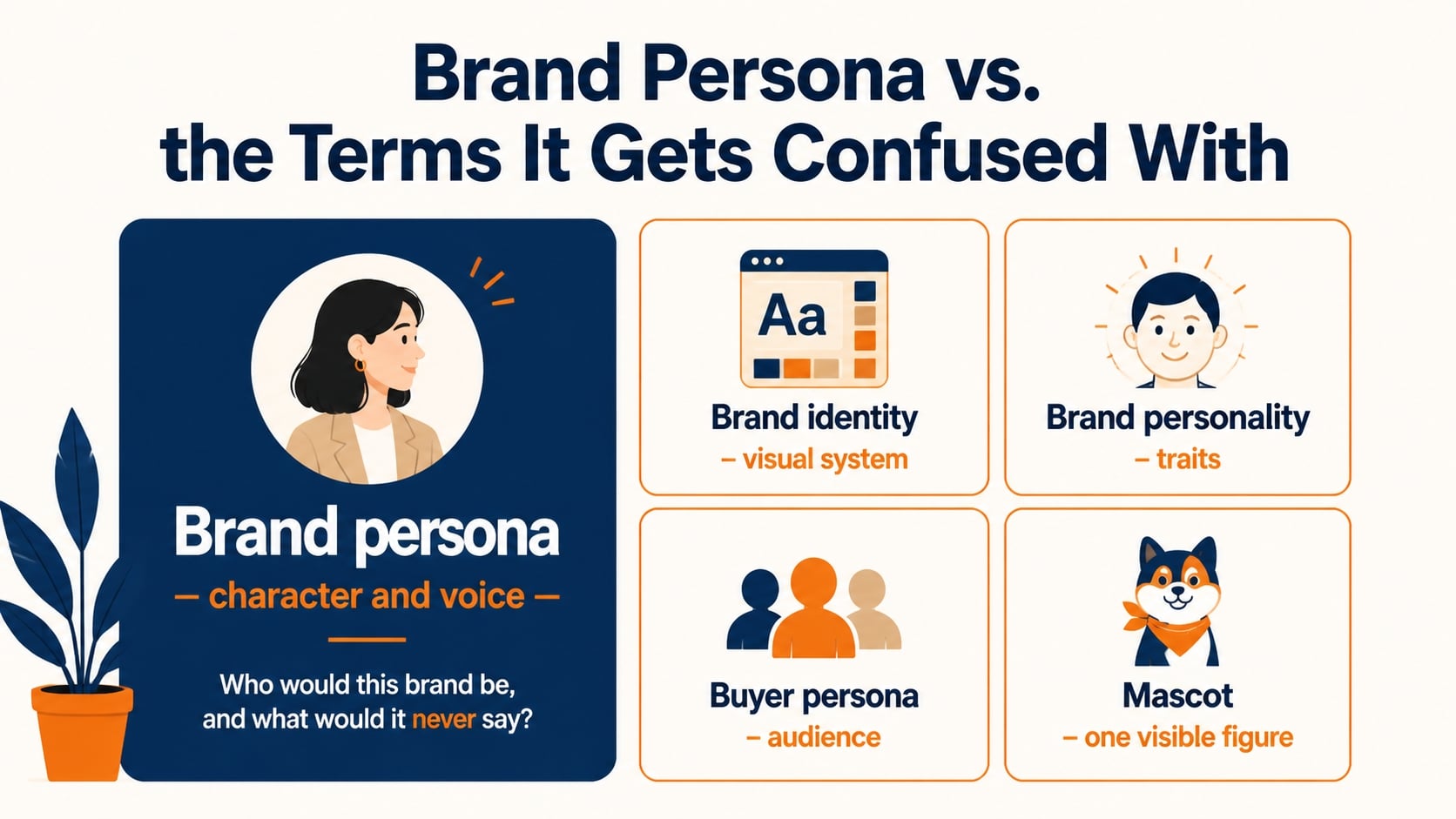
Four terms are often confused with a brand persona. Teams spend time debating definitions rather than making decisions. Each term governs a different decision. The persona tells you how the brand should behave when it speaks, and it is the one most teams overlook when they build a shareable template for their brand guidelines. Create that template early, so every writer and designer works from the same character and brand voice, on every website and channel the brand uses.
Brand Persona vs. Brand Identity
Brand identity is the visible system: the logo, colour palette, typefaces and layout rules. It answers “what does this brand look like?” A brand persona answers “who is this brand, if it were a person?” The two should match. When identity is designed without a persona, the visuals often carry a generic corporate tone that the copy then contradicts.
Brand Persona vs. Brand Personality
Brand personality is a set of human traits, such as friendly, bold or cautious, that describe how a brand comes across. A brand persona is more specific. It is a character with an archetype, a voice, a core value and a clear boundary. Personality supplies the adjectives, and the persona is the character who uses them. Studio Sunup draws a similar distinction. A team that has only written personality traits will struggle to answer “would this character say that?” in a real situation.
Brand Persona vs. Buyer Persona
A buyer persona describes a customer: their job, budget, frustrations and search habits. It is an audience tool that helps your marketing team decide who to reach. A brand persona describes the business speaking to that audience. Confusing the two leads to brand decisions driven by a customer profile. The company then imitates its buyer rather than presenting a consistent character. Use the buyer persona to decide what to say. Use the brand persona to decide how to say it.

Brand Persona vs. Mascot
A mascot is a visible character, such as a figure on packaging or in an advertising campaign. It is one expression of a persona, not the persona itself. Flo from Progressive Insurance, cited in the Vistaprint brand persona guide, works because the character carries the brand across many campaigns. A mascot can be retired while the persona survives. A small business without budget for a costumed figure can still have a strong persona, expressed through voice and service. Build the persona first, and the mascot becomes a choice rather than a requirement.
|
Term |
Governs |
Answers |
|
Brand identity |
Visual system |
What does the brand look like? |
|
Brand personality |
Traits |
What adjectives describe it? |
|
Brand persona |
Character and voice |
Who would this brand be, and what would it never say? |
|
Buyer persona |
Audience |
Who are we speaking to? |
|
Mascot |
One visible figure |
Which character appears in the ads? |
The 12 Brand Archetypes and How to Choose One
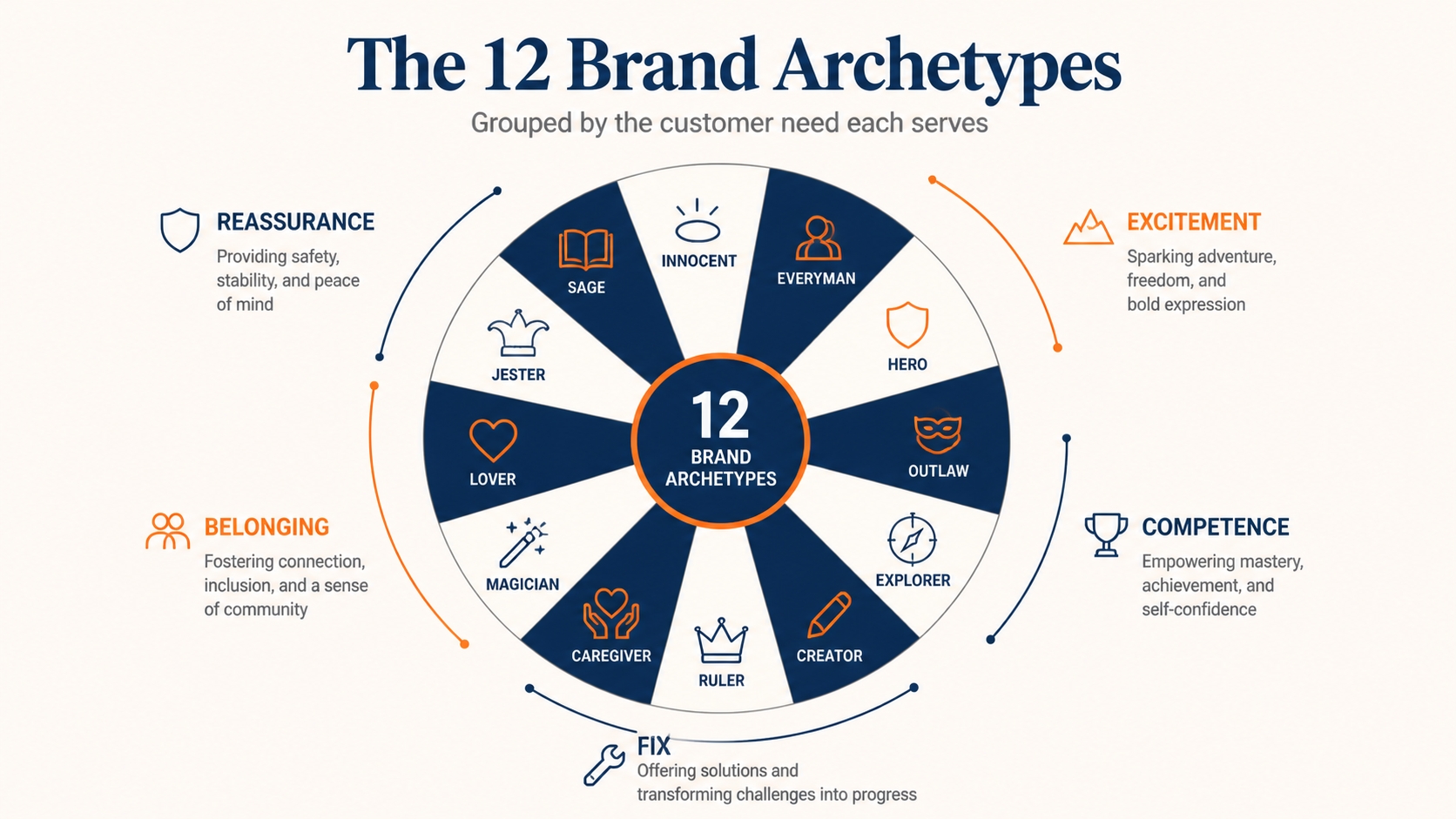
Most brand personas are not invented from scratch. They draw on a shared vocabulary of character types. The most widely used version is a set of 12 brand archetypes. Knowing where this vocabulary comes from, and how to choose from it, helps a team reach a decision quickly instead of debating what the brand is like. A team can create a working persona in a single meeting when it starts from a shared frame, so every member of the audience is considered from the same starting point.
Where the 12 Archetypes Come From
The 12 archetypes come from the Swiss psychiatrist Carl Jung’s work on universal personality patterns, which recur across human stories and cultures. Margaret Mark and Carol S. Pearson adapted those patterns for brands, and according to Product Marketing Alliance, most recognisable brand personas map onto one of these 12 archetypes.

The practical value is shorthand. Saying “we are a Sage” or “we are an Outlaw” lets a team agree on a direction quickly, and then refine it. The archetype is a starting frame, not the finished persona.
Matching an Archetype to Your Business Goals
Choose the archetype that fits what your customers need from you. Do not choose the one you find most flattering. A Singapore food business selling everyday value needs a different character from a wealth adviser selling trust.
Work through three filters:
- Customer need. Is the customer seeking reassurance, excitement, competence, belonging or a fix?
- Behaviour you already show. An archetype that contradicts what staff, packaging and service do today will fail later.
- Differentiation. If three rivals are all “Hero”, a fourth can stand out as a clear Caregiver or Everyman.
Record your choice as one line: the archetype, the core value, and one thing the brand would never say. That line is the starting point for the Persona Consistency Test covered later in this guide.
How Many Brand Personas Should a Company Have?
Most small businesses need one brand persona. Add a second only when the customers served are materially different, so the brand would have to speak in a different voice to reach them without contradicting itself. The usual error is the reverse: a company splits its persona by product line when only the offer changed, not the character. Ask whether the core promise differs, and only then consider a second persona.
Count the distinct buying audiences that each need a different promise. If the answer is two but the difference is about who the customer is rather than what they want, one persona with two tone variations is usually cleaner. Split into separate personas only when the core character would genuinely change. An example is a brand that acts as a Caregiver to parents and as a Sage to procurement teams.
Splitting too early fragments your identity and multiplies the work of keeping assets consistent. One persona, applied with discipline, works better than three applied loosely. A worksheet for mapping these filters can speed up the first pass, though the decision still rests on the brand voice the team actually uses.
How to Create a Brand Persona in Three Steps
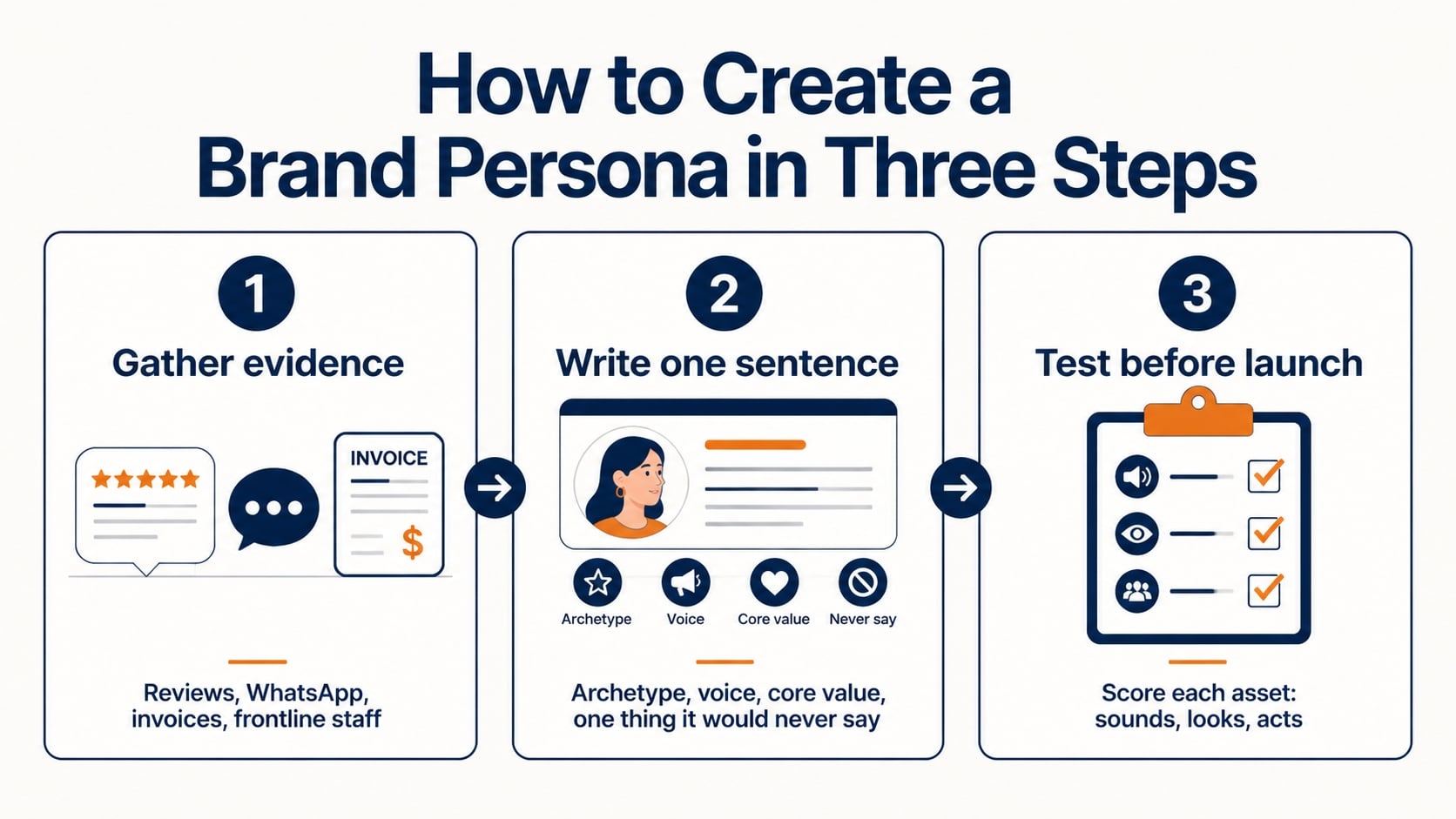
Step 1: Gather evidence from what the brand already does
Start with evidence, not adjectives. Collect the touchpoints customers already experience: the last ten Google reviews, recent WhatsApp enquiries, the wording on the invoice, the sign above the door, and what staff actually say when a customer walks in. Pull the phrases customers use into a single list. A café that replies to WhatsApp within minutes but lets email enquiries sit for a week already has a persona – the evidence only needs to be written down.
Talk to the frontline before the whiteboard. The team who answers the phone knows which promises hold under pressure – a late delivery, a complaint about a crowded room, a request for a refund. Ask them what customers praise and what they complain about. Where the answers split by customer group, a structured look at audience segmentation keeps the evidence organised without turning the exercise into a research project.
Timebox the step. One week of observation is enough for most small businesses. A persona built on this evidence describes what customers already see; a persona built without it describes what the brand hopes to become, and Step 3 will reject it later at a higher cost.
Step 2: Choose the archetype and write the persona in one sentence

Use the 12 archetypes from the previous section as a shortlist, and apply the three filters – customer need, behaviour you already show, and differentiation. The evidence from Step 1 usually eliminates half the list on its own: a business whose reviews praise speed and plain speaking is not an Innocent, whatever the founder’s preference.
Then compress. Write the persona as one sentence covering the archetype, the voice, the core value and one thing it would never say. For a Singapore café: “Alex, a practical café owner who answers messages within the hour, never uses jargon, and never promises a discount they cannot honour.” The sentence is the persona. A two-page document with mood boards can support it, but the sentence is what a writer reads before drafting a caption.
Test the sentence before adopting it. Read a recent social post, a recent invoice reply or a shop sign aloud, and ask whether the character would have produced them. If the sentence contradicts all of them, either the evidence was read wrongly or the sentence is aspirational – rewrite it until it describes behaviour the brand can show tomorrow morning.
Step 3: Test authenticity before you launch
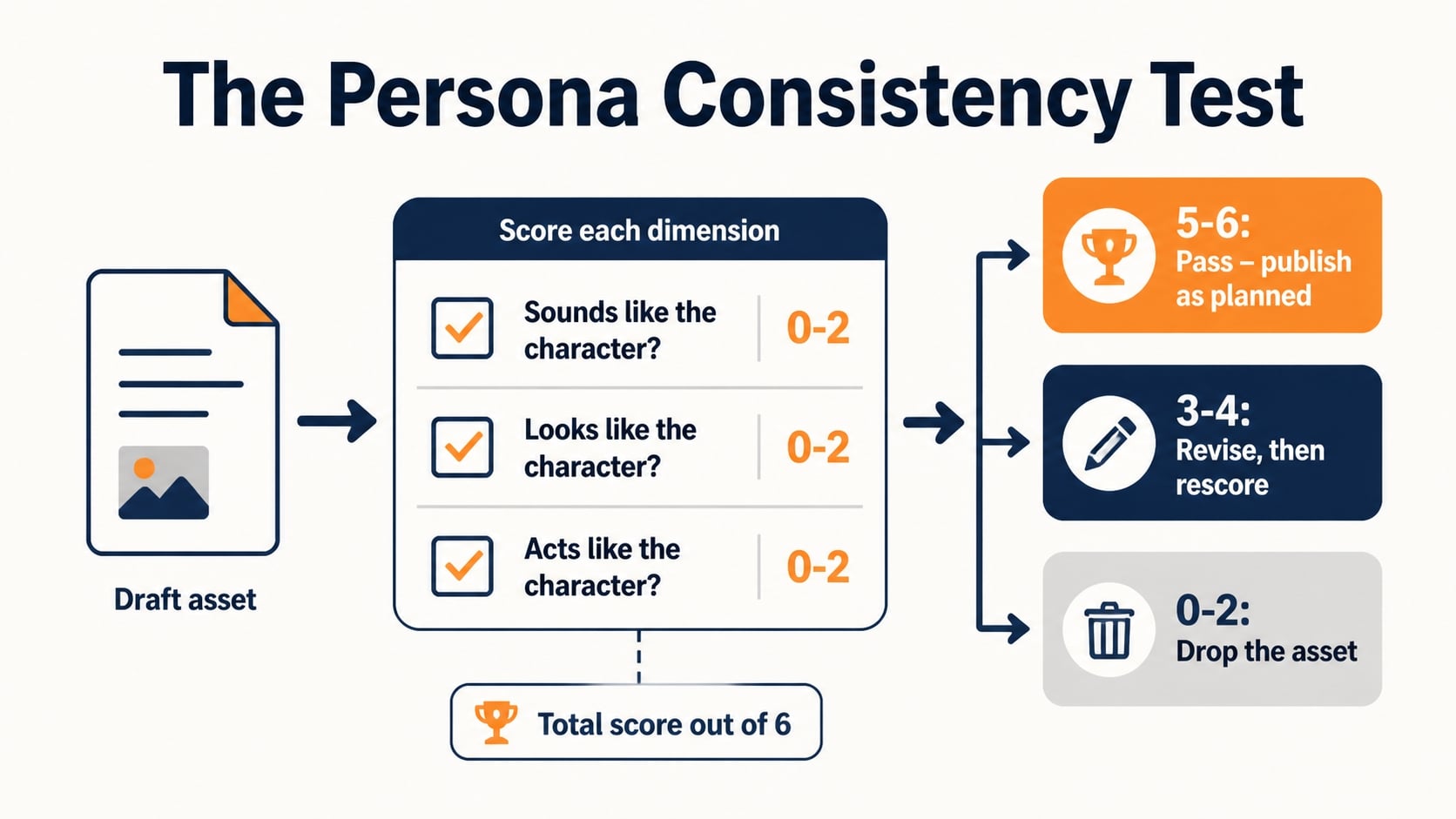
Before you launch, run the Persona Consistency Test on your planned assets. Test the real items you intend to publish or display: a social post, a shop sign, a packaging line or a sales script. Score each asset from 0 to 2 on three questions:
- Does it sound like this character?
- Does it look like this character?
- Does it act like this character?
Each question scores 0 (no), 1 (partly) or 2 (yes), so the total runs from 0 to 6. This is this guide’s own heuristic, not an industry standard. Its limits are worth knowing: the scores are judgement calls, so two reviewers may score the same asset differently. Use the score to start a conversation, not to settle one. The pass mark of 5 or 6 is set high on purpose, because one weak signal is often what makes a brand feel inconsistent to a customer. Apply the same check to every template you reuse, so each new asset stays true to the user persona and its messaging, and so the check can help your team keep every launch consistent.
|
Total (out of 6) |
Decision |
|
5 or 6 |
Pass, publish as planned |
|
3 or 4 |
Revise, then rescore |
|
0 to 2 |
Drop the asset |
The third question matters most for Singapore businesses. A persona that promises premium, attentive service needs a price point and staffing level that deliver it, or customers notice the gap on their first visit. Check the persona with your frontline team too. If staff contradict the character in everyday replies, the persona is aspirational, and design work will not fix that. Run the same check on your website and any launch materials before they go live. Where a launch offer is genuinely free, say so plainly in the copy, so the claim matches what the customer actually receives.
Applying Your Brand Persona Across Design, Voice and Content
A persona only works when it shows up in what people see, hear and read. Take each planned asset and ask whether it sounds, looks and acts like the character. A team can run this checklist on a shop sign or sales script in one sitting, and a free template for it can be adapted at the start of any brand review.
How a brand persona shapes visual design
Visual design is where a persona is most often lost. A brand that calls itself “warm and down to earth” but ships glossy, cold photography has effectively written two brands. The persona should set the limits for colour, typography, photography style and white space.
Ask three questions of any design. Would this character use this palette? Would it appear in this setting? Does it show this level of polish? Wendy’s offers a useful model. According to Studio Sunup, the brand has used fresh, never frozen beef since 1969. Its consistent red-and-white identity and plain, food-first imagery reinforce that single promise.
Voice guidelines and content strategy for consistency
Voice is the persona’s most audible trait, and Singapore brands face a specific challenge. Audiences move between English, Mandarin, Malay, Tamil and Singlish within a single day, so register matters as much as vocabulary. Pull ten to twenty real phrases from customer reviews, WhatsApp enquiries and comment threads. Then test your draft tone against them to catch drift before it reaches customers.
Write voice guidelines as “we say / we never say” pairs. These are easier to apply than adjectives. A voice that reads well on paper can still feel forced if the staff who answer the phone or handle complaints speak differently. Audit the service experience alongside the content calendar, because a persona your staff contradict will undo your branding faster than any weak post. Consistent messaging across every touchpoint helps customers recognise the brand in any channel.
Conclusion and Summary
A brand persona earns its place only when it describes how a brand already behaves. A character written as an aspiration reads well in a deck, then disappears once a salesperson, a packaging designer or a social media manager has to make a decision. Anchor the persona to what customers experience, then run each new asset through the Persona Consistency Test. Totals of 5 or 6 pass, 3 or 4 need revision, and 0 to 2 are dropped. In a multilingual, digitally busy market such as Singapore, that check keeps marketing and branding consistent, and is worth more than another round of adjectives. A free, practical check like this helps teams apply the persona the same way across every channel.
Frequently Asked Questions
What is the difference between a brand persona and a brand personality?
A brand personality is the set of human traits a brand already shows, such as friendly, bold or reserved. A brand persona is a deliberately chosen character built from those traits, with a voice, values and a clear sense of what it would never say. The personality describes what customers observe. The persona is the tool a team uses to make consistent decisions. Flo from Progressive Insurance shows the difference, as one recognisable character carried across campaigns.
Does a small business need a brand persona?
Yes, if it sells through more than one channel or has more than one person writing for it. A sole trader in Singapore posting on Instagram, replying on WhatsApp and printing a shop sign needs one sentence that tells everyone how the brand sounds. Without it, each asset drifts. A business with one owner and one channel can keep the persona in the owner’s head. Once someone else writes a post, the persona needs to be written down.
How many brand personas should a company have?
Use one primary persona per brand. Add a second only when the business runs two distinct brands with separate names, audiences and price points. Do not create a persona for each product line or campaign. Variations in tone for different channels are guidance within one persona, not new personas.
What is an example of a brand persona?
Flo from Progressive Insurance is a well-known example, as Vistaprint’s brand persona guide notes. A useful persona for a smaller brand looks like this: “Alex, a practical café owner who answers messages within the hour, never uses jargon, and never promises a discount they cannot honour.”
How long does it take to create a brand persona?
The time depends on how much existing customer evidence the team has to review, and it is confirmed once that review is scoped. Testing the persona against real assets, such as the next set of posts or the next packaging run, is a separate step. Rushing the observation step is the common mistake, because a persona written from aspiration rather than evidence has to be rewritten anyway.
Can a brand persona change over time?
Yes, but change should be deliberate and gradual. Wendy’s has used fresh, never frozen beef since 1969, as Studio Sunup’s comparison of brand persona and personality describes, which shows how a stable persona can last decades. A persona should shift when customer behaviour shifts, not when a new manager wants a different tone.