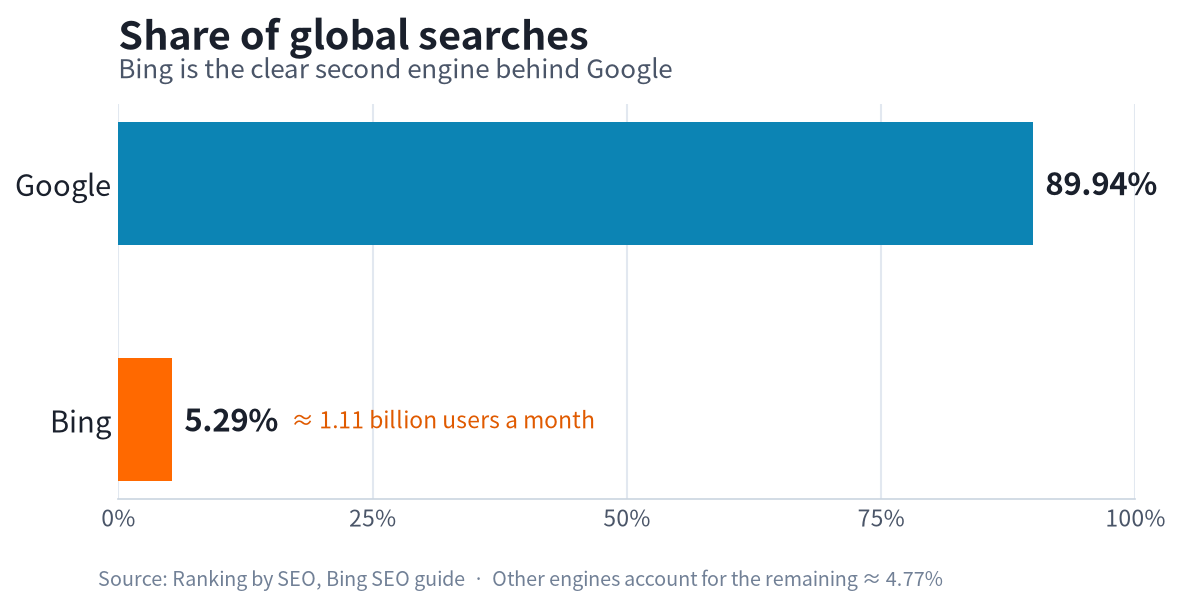
Bing holds about 5.29% of global searches, second behind Google’s roughly 89.94%, according to Ranking by SEO’s Bing SEO guide. For a Singapore business, the useful question is whether Bing’s users match your customers and whether your bing seo work earns visibility there.



Bing SEO is a separate discipline with its own tooling and ranking signals, so a Google-only plan leaves traffic on the table. This guide gives you a scorecard to decide what to fix first and how much budget Bing deserves. Each fix should be measured against the experience your visitors actually have on your website, and a specialist team offering seo services can help you prioritise that work.
Key Takeaways
- Bing is the clear second engine. It holds about 5.29% of global searches, behind Google’s roughly 89.94%, per Ranking by SEO.
- Bing is not a copy of Google. Its audience and features reward different actions.
- Mobile comes first. 66% of Bing’s users are on mobile, per SEOptimer.
- Shopping is the strongest case. Bing shopping ads reportedly earn 34% higher CTR than Google’s.
- Start with the scorecard. Score five areas from 1 to 5, and fix any area at 2 or below first.
- Check your own data. Global averages may not match your Singapore audience.
Why Bing Still Deserves Your SEO Budget
Bing matters for Singapore businesses because it is a large second search engine that many local teams ignore. Google handles roughly 89.94% of global searches, according to Ranking by SEO’s Bing SEO analysis, but a sound strategy still gives Bing search its own place alongside your seo services, and a disciplined optimisation effort on Bing can recover visibility that a Google-only plan leaves behind.
Bing holds about 5.29% of global searches, roughly 1.114 billion users a month. A business that ignores that audience is not ignoring a rounding error.
A Google-only plan leaves two things on the table. The first is traffic from users who prefer Bing, including those on Windows and Microsoft Edge defaults. The second is conversion. SEOptimer’s Bing SEO guide reports that Bing’s shopping ads earn a higher click-through rate than Google’s.
This guide treats Bing SEO as a distinct discipline. Bing Webmaster Tools reports on crawling and indexing in ways Google Search Console does not, and Bing’s AI features change how content gets surfaced. Treat Bing as its own tool for visibility, and check that your website is set up so Bing can crawl it properly.
The Bing Priority Scorecard below is an illustrative internal framework, not an industry standard. Your own analytics should make the final call.
What Bing SEO Is and Why It Matters for Search Visibility
Bing SEO is the work of making a website rank well, get crawled and get surfaced on Microsoft’s search engine. Many teams treat it as Google SEO with a different tab open, which costs money. Bing runs its own webmaster tooling, weighs some signals differently and surfaces answers through AI features. Improve your visibility on Bing search by treating it as a distinct channel rather than an afterthought, and use a dedicated search engine optimisation tool to track its performance separately.
Defining Bing SEO and how it differs from general SEO
General SEO covers the shared fundamentals: crawlable pages, useful content, relevant links and a fast site. Bing SEO adds:
- Separate tooling. Bing Webmaster Tools reports crawl errors, indexing status, search queries and backlinks. Google Search Console does not show what Bing sees.
- Different signal weighting. Bing puts more emphasis on exact-match keywords in titles and on-page text, so on-page SEO matters more here.
- Separate from paid search. Organic gains don’t automatically lift Bing Ads results, so measure the two separately.
Bing’s audience: mobile use, regional concentration and shopping behaviour
According to SEOptimer’s Bing SEO guide, 66% of Bing users search on mobile devices, so a site that fails on mobile loses most of its Bing visitors. The same source reports 32% of users in China, a global figure that says little about Singapore, so check your own referral data.
Shopping is Bing’s clearest commercial case. SEOptimer reports a 34% higher click-through rate on Bing shopping ads than on Google’s, but that covers paid ads from one source, so treat it as a reason to test.
How Bing’s AI features (Bing Chat and generative answers) change visibility
In 2023, Bing added AI features built on ChatGPT technology. SEO reports say this moved Bing from listing links to composing answers. Searchers often read a composed reply before reaching any link, so good user experience still decides whether a visitor stays.
Generative answers draw on pages that state a clear claim, define a term directly and support it with specifics. Write each key page so one paragraph answers a question on its own and makes sense when lifted out of context.
Bing SEO Ranking Factors and How They Differ from Google
Bing and Google both reward relevant, trustworthy pages, so many signals overlap. The difference lies in weighting and in a few signals that barely register on one engine. A Singapore business that copies its Google plan onto Bing will misallocate effort, so treat the two engines separately.
The core ranking signals Bing is known to weigh
Microsoft publishes its Bing Webmaster Guidelines, which set the baseline Bing expects. The weighting below comes from practitioner observation, not a published formula.
- Literal relevance to the query. Titles, headings and body copy should match search intent in plain language. Exact-match phrasing in headings tends to help more on Bing.
- Descriptive URLs. A clean path such as /bing-seo-guide carries more weight than a parameter-heavy URL, so keep the address of each page readable and keyword-led.
- Social signals. Microsoft’s guidance notes that social activity can influence results, which Google does not state. Sharing content on social media is one way to build that activity.
- Structured content. Bing reads schema markup, the labelling code that tells search engines what a page contains, and gives visible credit to well-labelled images and video.
- Backlinks from trusted, relevant sites. Practitioners observe that Bing weighs the authority and freshness of the linking domain.
- Page quality and user experience. Mobile readiness, load speed and clear navigation matter. About 66% of Bing’s users are on mobile devices, according to SEOptimer’s Bing SEO analysis. A fast, mobile-ready site is the simplest way to improve engagement on both engines.
Bing vs Google SEO: a side-by-side comparison table
| Area | Bing | |
|---|---|---|
| Keyword matching | More literal, exact-match phrases help | More semantic, handles synonyms and intent |
| URL structure | Keywords in URLs carry more weight | Keywords in URLs carry modest weight |
| Social signals | Acknowledged as a factor | Not a direct ranking factor |
| Backlinks | Authority and freshness of linking domain both matter | Authority and relevance of links matter |
| Multimedia | Visible credit for labelled images and video | Image and video search handled separately |
| Audience profile | Skews towards mobile users and shopping intent | Broadest general audience |
Where the two engines disagree, and what to do about it

The largest disagreements are on keyword literalness and social signals. Google rewards content that answers the intent behind a query, even when the wording differs. Bing rewards pages where query terms appear clearly in the title, URL and first heading. Place the primary keyword in the title tag, the URL and the H1, then let the body cover intent in full. This satisfies both engines without keyword stuffing, and it is where a sound digital marketing plan should begin. Many businesses hire seo services to handle this alignment for them.
On social signals, do not build a separate strategy just for Bing. Share each new article on the channels your buyers already use, and track referral traffic. If Bing sends little traffic from a channel, that signal is not doing much for you. Run a Bing search check after each change to confirm it works on that engine. A simple tool that reports referral sources will make this review quicker.
These differences are smaller than many guides suggest. For most sites, a page that is clear, fast and well linked will perform on both engines. Teams optimising for both should tie their engine optimisation goals to one measurable outcome and review performance on each engine over time.
Setting Up Bing Webmaster Tools
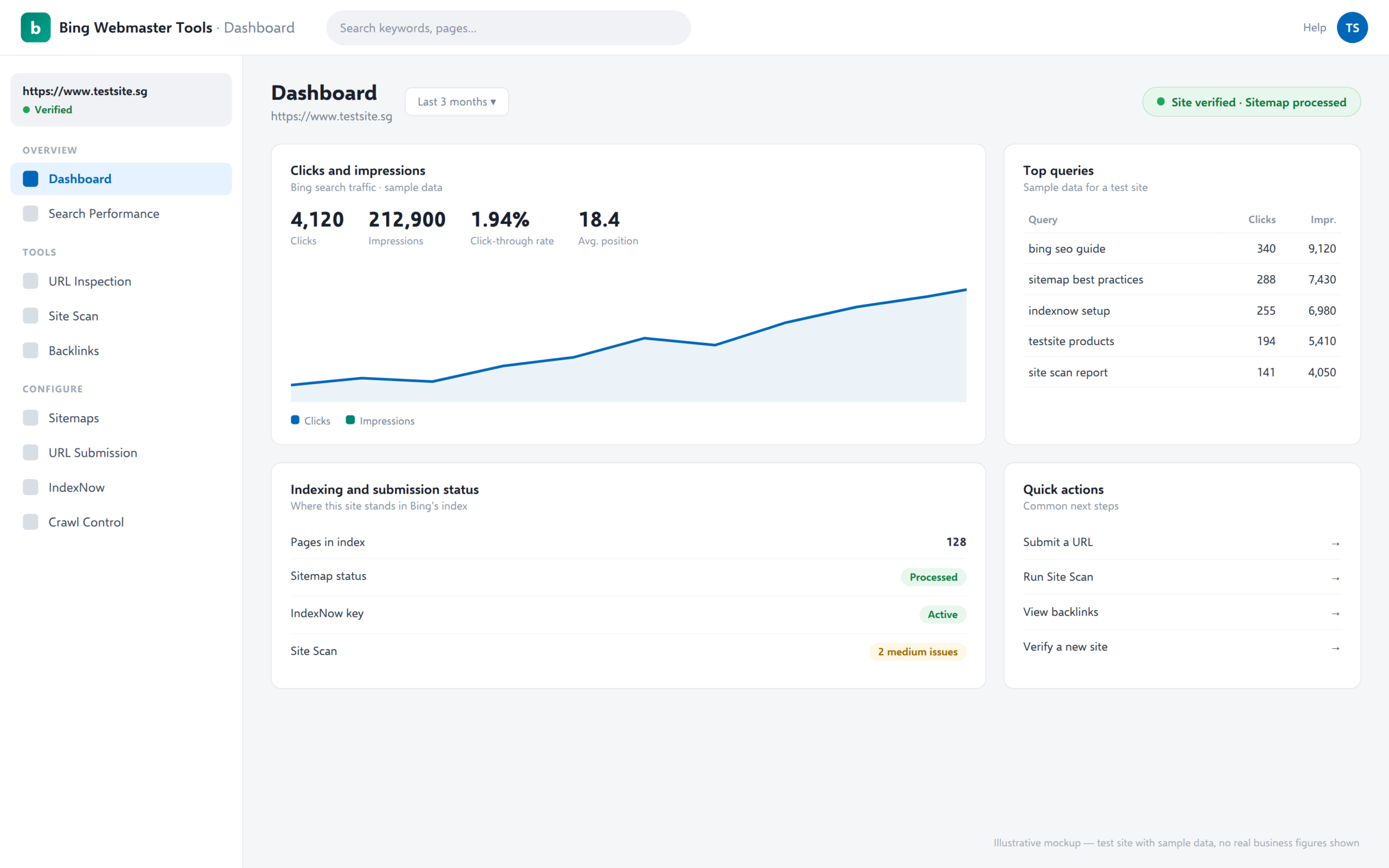
Bing Webmaster Tools is the free control panel that shows how Bing crawls, indexes and ranks your site. Many sites that rank poorly on Bing are not penalised. They have simply never been verified, so Bing has no clear view of their structure, errors or sitemaps. Set up the account before you optimise any content, since a verified site gives your seo services team a reliable baseline to work from. Verification is also the first step in any sound optimisation plan, because it shows which pages Bing can actually reach. A verified site also gives your strategy a dependable starting point for measuring what Bing actually sees.
Overview of features and what each one is for
Each feature answers a different question, so start with the one that matches your immediate problem.

| Feature | What it tells you | When to use it |
|---|---|---|
| Site Scan | Technical errors, broken links, missing titles | First audit and after major site changes |
| Index Explorer | Which URLs Bing has indexed | Confirming new pages are being found |
| Sitemaps | Submitted sitemaps and their processing status | After launch and after restructuring |
| URL Inspection | How Bing sees one specific page | Diagnosing a page that will not rank |
| Search Performance | Queries, impressions, clicks and position | Keyword research and tracking progress |
| Backlinks | Inbound links Bing has discovered | Link audits and disavow review |
| IndexNow | Instant notification of changed URLs | Sites that publish or update often |
Treat Site Scan and Sitemaps as your first two stops. They surface the errors that block everything else.
Step-by-step: adding and verifying your website
- Sign in to Bing Webmaster Tools with a Microsoft account.
- Enter your full domain, including the protocol, such as https://www.yourdomain.sg.
- Choose a verification method. The XML file and meta tag options suit most sites. DNS verification is the most durable if you can edit DNS records.
- Complete verification and wait for Bing to confirm.
- Submit your XML sitemap under Sitemaps and check that its status shows as processed.
- Set up IndexNow if your content management system supports it, so changed pages are announced rather than waiting to be recrawled.
- Run Site Scan and fix high-severity issues before publishing new content.
Verify the same URL version you use everywhere else. If your canonical site uses www and Bing sees the non-www version, your data splits across two properties.
Importing Google Search Console data into Bing Webmaster Tools
Bing offers an import option that copies verified sites and sitemaps from Google Search Console. It is the quickest route to a working account, and it lets you manage the same site list across both search engines without re-entering domains.
The import carries over your site list and sitemap references. It does not transfer historical search performance data, so do not expect Bing to show past Google figures. Bing starts collecting its own data from the point of verification, so allow a baseline period before judging rankings.
After importing, check each sitemap by hand. Sitemaps copied from Search Console can point to old URLs after a migration, and Bing will report those as errors.
Bing Webmaster Tools vs Google Search Console: which to use for what
The two tools overlap but are not interchangeable. Use Search Console to understand Google’s behaviour and Webmaster Tools to understand Bing’s. A fix that clears a Search Console warning will not necessarily clear the matching Bing warning, because each engine reports issues on its own terms and each search engine applies its own crawling rules.
| Task | Use Search Console | Use Bing Webmaster Tools |
|---|---|---|
| Google ranking and query data | Yes | No |
| Bing ranking and query data | No | Yes |
| Bing-specific crawl control and IndexNow | No | Yes |
| Backlink discovery in Bing’s index | No | Yes |
| Diagnosing Google index coverage | Yes | No |
Run both tools in parallel. A page that performs well on Google but has no Bing impressions is a signal to check Bing’s index and sitemap status, not proof that Bing SEO is failing. For a business serving customers in one city or region, track local seo queries separately, since location terms often behave differently in each engine. Track the keywords that bring each user to the site in both tools, so you can see where each search engine differs. Keep a shared Bing search and social media reporting rhythm so the findings from each channel feed into one experience review.

Technical SEO Requirements for Bing
Bing’s crawler, Bingbot, does not always make the same decisions as Googlebot about what to index or how often to refresh a page. A technical audit that passes for Google can still leave Bing pages stranded. Work through the checks below in order, because a page Bing cannot crawl cannot earn a ranking signal. Fixing these basics also supports a sound digital marketing strategy, since organic visibility depends on them.
Crawlability, indexing and submitting sitemaps (IndexNow and XML sitemaps)
In Bing Webmaster Tools, open the Sitemaps report and submit an XML sitemap listing only canonical, indexable URLs with a 200 status. Remove redirected, noindex and parameter pages, since they waste crawl budget. Keep the sitemap limited to pages that carry your keywords and deserve a place in the index, and check that each URL is set up for search engine optimisation before it is listed.
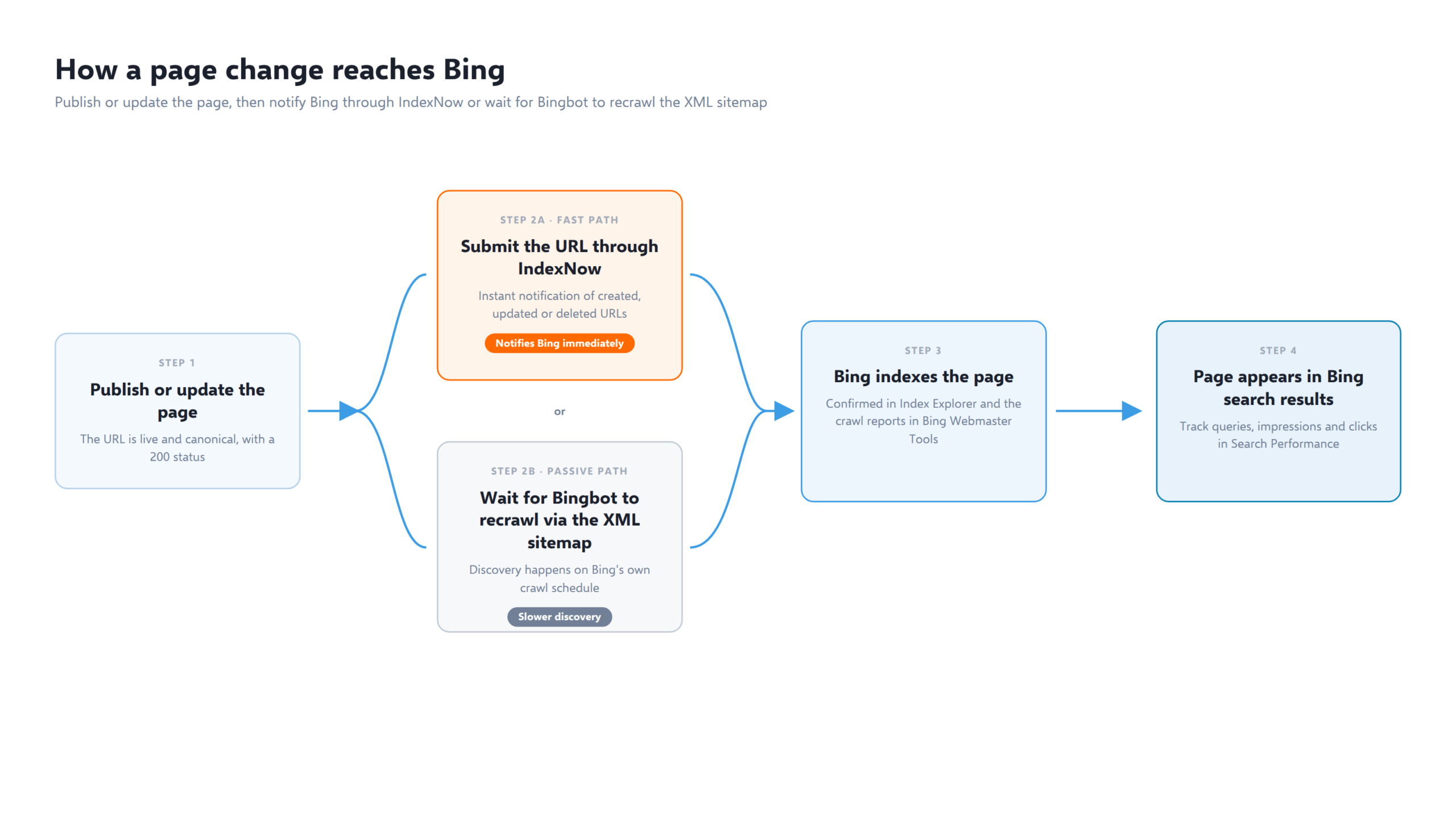
Then turn on IndexNow, which notifies participating search engines, including Bing, when a URL is created, updated or deleted. Most content management systems and many SEO plugins support it. The key file must sit at the root of the domain for verification. For a Singapore retailer that changes prices or stock daily, IndexNow is the most useful habit on this list, and it helps your website stay current in search results.
Each month, check the Index Explorer and crawl error report for soft 404s, robots.txt blocks and long redirect chains. Fix chains of three or more redirects first.
Site speed, mobile readiness and Core Web Vitals checks
Mobile readiness comes first for Bing. According to SEOptimer’s analysis of Bing SEO, 66% of Bing’s users are on mobile devices, so a site that renders poorly on a phone loses most of its Bing audience.
Test key templates with Google’s PageSpeed Insights and the Lighthouse mobile audit. Track Interaction to Next Paint (INP), which replaced First Input Delay as a Core Web Vitals metric. Aim for an INP under 200 milliseconds and a Largest Contentful Paint under 2.5 seconds. Bing does not publish its own thresholds, so these widely used industry figures serve as the practical target.
Third-party scripts such as tag managers and ad pixels are a common cause of poor INP. Defer them or load them asynchronously.
Structured data and schema markup that Bing reads
Bing reads schema.org markup in JSON-LD format, and Webmaster Tools reports structured data errors. Prioritise Product markup with price and availability for commerce pages, Article for editorial content, FAQPage where users genuinely ask the questions, and Organisation on the homepage. Local businesses can add LocalBusiness markup to support local SEO.
Validate every template with the Bing Markup Validator and recheck after each release. Only mark up what the reader can see, since markup that does not match the visible page can be ignored or penalised.
Bing introduced generative AI answers in 2023, and clean, labelled content is easier for the engine to extract and attribute. Treat schema as a way of stating facts clearly, not as a ranking trick. Where it helps, pair this work with Google SEO practices so one set of improvements serves both engines, and use the same discipline to improve how every template is marked up.
Conclusion and Summary
Bing SEO comes down to four repeatable actions: verify, submit, optimise and monitor. Verify your site in Bing Webmaster Tools, submit your XML sitemap and push changed URLs through IndexNow, optimise the pages that matter most, then review query reports and backlinks monthly. Treat this as a disciplined routine, not a one-off fix, and let your keyword research guide which pages you prioritise. Strong on-page SEO and clean site content give each page the best chance to rank in search results, so keep those fundamentals current. Search engine rankings reward consistency, so keep the routine running.
Treat Bing as its own channel. Its audience is smaller than Google’s and about 66% of its users are on mobile devices. Also, Bing shopping ads have a higher click-through rate, which makes commerce sites the strongest case for investment. Bing also draws signals from social media, so active profiles can support discovery.
Start with the Bing Priority Scorecard. Rate your site from 1 to 5 in each area, then fix any area scoring 2 or below first:
- Indexing: 5 means every canonical page returns a 200 status and appears in the Index Explorer.
- Webmaster Tools setup: 5 means the site is verified, the sitemap is accepted without errors, and IndexNow is active.
- On-page and structured data: 5 means every key template has a unique title, a single H1 and passes the Bing Markup Validator.
- Mobile and shopping readiness: 5 means key templates pass the Lighthouse mobile audit, INP is under 200 milliseconds, and product pages carry price and availability markup.
- Backlink quality: 5 means no unexplained spikes and that you’ve reviewed any harmful links.
Size your quarterly Bing budget from the total score, using your own analytics rather than global averages. If you lack the in-house capacity to run this routine, a dedicated seo service agency can handle the audits and reporting for your website. Every user of your site benefits when the pages they reach are fast, accurate and easy to use.
Frequently Asked Questions
Is Bing SEO worth the effort if Google has most of the market?
Yes, for most sites, though the case rests on audience and conversions, not raw volume. Bing holds about 5.29% of global searches, against Google’s roughly 89%. Check your own analytics first. If Bing already sends converting referral traffic, a dedicated budget line is justified. If not, start with a small test.
Do I need a separate Bing Webmaster Tools account?
Yes. It is a separate platform with its own verification, sitemap submission and reports. You can import Search Console data to save time, but the import does not keep the two in sync.
Does Bing use the same ranking factors as Google?
Not identically. Both reward relevant content and sound technical health, but the weighting differs. Bing gives more attention to exact-match signals and structured data.
How long does it take for changes to appear on Bing?
It varies with crawl frequency and how you notify Bing. Submitting URLs through IndexNow and keeping XML sitemaps current usually speeds discovery. Ranking changes take longer to settle than indexing changes, so judge a fix over several weeks.
Should I disavow backlinks for Bing as well as Google?
Only if your backlink audit shows genuinely harmful links. Bing has its own disavow tool inside Bing Webmaster Tools, so a file submitted to Google does not carry over. Use it sparingly, and only after trying to have the links removed.